Tuesday, October 30, 2012

Book review: The Strange Death of Mistress Coffin, by Robert J. Begiebing

An unsettling literary mystery spun around the first murder in Exeter, New Hampshire, a true-life unsolved crime, The Strange Death of Mistress Coffin wastes no time settling into its historical milieu.  The language is formal yet accessible, while the tale is darkly compelling.

In 1648, a magistrate of the Pascataqua plantation writes to Englishman Richard Browne with an invitation and request. Browne seeks entry into the forest trade to recoup his family's financial losses; his would-be benefactor, Jonathan Cole, has been unable to resolve a months-old case and asks for his help.

That past spring, a young woman’s nude, strangled, “much abused” body was found in the bay. Her husband has withdrawn charges against the principal suspect, who has since disappeared – whether out of guilt or for his own reasons, nobody can guess.

Begiebing introduces the late Mistress Coffin in slow, deliberate fashion: we learn others’ reports of her, then her first name, and only later, perhaps, her own thoughts. “She left herself too undone,” testified the suspect, Jared Higgins, a man hired to row her to market on the day she died.  “There was some enchantment over her ripe and plucky beauty... something in her ways to disturb Christian men and women.”

Such un-Puritan-like behavior is just one way this novel diverges from the expected. Godly devotion and superstitious beliefs exist alongside worldly acquisitiveness of a sort that today’s business moguls would recognize.  Hallmarks of refined civilization can be found even in the pristine wilderness: wealthy men keep large libraries, quality board-cloths are laid upon tables, and pewter servingware is used at meals. The people maintain strong ties with England and closely follow its troubled politics.  Finally, as Browne learns firsthand, sometimes earthly desires trump any outside rules.

The mysteries twist and deepen the longer Browne searches for answers, and with his unspoken attraction toward Higgins’ abandoned wife, he develops his own reasons for directing the investigation as he does. Times and customs may change, but human nature remains constant. As much a revelatory character study as an absorbing crime novel, The Strange Death of Mistress Coffin offers sharp depictions of colonial life and a startling bridge between that long-ago world and now.

This classic backlist title was recently reprinted by Hardscrabble Books/Univ. Press of New England (Aug. 2012, $16.95, trade pb, 236pp), with a striking new cover, in honor of the 20th anniversary of its initial release.  It forms a loose trilogy with Begiebing's two other novels of historic New England, The Adventures of Allegra Fullerton and Rebecca Wentworth's Distraction.

Saturday, October 27, 2012

On Alan Titchmarsh's The Haunting, a saga of early 19th-century and modern Hampshire

I first spotted Alan Titchmarsh's The Haunting on a display table at the Waterstone's in central Wells, England.  It was a miserable rainy day in late September, and I didn't want to be loaded down with packages, so I made a note to order it when I got home.

Dual-period novels in which the past haunts the present always pique my interest, and it also intrigues me to see the many variations on this theme.  I love Kate Morton's novels, and from the back cover blurb I would have predicted a similar type of read:

How can the mysterious disappearance of Anne Flint and the drowning of a young girl in a chalk stream in 1816 possibly affect the life of schoolteacher Harry Flint some two centuries later?  ... A story of love and betrayal, intrigue, and murder, where people are not what they seem, and the past is no more predictable than the future...

However, The Haunting has a very different feel to anything Morton writes; its gentle, flowing style reflects the rhythms of life in rural Hampshire, and while chapters alternate between spring 1816 and spring 2010, the two eras are only loosely interwoven.  The literal "haunting" mentioned in the title is almost incidental to the plot.  This is deliberate on the author's part, and the opening quotation (see beginning of 2nd paragraph on this page) explains why.

Anne Flint is an attractive 15-year-old housemaid at a country manor.  She is ambitious and literate (she loves reading romantic adventures about highwaymen) and dreams of becoming a lady's maid at a grand estate.  One bright spring day in April 1816, she grabs her opportunity and sneaks out the wrought-iron gate for a scheduled meeting.  Before day's end, another young woman will be found dead in the mill stream, wearing Anne's clothing.  Anne is nowhere to be seen. Her journey from that point on is sometimes predictable, sometimes not.

In 2010, at St. Jude's School in Winchester, teacher Harry Flint does his best to interest his students in history, but they're having none of it.  Still recovering from a recent divorce, he decides to make a fresh start by quitting his job and buying a small thatched cottage along the River Itchen.  His work colleague thinks he's crazy because the house is in such poor shape, but Harry thinks it's the perfect place for him to research his ancestry.  He doesn't get far.  His friendship with the young widow next door quickly turns romantic (and helps him get over his lack of confidence and innate stuffiness), but there are issues both must address before they can move forward.

Parallels between the late Georgian scenes and the modern ones are blatantly drawn at first (we really don't need the same phrases repeated in both sections).  Because of this, I expected more emphasis throughout on Harry's genealogical research and the specifics on how he and Anne were linked.  They have the same last name, after all.  Fortunately each story stands very well on its ownand that's all I'll say about what happens.  Being American, I hadn't known that Alan Titchmarsh was the well-known host of gardening programs on the BBC, but his talent for describing country landscapes is a pleasurable highlight.

The novel takes on a melancholy air as it poses thoughtful questions on the impossibility of recapturing the past and how impulse decisions and random chance can both have long-term effects... ones which extend over centuries.  Overall, though, it's not a depressing read.  It wraps up on a very satisfying note.
 
The Haunting was published by Hodder & Stoughton in paperback at £7.99 in August.  My copy is the large format paperback (the export edition) priced at £13.99, which has the cover art above.  Find it on Goodreads here.

Thursday, October 25, 2012

A look at Michael Ennis's The Malice of Fortune

Twenty years have passed since publication of Duchess of Milan, Michael Ennis’s spectacular Renaissance epic, so the appearance of his new novel is good cause to celebrate. The Malice of Fortune takes place in Italy in 1502, a few years after most events from the earlier book, and exhibits the same glorious ambience, deadly power politics, sharply rendered historical characters, and dark sensuality.

However, this novel is a different type of creature: a complex intellectual thriller with an even more sinister backdrop.

Damiata, a courtesan of Rome, is a heroine worth rooting for. Although she is as fierce as Isabella of Aragon and Beatrice d'Este from Duchess, she lacks their sphere of influence, status, and (yes) selfishness. Her efforts are focused wholly on her young son.

Five-year-old Giovanni is taken hostage by Pope Alexander VI, aka Rodrigo Borgia, to assure Damiata’s compliance. Borgia suspects her of inciting the murder of her former lover, the pope's son Juan – Giovanni's father – and sends her north to Imola to exonerate herself, if she can. The amulet Juan was wearing when he was killed was found in the possession of a dead woman there.

Imola is controlled by Cesare Borgia, Duke of Valentinois, Juan’s enigmatic brother, who is best known by the cool nickname "Valentino." Upon her arrival, Damiata finds a land in turmoil as Valentino and the treacherous mercenaries known as condottieri jockey for power. Even more dangerously for Damiata, a serial killer is depositing the results of his crimes in various locales around the city.

Damiata finds help from Niccolò Machiavelli, a minor Florentine diplomat and secretary to the Ten of War, and the great Leonardo da Vinci, Valentino’s chief military engineer. In this revitalized Italy struggling to break free from long-held superstitions, there are two ways by which to recognize a murderer: by his corrupt nature and by the evidence he leaves behind. “If we are to defeat Fortune, Secretary,” Valentino advises Niccolò, “we must anticipate events.” Between Niccolò’s forensic profiling (he studies ancient despots and psychopaths for clues to their character) and Leonardo’s brilliant scientific acumen and dissection experiments, they have both methods covered.

The Malice of Fortune doesn’t unfold like a typical murder mystery, with these two famous Renaissance men nosing into horrific happenings like traditional amateur detectives might. Ennis plays too close to real-life history for that.  His crafty puzzle respects his characters' personalities and is carefully slotted within actual recorded events. The body parts recovered in and around Imola appear in a pattern perfect for a mind like Leonardo’s to decipher, and which, combined with the crime’s grisliness, indicates that a truly cunning form of evil is at work. The killer not only incorporates Leonardo’s methodology but taunts them with it.

In 1502, Machiavelli’s writing of The Prince was still 11 years in his future; he appears here not as a seasoned political theorist but as a younger man still earning his clout. Niccolò picks up the narrative when Damiata’s account wraps up, giving readers an inside glimpse of his reasoning as well as events that, in this fictional version, led to the observations in his masterwork.

In the beginning, the plot feels somewhat imbalanced – gorgeous descriptions, but too little action – but over time, as the solution falls into place, the suspense grows and the pages turn more swiftly. It also has a fine sense of the dramatic that feels right for the era.  Dense, erudite, and steeped in the fraught power struggles and brainy pursuits of the Italian Renaissance, Malice doesn't respond well to a tentative approach. Fortune favors the bold, so grant it your complete attention and watch it repay you in full.

The Malice of Fortune was published by Doubleday in September at $26.95 (hb, 396pp, including a six-page author's note). The Canadian publisher is McClelland & Stewart (hb, $29.99).  Read Ennis's fascinating article in the National Post about its road to success, and the role that a good editor can play in book publishing.

Friday, October 19, 2012

Book review: Winter of the World, by Ken Follett

The second volume in Ken Follett’s Century Trilogy begins with a scene that aptly foreshadows its chilling title. The year is 1933. Hitler has just been made chancellor, and Germans are pondering how to react. Over breakfast with her family at their Berlin home, native Englishwoman Maud von Ulrich defends the outspoken stance she took in her last magazine column. "What would life be like for our children if Germany became a Fascist state?" she argues.

Her husband, Walter, a member of the Reichstag, prefers a less risky approach to the Nazi threat, while son Erik disagrees: "But the Aryan race must be superior – we rule the world!"

It’s all rather ominous – and obvious. Follett’s no-nonsense style can lack subtlety at times, but he more than makes up for it with his firm grasp of history and ability to juggle multiple story strands, each as attention-grabbing as the last. In great part, he meets the high standard set by the mega-bestselling Fall of Giants. Although its outline never hides too deeply beneath the plot, Winter of the World is another accomplished and consistently entertaining feat.

In this panoramic epic spanning 16 years, from the Depression through the Cold War, diverse characters from around the globe are caught up in major (and some minor) historical dramas. From protests in German streets to the London Blitz to the Manhattan Project’s inner workings, the five families from the first book – Welsh, English, Russian, German, and American – get even further entangled. The focus has moved ahead to a new generation. Some children pursue the same paths as their parents, and new heroes and heroines emerge.

Each fights his or her own battle where it happens, be it in the boardrooms of Washington, D.C., in the air over Midway Island or much closer to home. In keeping with reality, one rarely gets to choose. As Carla von Ulrich, daughter of Maud and Walter, does her courageous utmost to halt Nazi atrocities, Lloyd Williams, the Cambridge-educated illegitimate son of a housemaid-turned-MP, heads to Spain during its civil war to combat fascism, not expecting to fight communists too.

This is an era when a factory worker from St. Petersburg, Russia, can become an American millionaire, and his gorgeous socialite daughter can marry almost anyone she wants. Follett gives them space to grow, and through their experiences creates some very gratifying moments. Following wartime turmoil, the former Daisy Peshkov awakens from her rich, empty existence to establish a meaningful life, and although her uncouth father, Lev, never achieves likeability, the best comeback lines belong to him.

"The world of international politics and diplomacy was quite small," Lloyd Williams thinks at one point. This happens to be true. As he and other ordinary citizens turn into movers and shakers, their many coincidental meetings begin to make more sense. This mammoth saga is all about connections, and Follett also explains with clarity the links among the political and social movements during this darkest
of times.

Winter of the World includes nearly every type of Second World War story, drawing together scenes of country house drama, suspenseful front-line action, Soviet espionage, daring resistance, generational conflict and even interracial romance. Most impressively, rather than a patchwork of disparate segments, Follett has produced another seamlessly woven and enjoyably readable work, one which honours the individual acts of bravery that shifted history’s course.

Ken Follett's Winter of the World was published by Dutton in September at $36, or $38 in Canada (hb, 940pp).  In the UK, the publisher is Macmillan (£20, hb). This review originally appeared in Canada's Globe and Mail on Saturday, October 13th.

Monday, October 15, 2012

Book review: The Secret Keeper, by Kate Morton

To my mind, Kate Morton remains unsurpassed at crafting multilayered generational mysteries. Or maybe they should be called historical sagas filled with drama and intrigue?  Either way, this is my favorite type of book, and when paired with her complex characters, sensitive use of language, and intricate plotting in which family secrets are tantalizingly revealed bit by bit, the result is literary magic.

Morton is not only a superb storyteller, but the concept of "story" itself threads throughout her work. In The Secret Keeper, the protagonists must come to terms with the stories they've heard and told themselves— ones which shaped their outlook on the world—and decide whether or not (or how much) to believe them.

And as the novel's cover and first chapter both indicate, every good story begins with a house.

Greenacres Farm, a rustic dwelling in rural Suffolk, is the longtime home of the Nicolsons. Laurel Nicolson, her three younger sisters, and their baby brother Gerry spent a contented childhood there, comforted by the knowledge that their parents adored them as well as each other. Only one oddball incident spoils Laurel's remembered idyll.

In 2011, Laurel, a famous actress in her sixties, returns to Greenacres for a celebration of her frail mother Dorothy's 90th birthday. While there, seeing decades-old mementos and faced with Dorothy's wandering memories, she finds herself drawn to revisit the summer of 1961. As a dreamy young woman of sixteen relishing a quiet moment in her tree house, Laurel had observed a crime as shocking as it was inexplicable. Although events were resolved to the police’s satisfaction, Laurel has trouble reconciling the violent scene with her image of her beautiful, loving, good-natured mother.

Seeking reassurance that their happy life wasn't based on a lie, she feels the clues to what happened must reside somewhere in her mother's past. Laurel has little to go on: a WWII-era photo of Dorothy and another woman, their arms linked and their hair swept into Victory rolls; an old book inscribed to Dorothy by a friend named Vivien; and the name of the stranger who was killed in her family’s meadow. "Who are you, Dorothy?" Laurel wonders. "Who were you, before you became Ma?" 

This motif, the perceived rift between people of different generations, has echoes within several other situations in the book. “It was impossible to believe that the old woman upstairs had ever been that young or striking,” thinks the younger Dorothy—or Dolly, as she called herself then—about her employer, an embittered aristocrat who was hurt by love. This point may get a little overfamiliar with each repeated instance, but there's truth in it.

Morton’s war-ravaged London, depicted with atmospheric flair, is a treacherous place swirling with heightened emotions, class-conscious socialites, bright spots of glamorous decadence, and the ever-present possibility of death or betrayal. As the plot switches among different periods, from Dolly's love life during the Blitz to Laurel’s research in 2011 and also to instances before and after the war, each strand builds upon another, and the mystery gathers momentum. Each discovery leads to yet more secrets. The final reveal, once it comes, is absolutely worth staying up late for. (Raising my hand here... I finished it at 1am last Sunday.)

Over the course of three hugely successful novels, which all have similar themes, Kate Morton has established herself as the preeminent author of contemporary Gothics. As with her previous books, though, the growing sense of dread within The Secret Keeper comes not from supernatural happenings but from the unearthing of long-ago tragedies and knowledge of the harm that people can heedlessly inflict upon one another. No eerie embellishments are needed; the past is haunting enough.

The Secret Keeper is published tomorrow by Atria in hardcover (481pp, $26.99 US or $29.99 Canada).  In the UK, Mantle is the publisher (600pp, hb, £16.99), and in Australia, it appears from Allen & Unwin on November 1st at $35.

Friday, October 12, 2012

An interview with Kelly O'Connor McNees, author of In Need of a Good Wife

When I know an author has spent a year and more writing a new book, I feel a little guilty zipping through it too quickly.  Kelly O'Connor McNees' In Need of a Good Wife is so wonderfully readable, though, that I couldn't help it; I found myself continually drawn back into the characters' world. 

By the fall of 1866, Clara Bixby, a Manhattan tavern keeper's daughter, has fallen on difficult times: her father is dead, her husband abandoned her after a miscarriage, and she desperately needs money and a fresh start.  When she reads a newspaper article about the bachelor overpopulation in faraway Destination, Nebraska, she seizes the opportunity to set up the town's men with New York brides and bring the civilizing influence of good Christian women to the lawless West.

Rowena Moore, a once-prosperous Civil War widow, dreams of settling down with a wealthy businessman and re-establishing herself in social circles; Elsa Traugott, a quiet, middle-aged German laundress, hardly dares  acknowledge any dreams for herself at all. They and other single women sign on with Clara's plan, putting their future in her hands.  As the plot follows them from New York City to their new homes on the frontier, little works out as planned for any of the three, or for the hopeful men of Destination, for that matter. 

Mail-order brides have appeared in historical fiction before, yet this is the first time I've seen the matchmaking process imagined as a potentially lucrative business venture. This clever twist on a theme, along with the novel's depth of detail and the intertwining of its three brave heroines' stories, make it stand out. Kelly O'Connor McNees was kind enough to answer some questions as part of her blog tour.  I hope you'll enjoy this Q&A!

You've described yourself as a city girl. What aspects of life on the isolated Nebraska prairie of the mid-19th century did you find especially intriguing or appealing? 

I think I am interested in the hidden domestic lives of the women of the past because for a long time those experiences were missing from the narrative of history, and because I think the key to understanding what life was like for them lies in understanding the way they spent their time.

Keeping a family clothed, fed, and healthy was a task so arduous it boggles the modern mind. This was true in cities as well as rural outposts, but homesteading women had it particularly tough. These couples had to be almost completely self-sufficient. If you didn’t have something, you either made it yourself or went without. But there was enormous pride for them in being able to break the land and make it yield something, in building a house and a family.

I read one account of a woman homesteader that described how she gave birth, unassisted because there was no doctor nearby, to her sixth child on the kitchen table. That was in the morning. By the evening she was up cooking a meal for the men in the field. I admire and also am sort of haunted by that kind of resolve. Because you know there was pain and loneliness and suffering there, even if they wouldn’t acknowledge it.

Clara, Rowena, and Elsa are very different from one another, and sometimes their personalities and motives cause conflict (particularly Clara and Rowena). Did you identify with any of them more than the others, or find yourself taking one woman's side more frequently? 

Some people have told me that they find Rowena unlikable. I find that interesting. Obviously, she is self-interested, a thief, and a liar, so that’s not a ringing endorsement. But there’s something about her I like a lot. She will not be defeated. She will do whatever she has to do to survive in the way she feels she must. But she will pay a price for that too.

Clara, I felt, had to take on this project of matchmaking because she had to make her life about something besides the grief she feels after losing her child. She too is trying to survive somehow.

Elsa is quieter than the other two, more at peace with herself and her place in the world. She has made a little country inside herself, and she doesn’t need to leave it. There is strength in that, but strength too in venturing out anyway. I know she doesn’t actually exist, but sometimes I really wish I could have a cup of coffee with her.

With this novel, you’ve switched from writing about a well-known historical character to having three fictional women as protagonists. Did you find it any more liberating, knowing you were able to create their characters yourself? 

Oh, yes! It was wonderful to have the freedom to structure the plot any way I wanted, and to put these characters through a series of experiences I could invent. On the other hand, I started from an absolute blank, so it was a lot of work!

I loved reading the section of letters between bachelors and their potential brides. Were they as much fun to write as they were to read? 

Yes. That was one of my favorite sections to work on. I briefly considered writing the whole novel in that style, but of course epistolary novels have all kinds of pitfalls and I would have missed the opportunity for setting and description and real-time dialogue. I found inspiration for the tone and the content from letters in the Library of Congress archive. And just from imagining what kinds of things these potential mates might want to know about each other.

What were some of the more fascinating or surprising facts that you picked up in the course of your research? 

I was surprised to learn that in the early years of the Homestead Act, single women could take on as much land as a man could. That seemed very progressive to me—what an opportunity for a woman in that time. And I was fascinated anew (since I learn it over and over again as I read about the past) by just how resourceful and determined some women could be, how they never accepted the limitations of their time but went headlong into the thing they wanted—whether it was freedom or money or fame or regard—and claimed it.

In Need of a Good Wife tackles some serious issues – not just the difficulties of prairie life and the complications of marriage, but also things like the Civil War’s aftermath, urban poverty, and even insane asylums. Despite this, the novel isn’t depressing, there are many wonderful touches of light humor, and its tone is ultimately hopeful. Did you find this a challenging balance to achieve as you were writing? 

I don’t think I set out to include humor in the story, but it just sort of found its way in. I think a wry view of the world—an ability to laugh at inevitable suffering—is probably the most useful coping skill a person can hone. The real letters I found in my research, as well as the personal ads in the matrimonial newspapers, were often written with humor. These people knew finding love through an ad was a long shot, and possibly even a ridiculous endeavor. I found plenty of stories about the ways in which it went wrong. But they seemed to throw up their hands and say, “What the heck?” I admired this attitude: realistic but never cynical. This is the attitude that built the frontier.

Thanks very much, Kelly!

~

In Need of a Good Wife is published this month by Berkley in trade paperback ($15.00 / $16.00 in Canada, 387pp, including a detailed author's note and reader's guide).  Visit the author's website at kellyoconnormcnees.com.
To follow along on the blog tour for In Need of a Good Wife, check out these sites as well:

Oct. 2: http://stylesubstancesoul.com/category/interviews/
Oct. 3: http://www.greatthoughts.com/
Oct. 4: http://nomadreader.blogspot.com/ 
Oct. 5: http://www.erikarobuck.com/Blog.html
Oct. 8: http://www.2readornot2read.com/
Oct. 9: http://themaidenscourt.blogspot.com/
Oct. 10: http://literatehousewife.com/
Oct. 11: http://www.luxuryreading.com/
Oct. 12: http://readingthepast.blogspot.com/
Oct. 25: http://womensfictionwriters.wordpress.com/ 
Oct. 29: http://www.wondersandmarvels.com/

Tuesday, October 09, 2012

An interview with Mary Sharratt, author of Illuminations: A Novel of Hildegard von Bingen


There has been a lot of buzz surrounding Mary Sharratt's new novel, and for good reason.  Illuminations: A Novel of Hildegard von Bingen is biographical fiction at its most lyrical and profound.  With a vivid sense of place and deep insight into the mindset of its time, it reveals the truly inspiring story of a woman whose strength of character helped her endure thirty years in an anchoragea small cell within the monastery at Disibodenberg in Germanybefore emerging as a vital force who not only transformed the Church to which she dedicated her life but also an entire era.  I loved it.

Illuminations is published today by Houghton Mifflin Harcourt ($25.00, hb, 288pp).  I hope you'll enjoy this interview with Mary, and please read to the end... we have a giveaway opportunity which is open to all blog readers.

~

To imagine the life of a 12th-century abbess, mystic, and saint for a 21st-century audience would seem like a daunting task for any novelist, but I thought you did a magnificent job relating Hildegard von Bingen's spiritual beliefs and visions as well as her more human feelings. Did you know from the beginning that you would write her story in the first person? How did you capture her voice? 

Illuminations was truly my most daunting novel to write, because I was so in awe of Hildegard and so afraid of getting it wrong. I also felt quite intimidated to be writing about such a religious figure since I fall more comfortably under the "spiritual but not religious" umbrella. For a long time I struggled to find the right narrative voice and actually wrote two narratives--one first person and one third person--in parallel until finally the first person won out. My editor felt it was more intimate and compelling. By then I realized that in order to do justice to Hildegard's incredible story, I would have to let her breathe and reveal herself as human.

Why did you feel this was this the right time in your career for you to write Illuminations?

With four previous novels under my belt, I guess I finally felt I had achieved the right degree of literary maturity to tackle someone as complex as Hildegard. Also the twelve years I lived in Germany and my studies in herbal medicine all went into the novel. I'm glad I didn't attempt this project as a first novel! Unbeknownst to me when I started writing in 2009, the timing was perfect as the novel's publication coincided with Hildegard's elevation to Doctor of the Church--something I could not have predicted.

When we spoke about your previous novel Daughters of the Witching Hill in 2010, you mentioned how much it had meant to "inhabit the same landscape as your characters." How familiar were you with Hildegard's life before you moved to Germany, and how did your time there affect your impressions of her?

I didn't know a whole lot about Hildegard when I first went to Germany back in 1986--I am revealing my old age! But in Germany she had always been a cultural icon, admired by both religious and spiritual people and also by completely nonreligious people. They admired her for her music, for the complexity of her writings in all kinds of different subjects ranging from botany to cosmology to human sexuality. She also developed her own style of holistic medicine that's still practiced in Germany today. The secondary sources written about her in the German language are far more varied and reader friendly without sacrificing depth or accuracy than many of the English language books which can either be oversimplified, or dry as dust, or so complex that you almost need a PhD in theology to understand them.

In your novel, Hildegard has such a complex relationship with Jutta von Sponheim - who is the cause of her enclosure in the anchorage at Disibodenberg, but also her mentor and teacher while growing up. Hildegard also becomes Jutta's caretaker during her more melancholic and ascetic episodes. How did you come to portray the dynamic between them?

Jutta's own Vita, or saintly biography, written shortly after her early death, bears witness to Jutta's extreme asceticism which was at odds with the Benedictine ideal of moderation. Her fasts were so prolonged, for example, that her abbot actually broke down in tears and begged her to eat. The part in the novel where Hildegard finds the spiked penitent's chain wrapped three times around Jutta's wasted corpse is based on Jutta's Vita, as well. Jutta considered herself a living sacrifice and her suffering was meant to be redemptive and an imitation of Christ's passion, but even in the context of her time, her mortification of the flesh was considered very extreme.

It's plain to see that in Hildegard's own writing, she completely rejects this kind of masochism and endorses healthy moderation.

Seeing that Hildegard took a completely different path from Jutta seems to indicate some strain in their relationship. Although Hildegard was very forthcoming describing her life long friendship with Volmar, the monk who would become both her secretary and her confessor, and her beloved protegee, the young nun Richardis von Stade, she is curiously reticent describing her feelings for Jutta, the woman who was her mentor and spiritual mother. Hildegard only came into her powers and started writing and composing after Jutta's premature death. I believe Hildegard had to step free of Jutta's shadow before she could truly begin her life's work.

Given that Hildegard lived such a long life, especially for a medieval woman, how did you decide what to include versus leave out when structuring the novel?

This was so difficult for me and the novel went through many drafts. The original version I submitted to my editor was twice as long as the version that is now published and included a whole subplot about Hildegard's relationship with a Cathar woman whom she exorcised (true story) and the backstory of the apostate monk buried in Hildegard's graveyard. It had so many subplots that it needed quite a bit of pruning.

Although she doesn't have much time on the page, I loved the character of Trutwib, the female hermit whose prediction changes everything for Hildegard. Is she based on a real person?

Yes, she is. Trutwib was a widow who lived as a hermit and she delivered her prophecy just as Jutta and Hildegard first went into the anchorage. To make for more dramatic plotting, I had her announce her prophecy later in the story, when Hildegard was a teenager, no longer a child.

Music plays a large role in Hildegard's spiritual life. Which compositions of hers do you enjoy most, or influenced you the most? 

I love all her music and listened obsessively to it while writing Illuminations. I think my favorite piece is "Caritas Habundat in Omnia," (Divine Love Abounds in All Things), which is one of the most achingly beautiful sacred songs ever written. It also evokes Hildegard's vision of the Feminine Divine in the form of Caritas, Divine Love, whom she envisioned as a beautiful maiden with flowing black hair.

You've written three historical novels about fictional characters, then moved to depicting the inner lives of real-life women whose stories deserve to be rediscovered. I was also excited to read that your next subject will be 16th-century literary figure Aemilia Lanyer. Are there factors to which you attribute this shift in focus for your writing? 

Over the years I discovered that real life history is often quirkier, more bizarre and fascinating than anything I could possibly invent. I love to uncover real stories of historical women and drag them out of the margins and set them center stage. One of my goals as an author is to write women back into history. In Illuminations, I wanted to write a novel that was accessible to a wide secular audience and that could still portray Hildegard in all her complexity. That's the great magic of historical fiction.

Thank you so much, Mary!

~

For a chance to win a new hardcover copy of Illuminations for yourself, simply fill out the following form.  International entrants welcome!  Thanks to Houghton Mifflin Harcourt for providing me with a copy for this giveaway.  Deadline Friday, October 19th.


Thursday, October 04, 2012

A British interlude, in pictures

Hope you'll pardon my absence over the past two weeks.  I've been doing a little traveling.


The ruins of Glastonbury Abbey, in the center of Glastonbury


 The Roman Baths, Bath, on a rainy September morning
 
Wells Cathedral, Wells, on a rainy afternoon
 
Stonehenge, on the day of the autumnal equinox
(timing not planned in advance)


The stone circle at Avebury


A familiar sight in downtown London
 
The HNS London conference!  We had a great time.
Detailed reports, and video footage, available at the HNS site.

The Tower of London.  Mark and I had dinner with Andrea from the
Queen's Quill Review on Monday night, then saw Margaret George speak there.

And, of course, London book shopping!

I'm still pretty jet-lagged, and caught a cold after we got back, so I haven't been able to do much for the past two days other than stare at the screen.  Regular blog features will resume shortly. 

Wednesday, September 19, 2012

An interview with Kim Rendfeld, author of The Cross and the Dragon

Today I'm welcoming Kim Rendfeld to the blog for an interview about her debut novel The Cross and the Dragon (Fireship Press, July), a tale of revenge, sacrifice, and enduring love set in the Kingdom of the Franks during the beginning of Charlemagne's reign.  I first met Kim through our involvement with the Historical Novel Society and couldn't pass up the opportunity to speak with her about her characters, writing style, and original and compelling setting, among other things.

The Cross and the Dragon opens with the viewpoint of Alda, a 14-year-old noblewoman from 8th-century Francia (present-day Germany). Alda's brother has betrothed her to Count Ganelon of Dormagen, who she knows will treat her cruelly.  Although she eventually succeeds in winning the man she loves, Prince Hruodland, their marriage incites the anger of Ganelon, who vows revenge.  Worried about her husband's safety when King Charles calls him away to fight for a Christian stronghold in Hispania, Alda gives him her dragon amulet.  The story takes an unpredictable route during their separation from one another.

Kim was inspired by an old German tale involving Hruodland, who is best known as the hero from the epic poem "The Song of Roland."  I enjoyed seeing how she wove material from this ancient story into a historically accurate backdrop, one full of beautiful descriptions of the Rhine Valley, while fleshing out the characters and their motivations.  The plot moves from Alda's family home at Drachenhaus to King Charles' court to the battlefields of Hispania and, in the second half of the book, to Francia's religious houses.  The novel also includes a great scene in which Hruodland listens, in puzzlement and dismay, to a song recounting his purported actions at the Battle of Roncevaux (see more at Kim's guest blog for Unusual Historicals). This had me musing about the process through which history is transformed into legend.

What appeals to you about the era and realm of Charlemagne, so much so that you decided to use it as a setting for your historical fiction?

A romantic legend about Roland (Hruodland in The Cross and the Dragon) drew me to this period. When I started writing, I knew very little about the Middle Ages, let alone the Carolingian era (eighth and ninth centuries). As I learned about the history, I became fascinated by the personalities and the culture. Among aristocrats, the personal and the political were intertwined. The king’s marriage made a direct impact on his country’s politics and international relations.

This was also an age that believed in divine intervention, in which Christians held litanies in the hopes of victory. Yet vestiges of paganism remained. It was common for medieval people to wear amulets for magical protection, as Alda does.

All these elements are great fodder for a writer.

Given the limited number of sources, how did you go about researching the daily lives of women in the Carolingian era? 

This period lends itself to a paucity of information in general. Few people could read, and even fewer could write. It also predates the printing press, which means information was not mass produced.

Fortunately, scholars have found some sources and shared what they know. Among the resources are Daily Life in the World of Charlemagne by Pierre Riché (translated by Jo Ann McNamara) and articles by Janet Nelson, including “Women in Charlemagne’s Court: A Case of Monstrous Regiment.” Sometimes when I had a hole to fill, I would use Daily Life in Medieval Times (three books in one) by Frances and Joseph Gies, keeping in mind that this was a different country and century. I’ve posted more resources for historical research on my website, www.kimrendfeld.com.

I could not have written The Cross and the Dragon without the work of scholars and will repeat the historical novelist’s disclaimer: any mistakes are mine and mine alone.

You've written about being inspired by a romantic legend surrounding the ruins at Rolandsbogen in Germany, one that reinterprets characters from “The Song of Roland.”  What inspired you to work in mentions of the myth of Siegfried and the dragon as well?

Part of it is geography. Drachenfels, the legendary mountain (technically a high hill) where Siegfried killed the dragon, is across the Rhine from my heroine’s home. Worms, where Siegfried was murdered, is a seven- to ten-day journey upriver. In an age when storytelling was a form of entertainment, Alda would have heard the tales repeatedly, made all the more real because Drachenfels is so close.

The Siegfried myth also opens a window on the society in which The Cross and the Dragon takes place. Every culture has legends that reflect and shape its identity. A young man slaying a powerful monster reveals how the Franks saw the ideal warrior.

This circa 1830 illustration shows Nonnenwerth Island. In the distance are
Rolandsbogen and Drachenfels.
(Public domain image from Wikimedia Commons)

I especially enjoyed the many scenes that were set in the Benedictine abbey at Nonnenwerth and the Abbey of St. Stephen, since they emphasized the importance of religion, as well as people's internal conflicts between godliness and worldliness.  How did you set out to re-create the mindset of this very different time?

The desire to explain our world is part of human nature. In the 21st century, science plays a large part in our understanding when we ask why. In the Middle Ages, religion and magic filled that role. Once you realize that medieval people had their own logic, the mindset falls into place.

Writings from medieval people also reveal to how they saw the divine and provide some tools to getting into the mindset. Written in the sixth century, The Rule of Saint Benedict outlines how the saint wants monasteries to be run. Eighth- and ninth-century Frankish annals and letters cite Scripture and use such phrases as “through the grace of God” when recounting a victory and “hateful to God” to describe an enemy.

In reading The Cross and the Dragon, I got the impression you gave considerable thought to character names.  Was there ever any question in your mind about using Frankish names for your main characters, rather than the more familiar ones taken from the poem?

Using the Frankish variant of the names is another way to transport readers to another time and place, although I occasionally questioned the decision when I got rejections. I wanted names appropriate to the characters’ ethnicity yet accessible to modern readers.

I changed several characters’ names after receiving a rejection for my second manuscript. Among other things, the editor said she wanted the historical characters to play a greater role. I went back to the manuscript for The Cross and the Dragon because it had more historical characters and well-known fictional ones, and I planned to submit it to the editor through my then agent. That was when I borrowed heavily from “The Song of Roland.”

Still, it was important that the characters’ names reflect their origins. So I stuck with Hruodland rather than Roland. Oliver, Roland’s best friend in the poem, sounded too French for a guy from a locality in today’s Germany, which is why he’s Alfihar in the novel.

Alda changes over the course of the novel from a romantically inclined teenager to a still willful but less impulsive young woman, one who matures after being touched by loss.  Did you find any stage in her life easier or more challenging to write about?

In the earlier stages of Alda’s life, I had to grapple with how mature a medieval teenager would be. Adolescence was not the special time it is today. Alda is considered a marriageable woman at the same age I was in middle school. I came to the conclusion that teenagers can and will rise to the challenges presented to them. It was a little easier to write about Alda when she was touched by loss because we all grieve, regardless of our era.

The greater challenge with Alda is that she is a medieval woman, and I must yield to her medieval sensibilities. For example, she believes caring for servants is an obligation, but she will slap them when they get out of line and resort to even harsher punishment if they threaten her honor and her marriage. Yet Alda will go to great lengths to protect the people she loves—something anyone can relate to.

The language you use is remarkably clear and easy to follow.  Is this style something that comes naturally to you, as a copy editor and former journalist?
Author Kim Rendfeld

It’s something I learned through journalism, and it has become natural to me. Time and space constraints taught me to get to the point. Maturing as a writer made me care more about the readers understanding the story than showing off my cleverness.

I also had to unlearn some habits. News writing is an objective report that allows both sides to tell their stories and lets the readers make their own conclusions. By nature, it’s distant. Fiction is intimate. You want the readers to feel your characters’ joys and sorrows. You want to manipulate sympathy and emotion.

Did your placing in the quarterfinals for the Amazon Breakthrough Novel Award in 2011 assist in attracting a publisher?

It might have. Placing in the quarterfinals and getting a positive review of the unedited manuscript from Publishers Weekly gave me a boost when I really needed it. The editor I mentioned earlier had rejected The Cross and the Dragon with no explanation, and I had ended my relationship with my agent, who had given up on me. I was not sure of what to do next, but I knew I needed to do something different than the approaches that had failed so far. With nothing to lose, I entered ABNA.

The Publishers Weekly review gave me an endorsement I could use to promote the book as long as I did not make major changes to the novel and specified it was for the manuscript and not the final version. Agents didn’t seem to notice, but the Fireship Press editor who read my manuscript did.

My experience with ABNA gave me something else as important as the endorsement: the confidence to keep trying.

~

I'd like to thank Kim for taking the time to answer my questions. The Cross and the Dragon was published by Fireship Press (a specialist publisher for nautical and historical fiction and nonfiction) in in July at $23.95 in trade pb or $7.50 as an ebook.  Visit Kim online at kimrendfeld.com or at her blog, http://kimrendfeld.wordpress.com/.

Saturday, September 15, 2012

A Canadian historical fiction showcase, part 3

Based on my site stats, some of my most visited posts are those which focus on Canadian historical fiction. Apparently there are many people out there seeking these books! It's been a year since I posted on this last, so here's the 3rd entry in an ongoing series that showcases recent and forthcoming historical novels from Canadian authors and published by Canadian presses. The settings include not just Canada, but the Civil War-torn United States, ancient Greece, and mid-19th century Paris. Part 1 and Part 2 can be found in the archive.


In this novel, based on the true story of a 1915 maritime disaster which inspired a song, a woman whose husband and brother-in-law were lost at sea looks for answers. From a small press based in Newfoundland. Flanker Press, August.


In this literary novel spanning the second half of the 20th century, a wife and mother from small-town Manitoba searches for personal meaning and her own path in life as traditional women's roles give way to modern feminism. HarperCollins Canada, September.


A friendship between a Union army surgeon and a mysterious soldier, formed during the bloodiest battle of the American Civil War, ties them together after the second man goes missing, possibly a victim of business rivalries in British Columbia's salmon industry some twenty years later. Brindle & Glass, September.


The three Van Goethem sisters are the focus of Buchanan's sophomore novel (after The Day the Falls Stood Still), set in the glittering world of ballet in 1870s and 1880s Paris. Marie van Goethem is best known as the model for Degas' statue Little Dancer. HarperCollins, Canada, January 2013, pictured first; also Riverhead US, January.


In this coming of age story, the bygone days of 1950s small-town New Jersey prove to be anything but nostalgic and secure. A family tragedy involving a teenage girl is observed from the outside - at least at first - by two other young women. Penguin Canada, July.


Here we have another angle on women's lives in the Canadian colony of New France. A young Jewish woman named Esther, newly arrived in Quebec harbor in 1738, aims to distract officials from her background by telling wondrous stories. Cormorant, July.


The story of two women, one the daughter of white homesteaders and the other from the Blackfoot Blood tribe, who share the love of the southern Alberta prairie in the mid-19th century. Second Story, October.


The sequel to Lyon's Writers' Trust-winning The Golden Mean focuses on Aristotle's daughter, Pythias, too intelligent for her own good in a world full of superstition, and her yearning to create her own life after her famous father's death. Random House Canada, September.


An elderly, ill Halifax woman confronts her past, revisiting her troubled history and haunting secrets from decades before; episodes take her back to 1930s Newfoundland and to elsewhere in the maritime provinces during the war years. Viking Canada, September.


An atmospheric, character-centered story of Quaker pioneer life set in the late 18th century, based on the author's genealogy, beginning when a Pennsylvania father trades a horse for a slave. McClelland and Stewart, September.

Monday, September 10, 2012

Contest winner, and musings on review policies

I'm late in announcing the winner of my extra ARC for Suzanne Desrochers' Bride of New France.  Congratulations to Tiffany, who also recommended Elizabeth George Speare's Calico Captive in her comment.  I'll be in touch over email to get your address, and thanks for the book suggestion, too.  Hope you'll enjoy the read!

Because I'm overwhelmed with ARCs, I've temporarily stopped accepting review copy and interview requests.  I haven't begun to make a serious dent in the books I picked up at the ALA conference, and there are some books I've actually bought that I'd like to get to in the near future.  (I reserve the right to solicit books from publishers myself, however.)

This isn't the first time I've closed submissions, and it's not an event I usually announcemy review policy always has up-to-date submissions infobut I'd be curious to get feedback from my fellow bloggers about a related issue.  This blog's policy is very easy to find, and my contact details on the sidebar make clear reference to it, but it's become a source of increasing frustration that only a small percentage of the people who contact me about reviewing their book appear to have read it.  If you have, and if you've taken the time to query about or mail me a book in one of my areas of interest, thank you!  But this has become an all-too-rare event, alas.

For other book bloggers: Is this your experience, too?

For example:  I frequently get queries about reviewing e-books. I own a Kindle, but I take a lot of notes as I read, along with page numbers, and I find that reviewing from print works better for me.  Writing me a nastygram about this aspect of my review policy isn't going to impress me or show me the error of my ways.  Likewise, sending me a 10mb pdf, along with a query advising me how much I'll enjoy reading so-and-so military novel, will result in an immediate referral to the trash bin.  I receive several ginormous ebook files every week.

I continue to be baffled by the large number of queries addressing me as Susan, considering my first name is, um, right there in my email address, but that's another story.

My estimate is that 90% of the queries I've gotten are for novels that my policy excludes.  In contrast, when I get a pitch letter that indicates the sender has read the policy, I pay close attention.  (For the summer publicity intern who sent me an unsolicited ARC in July, citing my interest in early North American settings... I wish you'd stuck around another month to see that I reviewed the book you sent me.  Your letter worked, and I hope another publisher hires you full time!)  My time is limited, so I can't promise to get to absolutely everything I receive, but I'm grateful to those who take the time to read the directions.  That's really all it takes.

Thursday, September 06, 2012

Book review: Beautiful Lies, by Clare Clark

An enthralling novel about an elaborate fiction, Clare Clark's Beautiful Lies dazzles with its presentations of late Victorian London’s political and social occupations and a remarkable woman with something to hide.

Society in 1887 knows Maribel Campbell Lowe as the sophisticated, Chilean wife of Edward, the radical MP from Argyllshire. But when her mother contacts her out of the blue, and Edward’s fervent support of the working man attracts a sensationalist newspaper editor’s attention, she worries they will be ruined.

A wonderful creation, Maribel gradually earns readers’ empathy. She realizes exposure of her Yorkshire roots would be devastating socially and to Edward’s already shaky career, yet she can’t help reaching back to touch her past.

Though strongly paced and laced with suspense, the novel focuses on how Maribel’s deception shapes her character and interactions. Her unusual marriage (Edward knows some of her background) and warm relationship with her family-oriented best friend are well portrayed.

Their milieu springs to life with its stylish cultural ambience and socialist protests, and the city’s latest obsessions—Buffalo Bill’s Wild West Show and the burgeoning art of photography—have similar shades of artifice. An unpredictable, historically authentic take on how we all carry secrets.

Beautiful Lies will be published by Houghton Mifflin Harcourt on September 18th (hb, $26.00, 512pp).  It appeared in June from Harvill Secker in the UK (hb, £12.99), with identical cover art. This review originally appeared in the August issue of Booklist; I wrote it up as a starred review.

Having read Clark's Savage Lands for this site two years ago a novel about the Louisiana colony of New France, rather than the Canadian one from Suzanne Desrochers' novel I approached this one with some trepidation.  (For me, Savage Lands started out quite dry.)  I needn't have worried. It's one of my favorite books so far this year.

Tuesday, September 04, 2012

My progress with the Chunkster Challenge


(Thanks to Vicki Nesting, who called my attention to this all-too-appropriate graphic)

Earlier this year I decided to take up the Chunkster Challenge, setting my goal at Plump Primer level, which means six chunksters of 450pp or higher.  Well... (gulp) it's only September, but it appears I've met my goal.  In fact, I've met it twice and then some.

Just to recap, here's my list of chunky reading thus far, in order:

(1) Elliot Perlman, The Street Sweeper
(2) Rosie Thomas, The Kashmir Shawl
(3) Curtis Bill Pepper, Leonardo: A Biographical Novel - see Booklist review at end of linked page
(4) Rebecca Gablé, The Settlers of Catan
(5) Robert Lyndon, Hawk Quest
(6) Michelle Moran, Madame Tussaud
(7) Beatriz Williams, Overseas
(8) Kate Forsyth, Bitter Greens
(9) Clare Clark, Beautiful Lies - excellent book, I'll post the review shortly
(10) Adriana Trigiani, The Shoemaker's Wife
(11) Ken Follett, Winter of the World - for review out around the publication date.  At over 900pp, this should count double.
(12) Barbara Erskine, Lady of Hay - reread, for discussion with the author at HNS Conference London
(13) Elizabeth Chadwick, The Greatest Knight - ditto!

Whew!  No wonder my wrists are tired.  I also want to acknowledge having read Amanda Coplin's The Orchardist, Enid Shomer's The Twelve Rooms of the Nile, and Selden Edwards' The Lost Prince, which are sitting back and teasing me with their almost-but-not-quite 448pp length.  Could they not have printed two more pages in these books so I could make it sixteen?  Is that too greedy of me??

I haven't totaled up the page count. The year isn't yet over, and there may be more.

Friday, August 31, 2012

Book review: Bride of New France, by Suzanne Desrochers

Suzanne Desrochers' Bride of New France takes an unvarnished look at the lives of the filles du roi ("king's daughters"), young women sent from France to populate its colony in Canada in the 1660s and 1670s. While not easy to like, heroine Laure Beauséjour embodies the determination and self-interest required of those who found themselves forced to endure a harsh, unforgiving land. She learns from childhood on that if she doesn't put herself first, nobody else will.

As a girl, Laure is torn from her street-performer father's arms by Louis XIV's officials, an episode which gains her immediate sympathy points. The next scene, set some years later, shows her distrust of another person's obvious suffering and steals those points right back from her. Desrochers illuminates both sides of Laure’s character throughout the book, making readers wary but fascinated observers of her fate.

Growing up in the Salpêtrière Hospital in Paris, a notorious home for destitute, criminal, insane, and loose women, Laure is fortunate to find herself in the Sainte-Claire dormitory, where she and other "bijoux" (jewels) are trained in lace-making. After she makes the mistake of complaining to the king about their poor conditions and bad food, her dreams of becoming a seamstress to the nobility are dashed. She is told she’ll be one of 100 orphans and widows sent to New France in Canada to marry a colonist, become his helpmate, and bear French children for the realm. What she feels about this is unimportant.

Laure’s tale is spliced into three segments, organized in essence as follows: Paris and the traumatic ocean voyage to Québec; her journey to the primitive town of Ville-Marie, “the last settlement before forest completely takes over”; and her marriage to an ill-mannered coureur de bois who leaves her behind in their cabin during a rough winter with only a pig for company. While the novel isn’t quite 300 pages long, Laure's constantly changing experiences give it almost the feel of an epic.

Unlike at the Salpêtrière, Laure isn’t a prisoner in her new home, but as midwife/innkeeper Madame Rouillard tells her, “The price we pay for freedom is that we have to live here.” This beautifully described country, ruled by the fur trade and the seasons, abounds with wildlife, and members of the Algonquin and Iroquois tribes both support and threaten the colonists. Laure had already attracted unwanted attention by her unorthodox behavior aboard ship, which didn't endear her to the other women. (Given what happens to those closest to her, the distance they keep from one another is probably to their benefit.)  Her friendship and more with an Iroquois man who helps her survive makes her even more of an outcast. She is strong-minded, though, even in her impracticality. She insists on embroidering elegant Parisian-style dresses even after being told how useless they are in New France.

Although it may not be the best choice for those who need to emotionally connect with their protagonists, Bride of New France reveals an important chapter in the history of North America, especially from the female viewpoint, and is full of absorbing social history. It’s easy to see why it became a Canadian bestseller. The ramshackle town of Ville-Marie would later become known as Montréal, and the stories of its earliest pioneers are worth knowing. The conclusion demands a sequel, and fortunately, per Publishers Marketplace, one is in the works.

Bride of New France was published by Norton in the US in August at $24.95 (hardcover, 293pp, including author's note).  Penguin Canada reprinted it in trade paperback at $16.00 Canadian in January.

A contest in honor of my 700th post!  I had already bought the Canadian edition when an ARC arrived unsolicited from Norton, so I have an extra copy up for grabs.  If you'd like this practically new ARC to be yours, leave a comment on this post for a chance to win it.  Open internationally; deadline Friday, September 7th.

Wednesday, August 29, 2012

Guest post from Jenny Barden: Drake's First Great Enterprise - the Tragedy behind the Triumph

I'm happy to welcome Jenny Barden to the blog. Her debut novel Mistress of the Sea, published on Thursday by Ebury/Random House UK, is described as "an epic, romantic swash-buckling adventure set at the time of Francis Drake." It begins in Plymouth, England, in the year 1570, as Ellyn Cooksley stows away aboard Drake's expedition ship the Swan, disguised as a cabin boy, and begins an adventurous and life-changing journey to the New World.

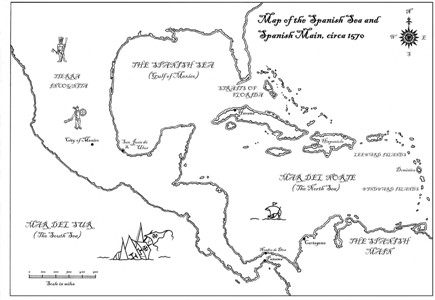
Jenny is also the coordinator of the 2012 Historical Novel Society conference, to be held in London in a month's time, and I'm pleased she was able to take time from her schedule to compose such a detailed and informative post!  The photographs included below are Jenny's, taken on her travels, and the map of the region is her composition as well.

~

Drake's First Great Enterprise - the Tragedy behind the Triumph
by Jenny Barden

It's easy to think of a daring escapade such as Drake's attack on the Spanish 'Silver Train' in 1573 as a rip-roaring adventure and overlook the suffering which lay behind it and the cost in lives lost. But Drake's success came at a heavy price, indeed it was born of tragedy, and tragedy dogged the enterprise right up until the moment he left Panama for Plymouth with his fabulous haul in booty.

What motivated Drake in his first venture against the Spanish, and for the rest of his life right up until the defeat of the Spanish Armada and beyond, was a desire for vengeance for what he saw as the treachery which led to the rout of John Hawkins' fleet at San Juan de Ulúa in 1568. Hundreds of English mariners were killed in this fiasco when the Spanish reneged on their truce and launched a surprise attack on Hawkins' ships while they were at anchor undergoing repairs following a hurricane in the Gulf of Mexico. Also lost were the hostages held by the Spanish as surety for the truce, and the Master of the Queen's flagship, Robert Barrett, a brilliant seaman and Drake's cousin, who was seized after a parley. Most of the English ships were destroyed or overrun, including the flagship along with those left on her, amongst them was Hawkins' nephew, Paul, who was only a boy. 

Map of the Spanish Sea and Spanish Main, 1570.  Click to see larger version

All these captives were destined for long imprisonment, some for forced labour, and others for cruel death after examination by the Inquisition. Robert Barrett was eventually burnt at the stake. Many more men died later of starvation or at the hands of Indians when they were put ashore from the overcrowded Minion, the largest of only two ships to escape, and even then, when the Minion eventually limped back home, most of the men left aboard were desperately sick, those who had not died of thirst or hunger on the way. The other ship to escape was the tiny Judith and that was captained by a young seaman called Francis Drake. It was his first command of any significance.

Drake later wrote of the scars this episode left:

Fort San Lorenzo at Portobelo, built after Drake's
raid on Nombre de Dios and his attack on the
Silver Train
'As there is a general vengeance which secretly pursueth the doers of wrong and suffereth them not to prosper, albeit no man of purpose empeach them, so is there a particular indignation, engrafted in the bosom of all that are wronged, which ceaseth not seeking by all means possible to redress or remedy the wrong received.'

This is how Drake described the desire for vengeance which drove him in his enterprise to seize the Silver Train. He later presented this account to Queen Elizabeth I on New Year's Day, 1593.* He never forgot the men who were lost at San Juan de Ulúa, and as reports of the fate of the captives filtered back to England, his bitterness only intensified.**

Drake was a driven man when he embarked on his plan to strike at the Spanish bullion supply from the New World as it was conveyed overland across the isthmus of Panama. He had undertaken two reconnaissance voyages and he had determined that the weak link in Spain's source of wealth from Peru was the point at which the treasure could not be protected by an armada, when it was on land at the poorly defended Caribbean port of Nombre de Dios, or in transit by mule train from the City of Panama through the rainforest clad mountains. But pinpointing the treasure while it was being moved about proved to be a mission fraught with difficulty.

The Las Cruces Trail - an extension of
the Camino Real, the Royal Road
Drake's first raid on Nombre de Dios in July 1572 left him seriously injured with a ball in his leg and without any spoils. His men took the town but could not break into the treasure house before a tropical storm, and heavy bleeding from Drake's wound, put an end to the attempt. Most probably there was no bullion in the city at that time because the treasure was only shipped overland from Panama after the armada from Seville had arrived in Cartagena, and only in the dry season (December to April) when the Royal Road was passable.*** But Drake did not know this - not then.

Months of frustration followed. Drake attacked shipping and settlements along the north coast of Panama all the way from the Chagres river to Cartagena but captured nothing of any great value. In one of the skirmishes his younger brother, John, was killed, shot in the stomach and no doubt dying in agony. Drake had achieved little apart from stirring up a hornets' nest. The Spanish were hot on his heels when he holed up at a secret island base in the 'Cativas', in what is now the San Blas archipelago.

A coral island in the San Blas Archipelago, known as 'the Cativas' in Drake's time
 
Here, Drake's men had built a stronghold on a coral island which they named Fort Diego after the Cimaroon (a runaway African slave) who had joined Drake as his ally (and was to serve him for much of his life). Months later, this place was renamed Slaughter Island because over a third of Drake's men lost their lives there - struck down by a mysterious disease they could not name or understand. Almost certainly that disease was the 'black vomit' or yellow fever. Amongst the victims was another of Drake's younger brothers, Joseph, who died in Drake's arms.

At this point Drake must have been close to despair, but he rallied his men (reduced from seventy-three to just over thirty) and, with the help of the Cimaroons, set out across county to attack the Silver Train near the City of Panama along the Royal Road. This also ended in failure when a Spanish outrider spotted one of Drake's men (reportedly drunk) and sounded the alarm causing the bulk of the convoy to double back. When Drake led his weary men back across the isthmus this was probably his lowest point. For all the ordeals he and his men had been through, for the loss of so many, including the death of his two brothers, he had nothing to show but cargoes of little worth and a catalogue of near misses and failures. His career thus far had been close to disastrous.

A view of the Panama shore near Nombre de Dios

To their fellow crewmen who had been left behind, those returning empty handed with Drake seemed 'as men strangely changed,' they recounted later*, '...and indeed our long fasting and sore travail might somewhat forepine and waste us; but the grief we drew inwardly, for that we returned without that gold and treasure we hoped for did no doubt show her print and footseps in our faces.' These were broken men; but Drake never gave up. The fortuitous arrival of French Huguenot privateers led by Guillaume Le Testu, a distinguished cartographer and explorer, provided Drake with the manpower he needed to have one final attempt on the Silver Train and seizing a fortune, this time near Nombre de Dios.

The masts of the Golden Hinde
(reconstruction)
In the critical foray only fifteen Englishmen took part, along with twenty Frenchmen and around forty Cimaroons - but what a triumph those men achieved! On 1st April 1573, Drake and his followers managed to capture a Silver Train of around 190 mules carrying almost 30 tons in silver and around half a ton of gold. Their difficulty then was carrying such a weight in treasure away, but eventually they managed to get back to their ships with most of the gold.****

Yet tragedy struck again at the very moment of Drake's victory. Captain Le Testu was felled by a blast of hailshot into his stomach, and his injuries were so severe he could not hope to make an escape. After burying most of the treasure, Drake had little choice but to leave Le Testu behind. The Spanish later found the French captain and exhibited his decapitated head in the market place in Nombre de Dios. They also tortured one of the mariners that Drake had left with Le Testu into revealing where the bulk of the treasure was buried. Drake must have mourned Le Testu's end; he was a man of singular talents who had become Drake's firm friend.

When Drake finally returned with a fortune to a hero's welcome in Plymouth, he left many brave men behind.

In my book, Mistress of the Sea, I have tried not to forget them.

~

Jenny Barden's Mistress of the Sea will be published tomorrow, 30 August 2012, by Ebury Press, Random House. It will be released first in hardback and trade paperback in the UK with the traditional paperback to follow.

The book is available through Amazon UK and other online bookshops, as well as bookstores throughout the UK.  Find it on Goodreads as well.

More about Jenny can be found on her website: http://www.jennybarden.com.

~

Notes:

* compiled from the reports of the crew by Drake's preacher, Philip Nichols, later published as Sir Francis Drake Revived in 1626

** remarkably, some of these captives escaped or won their freedom and eventually returned to England with amazing stories of endurance and fortitude. Job Hortop, gunner, was marooned, marched to the City of Mexico, tried, imprisoned, sent to Seville to answer the Inquisition, condemned to serve as a galley slave for 12 years, survived to be sold into servitude, escaped, and finally returned to England after 23 years

*** there's a piece about the Royal Road, el Camino Real, here: http://englishhistoryauthors.blogspot.co.uk/2012/08/el-camino-real-path-worn-through-time.html

**** for more about Drake's escape with the booty there's an article here: http://englishhistoryauthors.blogspot.co.uk/2012/07/carrying-away-booty-drakes-attack-on.html