Wednesday, April 10, 2013

The Boer War: Britain's Vietnam, a guest post by T.D. Griggs

T.D. (Tim) Griggs has written up an insightful post about the last days of empire, comparing Britain in the late 1800s with America in the next century.  Tim's most recent novel, Distant Thunder, is an epic love story set against the politically troubled, class-conscious backdrop of India, England, and the Sudan in late Victorian times.  The paperback edition appeared from Orion in January (£7.99, 464pp). Welcome, Tim!
~

The Boer War: Britain's Vietnam
T.D. Griggs

What a time the 1890s must have been – if you were British.

Britain was the world’s sole superpower. It controlled, directly or indirectly, something like one-third of the world’s population and land area. Most international trade was carried in British ships, and much of it consisted of British manufactures. British language and culture was hugely influential, and in many parts of the world overwhelmed local cultures, especially among the educated elites. 

In the 1960s, the United States occupied a remarkably similar position. Its de facto empire spread across Asia, Africa and South America. America’s colourful, vibrant, open culture was the envy of people the world over, especially the young, who imitated it energetically.

At the height of their powers, however, both these great nations lived in fear that their dominance was threatened. There had been warning signs. In the Crimean War of the 1850s, and the Zulu Wars twenty years later, Britain suffered serious reverses which exposed the failings of its much vaunted military power. In the 1950s the Americans had the same chastening experience in the brutal Korean War.

Both superpowers survived. But neither was to last.

For the United States, the turning point was to come with Vietnam in the 1960s. As a technological and nuclear superpower the US came up against an untrained adversary who fought with simple weapons, and didn’t know when they were beaten.

For Britain it was the South African War of 1899-1902. The Boers had virtually no formal military training, refused to obey the rules of conventional warfare, and were as elusive, as mobile, and as dedicated as the Viet Cong sixty years later.

Both great powers were humbled in their turn. Both lost tens of thousands of men. And neither was victorious. North Vietnam survived as a Communist state, despite all the Americans could throw at it, and the Boer republics regained their independence within a very few years and achieved virtually everything they had been fighting for. That included systematic repression of the black population, which the British had specifically promised to resist.

After Vietnam the United States never regained its sense of manifest destiny. Public opinion was never again wholeheartedly behind military adventures, and the country’s leaders were never again wholly trusted.

The Boer War had the same effect on the British. The hysterical celebrations which greeted the relief of Mafeking in mid-1900 (‘Mother may I go and maffick, tear about and hinder traffic?’) mark by their very violence the end of the old certainties. They exhibit a desperate need to cling to a set of values which was already passing.

The death of Queen Victoria just seven months later put the seal on this. The British appear to have understood instinctively that the end of the Victorian era inevitably meant the end of their own glorious century.

The more thoughtful of British commentators had seen this coming even before war broke out. Kipling’s poem Recessional was written for Victoria’s Diamond Jubilee but it might just as well have been penned for her funeral. 

Far called, our navies melt away; 
On dune and headland sinks the fire.
Lo! All our pomp of yesterday
Is one with Nineveh and Tyre
The poem’s refrain, Lest we forget, is nowadays invoked as an elegy for the fallen. In fact Recessional is an exhortation to the British to be humble in the face of their inevitable decline. Meanwhile, popular British novels of the 1890s, by writers like Le Queux and Childers and Romer, spoke of invasion threats and subversion by evil geniuses. The overall message was: the end is nigh.

In truth it wasn’t very nigh at that stage, but it was certainly approaching, and the British sensed it clearly enough.

What the USA really lost after Vietnam, and what Britain lost after the Boer War, was not military or economic supremacy, but moral ascendancy – confidence in their mission to rule.

Neither empire was ever to regain it.

~

T.D.Griggs writes: I was born in London, but have so far lived on four continents and have dual British and Australian nationality. I’ve worked variously as a journalist, industrial editor, and proprietor of a successful communications consultancy – interspersed with spells as a truck driver, barman and volunteer firefighter – before becoming a full-time novelist fifteen years ago. That seems like the kind of varied and colourful background a novelist ought to have, and it sometimes surprises me, looking back, that it’s actually all true.

My first novel, Redemption Blues, a contemporary crime drama – was a million-seller, and has just been re-edited and re-released. This is the first time it has appeared as an e-book, and the first time US readers will get the chance to see it, so I’m hoping for a whole new audience for it. That book was followed by a story written under my one-time pen-name of Tom Macaulay, The Warning Bell (Orion Books, 2010), a tense father-son drama set in the present but looking back to a World War Two mystery.

Distant Thunder (Orion Books, 2013) is my first venture into pure historical fiction. Set in the 1890s, it tells the story of two young lovers whose lives are caught up in the cruel machinery of the British Empire at its zenith, but just as the whole edifice is beginning to totter. The tale draws on my lifelong interest in the Victorian era, with all its glamour, confidence, adventure, and brutality, and has some – I hope – interesting things to say about imperialism.

These days I live in Oxford, within sight of the dreaming spires, with my Australian wife Jenny and half a black Labrador dog called James (the neighbours own the other half). Check out my website www.tdgriggs.co.uk and follow me on twitter @TDGRIGGS1.

Monday, April 08, 2013

Imagining Airenchester in The Raven’s Seal: A Guest Post by Andrei Baltakmens

In writing historical fiction, novelists must re-create the living world of the past using the tools at their disposal.  In his historical mystery The Raven's Seal, Andrei Baltakmens takes these world-building techniques to a new level, imagining the 18th-century cathedral city of Airenchester and constructing and populating it from the ground up.  Within the following detailed essay, Andrei explains the choices he made.  The Raven's Seal, called "a superb mystery with vibrant characters" by the Historical Novels Review, was recently named a finalist in ForeWord Reviews' Book of the Year Awards in the historical fiction category.  It was published by Top Five Books in November 2012 ($14.00, trade pb, 416pp).

~

Imagining Airenchester in The Raven's Seal
Andrei Baltakmens

I preface my novel The Raven’s Seal with an epigraph from Italo Calvino’s Invisible Cities. “With cities, it is as with dreams,” writes Calvino, “everything imaginable can be dreamed, but even the most unexpected dream is a rebus that conceals a desire, or its reverse, a fear.” I kept this quote with me for a long time, simply because it suggests a wonderful connection between cities, fictional cities, puzzles and mystery.  Invisible Cities is, among other things, a reimagining of one city: Venice. It shows how fiction gives us a multitude of ways to imagine a city so that we can see our relationship with our own cities anew, and to my mind the best historical fiction also allows us to reflect on and revise our relationship with our own times. The Raven’s Seal, as a historical mystery, was written primarily to engage and entertain, but it is through the city that I created as the setting for the story, as much as the prison that was to be the locus of the mystery, that I wanted to suggest some of the social themes that give a novel depth and resonance beyond the turns of its plot.

But why create an imaginary city when the most familiar examples of the eighteenth-century prison (such as Newgate, Kings Bench, or the Marshalsea) were in London? In the first place, I felt that London and Newgate were perhaps too familiar; astute readers, versed in the politics and events of the era, would be looking too closely for real-world correspondences and details that would distract from or obstruct the pace of the mystery. I took inspiration, as usual, from Dickens in this, since Dickens set his first murder mystery, the unfinished The Mystery of Edwin Drood, in the fictional cathedral town of Cloisterham, where the details of the plot and locales would be under his control. Like Dickens, I wanted the power to create an atmosphere of mystery and move my characters on a stage of my own design, and hence Airenchester (my own cathedral city) was founded. And like the Bellstrom Gaol, which I could fill with incidents and character, Airenchester became a place I could populate myself. It took on its own life and peculiarities, while also reflecting some of the most interesting elements of the period of the novel.

Certainly, the eighteenth century, the beginning of the modern period broadly understood, holds enormous interest for any writer. One thing my research into early-modern crime and the birth of the prison revealed was that the eighteenth century, rather than being sedately Georgian and orderly, was a period of significant social upheaval in Europe, due to changes in population, changes in agriculture and the growth of industrialisation, changes in crime and punishment, and critical changes at the core of society, in work and the acquisition of wealth, and in the rapidly widening gulf between the wealthy and the poor. The upper-classes rose on the tides of empire and capital, while the dispossessed saw their livelihoods removed, as cottage industry collapsed and the old systems of communal ownership were dispensed with. This last movement, the enclosures by which common lands were expropriated, legally or otherwise, by the wealthy, was something I was only able to refer to in passing as part of a broader conspiracy in my novel, but we tend to overlook how radical and far-reaching this change was. Today, when governments and lobbyists plan the privatisation of state assets and programs, or our DVDs become unplayable in different regions, governments and corporations are retreading the old path of the enclosures movement.

This background developed slowly through research and writing. Airenchester did not appear at once but accumulated. The prison, the notorious Bellstrom Gaol, materialised first, brooding on a hill, in my mind’s eye somewhat like Edinburgh Castle (though the Old Tolbooth, Edinburgh’s medieval prison described by Sir Walter Scott in The Heart of Midlothian was also at the back of my mind). But who had an eye on the Bellstrom? To show how the ruling classes of Airenchester had separated themselves from crime and poverty, as they had in London, I created the upper-class quarter of Haught, on its own hill opposite the prison and the slums that sheltered beneath it. There had to be a river, of course, like London, and like the city of Christchurch in New Zealand where I grew up (Christchurch, now sadly damaged by a series of earthquakes, is often described as the most English city in New Zealand). More neighbourhoods, roads, rookeries, twisting lanes, bridges, taverns, counting-houses, businesses, and thieves’ dives appeared along the river as the story grew. The physical conditions of the city also call out the people. For example, like all cities of the era, the streets were entirely dark at nightfall, necessitating link-boys with torches to light the way and the largely symbolic watchmen to monitor vagrants and disorder. Then there came the clerks and merchants, rakes, footpads and harlots to fill those streets. It is still astonishing to me that the city formed by imagination and the needs of a narrative attained enough coherence that a skilled illustrator (Jeffery Mathison) could make a workable map of the places I described.


All this would be simple stage dressing if this imaginary city could not suggest something of the real historical conditions of the time and, by extension, give the reader some pause for reflection. The sharp divisions between lower-class and upper-class in Airenchester, the desperation of the slums and the proliferation of crime, the indifference of authority to suffering and the inequalities and corruption that haunt the society of Airenchester are real issues that persist today. The broader availability of credit in the eighteenth century, the growth of financial speculation and the “bubbles” and financial collapses that these precipitated—all features of the society of Airenchester—became eerily relevant during the global financial crisis. Airenchester is also the site of a mystery wrapped up in a gaol at the core of the city. The clues to that mystery are not, by design, hard to uncover, but they point everywhere. Uncovering the mystery shows, I hope, something unexpected about Airenchester, and the patterns of power and crime that define it. I hope that readers will look for these echoes, the rebus that conceals both desire and fear, in my imaginary city.

~

Andrei Baltakmens was born in Christchurch, New Zealand. He has a Ph.D. in English literature, focused on Charles Dickens and Victorian urban mysteries. His first novel, The Battleship Regal, was published in New Zealand in 1996. He has published short fiction in various literary journals, including a story in the collection of emerging New Zealand male writers, Boys' Own Stories (2001).

For five years he lived in Ithaca, New York, where he was part of the professional staff of Cornell University. He is currently a graduate student in the Creative Writing Program at the University of Queensland in Brisbane, Australia, where he lives with his wife and son.

Friday, April 05, 2013

On E. A. Dineley's Regency saga, The Death of Lyndon Wilder and the Consequences Thereof

Upon opening the package containing E. A. Dineley's debut novel, I felt like clapping my hands in delight. Such a cute little book! It's a hardcover in miniature, just slightly larger than a mass market paperback. The cover leaves a period-appropriate impression; the designers have made it resemble an olde-timey manuscript printed on foxed paper. Eye-catching but not ostentatious. I liked it a lot.

The contents reflect the packaging. Nothing flashy or melodramatic, just solid, engrossing storytelling that kept me cheerfully entertained for not merely one but several afternoons. It's set confidently in the Regency era and in many ways reads like a novel written at that time.

A novel of manners both good and ill, The Death of Lyndon Wilder and the Consequences Thereof opens by plunging us into an atmosphere of mourning. The year is 1813, and the title character, the heir to Ridley in Wiltshire, has been killed by musket fire during the Napoleonic Wars. He leaves an orphaned nine-year-old daughter, distraught parents, and a younger brother who must, reluctantly, assume his place in the family.

Lyndon's mother, Lady Charles Wilder, a self-centered woman concerned about appearances, is particularly distressed because her husband had bought Lyndon a commission in a regiment inappropriate to his status, and this may have put him in harm's way. To raise the funds, her husband had had to cut down a large grove of oak trees on their property, and now their 5000-acre estate is starting to look shabby.

Lord Charles, a kindly elderly man who can't stand up to his wife, looks to his younger son, Thomas, a major in the Royal Horse Artillery, to solve their problems... if he can convince him to leave the military. Lady Charles, however, has never been close to Thomas. He serves as a sad reminder of the older son she adored and lost, and she's consoled only by the thought of Lyndon's heroic death.

The first 80 pages pass fairly calmly as we get to know the characters’ personalities and habits through their interactions. The plot takes a sharp step forward when Major Wilder arrives home at Ridley with unwelcome news, at least for his mother. Thomas had been named the primary beneficiary in his brother's will, and he also receives guardianship of his niece, Lottie. His mother is starved for information about Lyndon's last moments, but he can't give her what she needs.

What's more, Lyndon wasn’t a paragon of virtue... not by a long shot. Whatever his feelings toward his brother, Major Wilder is a decent, responsible man.  He knows he must prevent any dangerous revelations about Lyndon from coming out.
Here it stands next to a normal-sized
hardcover, for perspective.

The plot revolves around the relationships between members of the immediate family, other Wilder siblings living elsewhere, Lottie's youthful governess Anna Arbuthnot, and their neighbors the Kingstons – and how they adjust to life (if they do) in Lyndon's absence.

Miss Arbuthnot, a clergyman’s daughter considered unattractive with her red hair and freckles, grows to love her young charge.
During their mourning-related seclusion, she is drawn closely into the family drama, and Thomas appreciates the difficult position she’s in. The governess is “such a betwixt and between thing,” as Miss Arbuthnot writes to her father. It’s through her outsider’s viewpoint that we observe much of the goings-on.

This is a lively and comfortable read in which everyone acts according to character, except, well, when they don't – and that’s what keeps things interesting. Not everything is prim and proper, and Dineley adds periodic dashes of wit to the telling. When necessary, the tone is wise and gently biting (“Lady Charles was not pleased, but then she was not often pleased”) and sometimes hilariously funny. I admire how the author can size people up with one pointed description. "Mrs Kingston was certainly pretty, like a dove, all soft plumage and pouting bosom," she writes of the widow who had hoped to marry Lyndon and now sets her cap at Thomas.  It's clear Mrs Kingston doesn't have a chance.

Intelligent, curious Lottie's actions provide much humor; she has a way of getting what she wants and often forgets that personal remarks about people are considered rude. She and her good friend Horatio Kingston can get away with saying aloud what many adults around them can't.

Although the story rambles somewhat, it does so in a diverting way. The length (nearly 600 pages!) immersed me in the detail-rich environment and the daily lives of these memorable people. At the same time, the author illustrates the social inequities at the time, young people’s education, estate management in the Regency-era English countryside, the complexities of inheritance, and the destructive nature of excessive grief.

The jacket blurb calls the book “hauntingly written,” which may not be the best description. The mystery aspect – the secret about Lyndon Wilder – fades in and out of the plot until it comes back into focus at the very last, but readers may be so absorbed in the story that they don’t notice. The world feels so real and convincing that I have no doubt that the characters continued to exist after their story ended. If there’s a sequel, which I hope there is, I look forward to joining them again.

The Death of Lyndon Wilder and the Consequences Thereof was published by  Corsair, an imprint of the UK publisher Constable & Robinson, on March 7th, 2013, at £12.99 (hb, 584pp).

Thursday, April 04, 2013

Guest post from Jennifer Cody Epstein, author of The Gods of Heavenly Punishment

Today I'm very pleased to welcome Jennifer Cody Epstein, author of The Gods of Heavenly Punishment and The Painter from Shanghai.  She offers an insightful essay about what it's like to have her work marketed to a gender-specific audience and, among other things, how cover art for historical novels (one of my favorite topics) can influence readers' perceptions.  Please share your own thoughts on these issues in the comments!

~

“As a writer, would you say you push the boundaries of women’s literature?”

We were sitting in a hotel lounge in the lovely but rainy city of Bergen, where a journalist was interviewing me about my new book. The Gods of Heavenly Punishment (or When the Sky Fell, as my Norwegian publisher titled it—Norwegians, it seems, distrust religious references in titles) is a war novel, set against the blazing backdrop of the 1945 Tokyo firebombing. The story is told through the perspectives of five central characters: two female, three male.

“I don’t really see my work as exclusively ‘women’s’ literature,” I said, setting down my teacup. “Particularly this novel. I mean, I welcome women readers, obviously. But I wrote it to be read by both genders.”

My interviewer chewed her pen for a moment. “Well,” she said. “If you did write women’s literature, would you say you were pushing its boundaries?”

I suppressed a smile. This wasn't the first time I’d faced this label, “women’s literature.” But I still found it somewhat puzzling. Granted, my first novel, The Painter from Shanghai, was about a woman: Chinese prostitute-turned-post-Impressionist Pan Yuliang. Written third-person, present-tense and encompassing Asian history, art, travel and romance, it’s a story that arguably appeals largely to my gender. And while I hadn’t written it exclusively for fellow females, I also hadn’t argued with my publisher when they opted to market it that way, giving it a gorgeous but distinctly feminine cover (a woman’s profile, sepia-toned and deeply saturated with color) and presenting it as an ideal book-group pick. The truth is, I loved the cover. And their strategy was a very wise one, since the book indeed did well with book groups and sold decently in the States. It also sold in sixteen other countries under equally feminine-looking covers. Including Norway, where it became a bestseller.

So I’m not really complaining. Or at least, I know I shouldn’t be. After all, while men make up the bulk of fiction writers in the world, women are indisputably its biggest readers—something Ian McEwan noted a few years back after going to a park to give away thirty novels. As he reported in the Guardian, a full twenty-nine of those books were accepted by women—while all men but one (an unusually sensitive soul, it seems) declined. “When women stop reading, the novel will be dead,” he concluded. So if I had to choose one group to appeal to, it’d clearly be the ladies.

And yet it still sits a little strangely on me; this idea that I somehow read as more “womanly” than do my male counterparts—or even female ones who don’t get marketed the same way (think Jennifer Egan, Nicole Krauss, Gillian Flynn). After all, my literary influences are split pretty evenly between pink and blue. I love Toni Morrison, but no more than I love Nabokov. I’ve read as much Sarah Waters as I have Philip Roth. Or for that matter, Ian McEwan. In other words, I don’t really see myself as an overtly “womanly” reader.

I also realize, however, that being labeled a “woman’s writer” often goes hand-in-hand with another label about which I have less complex feelings: “historical fiction.” There is no doubt whatsoever that my last two novels are of that genre (I should know, since I spent years researching each of them). Strangely, though, when I first set out to write a historical novel I didn’t anticipate it pushing me towards one gender more than another. After all, history itself isn’t considered more female than male. If anything it’s the other way around (sic: history). And yet, do an Amazon search for “historical fiction” covers and the vast majority have women’s faces or bodies or accessories (jewelry, gloves, perfume bottles) on them. This is probably due to the fact that for a very long time, novels labeled “historical fiction” were often far heavier on fiction than on factual history. Many, in fact, were interchangeable with “romance” (e.g., bodice-ripper)—something my late grandmother’s bookshelves quite fully attested to.

I hasten to add that I have nothing against those sorts of novels. Indeed, growing up I loved nothing more than sneaking her monthly-delivered Harlequins into my bag, then reading them later with quivering excitement, in secret. But writing The Painter from Shanghai that wasn’t the genre that I had in mind. Sure, there’s sex in it—pretty good sex, from what I’m told. But what I really wanted to get at was the history—the amazing, rich, tumultuous history of Chinese politics and art, from the turn of the century through the Chinese Communist revolution. And again, I didn’t think that would appeal just to women. It’s also why I was slightly surprised when I saw the American cover for my new novel, The Gods of Heavenly Punishment. Emblazoned with Japanese-style flowers and a girl with a parasol, it was just as gorgeous as the cover of The Painter From Shanghai. And aesthetically, I loved it just as much. But I did ponder, briefly, about whether it was fully representative of my new novel, which is about both men and women, and about war.

In the end, though, I again went with the prevailing wisdom about how my novels should be marketed to our predominantly-female readership. And in the end, I’m very glad that I did. The book is so beautiful I teared up when I first held it—which is one of the best feelings any novelist can hope for. What’s more, everyone who sees the cover raves about it--men included. I’m also sure it leads many a perusing, potential reader to pick it up in bookstores, which, when it comes down to it, is what a great cover is really for. I will admit, though, that I laughed when I saw the Bergen newspaper piece, which came out a day after my interview. The title: “Women Writers Push the Boundaries of Women’s Literature.”

And there, front and center, was my novel.

~


Jennifer Cody Epstein's  The Gods of Heavenly Punishment was published in March 2013 by W.W. Norton ($26.95, hb, 382pp).   The Painter from Shanghai, her debut novel, is available in trade paperback, also from Norton ($14.95, 432pp).

For more details, including selected excerpts from The Gods of Heavenly Punishment, visit her website at http://www.jennifercodyepstein.com.

Tuesday, April 02, 2013

Around the world with historical fiction: April releases

I got a little carried away with this post. So many covers, so many books!  But over the past few months, I kept coming across historical novels I wanted to read, and so many of them were set to appear in April.  It's not the cruellest month at all, not for historical fiction readers.  The diversity of historical settings struck me as well.  Take a look at the places they'll let us travel!


20th-c England ~ 1911 Russia ~ 1930s New Jersey


1845 Nantucket ~ Tudor England ~ 17th-century England


12th-c Constantinople ~ 1920s US & Europe ~ early 20th-c & modern Australia


Biblical times ~ an imagined Song Dynasty China ~ 19th-c New England


1960s small-town Minnesota ~ 1880 South Africa ~ 1940s England, France, India, Jamaica


1840s West Africa ~ 1920s Kenya ~ Paris through the ages


1890s California ~ Tudor and modern England ~ Restoration England


WWII England ~ 20th-c England and Kenya ~ Postwar Taiwan and U.S. West

Monday, April 01, 2013

Small Press Month - wrap-up and contest winners

Thanks to everyone who entered the giveaway for a small press historical novel.  I thoroughly enjoyed reading all your comments (and blogiversary wishes!) and learning what aspects of the blog you liked the most, too. There were a few things that several of you mentioned that I thought I'd summarize here:

- You've asked your library to buy books mentioned here, and they were willing to do so.  This is very cool all around.

- I got a lot of general feedback on authors' guest post contributions and the variety they offer.  Jodi Daynard's piece in particular was mentioned by many readers as a standout essay.

- The galleries with book previews are what I should do more of, it seems.  My site stats bear this out too.  I'm glad to hear that because I have a very large preview post forthcoming tomorrow. 

- The demise of Google Reader was mentioned by a few readers.  I'm depressed about it too; I've been using it for years to track blogs.  I've been playing around with alternatives (Feedly, Netvibes, etc.) and have found Bloglovin to be the most convenient for my needs.  I especially like that I get an email every evening with links to the day's new posts.  There's an easy way to migrate your posts from Google Reader over to Bloglovin, and once you're signed in, you can follow Reading the Past here.

- I was also happy to see the small press focus went over well and drew people's attention to novels they might otherwise have missed, as one reader said.  I'd set myself a goal to post every other day or so to keep the momentum going.  I'd especially like to acknowledge the authors who supplied guest essays providing their perspectives on the genre, and the publishers who sent review copies - thanks!

I'd actually had plans to review even more small press novels (I had a pile of them set aside in my living room) but as usual, I got caught up in things like work and other writing assignments.  I'll still be reviewing small press titles, of course, just mixed in with other reviews I've been saving up.  Will I do this next March too?  It's something I've been debating, but I have almost a year to think about it.

And now for the giveaway winners:

Tim G.
and
Tiffany

Congratulations!  I'll be in touch via email to get your addresses - and please browse through the last month's posts and let me know which book you'd like as your prize.

Saturday, March 30, 2013

Russian history, a mystery, and a reviewer's dilemma

When I received an ARC of John Boyne's The House of Special Purpose from Booklist in mid-February, I was pleased; I enjoy reading novels set in Russia, and while Boyne's novels are highly acclaimed, I'd never read his work before.  I was also a little puzzled.  The publisher's description went:

"From the author of The Absolutist, a propulsive novel of the Russian Revolution and the fate of the Romanovs."

Given that and the title, the meaning of which anyone who's done any reading about the Russian imperial family will likely recognize, I knew the event that the plot would be leading toward.  Why now, I wondered.  Why are we seeing a novel about the fate of the Romanovs now, when it's already been proven what happened to them?  

This is the US edition, though.  The original UK edition appeared in early 2009, when things weren't wrapped up quite so tidily.  I imagine that historical discoveries that happen mid-writing (or just before publication) can cause trouble for a novelist.  Any fiction published on that topic before a certain date could be considered speculative, and thus acceptable to readers.  Novels published after that time could be called either straightforward historical fiction, or alternative history/fantasy, depending on the direction the author takes.  However, in the case of The House of Special Purpose, calling it either one in the review would give away the plot!  I didn't want to do that.

Also, in reading the novel, I was given many hints as to where the storyline would be heading, but I didn't know for sure (I was prepared to be wrong).  Boyne did a great job keeping the suspense level high.  And so I struggled a bit with how to word the review, wanting to acknowledge the issues but trying to keep it as spoiler-free as possible.  I've tried not to give too much away here, either... hopefully I've succeeded.

This is what I came up with; it appeared in Booklist's 3/15 issue.

Russophiles should immediately comprehend the title of Boyne’s suspenseful and touching novel. In 1981, as his adored wife, Zoya, lies dying, Georgy Jachmenev, an elderly Londoner, reflects on their lengthy marriage and the secret tragedies they endured. A parallel plotline opens in early twentieth-century Russia as young Georgy, a muzhik (peasant) from a backwater village, saves the life of the tsar’s cousin and is brought to St. Petersburg, where he becomes protector to the frail tsarevich and finds romance with Grand Duchess Anastasia. The two narratives dovetail, as the latter progresses forward in time while the former marches steadily backward. The book’s central mystery is dated now, which may limit readers’ appreciation, but it is ingeniously constructed and gripping nonetheless. While no prior historical knowledge is required, the more familiar readers are with the Romanovs, the more clues (and false leads) they will encounter as they proceed. Boyne takes some factual liberties, particularly in the earlier-set segments, but he also skillfully evokes the wrenching pain of loss and exile while presenting a tribute to enduring love.

What are your thoughts?  Would you pick up a novel in which the central mystery no longer exists in real life?  Does it take anything away from your reading experience, or would you go for it anyway if the subject grabbed your interest?

The House of Special Purpose will be published by Other Press, a NY-based independent publisher, on April 2nd, 2013 (trade pb, $16.95, 480pp); it appeared from Doubleday in the UK in 2009.

Thursday, March 28, 2013

A careful juggling act: the small publisher in genre fiction, a guest post by Evan Ostryzniuk

Evan Ostryzniuk's detailed and informative essay examines small press publishing from the author's perspective.  His post should be of great interest both to writers contemplating a move to smaller publishers and to readers curious about about the publishing industry.  His novels Of Faith and Fidelity and Of Fathers and Sons, both from London-based Knox Robinson Publishing, are books 1 and 2 in the English Free Company series set in the late 14th century.  Welcome, Evan! 
~

A careful juggling act: the small publisher in genre fiction
Evan Ostryzniuk

I will start this guest blog post with an equivocal statement. Being an author of a small publisher offers certain advantages and challenges, most of which stem from the limited scale of operations. Of course, I have not had the opportunity to work closely with a large publisher, so any implicit comparisons I might make may not be wholly accurate. That said, I have enjoyed my fair share of adventures with the start of my writing career!

When I went in search of a literary agent for my first novel, having been warned against submitting directly to a publisher of any description, I ran up against a polite and well-intentioned editorial wall. Despite having done a load of research on the publishing industry and how to present myself and my work properly, I could not find anyone to bite on my genre novel. Most responses, when I did receive genuine letterhead from the office of a literary agent, were generic and left me with the impression that they were looking for an instant hit or hoping to latch on to an already hot property, as opposed to cultivating unknown but ambitious authors. True, the genre I had chosen to write in is not at the very top of bestseller lists, so I was not discouraged by the experience, but it became clear to me that I would need to gird my loins if I wanted to travel down this well-trodden road that was thick with competitors.

So, after seeking solace in one of the many forums dedicated to wannabe authors, I chose the path-less-taken and sought out a small press, under the assumption that it would be amenable to direct contact. I quickly found a new, genre-specific publisher that had big plans and was willing to give my series of historical novels a chance. What immediately appealed to me about them, aside from their acceptance letter, was the opportunity for us to grow together. This might sound sentimental, but I am the type of person who wants to have if not control, then at least a thorough understanding of the publishing process. Major publishers have established structures, and so the author must follow the path laid out. A small outfit, on the other hand, offers a more intimate degree of interaction, exchange of ideas, and access to senior personnel who are making the decisions.

A major worry with small publishers is the level of professionalism, usually because of smaller staffs and less experience. I am fortunate that from the contract to editing to design, my publisher is an exemplar of professionalism. Also, any number of them might be fraudulent. This is one area where working with a small publisher can actually be an advantage, since because they have fewer competitive levers to level the playing field, they must compensate where they can. A major publisher can get away with ignoring or poorly treating their authors (up to a point) – small publishers cannot.

The greatest challenge of working with a small publisher, for me, is physical market access, as opposed to virtual access. The big boys hog shelf space in brick and mortar shops, especially when it comes to genre fiction. This leaves the author and publisher in a catch-22 situation, whereby a book cannot make it to the buying lists unless it has solid sales behind it, but without exposure sales are difficult to generate. Also, the small publisher does not have much leverage to really champion a book by an unknown author. As a result, I have had to sometimes resort to consignment selling and making personal agreements with shops.

The flip side to this old-fashioned way of doing the publishing business is that it is being comprehensively challenged by e-books and online sales, and this is a place where a small publisher can outpace established behemoths. The absence of a large bureaucracy, long-standing business model and vested interests within the company means that the small publisher is more flexible in adopting the new virtual tools of the industry, which allows for greater independence and more flexibility in approaches to promoting authors. I deal with very few people during the process of getting my books to print and the interaction is more dynamic. I can appeal to the senior editor directly instead of steadily calling upwards through a long chain of command, and responses are usually swift and precise.

That said, I am expected to do a lot of the leg work in generating interest in the product. This is both advantageous and problematic, I find. Because the publisher expects me to create ideas, suggest graphic elements and generally approve the final product, I have more control over my novel’s image. At the same time, the absence of an established methodology or system allows for uncertainty to remain about the venture and many valuable hours spent not in writing.

A similar situation exists in marketing and promotion, which is where I feel the least amount of support. The absence of an experienced PR arm with a long reach at a small publisher results in this heavy burden being transferred to the author. A shared fate implies shared responsibilities, but it also means having to master a host of new technologies and applications, which costs more time than money, albeit, but also means having to be even more creative. Sometimes, it is nice to have the path laid out. Again, having control over promoting and marketing also means having control of your own image. However, having the name of a major publishing house near the author’s name does provide a lot of cachet. At the same time, there is little risk of becoming overexposed.

Another major challenge is getting ‘high-end’ reviews, although this may be more of a function of the author’s fame than the reach of the publisher. Nevertheless, in today’s increasingly consumer-driven venues, I find that the duty of getting books into the hands of readers is falling increasingly on the author himself or herself, with some support from the publisher, and that mostly of the technical variety.

To sum up, I would say that a small publisher offers excellent opportunities for the strong-willed author who really knows how he wants his readership to see him or her and has enthusiasm for mastering a great many aspects of the business. At the same time, the author must be fully aware of certain limitations involved and be creative in overcoming those challenges.

About the author

Evan Ostryzniuk was born and raised in Canada. After graduating from the University of Saskatchewan with a B.A. in History and Modern Languages and an M.A. in History, Evan crossed the ocean to do post-graduate work at the University of Cambridge, concluding four years of research with a doctoral thesis on the Russian Revolution. He then found his way to Eastern Europe, where he took up positions as a magazine editor, university lecturer and analyst in the financial services sector before rising in the ranks of the publishing industry to become Editor-in-Chief of a popular weekly. Evan currently resides in Kyiv, Ukraine near a large candy factory. He travels extensively, including to the locations of his novels.

About the novel Of Fathers and Sons: Geoffrey Hotspur and the Este Inheritance

Italy 1395. The Este lands are vulnerable. The death of the Marquis of Ferrara, Alberto d'Este, has left his eleven-year-old son, Niccolo, as sole direct heir. Though born out of wedlock, the pope himself has legitimized Niccolo’s birth, but in an age when great lords ruled by sword as much as by law, having a boy lead the family can be a sign of weakness.

Made unhappy by the father, some Este vassals want to humble the son, and they see their opportunity in Niccolo’s insecure minority rule. Championing their cause is the head of a reduced branch of the Este clan who is not only a famous condottiere, but also a captain of the ambitious lord of Milan. Fearing that the defeat of Niccolo will lead to a shift in the already fragile balance of power in favor of the over mighty Milan, the city-states of Florence, Venice and Padua have combined to try and keep the Este inheritance in the boy’s hands.

Of Fathers and Sons is the second book in the English Free Company series set in the late Middle Ages. The Company is led by the skilled but reckless Geoffrey Hotspur, an orphan-squire and ward of the mighty Duke of Lancaster, whose driving ambition is to become a knight. Before Henry won his miraculous victory at Agincourt, before the Borgias became infamous, before Constantinople fell to the Turks, there was Geoffrey Hotspur, a man as tall as Charlemagne and possessing a sword that rivaled Excalibur. Geoffrey and Niccolo are confronted by the same questions: How can an orphan find his place in a society informed by patriarchal relations? For how long must a son follow the wishes of his father? When does the boy become the man?

Publication date: March 7, 2013
Available From: Knox Robinson Publishing
Hardcover: ISBN: 978-1-9084831-5-7
Paperback: ISBN: 978-1-9084831-6-4

Tuesday, March 26, 2013

Language and culture in Annapurna Potluri's The Grammarian, set in south India in 1911

Readers and publishers often wonder whether reviews sell books. I’d have to say yes, they can; the February 15th review of Annapurna Potluri’s The Grammarian in Shelf Awareness certainly sold me. Literary fiction about a Parisian linguist who travels to south India in 1911 and unwittingly provokes a cultural taboo? It was a novel I hadn’t heard of before, and the subject caught my attention (my academic background is in linguistics). The unfamiliar setting and haunting cover art didn't hurt. I ordered it the next day.

Its initial protagonist is Dr. Alexandre Lautens, a handsome professor at the Sorbonne, who has left his wife and children behind to study in India, a distant place with “as many languages as there were gods.” During his sabbatical, he plans to create the first written grammar of the Telugu language.

His host family in the coastal city of Waltair, the Adivis, is comprised of one man and four women: Shiva, an outwardly gracious and socially conscious Anglophile, plus his wife, mother, and two teenage daughters. Mohini is the beautiful younger girl, while Anjali, plain and crippled from polio, hides a sensitive heart behind a stoic mask, a defensive reaction to her father’s disappointment in her.

Their household is in a state of excitement preparing for Mohini’s forthcoming wedding, an event that Anjali, sadly, will never experience herself. During his stay, Alexandre takes an interest in Anjali, who enjoys literature and provides him with vocabulary for his project. Anjali finds him exotic and beautiful, while his feelings are more fatherly than romantic.

But when Alexandre's innocent act of kindness towards her – giving her a swimming lesson at the local beach – results in harsh gossip, embarrassment, and shame, Shiva makes a decision that has devastating and long-lasting repercussions for both his daughter and the foreign linguist.

A gorgeously composed yet solemn exploration of social values, prejudice, and the many forms of human expression, The Grammarian illustrates the purpose and power of language, as well as its constraints. The freedom that Anjali and Alexandre both feel, floating in the ocean, is a pure moment of happiness that, for them, transcends words:

The morning sun bounced its light off their skin, and the sea and sand; everything was bright with the evanescing promises morning brings, and her skin shone gold as his did in silver, the water crackling with sun… She thought for a moment of drowning so as to never have to live this life as before, because she now knew what it felt like to be awake.

Their return to the real world, however, is fraught with misunderstanding and distress.

In this time and place, some cultural barriers can't be bridged, something that Shiva’s elderly mother, Kanakadurga, knows well. She and Alexandre become close friends, sharing many delightful, edifying conversations that please them both. A magnificent character, she is a wise, forward-thinking realist about her tradition-bound society. Kanakadurga realizes that for Anjali, the granddaughter she adores, her only hope for a rich, full life lies elsewhere.

This novel is perfect for those who love languages and foreign cultures and seeing the complicated intersections between them. It demonstrates the author’s creative skill in bending language to her purpose. She crafts many turns of phrase that struck me with their beauty and rightness: England with its “riots of yellow leaves in autumn,” the streets of India “like a great mass of mottled humanity and beasts great and small, all converging in the light of a late afternoon upon some point in the horizon.”

Although I hadn’t been familiar with Telugu beforehand, the narrative would seem to reflect its melodic nature. With their multiple strings of phrases, Potluri’s lengthy, descriptive sentences create a punctuated rhythm that has an almost mesmerizing effect. In addition, just as the underlying meanings of words can be glimpsed through their etymologies, the characters are shaped by what happened in the past – particularly Shiva, an admirer of all things European in an era of increasing nationalist sentiment. The novel’s prologue, set in 1896, adds context to his later actions. In this way, The Grammarian can be read on multiple levels.

It’s a regrettable irony, in a novel about language, that the publisher didn’t take greater care with the text. With its numerous errors, typographical and otherwise, it reads like a manuscript that missed the copy editing stage. I read from the published hardcover, not an ARC.

Still, I hope this defect doesn’t discourage readers. In her account of a “mythic and strange land, located less in markers of longitude and latitude than in the psyche,” Potluri pinpoints why many of us read historical fiction – or fiction in general. It has the potential to put us into a mindset not our own, immersing us in a milieu we couldn’t otherwise visit – a goal she has accomplished superbly.

The Grammarian was published by Berkeley's Counterpoint Press in February ($24.00, hb, 272pp).

Monday, March 25, 2013

My 7th anniversary small press giveaway

We'll be returning to book reviews, guest posts, and other exciting things on Tuesday... but today it's time to party!


Reading the Past went live seven years ago, on March 25, 2006.  According to Hallmark, the traditional gift for a 7th anniversary is wool or copper, neither of which is all that exciting.  We're recovering from yet another snowstorm during the never-ending winter of 2013, so while I sit in my office with a warm shawl wrapped around me and wool socks on my feet, I thought I might give away a book or two instead.

Up for grabs:  Your choice of any small press novel mentioned in a post here between March 1st and March 31st of this year.  You don't have to tell me which one now – the month's not yet over – but I'll ask you to pick one if you're the lucky winner.  Your thoughts (optional) on any aspect of the site are very welcome, too.  What do you like most?  What would you like to see more of?

One entry per person, please; deadline March 31st.  I'll give away a book for every 50 entries I receive.  This contest is open internationally.

Good luck, and thanks for visiting and reading my site!

This contest is closed as the deadline has passed. Thanks to all who entered!

Friday, March 22, 2013

A look at Barbara Garland Polikoff's Her Mother's Secret, set in late 19th-century Chicago

Her Mother's Secret features a 15-year-old heroine, but you don't have to be a teenager to appreciate the detail-rich environment the author creates.  Barbara Garland Polikoff has partly based her latest novel on the life of her "gypsy aunt," a lively woman with bohemian fashion sense who studied and later taught art at Chicago's Hull House.

Perhaps to intertwine her aunt's experiences with well-known events of the late 19th century, the author shifted the plot backward by about 20 years.  She writes with a light, easygoing touch, which should make it comfortable for younger readers to assimilate her story.  Although the historical and cultural backdrops are presented with well-rendered specificity, many of the problems that Sarah and her family deal with are universal.

The Goldmans, as readers learn early on, are Jewish immigrants who fled their Russian shtetl following pogroms.  By 1892, they've settled into their Chicago neighborhood, where Sarah's father Jacob works as a butcher. However, the personal troubles they faced in the old country still cast a long shadow over their lives and their interactions with one another.  This is where the book's title comes from; there's something hidden in her mother Rifke's past that Sarah knows nothing about.

Although she remains close to her father, Sarah struggles with the knowledge that her older sister Fanny is Rifke's favorite.  When Fanny starts dating a young Irishman who runs with a bad crowd, her parents are less than pleased, which unexpectedly puts Sarah on Rifke's good side for a change.  Adults should appreciate how Polikoff refers to Rifke and Jacob by their first names, since this makes them seem more approachable.  The Goldmans undergo difficult times, but their story is warmly told.

Most of the novel covers Sarah's coming of age, her relationships with her parents and siblings, and her exploration of the artistic talents that blossom during her classes at Hull House.  She becomes best friends with an Italian classmate and takes a trip to the 1893 World's Columbian Exposition with an amusing young man named Charley.  "How small her parents' restrictions had made her world," she thinks, and readers should enjoy watching as her true personality emerges.

The novel reads in places like a series of interconnected vignettes.  Some important moments are told about  only in retrospect, which may leave readers feeling a little left out.  Overall, though, it presents an entertaining look at Chicago at a vibrant time in its history, as seen through the eyes of a shy young woman who gradually learns where she belongs.

Her Mother's Secret was published by Allium Press of Chicago in 2012 (trade pb, $14.99, 169pp).  A 12-page companion guide with photos, historical background, and discussion questions is available online.  Allium Press is an independent publisher focusing on fiction with a Chicago connection.  Their tagline is "Rescuing Chicago from Capone… one book at a time."

Wednesday, March 20, 2013

New historical novels from small and independent presses, part 2

Here's the second half of this month's feature on recently published novels from small and independent presses. If you missed part 1, it can be found here.  Please leave your recommendations for other small press historicals in the comments!


Romance and adventure featuring a Italian female chef and a handsome rancher of Nez Perce descent, taking place amid the rustic environment of Yellowstone Park in 1925.  Part of the author's continuing Yellowstone series (the last of which was Lake of Fire [link goes to an older review of mine], set in 1900 and covering the previous generation).  Camel Press, an independent publisher of genre fiction (Mar '13, $15.95, trade pb, 358pp).


WWI-era biographical fiction with a literary bent, about English poet Edward Thomas, his devoted wife Helen, and his friendship with an American colleague, poet Robert Frost.  StreetBooks, a micro-publisher from west Oxfordshire, UK (Feb '13, £9.99, trade pb).


A reluctant nun in Yorkshire finds herself torn between her religion and her country's future after Henry VIII breaks with Rome.  Written by an English professor with a PhD in Renaissance literature.  Knox Robinson, a specialist publisher of historical fiction, historical romance, and fantasy (Mar '13, $27.99 or £19.99, hb, 238pp).


In 1897 Paris, Clarie Martin, wife of one of the city's magistrates, looks into the mysterious deaths of immigrant girls.  Part 3 of an ongoing series; the previous two books featured Clarie's husband, Bernard Martin, as investigator.  Pegasus, a NY-based independent press (Feb '13, $25.95, hb, 384pp).


This gentle romantic adventure set during the first years of Kentucky's settlement (1774-1781) was shortlisted for the Pulitzer Prize following its original 1930 publication.  This was the winner of the publisher's 2012 "Uncover a Classic" competition.  Hesperus Press, whose specialty is neglected English literary classics (Oct '12, £8.99, trade pb, 200pp, available in the US in June).


Turn of the Tide is another competition winner; it took the Historical Fiction prize in the 2011 Harper Collins / Alan Titchmarsh People's Novelist Competition.  A man finds his actions restricted by ongoing clan wars in 16th-century Scotland.  Capercaillie Books, a small press from Edinburgh (Nov '12, £8.99, trade pb).


An exploration of survivor guilt and societal resentment that sweeps through a small Illinois town in 1925, following the worst tornado in American history.  Europa Editions, which publishes literary fiction, mystery, and narrative nonfiction from around the world (Mar '13, $16.00, pb, 272pp).


In 1691 Florence, a wax artist fascinated by the grotesque receives a lucrative commission that brings him into the circle of an apothecary's daughter with a shocking secret.  What a cover!  Granta, an independent UK press (Mar '13, £14.99, hb, 320pp).


A Jewish physician's daughter confronts religious turmoil after being forced to flee her home in the 9th-century Middle East, during Islam's Golden Age.  Yotzeret, an independent Jewish-focused publisher (Aug '12, $14.95, trade pb, 328pp).


Veteran historical novelist Wood returns to a subject that has long intrigued her, women in the medical arts, with this epic about a 19th-century Englishwoman who pursues her dream of becoming a midwife in Melbourne, Australia. Turner, a US-based independent (May '12, $19.95, trade pb, 464pp).

Monday, March 18, 2013

New historical novels from small and independent presses, part 1

This is the first of two posts showcasing ten recent historical novels from small and independent publishers, chosen primarily out of personal interest (I have copies of most of them).  Please explore the publishers' websites, linked below, for more details and additional books.


Biographical fiction about Frances Latham, daughter of Charles I's royal falconer in the 17th century, who defies her family's and society's expectations.  The novel moves from the English countryside to London to Ireland and concludes at last in colonial America. Fireship Press, which specializes in nautical and historical fiction and nonfiction (Sep '12, $19.95, trade pb, 395pp).


The story of the lost Khmer empire and the construction of the mountain-temple of Angkor Wat in what today is Cambodia, as seen through the eyes of a remarkable heroine, a woman named Sray.  River Books, a Bangkok-based press focusing on Thai arts and culture (Jan '13, $14.95, trade pb, 500pp).


This adventurous sequel to The Scarlet Kimono, set in 1641 Japan, follows a young Japanese woman forced to flee to England aboard a ship owned by the Dutch East India Company in order to save her life. Choc Lit, a UK press for women's romantic fiction (Feb '13, £7.99, trade pb, 400pp).


In the late 18th century, a woman finds adventure, danger, and romance as she journeys through the wilderness to rescue her kidnapped cousin.  Bell Bridge Books, which centers on but isn't limited to Southern fiction (Sept '12, $18.95, trade pb, 329pp).


In this fictional autobiography, 18th-century painter and printmaker William Hogarth tells of his life and the age in which he lived.  Overlook Press, an independent general interest publisher (Jan. '13, $26.95, hb, 272pp).


Literary fiction about a Japanese teenager who finds herself in the wrong place at the very wrong time - the firebombing of Tokyo in 1945 - and how she and others, including some Americans, come to terms with the aftermath.  Norton, an independent US press (Mar '13, $26.95, hb, 384pp).


In this imaginative retelling of the Rapunzel fairy tale and one of its first authors, set in France and Venice in the 16th and 17th centuries, three women's stories intertwine.  Previously published by Random House Australia (see my interview with the author from last May).  Allison & Busby, a "small publisher of big books" (Feb '13, £12.99, hb, 496pp).


A historical mystery set in a distant era, 18th Dynasty Egypt, in which Akhnaten's ascent to the throne stirs up palace intrigue.  Poisoned Pen Press, which focuses on mysteries (Feb '13, $14.95 pb, $24.95 hb, 250pp).


A jester-for-hire gets caught up in the fierce rivalry between warring families in early 13th-century Florence when he's ordered to carry out a prank.  Fireship Press (Oct '12, $19.95, trade pb, 311pp).


Literary fiction on the changing fortunes of a tiny border town in 1930s Mexico after a local doctor claims to have found a cure for impotence - and promotes it far and wide via an enormous radio tower.  Steerforth, a publisher of quality fiction and nonfiction (Jan '13, $14.99, trade pb, 432pp).  Previously published by House of Anansi in Canada.

Saturday, March 16, 2013

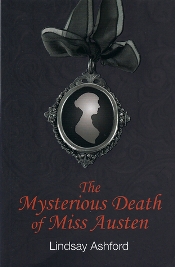
A spotlight on Lindsay Ashford's The Mysterious Death of Miss Austen

Honno ed., 2011
I bought a copy of Lindsay Ashford's The Mysterious Death of Miss Austen last year, based on the description in the online catalog of its publisher, Honno, an independent press featuring Welsh women's writing. After reading another novel of theirs in 2009, Margaret Redfern's Flint, I knew their editors had discerning tastes.

I didn't know at the time, though, that its author, a popular British mystery novelist with an academic background in criminology, had been interviewed by the Daily Mail and the Guardian about her controversial revelations or that her novel had been picked up by Sourcebooks for publication in the US.  (Although the latter should surprise no one.  Sourcebooks has cornered the market on Austen-themed fiction, and this was a smart purchase.)

Behind its dark yet unassuming cover lies an absorbing and disturbing recounting of events from the life of one of England's most beloved authors. Following extensive research, Ashford has run a poisoned comb through the dynamics of the large and close-knit Austen family and come up with a provocative notion that nonetheless—I can't help but admit—lies within the realm of possibility.  Did Jane Austen die from unnatural causes?  If so, how did this come about?  Was she murdered, and by whom?

The mystery hinges on two sources.  In one of Jane's letters, written just before she died at the young age of 41 in 1817, she described her looks as "black and white and every wrong colour."  Also, some years later, after forensic techniques had sufficiently developed, a lock of Austen's hair tested positive for arsenic.

Ashford's novel offers her interpretation of these facts and others, all taken from Jane's daily life and known activities and those of her relatives and friends.  The "detective" (a term used loosely, as the book doesn't read like typical crime fiction) is Anne Sharp, governess to the children of Jane's wealthy brother Edward Knight.  Anne, a bluestocking with no marriage prospects, sees Jane as a kindred spirit and conceives an unrequited love for her—a curious assumption the author makes.  Many of the other undercurrents swirling throughout the novel, however, actually existed.  Anne's keen observations of Jane's other relationships allow her insight into what may have been the cause of her dear friend's death.

Sourcebooks ed., August 2013
Saying more would be revealing too much of a tale that readers would be best off discovering on their own. I feel uneasy about the depiction of some historical characters, and whether or not I bought into the solution, I found it a fascinating read.  The settings are delightful and deftly rendered, as readers follow Anne from the Knights' isolated country house at Godmersham Park in Kent to Bath's famous Pump Room, where she overhears some startling conversations, to her new employer's home in Yorkshire.  

Although I'm far from an expert on Austen or her novels, I visited the Jane Austen Centre in Bath last year, learned more about her family history, and saw all of the exhibits and related memorabilia.  It had the effect of piquing my interest in her life.  Halfway through reading this book, while doing some online research, I also learned that Anne Sharp was a historical character, one of the few individuals to whom Austen had sent a presentation copy of Emma.  That knowledge added even more to my reading experience.

If you're at all interested in Jane Austen's writing, life story, and the places and people that surrounded and influenced her, give this insidiously compelling book a try and draw your own conclusions.

The Mysterious Death of Miss Austen was published in 2011 by Honno Press (£8.99, trade pb, 331pp). This August, Sourcebooks will publish The Mysterious Death of Miss Jane Austen in the US and Canada ($14.99 US / $16.95 Can, trade pb, 432pp; note the slight change to the title).

Friday, March 15, 2013

Guest post from Elan Barnehama, author of Finding Bluefield: Embracing Change

With Elan Barnehama's guest post for today, we move much closer to recent times: the colorful and turbulent 1960s, as experienced by a lesbian couple.  If you believe history only encompasses events from the distant and untouchable past, or focuses mainly on well-known names, read this essay and think again.  Many of the sentiments he expresses below resonated with me, and I hope you'll enjoy reading his post also.

~

Embracing Change
Elan Barnehama

My debut novel, Finding Bluefield, chronicles the lives of two women who, by seeking love and family, found themselves navigating unknown territory during a time when relationships like theirs were mostly hidden and often dangerous. It is a multi-generational family saga spanning the years 1960-1983 and set against a background of segregation, Martin Luther King’s March on Washington, the JFK election, Woodstock, the South, the Moon Landing, and the Sanctuary Movement.

The 1960s were loud, idealistic, and divisive with a lot of good music and free love. Outrageous was the norm for a counter-culture that approached activism as theater and turned personal statements into political manifestos. As the nation shook off the sleepy '50s, it found JFK in the White House inspiring hope and symbolizing a generational shift in power. But then there were all those assassinations, the Vietnam War, our cities on fire, and a turbulent civil rights movement. It didn’t take long for the US to find itself in one serious identity crisis. And that was where I wanted my characters to begin.

I’m interested in what happens below the surface, away from the spotlight, inside the crowds. Great events are as much about the leaders as they are about the participants. Individual stories contribute to the moment and add up to a movement. We all collaborate to create history. It’s a team sport.

Finding Bluefield is located within arm’s length of some of great moments. As the nation searched to find its footing, Nicky and Barbara were finding theirs. Kennedy’s victory, which included winning Nicky’s home state of Virginia, inspired her to act. She already had courage. The election victory gave her hope. She thought it gave her cover.

Later, Nicky attended the Martin Luther King March on Washington—where Dr. King shared his dreams with the world—because she wanted to see history. The DC Mall and huge crowd provided a venue and an opportunity for Nicky to anonymously sleep with a man in order to have a child in this pre-sperm donor, pre-in vitro fertilization world. But the scene’s main purpose was to highlight that Nicky’s rights as a lesbian were not on the agenda. The march was not for her. It did not have her back.

After Paul was born, Nicky and Barbara planned to raise him in the Bluefield home that bore Nicky’s family name for two hundred years. But, once word spread that Nicky was a lesbian, it turned out that two hundred years was not nearly long enough for Nicky to maintain her local status, her insider membership. Sure, change was going to come, but Nicky’s dream for her child turned out to be premature.

While working on the first draft of Finding Bluefield, I remembered reading a number of articles citing cases where courts used existing laws to justify removing children from gay and lesbian parents. In some cases in the 1950s and '60s, courts gave custody of children to fathers in divorces where the mother was "rumored" or confirmed to be a lesbian, in stark contrast to the almost universal approach, at the time, of granting custody to mothers.

Change, it turns out, is slow and messy. It often stumbles. And there are always casualties. Sometimes the casualties are caused by friendly fire. Many people grew frustrated with the pace of change in the '60s and became disillusioned. Others simply burnt out. I wanted to create characters that avoided the “loud and proud” megaphone, in-your-face lifestyle that was so much a part of the time but were in it for the long term.

author Elan Barnehama
Nicky and Barbara never apologized for who they were, and they never pretended to be straight. They didn’t go to elaborate lengths to cover up who they were. Their focus was to create a life together and have a family. They kept their lives to themselves and shared it only with the people they cared about. They were trying to get from one moment to the next safely, with grace, integrity, and love. By doing that, they became the role models they lacked. When their lives became other people’s business—like Carol Ann, Nicky’s sister—they were at risk.

Blending stories into the study and contemplation of the past has the potential to turn history into the active experience that it is. And since fiction must be believable, what the characters did, how they acted, what they thought, the decisions they made, all had to have been possible. The reader has to think it could have happened that way.

Everyone enters the world in the middle of great events—not all of them good. We can choose to embrace our lives or whine loudly about our circumstances. Or we can muster the courage to imagine a different life, a life that has yet to exist.

~

Elan Barnehama grew up in NYC, where he developed a taste for pizza and learned to recognize a joke. He's been a high school baseball coach, a radio news announcer, and a cook. He earned an MFA from UMass Amherst, and his commentaries and essays have appeared on public radio, the web, and in newspapers. He spends his days teaching college and the rest of his time writing, because between getting up in the morning and going to bed at night, it's what he wants to do. Elan lives in Northampton, MA.

Elan Barnehama's Finding Bluefield was published by Bold Strokes Books, a press focusing on LGBTQ literature, in September 2012 ($16.95, trade pb, 224pp).   Find out more at the author's website, elanbarnehama.com.

Tuesday, March 12, 2013

Ursule Molinaro's The New Moon with the Old Moon in Her Arms, a feminist novella of ancient Greece

At an initial glance, Ursule Molinaro's feminist novella appears to be a curious amalgam of ancient Greek tragedy and scholarly discourse.  The story is told with unorthodox punctuation and a self-aware modern voice, and it uses few historical fiction tropes. Readers won't find lengthy descriptions of fashion, hairstyles, or evocative foreign landscapes in this slim volume.

The New Moon With the Old Moon in Her Arms isn't a traditional historical novel and shouldn't be judged by those standards.  (The wonderful title, taken from the Scots ballad "Sir Patrick Spens," is just one example of the anachronistic borrowings Molinaro freely uses to make her points.)

But even within a plot nearly whittled down to its thematic essence, the author presents an absorbing and character-centered story that proceeds in an easy-to-follow, chronological fashion.  The style is nowhere near as complicated as it looks.

The narrator, an unnamed poetess in Athens of 293 BC, is living through the last month before her execution. As a form of protest against the patriarchal culture, the moon goddess Circe had persuaded her to put herself forward as a Thargelia volunteer: half of a couple who will be stoned to death on the next Expulsion Day, taking the city's sins with her when she dies.  Thargelia was a religious festival of ancient Greece, held in late spring; the author's research is sound in this and other instances.

Unlike past sacrificial victims, who were deformed or crippled—as was historically the case—the poetess is whole, shapely, and attractive.  On the downside, she's a 30-year-old unmarried virgin whose writing has gone unnoticed, and who lived with her parents until recently.  Those of an academic bent will empathize. It seems jobs in the humanities have always been hard to come by.

Living alone in secluded municipal quarters with an attendant to serve her every need, she doubts the wisdom of her choice with every new day that passes, but Circe is always there in the back of her mind with promises of laurel leaves, which will dull the pain at the end, as well as convincing arguments.  

"If we succeed I might be read: the moon goddess tries to bribe me back into submission.
 I'm not sure a posthumous audience is worth dying for: I say out loud into the quiet room."

If that's not enough for her to muddle through, an adolescent girl presents her with a moral dilemma, and a possible (if temporary) reprieve from her fate.  The poetess also tumbles into a lusty affair with a man who makes her feel desirable.  For the first time in her life, she has something to live for.

The narrator's decisions generate a fair bit of suspense (Will she take the escape route(s) offered?  And if she does, will she be caught?).  Interspersed with her musings, she (or Molinaro) adds informative historical digressions on linked topics: the months of the Greek calendar, the legend of Circe, the medicinal properties of stones, and interpretations of Homer's poetry—including ten excellent reasons Odysseus is overrated as a heroic figure. Those alone are worth the price of admission.

In the most prominent strand of knowledge braided into the story, Molinaro (or the narrator) provides many examples of how feminine power was deliberately subverted by men through the ages. She offers many points for discussion, and for this reason, one could easily imagine The New Moon as assigned reading in a women's history class.

This sharply intelligent, witty book shouldn't be restricted to this audience, though.  It demonstrates that experimental fiction can be approachable and smoothly readable, even for historical fiction fans who wouldn't normally consider it. Anyone interested in ancient Greek history should give it a try.

~

The New Moon With the Old Moon in Her Arms (subtitled "A true story assembled through scholarly hearsay") was published by the independent literary press McPherson & Co. in 1993 in trade paperback (119pp, $10.00).