Showing posts with label interviews. Show all posts

Monday, May 11, 2026

A conversation with Terri Lewis about her new historical novella, When They Came Home

Based on her grandparents, Edith and Milton Fieth, Terri Lewis’s When They Came Home is a moving portrait of a Midwestern couple's marriage in the aftermath of WWI. The story spans decades in its evocation of their lives in the first half of the 20th century. It intertwines multiple tales of survival and endurance: the psychological wounds that Milton suffers while fighting in France during WWI and their long-lasting aftereffects; Edith’s strength as she heroically raises their daughters essentially alone amid diminishing finances; and their steadfast devotion to one another over the course of many trying years. Winner of the 2025 Novella Prize from Miami University Press, the story is rich in character and atmospheric detail. My thanks to Terri for responding to my questions for this piece.


When They Came Home cover
Pub. by Miami University Press, May 2026


What new facets did you uncover about your main characters, Edith and Milton, as you began writing about them and transforming their lives into fiction?

I knew Edith and Milton simply as grandparents. She baked cookies, gave hugs freely, kept a drawer full of comic books for our visits, and told stories of her childhood on a farm. My quiet grandfather had a sweet tooth, drank a lot of coffee, and took me downtown in Denver to see the Christmas lights, or “downtown” to the post office and the drugstore for a soda in tiny Enterprise, Kansas, where they lived.

My perceptions of them changed when Mother gave me a candy box stuffed with documents, letters, black-and-white photos, and a single postcard attesting to their early lives. Lives completely unknown to me. My timid grandfather a WWI soldier in the French trenches? My quiet grandmother suing the government? Both strangers. I wrote and read and pondered until I could reconcile the split images, creating Milton and Edith on the page, new, but bolstered by the Milton and Edith I knew.

Were there any family records or mementos that you drew on to shape the story?

The documents in the candy box were germane in giving structure to the story. I had dates, locations, dollar amounts, plus two handwritten clarifications of events, one from Edith and one from Milton. For day-to-day information, I interviewed my mother and aunt and heard stories about the chicken farm and the remote country store. My interest and questions seemed to drive objects from cubby holes and drawers. It was amazing to hold them, to think about what they meant to my grandparents and then to write them into the novel.

Sample objects that appear: A silk souvenir handkerchief brought back from France by Milton for a sweetheart (not Edith). A whole chapter was built around a reed-rimmed tray with a note on the back: Milton made it while in hospital. Another chapter’s underlying emotion emerged from a sorrowful birthday photo. The most astonishing object was “the fork the stopped the bullet.”

Fork and sheath photo

When Mother told me about it, I laughed. Unbelievable! Then I was handed a leather sheath with a bullet hole and inside, the mangled fork marked MF for Milton Fieth. Tactile, amazing, but still unbelievable. I mentioned it briefly, not wanting readers to question the story.

Pictures of these artifacts and others are available on my website, terrilewis1.com.

Many of the characters’ dynamics are colored by secrets and silences, which is very reflective of the era: the painful parts of their lives that people feel they shouldn’t share. Milton is discouraged from talking about his wartime trauma, especially with his wife. And Edith conceals her own feelings to protect her children and to hide her shame at her family’s circumstances. Did this reticence affect your research or writing in any way?

I hadn’t considered that, but now I would agree for several reasons.

First, the story had been kept a secret, with good intentions: the grandchildren might be frightened of Milton if they knew his past. Silence became a way for the adults to achieve an untraumatized family. Once the grandkids were grown, the secret could do little harm.

Second, the ghosts of Milton’s dead friends appeared as a way to express his feelings, his horror, which he had been trained to push down.

Third, the documents themselves were reticent, official and bureaucratic, hiding dire events under formal language: A pension denied. AWOL declared. The effect on Milton and Edith’s lives completely ignored.

And finally, I believe that reticence became the voice of the novel, circumspect and quiet, even in devastation. Grounded in what I, as a child, felt in my grandmother. And how I thought the family would like the story told. Simply, with love.

I felt immersed in Midwestern small-town and farm life while reading. There’s so much detail that feels nostalgic yet also timeless (corn pudding, meatloaf, peach pie… all common dishes at a Midwestern country table even now). Did you have the chance to travel back to the area during the research or writing process?

Yes, I was lucky. My job at the EPA in Washington, DC sent me to two weeks training in Kansas City, meaning a free weekend.

On Saturday I drove to the Kansas Historical Society in Topeka, registered as a researcher, and spent the afternoon reading and looking through pictures, making snapshots of those that were germane, soaking up an earlier way of life. It was there I first saw the steam thresher belching smoke that came to play an important part in the story.


Milton and Edith photo
Milton and Edith


On Sunday I drove to Enterprise to a service in my grandmother’s beloved church. The minister asked if there were any guests and I introduced myself and mentioned Edith. Afterward, several people came to me with memories, including one older gentleman who had mowed her lawn.

Into this research, I folded my visits when I was a kid. Sitting on front porches while adults drank iced tea. Names of my grandmother’s friends, names which had appeared on pictures and documents at the Historical Society. The pickled peaches (which morphed somehow into watermelon), the little record player, the house with its cackling sink, tornadoes, and the old-fashioned washer on the back porch.

I wanted to write close to the story, to be inside what the characters saw and felt. Research and imagination were helpful, but my personal knowledge was invaluable.

When They Came Home spans decades yet feels just the right length for its content. What drew you to the novella format, and aside from the time involved (if that was the case), how did the process differ from writing a full-length novel?

This made me laugh. I had planned to write a dual time-line novel of the grandparents’ story and a grown granddaughter looking back. My aim was to show the heroism of those who live through trauma and who avoid transmitting it to the next generation. The granddaughter wasn’t to be me, so I sent her to California, gave her many siblings, added a death, a will, and struggled. The modern story never came to life; I think I was too close.

Then I saw the post about the Miami University Press Novella Award, and decided to submit the grandparents’ section. I pulled it free, worked right up to the deadline, wrote a hail-Mary ending, and sent it off. No chance to win. Then months later, acceptance! With a caveat: fix the ending. I was overjoyed. Not often do you get a chance to make things right!

That's great how things worked out!

Both of your published books have been historical fiction, though set centuries apart. Do you have an affinity for this genre, or was it more that the genre fit the tales you wanted to tell?

I’ve always been a lover of history, not the wars or kings or popes, but the lives of ordinary people. Medieval history particularly pulled me in after a wonderful college class, but I read widely. In both books it was a matter of a subject popping out, something I couldn’t let go (a normal writer’s experience I think). Also, I’m a fan of resurrecting women’s voices. Isabelle, the main character in my debut novel and King John’s second wife, was a queen of England and I’d never heard mentioned in any history class. Or consider, when a soldier breaks down, focus tends to be on him (or her); the heroism of wives like Edith is largely ignored.

Oddly, I seem to be moving forward in time in my novels: 1200 to 1918 to 1972 for my third book, Bodies in Arabesque, coming in March 2027. And it seems I’m staying the course; my fourth book will be almost contemporary.

I was fascinated to read about your previous career as a ballet dancer – both forms of expressive art, but a very different type of performance and audience. How did you transition from one focus to another?

I always intended to both write and dance. Since the body can only dance for a few years, I put off the writing until I retired. But then I discovered despite producing reams of letters, poetry, and some stories while I was dancing—exhaustion from rehearsals and performance make sitting a favorite activity—I had no idea of how to write for publication. To support myself, I took a career swerve into IT and began studying. Workshops, crit groups, conferences.

I had two advantages from my dancing career. I could block out peripheral movement and sound and work anywhere, and I knew how to take and use correction. What I didn’t now was how to make a plot. I wrote my first novel in bed at night. When I finished, astonishment that I’d done it and fear I couldn’t replicate the feat, led me to try another. Then I lucked into a workshop at Bethesda Writers Center where Barbara Esstman wrote on my submission that I had the skill to write a publishable novel, but “something had to happen.” That sentence saw me through a long slog. There’s a saying: it takes ten years to master any art form; as a former dancer and now a writer, I can attest to that.

~

Author bio:

Terri Lewis’s new novel is When They Came Home, a lyrical telling of hardship and love and winner of the Miami University Press Novella Award. Her debut was Behold the Bird in Flight, a Novel of an Abducted Queen, was named a favorite of 2025 by the Washington Independent Review of Books. She lives in Denver.

Socials:


Website: https://terrilewis1.com | Contains images of artifacts that inspired the book
Author Facebook: https://www.facebook.com/TerriLewisAuthor
Personal Facebook: https://www.facebook.com/terri.lewis1
Substack: terrilewis1.substack.com “Words that Dance”
Instagram: @terri.lewis1 | www.instagram.com/terri.lewis1

Monday, April 27, 2026

Interview with historical novelist Elisabeth Storrs about her latest book, Fables & Lies

With her new novel, Elisabeth Storrs moves from her familiar ground of long-ago Rome and Etruria, setting for her Tales of Ancient Rome trilogy, to WWII Germany—and her enthusiasm for the archaeology of the ancient world is carried forward here. Fables & Lies (The Book Guild, Apr. 28, 2026) centers on a woman from an ordinary German family, Freyja Bremer, who takes part in efforts to save invaluable museum artifacts housed in Berlin: a plotline based on a true story. Even more gripping is the deep dive into Freyja’s viewpoint as she gradually penetrates the fog of propaganda instilled into Germans for years by the cruel Nazi regime and awakens to a new and courageous purpose, one that involves considerable risk.

Emotionally involving and morally complex, Fables & Lies doesn’t hold back on its realistic view of the period, including Freyja’s family members’ individual stances toward the Nazis. It also demonstrates how deeply the regime infiltrated the archaeological field in an attempt to distort the historical record toward their racial ideology. I haven’t read another WWII novel like it. My thanks to Elisabeth for answering my questions in such depth!

~

What inspired you to write about the ancient artifacts known as Priam’s Treasure, specifically during the WWII years?

I am a great lover of the ancient world. In my reading, I came across the story of the archaeologist, Heinrich Schliemann, who not only proved Troy existed but also discovered a fabulous cache of gold there known as Priam’s Treasure.

Sophia Schliemann, wife of Heinrich Schliemann, wearing “Helen’s jewels”


During WW2, the treasure was kept in the Pre and Early History Museum situated next door to Gestapo Headquarters and SS House in Berlin. I was intrigued with the journey of this priceless trove which was smuggled out of Turkey then “bequeathed” to the German people by Schliemann. Now it is held by the Pushkin Museum in Moscow. Its ownership remains hotly debated by all three countries.

When researching the Trojan gold, I discovered the little-known story of German museum curators who protected their nation’s (and the world’s) treasures from constant aerial bombardment. As such, I wanted to tell their tale, which contrasts with the Nazis plundering both private and public collections across Europe.

Priam’s Treasure, in the Pushkin Museum


There are many WWII novels out there, yet I haven’t read a story like this one, one that spans from the beginning of WWII to the fall of Berlin, seen from the viewpoint of a German woman. Can you reveal more about your writing process: how you worked to create this intimately detailed storyline across the length of the war?

The book is very much about the experience of ‘ordinary’ Berliners rather than battles and acts of great heroism. Instead, I show courage can be found in the smallest acts of defiance. My protagonist, Freyja Bremer, is a museum assistant who works for Direktor Wilhelm Unverzagt. However, Unverzagt is also a Nazi who joins Himmler’s SS Ahnenerbe Ancestral Heritage Research Institute to protect himself and his museum. As such, the novel has two major plotlines: the mission of the German museum curators; and the work of the more fanatical SS Ahnenerbe scholars to promulgate the “Aryan Myth” and conduct racial studies to justify conquest, dispossession and murder. 

Sustaining a narrative spanning nearly six years was difficult but necessary if I was to convincingly combine the two plots. The spine of the novel follows Freyja’s love affair with Darien Lessing, an archaeologist who shows her the rot beneath the Regime’s lies as they strive to protect the museum’s collections. Intertwined is Freyja’s forced marriage to Kaspar Voigt, one of the Ahnenerbe’s racial studies scholars, and her quest to discover what her husband’s research entails.

To structure the novel, I identified various highpoints in the history of the safekeeping work and the Ahnenerbe’s activities to act as anchors in the narrative. I then placed these against major events in Berlin such as the RAF’s saturation bombing, American daylight raids, and the Soviet advance on the city and its collapse. The broader events of the war stay in the background with news of key invasions filtering through via rumors or Goebbels' propaganda.

When we first meet Freyja, she’s 21, working in Berlin’s Pre and Early History Museum in 1939, and she’s been inculcated in Nazi propaganda, including the pseudoscience related to Aryan race myths. It’s clear, though, that she has her own mind, and her conversations with Darien have her questioning so many things she’s been taught. How do you strike a balance between creating a sympathetic character and giving her a realistic perspective for a young woman living in this place and time?

Good question! It was a huge challenge to write the book from the perspective of a “child of the Reich” who goes on a journey to enlightenment. Hitler understood the importance of indoctrinating children. The education system was immediately attacked in 1933 with only Nazi teachers employed. The curriculum was limited, with physical fitness a priority. Girls were destined to be wives and mothers, boys to be soldiers. Between the age of 10-18, boys and girls were also required to attend programs run by the Hitler Youth or the League of German Maidens. Nazis worked hard to alienate children from parents who may have harbored anti-fascist sentiment, actively encouraging them to inform on them.

There was a seductive element to teaching children they were superior due to the “Aryan Myth” which asserted they were part of the “Master Race” who were “bearers of culture” compared to “sub-humans” who “destroyed culture,” i.e., Romani, Slavs, People of Colour and, most particularly, Jews.

Knowing this, I could not ignore Freyja’s indoctrination as many novels do when depicting “good” German protagonists. However, there are ameliorating factors in Freyja’s life that allows her to listen to the heretical views of an outsider like Darien Lessing. At 21, she represents a cohort that was exposed to liberal education before falling under the domination of Nazi dogma in their impressionable teens. Freyja also has the benefit of living with her father who acts as a moral compass due to his Christian beliefs. She shows integrity in remaining silent about her father’s resistance activities, and subsequently allows herself to be trapped in marriage to an SS scholar in order to protect him. In doing so, I hopefully show early on Freyja is innately caring and unwilling to betray those whom she loves.

Nevertheless, to reveal the operations of the SS Ahnenerbe, I was faced with the ethical dilemma of first marrying the brainwashed Freyja to the ethnologist, Kaspar Voigt, who sees her as the ideal Aryan wife. I saw it as the only credible plot device to reveal his despicable actions. It was disturbing to write the earlier scenes where Freyja is enthralled by Kaspar, who is a famous explorer when they first meet. I knew I was spouting dangerous rhetoric but, in doing so, I also reveal how persuasive esoteric Nazi beliefs were to those cocooned within its realm. As Primo Levi said: ‘When understanding is impossible, knowing is necessary.’


When I first encountered him in the novel, I hadn’t realized Wilhelm Unverzagt, director of the museum where Freyja works, was a historical figure. He certainly left a divided and controversial legacy, as is initially hinted when he advises Darien to move his academic focus to “a Germanic perspective of prehistory” for better career opportunities. You’ve brought considerable complexity to his portrayal. How did you develop your interpretation of him?

The novel is based, in part, on Wilhelm Unverzagt’s story but is a fictional account. I struggled greatly in understanding his true nature. Was he a true believer or simply a pragmatic opportunist who was prepared to make a deal with the devil? He certainly showed extraordinary courage when protecting Priam’s Treasure, ultimately defying a Hitler Order. I read many German journal articles about his life to glean insight into his character. And I was lucky enough to gain access to his day journals from 1944-46, together with some personal correspondence and a detailed account written by his wife post war. 

Unverzagt was an example of one of the many classical historians “Römlinge” who made a Faustian Bargain to advance their careers by switching their focus to German prehistory. Wounded in WWI, he was clearly embittered by Germany ceding Polish territory. In the early 1930s, he was persecuted by an academic rival who leveled accusations that Unverzagt was part Jewish, resulting in the loss of his professorship. This, in turn, led to his oversight of his museum being threatened. In response, he sought the protection of the SS Ahnenerbe and the patronage of both Himmler and Göring. 

Unverzagt was in no way involved in the more heinous activities of the Ahnenerbe’s racial studies program. However, despite his considerable international reputation, he was prepared to twist history to serve power. In the end, I concluded he was a charismatic chameleon who managed to succeed under whichever regime he lived. He died lauded for his work reconstituting the Pre and Early History Museum in East Berlin which included exhibits looted and then returned by Russia – but, alas, not Priam’s Treasure.

I hadn’t been familiar beforehand with the astonishing history of Berlin’s Jewish Hospital, and the heroism of both halves of interfaith couples during the war. How did you decide to include these details within the novel?

The Jewish Hospital certainly was a hidden gem which I chanced upon in researching the history of Berlin’s Jews. There was a brief mention in one text about Jewish doctors working there who were married to Gentile “Aryan” women thereby giving them “privileged” status which provided a limited degree of protection. The hospital became the only place that provided medical treatment to Jews, perversely healing them before sending them to the camps. Ultimately, it became the last transit camp in Berlin and then a refuge in the final Soviet assault. Finding reference to the hospital was a moment of serendipity as it provided the inspiration for a sub-plot exploring the persecution of “mixed race” couples. The hospital doctors faced terrible ethical choices under threat of deportation. And the pressure placed on their Gentile wives to divorce them thereby condemning their husbands to certain death was sustained and cruel. To tell their stories I created the characters of Darien’s sister, Parisa, who is married to Dr Leon Epstein. Freyja’s encounter with the couple opens her eyes to the true plight of the Jews and leads her to resistance.

What were some useful or especially interesting discoveries you made during your research in Germany?

“Walking the ground” upon which an historical novel is set is invaluable. I retained an expert guide who escorted me on an extensive personalised walking tour of Berlin over two days. This included the eerie experience of donning a hardhat and head torch to enter the pitch-black interior of the ruins of the Humboldthain Flak Tower, the only remaining example of three such “Flakturm” built during the war. These fortresses boasted three-meter-thick concrete walls and housed thousands of people during air raids. They also had huge cannons on their rooves to bring down enemy aircraft. The exhibits from various museums were stored in the tower erected near the Zoo. The tour (run by a speleology society) certainly gave me a taste of what it would have been like to shelter in one of these goliaths as Freyja did during the Soviet siege.

author Elisabeth Storrs


As you shared in your author’s note, the manuscript that became Fables & Lies had a very long gestation period. What kept you going, and what continued leading you back to it?

Ask my husband and he’ll tell you I am very persistent! I love escaping into both research and my imagination. The genesis for Fables & Lies was a contemporary novel I finished in 1994 after becoming fascinated with Schliemann’s life. At that time mystery shrouded the disappearance of Priam’s Treasure after the Soviets insisted it was lost in transit in the chaotic aftermath of the war. Various theories were postulated as to its whereabouts or destruction – including my rather improbable plot of locating it in suburban Sydney. Imagine my dismay (and delight) when I read in the newspaper the Russians admitted they’d hidden the treasure for nearly 50 years. My mystery became redundant and the manuscript was relegated to the bottom drawer.

Over the next ten or so years, I became obsessed with the Etruscans, which led to writing the three books in the A Tale of Ancient Rome trilogy. When those novels were finished, I was drawn yet again to Priam’s Treasure. How had it come to be in the Pushkin Museum? Why had the Russians lied about possessing it? I dusted off the manuscript to rewrite it as an historical novel covering the true story of the Trojan gold during WW2.

Researching a novel 30 years ago was a vastly different experience than now. Previously, I’d been limited to books in my local library. Now I had access via the internet to numerous German sources. Historians included the Axis viewpoint rather than presenting the war purely from the Western Allies’ perspective. I planned a simple plot featuring two female protagonists – a German woman (Freyja) striving to protect the treasure, and a Soviet Trophy Brigade Major whose mission was to steal it. However, when I learned about the SS Ahnenerbe, I was drawn to tell a more complex story exploring Himmler’s Master Plan. But I’m currently writing The Pinocchio Door which will finally reveal the Soviet side of the tale!

~

Elisabeth Storrs has a great love for history and myths. She is the award-winning author of A Tale of Ancient Rome trilogy which was endorsed by Ursula Le Guin, Kate Quinn and Ben Kane. Now her obsession lies with Trojan treasure and twisted Germanic prehistory in her new release, Fables & Lies: A World War II Novel. Elisabeth is also the founder of the Historical Novel Society Australasia and the $155,000 ARA Historical Novel Prize. She lives in Sydney with her husband in a house surrounded by jacarandas.

Connect with Elisabeth through her website or Triclinium blog. You can find her on Facebook, Instagram, Goodreads, Amazon, Pinterest, LinkedIn, and Bookbub. Subscribe to her newsletter for monthly inspirational interviews.


Monday, November 03, 2025

Interview with Susan Coventry, author of the biographical novel Till Taught By Pain

Within historical fiction, Susan Coventry's Till Taught By Pain offers something unique: the little-known story of an accomplished and historically important American surgeon, the talented nurse he married, and how their relationship was affected by his hidden cocaine addiction. William Stewart Halsted, a native New Yorker born in 1852, was a founding professor at John Hopkins Hospital.  His wife Caroline Hampton, niece of a Confederate general, broke away from images of traditional Southern womanhood by training as a nurse up north.

Seen through the viewpoints of both husband and wife, this biographical novel is a fascinating story of their individual struggles and their partnership, all informed by the author's firsthand knowledge of medicine (she's a retired physician) and primary source research into her characters and the era. I read it avidly from start to finish. I was glad to have the opportunity to ask Susan some questions about her work.  Hope you'll enjoy reading this interview!

~

Dr. William Stewart Halsted is no longer a household name, although Till Taught by Pain makes a convincing case that he should be. What had you learned about Halsted in med school, and what spurred you to look into his personal life in more depth?

We were taught very little history of medicine in medical school, so I’d never even heard his name until my pathology residency. While I was learning about breast cancer, someone made a passing reference to the Halsted method of radical mastectomy, mainly to point out that it had been discredited. It was a drastic and mutilating surgery, and I was given the impression that it was something of a crime committed against women way back in the past. But it’s really more nuanced than that. It was one step along a very long and ongoing path to treating cancer.

My interest in Halsted was sparked while reading a dual biography of Freud and Halsted, who both became addicted to cocaine while experimenting with the drug for medical purposes. (I’d initially picked up the book because I was curious about Freud’s addiction.) There is an anecdote in the book about how Halsted “invented” rubber gloves for his OR nurse (Caroline) who suffered a terrible dermatitis from the chemicals used for hand washing before surgery. It’s presented as a prelude to their courtship. That’s what grabbed my attention. The more I looked into this “Gloves of Love” story, the more complicated and fascinating both he and she became.


Pub. by Regal House (Nov. 4, 2025)


Halsted and Caroline come from very different backgrounds. I appreciated all the detail about their families, and how their upbringings added layers of interest and also complications to their partnership, considering they married just 25 years after the Civil War ended. Had you been interested in writing about late 19th-century America before conceptualizing this book?

It was more the other way around. I wasn’t specifically looking to write in this time and place, but Halsted’s story drew me into it. Their lifetimes spanned the Civil War through WWI, so there was a lot to digest. I had some built-in support from my husband, who is a historian focusing on the 19th century U.S., and my son, who is a high school history teacher, but writing in this time period taught me how little I knew about it. Fortunately, the research phase was fascinating, and I came out with way more interest in and knowledge of turn-of-the-20th century U.S. history than I had going in.

How did you choose the viewpoints, telling Halsted’s story in third person and Caroline’s in first?


I initially wrote the book from two third-person viewpoints. I’m much more comfortable writing in third person. But Caroline’s story was overwhelmed by Halsted’s, and she seemed to fade into the background. My wonderful developmental editor suggested switching to first person for both, but I couldn’t put myself convincingly in the head of a man in the throes of addiction and withdrawal. I needed him in third person. However, I found that writing Caroline’s viewpoint in the first person pulled her forward and brought her out of Halsted’s shadow.

The novel explores the notion of complicity and secrecy when it comes to addiction, and how Caroline – and Halsted’s close associates, too – acted to hide his drug dependence. Do you feel Caroline hasn’t been given sufficient credit in terms of ensuring her husband’s successful career? How complex was it to research a topic that was kept quiet during Halsted’s lifetime?

I definitely feel Caroline hasn’t been given enough credit! There isn’t much of substance about her in the historical record, but she was accounted to be a smart woman, able to hold her own with her brilliant husband. One problem I had researching her is that she is seen largely through the eyes of a few of his colleagues who considered her odd and anti-social, and that characterization has been carried forward as fact.

I don’t see how Halsted could have reached such heights and kept his addiction secret without Caroline’s support. Of course, that begs the question: should she have enabled his drug abuse? He was an impaired physician. Even she (in my fictional account) questions this.

It is complicated to research something that is currently accepted as true but that wasn’t common knowledge at the time of the story’s setting. Given how closely guarded a secret his addiction was, I do wonder how many people knew or suspected. It was fascinating to see how the secret was covered up and then uncovered over time. In letters exchanged by his colleagues, there are sometimes tantalizing hints, but no one comes out and names the problem. In a biography written shortly after his death, it is acknowledged that he had some trouble with cocaine early in his career, but it’s emphasized that he had completely recovered by the time he moved to Baltimore. Then as now, there is stigma attached to addiction so I imagine friends and colleagues who suspected it tried hard not to believe it. The question remains: Does this taint his legacy or make him more human, more complex?

author Susan Coventry

What are some favorite facts and stories you learned about from research into archival records?

My favorite finds in the archives are personal letters. Halsted is remembered as a reserved, private man with a biting wit. Yet in his letters, he is very polite and often playful. Perhaps even flirtatious. I have a letter that Harvey Cushing (another giant in the history of surgery) wrote to his fiancée, describing the aftermath of a carriage accident that injured Caroline, where he inserts a description of “the delicious coffee I’ve told you about and some bread and white unsalted butter. All very Halstedian.” To me, that comment demonstrated the admiration of a young mentee mixed with his amusement over his mentor’s quirks. I can “hear” him talking to his Katie, poking fun at the great surgeon. The young always feel slightly superior to their elders, don’t they?

Caroline’s letters were the most important to me, because they were revealing of her personality, and that was hard to get at otherwise. Very few of her letters are extant, unfortunately, and nothing touches on her husband’s addiction. But there are early letters to her aunt where she discusses her upcoming marriage that give a good glimpse into her state of mind. And my favorites are the rare surviving letters to Halsted, written when she was at their summer home in North Carolina while he was still back in Baltimore. She gives him day-to-day news. She gives him very explicit instructions on where to find the spaghetti she wants him to bring with him when he comes down. And in one, she adds a P.S., “Thank you for the candy. Don’t send anymore.” That really warmed my heart, to think of him sending her candy while they were apart, and her joking response that she shouldn’t be eating it. None of these anecdotal finds were earthshaking, but the big events of Halsted’s life, and Caroline’s, can be found in the biographies and histories of Johns Hopkins Hospital. For a historical novelist, the archives present a way to discover the personal side of the protagonists, and that helps to bring them to life.

You’ve written one YA novel about a 12th-century royal woman, a Regency romance series, and now literary biographical fiction set in the late 19th and early 20th centuries, which makes for a really interesting publishing journey! How did this come about – did your interests change over time, or was it more a matter of finding the right publishers for the subjects you wanted to write about? Do you have any suggestions for authors who want to explore a variety of styles and subjects in their historical fiction?

My interests changed over time.

Way, way back when I started writing, I was deeply into medieval history, particularly that of France and England. I didn’t intend to write a YA novel, but my kids were in their tweens/early teens at the time, so I was reading a lot of YA fiction with them, and that must have influenced the way I wrote.

In the years between the publication of The Queen’s Daughter (2010) and now, I wrote several other manuscripts that are now stuffed away in the drawer, but I came back to writing biographical fiction because I am especially drawn to novels that are firmly grounded in real people and events. At the same time, as a physician who’d been in the field a long time, I found myself more and more interested in the history of medicine. And when I came across Halsted and Caroline, I knew I wanted to write their story.

The romance series was something else entirely. I read romance to relax and escape. When the pandemic hit, I needed that escapism more than ever, so I decided to try writing romance as well as reading it. Counting on Love resulted. It was accepted by Dragonblade, and they publish series, not standalones, so I got to write three more novels to tell the love stories of each of the siblings. I suppose my suggestion for other authors who want to branch out and write in different styles or subgenres is to not chase trends but to write what you love to read. If you do want to take your writing in a different direction altogether, start by reading a lot in that genre or subgenre. And then, go for it!

~

Susan Coventry is a retired physician with a lifelong historical fiction obsession. Her first novel, The Queen’ s Daughter, was a YA historical set in the Middle Ages. She has since switched from YA to adult novels and moved on from medieval Europe to the turn-of- the-20th-century U.S. She lives in Louisville, KY with her historian husband, Brad Asher. Visit her website at https://susancoventry.com.

Wednesday, July 16, 2025

Interview with India Edghill about her new epic of 1870s India, A Tiger in the Garden

India Edghill’s latest novel A Tiger in the Garden is a sweeping epic set in the isolated Indian hills in the Victorian era. At its heart is the intricate battle of wills – and transforming relationship – between Lily Shawcross, a dark-haired English girl of just sixteen, and Sherdil, Rajah of the independent Indian state of Sherabagh.  Both become victims of the schemes of the same woman, Princess Lilavati of Sherabagh – who is Sherdil’s cousin and Lily’s old schoolfriend from England. Duped into taking Lilavati’s place as Sherdil’s would-be bride upon her arrival in Bombay, Lily is furious and wants to find a way back to her relatives in India.  For his part, Sherdil desperately needs Lily to continue the deception, since if any of the British discover an English girl was kidnapped into his hands, consequences would be severe both for him and for Sherabagh’s independence.

There are good reasons why others accept that Lily is really Lilavati; you'll have to read the book!

From a ride within a jeweled howdah atop an elephant to the luxurious zenana (secluded women’s quarters) of the Tiger Palace in Sherabagh, the novel is exquisitely detailed. Lily’s emotional maturity over the course of the story makes for a compelling journey, as does the slow-burning chemistry between her and Sherdil. As in her previous works of Biblical historical fiction, India Edghill brings to life the rivalries and friendships between women. Similar to M. M. Kaye's historical novels about India, this is a lengthy, involving read that lets you get to know the characters very well and vicariously spend time amid the novel's locale and culture.

When I’d interviewed India about Queenmaker: A Novel of King David’s Queen way back in 2001, she’d spoken about her novel-in-progress, A Tiger in the Garden, which I’m delighted to have had the chance to read in published form at last.  Thanks to the author for answering my interview questions.

It was over 20 years ago you’d told me you were working on A Tiger in the Garden, which you’d called “an epic novel of romance and adventure set in India in 1879.” I remember looking forward to reading it, back then, and was so happy to hear the news that the novel was done and about to be published! I’m always interested in learning how historical novels were conceptualized. What can you share about the origin story for this one?

The genesis for Tiger was actually very simple: I wanted to tell a “switched identities” story in which the main characters knew about the switch – yet it made no difference to how the action unfolded. It wound up taking me years of work and thousands of words to achieve what turned out to be quite a different story. (Similarly, Margaret Mitchell said of Gone With the Wind that she wanted to tell the story of a violent marriage – that of Scarlett and Rhett; it took her hundreds of pages to actually get to that story.)

It’s hard to believe that Tiger’s been in process for twenty years! Of course, much of that time was spent in research, and some of it on writing projects for St. Martin’s. And when I say “research,” I mean I fell deeply into the sheer joy of learning about people, places, and events I hadn’t known existed. When I started Tiger, the only way to acquire the books and articles I needed was by a combination of interlibrary loan and sheer luck. For instance, I happened upon a copy of General Roberts’ memoirs in a secondhand bookshop in Dublin, Ireland, which was pure luck. As time went on, new venues for acquiring research materials opened up, and I took full advantage of them. It was delightful to be able to find what I needed by typing in a title or author and clicking a search button! I admit I may have overdone it just a bit – my India library wound up being nearly 500 volumes.


Tiger in the Garden book cover
Talitho Press (2025)


So I have to confess I went overboard on research. But research is such fun! And India is a treasure-trove of amazing facts. I kept finding more and more interesting and sometimes just plain bizarre information. When I discovered there was a Hindu tribe in the Himalayas that actually ate beef, I admit I was flabbergasted. Discovering that white leopards existed was just plain delightful, and I promptly bestowed some upon my heroine.

Some research was more difficult than anticipated. On of the back-story characters is a freelance European adventurer in the early 1700s. For him, I needed information about 1690s Poland – which turned out to be amazingly hard to sift through. Thanks to the Internet and the kindness of strangers, I was able to find the information, but I was surprised at how difficult it was to discover.

As time went on, the story grew in all directions. Although it doesn’t necessarily make it into the novel, I wound up knowing all about even minor characters and incidents, including who the wound up eventually marrying. In one instance, that of the child Moti’s mother, who is just a walk-on, I realized she had brought her daughter north to escape the horrendous famine of 1876-78. This has nothing to do with the main story!

And as time went on, it grew harder and harder to let the story go; I loved all the characters so much! Eventually I had to force myself to declare it done and hand it over to my agent. But letting it go was a wrench. 

The décor within the zenana at Sherabagh is beyond sumptuous and decadent. I can imagine how much fun it was to imagine such a place into existence (at least in a fictional sense). What was this experience like? How did you recreate and design a plan for the Tiger Palace?

Oh, yes, that was great fun. I spent a lot of time immersed in books about India’s royal architecture, especially books with full-color illustrations. I modeled the Sherabagh palace and zenana on the older Indian palaces; places that grew and adapted over the course of centuries. The Sherabagh palace dates back a very long way; into the mists of semi-history, and was added to until it sprawled over a hillside and became a veritable labyrinth. Some portions of it are now deserted, and have become a habitation of various kinds of wildlife – as is seen in Lily’s war with the monkeys when she tries to tidy up the Old Palace.

Unlike (for example) Simla, which features in many historical novels, Sherabagh’s an independent state, and Sherdil naturally wants to avoid its being overtaken by the British. You get a good sense of the political climate in the novel, and the reader’s always aware of it in the background. How did you decide how much of the politics to weave into the story?

That was a tough one; the politics is vital to the story, but the story has to come first. And different characters view the politics of the time very differently. I tried to provide enough political information for the reader without overwhelming them with detail. And I tried to show how a historical incident can be seen through different eyes; Sherdil and his brother-in-law Kishore are both Indian rulers, but they view British politics and policies quite differently.

Lily is expecting to have a grand, exotic adventure when she comes to India, but she’s so young and sheltered that she has little experience with life and even less with men. How did her character develop during the writing process?

Originally Lily was your basic “I know everything about India” English character who was going to Learn A Lesson About Reality. But as time and writing went on, she developed into a more fully-rounded person, one who learns and grows, yes but who does that from a position of intelligence and good will. She changes from a well-meaning child to an adult woman, one who, as one reader put it, “releases the queen within.” I found it very hard to stop writing about her and release her into her happy future.

What made you decide to include shorter stories from earlier points in time (usually cross-cultural love stories) within the larger novel? Did you write them first, fit them in later, or some of both?

The “What’s Past is Prologue” stories were part of the novel from its inception. Each examines a relationship of both love and politics; some happily, others not. I wanted to explore how people could adjust and compromise to create a viable future for themselves; the stories echo that of Lily and Sherdil, the happiest story of adjustment and accommodation. I love all of the characters dearly – although I admit to being frustrated by Alice and Nataraj, who throw over everything for passionate love, but who are incapable of developing that into a true and enduring love.

You’ve mentioned that you’re a big M. M. Kaye fan. How does her work inspire you?

Oh, she’s marvelous! She was born in and lived for many years in India, a place she dearly loved, and that love radiates through her epic novels The Far Pavilions and Shadow of the Moon. Her descriptions are deeply evocative and her characters are deeply felt. I re-read her books often, and The Far Pavilions was my guiding star during the years I was writing A Tiger in the Garden.

And even better, while researching Kaye I met someone who s now a good friend of mine: Michael Kourtoulou, whose website www.mmkaye.com is a comprehensive survey of Kaye’s work. Thanks to Michael I was able to see The Far Pavilions musical in London in 2005, and he’s been a staunch supporter of Tiger.

What led you back to independent publishing with A Tiger in the Garden? Was your original indie publishing experience (with Queenmaker, before it was picked up by St. Martin’s) helpful at all with the process?

I do seem to have come full circle, don’t I? Well, first I handed Tiger over to my agent, and she loved it. But alas, editors, while personally liking the book, decided it was not a time period and setting (India 1878) that was marketable, and that it was way too long. (Oddly enough, “not a time period and setting that was marketable” is what was said about Queenmaker back in the 90s, which is why I wound up self-publishing it. Then The Red Tent hit big and suddenly Biblical women fiction was in demand and St. Martin’s bought it. Publishing is one crazy ride!)

My previous experience with indie publishing was so long ago that the entire playing field has changed. Now I was able to publish Tiger for free using Amazon’s publishing platform. While it cost me a month of struggling with formatting, it was basically pretty easy – and I was very pleased to be able to keep the cost down to $2.99 for the Kindle edition and $16.95 for the trade paperback.

And while I miss interacting with them on a daily basis, I’m glad to have Lily and Sherdil’s story out in the world at last.

~

Visit India Edghill's website to learn more about A Tiger in the Garden and her other historical novels.

Thursday, June 01, 2023

Interview with Stephanie Cowell about her new historical novel The Boy in the Rain (and giveaway)

Please help me welcome novelist Stephanie Cowell to the blog. Her newest novel, The Boy in the Rain, focuses on the enduring love affair between two young men in Edwardian-era Nottinghamshire and London: Robbie Stillman, an art student; and Anton Harrington, a banker who later achieves prominence as a socialist speaker. Because of the brutal legal punishment for homosexuality at the time, as well as the social opprobrium, the two must conceal their intimacy from the world.

I've known Stephanie for many years through the Historical Novel Society and am happy to see the novel she's worked on for so long appear in published form at last. It's out from Regal House today. 

I'm offering a giveaway at the end of the post since I wanted to give another historical fiction enthusiast the opportunity to read it. I'll be arranging for the novel to be sent directly from a bookseller to the winner's address (via either Amazon or Blackwell's, for non-US readers).

Thanks for Stephanie for doing a Q&A for my site!

How did the complex love story between Robbie and Anton capture you to such a degree, compel you to tell it, and get it out into the world?

The two men came to me in a sort of vision while walking down the outside wood steps of an old country house and haunted me from 1984 until I sold the novel a few years ago. I would put it away for four or five years at a time. I did not know if they came from some deep mystical place inside myself or had really lived in the past.

Reading the novel, and immersing myself in the viewpoints of Robbie and Anton, was such an intense experience. Their relationship, and how it changes over the years, feels so real and vibrant. How did you go about re-creating the worlds of gay men in Edwardian England?

The world they lived in came gradually in bits as I read many social history books of the times. It was the personalities of the two men which fascinated me and how, though their strengths and needs changed, they still felt their real home was with each other. When I was a young teenager, my mother told me about Oscar Wilde’s imprisonment for two years with hard labor, which he had to suffer for loving another man. It made her so angry. But I couldn’t put in much of the danger of the law against homosexuality in the novel at first, because I have always had a difficult time putting my characters in danger.

When I was writing my last big revision, Covid had arrived. I was alone in my apartment in NYC, the world epicenter of the epidemic for a time, hearing all the ambulances rush below my window. Those months, a real sense of danger came into the novel, the feeling that we didn’t know when we too would catch it. I wondered if it was anything like men’s fear of being dragged from their lives. Actually, Robbie likely didn’t have to hide much with his London artistic friends, but Anton had to be very cautious in his world. The boys’ brothel was based on something I had come across in my research.

George Langstaff, the country vicar who takes in and becomes a guiding force for Robbie, quickly became a favorite person of mine. How did his character come about?

I was raised without religion. At the time I began the early drafts of the novel (1984) I was drawn to the Church of England. At the same time, I was working on my novel Nicholas Cooke in which the main character becomes a priest. I joined an Anglican church in NYC. I think Mr. Langstaff’s character is much drawn from the father of a dear friend who was such a guide to me and who, with his wife, took me in to live when I was 18 and had to leave home. His passionate typing and heaps of books and way of walking and being went into creating George. He played the piano clumsily too. The vicar was also drawn from the small English rector in my own church.

Early 20th-century England was a time of huge political and social change. What drew you to this atmosphere for your setting?

The political and social worlds were not in the novel in the early drafts, though the book contained the story of how Anton had been forced by his father to separate from the penniless girl who was bearing his child. A friend who read the novel then said, “I think a guy like Anton would go up to Parliament to try to change laws to help the poor.” I began to revise that way.

I was also compelled by what I read about poverty in England at that time. I think the first book I read was by Jack London, who went to London and lived among the poor in disguise. It’s called People of the Abyss. It was the oddest thing when the Labour and Liberal parties were trying to get a bill passed to help the poor and aged in 1910, that the King, Edward VII, bullied the House of Lords into passing it. And of course, as a character points out in the novel, these high taxes on the wealthy meant that it would be harder to sustain the lives of the country house owners, such as the Crawleys of Downton Abbey. It was awful back then. Ploughmen would live on twelve shillings a week, and no one in their family had anything but bread and tea. And children of five or six would work in factories and mines twelve hours a day.

I enjoy how your historical novels delve into the lives of artists – painters like Robbie, authors, actors, musicians, and more – and the challenges they face in pursuing their craft. What do you hope readers take away from your work about the role of art in people’s lives, and in society?

I don’t think I ever wrote about anyone who was not an artist in some way! That was my world when I grew up. It was inconceivable to be anything but an artist, writer, dancer, actor. And of course, we all faced difficulties in making a living. Louise, Anton’s ex-wife who lives in a lovely London townhouse and knows people with money, helps Robbie to make a living painting portraits. There was a need for that then, following the footsteps of the great artist John Singer Sargent.

It is an oddity in the book that eventually Robbie is painting the wealthy to support Anton’s political campaign whose aim is to tax the wealthy! I guess I would like to show once again how precarious an artistic life can be. It was in my previous books showing how hard Mozart, Monet and Shakespeare struggled. When I was a single mother trying to make a living from music, we had trouble paying basic bills. The phone was shut off several times. Then I’d have to go down to the payment office to charm and distract them into turning it on again or give them a check that I “forgot” to sign!

In your author’s note, you talk about the lengthy writing process behind The Boy in the Rain and how you kept returning to the story in between publishing other novels. I was glad to have the opportunity to read it at last, and that you persevered! Did you have any favorite parts of the writing process, or key moments in the creation that you’d like to share?

I had to persevere because Anton and Robbie and their friends simply would not let me go. The novel kept almost being sold in earlier versions, and then editors would decide they wanted something easier to market, but its long gestation gave me a chance to develop the complex way the men related to each other. In some odd way they are both parts of me.

~

Stephanie Cowell has been an opera singer, balladeer, founder of Strawberry Opera and other arts venues, including a Renaissance festival and an outdoor arts series in NYC. She is the author of Nicholas Cooke, The Physician of London, The Players: A Novel of the Young Shakespeare, Marrying Mozart, and Claude & Camille: A Novel of Monet. Her work had been translated into nine languages and adapted into an opera. Stephanie is the recipient of an American Book Award.

6/10:  And the giveaway has ended.  Thanks to all who entered, and congrats to Pam! I'll be in touch via email.

Tuesday, September 27, 2022

Interview with Alana White, author of The Hearts of All On Fire, a mystery of 15th-century Florence

Today is publication day for my friend Alana White's The Hearts of All On Fire, an intricate historical mystery set amid the political turmoil and artistic achievements of 15th-century Florence.  It's officially the second in her series featuring lawyer Guid'Antonio Vespucci (a historical figure), but it works as a prequel to the first book (The Sign of the Weeping Virgin), and both books easily stand alone. This entry sees Guid'Antonio looking into two equally perplexing crimes: one involving a merchant who died from poisonous mushrooms at Guid'Antonio's own Saint John's Day table, and another dealing with a girl's terrible murder.  Thanks to Alana for answering my interview questions!

What initially spurred your interest in Florentine history during the Renaissance?


One day while reading National Geographic Magazine, I happened upon an article about the assassination plot to murder Lorenzo and Giuliano de’ Medici on a Sunday morning during Mass in Florence Cathedral in 1478. At the time, the Medici family were the leaders of the most powerful political faction in Florence. One brother was killed, one escaped in a most dramatic way. Since I’ve always loved reading historical fiction, I looked for the book with this amazing event at the heart of the story. I couldn’t find one—so, I determined to write it myself.

The more research I did into the time and these fascinating people, the more hooked I became. Lorenzo and Giuliano de’ Medici, Sandro Botticelli, Leonardo da Vinci, and my protagonist, Guid’Antonio Vespucci, a lawyer at the time and a bone deep Medici family supporter, were exact contemporaries. Threading together their stories has been equally challenging and enlightening.

Your first mystery with Guid’Antonio Vespucci featured the esteemed lawyer in his middle years. What inspired you to set this next volume further back in his past?

At the end of the first book, The Sign of the Weeping Virgin, Guid’Antonio is appointed ambassador to Rome. Since this is, in fact, what happened, the story resolves with him going there. I did not want to take the series to Rome—I wanted us to remain in Florence. I feared I had painted myself into a corner, but then realized I could go back five years to 1473 and stay in the City of Flowers. This offered all kinds of wonderful possibilities. For one thing, I could bring back to life the characters I had fallen in love with while writing Weeping Virgin, people who, unfortunately, fell victim to the assassins in the Cathedral. Speaking of the assassination, by retreating a few years, I could show that infamous plot as it begins to swirl around Guid’Antonio while he goes about his daily life and his investigations.

As in The Sign of the Weeping Virgin, in the new title, The Hearts of All on Fire, Guid’Antonio finds himself looking into solving two different crimes – which lead him into many corners of the city and into dark territory. I enjoyed all the details of the setting and the gradual disentangling of both mysteries, but it couldn’t have been simple to plot out. Why do you find yourself gravitating towards writing novels of such scope and complexity?

This is an absolutely wonderful question. I think it comes from the many connections pulling at Guid’Antonio. As I say, these are real people; a lot of research has been done about them all. Renaissance Florence is a rich tapestry, and it is also a minefield. I can’t write about Guid’Antonio without writing about his friends; Lorenzo de’ Medici, for one, strides across a huge stage. These are mysteries, so there must be a crime, one that hits Guid’Antonio close to home, so that we care about him as he untangles the who, how, and why, while protecting those he loves and moving up the ladder of power in Florence.

Then, too, since he is a lawyer, he has court cases—this is his job, his employment. Though I managed to avoid having a court scene in Weeping Virgin, in Heart he does have a big day in court, one I wanted to reflect the tragedy of betrayal by those who should love us against the theme of hope in the end. I wanted the primary mystery and the court case to dovetail and eventually come together. This also provides my “hero’s moment,” when Guid’Antonio fights for truth and justice, digging into and baring his soul to take a personal stand in court for someone who has absolutely no power.

And no, this was not simple to plot out. Many days I wanted to tear my hair, trying to figure out how I would poison one person at a table of five men and manage to kill my intended victim in the midst of the most popular festival day of the Florentine year. I drew that trestle table with five plates on it many times over, working out the logistics. It is really a matter of making connections along with Guid’Antonio as he enters the arena of piecing things together; as he says at one point, “an untended glance here, a slip of the tongue there.” Guid’Antonio is always paying attention—something the reader may not realize until the story’s end. I enjoy working with this time in history. Guid’Antonio has no DNA samples to consult, no firearms residue. He has himself and his wit. (And he can be a little sneaky.)

Several dogs are part of the plot of the novel, including Orsetto, Guid’Antonio’s adorable puppy. What interested you in this theme?

As a pet-lover myself, to me, it seems natural that Guid’Antonio would have a dog. As I designed the plot, I realized Orsetto, or Little Bear, could serve a real purpose in the story. In this instance, it is two-fold: Guid’Antonio is in his late thirties and not yet a father. He has no heir. In Florence at this time, this would have been a real concern for him. He has a lot of love to give and he gives a lot of love to Orsetto. At the same time, Guid’Antonio must experience a tremendous loss—or at least, temporarily. Orsetto provides that vehicle (but never fear. I don’t mind offering the spoiler that his puppy boy is fine in the end.) I also hope Guid’Antonio’s love for his dog reflects the kind of man he is without me pointedly saying that in the story.

What aspects of this novel did you enjoy researching the most? Did any subjects turn out to be especially difficult to dig into?

First, one of my supporting characters is a woman physician. I am so delighted I could create a woman doctor and stay true to the 1400s. This was possible thanks to two excellent works of nonfiction, The Renaissance Hospital, by John Henderson, and Doctors and Medicine in Early Renaissance Florence, by Katherine Park. Their work enabled me to bring Dottoressa Francesca Vernacci and the world of 15th-century medicine in Florence to life. From them I learned there were at least two women doctors in Florence.

Guid'Antonio Vespucci
How did this come about? Although women could not attend medical school (no women, Jews, or men who were not “legitimate” allowed), women could study outside the system and take an exam. If they passed it they could practice medicine. In my books, Francesca’s path is eased by the fact her father is a doctor—she studied independently with him and brilliantly passed her exam. Together, they manage the Vespucci family hospital, and that brings Francesca into close proximity with Guid’Antonio. I was especially happy that in The Hearts of All On Fire, I could dive into their past love affair (he’s now a married man, so no more of that). However, Francesca works with Guid’Antonio on cases he is investigating; in Hearts, she performs the autopsy that leads him to the perpetrator. At story’s end, there is a wonderful surprise in store for Francesca, one I think readers will enjoy.

As for especially difficult—I don’t know what I would do without Renaissance Italy scholars. I simply could not ignore the fact that Guid’Antonio is an esteemed lawyer. But what kind of cases would he handle? What punishments were deemed appropriate for various crimes? Again, several books paved the way (for example, Criminal Justice and Crime in Late Renaissance Florence by John Brackett). I’m currently writing Book III, which involves a tricky inheritance case—one that leads directly to the animosity fueling that Cathedral assassination. In my scenario, Guid’Antonio handles the court decision favoring the Medici family. I have found one excellent article written about that decision—and it is so complicated, I plan to contact the fellow who wrote it to request his help in slicing through it for the reader. I have found that these scholars love to engage.

What attracts you to the historical mystery genre?

Historical fiction has always been my favorite genre. As a youngster, I devoured books like The Man in the Iron Mask and Ivanhoe. Later, I was drawn to the Ellis Peters’s Brother Cadfael mysteries set in medieval England. They have been an inspiration to me. I also especially like the more recent C. J. Sansom Matthew Shardlake series, along with S. G. MacLean’s Damian Seeker. The Shardlake novels are especially textured, and The Seeker is my kind of guy.

What has your experience with publishing with Atmosphere Press been like?

Working with this hybrid press has been wonderful in every way. The staff are friendly and immediately responsive to my every question, no matter how small. I find the fact they usually get back to me within the day amazing. And their covers are lovely. Florence Cathedral is in the background on the Weeping Virgin cover; their designer researched how the Cathedral actually looked in the 1400s to be certain his rendering was correct. At my suggestion, they added Guid’Antonio’s mastiff to that cover. And then for Hearts, at my request they included his little dog, Orsetto, who is a curly-haired Lagotto Romagnolo. In every instance, Atmosphere Press goes above and beyond for their writers. Finding them has been a blessing.

Thank you, Alana!

Find more about the author and her novels at her website, www.alanawhite.com.

Friday, February 11, 2022

Interview with Heather Webb, author of The Next Ship Home: A Novel of Ellis Island

Thanks to author Heather Webb for stopping by Reading the Past for an interview about her new novel The Next Ship Home (Sourcebooks, Feb. 2022), which offers a unique lens on the American immigration story. Through the perspectives of two young women in the early 20th century -- aspiring translator Alma, the daughter in a German family who becomes a matron at Ellis Island, and Francesca, a newly arrived Italian immigrant -- I was quickly drawn into a sweeping story about cultural prejudice, corruption, the complications of family, and a surprising friendship.

I’ve read many historical novels dealing with immigration to America, but yours is the first that centered on operations at Ellis Island itself. All the details were fascinating to read about. What inspired you to focus your attention on what took place there?


The very first time I visited Ellis Island I was a high school teacher on a field trip with students. I was absolutely riveted by the place. There’s a real presence in those halls…so many people, so many stories to be told. I think, also, being a lover of language and culture—and a military brat—has always made the study of those trying to assimilate to a culture not their own has always fascinated me. I could relate in many ways. It’s funny that when I first started writing, I knew I wanted to write a book about Ellis Island but I also knew I wasn’t ready. Something inside me warned me that I needed to practice more, try other books and ideas, before it was time to sit down and tackle such a grand, challenging topic. I’m glad I listened to my intuition.

What resources did you use to re-create the duties and mindset of Alma, a matron at Ellis Island whose job involved assisting female immigrants and families?

I read several books about the operations at Ellis Island and I also mined information from a ton of immigrant interviews. Though there weren’t a lot of specifics on the day-to-day of a matron, there was just enough that I could glean the basics and fill in the rest. I also found helpful information on the plaques and in the videos at the immigration center on Ellis Island.

As a language aficionado myself, I rooted for Alma and her yearning to become a translator. I also enjoyed seeing her improve her repertoire of world languages, and the theme of how languages are a bridge to cultural understanding. How did you get interested in this topic?

I’m a former French and Spanish teacher and I thoroughly love language-learning in all its forms. I’m really fascinated by the way language reflects culture and how, in kind, culture shapes language. I enjoy studying how language has changed over time as well. I suppose you could say Alma was my ode to the language teacher inside me.

How did you decide on the approach to tell the story from two women’s alternating perspectives?

I knew I wanted to explore different classes of Americans from the newly-arrived immigrants to the first-generation Americans, as well as the wealthy, more established. As well, I wanted to depict the opposing perspectives of immigrant and worker to show the complexity of the immigration system. It’s very rarely a simple thing.

Ellis Island is enshrined in many family histories as a place of hope and new beginnings. Human nature being what it is, I shouldn’t have been surprised at the corruption and abuse that took place at Ellis Island, and which the immigrant characters unfortunately deal with. Were there any facts that took you by surprise as you researched this aspect of the novel?

author Heather Webb
Many! I really enjoyed reading about Teddy Roosevelt’s place in shaping immigration reform as well as his visit to the island in the fall of 1903. It was a horrible, stormy day and the boat carrying him and his staff nearly capsized in the swell of the bay. When he arrived to the island, very late to the elaborate lunch they’d planned, the food was cold but they did manage to serve oysters for which the Hudson Bay used to be famous, and also champagne. There are so many more facts, too, about the anarchists like Emma Goldman, President McKinley’s assassination, and much more. In truth, I had a hard time narrowing down what the story was truly about during the first few drafts.

Reproducing international languages and accents in dialogue can be tricky, because the effect can easily be overdone, but this isn’t the case with Francesca. Everything read as very natural to me. What suggestions do you have for other authors about writing dialogue for characters still gaining fluency in English?

First of all, thank you for the compliment. It’s not an easy thing and yet, I think it’s important to distinguish differences in the characters’ language. I’m a freelance editor and teacher as well so I usually recommend to my students to think of dialect and foreign language as a seasoning in a dish. Salt makes a dish delicious with just the right amount but it must be sprinkled with caution. Too much makes the dish inedible.

Since The Next Ship Home takes place in the United States, did you find the research any easier or different than it was for your previous novels?

Overall, I’d say it wasn’t easier because I’m always interested in international travel and I’m the first one on that plane, but it’s certainly true that living not far from New York City made my research much more accessible (and cheaper!). I took many trips to Ellis Island and into the city itself, and I also used the public library and its archives in the city to gather information and photos, trinkets, etc.

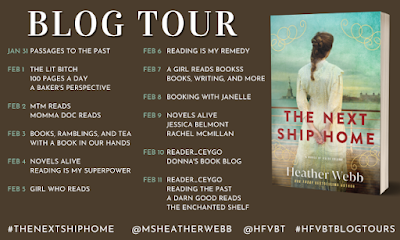
The Next Ship Home blog tour banner

About the author:

Heather Webb is a USA Today bestselling and award-winning author of historical fiction. In 2017, Last Christmas in Paris won the Women’s Fiction Writers Association award, and in 2019, Meet Me in Monaco was shortlisted for both the RNA award in the UK and also the Digital Book World Fiction prize. Heather’s new solo novel The Next Ship Home is about unlikely friends that confront a corrupt system, altering their fates and the lives of the immigrants who come after them. When not writing, Heather flexes her foodie skills, geeks out on pop culture and history, or looks for excuses to head to the other side of the world. For more information, please visit Heather’s website

Tuesday, October 26, 2021

Interview with Clarissa Harwood, author of the gothic novel The Curse of Morton Abbey, set in 1890s Yorkshire

I'm glad to welcome Clarissa Harwood back to Reading the Past for an interview about her new historical gothic novel, The Curse of Morton Abbey, which is out today. The heroine is Vaughan Springthorpe, a woman trained as a solicitor, who arrives at the Yorkshire estate of Sir Peter Spencer to help prepare it for future sale in his absence. Her employer's invalid brother, Nicholas, doesn't want his home sold, though. Estate gardener Joe Dixon appears to support her efforts, but there are enough mysterious happenings around Morton Abbey to make Vaughan realize that someone wants her gone. Nonetheless, she wants to prove herself and presses forward with her task, uncovering uncomfortable facts about the estate and the town in the process. I enjoyed trying to predict where the plot would lead, and the story is dark and suspenseful without edging into horror.  If you like romantic suspense, put it on your list!  


How did you choose the time and place of late Victorian Yorkshire?

This was a no-brainer for me because late-Victorian Yorkshire is my happy place! The novels of the Brontë sisters were a formative influence from my young adulthood, especially Jane Eyre, Wuthering Heights, and The Tenant of Wildfell Hall. I know I’m not alone in considering the Yorkshire moors the most romantic, evocative place on earth because of these novels. Of course, the Brontës were early rather than late Victorian, but I have a great love for late-Victorian literature because of my academic training. My doctoral dissertation focused on fin de siècle works such as Dracula and Heart of Darkness with their highly symbolic monstrous figures that represented widespread societal fears of the era.

Vaughan has an intriguing profession for a woman of her time, having been trained as a solicitor without the official designation (and with an expertise in conveyancing – a term new to me, but an important role). How did you research her career?

Because of Vaughan’s strong personality, I knew she needed to work at something unusual for a woman, but she’s definitely an introvert and wouldn’t want to be a leader or at the forefront of a movement like Lilia in Impossible Saints, so she needed something she could do quietly while still showing her determination and strength. Also, I needed a reason for her to go to Morton Abbey that didn’t involve childcare (she is not governess material). I taxed the patience of my university’s law librarian as I researched women law clerks and lawyers for months. Since women couldn’t officially practice law in late-Victorian England, it was difficult to find anything until I stumbled upon a real-life woman who was unofficially practicing law in late-Victorian England: Eliza Orme, who ultimately became the first woman to earn a law degree in England. I couldn’t resist giving Eliza a cameo role in The Curse of Morton Abbey.

I enjoyed how you combined classic gothic elements, like the English estate and family full of secrets, with feminist touches. Who are your influences in the genre of gothic fiction and romantic suspense?

There are too many influences to list them all, but I’ll start with the gothic novelists whose work I studied and taught: Horace Walpole, Ann Radcliffe, Mary Shelley, and Bram Stoker. Daphne du Maurier’s Rebecca is another iconic gothic novel, and I was scandalized by the way Netflix twisted it into a romance, which it isn’t! (I love romance, but I get testy when brilliant novels are adapted in ways that present them falsely.) For romantic suspense, Mary Stewart is a huge influence, and I re-read her brilliant novel The Ivy Tree regularly. More recent novels that draw on the gothic tradition while offering new twists include Kris Waldherr’s The Lost History of Dreams, Sarah Perry’s Melmoth, and Silvia Moreno-Garcia’s Mexican Gothic, which have contributed to the resurgence of interest in this genre.
The author visiting the Yorkshire Moors

The gardens that Joe Dixon maintains are beautiful and provide a restful atmosphere amid the mysteries of Morton Abbey. Do you have a favorite English garden?

This question made me laugh because I have no personal interest in gardens or gardening: in fact, my husband has banned me from working in our garden because I (unintentionally) kill the plants. For a while he let me do some pruning, but apparently I cut too much off the bushes. I do love sitting in a beautiful garden if the weather isn’t too hot, but I had to do a lot of research just to figure out what the names of basic plants were and what sort of work Joe would be doing in a late-Victorian Yorkshire garden.

What have been the most enjoyable and/or challenging aspects of independent publishing?


I feel as if I have the best of both worlds because my first two novels were traditionally published. If I’d started with indie publishing, I think I would have been completely overwhelmed, but because I knew generally how the process worked and how long it would take, I constructed a reasonable timeline for The Curse of Morton Abbey. Another advantage of having two published novels already under my belt was being able to draw on the knowledge and experience of my wonderful community of authors. They have saved me from making plenty of bad decisions!

The best part of independent publishing has been having control over every aspect of the process. It was especially fun working with my cover designer, Tim Barber at Dissect Designs (he was a dream to work with and I highly recommend him). The hardest part of independent publishing has been the stigma that still exists in the industry. It’s difficult and expensive to be reviewed by one of the big trade publications if you’re an indie author. The self-doubt that every author experiences from time to time is also worse if you’re an indie author because you don’t have the gatekeepers of the publishing world validating your work. What has helped me the most in this respect has been the support and encouragement of my agent, Laura Crockett. In fact, The Curse of Morton Abbey is the novel that first got her attention and prompted her offer of representation.

Thank you so much for inviting me to do this interview!

My pleasure, and thanks for answering my questions!

~

For more information about Clarissa Harwood and her books, please see her website, or find it on Goodreads here.