Friday, February 11, 2022

Interview with Heather Webb, author of The Next Ship Home: A Novel of Ellis Island

Thanks to author Heather Webb for stopping by Reading the Past for an interview about her new novel The Next Ship Home (Sourcebooks, Feb. 2022), which offers a unique lens on the American immigration story. Through the perspectives of two young women in the early 20th century -- aspiring translator Alma, the daughter in a German family who becomes a matron at Ellis Island, and Francesca, a newly arrived Italian immigrant -- I was quickly drawn into a sweeping story about cultural prejudice, corruption, the complications of family, and a surprising friendship.

I’ve read many historical novels dealing with immigration to America, but yours is the first that centered on operations at Ellis Island itself. All the details were fascinating to read about. What inspired you to focus your attention on what took place there?


The very first time I visited Ellis Island I was a high school teacher on a field trip with students. I was absolutely riveted by the place. There’s a real presence in those halls…so many people, so many stories to be told. I think, also, being a lover of language and culture—and a military brat—has always made the study of those trying to assimilate to a culture not their own has always fascinated me. I could relate in many ways. It’s funny that when I first started writing, I knew I wanted to write a book about Ellis Island but I also knew I wasn’t ready. Something inside me warned me that I needed to practice more, try other books and ideas, before it was time to sit down and tackle such a grand, challenging topic. I’m glad I listened to my intuition.

What resources did you use to re-create the duties and mindset of Alma, a matron at Ellis Island whose job involved assisting female immigrants and families?

I read several books about the operations at Ellis Island and I also mined information from a ton of immigrant interviews. Though there weren’t a lot of specifics on the day-to-day of a matron, there was just enough that I could glean the basics and fill in the rest. I also found helpful information on the plaques and in the videos at the immigration center on Ellis Island.

As a language aficionado myself, I rooted for Alma and her yearning to become a translator. I also enjoyed seeing her improve her repertoire of world languages, and the theme of how languages are a bridge to cultural understanding. How did you get interested in this topic?

I’m a former French and Spanish teacher and I thoroughly love language-learning in all its forms. I’m really fascinated by the way language reflects culture and how, in kind, culture shapes language. I enjoy studying how language has changed over time as well. I suppose you could say Alma was my ode to the language teacher inside me.

How did you decide on the approach to tell the story from two women’s alternating perspectives?

I knew I wanted to explore different classes of Americans from the newly-arrived immigrants to the first-generation Americans, as well as the wealthy, more established. As well, I wanted to depict the opposing perspectives of immigrant and worker to show the complexity of the immigration system. It’s very rarely a simple thing.

Ellis Island is enshrined in many family histories as a place of hope and new beginnings. Human nature being what it is, I shouldn’t have been surprised at the corruption and abuse that took place at Ellis Island, and which the immigrant characters unfortunately deal with. Were there any facts that took you by surprise as you researched this aspect of the novel?

author Heather Webb
Many! I really enjoyed reading about Teddy Roosevelt’s place in shaping immigration reform as well as his visit to the island in the fall of 1903. It was a horrible, stormy day and the boat carrying him and his staff nearly capsized in the swell of the bay. When he arrived to the island, very late to the elaborate lunch they’d planned, the food was cold but they did manage to serve oysters for which the Hudson Bay used to be famous, and also champagne. There are so many more facts, too, about the anarchists like Emma Goldman, President McKinley’s assassination, and much more. In truth, I had a hard time narrowing down what the story was truly about during the first few drafts.

Reproducing international languages and accents in dialogue can be tricky, because the effect can easily be overdone, but this isn’t the case with Francesca. Everything read as very natural to me. What suggestions do you have for other authors about writing dialogue for characters still gaining fluency in English?

First of all, thank you for the compliment. It’s not an easy thing and yet, I think it’s important to distinguish differences in the characters’ language. I’m a freelance editor and teacher as well so I usually recommend to my students to think of dialect and foreign language as a seasoning in a dish. Salt makes a dish delicious with just the right amount but it must be sprinkled with caution. Too much makes the dish inedible.

Since The Next Ship Home takes place in the United States, did you find the research any easier or different than it was for your previous novels?

Overall, I’d say it wasn’t easier because I’m always interested in international travel and I’m the first one on that plane, but it’s certainly true that living not far from New York City made my research much more accessible (and cheaper!). I took many trips to Ellis Island and into the city itself, and I also used the public library and its archives in the city to gather information and photos, trinkets, etc.

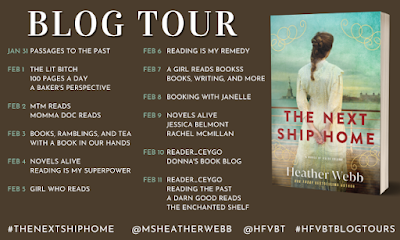
The Next Ship Home blog tour banner

About the author:

Heather Webb is a USA Today bestselling and award-winning author of historical fiction. In 2017, Last Christmas in Paris won the Women’s Fiction Writers Association award, and in 2019, Meet Me in Monaco was shortlisted for both the RNA award in the UK and also the Digital Book World Fiction prize. Heather’s new solo novel The Next Ship Home is about unlikely friends that confront a corrupt system, altering their fates and the lives of the immigrants who come after them. When not writing, Heather flexes her foodie skills, geeks out on pop culture and history, or looks for excuses to head to the other side of the world. For more information, please visit Heather’s website. 

Sunday, February 06, 2022

The Magnolia Palace by Fiona Davis offers an exciting, artistic escape into New York City's past

Fiona Davis’s novels offer the vicarious pleasures of getting an exclusive tour of New York City’s iconic landmarks. Her latest work centers on the Henry Clay Frick House, once a Gilded Age mansion, now a public museum and art library. While envisioning the gorgeous paintings, sculptures, and other precious objects inside the building (whose Fifth Avenue garden is adorned by large magnolias) is a highlight, the colorful personalities could carry the novel on its own.

By 1919, Lillian Carter has spent six years posing for public sculptures across New York under the name “Angelica.” While she’s enjoyed contributing to the city’s art scene, a murder scandal involving her landlord forces her to go into hiding.

A twist of fate propels Lillian into the role of private secretary to Helen Clay Frick, the industrialist’s mercurial 31-year-old daughter, who’s torn between pursuing her own interests and seeking her critical father’s approval. Lillian proves remarkably successful in her tasks, but while she dreams of a silent movie career, a secret assignment, one that’s too temptingly profitable to resist, ensnares her in longstanding Frick family tensions.

Decades later, in 1966, English model Veronica Weber secures a lucrative modeling assignment at the Frick Collection, but after the job turns sour, she finds herself accidentally trapped in the building overnight alongside a handsome African American museum intern. Initially watchful of one another, they team up to follow clues in a scavenger hunt created long ago.

The pages breeze by as potential romances develop (maybe not the ones you’d expect) and a mystery involving the whereabouts of the Magnolia Diamond unfolds. Deeper issues also undergird both narratives, which confront stereotypes about models and explore how a tragedy can warp family relationships years later. The two narratives dovetail in a satisfying way. Mystery and art lovers should relish this exciting escape into New York’s past.

The Magnolia Palace was published by Dutton in January; I reviewed it from NetGalley for February's Historical Novels Review.

The Frick Collection
Credit: Gryffindor, CC BY-SA 3.0, via Wikimedia

Read more about the Frick Collection at their website. Although I've been to NYC many times, I hadn't been familiar at all with this institution or the personalities surrounding it before reading this book. Now I have a long list of places to visit once travel is possible again.

Tuesday, February 01, 2022

The Books of Jacob by Olga Tokarczuk, her magnum opus about a controversial 18th-century Jewish figure and his world

Described as Polish Nobel laureate Tokarczuk’s magnum opus, this impressively sprawling story reveals the life and times of Jacob Frank, an 18th-century Jewish messianic figure. Frank is enigmatically charismatic and incredibly disruptive: a self-described “simpleton,” sporting Turkish garb, who violates social norms.

Opening in 1752 in Rohatyn, a Polish market town, and passing through numerous other European and Ottoman locales, the narrative expertly delves into the circumstances that shaped and elevated him. Forbidden from buying land and overburdened by taxes, many Jews seek deliverance. In this bizarre, intricate journey based in history, Frank and his followers come to reject the Talmud and, eventually, convert to Catholicism.

With language that’s engaging, erudite, and spiced with witty colloquialisms and wonderful turns of phrase via Jennifer Croft’s supple translation, Tokarczuk explores the state of being an outsider in places with fixed cultural boundaries and how Frank tries to work the system to advantage. Among the intriguing, diverse cast are Nahman, Frank’s ardent supporter, and Yente, a dying woman whose spirit views events from above.

There’s so much fine quotidian detail you’ll feel you’ve stepped into the novel’s canvas, while the overarching threads connect brilliantly. With its length, dozens of characters (some of whom adopt new names), and theological discussions, this panoramic tale requires commitment, but it’s masterfully done.

The Books of Jacob is published today by Riverhead in the US; it appeared in the UK last year from Fitzcarraldo Editions. I submitted this review for Booklist, and it was published (in shorter form) in the Dec. 1, 2021 issue.

This book is 992pp long, and the lengthiest novel I've ever read on my Kindle (I got it from NetGalley). It took me three weeks to read, and my Goodreads challenge definitely suffered.  A note from the publisher says:  "In a nod to books written in Hebrew, The Books of Jacob is paginated in reverse, beginning on p. 955 and ending on p. 1 – but read traditionally, front cover to back." This wasn't apparent from my copy, but it's an appropriate and cool feature. The translation from Polish by Jennifer Croft reportedly took seven years to complete.

As you can imagine, writing a 200-odd word review of a nearly thousand-page historical novel necessitates leaving out a lot, so tough decisions had to be made on what to include in my writeup. I was given a choice as to what I might like to review and selected The Books of Jacob because (1) the historical period is one I knew very little about beforehand; (2) a branch of my family comes from the area where part of this book takes place; (3) I couldn't resist the opportunity to be among the first to read this internationally acclaimed novel in English, as I'd heard a lot about it; and (4) after reading through the first chapter of the NetGalley copy, I was sold and wanted to continue.

Jacob Frank is a historical character, and his story as presented by Tokarczuk is utterly strange and based in truth. His story, and that of religious and social life at the time, is related through the eyes of numerous other characters, and it's left to interpretation as to whether Jacob is a charismatic con artist or a shrewd observer who determines an ingenious, unorthodox way to raise the Jews' status in society. There are no references to Jacob himself until a good ways in.  You may find yourself wondering when he'll finally make an appearance on the page, but by the time he does, you'll have a detailed picture of the unique circumstances surrounding him and the movement he creates.

Reviewing for the New York Times, Dwight Garner calls it "sophisticated and overwhelming," both of which are true. His conclusion also agrees with my experience.  Read his take on the novel here.

Saturday, January 29, 2022

More historical fiction award news: Langum Prize and National Jewish Book Awards

It seems to be the season for book awards. The honorees for the 2021 Langum Prize in American Historical Fiction were announced earlier this week, and the 2022 winners of the National Jewish Book Awards were named last week. Here are the details relevant for historical fiction readers.

The Langum Prize:

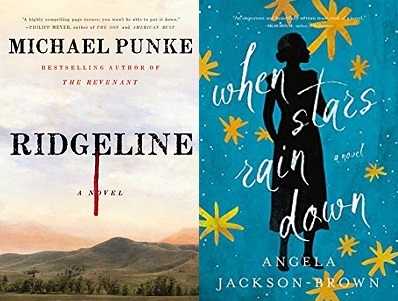
Ridgeline and When Stars Rain Down


Ridgeline by Michael Punke, which revisits the scene of the Fetterman massacre, a violent clash between white settlers and the Lakota in 1866 Wyoming, is the winner of the 2021 Langum Prize.

The Langum Prize finalist for 2021 is When Stars Rain Down by Angela Jackson-Brown, the coming-of-age story of a young Black woman in Depression-era Georgia.  Read my earlier review of this excellent novel.


National Jewish Book Awards:

National Jewish Book Award historical fiction winners


Sponsored by the Jewish Book Council, the National Jewish Book awards are presented annually for Jewish literature in a wide variety of categories. Links lead to the reviews or descriptions at the JBC website.

In the Book Club category, the winner is Helene Wecker's The Hidden Palace, a sequel to her historical fantasy novel The Golem and the Jinni, a cross-cultural immigrant story set in early 20th-century NYC.

Finalists in the Book Club category are Weina Dai Randel's The Last Rose of Shanghai (an epic love story of WWII Shanghai that I reviewed earlier) and Yaniv Iczkovits' (trans. Orr Scharf) The Slaughterman's Daughter (about a young woman's disappearance in the Pale of Settlement in the late 19th century).

For Debut Fiction, the winner is Jai Chakrabarti's A Play for the End of the World, which moves from the Warsaw Ghetto to India in the 1970s as it examines the themes of friendship, love, and the purpose of art.

Lori Banov Kaufmann's Rebel Daughter, a young woman's perspective on the destruction of Jerusalem in 70 CE, won the award for Young Adult Literature.

If you've read any, I'd love to hear your thoughts.  Congratulations to all the honorees!

Monday, January 24, 2022

Historical fiction award winners announced at the 2022 American Library Association LibLearnX conference

Yesterday afternoon, I tuned in to watch the 2022 Book & Media Award announcements from the American Library Association's RUSA Division. The event was broadcast on Facebook and YouTube (which my husband set up so I could watch on our TV). Our tortie cat Cocoa helped, or rather mostly got in the way of the screen.  LibLearnX is the new conference that takes the place of ALA Midwinter.

The graphic below with the book covers of four winners, coincidentally, is highly orange!


There were three major awards in which historical novels received recognition, so without further ado:

The winner for the Carnegie Medal for Excellence in Fiction was Tom Lin's The Thousand Crimes of Ming Tsu, about a Chinese orphan turned assassin in the post-Civil War West.

On the Notable Books List are several other works of historical fiction:

Jaime Cortez's Gordo, a short story collection set amid a California migrant workers' camp in the '70s (if you count the era as sufficiently historical);
Lauren Groff's Matrix, imagining the life of Marie de France, a French-born abbess in 12th-century England;
Honorée Fanonne Jeffers' The Love Songs of W. E. B. Du Bois, an expansive story tracing the heritage of a young woman's African American family;
and Anthony Doerr's Cloud Cuckoo Land, a historical-futuristic literary epic set partly in 15th-century Constantinople.

And for the Reading List, the ALA's annual awards in eight genre fiction categories, the award for Historical Fiction went to The Sweetness of Water by Nathan Harris, about the unusual friendship between enslaved brothers and a Georgia plantation couple in the post-Civil War years, and a subsequent tragedy.

On the Historical Fiction shortlist are:

Daughters of Sparta by Claire Heywood (a Greek myth retelling):
Leonora in the Morning Light by Michaela Carter (on 20th-century painter Leonora Carrington);
The Rose Code by Kate Quinn (suspense before and after Bletchley Park, WWII);
and A Tip for the Hangman by Allison Epstein (spy thriller with Christopher Marlowe).

Congrats to all the honorees!

Cocoa the cat and the ALA Notable Books
Miss Cocoa acting as live awards emcee

Thursday, January 20, 2022

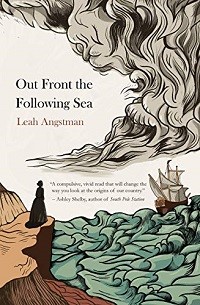
Out Front the Following Sea by Leah Angstman, a tale of female strength and survival in early New England

Hang on tight for a bracing read about a young woman’s strength in the wilderness and towns of late 1680s New England.

The courageous heroine of Leah Angstman’s debut novel is Ruth Miner, just sixteen when she’s forced to endure the frigid winter temperatures while caring for her elderly grandmother, suffering from dementia, in their spartan cabin near Shrewsbury, East Jersey Province. Considered an outcast following suspicion that she killed her parents through witchcraft, Ruth knows she must shoulder her burdens alone. Being an independent woman in this time and place, though, is dangerous, a theme carried through the entire novel.

Ruth’s one initial ally is a sea captain’s half-French son, Owen Townsend, who knows the truth about her past. After her grandmother’s inevitable death, Ruth knows she needs to flee a mob of angry townspeople and wangles a spot aboard Owen’s ship, the Primrose, as freight (not a fun prospect!) since all the passenger slots are filled.

Arriving in the coastal settlement of Stonington in Connecticut Colony, Ruth finds a quasi-home with a Quaker couple, though pressure mounts for her to find a husband. Owen, however, must be off on another voyage just as an older merchant comes seeking her hand. Meanwhile, despite a prevailing treaty, tensions between the English and French are heating up in the colonies, leading ultimately to King William’s War.

The atmosphere feels raw, the setting untamed, the characters stubborn and full of purpose. The author’s muscular language does much heavy lifting in evoking the time through original expressions and an impressive command of period vocabulary. Many insults are worth jotting down for future use (“You fewmet of a boar!” “Ale-soused applejohn!”).

Fast-paced action, an emotional love story, race relations, and international political intrigue intermingle in a compelling way. The author makes some impressively daring choices with her characters’ lives. At times the narrative feels whittled down from a longer book, since there are some gaps where we don’t get to see how characters got from point A to point B.

Few novels depict this troubled time in American colonial history, or early Connecticut, for that matter, and Ruth is a heroine well worth following on her dramatic journey of survival.

Out Front the Following Sea was published in January by Regal House; I reviewed it from an Edelweiss e-copy as part of the tour for Historical Fiction Virtual Book Tours.

Out Front the Following Sea tour banner

Monday, January 17, 2022

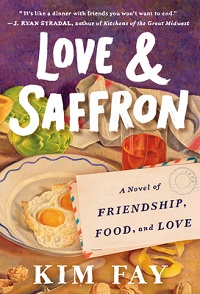
Love & Saffron by Kim Fay, an epistolary novel of food and women's friendship in 1960s America

Fiction and culinary travel writer Fay (The Map of Lost Memories, 2012) has crafted a delectable second novel showing how food can bring people together, even across distances and cultures.

In October 1962, Joan Bergstrom, an unmarried 27-year-old from L.A., sends an admiring fan letter to Mrs. Imogen Fortier, author of a magazine column on Pacific Northwest island life. To thank her, Joan shares a favorite mussels recipe and encloses a saffron packet.

The story is mostly told via the women’s warm-hearted correspondence. They become close while exchanging thoughts on food, their personal lives, and contemporary society.

Their connection nurtures them during tough times and draws in others as well. Imogen’s WWI-veteran husband, Francis, impresses her with his newfound interest in French cooking, while Joan’s friendship with her neighbors’ Mexican carpenter, begun over a shared meal, develops into something more.

Fay’s emotionally generous novel demonstrates how people’s worlds can expand when they open themselves to new possibilities. Readers will be touched by this enriching tale and inspired to embark on their own international culinary adventures.

Love & Saffron will be published by Putnam (US) on February 8th; I reviewed it for the Nov. 1, 2021 issue of Booklist.  The novel is 192pp long, and you can read it in an afternoon (which I did).  There are many scrumptious-sounding dishes described within, so prepare to start googling for recipes. 

This novel is very different in style and tone from her first novel, a quest-adventure set in 1920s Shanghai and Cambodia, and which I'd also reviewed back in 2012. I'd also interviewed Kim Fay about The Map of Lost Memories, and she spoke then about her interest in food and cooking.

Wednesday, January 12, 2022

In Love, In War: a guest post by Margaret Walker, author of Through Forests and Mountains

I'm happy to welcome Australian novelist Margaret Walker for a guest post about the background to her latest historical fiction work, Through Forests and Mountains (Penmore, 2021), which focuses on the Partisan women in WWII Yugoslavia. 

~

In Love, In War
by Margaret Walker

How many women do you know who commence an historical novel based on their shoe size? Or their head circumference? Or their height? When I was growing up in Sydney in the 1960s, all three were expected to be British, and the British were small.

I was an eight-pound twin. I was adopted at birth and my mother came from Yugoslavia, the home of large people.

I grew up hating shoes. All they ever did was hurt. I hated shopping. Nothing fitted, and I developed an early and permanent fixation about my size.

Then, in 1970, something wonderful happened. My adoptive mother told me about the women of the Yugoslav Partisans in World War 2 who had battled the Nazis alongside the men. She did it to console me – even at ten I could tell that – and with that heightened sense of romanticism that novelists are born with, I just knew that my biological mother had hurled grenades at cowering Germans. I felt a fierce pride that half of me had been involved in the Struggle for National Liberation, as it was called and, from that day, I was on a mission to teach my small-footed, small-headed world the history that justified every pair of shoes that had ever given me blisters. But first I treated my disproportionate self to a tour of the old Yugoslavia where, at long last, I met women my size.

Margaret in Belgrade vs Margaret in Sydney

My first novel His Most Italian City, about the persecution of my birth mother’s family under Mussolini, was published by Penmore Press in Arizona in 2019 and, with the confidence that gave me, I began to write Through Forests and Mountains about the Partisan women. In 2015, Jelena Batinić published a fabulous book called Women and Yugoslav Partisans, and in 2018 I bought a book of Partisan poems in Croatian, of which I translated about forty. "A Woman Under Arms" by Franjo Mraz is my favourite:

Oh, my rifle, I will never part with you!
You will be with me at the end of my wrist until the last day
Protecting the paths of freedom along which the conquered are moving.
Tremble, look, and listen to the woman warrior, the woman partisan!

So, like me, you want to tell the world about your obsession? You are in distinguished company, and I suggest that two things are essential. One, make your readers care about your protagonist from the first page. You must carry them along emotionally. Two: be such a sensational writer that you can make your reader passionate about carburettors, sushi and Tibetan Mastiffs.

Not interested in the Yugoslav Partisans?

I’m going to make you interested. Great style, emotional characters, racy plot, and a seriously nasty villain.

In the planning stages, I considered what the premise of a novel about women fighters ought to be and, after a few false starts, I decided to tell the story of a man who, in the ordinary course of his life, has trouble with women. He’s mechanical. He’s hopeless at female games. His love life is a series of brief, shallow relationships. However, as the war progresses, he finds himself in a position where he is forced to deal with women fighters.

How he responds to this provides the conflict, and conflict is important in novel writing. It gives the reader interest. In order to resolve it, I toyed with the idea of introducing romantic elements between him and the female protagonist.

Here I encountered a problem.

The Yugoslav Partisans were not allowed romance. The Anti-Fascist struggle was too important. The women who fought became hardened until they were almost like eunuchs. Their periods stopped. If they had children, they left them in the care of others and went off to fight.

Then I discovered the poems of Josip Cazi, a political commissar with the Partisans. As I read his verses, a picture emerged of a soldier whom I imagined might ‘lay his rifle tenderly next to hers’. So many of his poems were about his relationships with women, and their style is remarkably sentimental for wartime.

‘Jelice, my apple girl in blue. My partisan rose with the wild hair in the blushing dawn, in pearls of dew. My small hero.’

If he can do it, I can do it, I thought. (And, despite the rules, there must have been some fun and games amongst the Partisans because Jelena Batinić includes a quote from a German who observed that many of the women were pregnant.)

From that moment, my male protagonist was doomed to be smitten, poor fellow, and I hope I have made this clear to the reader from the beginning of the novel. By the time my manuscript assessor suggested that I might like to develop my dot-pointed romance, the horse had bolted, and honestly it was so much fun to write that I almost considered going in for the whole Mills and Boon thing – Her Gun at his Heart, A War on More Fronts Than He Anticipated, Surrender! – and so forth.

'I have spoken with the commissar,' Anton began, 'who has given us permission to marry. If you'd like,' he added.

'Oh...' said Mara and put a hand to her lips. 'Oh.'

Anton waited for her to say something else. When she didn't it was obvious, even to him, that her mind had not been on love.

In an effort to emphasise to her the uniqueness of the privilege granted them he said, 'They don't generally allow it.' Still no reply. He added desperately, 'The commissar's reply ran along the lines of what he thought would be in my best interests, or rather, you understand, our best interests.'

'I understand,’ said Mara.

'What he meant was, I can't go back to sea, so...'

'Marriage might be a sweetener?'

'Well, yes, I expect you could put it like that.’

She started to laugh. That thoughtless, girlish laugh that had so often wounded him. He felt lonelier than ever. He was aware, by then, that he had blown his chance of getting her that little bit closer to him for a longer time, instead of always being part of an army on the move. What might happen tomorrow? Where would they be sent? When would he see her again? What sort of struggle against the Axis powers might it be for him if he no longer had access to her heart? If only he could start again and ask her properly in a way that any young woman would like to be asked. But had he? No. He’d just done it his way, as usual.

But she stopped laughing and looked up at him fondly.

'Of course, I'll marry you, Anton,’ she said. ‘What would I do if you weren’t here?'


Note: Quotations from the poems, translated by Margaret Walker, are from Po Šumama i Gorama, Pjesme Boraca Narodnooslobodilačkog Rata [Through Forests and Mountains, poems of the fighters in the war of national liberation], published in Zagreb in 1952.

 ~

Margaret Walker is a teacher. She has a Bachelor of Science degree from the University of Sydney, and diplomas in Education and Professional Communication. Her short stories have been published in Australia and England.  Visit her author website at:  https://www.mwalkeristra.com.

Thursday, January 06, 2022

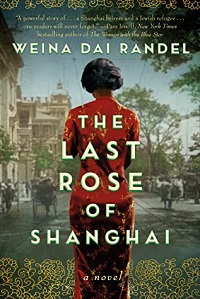
The Last Rose of Shanghai by Weina Dai Randel, an epic love story set in Japanese-occupied Shanghai

Set amid the maelstrom that was Japanese-occupied Shanghai beginning in 1940, Weina Dai Randel’s third novel is charged with incident and emotion matching its setting. It reads as if the author poured every ounce of creativity and feeling into her writing, and based on her comments at the end, this was the case.

At its essence, The Last Rose of Shanghai (named after the female lead’s favorite jazz song) tells the love story between Aiyi Shao, a young, sophisticated heiress who owns a nightclub called One Hundred Joys, and Ernest Reismann, the Jewish pianist she hires to attract new customers to her once-popular venue.

Ernest is newly arrived by ship from Nazi Germany with his younger sister, Miriam, and desperate for work after learning that Shanghai – the only port not requiring an entry visa – is flooded with other refugees. His foreignness is the problem, not specifically his religion; many Shanghainese, including Aiyi, are unaware of the antisemitism over in Europe. That remains true until it isn’t. When Japan forms an alliance with Germany, the Britons in Shanghai’s International Settlement become the enemy, and restrictions eventually tighten against the Jews.

The backgrounds of Aiyi and Ernest are gradually layered: she is reluctantly engaged to her conservative cousin, Cheng, yet despite her independent streak, she understands the importance of family. Ernest faithfully sends funds home for his parents to join him, not realizing until later that his efforts are futile (of course, the reader knows this). Their love affair is fiery and necessarily furtive. These passionate characters are flawed individuals who sometimes act out of selfishness, but with the world stacked against them in so many ways, it’s easy to root for their happiness.

The historical background comes alive with full-bodied color and sound, plenty of twists in the action, and brilliantly painted word-images: “… all of us Chinese in Shanghai were like trapped fish in a sunless marsh. To avoid the hook of death and go on living, we had no choice but to remain unseen under water,” Aiyi says. The author also weaves in cultural information, like the tones used to pronounce Aiyi’s name correctly (which Ernest never quite masters) and the bat mitzvah ceremony young Miriam prepares for. Anyone seeking an original focus on the frequently dramatized WWII era should pick up this book for a gripping emotional journey.

The Last Rose of Shanghai was published by Lake Union in 2021; I read it from NetGalley.

Wednesday, December 29, 2021

Isabel Allende's Violeta spans 100 years in a South American woman's amazing and eventful life

Allende has crafted many unique heroines of passionate, resilient spirit in her internationally best-selling historical novels, and Violeta Del Valle is no exception.

Born during the Spanish flu outbreak in an unnamed South American country (clearly based on Chile) in 1920, Violeta addresses her memoir to a beloved relative, Camilo, during the COVID-19 pandemic in 2020. She spins a captivating, cinematic tale of her century-long existence, intertwining large-scale political and social transformations with reflections on her life.

The spoiled daughter in a family with five older sons, Violeta watches the Del Valles’ finances tumble into ruin during the Depression. After losing their illustrious home, her family finds refuge in a remote southern farming town with many Indigenous residents and German and French immigrants.

This supposed exile becomes an enriching experience for Violeta. Her love life is complex, tumultuous, and unpredictable for readers, who will eagerly follow her narrative, which Violeta recounts in a style that’s remarkably forthright about her own and others’ personal failings.

The characterizations are intriguingly layered, and as people’s lives are buffeted by dramatic changes, including a military coup that destroys her country’s democracy, Violeta comes into her own strength. Allende has long been renowned as an enchanting storyteller, and this emotionally perceptive epic ranks among her best.

Violeta will be published by Ballantine in January; I reviewed it from a NetGalley copy for the 12/15 issue of Booklist (I made it a starred review).

There was no room to say this in the review, but past readers of Allende's work may recognize the name Del Valle, and Violeta is indeed connected to the characters from her first novel, The House of the Spirits.  It's not a major part of this book, and you definitely don't need to read any others first, but the link is mentioned. Other Del Valle family members figure in Allende's Daughter of Fortune and Portrait in Sepia.

I'll be back after the New Year with more posts. Thanks for visiting my site, and best wishes for good reading for 2022!

Tuesday, December 21, 2021

Best-of-year historical fiction roundups from around the web

Now that 2021 is drawing to a close, media outlets have been publishing their "best of" lists from the past year.  I've collected those that focus on historical fiction, though there aren't as many of these as I've found for other genres.

NPR's Best Books 2021 (which used to be called Book Concierge) has a historical fiction category with an impressively wide range of subjects and subgenres. I like how they include literary fiction (The Sweetness of Water), historical romance (Wild Rain), historical fantasy (A Marvellous Light), and books for younger readers (Finding Junie Kim) under the same umbrella. Among my own favorites on this list: Marie Benedict and Victoria Christopher Murray's The Personal Librarian and Laird Hunt's Zorrie.  Here are the NPR selections as a list rather than a visual graphic.

The New York Times presents their best new historical fiction of the season with a dozen recent releases, as well as an overall "best of" for 2021. There's a bit of overlap between them. The focus is, as you'd expect, literary fiction, and I haven't read any of these!

In The Times (London) we have critics Nick Rennison's and Antonia Senior's 15 top favorites of the year. Without a subscription you'll need to sign up for a free login, which gets you access to a limited # of articles. There's a nice mix of literary and commercial here, including Elodie Harper's The Wolf Den (set in Pompeii before the infamous eruption of Mt. Vesuvius), which I also loved. It will be published in the US next March.

In Canada, the CBC has 12 books for the historical fiction lover's shopping list, which includes some novels set in very recent history.

British magazine Woman and Home offers many historical novels (not all by women) for consideration for your TBR, conveniently divided by historical era.

Cosmopolitan has a lengthy list of 27 best historical novels from the last year. While it was posted in late October, some fall reads are included.

Lastly, Goodreads announced their most popular choices for Best Historical Fiction a few weeks ago, and I actually read nine of the nominees (but not the winner, Taylor Jenkins Reid's Malibu Rising).

Wednesday, December 15, 2021

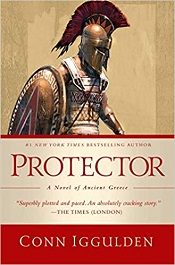
In Protector, Conn Iggulden continues his saga of the Greco-Persian Wars with the heroic story of Themistocles

In 480 BCE, the Persians are back, more determined than ever to crush Athens. Picking up where The Gates of Athens ended, the story continues exploring how the Athenians and their Spartan allies come together, not without difficulty, to repulse Persian invasion forces on land and sea despite being vastly outnumbered.

Three major battles – first Salamis, then Plataea and Mycale the following year – are skillfully choreographed, giving readers an overarching picture of the many moving parts alongside firsthand perspectives of the military commanders. The starring role belongs to Themistocles, an Athenian statesman and general whose tactical genius is matched by pride in his own abilities, a flaw which irritates his fellow leaders.

Iggulden makes a persuasive case for recognizing Themistocles as Western civilization’s ultimate savior. Being inside this heroic character’s head as he strategizes is a breathtaking experience.

The dialogue feels realistic while offering a sense of the momentous through many quotable lines and stirring oratory, particularly from the politician Aristides. Devotees of the ancient world will relish this exciting historical novel.

Protector was published in November by Pegasus, and it was out in the UK in May from Michael Joseph. I wrote this review for Booklist's Oct. 1 issue.  As with the previous book, The Gates of Athens, this series isn't just for military history fans (a group I don't consider myself part of), although the battle scenes really are sharply done. The characterizations are first-rate, and it was great to have the sense of being there while history was being shaped.

Thursday, December 09, 2021

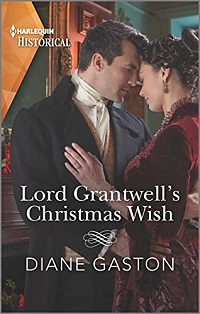
Review of Diane Gaston's holiday-themed Regency romance, Lord Grantwell's Christmas Wish

In her Regency romance featuring two estranged lovers, Gaston adds a dash of Christmas spice to a heartwarming story about the meaning of home and family.

When Lillian Pearson arrives at the palatial Yorkshire estate of Lord Grantwell in December 1817, she’s freezing, starving, and utterly frantic. Her Portuguese former brother-in-law is tailing her, convinced that she murdered her late husband.

Lillian knows she’s innocent, and she takes risks in asking Grant to hide her. They’d had a passionate affair years earlier, in Lisbon, until he caught her giving Wellington’s secret plans to the French—or so he believes. He’s never forgiven her.

Having recently become the guardian of his late brother’s orphaned stepchildren, Grant’s hands are full. But when he sees how well Lillian cares for young William and Anna, his heart starts softening.

The children are adorable, though traumatized from their earlier life; frustratingly, we don’t get the full backstory for their odd situation (they’d previously lived with their hard-hearted grandfather, not their mother and stepfather). Readers get to experience the joy of Regency-era Christmas traditions and children’s pastimes as Lillian and Grant try to give William and Anna a happy holiday, falling in love in the process.

Lord Grantwell's Christmas Wish is a Harlequin Historical title and the second in the author's Captains of Waterloo series, though it stands alone. I reviewed it initially for the Historical Novels Review last month. The first book, Her Gallant Captain at Waterloo, told the love story of Grant's estate manager and good friend Rhys Landon, a fellow soldier he'd met in Portugal, and the woman he married.  Rhys and his wife are major secondary characters in this volume. This romance has impressive depth for a novel of just over 200 pages.

Monday, December 06, 2021

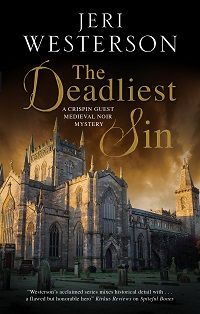
Interview with Jeri Westerson about The Deadliest Sin and wrapping up her Crispin Guest medieval mystery series

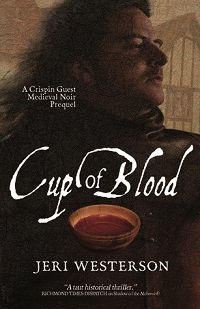
With her appearances on this blog during the publication of her Crispin Guest medieval mystery series, Jeri Westerson is coming full circle. Back in 2008, I'd published her guest post about Veil of Lies, in which Crispin made his first appearance in print, and this week the 15th and final book, The Deadliest Sin, will appear from Severn House. I've also reviewed a couple of the books here, including Cup of Blood (the prequel) and The Deepest Grave (book 11).  So including an interview with the author for this series finale seemed like a neat idea.

To briefly recap for newcomers: Crispin Guest is a disgraced knight turned detective on the streets of late 14th-century London. He had lost his noble title and fortune after joining with others to place his mentor John of Gaunt, Duke of Lancaster, on the throne, thus committing treason against King Richard II. Over time, Crispin's successful pursuit of justice under the nickname "the Tracker" has gained him a certain level of renown.

In The Deadliest Sin, opening in 1399, Crispin is asked by the prioress of St. Frideswide's to investigate the deaths of nuns whose murders depict two of the Seven Deadly Sins. At the same time, the political scene is heating up: Henry Bolingbroke, his late mentor's son, is returning from exile abroad and aiming to secure his inheritance. 

So, there's a lot that The Deadliest Sin needs to do: solve a complicated murder mystery, present the historical backdrop and engage with Crispin as he decides whether to side with King Richard or Bolingbroke, and wrap up the whole series.  It accomplishes all three of these goals superbly.  Plus, we get to see a new side to Jack Tucker, Crispin's apprentice, and his former lover Philippa also plays a role. While I'm sorry to say goodbye to Crispin, Jack, and company, the series ends on a terrific note. If you wanted, you could start with this book, since each novel is self-contained, and the necessary backstory is laid out in the beginning of each.

Hope you'll enjoy this Q&A, and thanks to Jeri for answering my questions!

The Deadliest Sin
takes place in 1399, which followers of English history will recognize as a turning point for the country. This created a lot of anticipation as I guessed how that would affect Crispin and his loyalties. You’ve written that you’d known from the beginning that the series would wrap up at this time. That said, did any elements about the storyline (or series as a whole) play out differently than planned when you sat down to write it?


Well, I didn't have any idea what the mystery would be in the last book. That had to come in its time. And with all that had come before in Crispin's life. I had planned his lady love from the beginning, too, but not other details. As for the series as a whole, I hadn't intended Jack as a continuing character, but when my editor asked if he'd be in the next book because readers liked him so well, I was all on board. And serendipitous it was, because Jack stood in for the reader, asking the questions readers wanted to know about the plot, and being the person in Crispin's life who was able to change him for the better, just by his presence. After all, when Crispin reluctantly took in this street urchin and cutpurse (Jack was eleven at the beginning), Crispin had no idea he'd have to raise the boy; teach him to read and write, and begin to look upon him like a son rather than a servant, as close as they had become.

In some ways, St. Frideswide Priory is an unusual and pretty disturbing place for a community of nuns. How did you come up with the setting and the crimes committed there?

Cloistered life is always fodder for disturbing stories, especially for nuns, many of whom had had no desire to be there but were forced by parents because of circumstances; not being able to marry them off, etc. Some of these places were the making of these women, while others were dark and unwholesome places. The women only learned the rudiments of the prayers, some having no skills with Latin with no time to really teach them except for what they needed to know to get by. It seemed a natural place for crimes. And the Seven Deadly Sins...a no-brainer. But really...what is the deadliest sin? Probably not what you think.

You’ve clearly accumulated a vast array of knowledge about daily life and politics in 14th-century England. What new research, if any, did you have to undertake to write this last volume?


There's always something I need to concentrate on for each volume, whether it's the relics or biographies of the real people, and this one I certainly had to get right about both Richard and Henry. Richard had gone to fight in Ireland and later met up with a chronicler poet from France who was an unwitting witness to his downfall. And Henry amassed an army and didn't really meet any opposition when he decided to make for England from his exile in France. It was all very interesting. Originally, I had begun the book in chapters alternating between Richard's venture and Henry's across England as he returned to take back his lands and title and then start the mystery, but the powers that be didn't want that. I still think readers would have easily immersed in it, but... *shrug* All in all, I can see that point of view because though there is an arc of the characters' lives running through the series, each book can technically stand alone, and this could have confused new readers.

Aside from perhaps Jack Tucker, do you have a favorite secondary character (or characters) from the series?

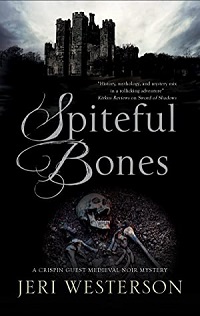
Absolutely. I really got to like John Rykener, a real person from the late fourteenth century. We know about him from one document of his arrest. He was a cross-dressing male prostitute and serviced both men and women. He was arrested not for prostitution, but for dressing as a woman. A big no-no. When he wasn't plying his trade, he served as an embroideress. And really looking deeply at him between the lines of the document, it's possible he is an example of a trans person in a time when such a notion was entirely foreign. Of course, so was homosexuality. He did say in the document when he was embroiled in an altercation with another man about a gown, that he would sic his "husband" on the man. And it was only later that I decided he would get his husband in the person of my fictional lawyer Nigellus Cobmartin, one of my favorite names for a character. They got their own story in Spiteful Bones, the penultimate book in the series.

Different religious relics are another element linking the series together, and it’s always interesting to see how they’ll appear within the books. How did this idea originate?


I was originally writing historical fiction stand alones, with ordinary people in extraordinary circumstances. But these were not the kinds of books publishers wanted to publish. They wanted recognizable characters in the courts and I just felt that was done to death. A former agent of mine suggested I write medieval mysteries, and it seemed that this kind of conceit worked better as a mystery, with fictional characters killing fictional victims amid the backdrop of real people of the time period. So I had to learn to write a mystery. And I didn't want your Brother Cadfael or nuns investigating, I wanted a man who had been set adrift from all that he had known, a knight who was banished from court and had lost it all. A hardboiled detective in a medieval setting, so I turned to one of my favorite books, The Maltese Falcon, and literally tore the book apart to see what made it tick; beat by beat, climax by climax, paragraph by paragraph. And during all that research, I really liked the idea of the falcon, the McGuffin that propels the plot and has with it its own mystique. In the fourteenth century, that translated to religious relics or venerated objects. They added a little something extra. It could be the center of the action, or something tangential, or even a red herring. We've had all sorts of things: the Crown of Thorns, the Virgin's Tears, Christ's blood, and even the Philosopher's Stone and Excalibur.

Over the fifteen books, the series has moved from Minotaur to Severn House with a dip into self-publishing for the prequel, Cup of Blood, and it’s great to see how well Crispin has survived today’s complicated publishing climate. What are some takeaways you’ve learned about the industry, given your experience? 

Yes, and I was lucky to be at that juncture when all was changing. After all, once upon a time when a big publisher dropped a series, that was it! It was done. But my agent felt there was still some life yet in it and I was definitely not done writing it. I knew it would take some time for him to find another publisher, so I picked up the real first book in the series that St. Martin's rejected--Cup of Blood--dusted it off, rewrote a lot of it, got it edited, and self-published it as a "prequel." My agent, of course, didn't want me to do that since he would have no stake in it, but it garnered two mystery award nominations and it had the added bonus of not letting a year go by without a Crispin book on the shelves. I always liked that story anyway, and it is where Crispin encounters Jack for the first time. So I'm certainly glad I did it. It got a boost because it belonged to an already established series, and I marketed heavily to libraries and knew it would still have the imprimatur of St. Martin's still attached to it. It's always done well and continues to do well. I can't necessarily say that for some of the others I have self-published, though they are in a different genre, that of paranormal.

Now that Crispin’s investigations have come to an end, at least on paper, what’s next for you in historical mysteries or historical fiction in general?

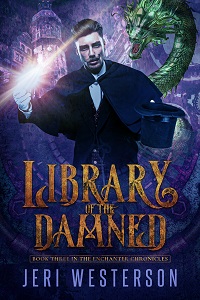
Well, I had just finished my gaslamp-steampunk fantasy series, the Enchanter Chronicles Trilogy, with the last book just released called Library of the Damned. That got me into researching the Victorian era (yes, even though it's fantasy, the era must be researched to give readers a foundation while they navigate all the paranormal things that are going on.) And so I didn't want to waste all that research and I got to thinking about a new Sherlock Holmes pastiche with one of his Baker Street Irregulars--all grown up--who starts his own consulting detective agency, with Holmes being one step ahead of him, and my detective trying to keep a step ahead of the law. It's a humorous mystery series where Holmes makes his appearance every now and then.

And then there is a Tudor mystery series that has been percolating a while in my head, and I finally completed the first in that series, Courting Dragons. Will Somers, Henry VIII's real court jester is the amateur sleuth. This also has a lot of humor, being in the pov of a court jester, and we see Henry through Will's eyes. It's called the King's Fool Mysteries and I hope my agent can sell it next year and to see the first published by the end of 2022 or in 2023. So I think I'll be busy for a bit.

Thank you for hosting me here. I appreciate the opportunity to talk about my Crispin series and upcoming series.


Wednesday, December 01, 2021

Zenobia Neil's Ariadne Unraveled: A Mythic Retelling presents a new side of the classical Greek myth

Best known in Greek mythology as the Princess of Crete who helped the Athenian prince Theseus escape the labyrinth and kill the Minotaur, her half-brother, Ariadne is given fresh treatment in this new retelling.

The prologue impressively evokes her despair and fury after waking alone on the shores of Naxos, abandoned by Theseus, her lover, after betraying her family for him. Neil first moves back and then forward from this low point in Ariadne’s life, giving her agency and showing her as much more than a selfish man’s discarded mistress.

Ariadne Unraveled primarily recounts the romance between Ariadne and her husband Dionysus, the god of wine and ecstasy, among other fun qualities, and how their life together is thwarted by the capricious jealousy of the goddess Artemis, Dionysus’s half-sister, whom Ariadne serves. (Theseus comes back into the picture midway through.)

Many different versions of Ariadne’s story exist, and Neil stitches a collection of them together into a coherent whole, all written in bright and energetic prose. Alongside their love story, we witness the ebb and flow of power: how Ariadne, a high priestess used to being surrounded by eager handmaidens, contends with the gradual loss of hers, while Dionysus, a new god, learns to control his divine abilities.

The writing style is anything but dry. The Minoans are an attractive, athletic, and sensual people, and the varied sex scenes will definitely steam up your Kindle. The special effects are fabulous, too: we have creative shapeshifting, wild drunken parties, gods making trouble, and grapevines that magically twine around things.

In contrast, the author’s portrait of the underworld is hauntingly plaintive. While Dionysus and Ariadne seem to fall in love instantaneously, their relationship grows in emotional richness over time. In all, an entertaining reinterpretation of a classic story.

Ariadne Unraveled was published in July by Hypatia Books, and I'd reviewed it from my own copy for November's Historical Novels Review.  As you can infer, this was a fun book to read, and a fun review to write. Ariadne's story has been a favorite of mine for a long time, ever since reading June Rachuy Brindel's novel Ariadne (1980) when I was in high school. I've also used it as a nickname on various online bulletin boards for years, including on LibraryThing. So of course I was going to read this novel eventually. I haven't yet read Jennifer Saint's Ariadne. Historical fiction readers who enjoy Greek myth retellings now have a lot to choose from!

Friday, November 26, 2021

Some beautiful historical novel cover designs

This is a post about the aesthetics of cover design: an appreciation of the historical novel, the physical object itself, as a work of art. 

I recently ordered a copy of Alison Weir's latest book, In the Shadow of Queens, from Book Depository. It's a collection that reprints the e-shorts (digital-only short stories and novellas) the author wrote to accompany her Six Tudor Queens books, a series of full-length historical novels about Henry VIII's wives.  The e-shorts, which reveal little-known accounts taking place in the shadow of larger events from Tudor history, were only sold in UK outlets, so I, as an American reader, wasn't able to buy them until now. Even then I had to buy a copy from overseas, since the book isn't being released in the US.  There are 13 tales in the collection.


It's not apparent from the image above, but the book doesn't have a dust jacket. Instead, the design is printed directly on the cloth, and it's an absolutely gorgeous package. 

Then I got to thinking about whether I owned any other examples like this, and found only a few on my shelves... not many at all.  It seems more common for genres like cookbooks, reference books, and picture books than for historical fiction (aside from graphic novels).


Five historical novels with printed designs

All but one of these above, the graphic novel/biography about Italian Baroque painter Artemisia Gentileschi at the center, was published by a British publisher. Moth by Melody Razak, at top left, a new release set during the Partition of India, has an elaborate cut-out design and a stepback cover featuring a woman's face.

Below are two other examples, older historical novels from American publishers. 

The Visionist and I, Elizabeth

Both of these feature art printed directly on the cloth and a near-transparent dust jacket with the title, author, and other elegant design elements. 

These beautiful designs represent a significant investment from their publishers. Can you think of any others like this?  I don't live within easy reach of print-and-mortar bookstores (other than Walmart and a few used bookstores downtown) so do almost all of my book shopping online, but if I saw any of these books on display, I'd be tempted to buy them for the covers alone!

Sunday, November 21, 2021

Eleanor Kuhns' Murder on Principle unravels a mystery in early 19th-century Maine

A man garbed in a bright yellow waistcoat, fawn-colored pantaloons, and red-trimmed Hessian boots is an unusual sight in the Maine woods, and the state of his body is even more so. The fashionable Mr. Randolph Gilbert lies dead, both strangled and stabbed.

In November 1800, Will Rees, weaver and amateur detective, is asked by Constable Rouge, his sometime rival, to help solve the murder, which was discovered by an elder from the nearby Shaker community. After Rees learns Mr. Gilbert’s purpose in town, he grows nervous. The man was seeking to recapture a light-skinned young woman and her baby who fled enslavement in Virginia, and Rees and his wife, Lydia, have just returned from that state on an abolitionist mission (as recounted in Death in the Great Dismal, the previous book).

The theme explored in this sharply rendered historical mystery, tenth in series, is a powerful moral question. “If the victim is a slave catcher, well then, I say thank you to his murderer,” Rees’s friend Tobias, a free man of color, tells him, requesting that he drop the investigation. Rees’s natural inclination to pursue justice causes him internal conflict, and his Black friends may not forgive him if he succeeds. Plus, he can’t help but wonder if they themselves are guilty. 

Kuhns devotes close attention to fine period details, from cooking implements to rural Shaker lifeways, while the contemporary relevance of some plot aspects is unmistakable. The late Mr. Gilbert was ill with smallpox, the pestilence is quickly spreading, and Rees moves to quickly inoculate his children using a doctor’s suggested methodology. Not everyone puts their trust in science, though.

The novel stands alone, though some characters’ backstories (the origin of Rees’s large, blended family, for instance) aren’t immediately obvious to newcomers. Recommended for readers enamored of early American settings.

Murder on Principle was published in 2021 by Severn House, and I'd reviewed it from NetGalley for November's Historical Novels Review.  The first book in the series is A Simple Murder, which won the Minotaur Books/Mystery Writers of America First Crime Novel competition in 2011. This latest book is the 10th in the series. The author, a fellow librarian, is the Assistant Director of the Goshen Public Library in upstate New York.
Friday, November 12, 2021

Housekeeper Mrs. Jeffries and her team solve another crime in Emily Brightwell's holiday-themed Victorian mystery

In Victorian London, Inspector Gerald Witherspoon of the Metropolitan Police Force has a reputation to uphold as a crackerjack crime-solver. But there’s a secret: he has help, and he’s unaware of it. Whenever he gets a new homicide case, his intrepid housekeeper, Mrs. Jeffries, calls meetings with her fellow servants and supportive neighbors, and they put their heads together. After Witherspoon comes home each evening, he relaxes over a glass of sherry with Mrs. Jeffries, telling her about the investigation, and she takes it from there. Even Constable Barnes, Witherspoon’s partner, is in on the ruse, which adds to the amusement.

This is the 40th book in Brightwell’s series, so their system clearly works well. The murders tend to happen around Christmastime, potentially mucking up holiday plans, so the pressure is on for a speedy resolution.

In this volume, the victim is Mrs. Harriet Andover, strangled in her home’s locked conservatory with a dressing gown sash. Harriet was an astute businesswoman who shored up her husband Jacob’s failing fortunes with her personal wealth, and none of her family or friends seem upset at her death. Inheritance swiftly rises to the top as the motive. “They are dreadful snobs, Constable, but like so many of that class, they’ve no money,” one character explains. Each suspect is hiding something, and as alibis are provided and tested, the story pokes fun at their ridiculous behavior. Harriet’s stepson Percy, for instance, is a real piece of work.

Mrs. Jeffries’s team is a motley bunch with different connections and talents. There are many clues of varying importance, and figuring out how they all come together makes for an enjoyable ride. The late Harriet was a sensible woman, respected by her servants; the one remaining mystery is why she’d married into such an unpleasant family.

Mrs. Jeffries and the Midwinter Murders will be published by Berkley on November 16th; I reviewed it for November's Historical Novels Review from a NetGalley copy.

For anyone worried about diving into a series in the middle (or at the end, in this case), let me allay your concerns; I had no trouble starting with this book. The series premise is neatly summarized.  This also makes me wonder about lengthy historical mystery series and if any others extend past 40 books. This one began with The Inspector and Mrs. Jeffries back in 1993, and it's stayed with Berkley as the publisher the whole time, which is notable in itself. 

Monday, November 08, 2021

Review of Paulette Kennedy's Parting the Veil, a Victorian romantic suspense debut

Paulette Kennedy’s debut, Parting the Veil, is a veritable Gothic feast. Romantic suspense is a genre the author clearly loves, and the novel’s stuffed full of its hallmarks and tropes: a single woman, a mysterious inheritance, a crumbling mansion reputed to be haunted, its broodingly handsome owner, a shocking Tarot card reading… and that’s just to start.

The fun is in recognizing which of these elements will play out as expected, and which will be given an unexpected twist.

In 1899, Eliza Sullivan and her younger, mixed-race half-sister Lydia, natives of New Orleans, arrive in the Hampshire village of Chesterbridge to take up residence at Sherbourne House, which had been left to Eliza by a great-aunt she barely knew. The terms of Tante Theo’s bequest, though, disconcert the independent-minded heiress. Eliza learns that to take possession of her fortune, she must get married within three months.

Malcolm, Viscount Havenwood, is the sole surviving member of his family after a fire three years earlier damaged his home’s south wing. An immediate physical attraction springs up between Eliza and Malcolm. She throws caution to the wind and – against the practical Lydia’s advice – weds him.

But married life perplexes Eliza. While ardent in the bedroom at night, Malcolm is cold and proper, even condescending, during the day. His behavior will have readers wondering whether Malcolm deserves a happily-ever-after with our heroine.

A profusion of mysteries drives the story along. What (or who) causes the rhythmic tapping Eliza hears at night? What happened to Malcolm’s Scottish mother, who was rumored to be mad? Why does he behave so weirdly? Why is Eliza haunted by painful childhood memories?
author Paulette Kennedy

The atmosphere is a piquant blend of Southern Gothic meets Jane Eyre. As Americans, Eliza and Lydia’s entrance into Hampshire society meets with curiosity; contrary to stereotype, though, they aren't treated like unwelcome outsiders. They form friendships with local women, including newlywed Sarah Nelson, whose candor is a breath of fresh air. There are hints of same-sex relationships in some women’s pasts, which add layers of intrigue. (One minor complaint: the pet name “darling” is overused.)

For readers on the fence about romantic suspense, the ambience may be overwhelming. But for those who adore it, settle into this compulsive read and soak it all in.

Parting the Veil is published by Lake Union this month; I read it from a NetGalley copy as part of the blog tour for Historical Fiction Virtual Book Tours.

Blog tour banner

Friday, November 05, 2021

The Family by Naomi Krupitsky visits mid-20th-century Mafia families from the female viewpoint

Mario Puzo meets Elena Ferrante in Krupitsky’s dynamite debut novel, a decades-spanning saga beginning in 1920s Brooklyn. “There is no easy way to untangle what is Family and what is family,” her characters realize, to their chagrin and peril.

Daughters of influential Mafiosos, fiery Sofia Colicchio and her introverted best friend, Antonia Russo, know their families aren’t typical. Schoolmates avoid them, their mothers constantly worry, and on Sundays they attend a large Italian feast at their fathers’ boss’s home.

When Antonia’s papa tries to escape his profession, he gets “disappeared,” a terrible warning against future betrayals. Sofia and Antonia are resilient, multifaceted young women whose bond occasionally strains as they test the boundaries of independence, and their choice of husbands ensnares them further in Family business.

Depicting twentieth-century Mafia families primarily from the female viewpoint is a fabulous concept that Krupitsky carries out with aplomb. Perspective shifts are smooth, and the backdrops of Prohibition and WWII are superbly realized.

Italian American traditions (including delicious casseroles) are highlighted, and the unique immigration stories show why and how Italian and Jewish newcomers get pulled into organized crime. Fans of Adriana Trigiani and Lynda Cohen Loigman will inhale this tense, engrossing novel about family ties, women’s friendships, and the treacherous complications of loyalty.

The Family was published on Tuesday by Putnam in hardcover and ebook. I read it back in May and reviewed it for the September 1st issue of Booklist, and I'm glad my editor there decided to assign it to me!  

Also, am I wrong, or does the font used on the cover remind you of the one used for Mario Puzo's The Family, his novel about the infamous Borgias of 15th-century Italy, who he called the "original crime family"? 

Monday, November 01, 2021

Carolyn Korsmeyer discusses writing and researching Charlotte's Story, her novel about Charlotte Lucas from Pride & Prejudice

Please help me welcome Carolyn Korsmeyer with a post about re-creating the world of Charlotte Lucas from Pride and Prejudice, and what she learned over the course of the writing process. Her explanation of the differences between approaching a setting from the viewpoint of a reader vs. that of a writer really resonated with me.  

~

Researching and Writing Charlotte's Story
Carolyn Korsmeyer

I have been drawn to historical fiction since I first learned to read, but my first attempt at writing it came when I wrote a novel in the voice of one of Jane Austen's characters, Charlotte Lucas of Pride and Prejudice. It was her realistic, dispassionate, and cool decision to wed the Reverend William Collins that interested me, because I thought reflection on that choice might resonate with contemporary readers in ways that extend beyond Austen's own times.
It was intriguing to imagine the inner life of a woman who faced some of the same choices as we do today, and yet was hindered by customs and limits that no longer exert the same force—although they have by no means disappeared. I decided to write a first-person narrative so that her own thoughts and worries were immediately accessible on the page. Her ruminations needed to conform reasonably well with early nineteenth-century sensibilities, but they also needed to ring true to readers today.

Charlotte is a middle-class woman with few financial resources of her own. She is not particularly pretty, so a stable and prosperous future more or less depends on making a good marriage. It might seem, to use contemporary language, that she "settles" on an unattractive man of means whom few others would want. That, however, is not quite the way I imagined it. Charlotte recognizes and accepts social restrictions that women today would not, and she is not inclined to be rebellious. (Unlike the heedless Lydia Bennet, for instance.) On the other hand, she is also not passive. She is strategic, in her own words "conniving," when the need arises.
Austen is still so popular that for many readers her novels almost achieve the familiarity that we find with contemporary fiction. That was my own impression when I launched into writing Charlotte's Story. But then I began to stumble over details about her household, the way she got from place to place, what she ate, what she wore, how long it took to walk from one neighbor to another, and so forth. Pretty soon I realized the difference between thinking you recognize a world as you read, and actually writing that world, when puzzles and uncertainties emerge.

The same thing, incidentally, has happened with my second historical novel, which is set in a place where I have lived for decades and whose history is very familiar. But when I actually began to write this story, its details demanded an unexpected amount of research. I think this demonstrates a deceptive and elusive distinction between reading—where you enter another world and feel at home—and writing—where inventing that world reveals your ignorance. It brings the gap between now and then into focus.

For Charlotte's Story, I took off from the text of Pride and Prejudice itself, imagining myself in the Bennet rooms (oh—but what's the floor plan?), walking into Meryton (how long does that take?), perhaps riding in a coach (what, actually, is a barouche?), stitching by the fire (how do you net a purse?) Immediately, I realized that I didn’t know as much as I thought I did.

Charlotte was brought into being just as the COVID pandemic shut us all down, so I was lucky that lots of virtual resources were available. I had recently joined the Jane Austen Society, and they held their 2020 annual meeting virtually. It was full of enlightening and entertaining events. I watched lectures on conveyances, clothing, dancing, manners. I took a virtual tour of Austen's home in Chawton. Later I tuned into lectures sponsored by local chapters. With the libraries all closed, I scoured my own shelves and read every nineteenth-century English novel I could find, plus some old travel literature that had landed in my attic. I looked up maps of English cities like Bath to see how their streetscapes had changed over time. And I also watched period-style movies and TV series, noting with some alarm when they came in for criticism regarding their historical accuracy (Wrong hairstyle! Inappropriate shoes!).
author Carolyn Korsmeyer

However, the errors to guard against are far from just factual. There is also the question of style and tenor of writing, which keeps a narrative in tune with the time of its settings. For example, the dialogue exchanged in Austen's own novels is far more elaborate and repetitive than would be common now, but Charlotte and her friends needed to converse in a manner that fit their times. It isn't a good idea just to try to imitate a style; rather one needs to find a tone and vocabulary that is congenial with an older one, but that also flows naturally for contemporary readers.

Even more subtle are the distortions that might enter one's writing when developing a character from the past. It is fascinating to wonder how influenced we all are by our own times and cultures. If we lived two centuries ago, would we have the same values and attitudes and feelings? Are there universals that apply to all people at all times? Perhaps the very basic ones do: we fear danger, we worry about children, are angry at insults, and so forth. But we are by no means insulted at the same things, and our worries and fears have quite different content now. (Think of Geraldine Brooks's wonderful novel Caleb's Crossing and the way she conjures a fear of hell in her Puritan characters.) Literature that was written in the past gives us hints about those similarities and differences, and fiction can explore them still further. The historical fiction writer can be seen as a historian of emotions as well as of actions, characters, and plots from long ago.

~

About Charlotte's Story (TouchPoint Press; on-sale October 11th; ISBN: 978-1-952816-58-1; trade paperback and ebook editions):

Charlotte Lucas, a character first appearing in Jane Austen’s Pride and Prejudice, has made an unfortunate marriage to the loquacious William Collins, reckoning that his tedious conversation is a small price to pay for the prosperous home and family she hopes to gain. However, trouble brews within the first months of marriage, and she is upset and angered by his presumptuous tendency to interfere with her friendships.

To ease the strain of their relationship, Charlotte leaves her husband to visit the fashionable city of Bath with several women companions. The weeks in Bath prove to be a time for self-discovery and freedom, even license. Although the marital frost between Charlotte and William begins to thaw, that tranquility lasts only briefly, for events in Bath have resulted in an unfortunate, even calamitous, consequence.

Charlotte devises a solution to the advantage of all that combines bold connivance and compassionate duplicity. Some would castigate her audacious stratagem, but she believes it justified by the hope of happiness and the wit and courage to seek it.

About the author:

A longtime admiration of Jane Austen and other nineteenth-century women novelists led Carolyn Korsmeyer to write Charlotte’s Story. She is also the author of numerous philosophical works, including Things: In Touch with the Past, Savoring Disgust: The Foul and the Fair in Aesthetics, and Making Sense of Taste: Food and Philosophy. Her website is https://www.carolynkorsmeyer.com.