Monday, October 18, 2021

A visual preview of the winter 2022 season in historical fiction

Here's my latest seasonal preview of forthcoming historical novels, covering books to be published between January and March next year. I'm featuring 15 titles of personal interest (and I'll be lucky to have time to read them all!), and have aimed to include a range of settings and time periods. They're listed in alpha order by author surname. Will you be adding any to your TBR piles also?  Links below go to the books' Goodreads pages.


Kianna Alexander's Carolina Built (Gallery, Feb.) is biographical fiction about Josephine Leary, a woman born into enslavement who achieved huge success in the business world as a real estate developer in late 19th-early 20th-century North Carolina. Another American-set historical is Leah Angstman's Out Front the Following Sea (Regal House, Jan.), which follows a young woman accused of witchcraft in 17th-century New England. Yonder by Jabari Asim (Simon & Schuster, Jan.), called "The Water Dancer meets The Prophets" by the publisher, takes place on a plantation in the Southern states in the mid-19th century.
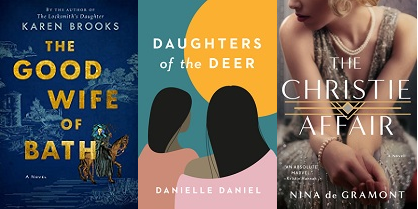


Karen Brooks always incorporates intriguing settings and plots, and her latest, The Good Wife of Bath (William Morrow, Jan.; already out in Australia) retells Chaucer's classic story of pilgrimage from the title character's viewpoint.  Danielle Daniel's Daughters of the Deer (Random House Canada, Mar.) has been on my list ever since I saw the publishing deal reported in Publishers Marketplace. Set in New France in the 1600s, it focuses on a Algonquin woman who agrees to marry a French settler in an alliance to save her people. Interestingly, Agatha Christie (and her mysterious 11-day disappearance in 1926) has been the subject of several novels of late. Nina de Gramont's The Christie Affair (St. Martin's, Feb.) delves into the mystery from the perspective of Christie's husband's mistress. Lots of buzz for this one.


Basing her first novel on the true story of Queen Victoria's Yoruba goddaughter Sarah Forbes Bonetta, Anni Domingo's Breaking the Maafa Chain (Pegasus, Feb.; already out in the UK from Jacaranda Books) traces the separate journeys of two African sisters from their homeland to England and America, countries which have different views on slavery in the mid-19th century.  Melissa Fu's debut Peach Blossom Spring (Little, Brown, Mar.) promises to be a moving saga of about three generations of a family in China and America beginning in the 1930s.  A Ballad of Love and Glory by Reyna Grande (Atria, Mar.) is described as a "sweeping historical saga," which the title emphasizes; it centers on the unexpected love story between a Mexican healer and an Irish immigrant during the Mexican American War.


Stephen Harrigan is an excellent prose stylist (his Remember Ben Clayton is a favorite of mine), and his upcoming novel The Leopard Is Loose (Knopf, Feb.), set in 1952 Oklahoma, shows the tumult of the postwar era through a child's eyes. Skipping over the Atlantic to England just after the Black Death, Peter Manseau's The Maiden of All Our Desires (Arcade, Feb.) plunges into the dramas of faith and flesh within a community of nuns. Louisa Morgan's The Secret History of Witches was a word-of-mouth hit, and her newest, The Great Witch of Brittany (Redhook, Feb.) is a prequel beginning in 18th-century Brittany that reveals the backstory of the powerful clan's magical matriarch, Ursule Orchière.


The wide-ranging, glamorous, hard-working 20th-century life of cereal heiress and socialite Marjorie Merriweather Post is depicted in Allison Pataki's The Magnificent Lies of Marjorie Post (Ballantine, Feb.)  Eva Stachniak, who most recently chronicled the life of Polish dancer-choreographer Bronislava Nijinska, moves to 18th-century France with The School of Mirrors (William Morrow/Doubleday Canada, Feb.), about the young women selected as potential mistresses for Louis XV. Lastly, The Last Grand Duchess by Bryn Turnbull (MIRA, Feb.) reveals the inner life of Romanov grand duchess Olga, eldest daughter of Nicholas and Alexandra.

Friday, October 15, 2021

When I Come Home Again by Caroline Scott, a beautifully written post-WWI novel of mystery, loss, and hope

Caroline Scott’s The Photographer of the Lost (US title The Poppy Wife) is one of my favorite recent novels about WWI, so when I had some free time, her follow-up, When I Came Home Again, rose to the top of my TBR. Like its predecessor, it’s a gorgeously melancholy depiction of the era, evoking the personal and national losses of the Great War and their enduring aftereffects – not just on returning soldiers but on the families left behind.

Both are slow-burning mysteries, though atypical ones. There’s no formal detective, just a natural unfolding of events. The Photographer of the Lost has the stronger plot of the two, though this one is still very good.

The story opens in November 1918 in Durham Cathedral. A man is caught desecrating its Galilee chapel by drawing chalk illustrations on the flagstones. Though clearly a former soldier, he has no memory of who he is. The police give him the name “Adam Galilee” and place him into the care of Dr. James Haworth, who brings him to a convalescent hospital in Westmorland called Fellside, in the hopes he’ll recall his name and previous life. It doesn’t work; the trauma he experienced is so terrible that it remains buried.

In 1920, when a newspaper publishes a collection of photographs, including Adam’s, under the strapline “the living unknown warriors,” a parade of women comes forth, all wanting Adam to be their lost loved one.

Three women feel certain he belongs with them. Scott conveys their desperate eagerness to claim Adam as their son, brother, or spouse, and Adam’s panicked reaction since he doesn’t recognize any of them. But who is he? Is it possible none are right? Memories can be unreliable. And James, in wanting to identify Adam, may be pushing him down an incorrect path. James is also facing his own wartime demons, which affect his marriage to Caitlin, a talented potter.

The principal mystery involves Adam, but because he’s initially a blank slate upon which others project their hopes, the women’s tragic stories resonate more strongly. There’s Celia, who refuses to believe her son Robert will never come home. Anna hopes for a fresh start with her missing, troubled husband, Mark. Lucy was left to raise her brother’s children after he failed to return from France and resents her stifling existence. Caitlin is the only woman Adam feels comfortable with, since she doesn’t want anything from him except friendship.

Over time, Adam’s character gets colored in. He’s a gentle soul with artistic talent who knows the Latin names for plants, but not his own name, or the name of the woman whose image he draws.

At the end, some clues are left unexplained, which bothered me a bit. But I did appreciate how well the novel transported me to the post-WWI era, and into the minds of men and women searching for an exit to the holding patterns of their lives.

When I Come Home Again was published by Simon & Schuster UK in 2020 (I read it from a personal copy I purchased on Kindle).

Sunday, October 10, 2021

Small Pleasures by Clare Chambers unveils the hidden lives of ordinary people in '50s Britain

Can Gretchen Tilbury’s tale about her 10-year-old daughter be true, and if so, how is it scientifically possible?

In 1957, reporter Jean Swinney, pushing 40, has a tedious home life caring for her irritable, reclusive mother. In investigating a claim of parthenogenesis, a virgin birth, for her suburban London newspaper, Jean sees her world unexpectedly transformed.

Surprisingly, she finds no apparent holes in Gretchen’s story. Gretchen had been bedridden in a clinic alongside others when Margaret was conceived. As mother and daughter undergo laboratory tests to prove or debunk the hypothesis, Jean’s intrinsic loneliness leads her to respond to the Tilburys’ friendly overtures.

Margaret is a charming girl, and Howard, Gretchen’s older husband, has a disarming manner that attracts Jean. As Jean’s personal and professional circles become enmeshed, the plot takes dramatic, even shocking turns.

British novelist Chambers penetrates the secret hopes and passionate inner lives of ordinary working people throughout her gripping novel, while its locked-room-style medical mystery calls to mind Emma Donoghue’s The Wonder (2016). The characters provoke so much empathy, readers may have trouble remembering that they’re fictional.

Small Pleasures will debut in the US on Tuesday this week; the publisher is Custom House, a HarperCollins imprint.  In the UK, where it's been out since last July, it was longlisted for the Women's Prize for Fiction and was a breakout hit.  I reviewed it for Booklist's September 1 issue from an Edelweiss e-copy.

I thought about this book for days after I finished and wasn't able to read anything else during that time. If you've read it, you'll likely understand why; I'll say no more!

Tuesday, October 05, 2021

Historical Research: A Many-Faceted Jewel, an essay by Catherine Gentile, author of Sunday's Orphan

Catherine Gentile's Sunday's Orphan, a novel of a woman's self-discovery and family history set in 1930s Jim Crow-era Georgia, was published in September. I'm pleased to welcome the author here today for a post about her research.

~

Historical Research: A Many-Faceted Jewel
Catherine Gentile

The historical fiction of Pulitzer Prize winner Edward P. Jones, The Known World, inspired me to fulfill my desire to write about the complexities of life during 1930. I envisioned a novel set on a plantation on a fictional island town off the coast of Georgia. Little did I realize the scope and depth of research needed to support the characters who would live in that island town, from the weather, topology, flora, and fauna, to the modes of transportation, the embracing issues of politics and religion, and squirmy birthing and funeral practices—I researched every detail. As painstaking a process as it was, I loved every second!

To gain a deeper appreciation for the layout and management of Southern plantations, I visited plantations in Louisiana, South Carolina, and Georgia. I then designed Mearswood Plantation and located the cabins, barns, and outbuildings, pastures, and gardens within a sketch. This primitive drawing served as an invaluable map that helped me maintain consistency of locations and positions of structures relative to one another.

Shack in woods, side view

I wasn’t sure what the simple cabins and privies on the plantation looked like. Fortunately, while hiking in Georgia, taking photos of the flora and fauna within the marshes, I came upon the serendipitous answer: cabins in varying stages of decay. These pretty much substantiated my imaginings, but the fact that they were situated on raised posts was a revelation.

Shack in woods, front view


I didn’t have the same luck with privies, thank goodness! Again, I resorted to my primitive sketching ability, which gave me enough information to address the privies that appeared in the novel more often than I had anticipated!

Hiking proved invaluable from recreational and research points of view, as I gained understanding of the poor soil quality, the variety of trees, the construction of shell middens, and intensity of forest growth. The abundance of Old Man’s Beard, aka Spanish Moss, became an important detail for the novel. Naughty as this was, I confess to secreting samples of pine straw and other plants home for me to study.

Shell-packed dirt road in the woods


The idyllic nature of hiking found its polar opposite in the unsettling research on Jim Crow “law” and its soul-crushing abuses. Try as I did to circumvent incorporating such information in my novel, fellow authors in my writing group argued that they were essential to the story. Gilbert King’s The Devil in the Grove helped me adjust my attitude and hence, set the stage for writing those chapters. I needn’t go into detail here. Suffice it to say, online offerings, memorials to victims of lynching, helped in this regard. Acts of hanging and reports of the celebratory atmosphere—bands, parties, picnics—surrounding these acts captured the cruelty. Postcards of individuals on whom these acts were committed captured its heart-searing insensitivity. As much as I loved research, working these pieces of human history into Sunday’s Orphan was dispiriting.

Later, during an antiquing trip, the research gods smiled on me when I happened across a 1927 copy of Successful Farming. This treasure trove contained articles on farming, raising livestock and children, putting up preserves, and farm finances. Loaded with ads, these primarily black and white pictures provided close ups of furnishings, kitchen tools and appliances, and gave me a peek at work-a-day clothing and their more fashion conscious cousins, hats and dresses. And yes, I bought that copy of Successful Farming.

Marsh's edge

 
I located internet photos depicting the scandalous decrease in the post Roaring Twenties length of women’s skirts, and incorporated this small, but telling detail into Sunday’s Orphan, when a fashionable Bostonian visits Mearswood Plantation in Georgia and relinquishes her city clothing for hand-sewn country attire. Fascinating sociological details such as women’s horrified responses to manufactured undergarments replacing those that were hand-made appeared as well, but those had to be saved for another story.

Librarians were generous in helping me locate information. One knowledgeable research librarian at Tybee Library plied me with stacks of resources containing answers to questions I had amassed while drafting Sunday’s Orphan. Another librarian loaned me audio tapes of interviews conducted with rural Southern midwives, describing their practices and experiences.

Catherine Gentile
(credit: Lesley McVane)
There, however, was little documentation to prove that people living in 1930 actually farmed the scrappy soil on Georgia’s barrier islands. I couldn’t find the answer in the library, and residents with whom I spoke weren’t sure. Farming played an important role in Sunday’s Orphan, and I wanted to be sure it had, in fact, occurred on the barrier islands. Walking through a local cemetery, I considered my authorial options should this piece be untrue. Again, the research gods smiled on me: there, in Tybee Island Memorial Cemetery, was the headstone of Nameless Brown, husband, father, and farmer.

Research deepened my experience of Georgia; now, I’m anxious to draft my next work of historical fiction. Learn more at www.catherinegentile.com.

Thursday, September 30, 2021

V for Victory by Lissa Evans, a darkly comic tale of WWII London

This darkly comic novel is the third in a loose trilogy, following Crooked Heart (2015) and Old Baggage (2019), and the characters’ backstories are revealed as the plot progresses.

In 1944, London’s neighborhoods lie battered from attacks by German bombers. Known as an efficient Hampstead landlady, Mrs. Margery Overs is actually an impostor whose real name is Vera (Vee) Sedge, and her 14-year-old “nephew,” Noel, is a former child evacuee she has taken in.

A charmingly sharp lad, Noel cooks for Vee’s lodgers, who tutor him in various subjects. After Vee witnesses a traffic accident, and Noel meets someone who knew his beloved late godmother, their true identities are at risk of being exposed.

Evans excels at portraying war-weary Londoners conducting their lives while death arrives with terrible randomness; among them is air-raid warden Winnie Crowther, whose husband is a prisoner of war. Many are forced to weigh the cost of keeping secrets. The eclectic characters are all uniquely human, and their interactions—there are no dull conversations—make the novel witty and moving.

V for Victory was published by Harper in May in the US, and I'd reviewed it for the April 15 issue of Booklist.  I hadn't read the previous two books, but that proved not to be a problem.

Crooked Heart
 won the ALA's Reading List Award in the historical fiction category in 2016. It tells the story of how Noel ended up living with Vee, and how they become small-time criminals during the Blitz. Old Baggage, set in the late '20s, is the tale of Noel's unofficial godmother, Mattie Simpkin, "a woman with a thrilling past and a chafingly uneventful present" (per the publisher's blurb), a former militant suffragette figuring out what to do with her life now that the vote has been won. Judging by V for Victory, Evans mingles dark humor and serious subjects very well, and her older books promise a similar experience.

Sunday, September 26, 2021

Messages in the Air: The Watch House by Bernie McGill, set on Rathlin Island in the late 19th century

The enduring struggle between ancient traditions and modern technology is given a Northern Irish flair in Bernie McGill’s The Watch House.

The setting is Rathlin Island, a rugged, picturesque isle just seven miles from the town of Ballycastle on the mainland. Not having heard of it before, I was glad for the opportunity to learn more about the place and its people through historical fiction.

In 1898, as thirty-year-old Nuala Byrne agrees to wed Ned McQuaid, a tailor nearly twice her age, two foreign engineers arrive on Rathlin to test the capabilities of Guglielmo Marconi’s newest marvel – wireless telegraphy. These subplots quickly intersect.

Just a child when her parents and siblings left for a supposedly better life in Canada, Nuala had cared for her aging grandparents until their deaths and hopes for a stable life with her new husband. She doesn’t realize the Tailor and his crabby sister, Ginny, come as a package deal, or that Ginny will treat her as a drudge. Asked to prepare lunches for Marconi’s associates, she develops a rapport with one of them, Gabriel, who teaches her Morse code – and more.

One can guess how their relationship will develop. The novel opens in April 1899 with a scene of Nuala recovering from childbirth, and Ginny planning to take drastic measures to save her brother from raising an illegitimate child. Her traumatic actions almost put me off the rest of the book, but I kept reading and am glad I did.

This evocative novel centers on the mysteries of communication. Introducing Nuala to the notion of electromagnetic waves using layman’s terms, Gabriel, in the island’s watch house, demonstrates how the technological gadgetry can be made to ring a bell. The concept amazes her: “I shake my head and stare at the empty space between the table and a bell. He is asking me to believe in the invisible…

Likewise, Nuala switches easily between Gaelic and English, though never saw herself as a translator before. Plus, there’s a dark-haired girl at the Tailor’s home that no one but Nuala can see. Maybe Nuala is tuned into a special frequency that lets the dead communicate with her, but she isn’t comfortable talking to anyone about it.

The islanders’ dialogue, and Nuala’s lilting narrative voice, complements the small-town Irish locale, and the ending is both satisfying and unsettling. One character’s impressions of Nuala are so different from the quick-minded, brave woman we’ve come to know that it startles. Some communication gaps just seem too deep to bridge.

The Watch House
 was published in 2018 by Tinder Press in the UK. I've been making a point to read and review more of my own books, even if I've had them for a while, and this is one of them.


Rathlin Island
Rathlin Island Harbour
Credit: Brian O'Neill, CC BY-SA 3.0, via Wikimedia Commons

Wednesday, September 22, 2021

Review of The Bombay Prince by Sujata Massey, a mystery of 1920s India

The “Bombay prince” is the future Edward VIII, who in November 1921 took a four-month tour of India, one of the many colonial lands he expected to rule one day. Many Indians supporting independence were angry about the visit, which led to calls for boycotts and agitation in the streets.

This historic event is the setting for the third in Sujata Massey’s excellent mysteries of 1920s India featuring Perveen Mistry, the country’s first female solicitor (she’s fictional but based on a real-life figure).

Miss Freny Cuttingmaster, a talented student at Woodburn College, stops by Mistry Law for a legal consultation with Perveen. She and her classmates are required to attend the parade celebrating the Prince of Wales’s arrival in Bombay, but Freny detests what he symbolizes and wants to stay away. Impressed by her principles, Perveen advises her as best she can. Then, on the day of the procession, poor Freny’s body is found on the ground, beneath a balcony on her campus. Was her death suicide-as-protest, a political murder, or something else?

Massey admirably directs a cast of dozens, all with distinct personalities and with a range of religious backgrounds. The amount of cultural information smoothly woven through these pages is astounding and is exhibited via the characters’ interactions. The Cuttingmasters are Parsis, like Perveen, which leads her and her lawyer father, Jamshedji, to advocate for Freny’s distraught parents during the coroner’s inquest and ensure her funeral at Doongerwadi isn’t improperly delayed. Feeling an affinity for their late daughter, Perveen wants to see justice done, but she’s disconcerted by Mr. Cuttingmaster’s abruptness (he’s a tailor, as his name suggests) and tries to act without causing offense. She doesn’t always succeed.

Perveen’s manner feels stiff at times, which she acknowledges; it feels appropriate to her status as a pioneering woman in her field who happens to be separated from an abusive husband. Both on the job and within society, her behavior must be above reproach, plus Jamshedji disapproves of her socializing with men. This includes Colin Sandringham, an English political agent helping to arrange the prince’s itinerary. Readers of the previous book will be happy to see him again. Perveen and Colin had become close during her trip to Satapur, but as for a relationship between them – there be danger ahead, she knows.

Followers of the series should delight in how this book ends, and anyone tempted by mentions of the delicious Indian dishes consumed by the characters can find recipes on the author’s website.

The Bombay Prince was published by Soho in 2021; thanks to the publisher for approving me on NetGalley.

Monday, September 20, 2021

My notebook and I got drenched and my story was born: an essay by Joanna FitzPatrick, author of The Artist Colony

Joanna FitzPatrick, whose latest novel The Artist Colony is published this month by She Writes Press, is here today with an essay about the research which inspired her fiction.

~

"My notebook and I got drenched and my story was born"
Joanna FitzPatrick

For me, born to travel, research takes me on a journey into the past, and that's why I love writing historical fiction. And it's a journey packed with surprises. Final destination unknown.

After writing an historical novel based on the letters and journals of the short story writer, Katherine Mansfield, which required a strict adherence to her biographical point of view, I looked forward to wandering freely into my next historical novel, creating new characters, and this time I wanted to write a mystery.

After you find an era that appeals to you, mine is the 1920s, one of the joys of research is intentionally falling down rabbit holes to find out everything you can about your subject: Prohibition, women's voting rights, rum runners, suffragettes, artists and artist colonies are some of my favorite subjects. And I feel a tremendous responsibility to my readers to thoroughly know these historical facts before I build a story around them.

As you can tell, I love reading history, but as a fiction writer the real exhilaration comes when I resuscitate history through the characters I create and then let them loose to see how they will behave.

One pathway in my research led me to the history of Asian communities in Monterey. The more I read about how these migrants were punished for their self-reliance and determination to make a good life for themselves in America, I knew my historical novel wouldn't be complete without including their powerful, but tragic voices.

In my research into the Portuguese whalers' and immigrant fishermen's stories, I was particularly intrigued by the Japanese abalone divers, which led me to the amas, women divers who also became characters in my novel.

Once I had embedded myself in Monterey's history, it was time to close those weighty books and head out to where that history took place.

As I entered the creaky wooden door into Whalers Cabin at Point Lobos, I felt my story take hold of me. Whalers Cabin was originally built in the mid-1800s and is currently a historical museum with artifacts and photographs of the many people who came to Monterey from long distances and settled on these shores.

Later, standing outside under the canopy of an ancient cypress, I thought, what if . . . and my plot began to percolate. My imagination on fire, pencil in hand, my fingers wrote down my ideas as quickly as I came up with them.

In my own cloud, I wasn't aware of the approaching storm until the heavy clouds burst overhead. It was my first shoreline squall and its dramatic energy added to my own excitement. While my notebook and I got drenched, my story was born.

When the sun broke through and the rain stopped as quickly as it had started, I took the trail outside Whalers Cabin to the unmarked Kodani Village. Gennosuke Kodani, a Japanese abalone diver, made his home on a bluff above Whalers Cove and he caught and canned abalone for a lucrative international market. His Pacific Grove Cannery was built on the opposite side of his village. There are no remnants left of the Kodani Village. But there are sepia photographs of his home, guest houses, bunk rooms, and Japanese women drying abalone on racks. It was easy to put my character Sarah on the bluff watching the women work and smelling the stinky abalones.

Reading history is not always a delicious piece of cake. Historical facts can be heartbreaking when doors open into the past where dark forces are released. In my research, horrible facts were exposed that rattled my strong belief in justice for all. These facts could not be ignored. My characters would have to work through the rampant racism in their own community–to ignore these facts would be a different story.

I went back to the drawing board and expanded my research to our country's treatment of Asian immigrants during the early 20th century so I could better understand the blatant discrimination in this idyllic artist colony on the Pacific shore. These facts would force my characters to question their own humanity. And because of this expanded research, what started out as a plot-driven mystery became a character-driven historical novel with an element of mystery.

I had started The Artist Colony journey before the COVID-19 pandemic, but as I was working on the last revisions, events took place outside my writing studio that linked my hundred-year-old story to the racial discrimination happening today.

I know I don't have the power to change the course of history, but perhaps the readers of The Artist Colony might choose to question their own humanity so that a writer a hundred years from now won't be telling the same story I wrote, because it's true: Those who don't know history are destined to repeat it.

~

Joanna FitzPatrick
(credit: Michelle Magdalena)
Joanna FitzPatrick
was raised in Hollywood. She started her writing habit by applying her orange fountain pen and a wild imagination to screenplays, which led her early on to produce the film White Lilacs and Pink Champagne. Accepted at Sarah Lawrence College, she wrote her MFA thesis Sha La La: Live for Today about her life as a rock ’n’ roll star’s wife. Her more recent work includes two novels, Katherine Mansfield, Bronze Winner of the 2021 Independent Publisher Book Award (IPPY) in Historical Fiction, and The Drummer’s Widow. The Artist Colony is her third book. Presently, FitzPatrick divides her time between a cottage by the sea in Pacific Grove, California and a hameau in rural southern France where she begins all her book projects. Find her online here:

Author website: www.joannafitzpatrick.com
Facebook: www.facebook.com/JoannaFitzPatrickauthor
Twitter: https://twitter.com/Fitzpatrick_jo
Instagram: https://www.instagram.com/joannafitzpatrick.author/

Thursday, September 16, 2021

The Floating Book by Michelle Lovric, a sensual novel of 1460s Venice

Set mostly in 1460s Venice, the atmosphere of M. R. Lovric’s The Floating Book resembles dark chocolate: alluring, richly decadent, and somewhat bittersweet.

The novel is an older title which I’d bought just after its publication but hadn’t read until now – my bad. The copy on my shelves is the Virago (UK) edition, from 2003 (with the gorgeous painting at left), but it was also published in the US under the author’s full name, Michelle Lovric (below at right). The Goodreads reviews are all over the place: some readers adored it, while others couldn’t finish. I decided to ignore the critics and dive in, and I’m glad I did.

The story follows a collection of intriguing characters as their lives become entangled. Sosia Simeon, a troubled young Jewish woman from Dalmatia, has a series of sexual liaisons with men – she prefers Venetians – while ignoring the older husband she detests, a caring Jewish doctor. Wendelin von Speyer arrives from Germany with his brother, Johann, and they secure a monopoly on the newfangled, controversial trade of mechanical printing. Several men grow obsessed with Sosia, including Wendelin’s editor Bruno Uguccione (she becomes his first lover), while there’s one who doesn’t, to her dismay: the scribe Felice Feliciano.

In Italian, we learn, the word sosia means a lookalike, a theme Lovric skillfully plays with. The woman Sosia becomes the dark reflection of another character: Wendelin’s bright-haired Venetian bride, Lussièta, whose first-person narrative enters the story partway through. Their marriage, blissful at first, grows progressively more strained. Wendelin’s decision to publish the work of the Latin poet Catullus, whose frank eroticism shocked the ancient Romans and Renaissance-era Venetians alike, seems to shadow all the characters like a dark cloud. Letters from Catullus himself, in unrequited love with the scandalous Roman noblewoman Clodia, add interesting parallels, since Clodia and Sosia have much in common.

What hits you first is the language, which reads like poetry:

“In certain light-suffused mists, Venice deconstructs herself. One sees faint smears of silhouettes, and in these the architect's early sketches: the skeletons of the palazzi as he saw them on paper when they were only dreams. When the haze lifts, those buildings swell again with substance, as if freshly built. But until that happens the Venetians nose their way around their city…”

The Floating Book has as many moods as Venice herself: by turns romantic, industrious, seductive, joyous, and sinister. Lovric gives us many funny moments by introducing Wendelin’s thieving cat and a letter from Wendelin to his former mentor at home, in which he despairs of his patrons’ and employees’ involvement with unsuitable women, not realizing they all are Sosia. We also have a multi-page rant by a Venetian priest against the ungodly book, which is both hilarious in its over-the-top pomposity, and frightening in its fanaticism.

I confess I found the last part of the novel the least compelling, since the darkness that befalls nearly everyone doesn’t always make sense, other than it’s a plot direction the author wanted to take. In other ways, though, the mysteriousness of the Venetian setting adds to its fascination. Even with so many facets of the city brilliantly illustrated, some aspects remain filmy and tantalizingly unknowable.

Monday, September 13, 2021

Early Hollywood is a family affair in The Limits of Limelight by Margaret Porter

Margaret Porter’s newest historical novel introduces the early life of Helen Brown Nichols, a teenager from Oklahoma City whose family connections led her to modest success as an actress during the Depression – but who found enduring professional achievement in a different artistic field.

Helen’s Aunt Lela and her first cousin, Virginia “Ginger” Rogers, see potential in the dark-haired beauty, and it doesn’t take much convincing for Helen to accept their invitation to live with them in Hollywood, the idea being that the pair will look out for her while helping open doors to opportunities. Before Helen even arrives in the big city, Ginger persuades her to take the stage name “Phyllis Fraser,” and Porter refers to her as Phyllis from that point forward.

The tale moves with a light, steady pace as it nimbly illustrates Phyllis’s professional successes and disappointments, including her securing a contract with RKO and her hopes to appear on-screen beyond all-too-brief appearances (some of her initial performances end up on the cutting-room floor).

In a competitive atmosphere notorious for overlarge egos and backstabbing, The Limits of Limelight stands out as a story of female friendship and mentorship. Aunt Lela and Ginger steer Phyllis away from casting couches and other pitfalls, and Phyllis’s level-headed nature serves her well, also, even as a minor. Many future screen stars establish a firm presence on the page – Boris Karloff, Katharine Hepburn, Fred Astaire – giving readers a glimpse of their personalities and lives before they became famous.

Phyllis becomes good friends with Peg Entwistle and Mary Blackford, actresses whose lives and careers deserve to be better known. She also grows close to the actress Dawn O’Day/Anne Shirley.  Both of these are stage names, a practice that’s treated as nonchalantly as the rest of Hollywood does. Dawn/Anne takes her name from the part she played in Anne of Green Gables, and even her real-life mother adopts the last name of “Shirley” going forward! Although Phyllis does her best, she feels her true talent lies in writing and pursues opportunities as she’s able.

While it may lack the dramatic twists and turns of juicier Hollywood sagas, this shouldn’t be seen as a defect. The Limits of Limelight is solid, well-researched historical fiction providing a behind-the-scenes look at the screen stars who entertained Depression-era America.

The Limits of Limelight is published tomorrow, Sept. 14th, by Gallica Press; thanks to the author for a PDF copy.  [Find it on Goodreads]

Saturday, September 04, 2021

Gayl Jones's Palmares, an immersive epic of seventeenth-century colonial Brazil

After a 21-year absence, Jones makes a strong return with her mesmerizing epic of late 17th-century Brazil. Her narrator is a Black woman, Almeyda – a name spelled differently than that of a former Portuguese colonial governor (de Almeida), which she tells people who note the similarity.

Educated by a priest on the plantation where she is enslaved as a child, Almeyda soaks up stories and keenly observes everything. Following many significant and traumatic life changes, she flees to Palmares, a legendary community promising liberty for the enslaved, and marries her husband there. After Palmares is demolished, Almeyda travels widely to find him, hoping he survived.

Jones’s storytelling exerts a powerful pull, and readers will achieve complete immersion into a setting whose African and Indigenous cultures are memorably delineated. Through richly woven prose, Almeyda’s journey compels reflection on how freedom must always be defended and how women bear extra societal burdens.

The mystical sequences give the plot additional depth and texture. While overly long in parts, Jones’s novel is a superb reclamation of the historical narrative.

Gayl Jones' Palmares will be published by Beacon Press on Sept. 14th; I'd reviewed it from an Edelweiss copy for Booklist's September 1 issue. 

Some additional notes:

It's hard to encompass an epic novel of 500 pages in a review of 175 words. There are dozens of characters, with new people introduced in nearly every chapter, which has the potential for confusion. Each is so distinct, however, that they're not difficult to remember, and some make later appearances, too.

Palmares (or the Quilombo dos Palmares, "quilombo" meaning a community of former enslaved people) was a real settlement in eastern Brazil that thrived for most of the 17th century; read more at Black Past. My e-copy of the novel didn't have a map, but I made use of ones I found online as I was reading.

I especially appreciated how Palmares upends the traditional narrative about colonial history by centering the viewpoint of a multilingual Black woman along a personal journey, and by showcasing the cultures, religions, and languages (Portuguese, Tupi-Guarani, English, and more) mingling at this place and time. Almeyda's mother describes their family as "Sudanese with a touch of Moorish blood." Her grandmother also plays a memorable role.

Read more about Gayl Jones' life and literary accomplishments at Publishers Weekly and in The Atlantic ("The best American novelist whose name you may not know"), as profiled by Calvin Baker. Her first editor was Toni Morrison, who championed her work after reading her first manuscript in 1975. Jones wrote, revised, and polished Palmares over the course of more than 40 years, and readers will soon get the opportunity to experience it for themselves. She is reportedly a private person who doesn't do interviews, but you can expect to be hearing more about the book in literary circles after it's published in two weeks.

Monday, August 30, 2021

The Perfume Thief by Timothy Schaffert takes an original look at Nazi-occupied Paris

Incorporating the tense setting of Nazi-occupied Paris, Schaffert concocts a memorable work that oozes atmosphere and originality.

Her criminal past behind her, the stylishly dapper Clementine, a queer American in her early seventies, runs a thriving perfume shop supplying fragrances for the women of the cabarets. Then Zoé St. Angel, the headlining chanteuse at Madame Boulette’s, pleads for Clem’s help in retrieving a diary with the secret formulas used by a missing perfumer, Monsieur Pascal.

Clem accepts this dangerous challenge, which involves keeping company with the Nazi living in Pascal’s house, Oskar Voss, who adores French culture. “Perfume isn’t only about chemistry. It’s also about psychology,” she says, and the novel is redolent with exquisite scents, the meanings they convey, and the memories they evoke.

The plot sometimes gets buried underneath all the descriptions, but it boasts beguiling characters who gain depth with each unveiled layer. Schaffert creates a lasting impression through his tribute to these unique artists – the “alchemists of the city’s very soul” – and their courageous and creatively daring methods of resistance.

The Perfume Thief is published by Doubleday this month. I wrote this review for the July issue of Booklist, based on a NetGalley copy.  Even if you're feeling weary of WWII settings, this title is different and well worth reading.

Wednesday, August 25, 2021

My Policeman by Bethan Roberts depicts a complex love triangle in 1950s Brighton

Roberts’ dramatic novel, first published in the UK in 2012 and now adapted for a forthcoming film starring Harry Styles, Emma Corrin, and David Dawson, poignantly depicts a love triangle that tears apart three lives.

In 1950s Brighton, England, schoolteacher Marion Taylor has had a longtime crush on her friend’s older brother, the blond, athletic Tom Burgess. They grow close as he gives her swimming lessons, but Marion ignores signs that something is amiss.

To achieve respectability and hide his romantic relationship with museum curator Patrick Hazelwood, Tom, a police constable, marries Marion. Jealousy soon rears its head.

Roberts tells the story through Patrick’s journal and Marion’s confessions, which she pens in 1999 while caring for Patrick following his stroke. Their accounts make for riveting but occasionally uncomfortable reading. Marion doesn’t seem particularly kind, while Patrick endangers himself by writing about his feelings and actions, since being gay was illegal at the time.

Both call Tom “my policeman,” and one senses love and defiant possessiveness in the word my. Scenes of seaside Brighton and the era’s repressive attitudes are skillfully rendered.

My Policeman is published by Penguin this month in the US; I reviewed it for Booklist in July. According to IMDB, the film version is currently in post-production. Read more about the film at Vogue UK.

Sunday, August 22, 2021

Painting the Light by Sally Cabot Gunning examines women's freedoms on Martha's Vineyard in 1898

Gunning’s sixth historical novel, set on Martha’s Vineyard in 1898, is a luminous portrait of a woman regaining her independence.

Ida Pease wasn’t always a farm wife; she had grown up on Boston’s Beacon Hill and trained as a watercolor artist. After the tragic deaths of everyone in her family, Ida had been charmed by a sheep farmer from Vineyard Haven, Ezra Pease, and chose to marry him – thus giving him access to her money.

Two years later, left in charge of the lambing and harvest while Ezra occupies himself elsewhere, she regrets her hasty decision. When the Portland is wrecked in a storm while sailing to Maine, and Ida learns Ezra and his business partner, Mose Barstow, were aboard, she is stunned but can’t muster up grief for her unpleasant late husband.

Ezra’s death, however, opens a Pandora’s box of secrets, the gradual revelation of which drives the plot along. Ida abruptly finds herself without means and dependent on others for support and answers – among them Ezra’s flinty Aunt Ruth and Henry Barstow, Mose’s brother and executor, to whom Ida has always felt an inexplicable connection.

The pacing is unhurried, but this isn’t a weakness: depictions of the island’s pastoral beauty and the hard work of rural life encourage lingering. The characters have significant depth and multiple rough edges, Ida included.

Eager to return to Boston and resume painting, Ida is forced instead to fight for every inch of emotional ground and every dollar owed to her. She also takes up bicycling – these scenes feel wonderfully freeing – though many island residents find her actions unladylike. The background details on the women’s suffrage movement are a natural fit for this intricate tale of a woman learning to observe the true colors of the world around her.

Painting the Light is out now from William Morrow; I reviewed it from an Edelweiss e-copy for the August issue of Historical Novels Review.

Thursday, August 19, 2021

Julie Klassen's A Castaway in Cornwall takes a romantic escape to Poldark country

A castaway, the dictionary tells us, is “a person who has been shipwrecked and stranded in an isolated place.”

Both the heroine and hero of Julie Klassen’s historical novel are castaways, literally or figuratively. With its picturesque backdrop of North Cornwall’s rocky shores during the Napoleonic Wars, it’s tailor-made to draw in Poldark fans, though the love story is more of a gentle, slow burn than one of smoldering passion.

In 1813, Laura Callaway, a young woman of 23, is a lost soul of sorts. Orphaned as a teenager, she had moved to Cornwall eight years earlier to live with her late aunt’s husband, Matthew Bray. Unfortunately, Matthew’s new wife has never truly accepted Laura as part of the family. As a pastime, Laura wanders along the shoreline, collects objects washed up on the sand after shipwrecks, and tries to identify their rightful owners. After the Kittiwake runs aground off the coast one evening, she guards the life of the survivor of the wreck. He calls himself Alexander Lucas and claims to be from Jersey – but he speaks English with a slight accent, and signs point to something hidden in his background. With Britain at war with France, what could his secret possibly be? And Alex may not, in fact, be the only passenger who survived…

Both Alex and Laura are wholeheartedly good people, and their falling in love, despite the obstacles thrown in their path, is a foregone conclusion. Laura’s principal flaw is that she lets her pride get in the way of getting to know her neighbors. Her discoveries over the course of the book eventually set her to rights and give her a sense of belonging.

A Castaway in Cornwall is a story where the setting is a character in its own right, and it’s the most intriguing and multifaceted one of all. The author establishes a sense of community through her large cast while blending Cornish history and customs credibly into the plot. We learn, for example, about St. Enodoc in Trebetherick, a quaint old church partly buried underneath the dunes, and how its minister (Laura's Uncle Matthew) is lowered via rope through a hatch in the roof in order to conduct services there once a year. There are more authentic Cornish names than you can shake a stick at, and the shipboard action scenes are first-rate; I wouldn’t have minded more of them.

Though marketed as Christian fiction, the biblical content is very light overall. It’s an enjoyable story, though there is one scene toward the end that adheres to genre conventions but made me uneasy, given everything that happened beforehand.

A Castaway in Cornwall was published by Bethany House in December 2020; I read it from a NetGalley copy.

Saturday, August 14, 2021

The Boy King by Janet Wertman examines the short reign of the young Tudor monarch, Edward VI

The six-year reign of Edward VI is often forgotten amid the eventful lives of his fellow Tudor monarchs. With the newest novel in her Seymour saga, Janet Wertman shows why the boy and his era are worth a closer look.

Born in 1537 as the long-sought male heir to Henry VIII and his third queen, Jane Seymour, who died days later, Edward embodied the hopes not just of his family but of the entire nation. His story in Wertman’s retelling is one of unachieved potential, a theme which Edward himself sadly acknowledges. He knows he’s too young to rule alone.

Spanning from his father’s death in 1547 to his own in 1553, aged fifteen, the novel is pure catnip for fans of Tudor politics – which are made easy to grasp because politics and character are so inextricably woven together. Lonely and overprotected, with the most private aspects of his life governed by ritual (a scene showing how his bed is freshly assembled each night to assure his safety is illuminating for both him and the reader), Edward struggles to discern his advisors’ true motives. They may have England’s best interests at heart, or they could be seeking to consolidate power.

The ongoing rivalry between the Lord Protector – his uncle Edward Seymour, Duke of Somerset – and John Dudley, Earl of Warwick, plays out in powerful fashion, and the behavior of Somerset’s irresponsible brother, Tom, teaches Edward a tough lesson. Not even a nine-year-old likes to be caught off guard.

Edward’s viewpoint, shown in close third person, is utterly credible: his yearning to fulfill the promise that his birth foretold, his internal growth as he learns the threats facing his realm and rule, and his longings for aspects of a normal childhood. His insistence on viewing an acrobat’s street performance on his coronation day is meaningful and sad, “the first time since his accession that he had actually done what he wanted instead of what someone else wanted.” Edward’s cascade of emotions while seated on the Coronation Chair in Westminster Abbey, in full view of the large congregation, is magnificent:

“After a joyous time, he caught his breath and his heart returned to normal… The warm oil’s touch on his forehead was a mystical cord binding him to Christ. For a moment he was Christ, all blinding light and pulsating energy. Then the word pulled him back and from that height he tumbled through time, past the other sanctified prophets and rulers, until he was just himself sitting on the holy chair again, a boy straining to hold the heavy regalia upright.”

The Boy King has a serious tone befitting its subject, so the few moments of joy and kindness stand out, such as Edward’s love for his loyal dog and his friendship with Barnaby Fitzpatrick, a baron’s son whose honesty he trusts. Alas, their closeness is used against him.

In counterpoint to Edward’s perspective, Wertman also gives us that of his sister, Mary, a woman in her thirties whose devotion to her mother’s Catholicism is as fervent as Edward’s Protestant beliefs. While his councilors urge lenience with Mary’s religious expression, in the interest of international diplomacy, Edward detests “popish superstition.” Although Edward’s personal story is tragically short, one can’t help but wonder how his intolerance would have affected England in the future, had he lived longer.

The Boy King was independently published in 2020; thanks to the author for the Kindle copy. [Find it on Goodreads]

Tuesday, August 10, 2021

Finding the Tracks of a Scottish Witch, an essay by Nancy Hayes Kilgore, author of Bitter Magic

A big welcome to Nancy Hayes Kilgore, who contributes an essay about her research into the life and times of a historical 17th-century Scotswoman who confessed to performing witchcraft.

~

Finding the Tracks of a Scottish Witch
Nancy Hayes Kilgore

How do you find the tracks of a 17th-century witch? This was my quest as I traveled to the Highlands of Scotland to research my novel, Bitter Magic.

Bitter Magic
 is inspired by the true story of Isobel Gowdie, whose witchcraft confession in 1662 is one of the most famous in Scottish history. Famous, partly because of its length – it was recorded verbatim over the course of four weeks – but mostly because of its uniqueness.

Unlike many witchcraft confessions, which contain similar elements – I made a pact with the devil, I killed someone with a curse, I stopped the milk in my neighbor’s cow – Isobel’s confession veered off significantly from the script that was often fed to and forced out of the victims.

Isobel elaborated upon and embellished her story beyond what her interrogators asked of her, describing what characters looked like and how she felt. She turned herself into a hare or a crow, she said. (The crow became a featured image in my novel.) She talked about leaving her body and flying through the night with the fairies. She knew the fairy queen. “I was in the Downie Hill and got meat there from the queen of fairy, more than I could eat. The queen of fairy is brawlie clothed in whyt linens and in whyt and browne cloathes..."

Isobel knew the devil and was “sore affrighted” of him. Nevertheless, she described having sex with him.

Before I went to Scotland, I spent several years researching and writing drafts of this tale of Isobel Gowdie and her community, including the landed gentry, who were “Covenanters.” These strict Presbyterians believed that “cunning women” like Isobel, peasants who adhered to the old folklore and beliefs, were demons in human form. I was also interested in the Christian women who may have been sympathetic to or protective of the “witches,” like my protagonist, Margaret.

I wanted to find all the places I had researched and written about in my first drafts of Bitter Magic – the castles where some of my characters lived, the “fermtoun” where Isobel lived, the Auldearn Church where she met the devil, but most of all I wanted to find the Downie Hill, Isobel’s sacred place. I wanted to climb up and stand on top of it. Would I find a special vibrational energy there? Would I sense the “Otherworld? From my research I had learned that The Downie Hill was an actual hill and that it is still where Isobel said it was, between Auldearn and Brodie. This was where the fairy queen lived, she said, and where she could enter the Otherworld of fairies, elves, and other beings. The Downie Hill would open and she would go in to see and visit them.

The Downie Hill, in actuality, is a mound, one of a number of mounds or hillocks that are now assumed to be Iron Age dun forts (750 BC – 43 AD). These were ancient dwellings or forts that scholars believe, over time, became covered with earth and buried. Some of them have been excavated to reveal artifacts, but many, like the Downie Hill, have not.

In Isobel’s time, the 1660s, the mounds were known as fairy mounds. Most people, even the church and ruling class, believed that these mounds were where the fairies were active and that magic happened there. Thus, they were, and still are, called fairy mounds.

Great Britain has a very handy mapping system, the Ordnance Survey, that plots almost every hill and valley as well as ancient sites. On the OS map, I located the Downie Hill. But finding it on the ground was not so easy.

I drove around the neighboring roads until suddenly I spied, across a wide expanse of field and almost hidden behind a thicket of trees, an enormous mound. A cone-shaped hill thrusting up out of the flat land that I would have missed if the sun hadn’t been shining directly on it. I stopped at the farmhouse across the road and knocked on the door. A friendly young man at the door said, oh yes, that’s an old hill fort. And it was okay if I walked over to it. I trudged the half mile across the stubbly field, and when I came to the tree-covered hill, discovered that the area around it was too overgrown with ferns and brush to get through.

When I told my new friend Morag about my find, she was as enthusiastic as I to visit the Downie Hill, and on this sunny July day we set out on our adventure in her little sports car with the top down. We found another path from a roadside lay-by, and began to hike in. Now we could see the hill, but the terrain was uneven and covered with six-foot ferns – bracken. I had reservations about pushing through, but Morag, a more intrepid hiker than I, said, “Of course we can forge through all of that,” and I followed her up the hill. At the top the bracken was as thick as below, but we found a small clearing and stood amidst the ferns.

A sudden quiet fell. No bagpipes playing from the clouds, no wild men in kilts, and not even flickering fairies. The sun sparkled and the ferns shone green and radiant, and we were drawn inward, to a stillness in tune with this place.

I looked down. On the ground beside me was a crow feather.

I picked it up, took it home, and tacked it on the wall above my writing desk.

~

Nancy Hayes Kilgore
(credit: Kathy Tarantola)
Nancy Hayes Kilgore
, winner of the Vermont Writers Prize, is the author of two other novels, Wild Mountain (Green Writers Press, 2017,) and Sea Level (RCWMS, 2011,) a ForeWord Reviews Book of the Year. She has published in a She Writes Press anthology, in Bloodroot Literary Magazine, Vermont Magazine, The Bottle Imp, and on Vermont Public Radio.

Nancy is a graduate of the Radcliffe Writing Seminars and holds a Master of Divinity degree and a Doctorate in Pastoral Counseling. She is a former parish pastor, a psychotherapist, a writing coach, and leads workshops on creative writing and spirituality. Find her online at nancykilgore.com.

Sunday, August 08, 2021

A gallery of twelve new ancient and medieval historical novels

While the WWII trend in historical fiction is still riding high, novels set in the more distant past still exist and have a strong readership base. Here are a dozen new and upcoming novels taking place in ancient and medieval times, all of which I've either read or have my eye on.  (On a personal note, I'm typing this, or trying to, while the newest addition to the household, a formerly stray tortie named Cocoa, is attacking my legs and climbing all over my desk and keyboard.  It's a challenge!)  On to the books...


In From the Ashes, Melissa Addey presents a colorful behind-the-scenes view of the Roman Colosseum's construction and grand opening through the eyes of an enslaved young woman, Althea, who must take charge after her master is subsumed with grief following the loss of his family during the eruption of Mt. Vesuvius. I've read this one and found it highly entertaining and moving, especially the scenes showing the startling disappearance of Pompeii. Letterpress Books, Feb. 2021. [see on Goodreads]


Karen Brooks always chooses singular heroines and intriguing historical periods for her fiction. The Good Wife of Bath, set in 14th-century England, promises to cast new light on the well-known, multi-married character from Chaucer's Canterbury Tales.  HQ Australia, July 2021; it will be published in the US next winter. [see on Goodreads]


Setting her debut in thirteenth-century Mongolia, F. M. Deemyad recounts the story of three princesses from different lands whose fates were closely linked to the empire of Genghis Khan. History Through Fiction, March 2021. [see on Goodreads]


The protagonist of Annie Garthwaite's debut novel is Cecily Neville, future matriarch of the Yorkist branch of the Plantagenet family, as she seizes the opportunity to see her political fortunes rise during England's War of the Roses. Viking UK, July 2021. [see on Goodreads]


There's been considerable buzz about Lauren Groff's Matrix, which retells the story of Marie de France, a rebellious young woman of seventeen when she's exiled to England to take charge of a faltering abbey of nuns in the late 12th century. Riverhead, Sept. 2021. [see on Goodreads]


In Elodie Harper's new novel, the "wolf den" of the title is the lupanar (brothel) in ancient Pompeii; this is an absorbing, fast-paced story recounting the lives of the women who live and work there, and it does so without delving into salaciousness. Yes, another novel on this list that's set in that well-known, tragic city.  The eruption of Vesuvius is still a few years in the future for this book, which is first in a series. Head of Zeus, May 2021. [see on Goodreads]


Johnson's romantic novel features two strong-willed leads: an heiress from Carthage and a Roman centurion, whose lives come together during the time of Hannibal's crossing of the Alps in 218 BCE. Bellastoria, April 2021. [see on Goodreads]


I enjoyed Fortune's Child, first in James Conroyd Martin's two-book series about Empress Theodora in 6th-century Byzantium, and am looking forward to reading this sequel, which centers on her years as empress as opposed to her earlier life. Hussar Quill Press, June 2021. [see on Goodreads]


Carol McGrath is skilled at bringing forth the personalities of lesser-known medieval royal women. Her subject in The Damask Rose, second in her She-Wolves trilogy, is Eleanor of Castile, queen of Edward I and prominent businesswoman in the thirteenth century. Headline Accent, April 2021. [see on Goodreads]


Christina of Markyate, not her birth name, was a 12th-century English anchoress from a wealthy family who denied herself worldly pleasures and dedicated herself to a spiritual life.  Having just finished Mary Sharratt's Revelations, I'm intrigued by Ruth Mohrman's novel about an earlier medieval mystic; the author has a doctorate in medieval literature. Cadoc Publishing, Jan. 2021. [see on Goodreads]


I've been looking forward to Anne O'Brien's novel about the 15th-century Pastons for some time. The Royal Game follows three women from this famous English family during their surprising rise to power.  HQ, September 2021.  [see on Goodreads]


Last but not least (the books in this post are alphabetized by author surname), The Moon God's Wife is also set the furthest back in time: the setting is Mesopotamia of 2300 BCE.  Shauna Roberts' novel imagines the story of Enheduanna, a high priestess of the goddess Inanna whose name has come down in history as the first recorded poet. Nicobar Press, July 2021. 

And here's Miss Cocoa, posing on a historical fiction book pile which has since been dismantled because I bought more shelves.  Happy International Cat Day from both of us!


Wednesday, August 04, 2021

The Bohemians by Jasmin Darznik, a shimmering portrait of Dorothea Lange's early years in San Francisco

In her second novel, Darznik presents a shimmering portrait of little-known histories: that of an iconic American photographer, a culture, and a city, all at a time of pivotal transformation.

In May 1918, 22-year-old Dorothea “Dorrie” Lange arrives in San Francisco, full of ambition and dreams. Almost immediately, she’s robbed of her savings and forced to hock her beloved Graflex camera to survive. Through her tight friendship with the effervescent Caroline Lee, a Chinese American woman who speaks unaccented English and wears her own beautifully tailored clothing, Dorrie gets introduced to Monkey Block, a four-story structure that withstood the 1906 fire and earthquake and hosts an enclave of bohemians: talented and freewheeling artists, writers, and performers.

Following months of hard work, Dorrie opens her own portrait studio, with Caroline as her assistant, and weighs pursuing a relationship with Western painter Maynard Dixon. The story compellingly narrates her journey as she learns to observe places and people with a candid eye and present them as they wish to be seen.

“What had struck me most about San Francisco so far wasn’t the newness of the place—that I’d expected—but the absence of the past,” Dorrie relates. In many ways, San Francisco seems to be a city where difference is celebrated, but it treats its Chinese residents abominably and doesn’t acknowledge the incongruity; Caroline has developed a tough exterior to protect against internal pain.

As a character, Caroline has a basis in history (Lange did work alongside a Chinese woman), and her personality as imagined by Darznik is deeply multifaceted and unforgettable. Donaldina Cameron and Consuelo Kanaga are among other real-life secondary figures whose courageous lives are worth heralding.

With its themes of female self-invention and empowerment, xenophobia, and people’s enforced separation during the Spanish flu pandemic, readers will find this novel uncannily relevant for today’s world.

The Bohemians was published by Ballantine this year, and I'd reviewed it initially for August's Historical Novels Review.