Tuesday, November 11, 2008

Tacky Tuesday

While going through my bookshelves last weekend, I found another bunch of vintage historical novels whose covers (and blurbs) are the epitome of tackiness.

I don't think anything can quite match the tackiness of the first batch, though. Has anyone actually read any of these?

"To restore the honor of Rome and of his own family, Severus Varus left the decadent life of Rome... his only hope was to join the barbarians."

From the back cover: "Violence, desire, and royal intrigue! With the clash of swords and the thrust of spears, The Purple Quest builds to an exciting climax in the city of Tyre and aboard the ships that for five hundred years had carried the Phoenicians to the farthest corners of the ancient world..."

"Godiva... beautiful but unhappy. Tom was a cautious man -- he never meant to spy..."

"Jezebel, whose bewitching beauty was a deadly weapon, would stop at nothing to further her greed for power. One man among many who came under her spell was Prince Michael of Judah."

"The tumult of battle and the decadent luxuries of harem life are all vividly recreated in this lusty novel of 16th century Turkey."

"Barbaric Greeks storm the walls of the great city, hungry for the wealth of the rich and highly cultured Trojan civilization."

"A magnificent, ringing novel of the days when lusty Northmen raped and plundered the civilized world."

"Unholy love! Amid the soft, scented corruption of the royal court, the mighty Cardinal Richelieu had held himself aloof... but when this steel-nerved man beheld the young Queen Anne, his body betrayed him, and for the first time his brilliant mind became a servant to his lust."

Monday, November 03, 2008

Guest post from Jeri Westerson

Today Jeri Westerson, author of the medieval mystery Veil of Lies, is stopping by on her blog tour to speak about the appeal of history and historical fiction. Welcome, Jeri!

Veil of Lies is a November release from St. Martin's Minotaur; it was named an Editors' Choice title in November's Historical Novels Review. Jeri's blog is Getting Medieval.

Enthralled By History

Why are we enthralled by history? What makes those long-ago days so intriguing? For some, it started with an inspiring teacher who knew how to involve their students in the times and places in the past (alternately, I hear from people who said how much they hated history because their teachers were so dull). I was lucky. I grew up with the stuff at home.

My mother was a dedicated Anglophile, and my father was after a medieval history degree to teach before he was waylaid by those new-fangled inventions called the computer. Needless to say, anything I wanted to know about England in the middle ages was at my fingertips. Our bookshelves at home were better than Google. They groaned with the classics of historical fiction: Thomas B. Costain, Jean Plaidy, Anya Seton, Norah Lofts, Mary Stewart. But there was also Beowulf and The Canterbury Tales. In fact, we had a children's version of The Canterbury Tales and I have the book still! And my mother played a record album with an actor reciting some of the stories in Middle English. I was possibly the only kindergartner in South Central Los Angeles in the 60's—anywhere?—who could recite the first few lines of the Prologue in Middle English.

Such was my life. And history was always a part of it. I enjoyed looking back at the past and finding the threads that lead to how we shape our lives today, how something so distant could have such an impact centuries later. And it always amazes me how political leaders fail to learn from the past—even the recent past. Maybe they had lousy history teachers.

Many of us are in the enviable position of loving historical fiction. And now—thanks to pioneers like Ellis Peters with her Brother Cadfael series—we can also enjoy our history blended with mystery. I remember the first time I discovered this. It was in the early nineties and I was in an independent bookshop which, sadly, is no longer there. All they stocked were mysteries (and this was the first time I had seen that. I have since learned that there are many such bookshops all over the United States devoted solely to mysteries) and I had a yearning to read a medieval mystery, wondering if such a thing existed. Did it! There was Ellis Peters and many other authors as well. I discovered something wonderful. It was historical fiction but it had the added benefit of being a mystery!

I love immersing myself in a different place and time. The smell of the streets of London, the smokiness from hearths, the raw smells of butchered meats hanging in open stalls, the sharp tang of young wine, the dank odors of the Thames whispering on its rocky banks.

What was it like? What did the people think about in their daily lives?

How did they deal with murder?

But talking about the "Middle Ages" as one unit can be a bit deceiving. Which part are we focusing on? Depending on where we turn our eye, we concentrate on completely different experiences. Generally, when speaking of the "medieval period", scholars distinguish that portion of history from 500 to 1500 A.D. (Incidentally, no historian of any repute would be caught dead calling those earlier years the "Dark Ages." They were called the "Early Middle Ages.") As you can see, that is a tremendous span of time beginning from the fall of the Roman Empire and finishing with the dawn of what we call the Renaissance. Technology, clothing and hair styles, mores, customs, languages—a host of experiences—went through immense changes in that timeframe of one thousand years. What then do most people re-imagine as the "Middle Ages"?

I think King Arthur has a lot to do with our romantic imagery of this period. Tournaments, shining armor, flapping banners, long gowns with pointy sleeves, conical hats with transparent veils, honor, chivalry, courtly love. And yet, the historic Arthur—if ever there was one—appeared far earlier than this version of the middle ages that most diners of the Medieval Times dinner theatre are seeking. The period we're thinking of would be considered the "High Middle Ages"—the 11th, 12th, and 13th centuries. Once the barbarian invasions ceased, Europe settled in and—despite the occasional forays into one's neighbors' domains—country borders took form and the idea of nation-states was burgeoning, along with a rise of artistic and intellectual ventures not seen before. It was an intense period of religious ideology blending with everyday life; it was the start of the crusades, forging a Eurocentric set of principles and beliefs that would march through the centuries, influencing our religious and nationalistic ethics to this very day.

The "Late Middle Ages"—the period I like to write about—was truly the dawn of national identity. In England, the language of the court was English (where before it had been French, the language of the Normans). The 14th century was the time of Chaucer, where even the popular literature was in Middle English, our precursor to modern English. It was the time of the aftermath of the Plague (some forty years prior to the action of the story), tournaments, battles, a boy king who, at the end of the century, is deposed and murdered.

Falling in love with history is usually a lifelong obsession. I know there are the minority of historical fiction readers who only concentrate on one period of time. But the majority won't turn their nose up at an Egyptian novel and sneer at a Roman story. No, we history lovers love it all, whether it's the foreignness of the setting as in Simon Levack's Aztec mysteries, or a story of ancient Japan as in I.J. Parker's mystery series, or something in the western European tradition that we find familiar. My particular brand of mystery is a medieval noir called VEIL OF LIES. My protagonist, Crispin Guest, is a disgraced knight turned detective on the mean streets of 14th century London. Not only do I get to immerse myself in all the intricacies of England in the 1300s, but I also derive a bit of the style from the noir and hard-boiled novels of the 1930s and '40s. What's not to like about that?

You can read the first chapter of VEIL OF LIES at my website http://www.jeriwesterson.com/.

Wednesday, October 22, 2008

Coming soon to bookstores near you

This past summer, the editor of Bookmarks Magazine asked me if I'd like to write a followup to the "best historical fiction" piece I wrote for them three years ago. (If you click on the link, that's a photo of editor Jon Phillips at the top, not me.)

So this afternoon I was browsing the website of Bookmarks and was very excited to see the cover of their November/December issue.

I love it, needless to say, and can't wait to see what they did with the interior layout.

Bookmarks gave me the opportunity to conceptualize the article, within the general parameters of "great historical fiction." I decided to highlight a dozen very current trends in the genre, the novels that inspired them, and some of the best examples of each category. If you get hold of the article, I hope you enjoy reading the result, even if you don't agree with all of my choices!

Copies should be available in bookstores and subscribers' mailboxes in early November; they can also be ordered through their website if your bookstore doesn't carry it.

Sunday, October 19, 2008

Reviews of obscure books:
Lion Feuchtwanger's Raquel: The Jewess of Toledo

Feuchtwanger, Lion. Raquel: The Jewess of Toledo. New York: Messner, 1956. 433pp. Translated from the German by Ernst Kaiser and Eithne Wilkins.

The first hint I got that this novel held any great significance was several years ago. I received an email from a gentleman who was searching through LibraryThing and saw that I owned a copy. He said he’d been trying to find it for years, and would I like to sell it? I did not, and thought it nervy of him to ask! Then, in the comments on one of my blog posts from December 2006, Elena Maria Vidal mentioned she’d read Raquel: The Jewess of Toledo in college. She called it “a great love story between Alfonso King of Castile, who was married to Eleanor of Aquitaine’s daughter, and his Jewish mistress. It was a fascinating look at the Jews in Spain... a tremendous book."

Given the author’s stature and popularity during his lifetime, it’s perhaps surprising that his novels, at least in English, have fallen into obscurity today. Lion Feuchtwanger (1884-1958) was a German Jew whose religion, Jewish literary themes, and outspoken anti-Nazi sentiments led to his persecution at home. Through the efforts of the Emergency Rescue Committee (an activist group dedicated to providing exit visas to high-profile political refugees in occupied France), Feuchtwanger was rescued from a French concentration camp, disguised in women’s clothing, and brought to the United States with his wife. They settled in southern California, where he continued his literary career. Raquel is one of his later works. While his historical novels have been out of print and hard to find in the United States and Great Britain for decades, they’re still in print in Germany. See the German cover of Raquel at right.

Raquel: The Jewess of Toledo opens in the year 1187 or thereabouts. Alfonso VIII, the very Christian king of Castile, has just failed in his attempt to conquer Seville, in the Muslim-controlled southern half of Spain. His coffers are near bankrupt, and he needs to restore prosperity to his suffering realm. To this end he selects a wealthy merchant, Ibrahim of Seville, as his new Minister of Finance. Although Ibrahim was forced to convert to Islam as a young man and has many connections among high-ranking Muslims in Andalús, he was born a Jew and has never forgotten his origins. When he relocates to Toledo, he reverts to his birth name of Yehuda Ibn Esra and re-establishes himself in his family’s hereditary castillo. He makes it his mission not only to collect taxes for King Alfonso and manage his finances but also to serve as a protector of his fellow Jews in the likely case of another Holy War. With Don Yehuda comes his family friend Musa Ibn Da’ud, a Muslim physician who’s part of his household; his fourteen-year-old son, Alazar; and his seventeen-year-old daughter, Rechya, who adopts the Castilian name of Raquel.

Although Alfonso lives in relative contentment with his wife Doña Leonor, daughter of Henry II of England and Eleanor of Aquitaine, beautiful Raquel quickly attracts his attention. She intrigues him when she forthrightly states she prefers the comfort and Andalusian-influenced décor of her father’s castillo to Alfonso’s cold stone fortress at Burgos. Raquel is presented an intelligent and clever young woman, literate in Arabic and Hebrew yet unused to proclaiming her Jewish faith so openly. When Alfonso asks Yehuda if Raquel will become his mistress, Yehuda faces a tough decision. He knows he must leave Castile for good if he doesn’t agree. Despite the disgrace to her family’s name, Raquel consents. Thus begins a seven-year affair in which King Alfonso, enraptured by Raquel’s charms, neglects his wife and the greater workings of his kingdom, leaving Yehuda to gain influence at court – as well as many enemies.

Despite being the title character, Raquel can’t really be called the protagonist, as we rarely see anything through her eyes. The novel is no feminist re-imaging of historical events. Raquel comes to view Alfonso as her chivalrous knight in shining armor and endeavors to see the best in him, despite his restless nature and occasional anti-Jewish prejudices. Throughout the novel, the point of view shifts between Yehuda, Alfonso, and some of the secondary characters, such as Don Rodrigue, secretary to Toledo’s archbishop and one of Alfonso's privy councillors; Doña Leonor; and Don Ephraim Bar Abba, head of the Aljama, Toledo’s Jewish community. For readers who can’t get enough of Eleanor of Aquitaine, you’ll be pleased to see she makes her appearance three-quarters of the way through. Eleanor steals every scene she’s in, though the advice she gives her jealous daughter feels petty and beneath her.

For the greater part of the novel, as Alfonso grows ever more tempted by the possibility of dissolving Castile’s neutrality -- which would let its men participate in the Pope’s new Crusade -- Yehuda continues urging him towards peace. Unsurprisingly, given the author's background, religious tolerance and mutual understanding is the novel’s strongest theme, best personified by Yehuda, Musa Ibn Da’ud, and Don Rodrigue, who become close friends. In this sense, the novel can be read as a morality tale.

Despite the 50+ years since it was published, the translation still reads smoothly, aside from the occasional distractions of having multiple exchanges of dialog within the same paragraph. This is a novel that demands concentration, especially if you’re unfamiliar with 12th-century Spain. Feuchtwanger throws a lot of historical detail into the first chapter, and there are many characters to track. On the plus side, it rewards readers’ efforts. It’s a worthwhile introduction to the politics and religions of the period, particularly if you appreciate medieval characters whose faith shapes their worldview.

From what I’ve been able to determine, the truth behind Raquel: The Jewess of Toledo fits somewhere in the intersection between history and legend. (Note: clicking on the following link reveals major spoilers!) The Jewish Encyclopedia reports that Alfonso X, in his writings, related his grandfather’s love for a Jewess known as “la Fermosa” (the beautiful) as fact. Another article in Medieval Iberia: An Encyclopedia relegates the tale to legend and traces occurrences of it over the centuries. I wasn’t able to find any historical data on Yehuda Ibn Esra, which leads me to believe he may be fictional. This isn’t my area of expertise, but I did find what might be a historical error relating to Alfonso and Leonor’s daughter, Berengaria (Berenguela), and who she ends up marrying.

If you'd like to get hold of a copy (and don't read German), you might try interlibrary loan, as the prices for used copies in English can be ridiculous. (I bought my copy at a used book sale at least a decade ago.) Raquel: The Jewess of Toledo is well worth reading, and on a timely subject to boot. Maybe if we’re lucky it will be reprinted one day.

Friday, October 17, 2008

Giveaway winners!

As it's 5pm here, it's time to do the drawing for this week's giveaway. This is the biggest turnout I've ever had for a contest, and I appreciate everyone's interest.

And the winners are...

For Company of Liars - Alex from Paris, France.

For Nefertiti (since the publisher was very generous with copies, turns out I have two extras to give away rather than one) - Amanda and Katherine, both from NYC.

For Christ and Saints - Margaret D.

For Time and Chance - Virginia from Virginia.

For Devil's Brood - Teje.

For The Memorist - Teabird.

If you're one of the winners, I've dropped you a note about what you've won. Please email me back (sljohnson2@eiu.edu) with your mailing address and I'll get your book out to you. Hope you enjoy them!

Sunday, October 12, 2008

Lots of free stuff

Would you like to help me with my overflowing bookshelves? I have six historical novels up for grabs this week. I recommend them all. They're duplicates from my collection, and I'd just as soon see them go to readers who want them - and maybe get the authors a little extra publicity at the same time.

They are as follows:

Karen Maitland, Company of Liars (ARC)
Michelle Moran, Nefertiti (ARC)
Sharon Kay Penman, Devil's Brood (ARC, part 3 in Plantagenet trilogy; all can stand alone)
Sharon Kay Penman, Time and Chance (new pb, part 2 in Plantagenet trilogy)
Sharon Kay Penman, When Christ and His Saints Slept (new pb, part 1 in Plantagenet trilogy)
M.J. Rose, The Memorist (ARC)

A couple of the ARCs are pre-read (by me), but I've treated them well! I will mail them anywhere. To enter - leave a comment on this post by 5pm on Friday 10/17 telling me which ones you're interested in, or email me at sljohnson2@eiu.edu with the same information. I'll do a random drawing on Friday night and determine the winners. If by chance someone comes up the winner for more than one book, I'll email you and ask which one you prefer, then move on to a runner-up for the other.

Good luck and happy reading!

Tuesday, October 07, 2008

Back in the blogosphere

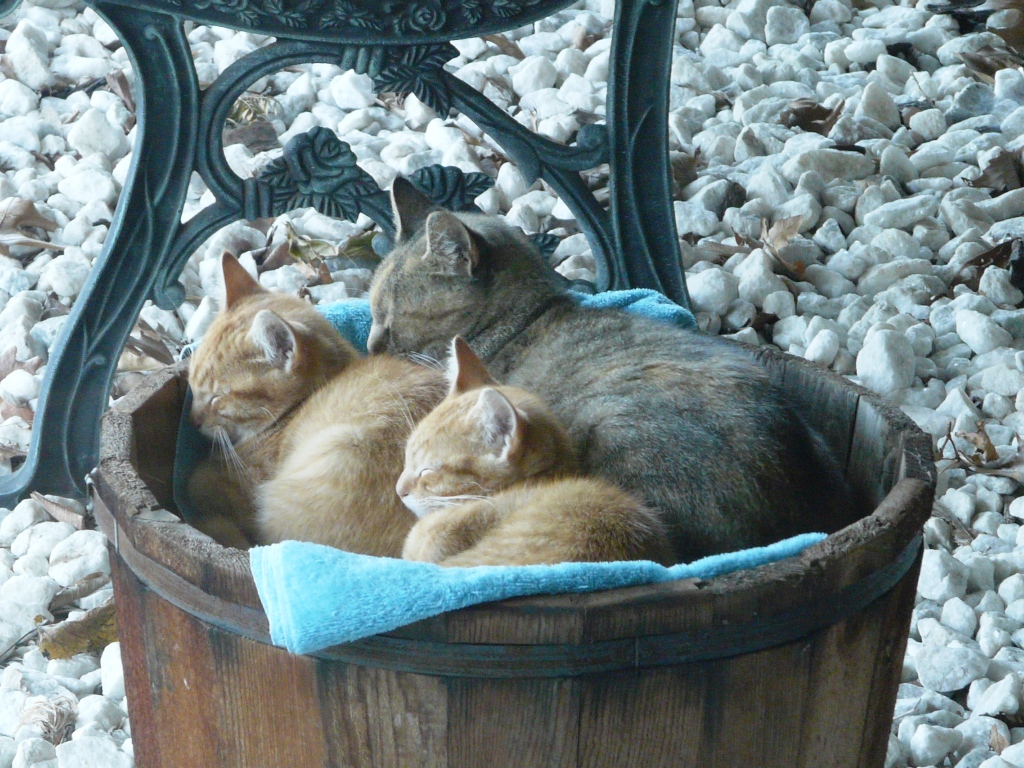
To make up for my silence of the past two weeks, I thought I'd post a cute kitty picture. The neighborhood strays like napping in the planter in our front yard.

Anyway, I've been dealing lately with a heavy workload at the library, HNR deadlines, and severe allergies to the local harvest (corn and soybeans). As a result I haven't felt much like blogging or even reading. I got 50 pages into one book I'd hoped to cover here, but ran out of time before another deadline hit, so had to put it aside temporarily.

In the meanwhile, book arrivals are piling up next to my desk.

You'll notice they're two deep - the pile further back includes everything I got at BookExpo Canada in June, as I'm totally out of shelf space. It's a problem.

Until I get my thoughts together for a real post, here are some historical deals from the last week, from Publishers Marketplace.

Oxford University Press editor Matt Gallaway's THE METROPOLIS CASE, the sweeping tale of unlikely quartet, bound together by the strange, spectacular history of Richard Wagner's masterpiece opera, Tristan and Isolde, to Suzanne O'Neill at Crown, by Bill Clegg at William Morris Agency (NA).

Julie Lessman's REFUGE FROM THE STORM, in which a privileged woman at first thrives on the glitz and glamour of The Roaring Twenties until her world crashes in the Great Depression forcing her to work with a man who is the bane of her existence, FAR FROM RUBIES, and BESIDE THE STILL WATERS, to Lonnie Hull Dupont at Revell, by Natasha Kern at Natasha Kern Literary Agency (World).

Bestselling author of Loving Frank Nancy Horan's new novel, again to Libby McGuire and Susanna Porter at Ballantine, in a major deal, by Lisa Bankoff at ICM (world). [no plot description available]

Award-winning author of The Physician of London and Marrying Mozart Stephanie Cowell's THE GREEN DRESS, a wonderful re-imagining of the tragic love story between the young, ambitious Claude Monet and his muse, Camille Doncieux, to Suzanne O'Neill at Crown, in a good deal, for publication in Spring 2010, by Emma Sweeney at Emma Sweeney Agency (NA).

Robin Maxwell's O, JULIET, O, JULIET, the follow-up to MADEMOISELLE BOLEYN and the forthcoming SIGNORA DA VINCI, in which the historical Juliet from Shakespeare's play is imagined as a young woman living in early Renaissance Florence during the rule of Cosimo de Medici, when inter-family warfare was at its bloody height, to Kara Cesare at NAL, in a very nice deal, by David Forrer and Kimberly Witherspoon at Inkwell Management (NA).

Julianne Lee's BLOODY MARY, about Mary Tudor, to Ginjer Buchanan at Berkley, in a nice deal, by Ginger Clark at Curtis Brown (NA).

Ariel Allison Lawhon's EYE OF THE GOD, the world's most spectacular museum heist, a cursed jewel, and a romance doomed to fail, all tied together with stunning historical fact, create the vast and intricate setting for the first-ever novel about the Hope Diamond, to Barbara Scott at Abingdon Press, for publication in Fall 2009, by Jonathan Clements at The Nashville Agency.

William Ryan's THE HOLY THIEF, first of historical detective series set in 1930s Russia, to Maria Rejt at Macmillan, in a good deal, in a three-book deal, for publication in spring 2010, by Andrew Gordon at David Higham Associates.

Monday, September 22, 2008

An interview with Andromeda Romano-Lax

Andromeda Romano-Lax's The Spanish Bow depicts, through the personal stories of two musicians, the complex, fraught relationship between politics and the arts over half a century of Spanish history. In 1898, when five-year-old Feliu Delargo chooses a cello bow from among the belongings of his late father, his life's path is set. His musical talent propels him from the small Catalan village of Campo Seco to Barcelona, where anarchist sentiments are in full swing, and later to the royal court in Madrid, where he becomes a favored musician of the queen.

Feliu forms a professional partnership with Justo Al-Cerraz, a flamboyant Spanish pianist who becomes his good friend and occasional rival. As they go on tour throughout Europe, their brilliant performances and associated fame bring them into the company of numerous famous names, from Pablo Picasso, Kurt Weill, and Manuel de Falla to Francisco Franco and Adolf Hitler. Their lives also become intertwined with that of Aviva, an Italian-Jewish violinist with a heartbreaking personal history.

A travel writer and serious amateur cellist, Andromeda writes in her Author's Note that she conceptualized this novel in the wake of 9/11, partly as a way of addressing the question on the value of art during difficult times. In this time of political strife, as artists of all types are motivated to make their political stances known (and weigh whether to do so at all), the themes of The Spanish Bow resonated strongly with me, and I expect others will feel the same. I enjoyed this absorbing, thought-provoking novel immensely and highly recommend it.

The Spanish Bow is newly out in paperback (Harcourt, $15.00, 560pp, ISBN 978-0156034098). The author's website is http://www.romano-lax.com/, and her blog touches on the topics of writing, reading, publishing, and politics from the viewpoint of an Alaska-based writer.

What made you decide to write a large-scale epic, one spanning over fifty years of Spanish history, as opposed to focusing on a single historical event?

Naivete, what else? But seriously, I always knew it would cover the lifespan of the main character, Feliu, beginning in 1898, when the Spanish Empire was crumbling, until at least the 1930s. The first image that came to mind was the image of an innocent boy running through the streets of his Catalan village, and the first voice was the melancholic voice of the elder narrator; I knew the story would bridge the two and contain the story of a musician’s life as well as a country’s passage through sometimes beautiful, often difficult times.

There's a theme running through the novel about the myth vs. the truth about Spanish history and culture (or cultures, I should say). For example, critics abroad ironically complain that Al-Cerraz's music and performances aren't "Spanish enough." Also, during his and Feliu's visit to Granada, he's disappointed to learn from Manuel de Falla that his Andalucian-influenced "Nights in the Gardens of Spain" was inspired by a brochure he read while in Paris. Was this one of your own goals in writing, to bring the real Spain and its history alive for those who don't know it, or who might have the wrong impression about it?

Thank you for pointing out what many reviewers missed, this thread about the stereotyping of Spanish culture and the impossibility of defining a single Spain. I wanted to help the reader unravel the images of “sunny Spain,” the Carmen-opera stereotypes (Carmen being written by a Frenchman, Bizet) and many other ironies and absurdities.

The cellist, Feliu (who is Catalan), is a small, somber man from a proud region that had a long history before a unified Spain existed. His friend and rival, the pianist Al-Cerraz, may be closer to what Americans expect of a Spaniard, being passionate and loud and funny. But he is also cursed by Spanish typecasting, and burdened by a commission to write an opera based on Don Quixote. In the end, Al-Cerraz succeeds as a composer by embracing the diversity of sounds and themes he has absorbed in his travels.

There is a lot more that could be said here, including the fact that the Spanish Queen in the novel, Queen Ena, is actually British-born, which doesn’t help her in winning the hearts of her people. Most of the characters in my novel aren’t “Spanish enough,” in one way or another. Among the Spanish Civil War’s many causes was the confusion Spaniards felt in their search for a strong national identity after their empire crumpled.

What were some interesting or surprising things you discovered during the research process?

Queen Ena’s story was one. She was the granddaughter of Queen Victoria, and she married King Alfonso XIII, an immature, playboy king who did little to stop Spain’s slide into chaos. The Queen Ena portrayed in the book (based on what I learned about her) is a sympathetic, stoic figure. I compare her to the sounding post (a wooden rod you find in a cello or violin): “Everything else could move, could vibrate, because she stayed in place.” In the novel, Feliu becomes her private musician, the one person who is allowed to glimpse her passions and her vulnerabilities.

Out of all the historical characters who make appearances - Queen Ena, Picasso, Kurt Weill, Franco, and others - who did you enjoy writing about the most?

I’ve mentioned Ena already, so let me say that I also had fun with some episodes involving Kurt Weill and Bertolt Brecht, who in the novel (as in life) put on a strange little German opera called “Der Jasager,” or “The Yea-Sayer.” It was a “teaching play” that toured German schools in the 1930s, with a story that was meant to make a very particular and somewhat confusing political point. When that point was misunderstood, there was talk of putting on a parallel production, “The Nay-Sayer,” to make the point more clear.

In the novel, I poke gentle fun at this idea of using music or art for such direct propagandistic ends, even though Weill and Brecht had the best of intentions. I think many readers probably thought I made up this minor storyline, but it was based strongly in fact and says quite a bit, I think, about how musicians and artists scrambled to come up with ways to fight Nazi ideology.

Although I'm not a musician, one of the aspects I appreciated most about The Spanish Bow was the vivid imagery with which you describe both listening to music and playing an instrument. The exuberance of the characters' performances come through; I especially enjoyed the scene in which Justo/El Nene and his trio perform at the young Feliu's school. Did you find it to be a challenge to write a novel about classical musicians that could appeal to all types of readers, regardless of their musical training?

There was always the danger of explaining too much or too little, of course. Throughout the novel, I describe music through Feliu’s sensibilities, so when he is a young boy, he can only compare the sound of the cello to things he knows, like tart lemons or bitter chocolate. Later, he can talk more knowledgably about techniques, composers, and so on.

But of course, all writers worry about whether they get things “right.” One happy moment for me was when a pianist who had just finished reading my book said, “How did you know?” She was referring not to how I described music in a technical sense, but how I captured the anxieties that professional musicians feel. Those emotions interested me the most.

In one scene, after observing American tourists' reaction to Picasso's Guernica, followed by his playing of Bach, Feliu concludes that visual art and music both have the power to influence public opinion, but in different ways. Do you feel that, at the time, musicians bore a different type of burden than other artists?

No, I think they all had the same burden. Artists had to decide whether their visual art would have political imagery that might send a particular message. (Picasso resisted this at first, then embraced it with his painting, Guernica.) Musicians, even if they played politically neutral music (if there is such a thing – actually, most music has a national character of some kind), still had to decide whom they played for. It just so happens that many dictators of the 1930s really loved the arts (can we imagine this now?) and wanted specific composers and musicians to play for them personally.

You've written that the character of Feliu was loosely based on Spanish cellist Pablo Casals, and Justo Al-Cerraz on pianist/composer Isaac Albéniz. Was there a similar historical inspiration for Aviva?

Aviva is a completely imaginary character, though one thing about her is based on fact: the idea that she did not want to leave Germany in the 1930s because, for a time, it was a very competitive and rewarding place for Jewish musicians to be, and if you left your German job you might not get it back. Even as the Nazis were gaining power, Jewish musicians were moving to Germany to take advantage of the opportunities there, and Nazi propagandists were delighting in showing them off, as proof of their own tolerance (a temporary tolerance, of course). It’s a frightening thought.

Spanish settings are seeing a renaissance in historical fiction now, but when The Spanish Bow was first published last year, they weren't quite so common. When you were trying to get published, how did agents and editors initially react to the setting and scope of your novel? Do you have a feel for why other writers might be turning to Spain for inspiration at this point in time, and why publishers are following suit?

I’ll make a few guesses. The Shadow of the Wind by Carlos Ruiz Zafón was published before The Spanish Bow, and that may have helped. But more significantly, I think this is just the right time to take a look at Spanish history, which was veiled until recently by a national desire to forgive and forget the bloody, fascist past. Franco outlived all the other European dictators, and cast a long shadow. I don’t think Spaniards have had the same national reckoning that countries like Germany had, post-Hitler.

Having said all that, I think my publisher was less interested in the specific setting than in the book’s emotional arc, and its celebration of music and art during difficult times. I personally hope that readers interpret it as a story with modern relevance, almost eerily so. Struggling, confused countries – especially ones losing international power or embroiled in unpopular wars – often resemble each other, regardless of the time period. And people everywhere face the difficult choice of whether to face or hide from the turmoil around them.

Sunday, September 14, 2008

Roundup of various things

It's been a quiet Sunday in central Illinois - Ike has come and gone, scattering leaves and branches all over the front yard and splitting two more of our trees in half. There's nothing else really significant to report here, though I figured it was time I posted some more deals and other news.

Occasionally I get comments on older posts. Recently, someone left a comment on my review of Diana Norman's Fitzempress' Law (from 11/06) asking about the meaning of the book's last line. I gave it a shot, but if you've read the novel and have a better answer, please reply at the end of the earlier post. I'm amused that when you google for Diana Norman, that review comes up #2, even before Wikipedia. Per my blog stats, there are an awful lot of people looking for reviews of her books.

Also, my post about novelist Alice Borchardt seems to have become a virtual guest book for some of her fans, who hadn't heard of her passing.

Fountain City Publishing will be reissuing nine classic historical novels by Lawrence Schoonover, beginning with The Queen's Cross, a novel about Isabella of Castile (out this month). Publisher George Scott is Schoonover’s great-nephew.

The Jewel of Medina, to be published next month in the US by Beaufort Books, has an official website. Not much is there yet.

And three recent historical novel deals, as reported by Publishers Marketplace. My comments in brackets.

Brandy Purdy's VENGEANCE: A NOVEL OF JANE BOLEYN, the fictional retelling of the Boleyn saga by Jane, the other, "other Boleyn girl," as she sits in the Tower of London awaiting her execution at the command of Henry VIII for her jealousy-driven betrayal against family and country, to John Scognamiglio at Kensington, in a nice deal, by Nicholas Croce at The Croce Agency (World). [Previously published by iUniverse as Vengeance is Mine.]

Tracy Barrett's KING OF ITHAKA, the events of Homer's Odyssey as seen from the perspective of Telemachos, who, with his two best friends - one of whom is a centaur - undertakes a quest to find his father Odysseus and, in the process, moves from indolent, privileged youth to the beginnings of responsible adulthood, to Reka Simonsen at Holt, in a nice deal, by Laura Rennert at Andrea Brown Literary Agency (World).

Cecelia Holland's THE SECRET HISTORY OF ELEANOR OF AQUITAINE, the intriguing and sensual life of one of history's most fascinating queens, to Susan Allison at Berkley, for publication in Spring 2010, in a two-book deal, by Susanna Einstein at LJK Literary Management (NA). [Wow. The choice of subject took me by surprise, and with the switch to a new publisher, this means we'll be seeing her books in stores once again. All good.]

Friday, September 12, 2008

And the giveaway winners are...

Elizabeth Kerri Mahon, Laura from Alabama, and Gwendolyn from Rhode Island!

Drop me an email with your mailing addresses if you haven't already sent them in, and I'll send the information off to Christine. Hope you enjoy the books and goodies. Thanks to everyone who entered the contest!

Monday, September 08, 2008

An interview with Christine Blevins

I'm pleased to present this interview with debut historical novelist Christine Blevins. We have a giveaway this time, too; more details at the end of the post.

Christine Blevins's Midwife of the Blue Ridge follows Maggie Duncan, a midwife and healer, from her youth and apprenticeship in the Scottish Highlands through her adventures in the American colonies. In 1763, shortly after the ship carrying Maggie and her fellow immigrants arrives in Richmond, Virginia, she becomes the indentured servant of Seth Martin, a backwoodsman living with his family at the foothills of the Blue Ridge Mountains. Seth sorely needs her assistance in caring for his pregnant wife, Naomi, whose health is fragile.

Maggie's journey brings her into contact with people from many different backgrounds: Palatine Protestant immigrants, native Virginians, Shawnee Indians, African American slaves, and a nasty English nobleman, among others. As Maggie struggles to survive in the dangerous, primitive land she now calls home, her growing romance with rugged longhunter Tom Roberts is complicated by his reluctance to settle down. One of the aspects I enjoyed most about Midwife was how it conveyed the precariousness and occasional brutality of life on the frontier. Although it's not a military novel, the shadow of war – the recent French and Indian War in the colonies, and the Battle of Culloden years earlier in Scotland – informs all of the characters' experiences.

Readers of this blog know how much I enjoy colonial American settings, so I couldn't resist asking Christine if she'd like to do an interview. Midwife of the Blue Ridge was published in paperback this August by Berkley ($14.00, 414pp, 978-0-425-22168-6). Her website is http://www.christineblevins.com/.

The novel has Maggie set out with her new master from Richmond over a seven days' journey to the foothills of the Blue Ridge Mountains, and I'm wondering where, approximately, that would be on one of today's maps. Is Roundabout Station based on a real-life fort of the time?

I imagined the station was around or about where the present day town of Wytheville, Virginia, is located. Roundabout Station is a fictional fort, but it is based on typical frontier forts in structure and use.

On your website, you mention that Tom Roberts was inspired by two of your husband's ancestors who were longhunters on the Blue Ridge. How did you go about researching them, and him?

When my husband Brian and I were researching the Blevins line – trying to find the first Blevins who came over the water – we proceeding in the standard way of finding birth, marriage and death records. Of course the farther back you go, the trickier it gets – especially once you venture into places and times without formal government structure or established churches, and we ended up getting stuck six generations back, with Elisha Blevins, born in Virginia colony, 1752.

While researching census records at the Newberry Library here in Chicago, we stumbled upon mentions of Jack and William Blevins in a few history texts. Jack and William were a father and son team of hunters, who were among the first white men to venture through the Cumberland Gap. Though we were never able to solidly connect our Elisha Blevins with these two longhunting Blevi, genealogically, I became intrigued by and connected to this time and place in colonial American history that I did not know much about.

In further research on the longhunter lifestyle, I was captivated by a memoir originally published in 1799 titled An Account of the Remarkable Occurrences in the Life and Travels of Col. James Smith During his Captivity with the Indians, and by a lot of the biographical information on Daniel Boone (the most famous longhunter). The Tom Roberts character ended up being a composite of William Blevins, James Smith and Daniel Boone.

How did you develop Maggie's character? For example, why did you decide to make her an indentured servant from the Scottish Highlands?

As I researched the longhunters, I learned Will Blevins had a sister named Susannah, who was married to a longhunter named Elisha Walden. A longhunter might be gone for a year, sometimes two years at a time, and I began to imagine what it must have been like for a woman like Susannah Blevins, left alone with children and a farm to tend, out in the middle of nowhere. The longhunters drew me onto the frontier, but their women kept me there.

In order to be able to cultivate the love story I had in mind, my female character needed to be a single woman, living out on the frontier – which limited me to a frontiersman’s daughter, widow, or servant. For me it was an easy choice – an indentured servant is by definition a most desperate character, and the stuff of good fiction.

Making Maggie an immigrant was also a way for me to insert a bit of my own family history into the story. As a first generation American, I have an understanding of the forces that move people to migrate over great distances – war, poverty, persecution – and I know living through the horror of war, losing family, disconnecting from the familiar and traveling into uncertainty – these things build independence, strength and determination, qualities Maggie needed to survive.

As for Maggie Duncan coming from Scotland – that happened to fit the immigration pattern for the time, and also my penchant for things Scottish. My husband calls me a wannabe WASP.

Given the subjects of Midwife and the forthcoming The Tory Widow, do you have a special interest in women's lives in American history?

I have a special interest in both men’s and women’s lives in history, which is why I love to read historical fiction, set in most any time and place. My strong affinity for American history was developed through childhood – a quest to find American roots of my own. I find knowing and understanding America’s past connects me to my country.

And I guess because I am a woman, I more drawn to the lives of women – especially average women – a frontier wife like Susannah Blevins, or a printer’s widow who carries on with business during the Revolution – the kind of women whose stories tend to get lost in history.

What is it about life on the early American frontier that attracts you?

The adventure and desperation of living on the edge.

The novel takes place in a few different settings: Scotland, a backwoods settlement in Virginia, a stockade fort, and a Shawnee village. Which locales (or scenes) did you find the most enjoyable to research? The most challenging?

I find the research is always enjoyable – but I would say researching the information to write the Shawnee portion of the story was the most challenging.

I expect readers will absorb a lot about frontier medicine from Maggie's experiences as healer. Did you have interest or expertise in herbalism before beginning your novel?

No, I didn’t have any special expertise, or interest in herbalism until I decided to make Maggie a midwife. 18th century midwives were akin to physicians, especially on the frontier, where doctors were few and far between. These women were called upon to do much more than deliver babies – they were vital members of the community. Once I dove in, I was hooked – herbal birth control, painkillers, anesthesia – dealing with fevers and infection before the advent of antibiotics –surgical methods – it became a challenge to fit it all into the story.

The characters' backgrounds are readily identifiable by their speech patterns and vocabulary. (For example, I hear "warsh" for "wash" often in downstate Illinois, too.) How difficult was it to re-create their dialects on the page?

The dialects and speech patterns kind of sprout up from each individual character, based on his or her back story. I do read a lot of letters, narratives, poetry, and song lyrics, from the time, which helps me to get a certain rhythm. Maybe being bilingual and growing up around people with accents helps me in determining the speech patterns – I don’t know. I will not claim to have re-created how an 18th century Scotsman or Virginian actually spoke – but I did my best to convey the differences in backgrounds. In truth, if I wanted to be historically accurate, Maggie should have been a Gaelic speaker with little or no English, but I was afraid her having to learn English would bog the pace of the story, so I used a little literary license in that instance.

Midwife of the Blue Ridge contains many vivid descriptions of day-to-day life on the American frontier; all of the little details gave me a good mental picture of what the characters were seeing and experiencing. Do you feel that your background as a graphic designer influences your writing in this respect?

I think the ability to visualize helps me as much in graphic design as it does in my writing.

What other historical novels are your favorites? Are there any authors whose work you admire above others?

Oy, this question is so difficult… A very brief listing:

As a kid, some of my favorite books were the Little House series, and books by Louisa May Alcott. I graduated to Bronte, Dickens, Dumas and Sabatini. Fraser’s Flashman books are fun and Clavell’s Shogun is a huge all-time favorite of mine.

To include some authors who are still among the living, I can say I very much enjoy and admire the writing and storytelling in Sarum by Edward Rutherfurd, The Dress Lodger by Sheri Holman, The First Man in Rome, by Colleen McCullough, The Crimson Petal and the White by Michel Faber, Outlander by Diana Gabaldon, Steven Saylor’s mystery series featuring Gordianus the Finder, and I love Bernard Cornwell’s work, especially the Arthur Trilogy, and the Starbuck Chronicles.

There are many, many more, but I don’t want to hog up your blog.

At the last HNS conference, several agents reported (to my regret!) that American settings don't sell, yet you've been successful with not only one but two novels fitting this description. What advice, if any, would you give other historical novelists interested in so-called unfashionable locales, either in early America or elsewhere?

I attended the conference having just signed my two-book deal with Berkley a few weeks before, and since the agent who made that pronouncement in her speech was the author of one of the rejection letters in my ginormous pile of agent rejection letters. I’ll admit to feeling a little smug at first.

But really, I so dislike these kinds of general and inaccurate statements. I know stories with British settings are doing quite well, but Water for Elephants, The 19th Wife, The Lace Reader, The Heretic’s Daughter – to name a few recently published examples – are proof that some editors are not only buying books with American settings, they are realizing great success as well.

Over the course of the HNS conference, I met quite a few writers disheartened by this agent’s pronouncement, and I was happy to be able to act as the poster child for American settings, and offer encouragement and hope. I can’t imagine writing to a trend – though I know people do – but since I feel the market will support great storytelling and strong writing, no matter the time, place or culture, the only advice I can give is this: write the story you have a passion for writing, and then find an agent who loves it and believes in it as much as you do. It’s not easy, but it is possible.

And from Sarah, again: Thanks, Christine, for taking the time to do this interview!

We also have a special giveaway contest. Christine will be providing signed copies of Midwife of the Blue Ridge, along with some related goodies, to three randomly selected blog readers. To enter, either leave a comment on this post, or email me at sljohnson2@eiu.edu with "Midwife" as the subject. This contest is open to everyone regardless of location. Deadline is the end of the day this Thursday, Sept. 11th, with winners to be announced on Friday.


Saturday, September 06, 2008

Reviews of obscure books:
Brigid Knight's The Cloister and the Citadel

Knight, Brigid. The Cloister and the Citadel. London: Hutchinson, 1958. 236pp. Hardbound.

Charlotte de Bourbon’s short, dramatic life seems ideally suited to fiction. A French princess pledged to the convent from childhood, she became a reluctant abbess at age twelve, converted to Calvinism, fled to Germany, married a man who became a national hero, bore him six daughters in seven years, and died of exhaustion after nursing him back to health after a failed assassination attempt. So why has hardly anyone heard of her?

I picked up this book because I’ve enjoyed some of the author’s previous novels about Dutch history, and because it was on a subject I knew next to nothing about. Brigid Knight is or was, I believe, a British novelist, the pseudonym of Kathleen Henrietta Eve Sinclair. During the mid-20th century, she wrote a collection of novels set at various points in the history of the Netherlands, from the time of the Reformation through the later years of its South African colony. The Cloister and the Citadel centers on a little-known Renaissance princess, Charlotte de Bourbon-Montpensier (abt. 1546-1582), and her marriage to William “the Silent,” Prince of Orange and Count of Nassau. Known today as the founding father of the modern Netherlands, William had the dubious distinction of being the first head of state to be assassinated by a handgun, an event recounted in Lisa Jardine’s The Awful End of Prince William the Silent (2006). Through their eldest daughter, Louise Juliana of Nassau, Charlotte and William became the great-grandparents of Sophia, Electress of Hanover, mother of George I of England and ancestress of the British royal family.

Charlotte was the daughter of Louis de Bourbon, Duc de Montpensier, and Jacqueline de Longvic (Longwy). I’ve been trying to determine Charlotte’s exact relationship to the French monarchs of her era, though haven’t yet found a family tree that shows the complete Bourbon genealogy. Knight’s version of her life story begins in 1559, when twelve-year-old Charlotte, raised in the convent since infancy, is forced by her parents to become Abbess of Jouarre after the death of its previous abbess, her aunt Louise. Denied a dowry and seeing no other choice, Charlotte accepts the formal ring of office, despite her insistence that she has no vocation. Still, she holds back from taking formal vows. Thus begins the most fascinating part of the novel. Charlotte successfully governs her flock, despite her reluctance to play the role of abbess. Many times she attempts to obtain a dispensation to release her from the convent, though they all fail. Over time, she comes to accept Calvinist doctrine as the one true religion, which leads to her boldest act. At age eighteen, after considerable planning to ensure her safety and that of her flock, she flees Jouarre for Heidelberg, where she takes sanctuary with Frederick, Elector Palatine, and his wife. It’s in Germany where she meets William of Orange and becomes his third wife. This creates an enormous scandal not only because of Charlotte’s status as a “runaway nun,” but because of William’s own marital woes. His second wife, Anna of Saxony, is a mentally unstable woman who had an extramarital liaison and illegitimate child with Jan Rubens, her lawyer. (After his release from prison, Rubens returned to his faithful wife, which resulted in the birth of Peter Paul Rubens.) William’s marriage to Anna is soon annulled, a fact that Anna’s relatives refuse to accept.

The novel proceeds in measured fashion, recounting Charlotte and William’s brief courtship, their long separations while he leads the Dutch uprising against the Spanish, his negotiations with France in support of his goal, and the births of their six daughters. Although we never see any military action firsthand, Knight goes into considerable detail on the historical backdrop, such as the growing Huguenot influence in France, the Sea Beggars’ raids against Spanish squadrons along the Dutch coast, and William’s dogged pursuit of a united Netherlands. Many Renaissance-era notables play significant roles, from Jeanne of Navarre, a confidante and mother figure for Charlotte in matters of religion, to Catherine de Medici, Queen Mother of France, whose respect Charlotte earns after she stands up to her parents. Knight is particularly good at explaining the complex relationships between France, the Netherlands, and their respective leaders. She drifts back and forth from fiction to nonfiction and back again, sometimes relating typical scenes with characters and dialogue, other times recounting the history straightforwardly. She shifts from close third person to omniscient viewpoint with increasing regularity as the novel continues, though occasionally swoops back in to recount emotional scenes more intimately. Some of the characters' actual letters, in English translation, are reproduced verbatim, in a way that enhances their fictional personalities. Per the author's notes, the archives at l’Abbaye de Jouarre proved a gold mine in terms of primary research sources.

Despite the odd stylistic changes, the strangest thing about it is how readable the novel is anyway, and I credit the history itself for that. Although Charlotte and William’s relationship is highly romanticized, and their personalities grow steadily more idealized, I can’t say I was ever bored. Their personal and political stories are gripping in themselves. To readers today, its style may seem old-fashioned, but I came away from it enlightened about a historical period underutilized in fiction, and in nonfiction for that matter.

For more reviews in the "obscure books" series, click on the tag below.

Wednesday, September 03, 2008

An interesting UPS delivery

No, this isn't directly book-related, but...

I keep a large bin by the front door for UPS and FedEx to leave packages in. It's used mostly for review book shipments. This morning, two of the neighborhood kittens decided to use it as a napping place.

And that's our cat Callie, peeking out the front door at them, looking very annoyed and jealous.

Sunday, August 31, 2008

The deals are piling in...

Anyone read Spanish or Portuguese?

Brazilian rights to Sherry Jones's THE JEWEL OF MEDINA and A'ISHA AND ALI, to Luciana Villas-boas at Editora Record, by Natasha Kern at Natasha Kern Literary Agency.

Spanish rights to Sherry Jones's THE JEWEL OF MEDINA, to Lucia Luengo at Ediciones B, in a very nice deal, for publication in early spring 2009, by Natasha Kern at the Natasha Kern Literary Agency.

Here are some others from Publishers Marketplace over the last two months.

Ellen Horan's 31 BOND STREET, interweaving fiction with actual events surrounding the infamous murder of Dr. Harvey Burdell and the subsequent trial of his housekeeper and lover Emma Cunningham, a historical narrative that blends romance, politics, greed and sexual intrigue, set against the background of bustling, corrupt New York City, four years before the Civil War, to Jonathan Burnham and Claire Wachtel at Harper, in a major deal, for seven figures, in a pre-empt, for two books, by Marly Rusoff at Marly Rusoff & Associates.

Oxford-born Claire Letemendia's debut THE BEST OF MEN, a historical novel in the vein of THE DRESSLODGER and AN INSTANCE OF THE FINGERPOST, set in 17th Century England and Spain, introducing the a nobly born mercenary, spy and cardsharp who, having lost both his honor and faith in mankind, uncovers a plot to kill Charles I and is drawn against his will into helping the one last political figure he respects, to McClelland & Stewart, by Sam Hiyate at The Rights Factory.

The House at Riverton and The Forgotten Garden author Kate Morton's THE DISTANT HOURS, a historical mystery of wartime romance, broken promises and almost-forgotten secrets, to Maria Rejt at Pan Macmillan, in a major deal, in a two-book deal, by Julia Lee at Allen & Unwin.

Michelle Cameron's SHIRA OF ASHKENAZ, about the daughter of one illustrious rabbi and then wife of another, following three generations of the heroine's family as they move from Falaise to Paris and then to Rothenberg, amidst the growing anti-semitism of 13th century Europe, to Maggie Crawford at Pocket, for publication in fall 2009, by Judith Riven at Judith Riven Literary Agent (world). [edited to correct title]

Leila Meacham's ROSES, Spanning the 20th century, following three generations of Texans in a small town dominated by founding families who control the timber and cotton industries and whose deceits, secrets and tragedies are a part of the town's history, to Deb Futter at Grand Central, for publication in January 2010, by David McCormick at McCormick & Williams Literary Agency.

And from Publishers Weekly:

Adam Schell's Tomato Rhapsody: a Tale of Love, Lust, and Forbidden Fruit sold to Kate Miciak and Nita Taublib at Bantam, in a pre-empt, via Laurie Fox at Linda Chester. The debut novel, set in 16th-century Tuscany with a Romeo & Juliet-style love story, is based on the true story of a Jewish man on Columbus's second voyage who brings the tomato from the New World to Italy.
Also, for those interested in my reusable cover art gallery, people have been spotting additional examples and sending them to me at the rate of one or two a week. Take a look for a creative interpretation of Flaming June and yet another reuse of the "bed in the water" image.

Thursday, August 28, 2008

A sidenote on Medina

I read this morning via GalleyCat that, because of Random House's decision not to publish The Jewel of Medina, the Langum Charitable Trust will not be accepting any Random House novels for consideration for either of its prizes until Jewel finds a publisher.

The press release is here. (Does this include Jewel's publication in Denmark, I wonder? It's not clear.)

Jewel wouldn't have been eligible for their historical fiction prize, which is open only to novels with American settings (self- and subsidy-published books excluded). Kurt Andersen's Heyday, from Random House, won the $1000 prize for 2007. There are very few literary prizes just for historical fiction, and the Langum Prize goes far in increasing visibility for the genre; I'm appreciative of its existence.

However, I disagree with the decision to penalize Random House's other historical novelists for a corporate decision they had nothing to do with. Not only would this eliminate, as GalleyCat points out, David Liss's The Whiskey Rebels, David Ebershoff's The 19th Wife, and Jane Kamensky and Jill Lepore's Blindspot from consideration, but also Karl Iagnemma's The Expeditions (from Dial) and Hannah Tinti's The Good Thief (Delacorte) -- both of which have been receiving excellent reviews. There are other Random House novels that fit the prize criteria as well.

While I don't agree with RH's decision regarding Jewel, I don't feel that this blacklisting is a particularly laudable or appropriate form of protest.

Sunday, August 17, 2008

More new stuff

It took a few days to gather all this information, but I've finally gotten the HNS forthcoming books page for 2009 started, with titles through next May. The Editors' Choice reviews for August's print HNR are online now, too, as are all of the reviews for August's HNR Online. I still don't have the ToC for the print issue typed in; it's a big job, and after all the posting I've done lately, my wrists are tired! HNS members should be getting their August issue this week or next.

Friday, August 15, 2008

A visual preview of the winter season, part 2

Here's a preview of some more historical novels scheduled to come out in winter and spring; same disclaimers apply as last time. For corrections, leave a comment or send me an email, and I'll update the page. I'm still working on the corresponding listing for the HNS forthcoming books page, which will be more comprehensive. In the meanwhile, enjoy!

Vesuvia Adelia Rachel Ortese Aguilar returns in a third installment of the Mistress of the Art of Death series. This time she's at Glastonbury Abbey, investigating whether bones found there in 1176 are really those of Arthur and Guinevere. Putnam, February.

Grace Plantagenet, illegitimate daughter of Edward IV, has the ideal position at court to listen and learn about Perkin Warbeck, the man claiming to be her half-brother. Grace is a shadowy historical character, mentioned in passing as being present at Elizabeth Wydville's funeral. Ah, now we know where the title comes from! Touchstone, March.

From an expert on Japanese culture (Lebra was the first woman to receive a PhD in Japanese history in the US), a new novel about a 19th century Japanese woman who builds the largest sake empire in the country during an era when women were forbidden to do business. Avon A, February.

Higgs returns to her trademark Scottish settings with a retelling of the Old Testament story of Ruth, set against the backdrop of 1745 Edinburgh. Her novel Thorn in My Heart, the first novel in her earlier Scottish trilogy, retells the Leah-Jacob-Rachel triangle in the Scottish lowlands of the 1780s, and is one of my all-time favorites. WaterBrook, March.

You know the Jane Austen craze has gotten serious when a novelist as distinguished as McCullough joins the party. This P&P sequel promises something different from the usual Regency romance theme: "a look at the seamy underside of British life in the early 19th century" and a chance to see what may have happened to Elizabeth Bennet's plain and nerdy sister, Mary. Simon & Schuster, December.

A literary thriller about the secret double life of Charles Dickens, which may reveal the truth behind his unfinished final novel, The Mystery of Edwin Drood, as recounted by his friend, writer Wilkie Collins. (Thanks to John for mentioning this novel in the comments last time.) Little Brown, February.

A historical thriller detailing the adventures of a penniless orphan in Renaissance Venice. Read the article from Forbes Online detailing how Newmark garnered online buzz for her self-published book, which was later sold to Simon & Schuster in a major deal. The previous title was Bones of the Dead, and some hopeful person is selling the original IUniverse edition for $199.00 on Amazon, if you really want to read it now. Atria, December.

"A poignant family saga set against the backdrop of the Great Irish Starvation," tracing the Irish-American experience from Galway Bay in Ireland to the frontier town of Chicago, written by a descendant of survivors of the famine. From Grand Central, February.

A novel illustrating the birth of Islam, written by a Hollywood screenwriter, as seen from the viewpoint of the Prophet's young wife, Aisha. I reported this deal, along with the one for Sherry Jones's A'isha, Beloved of Muhammad (later retitled), to little fanfare back in September 2007. Per the official word received via Galleycat, Simon & Schuster has "no intention to change [its] publishing plans" following the Jewel of Medina controversy. That's as it should be, imnsho. From Atria/S&S, April.

A mix of family saga, satire, and magical realism spanning five generations of Chinese women, beginning in the 1950s, described as "one of the foremost works of Chinese literature of the 20th century." Atria International, February.

A biographical novel of Jane Popyncourt, a member of the royal court of Henry VIII and mistress to the Duc de Longueville. I know I've said I'm tired of the Tudors, but I'll read this one, as it focuses on historical figures who are unfamiliar to me - and I've enjoyed her other novels. The author is Kathy Lynn Emerson writing under a pseudonym, of sorts. Pocket, February.

A sweeping story of Jamaican slavery in the tradition of Beloved, says the publisher, focusing on a young slave woman on a sugar plantation at the turn of the 19th century who may either be the key or the weak link in other women's plans for a slave revolt. Riverhead, February.

A very different retelling of the Tristan and Isolde legend, with Isolde as daughter of Mordred and granddaughter of Morgan le Fay. First in a new Arthurian fantasy trilogy. Touchstone, May.

Monday, August 11, 2008

Book done.

Eighteen months, 2750 citations/annotations, and 244,000 words after I began working on my manuscript in February 2007, Historical Fiction II: A Guide to the Genre is finished. It''ll be available next spring, as far as I'm aware.

If you hear a thud in the next couple of days, it's me collapsing after carting the manuscript over to UPS. I've just printed it out and am going through it page-by-page, creating the table of contents and making note of unfamiliar words for the style sheet.

Anyway, I'm feeling a little numb and disorganized, but there are a couple other things I should mention before I forget.

We're soliciting speakers for the next Historical Novel Society conference, to be held June 12-14, 2009, in Schaumburg, IL. The link goes to our proposal form. If you're already on one of the HNS email lists, you'll already know about this, but the Board wants to get the word out as widely as possible.

Vanessa from Arrow Books (UK) recently commented on an old Jean Plaidy-related post from Oct 2006, as follows, with some news you might find interesting:

Defenders of the Faith and The Scarlet Cloak (along with the Lucrezia Borgia novels Madonna of the Seven Hills and Light on Lucrezia) in June 2009. We'll also be reissuing the last six titles in the Plantagenet series in the same year.
I bought Defenders about ten years ago from an eBay seller, paying around $35. I haven't read it yet. Maybe I should have waited?

Sunday, August 03, 2008

A visual preview of the winter season

Some publishers have begun to release information on their Winter 2009 titles. Most don't have cover art available yet, at least not publicly, but these are the ones I've come across so far. All of these images were taken from publishers' online catalogs or Amazon, and are subject to change. You'll remember what happened with Devil's Brood.

For some, all I could find were b/w images. Leave a comment if you come across newer versions of these covers. In the meanwhile, enjoy.

The story of Delia Chandler, a Southern girl who marries into the British aristocracy, following her from pre-WWII England to British-occupied Egypt. Broadway, March; to be published in the UK by HarperCollins as A Dangerous Desire.

From Revell in March, inspirational biographical fiction about King David's first wife, book 1 in a series.

Mythological novel about "Deirdre, the Irish Helen of Troy, whose beauty ignited a bloody war between two medieval Irish kingdoms" (Publishers Marketplace). From Bantam Spectra in February, from the author of the Dalriada Trilogy set in Roman-era Scotland.

A female perspective on the American Revolution, not a subject you normally get to read about (and for me, different = good). From Berkley in April, from the author of Midwife of the Blue Ridge.

Frank Lloyd Wright, through the eyes of four women who loved him (not just Mamah Cheney, for readers who remember Nancy Horan's take on that aspect of his life). Viking, February.


The story of Caterina, a fifteen-year-old girl who in 1452 gave birth to an illegitimate son named Leonardo in the city of Vinci. January, from NAL. In the endpapers of Mademoiselle Boleyn, it was mentioned this would be Robin Maxwell's next novel.

Biographical novel of Anne Whateley, betrothed to Will Shakespeare just days before he was forced to wed the pregnant Anne Hathaway. Putnam, February.


Did anyone else enjoy Margaret Lawrence's Hannah Trevor mystery series, three novels set in post-Revolutionary Maine, as much as I did? There was a sequel, The Iceweaver (2001), featuring Hannah's deaf daughter Jennet, more a literary novel than a mystery. I believe Roanoke is her first novel since then. It's described by the publisher, Bantam Dell, as a literary suspense novel about the lost colony of Roanoke and a charismatic spy sent to the Americas. Out in February. The glittery cover makes it look like more like historical fantasy.

Publishers Marketplace described this last fall as "a historical novel set in Hong Kong, at the outbreak of WWII, and 10 years after, following two love affairs linked by the events of the war." From Viking, January.


Per Publishers Marketplace, the original (working) title was "The Battle of Teutoberg Forest," which was accurate if uninspired. Fans of the period will recognize the new title, but will anyone else? Either way, it's an attention-grabber. From St. Martin's, April. (b/w image)

From the author of Moloka'i, which got a rave review in HNR some time ago, a new novel about a "young immigrant bride in a ramshackle town that becomes a great modern city." Set in Honolulu beginning in 1914. St. Martin's, March (b/w image).

An imagined life of Eve, the first woman, inspired by the Genesis account and Mesopotamian history. February, Delacorte.

Historical fantasy from the author of Black Ships, which I highly recommend. "Charmian is Cleopatra's half sister, daughter of Pharaoh and a woman of the harem. She shares with her a grace and a terrible burden -- to be the Hand of Isis Incarnate in Egypt's most desperate hour." From Orbit next March.

Two years ago, Publishers Marketplace described this as "first in series of historical thrillers in which the painter Gustav Klimt is fingered as the murderer of five young Viennese girls, but ... the trail actually leads directly to the gates of the Hofberg itself." January from Thomas Dunne/St. Martin's (b/w image).

Repackaged edition of the first novel (originally Berkley, 2003) in Diana Norman's Makepeace Burke trilogy set in pre-Revolutionary Boston and Georgian London, now that Norman's finally getting the recognition she deserves for her Ariana Franklin novels. Out in March from Berkley. Now might we have reissues of Fitzempress' Law and Shores of Darkness, please?

Friday, August 01, 2008

Book review: Barbara Wood's Woman of a Thousand Secrets

Wood, Barbara. Woman of a Thousand Secrets. NY: St. Martin's Griffin, Sept. 2008. 483pp. $13.95, trade pb, 978-0-312-36369-7.

Reviewed for LibraryThing's Early Reviewer program (it's not out until next month).

In Barbara Wood’s colorful followup to Daughter of the Sun (2007), an “island girl” from pre-Columbian times sets out on a quest which takes her from the burgeoning metropolis at Mayapan to the rainforest jungles of Tikal (modern-day Guatemala) and finally westward to the Mexican interior.

Twenty-one years ago, an elderly couple living on Pearl Island, off the Cuban coast, took in a baby they found floating in a waterproof basket. Although tall, light-skinned Tonina enjoys swimming through the island’s gentle lagoons and is beloved by her adoptive grandparents, local men find her unattractive and are humiliated by her success in pearl diving. It becomes clear she’ll never fit into their society, so her grandmother, Guama, invents a story about her husband’s illness as a way of convincing her to leave voluntarily. Landing on a deserted beach after jealous rivals attack her party’s canoe, Tonina gathers up her travel pack containing food, medicine, coconut face paint, and a mysterious glass goblet and marches inland in search of the red healing flower that will cure her grandfather. During her adventure, she encounters many people, places, and customs she finds unfamiliar and exotic. Her search assumes near-religious proportions to the followers she attracts, among whom are the trader One Eye, a crafty dwarf, and H’meen, a young healer aged before her time. But none becomes as important to Tonina as Kaan, a ballplayer of common birth who disdains his outsider origins to gain acceptance by the Mayans. Kaan’s own sacred pilgrimage is destined to separate them eventually, yet he’s honor-bound to accompany her at first. There’s also an egomaniacal villain, of course, though he’s not nearly as well-rounded as the other characters.

Tonina’s journey immerses readers in the diverse cultures of the place and period, and the plot develops organically out of Wood’s vividly rendered settings. The historical detail is woven smoothly into the story, for the most part. Some commentary meant to provide external context is distracting: for example, we’re told that in the land of the goblet’s origin, it’s the Year of Our Lord 1323, and that the islanders’ lives will change irrevocably 200 years hence. Because many such examples occur early on, the novel takes a little while to settle into, but it’s a fascinating journey from that point forward. Readers who picture pre-Columbian Mexico merely as a land of bloodthirsty sacrifices and magnificent stone ruins will see both of these, but will also discover much about politics, religious ceremonies, clothing, roads, dwellings, calendars, even sports. Wood makes clear that many different ethnic groups populated the region, though some shared a language or other customs. Many plot twists are completely unexpected; Tonina’s mission alters slightly at several points in the narrative. Some events can’t be explained by traditional Western reasoning, but feel appropriate to the setting. The novel has plenty of lively humor, too, particularly in a certain hammock scene.

An absorbing, immensely enjoyable fictional travelogue through the lush scenery and multifaceted civilizations of ancient Mesoamerica, with, perhaps, room left for a sequel.