


In my efforts to be way ahead of my deadlines for a change, this is my first chance to blog for a while. Seems everyone has a "life trumps blogging" post every so often, no? In the last week I've read three novels and written reviews for six. Vanora Bennett's Portrait of an Unknown Woman, which will get a full writeup in my May NoveList column, is my pick for the current season. To my mind it's comparable to Sharon Kay Penman at her best, and Penman's one of my favorite authors.
The snow's still hanging around, though it may hit 40 today, which means a muddy, slushy mess in our immediate future. This photo (taken by Mark) of our backyard over the weekend is pretty funny.
Some historical bits and pieces.
On her website, Joan Druett - author of the Wiki Coffin maritime mysteries set in the 1830s - offers a contest: who can find the most technical errors in the cover design of her latest, Deadly Shoals? Even if you're a landlubber like me, you can discover clues by reading the first chapter, which is online.
A couple Publishers Marketplace deals:
Author of THE BLOOD CONFESSION Alisa Libby's historical novel based on the life of Catherine Howard, fifth wife of Henry VIII, to Mark McVeigh at Dutton Children's, by Esmond Harmsworth at Zachary Shuster Harmsworth Literary Agency (world).
I'm curious to see a YA treatment of Catherine "yours as long as life endures" Howard's life, but I assume an author whose last YA novel was based on Erzsebet Bathory is up to it.
Sheila Kohler's BLUEBIRD, OR THE INVENTION OF HAPPINESS, to Susan Allison and Jackie Cantor at Berkley, by Carol Lazare at Other Press.
This is good news about the paperback rights for this biographical novel of Irish-French aristocrat Henriette Lucy Dillon; the hardcover will be out in April. My review of Bluebird was out in the 2/15 issue of Booklist, though it's not on Amazon yet.
Wednesday, February 21, 2007


Wednesday, February 14, 2007
Snow day!
 Here's our backyard, on a beautiful sunny Wednesday morning, and as you'll see, it's feeding time at the zoo. None of the footprints were made by humans. EIU's classes are cancelled again today (this never happens), so with no scheduled hours this afternoon, I've emailed in my intentions to take some time off. I'll still be working my usual Wednesday evening reference desk shift tonight, assuming I can get out of the driveway, but I don't expect much business. What's more, the library's closed Friday for Presidents' Day.
Early this morning I wrote my review of Sharon Ewell Foster's Abraham's Well, for HNR, and I've already started reading Vanora Bennett's Portrait of an Unknown Woman, for review for NoveList; it's excellent so far. Two more historical novels for Booklist review are en route, for publication in their April "spotlight on historical fiction" issue. I've also got at least two more books in the immediate TBR pile. But with all this unexpected free time, I plan to curl up on the couch and get a good amount of reading done.
Sidenote to any librarian reading this - I have a large number (maybe 30 at present) of non-historical fiction paperbacks for free giveaway to your library, in return for a receipt I could use for tax purposes. They're a mix of paranormal and erotic romance, contemporary mystery, and women's fiction, mostly. All brand new, unread, 2007 publications. My library has said "enough" because our paperback shelves are overfull, and I've already donated plenty to our book sale. If you'd like them, send me your mailing address and I'll have a large box in the mail to you soon (and every so often, if you want regular shipments). If more than one librarian replies, I'll divide the box up, or alternate between you. Thanks!
Tuesday, February 13, 2007
Big big snow
 Welcome to my front yard, around 4:30pm today (photo taken by Mark). The snow's still coming down, and there's a nice thick layer of ice underneath it all. The University of Illinois, as the news folks keep telling us, cancelled classes today for the first time since 1979. They're also cancelled tomorrow. EIU cancelled today, too, at 11am, by which point I was already at work.
No, this post has no historical fiction content whatsoever, although if I'm home tomorrow, I'll probably be writing a couple outstanding reviews.
Monday, February 12, 2007
Monday evening book chat
Posting on Monday night because I didn't have time to post this afternoon - on my lunch break from my "real" job I finally managed to get copies of reviews from HNR's Feb issue out to publicists. This printing (from the issue mock-up), letter-writing, and envelope-stuffing exercise usually takes a few days.
Some links and commentary below.
This is not historical-related at all, but from the Scotsman, an esteemed book reviewer writes her first novel and gets reviewed - demonstrating, perhaps, that reviewers had better put their money (keyboard?) where their mouth is before turning to fiction. Killer final paragraph:
See what I mean about pointless ramblings?
As everyone and their brother probably already knows, Stef Penney's The Tenderness of Wolves from new UK publisher Quercus (and Viking Canada) won the Costa Book of the Year, quite an achievement for a first novelist, especially given that it's set in snowy Canada, a country she'd never visited - provoking numerous discussions about the importance/necessity of primary source research. And yes, it is a historical novel, granted Editors' Choice status in HNR's February issue. Sometimes, I guess we get things right.
If I ever do decide to write a novel, I'll try to set it in Hawaii or Florida or someplace warm, and you'd better believe some on-site research will be in order.
Fred Mustard Stewart, author of numerous American historical sagas such as Ellis Island (which was made into a TV miniseries), died last Wednesday. Obituary in the New York Times.
Diana Gabaldon really likes Ariana Franklin's Mistress of the Art of Death. So did I.
An article/interview on Kevin Baker's approach to historical fiction, from the Columbus Dispatch:
Rumor has it that my book has been spotted as the centerpiece of a historical fiction display at Braintree Public Library in Massachusetts. I'm investigating whether my contacts in the area (mother-in-law) will be able to sneak a photo.
I'm also discovering that, sadly, I'm a more productive/responsible reader when I do have deadlines looming, as demonstrated by the relatively sparse number of novels read so far this year (despite reading four Booklist review books between January 1 and January 5). I'll talk more about some of these novels in another post, as this is getting long.
Some links and commentary below.
This is not historical-related at all, but from the Scotsman, an esteemed book reviewer writes her first novel and gets reviewed - demonstrating, perhaps, that reviewers had better put their money (keyboard?) where their mouth is before turning to fiction. Killer final paragraph:
Not only that, the [unnecessary digressions] add to the already suffocating sensation of reading a book about literary people, written for literary people, by a literary person. When the media eventually gets around to eating itself, it will sound like this.Um... ouch. Now, plenty of reviewers I know have written novels, and are quite good at it, but you won't see a work of fiction from me anytime soon. For one, I'm a horrible storyteller and constantly digress into pointless ramblings. The only novel (I use this term very loosely) I've ever written was called It Happened Last Summer, created for an 7th grade English project. It was a contemporary mystery/ghost story whose solution hinged on the fact that ghosts from 50 years ago couldn't possibly know how to operate modern-day air conditioners. I kid you not. My co-author was a classmate and good friend who later went on to get a JD and a PhD in philosophy; she's now a professor at an elite East Coast university. She's also an award-winning bodybuilder. If either of us had been moderately successful in fiction, none of this would ever have happened, although I could have been doing something a lot more exciting and lucrative than librarianship and review editing.
See what I mean about pointless ramblings?
As everyone and their brother probably already knows, Stef Penney's The Tenderness of Wolves from new UK publisher Quercus (and Viking Canada) won the Costa Book of the Year, quite an achievement for a first novelist, especially given that it's set in snowy Canada, a country she'd never visited - provoking numerous discussions about the importance/necessity of primary source research. And yes, it is a historical novel, granted Editors' Choice status in HNR's February issue. Sometimes, I guess we get things right.
If I ever do decide to write a novel, I'll try to set it in Hawaii or Florida or someplace warm, and you'd better believe some on-site research will be in order.
Fred Mustard Stewart, author of numerous American historical sagas such as Ellis Island (which was made into a TV miniseries), died last Wednesday. Obituary in the New York Times.
Diana Gabaldon really likes Ariana Franklin's Mistress of the Art of Death. So did I.
An article/interview on Kevin Baker's approach to historical fiction, from the Columbus Dispatch:
I believe historical fiction should not be divorced from other literature. It should be held to the same standards and requirements, and the first requirements of all fiction are "Tell a good story" and "Know the human heart."Worth reading.
Rumor has it that my book has been spotted as the centerpiece of a historical fiction display at Braintree Public Library in Massachusetts. I'm investigating whether my contacts in the area (mother-in-law) will be able to sneak a photo.
I'm also discovering that, sadly, I'm a more productive/responsible reader when I do have deadlines looming, as demonstrated by the relatively sparse number of novels read so far this year (despite reading four Booklist review books between January 1 and January 5). I'll talk more about some of these novels in another post, as this is getting long.
Thursday, February 08, 2007
Everything old is new again
Occasionally I get questions from people asking why the HNS bothers reviewing novels that are reprints. The February HNR, for example, contains reviews of Anya Seton's The Winthrop Woman and Ben Ames Williams' A House Divided, both reissued by Chicago Review Press in late 2006; William Golding's To the Ends of the Earth, a 3-in-1 compilation of his classic sea trilogy, from Farrar Straus & Giroux; and Judith Merkle Riley's In Pursuit of the Green Lion, rereleased by Crown/Three Rivers to coincide with publication of v.3 in her Margaret of Ashbury trilogy.
We don't review every novel of this type. Very few of the Plaidys, either the Three Rivers trade pbs or the UK editions with the attractive new covers, have been revisited by us. It all depends on space, whether publicists decide to send them, and whether the editors think they're worth extra attention. (At the risk of derailing this post, I'll mention that some Victoria Holts will also be reissued soon, but the covers are, imho, garish in an odd psychedelic way and a little creepy.)
It struck me while reading the 1/29 Publishers Weekly over lunch that HNR isn't unusual in sometimes reviewing new editions of older books, although I haven't seen this done in PW very often. On p.42 I found a very nice review for Orson Scott Card's Saints, in its new Subterranean Press edition. Saints is a historical novel about Dinah Kirkham, a heroine of the early Mormon church; born in Britain, Dinah lives through the Industrial Revolution of the early 19th century, converts to Mormonism, and emigrates to America, where she becomes one of the wives of Church founder Joseph Smith. The novel has an interesting history in itself. First published in 1984 by Berkley as A Woman of Destiny and marketed as a romantic saga, it was renamed Saints and republished by Forge as a mainstream historical in 1988. It also appeared as a Forge trade paperback in 2001. (I own the original and the 2001 editions. Yes, I realized they were the same book. I liked the 2001 cover better.)
A quick trawl through the PW and Booklist databases reveals no previous reviews for the earlier editions of Saints, under that title, though plenty of libraries own copies - well over 300 holdings in WorldCat for the two combined, plus 70 holding libraries for the original Woman of Destiny. So it's not quite the undiscovered gem the review hints at (emphasis on "undiscovered").
Still, six years after its most recent edition, it gets republished, repackaged, and garners a rare starred review from PW. Not bad at all for a historical novel on its fourth life in print.
We don't review every novel of this type. Very few of the Plaidys, either the Three Rivers trade pbs or the UK editions with the attractive new covers, have been revisited by us. It all depends on space, whether publicists decide to send them, and whether the editors think they're worth extra attention. (At the risk of derailing this post, I'll mention that some Victoria Holts will also be reissued soon, but the covers are, imho, garish in an odd psychedelic way and a little creepy.)
It struck me while reading the 1/29 Publishers Weekly over lunch that HNR isn't unusual in sometimes reviewing new editions of older books, although I haven't seen this done in PW very often. On p.42 I found a very nice review for Orson Scott Card's Saints, in its new Subterranean Press edition. Saints is a historical novel about Dinah Kirkham, a heroine of the early Mormon church; born in Britain, Dinah lives through the Industrial Revolution of the early 19th century, converts to Mormonism, and emigrates to America, where she becomes one of the wives of Church founder Joseph Smith. The novel has an interesting history in itself. First published in 1984 by Berkley as A Woman of Destiny and marketed as a romantic saga, it was renamed Saints and republished by Forge as a mainstream historical in 1988. It also appeared as a Forge trade paperback in 2001. (I own the original and the 2001 editions. Yes, I realized they were the same book. I liked the 2001 cover better.)
A quick trawl through the PW and Booklist databases reveals no previous reviews for the earlier editions of Saints, under that title, though plenty of libraries own copies - well over 300 holdings in WorldCat for the two combined, plus 70 holding libraries for the original Woman of Destiny. So it's not quite the undiscovered gem the review hints at (emphasis on "undiscovered").
Still, six years after its most recent edition, it gets republished, repackaged, and garners a rare starred review from PW. Not bad at all for a historical novel on its fourth life in print.
Wednesday, February 07, 2007
Writer wanted for historical anime piece
The Historical Novels Review is looking for someone interested in writing a piece on historical anime films for our regular "History and Film" column in the magazine. Length should be 1500-1800 words and can either deal with a single film or a collection of them. The piece would accompany a longer article on historical fiction graphic novels, which is currently in preparation.
If interested, please email managing editor Bethany Latham at blatham@jsu.edu for details. The HNS is an all-volunteer organization, and as such, we cannot offer payment - but if this is a topic that interests you and you'd like to write about it, please get in touch.
If interested, please email managing editor Bethany Latham at blatham@jsu.edu for details. The HNS is an all-volunteer organization, and as such, we cannot offer payment - but if this is a topic that interests you and you'd like to write about it, please get in touch.
Catalog this...
A blurb in the latest issue of Library Journal (which quoted Matt Weiland's piece in the NYT Book Review from 12/31) about the interesting Library of Congress subject headings assigned to novels got me thinking. He admires the succinct description offered by "Middle class men -- Fiction" for John Updike's Rabbit, Run, for example.
Here are some other examples to muse on, from current historical novels. Subjects for biographical novels are usually straightforward, but for those with fictional characters, literary fiction, "novels of ideas," etc., the catalogers can be quite creative.
Subject headings for Dan Simmons' The Terror:
Survival after airplane accidents, shipwrecks, etc. -- Fiction.
Sea monsters -- Fiction.
For Judith Merkle Riley's The Water-Devil:
Forced marriages -- Fiction.
Women mystics -- Fiction.
For G.W. (Gordon) Dahlquist's The Glass Books of the Dream Eaters:
Rejection (Psychology) -- Fiction.
For Brenda Rickman Vantrease's The Mercy Seller:
Illumination of books and manuscripts -- Fiction.
For David Gemmell's Shield of Thunder:
Troy (Extinct city) -- Fiction.
For Heather Terrell's The Chrysalis (which may be a modern novel about WWII, haven't checked yet):
Art treasures in war -- Fiction.
World War, 1939-1945 -- Destruction and pillage -- Europe -- Fiction.
See, there are Library of Congress subject headings for just about everything. (Back to my more content-intensive posts once my work and HNS schedule lightens up, I hope.)
Here are some other examples to muse on, from current historical novels. Subjects for biographical novels are usually straightforward, but for those with fictional characters, literary fiction, "novels of ideas," etc., the catalogers can be quite creative.
Subject headings for Dan Simmons' The Terror:
Survival after airplane accidents, shipwrecks, etc. -- Fiction.
Sea monsters -- Fiction.
For Judith Merkle Riley's The Water-Devil:
Forced marriages -- Fiction.
Women mystics -- Fiction.
For G.W. (Gordon) Dahlquist's The Glass Books of the Dream Eaters:
Rejection (Psychology) -- Fiction.
For Brenda Rickman Vantrease's The Mercy Seller:
Illumination of books and manuscripts -- Fiction.
For David Gemmell's Shield of Thunder:
Troy (Extinct city) -- Fiction.
For Heather Terrell's The Chrysalis (which may be a modern novel about WWII, haven't checked yet):
Art treasures in war -- Fiction.
World War, 1939-1945 -- Destruction and pillage -- Europe -- Fiction.
See, there are Library of Congress subject headings for just about everything. (Back to my more content-intensive posts once my work and HNS schedule lightens up, I hope.)
Thursday, February 01, 2007
Thursday historical fiction roundup
I'm writing from my office on my lunch break. My favorite reference question of the day - so far - came from a student looking for books on Thermopylae. "Do you know how to spell Thermopylae?" he asked. Yes, yes, I do, I said proudly (with thanks to Steven Pressfield) - and then I showed him how to search the online catalog. Another happy library patron.
BEA this year is back in NYC the first weekend in June, as it is every other year, and just like in '05, they'll have a special librarians' hotel, which is (again) the Holiday Inn Midtown on 57th. It's within walking distance of Central Park and - if you really like to walk - the American Museum of Natural History. (Been there, done that, in '05.) It's a great improvement over the New Yorker Hotel which was, I believe, the designated librarians' hotel in '03. Anyone else going?
HNS, of course, is the second weekend in June, and I've just been booked to give a 1/2 day workshop for a library system in Massachusetts (on historical fiction, naturally) on Tuesday, June 5th. It's going to be a very busy week, but I wouldn't miss BEA in NYC for anything. Just like last year, I'll be posting info on "galleys to grab" in April, when that info appears in Publishers Weekly and on the BEA website.
A roundup of some recent deals.
This is nonfiction, UK only at present:
Impossible Journeys author Matthew Lyon's THE FAVORITE, the intimate story of the relationship between Queen Elizabeth and Sir Walter Raleigh that re-evaluates the life and times of a great British hero and his queen and brings new light to his role within the court, politics, adventure and science, to Leo Hollis at Constable & Robinson, in a nice deal, by Sarah Such at Sarah Such Literary Agency (world).
Susan Holloway Scott's two untitled books set in the bawdy Restoration court of King Charles II, to Claire Zion at NAL, by Meg Ruley at Jane Rotrosen Agency (NA).
Susan Holloway Scott blogs over at Word Wenches; her first mainstream historical novel, Duchess, about Sarah Churchill, was one of HNR's editors' choice picks for November.
I have a feeling there's more to this novel/film than this blurb suggests:
Juan Eslava Galan's THE MULE, about the relationship between a man and his mule set during the Spanish Civil War, to be a movie directed by Michael Radford (Il Postino), to Josh Pasternak at Bantam Dell, by Anne Edelstein of the Anne Edelstein Literary Agency, in association with Silvia Bastos Agencia Literaria.
This one just begs for a certain type of cover art:
Journalist Craig McDonald's HEAD GAMES, based on the theft of Mexican Revolutionary Pancho Villa's head in the 1920s, to Benjamin LeRoy of Bleak House, for publication in fall 2007, in a two-book deal, by Svetlana Pironko at Author Rights Agency.
And just to show that librarians really do rule the world:
The Dead Beat author Marilyn Johnson's KEEPERS: Librarians, Cybrarians and Other Superhuman Guardians of Civilization, in which the author travels around the country meeting the visionaries and cultural saviors who have transformed libraries in the digital age in a quest to answer the question "What is worth saving?", to David Hirshey at Harper, in a pre-empt, by Chris Calhoun at Sterling Lord Literistic.
BEA this year is back in NYC the first weekend in June, as it is every other year, and just like in '05, they'll have a special librarians' hotel, which is (again) the Holiday Inn Midtown on 57th. It's within walking distance of Central Park and - if you really like to walk - the American Museum of Natural History. (Been there, done that, in '05.) It's a great improvement over the New Yorker Hotel which was, I believe, the designated librarians' hotel in '03. Anyone else going?
HNS, of course, is the second weekend in June, and I've just been booked to give a 1/2 day workshop for a library system in Massachusetts (on historical fiction, naturally) on Tuesday, June 5th. It's going to be a very busy week, but I wouldn't miss BEA in NYC for anything. Just like last year, I'll be posting info on "galleys to grab" in April, when that info appears in Publishers Weekly and on the BEA website.
A roundup of some recent deals.
This is nonfiction, UK only at present:
Impossible Journeys author Matthew Lyon's THE FAVORITE, the intimate story of the relationship between Queen Elizabeth and Sir Walter Raleigh that re-evaluates the life and times of a great British hero and his queen and brings new light to his role within the court, politics, adventure and science, to Leo Hollis at Constable & Robinson, in a nice deal, by Sarah Such at Sarah Such Literary Agency (world).
Susan Holloway Scott's two untitled books set in the bawdy Restoration court of King Charles II, to Claire Zion at NAL, by Meg Ruley at Jane Rotrosen Agency (NA).
Susan Holloway Scott blogs over at Word Wenches; her first mainstream historical novel, Duchess, about Sarah Churchill, was one of HNR's editors' choice picks for November.
I have a feeling there's more to this novel/film than this blurb suggests:
Juan Eslava Galan's THE MULE, about the relationship between a man and his mule set during the Spanish Civil War, to be a movie directed by Michael Radford (Il Postino), to Josh Pasternak at Bantam Dell, by Anne Edelstein of the Anne Edelstein Literary Agency, in association with Silvia Bastos Agencia Literaria.
This one just begs for a certain type of cover art:
Journalist Craig McDonald's HEAD GAMES, based on the theft of Mexican Revolutionary Pancho Villa's head in the 1920s, to Benjamin LeRoy of Bleak House, for publication in fall 2007, in a two-book deal, by Svetlana Pironko at Author Rights Agency.
And just to show that librarians really do rule the world:
The Dead Beat author Marilyn Johnson's KEEPERS: Librarians, Cybrarians and Other Superhuman Guardians of Civilization, in which the author travels around the country meeting the visionaries and cultural saviors who have transformed libraries in the digital age in a quest to answer the question "What is worth saving?", to David Hirshey at Harper, in a pre-empt, by Chris Calhoun at Sterling Lord Literistic.
Monday, January 29, 2007
Fergie's historical novel, part deux
Last July I briefly mentioned a publishing deal for Sarah Ferguson, Duchess of York, for her historical novel Hartmoor, which reportedly sold to St. Martin's Press. Today's Publishers Marketplace has the official word:
Duchess of York Sarah Ferguson's HARTMOOR, a historical novel written with novelist Laura Van Wormer, to Sally Richardson and Hope Dellon at St. Martin's, for publication in winter 2008, by Peter Sawyer of the Fifi Oscard Agency and Loretta Barrett (world).
The good news: Van Wormer is a published novelist (in contemporary mystery) and quite a successful one, it appears, although I've never read any of her work. She's also familiar with the historical period of Hartmoor, as she's been working on a biography of late 18th century actress-turned-aristocrat Elizabeth Farren (1762-1829) for almost 15 years. Her website includes a note to readers, dated yesterday, with more details about her collaboration with Ferguson.
Hope Dellon, one of the St. Martin's editors who purchased Hartmoor, will be one of nine publishing professionals meeting with prospective authors at June's HNS conference in Albany.
Duchess of York Sarah Ferguson's HARTMOOR, a historical novel written with novelist Laura Van Wormer, to Sally Richardson and Hope Dellon at St. Martin's, for publication in winter 2008, by Peter Sawyer of the Fifi Oscard Agency and Loretta Barrett (world).
The good news: Van Wormer is a published novelist (in contemporary mystery) and quite a successful one, it appears, although I've never read any of her work. She's also familiar with the historical period of Hartmoor, as she's been working on a biography of late 18th century actress-turned-aristocrat Elizabeth Farren (1762-1829) for almost 15 years. Her website includes a note to readers, dated yesterday, with more details about her collaboration with Ferguson.
Hope Dellon, one of the St. Martin's editors who purchased Hartmoor, will be one of nine publishing professionals meeting with prospective authors at June's HNS conference in Albany.
Friday, January 26, 2007


Sunday, January 21, 2007
This quarter's Editors' Choice books
As you may have seen (if you're on the main HistoricalNovelSociety Yahoo group), I've been doing some website updates this weekend. Reviews for the 19 books designated as HNS editors' choice titles for February 2007 are online now.
Some observations:
- So far I've read only three of them... Ines of My Soul, Mistress of the Art of Death and The Ruby in Her Navel. The EC decisions are made by the editors (ten of us) based on reviewers' opinions. I agreed on these three, though didn't feel that Ines is one of Allende's best (that one might not've made it on my personal list; I generally love her work, though felt this one dragged in the middle). I hadn't even heard of some of the choices, namely a few of the British titles, before the reviews were turned in to me.
- Whenever the books use different cover designs in the US and UK (and in the case of one of the titles, in Canada) I include them all on the website. For this issue, there were a number of these novels. The transatlantic differences always intrigue me, especially - in this case - the dual covers for Sam Barone's Dawn of Empire. I'm not sure if it's one of his, but the UK version looks like a Larry Rostant design with its classic "men's weapons" image; Rostant also did the covers for Tim Severin's Odinn's Child, with the Viking helmet, and those in Simon Scarrow's Roman series (UK editions). On the other hand, the US cover features an attractive, muscular woman facing a prehistoric city scene, as if the publisher was trying to reach fans of Clan of the Cave Bear-type novels in addition to male adventure readers. My ARC doesn't list the cover artist.
- Markus Zusak's The Book Thief - sold as a young adult title in the US, but adult fiction in the UK. Curious. The covers are also very different.
Anyway. Hope you enjoy the reviews. It's a quiet Sunday night here, or would be if football weren't playing in the background. I've finished up the Rutherfurd, which took me just over a week, and have started on a contemporary mystery set in northern New Mexico, Sandi Ault's Wild Indigo. Just for something different.
Some observations:
- So far I've read only three of them... Ines of My Soul, Mistress of the Art of Death and The Ruby in Her Navel. The EC decisions are made by the editors (ten of us) based on reviewers' opinions. I agreed on these three, though didn't feel that Ines is one of Allende's best (that one might not've made it on my personal list; I generally love her work, though felt this one dragged in the middle). I hadn't even heard of some of the choices, namely a few of the British titles, before the reviews were turned in to me.
- Whenever the books use different cover designs in the US and UK (and in the case of one of the titles, in Canada) I include them all on the website. For this issue, there were a number of these novels. The transatlantic differences always intrigue me, especially - in this case - the dual covers for Sam Barone's Dawn of Empire. I'm not sure if it's one of his, but the UK version looks like a Larry Rostant design with its classic "men's weapons" image; Rostant also did the covers for Tim Severin's Odinn's Child, with the Viking helmet, and those in Simon Scarrow's Roman series (UK editions). On the other hand, the US cover features an attractive, muscular woman facing a prehistoric city scene, as if the publisher was trying to reach fans of Clan of the Cave Bear-type novels in addition to male adventure readers. My ARC doesn't list the cover artist.
- Markus Zusak's The Book Thief - sold as a young adult title in the US, but adult fiction in the UK. Curious. The covers are also very different.
Anyway. Hope you enjoy the reviews. It's a quiet Sunday night here, or would be if football weren't playing in the background. I've finished up the Rutherfurd, which took me just over a week, and have started on a contemporary mystery set in northern New Mexico, Sandi Ault's Wild Indigo. Just for something different.
Friday, January 19, 2007
Five funny things about me
I decided to answer this meme, just because it's Friday. You be the judge about how funny (either strange, or ha-ha) they are, though I don't think they're quite at the level of the things on Susan's list.
(1) When I was around four years old, the kid across the street, Stevie Radle, and I decided it would be a good idea to lock ourselves out of my parents' house while they were out for a walk. I don't know why, but we thought this was a pretty fun game, at least until they came back. They hadn't brought any keys with them.
(2) During high school, I was an intern at the local university's planetarium. We put on shows, took visitors up to the observatory, and went down to the Connecticut shoreline at odd hours to view Halley's Comet. As a result, I got seriously interested in astronomy and, for a while, thought of majoring in it in college. Alas, I didn't care for the hard-core physics stuff, so that went by the wayside. I did, however, get to know constellations and their stories extremely well. I even pasted glow-in-the-dark stars in constellation patterns all over my bedroom ceiling. When the lights went out, the winter night sky - Orion, Taurus, Canis Major - came into view. Houseguests (like my grandmother) who slept in my bedroom after I moved out were kind of spooked by this.
(3) I have a weird photographic memory for books, titles, and cover art. Normally I only need to see a title/author combination once, even if it's just on a shelf at Borders, to have it register and stick. This information usually has no practical purpose, but it comes in handy for trivia contests or when people play the "I know it's by so-and-so and has a blue cover" game. It's also useful when I need to find a book on my shelves at home. Unfortunately, this ability doesn't extend to remembering people's names or faces. By the time a student's left the reference desk, even if I've been helping them for 15 minutes, I've already forgotten what they look like unless it's someone I've worked with a lot.
(4) I made some extra money one holiday season by working at a mall music store. They had a really bad selection of jazz, blues, and folk music, among other things. Not a surprise. I was a big folk music fan, and sometimes got into conversations with customers about our favorite groups. I'd even happily refer them to a store with a much wider choice of CDs if they had trouble finding what they wanted at the mall and didn't want to wait for a special order. A couple people asked me if my boss knew I was making referrals to their competitors. "Of course," I said, untruthfully. I didn't realize what a stroke of business genius this was, not having seen how it worked for Mr. Macy in Miracle on 34th Street yet.
(5) My first ever official publication was a humor piece called "Are You an Internet Nerd?", which got accepted to the Usenet group rec.humor.funny back in 1991, when I was in linguistics grad school. There are still copies floating around the web. I was real excited when the Electronic Frontier Foundation asked if they could reprint it in their online newsletter. Some of the references still make sense, amazingly.
(1) When I was around four years old, the kid across the street, Stevie Radle, and I decided it would be a good idea to lock ourselves out of my parents' house while they were out for a walk. I don't know why, but we thought this was a pretty fun game, at least until they came back. They hadn't brought any keys with them.
(2) During high school, I was an intern at the local university's planetarium. We put on shows, took visitors up to the observatory, and went down to the Connecticut shoreline at odd hours to view Halley's Comet. As a result, I got seriously interested in astronomy and, for a while, thought of majoring in it in college. Alas, I didn't care for the hard-core physics stuff, so that went by the wayside. I did, however, get to know constellations and their stories extremely well. I even pasted glow-in-the-dark stars in constellation patterns all over my bedroom ceiling. When the lights went out, the winter night sky - Orion, Taurus, Canis Major - came into view. Houseguests (like my grandmother) who slept in my bedroom after I moved out were kind of spooked by this.
(3) I have a weird photographic memory for books, titles, and cover art. Normally I only need to see a title/author combination once, even if it's just on a shelf at Borders, to have it register and stick. This information usually has no practical purpose, but it comes in handy for trivia contests or when people play the "I know it's by so-and-so and has a blue cover" game. It's also useful when I need to find a book on my shelves at home. Unfortunately, this ability doesn't extend to remembering people's names or faces. By the time a student's left the reference desk, even if I've been helping them for 15 minutes, I've already forgotten what they look like unless it's someone I've worked with a lot.
(4) I made some extra money one holiday season by working at a mall music store. They had a really bad selection of jazz, blues, and folk music, among other things. Not a surprise. I was a big folk music fan, and sometimes got into conversations with customers about our favorite groups. I'd even happily refer them to a store with a much wider choice of CDs if they had trouble finding what they wanted at the mall and didn't want to wait for a special order. A couple people asked me if my boss knew I was making referrals to their competitors. "Of course," I said, untruthfully. I didn't realize what a stroke of business genius this was, not having seen how it worked for Mr. Macy in Miracle on 34th Street yet.
(5) My first ever official publication was a humor piece called "Are You an Internet Nerd?", which got accepted to the Usenet group rec.humor.funny back in 1991, when I was in linguistics grad school. There are still copies floating around the web. I was real excited when the Electronic Frontier Foundation asked if they could reprint it in their online newsletter. Some of the references still make sense, amazingly.
Thursday, January 18, 2007
Lunchtime musings
I'm on my lunch break after two very busy hours at the reference desk... I worked the shift alone because most of my colleagues are away at ALA Midwinter in Seattle. It continues to surprise me when students approach the desk asking where our "fiction section" is, or where we keep books by popular novelists. This morning I helped students find books by Terry Goodkind, Margaret George, Janet Evanovich... and a few more. I'm generally pleased to get these questions, as they let me use my readers' advisory knowledge on the job rather than as the side-thing it normally is.
As it happens, my library does purchase novels for recreational reading, so I was able to help the folks who asked. But apart from our Bestsellers (brand new hardcover fiction) and our Read and Relax collection (new paperbacks), we don't have a "fiction section." All of the other novels are mixed in with other works of literature and shelved by Library of Congress call number in the stacks. However, most academic libraries don't have budget lines for popular fiction (and ours is fairly small), so I'm not sure where this expectation comes from. Do students expect all types of libraries to have the same types of books? I'm honestly curious. When you go to a university library, do you think you'll find a section for popular reading? Would you hope to find one there?
I'm still only 2/3 done with the Rutherfurd, so the mention of Margaret George above is all the historical fiction content this post has for now.
As it happens, my library does purchase novels for recreational reading, so I was able to help the folks who asked. But apart from our Bestsellers (brand new hardcover fiction) and our Read and Relax collection (new paperbacks), we don't have a "fiction section." All of the other novels are mixed in with other works of literature and shelved by Library of Congress call number in the stacks. However, most academic libraries don't have budget lines for popular fiction (and ours is fairly small), so I'm not sure where this expectation comes from. Do students expect all types of libraries to have the same types of books? I'm honestly curious. When you go to a university library, do you think you'll find a section for popular reading? Would you hope to find one there?
I'm still only 2/3 done with the Rutherfurd, so the mention of Margaret George above is all the historical fiction content this post has for now.
Sunday, January 14, 2007
A brief and unintentionally amusing weekend interlude
While en route to the laundry room this afternoon (exciting weekend here) I got distracted by my Robert Hale bookshelf. Has anyone else read Janet Kilbourne's Where Nobles Tread? I hadn't made note of the subject before, but it's an obscurish historical novel about one of Queen Isabella's ladies-in-waiting who becomes torn between two men, the devilishly irresistible Piers Gaveston, favorite of Edward II, and Gaveston's enemy, William Darcy.
I debated reading and reviewing it as part of my "obscure books" series but don't think I can get through it in its entirety. The opening scene is... memorable. I can't decide if Gaveston's being portrayed more like a reject from Saturday Night Fever (he and his "tanned, muscular body" make their entrance wearing tight-fitting hose, a rich purple tunic, and a white, sequined shirt, the latter two of which are open to the waist - exposing a silver medallion dangling against his manly chest) or some refugee from Woodstock (because of his long, flowing black hair). Isabella is a sharp-tongued harridan who moans in detail about her unhappy marriage to her new lady-in-waiting two minutes after meeting her. And Edward is tall, handsome, and generally royal in appearance, but the bigger problem is that he knows he's "just plain damn lazy and always would be" (p.25).
I'd say it degenerates from here, but there is no high point to the novel, really. Example dialogue consists of "Die, you filthy traitor!" and "You dirty bastard... all you can think about is his body, isn't it?" I understand the author was a mere seventeen when it was published, and it shows... but despite her young age, she writes quite imaginative sex scenes.
Several copies are available on ABE. Start shopping now. For now, I think I'll be heading back to Princes of Ireland.
I debated reading and reviewing it as part of my "obscure books" series but don't think I can get through it in its entirety. The opening scene is... memorable. I can't decide if Gaveston's being portrayed more like a reject from Saturday Night Fever (he and his "tanned, muscular body" make their entrance wearing tight-fitting hose, a rich purple tunic, and a white, sequined shirt, the latter two of which are open to the waist - exposing a silver medallion dangling against his manly chest) or some refugee from Woodstock (because of his long, flowing black hair). Isabella is a sharp-tongued harridan who moans in detail about her unhappy marriage to her new lady-in-waiting two minutes after meeting her. And Edward is tall, handsome, and generally royal in appearance, but the bigger problem is that he knows he's "just plain damn lazy and always would be" (p.25).
I'd say it degenerates from here, but there is no high point to the novel, really. Example dialogue consists of "Die, you filthy traitor!" and "You dirty bastard... all you can think about is his body, isn't it?" I understand the author was a mere seventeen when it was published, and it shows... but despite her young age, she writes quite imaginative sex scenes.
Several copies are available on ABE. Start shopping now. For now, I think I'll be heading back to Princes of Ireland.
Saturday, January 13, 2007
Those long historical novels
There are novels that you can't put down. Then there are others you have trouble picking up. Literally.
After a failed attempt at Ghislaine Schoeller's Lady Jane, a (deservedly?) obscure and rather emotionless biographical novel about Lady Jane Digby (I made it 150 pages in), I've begun reading Edward Rutherfurd's The Princes of Ireland: The Dublin Saga in preparation for a read-alike article for NoveList. It's first of a two-volume series, and fortunately it looks less dense than Sarum or Russka - the print's bigger, for one - but it's still 760pp long. For a while this afternoon I was vegging out on the couch, head propped against a cushion, but found it impossible to read Princes with a cat on my lap. I tried holding it in the air, but my wrists got tired quickly; I tried leaning it against my knees, but that wasn't comfortable. Eventually the cat got sick of being displaced by a book and jumped off.
That made reading a lot easier.
Historical novels have a reputation for being long books, don't they. Some are, I fear, unnecessarily so. Fantasy novels have a similar problem lately... read the review and comment trail for this heavily hyped upcoming work of epic fantasy, a 900-pager. That one did look interesting to me, but I'd have to be in an awfully ambitious mood to pick it up.
Length does make sense for the type of multi-generational epic that Rutherfurd writes, I suppose. It occurred to me to wonder what the longest historical novels in my collection were, because I knew that Princes probably wouldn't come close. These ranked at the top:
Paul Anderson's Hunger's Brides: A Novel of the Baroque, at 1376pp. (The paperback edition, called Sor Juana or the Breath of Heaven: The Essential Story from the Epic Hunger's Brides, is just over half the length.)
Henryk Sienkiewicz's With Fire and Sword, at 1135pp.
Mary Gentle's Ash: A Secret History, at 1113pp. (UK edition. The US edition was split up into four paperbacks, released a couple months apart. I heard this was one reason that Ash didn't succeed stateside.)
James Michener's Centennial and Alaska, at 1088pp and 1073pp respectively.
Daniel Peters' The Incas, at 1057pp.
Rutherfurd's Sarum, at 1056pp.
Donna Gillespie's The Light Bearer, at 1024pp. (Mass market paperback edition.)
Diana Gabaldon's A Breath of Snow and Ashes, at 992pp.
Margaret George's The Memoirs of Cleopatra, at 964pp.
In case you're curious, Susanna Clarke's Jonathan Strange and Mr. Norrell, at 800pp, is somewhat further down the list.
Figuring this out was easy - I opened up my catalog in Readerware and sorted the books by # of pages. Page length doesn't always correlate with word count, since I suspect Faulks' Human Traces, with its tiny print and 570pp+ of text, is probably just as long as anything written by George or Gabaldon. No easy way to count words, though.
I've read Rutherfurd before, but I have to say that Princes really hasn't grabbed me yet, and I'm 75pp in. Lots of emphasis on geography and history, not so much on character or action. The maps of Dublin and environs are a big help, with all the references to places and bodies of water and what directions they are in relation to other things. I hope Princes picks up some before the scene switches to a later time period, as I know it's bound to do soon.
After a failed attempt at Ghislaine Schoeller's Lady Jane, a (deservedly?) obscure and rather emotionless biographical novel about Lady Jane Digby (I made it 150 pages in), I've begun reading Edward Rutherfurd's The Princes of Ireland: The Dublin Saga in preparation for a read-alike article for NoveList. It's first of a two-volume series, and fortunately it looks less dense than Sarum or Russka - the print's bigger, for one - but it's still 760pp long. For a while this afternoon I was vegging out on the couch, head propped against a cushion, but found it impossible to read Princes with a cat on my lap. I tried holding it in the air, but my wrists got tired quickly; I tried leaning it against my knees, but that wasn't comfortable. Eventually the cat got sick of being displaced by a book and jumped off.
That made reading a lot easier.
Historical novels have a reputation for being long books, don't they. Some are, I fear, unnecessarily so. Fantasy novels have a similar problem lately... read the review and comment trail for this heavily hyped upcoming work of epic fantasy, a 900-pager. That one did look interesting to me, but I'd have to be in an awfully ambitious mood to pick it up.
Length does make sense for the type of multi-generational epic that Rutherfurd writes, I suppose. It occurred to me to wonder what the longest historical novels in my collection were, because I knew that Princes probably wouldn't come close. These ranked at the top:
Paul Anderson's Hunger's Brides: A Novel of the Baroque, at 1376pp. (The paperback edition, called Sor Juana or the Breath of Heaven: The Essential Story from the Epic Hunger's Brides, is just over half the length.)
Henryk Sienkiewicz's With Fire and Sword, at 1135pp.
Mary Gentle's Ash: A Secret History, at 1113pp. (UK edition. The US edition was split up into four paperbacks, released a couple months apart. I heard this was one reason that Ash didn't succeed stateside.)
James Michener's Centennial and Alaska, at 1088pp and 1073pp respectively.
Daniel Peters' The Incas, at 1057pp.
Rutherfurd's Sarum, at 1056pp.
Donna Gillespie's The Light Bearer, at 1024pp. (Mass market paperback edition.)
Diana Gabaldon's A Breath of Snow and Ashes, at 992pp.
Margaret George's The Memoirs of Cleopatra, at 964pp.
In case you're curious, Susanna Clarke's Jonathan Strange and Mr. Norrell, at 800pp, is somewhat further down the list.
Figuring this out was easy - I opened up my catalog in Readerware and sorted the books by # of pages. Page length doesn't always correlate with word count, since I suspect Faulks' Human Traces, with its tiny print and 570pp+ of text, is probably just as long as anything written by George or Gabaldon. No easy way to count words, though.
I've read Rutherfurd before, but I have to say that Princes really hasn't grabbed me yet, and I'm 75pp in. Lots of emphasis on geography and history, not so much on character or action. The maps of Dublin and environs are a big help, with all the references to places and bodies of water and what directions they are in relation to other things. I hope Princes picks up some before the scene switches to a later time period, as I know it's bound to do soon.
Monday, January 08, 2007
A transatlantic issue
 An ARC of this upcoming novel arrived via UPS this evening, courtesy of Ballantine. It will be on the next review book list. Normally this is the type of novel I'd snag for myself, eliminating it from the review pile before it even got there, and if I didn't take it, one of my fellow editors (who has similar tastes) surely would.
Thing is, I already own a copy, since it was published by Hutchinson (UK) last April. And when I asked my co-editor about it, she said she'd bought her copy last year, too. But the US publication date isn't until March 2007.
I know we're not the only ones so impatient to read it (or, in this case, own, as I still haven't read it - bad me) that we went to the trouble of ordering from Amazon UK and paying a small fortune in postage. I'm curious how many of the "royal fiction" crowd (you know who you are) did the same, especially non-British folks. I remember reading Susan's review last summer, for example, and had purchased my copy around the same time.
I suspect the year-long delay was unavoidable from the publisher's standpoint. But nonetheless, I wonder if the lag time, along with the ease of transatlantic ordering, will cut into the market for the US edition to any great extent. Elizabeth Chadwick posted about this issue last year on the Historical Novel Society email list, with regard to her novel The Greatest Knight, which, at that time, hadn't found an American publisher. (It still hasn't.) Alison Weir's a well-known name to folks interested in Tudor-era history. The fact that this is her first novel, combined with the popularity of Jane Grey, plus the proliferation of existing reviews - people have been discussing it on forums and blogs for months - makes me wonder if the online "buzz" that normally accompanies new releases has passed.
What do you think - do you regularly purchase novels from overseas booksellers if you know you'll have to wait a while for a more local edition? How long are you willing to wait? And what specific authors, or novels, are you willing to shell out the big bucks (in postage) for?
Sunday, January 07, 2007
An ambitious weekend
In the past seven days, I've started and finished four review books (titles in the sidebar at left) and have written four reviews. I'll email them to my editor tomorrow. Apart from one, due 1/11, they're at least three weeks early, so he may be surprised. Mostly I wanted to get them out of the way, but now I'm faced with the unexpected realization that I have a choice as to what to read next.
As I write, I'm also making some baklava for Mark's birthday tomorrow (found some phyllo that had been sitting in the freezer way too long) that's based off an Internet recipe. It contains scintillatingly helpful directions such as "boil Baklava syrup until syrupy," so maybe I should be more suspicious, especially as it comes from a Southern cuisine website. They didn't mean southern Greece, I don't think.
Other random updates:
My review of Beverly Swerling's City of Glory is on Amazon now.
I posted a bunch of UK titles on the forthcoming books page that were sent to me by one of the UK HNS editors (Ann Oughton). I also posted St. Martin's Press titles through next August.
Conference registration has been open for two months, and we're about half full. We'll sell out early for sure.
Baklava's done now. It looks really good, if I do say so.
As I write, I'm also making some baklava for Mark's birthday tomorrow (found some phyllo that had been sitting in the freezer way too long) that's based off an Internet recipe. It contains scintillatingly helpful directions such as "boil Baklava syrup until syrupy," so maybe I should be more suspicious, especially as it comes from a Southern cuisine website. They didn't mean southern Greece, I don't think.
Other random updates:
My review of Beverly Swerling's City of Glory is on Amazon now.
I posted a bunch of UK titles on the forthcoming books page that were sent to me by one of the UK HNS editors (Ann Oughton). I also posted St. Martin's Press titles through next August.
Conference registration has been open for two months, and we're about half full. We'll sell out early for sure.
Baklava's done now. It looks really good, if I do say so.
Friday, January 05, 2007
Piles and piles of books
If I seem a little scattered or absent lately, it's because my living room has been taken over by historical novels. More so than usual.
First, a pile of recent purchases and Christmas gifts:
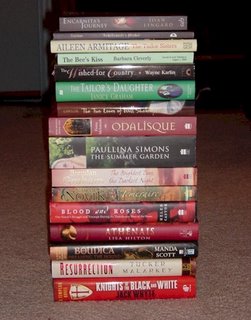
Click on it for a larger picture. When I ordered it, I had no idea The Summer Garden was 850 pages long. Can this woman write short books? Yikes. The copy of Temeraire is the Australian edition, of all things. Curious, but it has a cool embossed cover with a black dragon on it.
Secondly, two piles with review books about to be mailed to reviewers for the next HNR (once my co-editor Ellen determines who's getting what, that is).
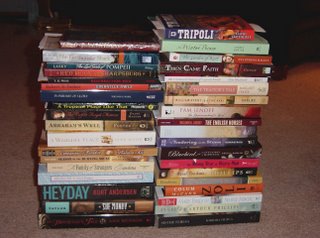
The people behind me in line at the post office next Wednesday are going to love me.
First, a pile of recent purchases and Christmas gifts:

Click on it for a larger picture. When I ordered it, I had no idea The Summer Garden was 850 pages long. Can this woman write short books? Yikes. The copy of Temeraire is the Australian edition, of all things. Curious, but it has a cool embossed cover with a black dragon on it.
Secondly, two piles with review books about to be mailed to reviewers for the next HNR (once my co-editor Ellen determines who's getting what, that is).

The people behind me in line at the post office next Wednesday are going to love me.
Tuesday, January 02, 2007
An interview with Deanna Raybourn
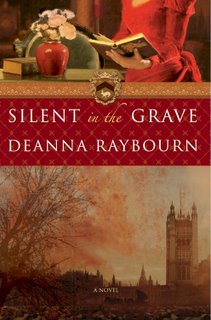 Last April, I spotted Deanna Raybourn's Silent in the Grave in Publisher's Weekly's list of "galleys to grab" at BookExpo America, and blogged about it. While at BEA in DC in June, I met Deanna at her signing booth, and we chatted about the blog, historical fiction in general, and the exciting "headless woman" treatment her novel was going to get (at left; the cover of the galley I received showed an earlier version).
Silent in the Grave begins a trilogy starring Lady Julia Grey, an unwitting and unlikely amateur detective. Her adventure begins in 1866. Her inattentive husband, Sir Edward Grey, has just collapsed and died during a dinner party at his London townhouse. The family doctor blames Edward’s longstanding heart condition, and Julia believes him, despite suggestions by Edward’s private inquiry agent, Nicholas Brisbane, that it was murder. It’s over a year later when Julia comes across compelling evidence that proves Brisbane was right. She engages Brisbane’s services, and during their investigation, she uncovers unpleasant and frequently sordid facts about her late husband’s behavior, as well as surprising truths about herself.
Despite its length, Silent in the Grave is a gripping, fast-paced read that balances its darker aspects with deft humor, and I thoroughly enjoyed it. Deanna is a sixth-generation Texan who now makes her home in a Virginia college town. Silent in the Grave is her first novel. More information can be found at her website, www.deannaraybourn.com, or her novel's site, www.silentinthegrave.com.
What attracted you to Victorian England?
Oddly enough, the book was initially conceived as a Regency piece. I wrote the first fifty pages or so with an 1816 setting before I decided it needed to be changed. The Regency was a frothy and sparkling time and dictated a different voice for Julia. Moving the action sixty or seventy years further into the nineteenth century changed that voice entirely. It brought in something darker and edgier, and I think the repression and shadowed sexuality of the Victorians is much more in keeping with the story than the vivacity and lightness of Regency manners. It also changed the domestic technology, so that necessitated a fresh batch of research. I gnashed my teeth for awhile over that, but ultimately it served the book much better to change the historical setting.
Lady Julia narrates her story in the first person, which is somewhat unusual for a historical mystery. Why did you choose to write from her viewpoint, and how did you create her voice?
I actually didn’t choose the viewpoint. Very early on in the plotting phase the first line popped into my head, and I loved it. That established the voice, and it felt right for the book so I went with it.
The members of Julia's family, the Marches, are quite eccentric, to say the least. Are any of them based on real people, historical or otherwise?
The Marches are entirely original. Throughout history, the English aristocracy has been loaded with deliciously eccentric characters, most of them far more outrageous than the Marches. In the case of the Marches, it may have arrested their development a bit as well by allowing them to follow their own whims. The typical person on the street may have their caprices, but they can’t give way to them because they have a job to hold down or children to raise or a house to keep or they’re afraid of what the neighbors might think. The Marches are rich enough to indulge their follies and highly-born enough not to care for anyone’s opinion. Taken as a whole, they remind me a bit of the Mitfords, but they aren’t based on any particular family.
Silent in the Grave includes a fair amount of detail on medicine, and medical research, in Victorian times. How did you go about researching this?
The Internet is a glorious thing. Before researching this book, I had only ever used it for shopping or e-mail, but with this story, I learned how to ferret out pretty much anything I needed to know. I still made endless trips to the library; I consulted a helpful urologist; I e-mailed a staff member at the University of Edinburgh medical school, but for quick fact-checking, nothing beats the Internet.
One of the aspects I enjoyed most was that despite the dark atmosphere, which became more and more pervasive toward the end, you incorporate a good amount of humor into the novel. For example - Julia's morbid Aunt Ursula (aka "the Ghoul"), the missing Tower raven, and the wry comments Julia utters on occasion. I wonder if you could talk a little about the role of humor in historical fiction, and in Silent in the Grave in particular – why was it important to you?
Humor is tremendously important, particularly in historical fiction because it humanizes characters who can so easily stray into sounding pedantic or dry without it. On the other hand, it is essential to use it subtly or the historic atmosphere is shattered. And there are different kinds of humor in the book. Julia banters with her sister, Portia, and they trade friendly insults, but that interaction is completely different in tone from the scathing sarcasm she might direct at Nicholas, or the wryness of her personal observations in the narrative. Humorous characters, such as the Ghoul, were put in deliberately to lighten the tone of the book and provide a balance to the darker elements. I didn’t want the grim circumstances of a murder investigation to define the relationships in the book. It was important to me that real life peek around the curtains and wink at the reader from time to time.
On p.260, Julia comments that she "adored history, not the dry dates and boring battles, but the stories and people who populated them." Does her statement reflect your own views on history as well - and if not, how do they differ?
History can be painfully dry. The key to making it come alive is not to neglect the human element. Everyone knows Wellington decimated Napoleon at Waterloo, but the story becomes much more interesting when you discover that part of Napoleon’s defeat allegedly came from his inability to mount a horse and survey the battlefield due to raging hemorrhoids. Bloody Mary Tudor becomes a great deal less monstrous and much more pitiful when you move past the burnings at Smithfield and realize she was so desperate to have a child she managed to mistake terminal cancer for a pregnancy she joyfully announced to the court. Facts are only as interesting as the stories behind them.
One scene finds Julia glancing at books in her study, reminiscing about treasured reads from her youth. She remarks that many were "romantic stories with dark, brooding men with mysterious pasts and scornful glances" which, to her anger and chagrin, left her with an overactive imagination. Nicholas Brisbane fits the image of the classic tortured hero in some ways, but not in others. How did you develop his character?
Julia just sprang from my head like Athena, fully-formed. Nicholas was WORK. I did start with the idea of dark and brooding because I wanted a man who would quicken Julia’s pulse and play into her fantasies, but I wanted him flawed, deeply and perhaps irreparably flawed. I knew there had to be some experimentation on his part with illicit substances, but I wanted it to be from medical necessity. I wanted Nicholas to be full of contradictions: from a good family, but socially questionable; of aristocratic blood, but mixed with something else; well-connected, but technically in trade. And I knew he needed a mysterious past full of secrets even I don’t know. He has traveled the world, and on his travels he has collected scars and souvenirs and arcane bits of knowledge that are occasionally useful. The one thing he has never found is a woman as engaging as Julia Grey. Ultimately, I wanted to create a character so complex that even if Julia did end up spending the whole of her life with him, she would never fully understand him.
Throughout the novel, I noticed you took care to use British spellings and terminology. As an American author writing about historical England, what are some other cross-cultural issues you felt you had to pay special attention to? How did you get into the mindset for writing about Victorian times?
My reading is primarily British, which helps enormously. Besides the obvious research materials, I read novels either set or written in the time period. If I’m in the mood to putter in the kitchen, I read Nigella Lawson or Rita Konig rather than American authors. If I’m thinking about gardens, I pull out my Beverley Nichols. Even if I’m taking a break from “work” mode and reading something frothy, it’s usually British chick lit, not American. There is something about British writing that manages to be both exotic and extremely comforting at the same time. One of the most gratifying compliments I’ve received was from the head of my publisher’s UK office; he was surprised the writer was American—he assumed I was British! But my father is only a first-generation American, so I’m not too far removed in any case. For me, the most difficult aspect was not establishing a British voice, it was establishing an upper-class, nineteenth-century voice. The aristocracy inhabits a rarified world that can be extremely difficult for an outsider to comprehend. But the more I read, the more I realized how little has changed. If you go beyond formal writing and read personal correspondence or diaries, Victorians could be strikingly informal and recognizable to a modern reader.
What are some of the more interesting or odd facts you uncovered during the research process?
I borrowed a textbook from a kindly urologist full of pictures that still give me nightmares. It was useful, but VERY disturbing.
With your double major in English and history, it seems almost logical that you ended up writing historical fiction. What about the genre attracted you?
Actually, it happened the other way around. I double-majored in English and history because I wanted to write historical fiction. I wasn’t entirely certain what specific genre I wanted to target, but I had always written, and what I wrote was always set in the past. My English courses taught me dramatic structure, how to pick apart characters, how to look at a story from a critical standpoint; my history courses taught me research skills. Both disciplines have proven extremely helpful, perhaps English more so.
Thanks, Deanna, for your willingness to do the interview. Silent in the Grave was published in January 2007 by MIRA ($21.95 US / $26.95 Can) in hardback, 509pp, ISBN 0-7783-2410-9.
Monday, January 01, 2007
My 2007 reading resolutions
It's that time of year. Who knows if I'll actually keep any of these, but it's my intention to do so, anyway, as of this first day of 2007...
1) To read more books, period. I've become a slower reader over the years, and to some degree this is unavoidable (and American Idol begins again in two weeks, so this will be a challenge)... but there are a number of great-sounding books from 2006 (and earlier) that I've yet to read, and really should have.
2) To buy fewer books that don't immediately rank highly in the TBR pile. My shelves are already overfull. Note to self to be a good librarian and borrow more books from my workplace.
3) To break bad reviewing habits, i.e., waiting too long after finishing a novel before beginning the review, because this entails re-reading the novel, or at least skimming, and I don't have time for this - for reasons above.
4) To read at least one classic novel that's new to me, for my own edification. (No, there's no unspoken "if it kills me" in there... or, well, maybe there is.) But it was embarrassing last year, perusing the library's copy of 1000 Great Books to Read Before You Die and realizing how few I'd read, and even worse, that there were some I hadn't heard of. Suggestions welcome.
5) To keep an ongoing reading list. I always know if I've read a given book or not, but my attempt to develop a Top 10 list for 2006 made me realize that I should have been noting these titles all along. I'll be doing so on this blog's sidebar, somewhere.
I'll be posting the interview tomorrow morning. I tried twice to get a draft version going today, but Blogger kept eating it, and I've no desire to fight with it any longer. Given this, I further resolve to do all composition of lengthy blog posts in MS Word rather than here, lest this happen again.
1) To read more books, period. I've become a slower reader over the years, and to some degree this is unavoidable (and American Idol begins again in two weeks, so this will be a challenge)... but there are a number of great-sounding books from 2006 (and earlier) that I've yet to read, and really should have.
2) To buy fewer books that don't immediately rank highly in the TBR pile. My shelves are already overfull. Note to self to be a good librarian and borrow more books from my workplace.
3) To break bad reviewing habits, i.e., waiting too long after finishing a novel before beginning the review, because this entails re-reading the novel, or at least skimming, and I don't have time for this - for reasons above.
4) To read at least one classic novel that's new to me, for my own edification. (No, there's no unspoken "if it kills me" in there... or, well, maybe there is.) But it was embarrassing last year, perusing the library's copy of 1000 Great Books to Read Before You Die and realizing how few I'd read, and even worse, that there were some I hadn't heard of. Suggestions welcome.
5) To keep an ongoing reading list. I always know if I've read a given book or not, but my attempt to develop a Top 10 list for 2006 made me realize that I should have been noting these titles all along. I'll be doing so on this blog's sidebar, somewhere.
I'll be posting the interview tomorrow morning. I tried twice to get a draft version going today, but Blogger kept eating it, and I've no desire to fight with it any longer. Given this, I further resolve to do all composition of lengthy blog posts in MS Word rather than here, lest this happen again.
Friday, December 29, 2006
End of the year post...
The Great New England Bookstore Tour (known in other circles as Christmas vacation) is over, and I managed to find/purchase/receive about a dozen new historical novels. I even got the chance to read four of them while in Connecticut, while my slow-moving review book lay neglected on the coffee table back home. It's starting to make me feel guilty, though, so I'll be taking it up again shortly.
I probably won't be blogging again until after New Year's, as I'll be compiling and editing reviews for next week's deadline, processing the conference registrations that arrived while I was gone, and attempting to make the switch to the new Blogger without losing anything. In the meanwhile, if you haven't seen it for a time, I've updated the HNS forthcoming books page with titles through next August, in particular new historical fiction from Penguin, Houghton Mifflin, and Simon & Schuster.
In early January, I'll be posting an interview with Deanna Raybourn, whose debut historical Silent in the Grave is newly out in bookstores - and which I mentioned as a "galley to grab" at last year's BEA. Time permitting, I hope to interview other historical novelists for the blog in the future.
Hope you all have a great new year, and here's to more good reading for 2007!
I probably won't be blogging again until after New Year's, as I'll be compiling and editing reviews for next week's deadline, processing the conference registrations that arrived while I was gone, and attempting to make the switch to the new Blogger without losing anything. In the meanwhile, if you haven't seen it for a time, I've updated the HNS forthcoming books page with titles through next August, in particular new historical fiction from Penguin, Houghton Mifflin, and Simon & Schuster.
In early January, I'll be posting an interview with Deanna Raybourn, whose debut historical Silent in the Grave is newly out in bookstores - and which I mentioned as a "galley to grab" at last year's BEA. Time permitting, I hope to interview other historical novelists for the blog in the future.
Hope you all have a great new year, and here's to more good reading for 2007!
Saturday, December 23, 2006
Islands of books
I'm writing from Connecticut, where I'll be until a couple days after Christmas. Just got back from one of my favorite used bookstores, the Niantic Book Barn, down by the shore in Niantic, on this foggy but surprisingly warm day. The store comprises one large two-story barn plus a loose collection of maybe half a dozen outbuildings, each of which is packed with used books. The one at the entrance, where books are bought when the weather's fair, is called Ellis Island. Quirky signs and shelf labels are scattered throughout the entire store; for example, the section labeled "That Pestiferous Little Corsican" features Napoleonic history. "Do not place books on the radiator - remember Fahrenheit 451!" warns another sign in the Haunted Barn.
The Book Barn also boasts the floppiest and laziest bookstore cats I've ever seen. They're so tame and used to being petted by customers that they don't even wake up. If you're not into cats, you can head outside (follow the bleating and baaing) to the small fenced-in area and visit with the friendly goats.
I bought two books - Manda Scott's latest Boudica novel (not having read the first two in the series didn't stop me, although maybe it should have) and Wayne Karlin's The Wished-For Country, set in colonial Maryland. Fortunately, Librarything tells me that I don't already own either one. It's an occasional problem.
The Book Barn also boasts the floppiest and laziest bookstore cats I've ever seen. They're so tame and used to being petted by customers that they don't even wake up. If you're not into cats, you can head outside (follow the bleating and baaing) to the small fenced-in area and visit with the friendly goats.
I bought two books - Manda Scott's latest Boudica novel (not having read the first two in the series didn't stop me, although maybe it should have) and Wayne Karlin's The Wished-For Country, set in colonial Maryland. Fortunately, Librarything tells me that I don't already own either one. It's an occasional problem.
Wednesday, December 20, 2006
The latest big medieval deal, and a top 10 list
This deal has been on the front page of Publishers Marketplace for the past few days:
Karen Maitland's A COMPANY OF LIARS, set in England in 1348, as the plague is spreading and a band of misfits are trying to outrun it, including a scar-faced trader in holy relics, a minstrel from Venice, an itinerant painter of church frescoes, a deformed storyteller wanted by the law, a strange albino child, a healer, and a bad-tempered magician traveling with an embalmed mermaid, and THE OWL KILLERS, also set in the middle ages, to Kate Miciak for Dial and Bantam, in a major deal, by Kathleen Anderson at Anderson Literary Management, on behalf of Victoria Hobbs at A.M. Heath (NA).
I said earlier I'd do an end-of-the-year Top 10 list, but there are so many historical novels from 2006 I haven't read that it's almost silly. But disclaimers aside, here they are, in alphabetical order by author:
Gretchen Craig, Always and Forever (Louisiana, 1823-37)
Margaret Ball, Duchess of Aquitaine (Aquitaine and Paris, France, 1137-49)
Charles Frazier, Thirteen Moons (Great Smoky Mountains, North Carolina, 1830s)
Margaret George, Helen of Troy (ancient Greece)
Sally Gunning, The Widow's War (Cape Cod, Massachusetts, 1761)
Jane Harris, The Observations (Scotland, 1863)
Amy Hassinger, The Priest's Madonna (Rennes-le-Château, France, 1890s)
Jaime Manriquez, Our Lives Are the Rivers (Ecuador and Peru, 1820s)
James Morrow, The Last Witchfinder (England, Massachusetts, and Pennsylvania, 1688)
Mary Sharratt, The Vanishing Point (Maryland, 1689)
Where reviews that I've written exist on the free web, I've linked them. For the Amazon reviews, look for the Booklist mentions.
As for what I'm reading now, I'm nearly done with Ann Waldron's The Princeton Imposter, part of the "Death is Academic" murder mystery series set on the Princeton campus. It showed up in yesterday's UPS mail, and I got sucked in after reading the first couple pages.
Karen Maitland's A COMPANY OF LIARS, set in England in 1348, as the plague is spreading and a band of misfits are trying to outrun it, including a scar-faced trader in holy relics, a minstrel from Venice, an itinerant painter of church frescoes, a deformed storyteller wanted by the law, a strange albino child, a healer, and a bad-tempered magician traveling with an embalmed mermaid, and THE OWL KILLERS, also set in the middle ages, to Kate Miciak for Dial and Bantam, in a major deal, by Kathleen Anderson at Anderson Literary Management, on behalf of Victoria Hobbs at A.M. Heath (NA).
I said earlier I'd do an end-of-the-year Top 10 list, but there are so many historical novels from 2006 I haven't read that it's almost silly. But disclaimers aside, here they are, in alphabetical order by author:
Gretchen Craig, Always and Forever (Louisiana, 1823-37)
Margaret Ball, Duchess of Aquitaine (Aquitaine and Paris, France, 1137-49)
Charles Frazier, Thirteen Moons (Great Smoky Mountains, North Carolina, 1830s)
Margaret George, Helen of Troy (ancient Greece)
Sally Gunning, The Widow's War (Cape Cod, Massachusetts, 1761)
Jane Harris, The Observations (Scotland, 1863)
Amy Hassinger, The Priest's Madonna (Rennes-le-Château, France, 1890s)
Jaime Manriquez, Our Lives Are the Rivers (Ecuador and Peru, 1820s)
James Morrow, The Last Witchfinder (England, Massachusetts, and Pennsylvania, 1688)
Mary Sharratt, The Vanishing Point (Maryland, 1689)
Where reviews that I've written exist on the free web, I've linked them. For the Amazon reviews, look for the Booklist mentions.
As for what I'm reading now, I'm nearly done with Ann Waldron's The Princeton Imposter, part of the "Death is Academic" murder mystery series set on the Princeton campus. It showed up in yesterday's UPS mail, and I got sucked in after reading the first couple pages.
Monday, December 18, 2006
Old favorites, and some new ones
About five years ago, I wrote a column for HNR on specific novels that deserved to be published (or republished), because I felt there was a strong market for them. To my surprise, nearly all of them have since appeared in print, or will shortly. As examples: Donna Gillespie's Lady of the Light, Judith Merkle Riley's The Water Devil, Anya Seton's Green Darkness and Katherine, Colin Falconer's The Sultan's Harem...
I don't know if I've been lucky, whether I can pick them, or what.
Then this evening, while browsing the HarperCollins rights guide (this is what I do in my spare time, see), I read that Patricia Clapp's Jane-Emily is going to be reprinted next July by Harper Paperbacks. This is very exciting news. Jane-Emily was one of my two favorite novels as a child, the other being Janet Lunn's Twin Spell. With no idea of where my original copy disappeared to, I considered getting a copy off ABE a few months ago, but didn't feel like paying very much for a paperback in ratty condition. Now I won't have to.
In case you don't know it, Jane-Emily is a classic novel of the supernatural set in Lynn, Massachusetts, in 1912. Jane, a nine-year-old orphan spending the summer at her grandmother's stately home with her eighteen-year-old Aunt Louisa (who narrates) , makes contact with the spirit of another young girl, Emily, who died on the grounds of the same house twelve years earlier. Every time I see a glass reflecting ball in someone's yard, it reminds me of Jane-Emily, for in the novel, it glows whenever Emily's ghost is nearby. It's haunting, romantic, and terrifying, and with Jane and Louisa as the two protagonists, it can be read and enjoyed by people of any age.
Not to mention that the cover was seriously cool. Picture a New England-style house in the deep blue of late evening, with a reflecting ball mysteriously aglow in the foreground. This is what I remember, 20 or so years after I last read the novel, though I can't find a photo online.
While typing this, I visited the Amazon page for Jane-Emily and read comments by both the publisher and Patricia Clapp's granddaughter, who posted there.
Has anyone else read it? Do you know of any novels that are currently unavailable that you'd like to see published?
I don't know if I've been lucky, whether I can pick them, or what.
Then this evening, while browsing the HarperCollins rights guide (this is what I do in my spare time, see), I read that Patricia Clapp's Jane-Emily is going to be reprinted next July by Harper Paperbacks. This is very exciting news. Jane-Emily was one of my two favorite novels as a child, the other being Janet Lunn's Twin Spell. With no idea of where my original copy disappeared to, I considered getting a copy off ABE a few months ago, but didn't feel like paying very much for a paperback in ratty condition. Now I won't have to.
In case you don't know it, Jane-Emily is a classic novel of the supernatural set in Lynn, Massachusetts, in 1912. Jane, a nine-year-old orphan spending the summer at her grandmother's stately home with her eighteen-year-old Aunt Louisa (who narrates) , makes contact with the spirit of another young girl, Emily, who died on the grounds of the same house twelve years earlier. Every time I see a glass reflecting ball in someone's yard, it reminds me of Jane-Emily, for in the novel, it glows whenever Emily's ghost is nearby. It's haunting, romantic, and terrifying, and with Jane and Louisa as the two protagonists, it can be read and enjoyed by people of any age.
Not to mention that the cover was seriously cool. Picture a New England-style house in the deep blue of late evening, with a reflecting ball mysteriously aglow in the foreground. This is what I remember, 20 or so years after I last read the novel, though I can't find a photo online.
While typing this, I visited the Amazon page for Jane-Emily and read comments by both the publisher and Patricia Clapp's granddaughter, who posted there.
Has anyone else read it? Do you know of any novels that are currently unavailable that you'd like to see published?
Saturday, December 16, 2006
In a bit of synchronicity
On the subject of women's historical fiction discussed in my 12/12 post - have a look at "Tapestry of Tales," an article from today's (well, tomorrow's) The Scotsman.
It's written from a UK viewpoint, which may (?) explain the comment "It is still a form that is dominated by women, and it is hard not to wonder if that is the reason for the industry's ambivalent attitude to one of its biggest success stories." Is this true in the UK? I hardly think the US publishing world is ambivalent to women's historical fiction; quite the opposite.
The article's lengthy and quite detailed, and definitely worth reading for an overview of the genre - though they oversimplify the HNS definition of historical fiction, and don't make much of a case for their argument. I'm also confused by Philippa Gregory's comments - Anya Seton (which the paper spells as "Seaton") wrote about Katherine of Aragon? Did she mean Norah Lofts, I wonder?
It's written from a UK viewpoint, which may (?) explain the comment "It is still a form that is dominated by women, and it is hard not to wonder if that is the reason for the industry's ambivalent attitude to one of its biggest success stories." Is this true in the UK? I hardly think the US publishing world is ambivalent to women's historical fiction; quite the opposite.
The article's lengthy and quite detailed, and definitely worth reading for an overview of the genre - though they oversimplify the HNS definition of historical fiction, and don't make much of a case for their argument. I'm also confused by Philippa Gregory's comments - Anya Seton (which the paper spells as "Seaton") wrote about Katherine of Aragon? Did she mean Norah Lofts, I wonder?
Three deals and not much more
We saw "The Holiday" earlier this evening up in Savoy... of course, my ears perked up when the Jude Law character said that his father wrote historical fiction. A very respectable profession. Then I had to see whether I recognized any titles on his bookshelves (Lalita Tademy's Cane River was one of them, for the record; he has good taste).
Things may be quiet around here for a while, as all the book reviews for Feb 2007' s HNR are arriving, and I'm in the midst of reading a decent but slow-moving review book. But for now, here are some deals from Publishers Lunch on Friday.
Gerri Brightwell's THE DARK LANTERN, about the secrets in a Victorian London household and how they affect the master's experiments in establishing identity through body measurements, to Allison McCabe at Crown, for six figures, in a pre-empt, for publication in spring 2008, by Zoe Fishman at Lowenstein-Yost (world). (The author's website includes the opening pages)
C.J. Sansom's WINTER IN MADRID, a spy thriller set in 1940s Spain, again to Kathryn Court at Viking, for publication in winter 2008, by Jean Naggar of the Jean V. Naggar Literary Agency, for Antony Topping of Greene & Heaton (US).
(Glad to see this one is being published in the US, finally)
National commentator and columnist Robin Gerber's ELEANOR VERSUS IKE, a fictional reimagining (inspired by actual events) of what would have happened if Eleanor Roosevelt ran for president against Eisenhower in 1952, to be published just in time for the historic 2008 presidential primaries, to Sarah Durand at William Morrow, by Stephanie Tade at the Stephanie Tade Agency.
Lastly, there are a couple editorial positions open at the HNS Newsletter. The newspapers described have online book review sections, so geography isn't a factor (you don't need to be British to cover British papers). For details, contact Sarah Cuthbertson at the email at the end of this announcement:
***WANTED: Editors!!***Lucienne and Sarah will both be leaving the HNS Newsletter at the end of January 2007. Ideally, from 1 February 2007 we'd like at least one new editor to cover one or more British newspapers. Obviously, the more editors the merrier as it would spread the load. The job means scanning newspaper book review pages for reviews of historical fiction and non-fiction and pasting the details (book title and author, name of newspaper, review date, name of reviewer, review URL) into a newsletter template under the relevant headings. For historical fiction add a taster quote from the review; for non-fiction only add a quote or description if the topic isn't obvious from the title. It takes about 30-45 minutes per newspaper per week. The links are then sent to the co-ordinating editor who compiles each issue and posts it to the members once a fortnight via Yahoo Groups. At present the editors take turns as co-ordinator for 2 months each. For more details, if needed, contact sarah76cuthbert@aol.com
Things may be quiet around here for a while, as all the book reviews for Feb 2007' s HNR are arriving, and I'm in the midst of reading a decent but slow-moving review book. But for now, here are some deals from Publishers Lunch on Friday.
Gerri Brightwell's THE DARK LANTERN, about the secrets in a Victorian London household and how they affect the master's experiments in establishing identity through body measurements, to Allison McCabe at Crown, for six figures, in a pre-empt, for publication in spring 2008, by Zoe Fishman at Lowenstein-Yost (world). (The author's website includes the opening pages)
C.J. Sansom's WINTER IN MADRID, a spy thriller set in 1940s Spain, again to Kathryn Court at Viking, for publication in winter 2008, by Jean Naggar of the Jean V. Naggar Literary Agency, for Antony Topping of Greene & Heaton (US).
(Glad to see this one is being published in the US, finally)
National commentator and columnist Robin Gerber's ELEANOR VERSUS IKE, a fictional reimagining (inspired by actual events) of what would have happened if Eleanor Roosevelt ran for president against Eisenhower in 1952, to be published just in time for the historic 2008 presidential primaries, to Sarah Durand at William Morrow, by Stephanie Tade at the Stephanie Tade Agency.
Lastly, there are a couple editorial positions open at the HNS Newsletter. The newspapers described have online book review sections, so geography isn't a factor (you don't need to be British to cover British papers). For details, contact Sarah Cuthbertson at the email at the end of this announcement:
***WANTED: Editors!!***Lucienne and Sarah will both be leaving the HNS Newsletter at the end of January 2007. Ideally, from 1 February 2007 we'd like at least one new editor to cover one or more British newspapers. Obviously, the more editors the merrier as it would spread the load. The job means scanning newspaper book review pages for reviews of historical fiction and non-fiction and pasting the details (book title and author, name of newspaper, review date, name of reviewer, review URL) into a newsletter template under the relevant headings. For historical fiction add a taster quote from the review; for non-fiction only add a quote or description if the topic isn't obvious from the title. It takes about 30-45 minutes per newspaper per week. The links are then sent to the co-ordinating editor who compiles each issue and posts it to the members once a fortnight via Yahoo Groups. At present the editors take turns as co-ordinator for 2 months each. For more details, if needed, contact sarah76cuthbert@aol.com
Tuesday, December 12, 2006
Idle observations on current historical novels
I've been pulling together a list of what I call "traditional historical novels" (genre fiction, that is, as opposed to literary fiction - though the line between them is blurring more and more) published between mid-2004 and mid-2007. You may find this interesting. The numbers will change slightly as more novels are published or announced, but thus far, 2/3 of them (98 out of 148) fit the "women in history" theme. In fact, most fit one of these categories:
- biographical novel of a female ruler, or female member of a royal family
- biographical novel of the wife/consort/mistress of some famous man (including biblical figures)
- novel of a fictional woman's daily life in a given time period
What I'm not seeing are many new deals for this type of novel in Publishers Marketplace, though there have been a few. It makes me wonder whether this theme - along with the corresponding headless bodice covers - will have played itself out in the next year or two.
I haven't yet started analyzing literary historical novels for the same time period, though I know there are many more of them.
- biographical novel of a female ruler, or female member of a royal family
- biographical novel of the wife/consort/mistress of some famous man (including biblical figures)
- novel of a fictional woman's daily life in a given time period
What I'm not seeing are many new deals for this type of novel in Publishers Marketplace, though there have been a few. It makes me wonder whether this theme - along with the corresponding headless bodice covers - will have played itself out in the next year or two.
I haven't yet started analyzing literary historical novels for the same time period, though I know there are many more of them.
Sunday, December 10, 2006
Visiting a new world
This post's topic may seem tangential to what I usually talk about, but bear with me - it may not have to do with historical fiction per se, but it does touch upon history (well, that may be a stretch) and reading in general.
I spent Friday afternoon at the University of Illinois undergraduate library seeing a demo of library services within Second Life, a 3-D virtual world where people can interact with one another and the world around them by creating "avatars" that represent themselves. About 25 other librarians from central Illinois attended, and the organizers told us to bring our avatars if we had them (seriously)... and a few did.
Now I'm not a gamer, and the last time I used software to enter a "virtual world" of any kind (other than the Internet itself), it was probably 1985, and everything was text-based. At the risk of sounding like a dork, I'll admit this Second Life thing totally amazed me. I had no idea that people could create a 3-D virtual world that looked so realistic (well, in an anime-like, computer-generated kind of fashion). There are buildings, landscapes, and waterways, and people have re-created a number of real-life contemporary and historical properties "in-world" (the lingo for describing something within that environment). You can see some screenshots of the Second Life environment here, including an image of Caledon, a 19th century library where avatars are required to be dressed in Victorian attire in order to enter.
A number of librarians worldwide have gotten together to provide library services within Second Life, figuring that if they are to remain relevant and up-to-date in the 21st century, they (we) should go to places where patrons are spending their time. And as they have found, if you do enter Second Life identified as a librarian, people will ask you questions, just like they do in real life (aka "first life"). Staff at the Alliance Library System in Peoria schedule regular book discussion groups in this virtual environment. Basically, people can bring their avatars over to a common locale at a certain time and chat with one another online about that week's book. The blog at InfoIsland.org summarizes current and upcoming library events, such as an immersive exhibit and re-enactment of "Marie Antoinette, the Teen Queen," which has been rescheduled for sometime after Christmas.
And if you attend Bradley University, you can take a continuing education course completely within the Second Life environment.
What do you think of this concept - is this what people will have to do to reach readers in the future? Does anyone reading this regularly visit Second Life? If you're an author, can you visualize yourself giving a presentation or reading here? It was hard to get my mind around the whole concept, and I don't have the free time that it seems to demand, but I found it fascinating in a strange sort of way.
I spent Friday afternoon at the University of Illinois undergraduate library seeing a demo of library services within Second Life, a 3-D virtual world where people can interact with one another and the world around them by creating "avatars" that represent themselves. About 25 other librarians from central Illinois attended, and the organizers told us to bring our avatars if we had them (seriously)... and a few did.
Now I'm not a gamer, and the last time I used software to enter a "virtual world" of any kind (other than the Internet itself), it was probably 1985, and everything was text-based. At the risk of sounding like a dork, I'll admit this Second Life thing totally amazed me. I had no idea that people could create a 3-D virtual world that looked so realistic (well, in an anime-like, computer-generated kind of fashion). There are buildings, landscapes, and waterways, and people have re-created a number of real-life contemporary and historical properties "in-world" (the lingo for describing something within that environment). You can see some screenshots of the Second Life environment here, including an image of Caledon, a 19th century library where avatars are required to be dressed in Victorian attire in order to enter.
A number of librarians worldwide have gotten together to provide library services within Second Life, figuring that if they are to remain relevant and up-to-date in the 21st century, they (we) should go to places where patrons are spending their time. And as they have found, if you do enter Second Life identified as a librarian, people will ask you questions, just like they do in real life (aka "first life"). Staff at the Alliance Library System in Peoria schedule regular book discussion groups in this virtual environment. Basically, people can bring their avatars over to a common locale at a certain time and chat with one another online about that week's book. The blog at InfoIsland.org summarizes current and upcoming library events, such as an immersive exhibit and re-enactment of "Marie Antoinette, the Teen Queen," which has been rescheduled for sometime after Christmas.
And if you attend Bradley University, you can take a continuing education course completely within the Second Life environment.
What do you think of this concept - is this what people will have to do to reach readers in the future? Does anyone reading this regularly visit Second Life? If you're an author, can you visualize yourself giving a presentation or reading here? It was hard to get my mind around the whole concept, and I don't have the free time that it seems to demand, but I found it fascinating in a strange sort of way.
Monday, December 04, 2006
Switching gears
I've been taking a break from review books, and historical fiction in general, and have spent the past two evenings engrossed in Lois McMaster Bujold's The Curse of Chalion - an epic fantasy novel that was sitting neglected in my TBR pile for about five years. (That didn't stop me from buying both of the sequels when they came out. I haven't read them yet either.)
The endorsements on the back cover intrigue me, for Robert Jordan, Jean Auel, Mary Jo Putney, Harry Turtledove, Jo Beverley, and Dennis L. McKiernan all contributed glowing commentary. Prominent names in a few different fields. Which goes to show the publisher's expectations for the novel's success, as well as its cross-genre appeal.
Meanwhile, my editor's asked me and a bunch of other authors to select our favorite 2006 novel for the year-end update of Reader's Advisor Online (a database containing the electronic versions of my book and others in the same series). I haven't yet decided what I'll pick. There are so many titles I haven't read that picking a favorite is somewhat arbitrary. But I'll come up with one or two, I'm sure, and will try to post a Top 10 (or more) list here sometime before the end of the year. There are still 27 more days left of December, after all...
The endorsements on the back cover intrigue me, for Robert Jordan, Jean Auel, Mary Jo Putney, Harry Turtledove, Jo Beverley, and Dennis L. McKiernan all contributed glowing commentary. Prominent names in a few different fields. Which goes to show the publisher's expectations for the novel's success, as well as its cross-genre appeal.
Meanwhile, my editor's asked me and a bunch of other authors to select our favorite 2006 novel for the year-end update of Reader's Advisor Online (a database containing the electronic versions of my book and others in the same series). I haven't yet decided what I'll pick. There are so many titles I haven't read that picking a favorite is somewhat arbitrary. But I'll come up with one or two, I'm sure, and will try to post a Top 10 (or more) list here sometime before the end of the year. There are still 27 more days left of December, after all...
Saturday, December 02, 2006
A reading of Emma Tennant's The Harp Lesson
 Since roads were treacherous and I had vacation time to use up, I took yesterday off, spending most of the day reading. I started and finished one slim novel, Emma Tennant's The Harp Lesson, biographical fiction about Pamela Sims, aka "La Belle Pamela" (1773-1831), who happens to be the author's 3rd great-grandmother. The discussion following my "what's in a name" post inspired me to pick it up.
If you know Tennant mainly as the author of Jane Austen pastiches, you're in for a surprise and treat with this volume. Pamela was a young woman of mysterious origin. Raised as the daughter of an Dorset washerwoman until the age of six, she was fetched one day by messenger and brought to the estate of the Duc de Chartres (later the Duc d'Orléans), where she resided until the French Revolution. At the French court, she was believed to be the illegitimate daughter of the Duc - who took the name Philippe Égalité during the Revolution - and Madame de Genlis, the tutor of his children. It was Madame de Genlis, an admirer of Samuel Richardson's work, who changed the young girl's name from Anne or Nancy to Pamela. Tennant recounts her story in the form of a fictional memoir, related both by Pamela and her daughter, called Little Pam, in alternating chapters.
By all accounts, Pamela led an extraordinary life, both in France and in Ireland, as the wife of revolutionary Lord Edward Fitzgerald. But Tennant takes a low-key approach, recounting the major events of Pamela's life using understated prose that's quite poetic at times. It works. The sections narrated by Pamela and her daughter overlap and flow into one another. While Pamela tells her story to Little Pam, the younger woman takes down her mother's words and, later, relays them to her own family - an oral history that was passed down to Tennant. While there are dramatic moments, there are no great revelations. The true parentage of La Belle Pamela remains even more of a mystery, for both of her potential mothers deny giving birth to her.
A lovely little book about the private life of an enigmatic 18th century woman who rose from obscurity to lead a very public existence. Its front and back covers display scenes from a painting by Jean-Antoine-Théodore Giroust. Pamela holds the sheet music for Adélaide, daughter of the Duc d'Orléans (possibly her half-sister?), who learns to play the harp while her tutor Madame de Genlis, a celebrated educator and harpist herself, looks on. Click on the link above for the image, as well as additional details about the lives of all three women.
Full citation: Tennant, Emma. The Harp Lesson. London: Maia, 2005. 159pp. ISBN 1-904559-16-6.
Thursday, November 30, 2006
Expect the unexpected
For no particular reason; I was glancing at a list of older historical novels when the subject for a blog post came to me. This isn't an official meme (can things be "official" in blogland?) but you're welcome to make it one.
Five novels I didn't expect to like but did:
(1) Isabel Allende, Daughter of Fortune.
For years, I mistakenly had the impression that Allende's works were obscure and inaccessible. Silly me. This was a rollicking good story about Chilean and Chinese immigrants during the California Gold Rush; the sequel, Portrait in Sepia, was equally well done.
(2) John Ensor Harr, Dark Eagle.
Biographical novel about a man whose name is synonymous with "traitor" - it promised lots of battles, names, and dates. Sounded dry. But the story behind Benedict Arnold's treason wasn't as simple as it appeared. Great characterizations here, especially Arnold, his much younger wife Peggy Shippen, and Major John Andre.
(3) John Lanchester, Fragrant Harbor.
What I thought would be a typical coming-of-age story about an naive young Englishman in pre-WWII Hong Kong was a poignant, engrossing novel about love and corruption in a brilliantly realized locale, depicted vividly and with a certain irony ("Hong Kong" translates as "fragrant harbor").
(4) Beverly Swerling, City of Glory.
I didn't care for Shadowbrook as much as I'd hoped - loved the unusual French and Indian War setting, but didn't sympathize with the characters, and felt the plot dragged throughout - but was pleasantly surprised by City of Glory. A very entertaining saga set amid the War of 1812 in Manhattan. Review forthcoming.
(5) Rennie Airth, River of Darkness.
A serial killer stalks the Surrey countryside in the post-WWI years. Blood, guts, and forensics, with lots of gross bits. Ugh. But the intense psychological drama and gripping storyline won me over. I'd gladly read the next in the series, although so far I haven't.
Five novels I expected to like but didn't:
(1) Nicole Galland, The Fool's Tale.
This one had great potential. A love triangle between a king, queen, and the king's fool in 12th century Wales. The author did some research on medieval Welsh law, and the romantic subplot was compelling, but I found the fool's antics (not to mention his very existence) ridiculous and totally out of keeping for the period.
(2) Judith Koll Healey, The Canterbury Papers (UK title The Lost Letters of Aquitaine).
A classic example of good story and bad history. I have a thing for novels about obscure royal women, so this historical adventure about Princess Alais of France, who became Henry II's mistress while betrothed to his son, appealed to me. But there are many chronological impossibilities, especially regarding historical figures, and the characters' actions were more modern than medieval.
(3) Audrey Howard, As the Night Ends.
Generally I enjoy Audrey Howard's regional sagas, despite the melodramatic tone that's crept into the last few. But this one had an annoying heroine - it's hard to root for a romance when you feel sorry for the hero - and it covered too much historical ground. Nearly every major event in early 20th century British history was crammed into an already overstuffed storyline.
(4) Catherine Jinks, The Gentleman's Garden.
All the novels by Jinks that I've read take a slightly different tone. The Inquisitor was a dark and serious medieval thriller; The Notary was a bawdy medieval romp. This literary romantic novel of 1814 Australia was written in the style of Austen and Eliot (per press materials), but I never warmed to the standoffish female lead, and the pace was incredibly slow.
(5) Prince Michael of Greece, The White Night of St. Petersburg.
A star-crossed romance of a Russian grand duke, the mistress he couldn't give up, and the financial havoc they caused. Terrific potential. But it's hard to feel sympathy for a protagonist with so little common sense, and the author's dry and plodding style didn't help things.
Five novels I didn't expect to like but did:
(1) Isabel Allende, Daughter of Fortune.
For years, I mistakenly had the impression that Allende's works were obscure and inaccessible. Silly me. This was a rollicking good story about Chilean and Chinese immigrants during the California Gold Rush; the sequel, Portrait in Sepia, was equally well done.
(2) John Ensor Harr, Dark Eagle.
Biographical novel about a man whose name is synonymous with "traitor" - it promised lots of battles, names, and dates. Sounded dry. But the story behind Benedict Arnold's treason wasn't as simple as it appeared. Great characterizations here, especially Arnold, his much younger wife Peggy Shippen, and Major John Andre.
(3) John Lanchester, Fragrant Harbor.
What I thought would be a typical coming-of-age story about an naive young Englishman in pre-WWII Hong Kong was a poignant, engrossing novel about love and corruption in a brilliantly realized locale, depicted vividly and with a certain irony ("Hong Kong" translates as "fragrant harbor").
(4) Beverly Swerling, City of Glory.
I didn't care for Shadowbrook as much as I'd hoped - loved the unusual French and Indian War setting, but didn't sympathize with the characters, and felt the plot dragged throughout - but was pleasantly surprised by City of Glory. A very entertaining saga set amid the War of 1812 in Manhattan. Review forthcoming.
(5) Rennie Airth, River of Darkness.
A serial killer stalks the Surrey countryside in the post-WWI years. Blood, guts, and forensics, with lots of gross bits. Ugh. But the intense psychological drama and gripping storyline won me over. I'd gladly read the next in the series, although so far I haven't.
Five novels I expected to like but didn't:
(1) Nicole Galland, The Fool's Tale.
This one had great potential. A love triangle between a king, queen, and the king's fool in 12th century Wales. The author did some research on medieval Welsh law, and the romantic subplot was compelling, but I found the fool's antics (not to mention his very existence) ridiculous and totally out of keeping for the period.
(2) Judith Koll Healey, The Canterbury Papers (UK title The Lost Letters of Aquitaine).
A classic example of good story and bad history. I have a thing for novels about obscure royal women, so this historical adventure about Princess Alais of France, who became Henry II's mistress while betrothed to his son, appealed to me. But there are many chronological impossibilities, especially regarding historical figures, and the characters' actions were more modern than medieval.
(3) Audrey Howard, As the Night Ends.
Generally I enjoy Audrey Howard's regional sagas, despite the melodramatic tone that's crept into the last few. But this one had an annoying heroine - it's hard to root for a romance when you feel sorry for the hero - and it covered too much historical ground. Nearly every major event in early 20th century British history was crammed into an already overstuffed storyline.
(4) Catherine Jinks, The Gentleman's Garden.
All the novels by Jinks that I've read take a slightly different tone. The Inquisitor was a dark and serious medieval thriller; The Notary was a bawdy medieval romp. This literary romantic novel of 1814 Australia was written in the style of Austen and Eliot (per press materials), but I never warmed to the standoffish female lead, and the pace was incredibly slow.
(5) Prince Michael of Greece, The White Night of St. Petersburg.
A star-crossed romance of a Russian grand duke, the mistress he couldn't give up, and the financial havoc they caused. Terrific potential. But it's hard to feel sympathy for a protagonist with so little common sense, and the author's dry and plodding style didn't help things.
Tuesday, November 28, 2006
One Big Deal and several other deals
From Publishers Marketplace as usual. Yes, it looks like publication of the first one (as yet untitled) is two years away...
Katherine Neville's sequel to her debut novel, The Eight, ranging from the dawn of the war of Greek Independence in 1822 to the outbreak of the Iraq War in 2003, this novel begins when the heroine of The Eight mysteriously vanishes, and her daughter must follow a set of cryptic clues on a dangerous quest to discover who murdered her father, to Mark Tavani at Ballantine, for publication in fall 2008, along with an audio version of The Eight for the first time, by Simon Lipskar at Writers House (NA).
Christy Award-nominated author of Chateau of Echoes Siri L. Mitchell's WHITE ILLUSIONS, a Cinderella story in reverse, as a beautiful woman uses poisonous lead-based paint to turn herself into an ugly duckling in order to further her husband's position in the court of a vain Queen Elizabeth, to David Long at Bethany House, by Beth Jusino at Alive Communications (world).
Tamera Alexander's untitled Colorado series, the first title about a former Confederate Lieutenant who moves west, but instead of riches discovers a life of welcomed solitude from his dark past - until a "lady Yank journalist" arrives in town dredging up old memories forcing him to re-evaluate his perceptions on hope, again to Charlene Patterson at Bethany House, in a good deal, in a three-book deal, by Deidre Knight of The Knight Agency (World).
Jana G. Oliver's VIRTUAL EVIL and MADMAN'S DANCE, the second and third novels in the Time Rovers Series, in which a time traveler from 2057 is sent on a mission to Victorian England during the Ripper murders and encounters a secret society of shape-shifters bent on changing history, to Gwen Gades at Dragon Moon Press, in a two-book deal.
Katherine Neville's sequel to her debut novel, The Eight, ranging from the dawn of the war of Greek Independence in 1822 to the outbreak of the Iraq War in 2003, this novel begins when the heroine of The Eight mysteriously vanishes, and her daughter must follow a set of cryptic clues on a dangerous quest to discover who murdered her father, to Mark Tavani at Ballantine, for publication in fall 2008, along with an audio version of The Eight for the first time, by Simon Lipskar at Writers House (NA).
Christy Award-nominated author of Chateau of Echoes Siri L. Mitchell's WHITE ILLUSIONS, a Cinderella story in reverse, as a beautiful woman uses poisonous lead-based paint to turn herself into an ugly duckling in order to further her husband's position in the court of a vain Queen Elizabeth, to David Long at Bethany House, by Beth Jusino at Alive Communications (world).
Tamera Alexander's untitled Colorado series, the first title about a former Confederate Lieutenant who moves west, but instead of riches discovers a life of welcomed solitude from his dark past - until a "lady Yank journalist" arrives in town dredging up old memories forcing him to re-evaluate his perceptions on hope, again to Charlene Patterson at Bethany House, in a good deal, in a three-book deal, by Deidre Knight of The Knight Agency (World).
Jana G. Oliver's VIRTUAL EVIL and MADMAN'S DANCE, the second and third novels in the Time Rovers Series, in which a time traveler from 2057 is sent on a mission to Victorian England during the Ripper murders and encounters a secret society of shape-shifters bent on changing history, to Gwen Gades at Dragon Moon Press, in a two-book deal.
Monday, November 27, 2006
Egosurfing
Last night I took a break to do a little egosurfing, that is, googling my book title to see what people are saying about it. Googling my name isn't always helpful, although a surprising number of the first couple pages of hits are me. (I'm not the murderer, attorney, quilter, or dietician among them.) What I found:
- It's been reviewed in the latest issue (v.30 no.3) of Collection Management. We don't subscribe, and I'm assuming the publicity dept. hasn't seen it (or they'd have sent it to me) so I requested a copy over interlibrary loan. Collection Management is a peer-reviewed academic journal, which explains the year-and-a-half delay. I'm used to this; I edit for another library journal from the same publisher.
- It's listed on a bunch of library websites and newsletters. Always good to see.
- Someone had positive (and mostly correct) things to say about it on the Romantic Times boards.
- I found another review from the Australian Library Journal, dating from this August. Positive comments overall, though parts are snarky. I always find it interesting what reviewers outside North America have to say about titles geared for an American audience. I got similar comments on my first book when British and Australian reviewers took it on, even after being very clear about the expected readership in the intro. I like very much that readers outside the US will be reading it, and using it for book recommendations, but the selection of novels is based on the American market, which is what I know best. Alas, very few historical novels set in Australia have been published in the US in the last ten years. That must be the "eclectic" part. I wish it weren't so.
- Three people have it on their wishlist in Paperbackswap. I suspect they'll be waiting a long time, because nobody in their right mind's going to input a 4-pound hardcover into a system meant for trading 8-oz paperbacks. The postage is a killer.
Anyway, I'm generally pleased, as WorldCat lists about 700 holding libraries/library systems for it currently.
For those of you following the never-ending book saga ("never-ending" modifies both words here) - I've finished the novel and have drafted the review, though I'm still fiddling with the last two sentences. Having only 175 words to work with was a challenge, but I consider it an art form if I can pull it off with none to spare.
My guilt assuaged, now I'm going to read something fun.
- It's been reviewed in the latest issue (v.30 no.3) of Collection Management. We don't subscribe, and I'm assuming the publicity dept. hasn't seen it (or they'd have sent it to me) so I requested a copy over interlibrary loan. Collection Management is a peer-reviewed academic journal, which explains the year-and-a-half delay. I'm used to this; I edit for another library journal from the same publisher.
- It's listed on a bunch of library websites and newsletters. Always good to see.
- Someone had positive (and mostly correct) things to say about it on the Romantic Times boards.
- I found another review from the Australian Library Journal, dating from this August. Positive comments overall, though parts are snarky. I always find it interesting what reviewers outside North America have to say about titles geared for an American audience. I got similar comments on my first book when British and Australian reviewers took it on, even after being very clear about the expected readership in the intro. I like very much that readers outside the US will be reading it, and using it for book recommendations, but the selection of novels is based on the American market, which is what I know best. Alas, very few historical novels set in Australia have been published in the US in the last ten years. That must be the "eclectic" part. I wish it weren't so.
- Three people have it on their wishlist in Paperbackswap. I suspect they'll be waiting a long time, because nobody in their right mind's going to input a 4-pound hardcover into a system meant for trading 8-oz paperbacks. The postage is a killer.
Anyway, I'm generally pleased, as WorldCat lists about 700 holding libraries/library systems for it currently.
For those of you following the never-ending book saga ("never-ending" modifies both words here) - I've finished the novel and have drafted the review, though I'm still fiddling with the last two sentences. Having only 175 words to work with was a challenge, but I consider it an art form if I can pull it off with none to spare.
My guilt assuaged, now I'm going to read something fun.
Friday, November 24, 2006
What's in a name?
As it turns out, in the case of the novel I just attempted, an awful lot.
On a Highland Shore came highly recommended by friends, and Givens has a reputation for historical accuracy. In terms of historical detail - events, places, and so forth - this seems to be true. But... the heroine's best friend, a secondary character who plays a big role in the first 50 pages, is named Fiona. The novel's set in Scotland in 1263. This is a problem, because the name Fiona - very popular in Scotland nowadays - was a 19th century, or maybe 18th century, invention. Some background: it was popularized by Scots novelist/poet William Sharp, who chose "Fiona MacLeod" as his pseudonym beginning in 1893, and likely first used by James McPherson, supposed "translator" of the Ossian Cycle, in his poem "Fingal" circa 1762.
More details on the origins of "Fiona" here. The literature seems clear that it's not a medieval name; it's never been documented as such.
Am I being pedantic? You tell me, but I'd be lying if I denied that every time I saw the name, it pulled me out of the story. I would have quibbled just as much if a medieval English heroine was named Pamela. The story itself was engaging, and the heroine appealing (if a bit too modern in her actions), but I'm also not a fan of accents written out phonetically in dialogue. I understand that we're in Scotland, but don't need to be hit over the head with it every time someone speaks. (Diana Gabaldon, however, does this well.)
Chacun à son goût and all that, but for me, the novel's been reshelved - maybe to be picked up at another time.
This got me thinking about first names invented by authors. Surely all names were used first by someone, but not all can be documented. Sir Philip Sidney not only invented "Pamela" for his 1590 poem "Arcadia," but also - if you believe this page (whose data comes from a variety of name dictionaries) - the name "Stella." Samuel Richardson named the heroine of his novel Pamela after Sidney's character, and the name grew in popularity after that. Not surprisingly, Shakespeare is credited with inventing many female names: Jessica, Olivia, Viola, Miranda, Cordelia.
These days, of course, anything goes. Apple, Sailor, Moon Unit, anyone? I was also greatly amused by last night's episode of Ugly Betty, in which our intrepid heroine plans for a photo shoot for the celebrity infant known as "baby Chutney."
On a Highland Shore came highly recommended by friends, and Givens has a reputation for historical accuracy. In terms of historical detail - events, places, and so forth - this seems to be true. But... the heroine's best friend, a secondary character who plays a big role in the first 50 pages, is named Fiona. The novel's set in Scotland in 1263. This is a problem, because the name Fiona - very popular in Scotland nowadays - was a 19th century, or maybe 18th century, invention. Some background: it was popularized by Scots novelist/poet William Sharp, who chose "Fiona MacLeod" as his pseudonym beginning in 1893, and likely first used by James McPherson, supposed "translator" of the Ossian Cycle, in his poem "Fingal" circa 1762.
More details on the origins of "Fiona" here. The literature seems clear that it's not a medieval name; it's never been documented as such.
Am I being pedantic? You tell me, but I'd be lying if I denied that every time I saw the name, it pulled me out of the story. I would have quibbled just as much if a medieval English heroine was named Pamela. The story itself was engaging, and the heroine appealing (if a bit too modern in her actions), but I'm also not a fan of accents written out phonetically in dialogue. I understand that we're in Scotland, but don't need to be hit over the head with it every time someone speaks. (Diana Gabaldon, however, does this well.)
Chacun à son goût and all that, but for me, the novel's been reshelved - maybe to be picked up at another time.
This got me thinking about first names invented by authors. Surely all names were used first by someone, but not all can be documented. Sir Philip Sidney not only invented "Pamela" for his 1590 poem "Arcadia," but also - if you believe this page (whose data comes from a variety of name dictionaries) - the name "Stella." Samuel Richardson named the heroine of his novel Pamela after Sidney's character, and the name grew in popularity after that. Not surprisingly, Shakespeare is credited with inventing many female names: Jessica, Olivia, Viola, Miranda, Cordelia.
These days, of course, anything goes. Apple, Sailor, Moon Unit, anyone? I was also greatly amused by last night's episode of Ugly Betty, in which our intrepid heroine plans for a photo shoot for the celebrity infant known as "baby Chutney."
Wednesday, November 22, 2006
Happy Thanksgiving
Tomorrow's the big holiday, so I spent today with my bread machine, making a couple loaves of holiday bread and dipping into the fruitcake mix a little too often (it's bad for me, but there is real fruit in it).
I'm over halfway through my review book, and in the holiday spirit, I am giving thanks that nothing quite so odious has happened in Part 2. Yet. But because I'm also thankful that most other authors have a greater sense of decency - as well as a less, um, overstuffed writing style - I'll be putting this novel down for the interim and finding something more to my taste. I've picked out Kathleen Givens' On a Highland Shore, which a couple friends have recommended, and we'll see how that goes.
For the moment, though, we're settling in to see The Da Vinci Code on DVD. I still haven't read the book.
I'm over halfway through my review book, and in the holiday spirit, I am giving thanks that nothing quite so odious has happened in Part 2. Yet. But because I'm also thankful that most other authors have a greater sense of decency - as well as a less, um, overstuffed writing style - I'll be putting this novel down for the interim and finding something more to my taste. I've picked out Kathleen Givens' On a Highland Shore, which a couple friends have recommended, and we'll see how that goes.
For the moment, though, we're settling in to see The Da Vinci Code on DVD. I still haven't read the book.
Tuesday, November 21, 2006
A few new deals
From Publishers Marketplace this week. There really have not been many historical fiction deals reported over the last month, but these may be of interest:
Cambridge University historian and author of BLOOD & ROSES Dr. Helen Castor's SHE-WOLVES, a portrait of seven pre-Tudor queens, ranging from Eleanor of Aquitaine to Margaret of Anjou, who had to find ways to pretend that they weren't actually running the country, to Walter Donohue at Faber & Faber, by Patrick Walsh at Conville & Walsh.
Ildefonso Falcones' Spanish bestseller THE CATHEDRAL OF THE SEA, to Julie Doughty at Dutton, publication in for spring 2008, by Sandra Dijkstra at Sandra Dijkstra Literary Agency (NA). (First announcement for US publication; UK details are here.)
And a film deal: Sarah Dunant's novel about a courtesan and her companion dwarf in sixteenth century Renaissance Italy, optioned for feature film to producers Donna Gigliotti (Emma and Shakespeare in Love) and Barry Weissler (Chicago), by Lesley Thorne at Gillon Aitken Associates, on behalf of colleague Clare Alexander .
Cambridge University historian and author of BLOOD & ROSES Dr. Helen Castor's SHE-WOLVES, a portrait of seven pre-Tudor queens, ranging from Eleanor of Aquitaine to Margaret of Anjou, who had to find ways to pretend that they weren't actually running the country, to Walter Donohue at Faber & Faber, by Patrick Walsh at Conville & Walsh.
Ildefonso Falcones' Spanish bestseller THE CATHEDRAL OF THE SEA, to Julie Doughty at Dutton, publication in for spring 2008, by Sandra Dijkstra at Sandra Dijkstra Literary Agency (NA). (First announcement for US publication; UK details are here.)
And a film deal: Sarah Dunant's novel about a courtesan and her companion dwarf in sixteenth century Renaissance Italy, optioned for feature film to producers Donna Gigliotti (Emma and Shakespeare in Love) and Barry Weissler (Chicago), by Lesley Thorne at Gillon Aitken Associates, on behalf of colleague Clare Alexander .
Sunday, November 19, 2006
Deal-breakers
So here I am yesterday around 11pm, about 90 pages into my latest historical novel, when I come across a scene so incredibly distasteful that it stops me in my tracks. If this wasn't a review book, I'd have put it down right then, if not flung it across the room. (The latter may still happen.) It doesn't help that this novel's pacing is so slow I can barely make it through 50 pages an hour. However, since I'm obliged to finish it, I'll continue to persevere through the next 450-odd pages. And hope it gets better.
I'm sure that was the author's intent, to develop a character so repulsive that the reader feels it, but it sure doesn't make me want to read further. As this is a review book, I won't go into the details now, other than to say you'd probably be sorry you asked.
I don't usually get squeamish about scenes in novels like I do about films at times - over the last few books, I've read about graphic autopsies, murders, hangings (you name it, really, historical fiction can be very realistic) - but there are some mental images I would prefer not to have.
However, Saturday night wasn't a total loss, since a few hours earlier we were up in Champaign at the Borders, where I noted the titles/ISBNs of a good number of books to order for the library's math collection on Monday. Not very exciting, but necessary - I have a bunch of funds I need to spend in the next few weeks.
I'm sure that was the author's intent, to develop a character so repulsive that the reader feels it, but it sure doesn't make me want to read further. As this is a review book, I won't go into the details now, other than to say you'd probably be sorry you asked.
I don't usually get squeamish about scenes in novels like I do about films at times - over the last few books, I've read about graphic autopsies, murders, hangings (you name it, really, historical fiction can be very realistic) - but there are some mental images I would prefer not to have.
However, Saturday night wasn't a total loss, since a few hours earlier we were up in Champaign at the Borders, where I noted the titles/ISBNs of a good number of books to order for the library's math collection on Monday. Not very exciting, but necessary - I have a bunch of funds I need to spend in the next few weeks.
Friday, November 17, 2006
Coming up for air
I've been working on conference stuff starting around 8am today and finishing around 8pm, with a few breaks for meals, laundry, and a post office run. It didn't feel much like a day off.
However, I also managed to update the HNS forthcoming books page with historical novels through next August, believe it or not, since Penguin and Random House have released info on their upcoming titles. Several historical novels from the '80s are being reprinted in trade paperback, such as Rosalind Laker's To Dance with Kings and Margaret Forster's Lady's Maid, both from Random House imprints. Also, Overlook is reprinting a couple of Joan Grant's older historicals (which are supposedly based on her past lives...)
My picks for books I most want to read: Kate Furnivall's The Russian Concubine and Anita Amirrezvani's The Blood of Flowers. Mainly because they're set in locales you don't often read about.
However, I also managed to update the HNS forthcoming books page with historical novels through next August, believe it or not, since Penguin and Random House have released info on their upcoming titles. Several historical novels from the '80s are being reprinted in trade paperback, such as Rosalind Laker's To Dance with Kings and Margaret Forster's Lady's Maid, both from Random House imprints. Also, Overlook is reprinting a couple of Joan Grant's older historicals (which are supposedly based on her past lives...)
My picks for books I most want to read: Kate Furnivall's The Russian Concubine and Anita Amirrezvani's The Blood of Flowers. Mainly because they're set in locales you don't often read about.
Tuesday, November 14, 2006
If I lived near Washington DC
I'd be going to this lecture series next February at the Smithsonian.
I have been a bad blogger, not posting in over a week, but I have been reading, and writing, and - mostly - conferencing, plus tonight I packed up 25 more review books for mailing, the last batch for next February's HNR. After spending all day Saturday in Springfield, then all day Sunday at work, my schedule's all messed up.
Then as I emerged from my week-long state of mental disorganization, I learned there's a new 1085-page historical novel out that everyone's talking about (except me, obviously, besides now) and that I'd never even heard of. Emails to Penguin Press will be sent tomorrow morning. The Amazon subject headings say it's literary fiction, not historical fiction, and I don't remember it from the catalog. My feeble excuses.
I'm glad I have most of next week off, so I can tackle my one remaining doorstop of a review book.
I have been a bad blogger, not posting in over a week, but I have been reading, and writing, and - mostly - conferencing, plus tonight I packed up 25 more review books for mailing, the last batch for next February's HNR. After spending all day Saturday in Springfield, then all day Sunday at work, my schedule's all messed up.
Then as I emerged from my week-long state of mental disorganization, I learned there's a new 1085-page historical novel out that everyone's talking about (except me, obviously, besides now) and that I'd never even heard of. Emails to Penguin Press will be sent tomorrow morning. The Amazon subject headings say it's literary fiction, not historical fiction, and I don't remember it from the catalog. My feeble excuses.
I'm glad I have most of next week off, so I can tackle my one remaining doorstop of a review book.
Monday, November 06, 2006
Reviews of Obscure Books:
Diana Norman, Fitzempress' Law
Norman, Diana. Fitzempress' Law. New York: St. Martin's Press, 1980. 284pp. Also Hodder & Stoughton, 1980, 284pp.
Novels pass into obscurity for a variety of reasons - poor writing, low reader interest, small print runs, old age. But the reason, I suspect, that Fitzempress' Law is so hard to find has more to do with the author's excellent reputation as a medieval novelist. Aside from library editions, most copies reside in the hands of readers who won't give them up. This novel, Norman's first, has three major themes in common with her latest (Mistress of the Art of Death, 2007, written as Ariana Franklin), published 27 years later. Namely: rural life in 12th century England, as seen from the inside out; the plight of the Jews of Cambridge; and the judicial reforms of Henry II and their relevance to the modern world. I had no idea of the similarity of setting and subject when I decided to read the novels one after the other, but they make for a nicely matched pair. Their plotlines, however, are quite different.
In the present day, three 18-year-old hoodlums get thrown back in time after committing a crime against an eccentric old woman. She invokes a curse on the trio that the only way to save their souls will be through law. Now, in Henry II's England, each must find a way of using early medieval law to solve a major personal crisis. Len awakes in the body of Aluric of Tatchwerte, a village in the Hundred of Broadwater in Hertfordshire. Aluric is a swineherd who had been mute for many years, ever since the mysterious stabbing death of his older sister. He's charged with proving he was born a free man, which will allow him to fulfill his mother's dream of becoming a monk. Pete, who in his previous existence was a shy, unassertive type, enjoys his newfound status as Sir Roger of Mardleybury, a knight in service with Henry II's forces in France. Unfairly disseised of his hereditary lands, Pete must find a way of proving his right to his late father's manor. And Sal finds herself occupying the body of Hawise, a young gentlewoman whose betrothal was unfairly broken and who was forced into a nunnery against her will.
This isn't a typical time-travel novel, in that the characters spend remarkably little time exploring the differences between "then" and "now"; they're fully absorbed into the 12th century almost immediately. In fact, they find that their new circumstances, difficult and uncomfortable as they are, offer them much that their previous existence did not. Len, formerly an orphan, now has a mother and a home of his own, though Edeva practices "tough love" on her son, and their residence is a peasant's hut. As a leader of men, Pete develops self-confidence and a new sense of authority, and Sal, to her great surprise, finds serenity in the contemplative life of the cloister. If not for the fact that she must use the law to validate her betrothal, in order to break the curse, Sal as Hawise might well have taken her religious vows.
Norman's descriptions of medieval English life are breathtaking; there are so many distinctive, memorable scenes that bring the 12th century to vivid, sparkling life. One gets to experience the back-breaking but necessary task of farming the land, day in and day out, despite uncooperative soil and tired oxen. Besieging a French castle by gradually starving its residents into surrender. Surviving the harsh winters of rural Hertfordshire with only a meager fire and minimal food and shelter. Protecting the Jews of Cambridge in an era when Jewish moneylenders are despised for their wealth and their supposed uncleanness. And overshadowing everything is Fitzempress's fatal quarrel with Becket, an act for which the English can never forgive him - despite his numerous judicial reforms (which resulted in the modern jury system), his keen intelligence, and his wise counselors' general belief that Becket got what he had coming to him.
Norman presents the religious zeitgeist among the populace with delicious irony. Christianity exists side-by-side with an earthy paganism that refuses to die out completely. When another young girl is found stabbed in the forest, Tatchwerte's peasants blame the Wild Hunt, despite their knowledge that not naming a human murderer will result in their village being fined. The local cleric, Father Herve, is fortunately more forward-thinking:
For other reviews in the Obscure Books series, see here and here.
Novels pass into obscurity for a variety of reasons - poor writing, low reader interest, small print runs, old age. But the reason, I suspect, that Fitzempress' Law is so hard to find has more to do with the author's excellent reputation as a medieval novelist. Aside from library editions, most copies reside in the hands of readers who won't give them up. This novel, Norman's first, has three major themes in common with her latest (Mistress of the Art of Death, 2007, written as Ariana Franklin), published 27 years later. Namely: rural life in 12th century England, as seen from the inside out; the plight of the Jews of Cambridge; and the judicial reforms of Henry II and their relevance to the modern world. I had no idea of the similarity of setting and subject when I decided to read the novels one after the other, but they make for a nicely matched pair. Their plotlines, however, are quite different.
In the present day, three 18-year-old hoodlums get thrown back in time after committing a crime against an eccentric old woman. She invokes a curse on the trio that the only way to save their souls will be through law. Now, in Henry II's England, each must find a way of using early medieval law to solve a major personal crisis. Len awakes in the body of Aluric of Tatchwerte, a village in the Hundred of Broadwater in Hertfordshire. Aluric is a swineherd who had been mute for many years, ever since the mysterious stabbing death of his older sister. He's charged with proving he was born a free man, which will allow him to fulfill his mother's dream of becoming a monk. Pete, who in his previous existence was a shy, unassertive type, enjoys his newfound status as Sir Roger of Mardleybury, a knight in service with Henry II's forces in France. Unfairly disseised of his hereditary lands, Pete must find a way of proving his right to his late father's manor. And Sal finds herself occupying the body of Hawise, a young gentlewoman whose betrothal was unfairly broken and who was forced into a nunnery against her will.
This isn't a typical time-travel novel, in that the characters spend remarkably little time exploring the differences between "then" and "now"; they're fully absorbed into the 12th century almost immediately. In fact, they find that their new circumstances, difficult and uncomfortable as they are, offer them much that their previous existence did not. Len, formerly an orphan, now has a mother and a home of his own, though Edeva practices "tough love" on her son, and their residence is a peasant's hut. As a leader of men, Pete develops self-confidence and a new sense of authority, and Sal, to her great surprise, finds serenity in the contemplative life of the cloister. If not for the fact that she must use the law to validate her betrothal, in order to break the curse, Sal as Hawise might well have taken her religious vows.
Norman's descriptions of medieval English life are breathtaking; there are so many distinctive, memorable scenes that bring the 12th century to vivid, sparkling life. One gets to experience the back-breaking but necessary task of farming the land, day in and day out, despite uncooperative soil and tired oxen. Besieging a French castle by gradually starving its residents into surrender. Surviving the harsh winters of rural Hertfordshire with only a meager fire and minimal food and shelter. Protecting the Jews of Cambridge in an era when Jewish moneylenders are despised for their wealth and their supposed uncleanness. And overshadowing everything is Fitzempress's fatal quarrel with Becket, an act for which the English can never forgive him - despite his numerous judicial reforms (which resulted in the modern jury system), his keen intelligence, and his wise counselors' general belief that Becket got what he had coming to him.
Norman presents the religious zeitgeist among the populace with delicious irony. Christianity exists side-by-side with an earthy paganism that refuses to die out completely. When another young girl is found stabbed in the forest, Tatchwerte's peasants blame the Wild Hunt, despite their knowledge that not naming a human murderer will result in their village being fined. The local cleric, Father Herve, is fortunately more forward-thinking:
Len said, "It's nonsense, this Wild Hunt business. A real person killed her. I've seen that knife before, I know I have. Where the hell was it?"Fitzempress' Law is full of these exchanges, conversations between characters that reveal who they are, what they believe, what they stand for. The initial time-travel plot device really isn't the point. Instead, I spent much of the time hoping that the trio would decide not to return to the 20th century, so much did I enjoy their experiences in their new lives - as much as I believe they themselves did. This is one of the best examples of medieval fiction I've come across. It deserves to be more widely available, but even if that won't happen, it deserves to be more widely read.
The priest just watched him.
"You don't believe it was the Wild Hunt, do you?"
"No," said Father Herve, "that's just heathenish superstition."
"Who do you think it was then?"
"The devil." (p.120)
For other reviews in the Obscure Books series, see here and here.
Sunday, November 05, 2006
HNS conference registration is open
At long last, the Historical Novel Society's Albany conference next June is officially open for business. I transferred all the web files over on Saturday night, and announcements are going out today. There are some holes in the schedule - presenters are still being confirmed - but you can get a good idea of the variety of programs offered. New for 2007 is the Saturday evening "feast and fun" (an optional event), which includes a talent revue with historical novelists as the performers.
Registration is limited to 300 people, and I expect it to sell out (as it did in 2005) - so if you plan on attending, please don't wait until the last minute to sign up. If you're curious to learn what these conferences are like, read the write-ups from our 2005 event in Salt Lake City.
Hope to see many of you there!
Registration is limited to 300 people, and I expect it to sell out (as it did in 2005) - so if you plan on attending, please don't wait until the last minute to sign up. If you're curious to learn what these conferences are like, read the write-ups from our 2005 event in Salt Lake City.
Hope to see many of you there!
Friday, November 03, 2006
A heady brew of book review clichés
Experienced writers of book reviews - just like all experienced authors - know to watch for clichés in their work. No doubt you're familiar with some of these: calling a book "unputdownable" or an "emotional rollercoaster," for example. Or noting that some faults are "only minor quibbles," or that a novel will "stay in your mind for long after the last page is turned."
For a refresher course on these and other overused phrasings, this 2004 article from the Telegraph is here to offer assistance.
But perhaps the book reviewer's most tempting adversary is the recipe format. As in, "take The Da Vinci Code, throw in some Name of the Rose, top it off with a dash of Left Behind - and you'll have something resembling Lisa Bergren's The Begotten."
Okay, I just made that one up, after examining one of the novels in my TBR pile (and I don't think it's half bad), but you get the idea. In keeping with last Friday's theme of sins and redemption, I have a confession to make - sometimes I find these recipes very funny. I nearly burst out laughing when I read Elizabeth Hawksley's review of Deryn Lake's The King's Women, about to be published in November's HNR, in which she described it as "Dan Brown meets Angelique." And plainly written on the ARC of Ariana Franklin's Mistress of the Art of Death is a quote from Kirkus describing it as "CSI meets The Canterbury Tales." It fits, it really does.
I'd like to propose a challenge of sorts, without knowing whether anyone will take me up on this or not. For the novel you're currently reading (or any other you feel like), what recipe would you use to describe it? Be as creative as you wish. Alternatively, use the recipe format to propose a fictitious novel that you think would be an interesting read.
I'll be curious to see what types of literary stews people manage to cook up. Hopefully they will be edible (or readable, as the case may be).
For a refresher course on these and other overused phrasings, this 2004 article from the Telegraph is here to offer assistance.
But perhaps the book reviewer's most tempting adversary is the recipe format. As in, "take The Da Vinci Code, throw in some Name of the Rose, top it off with a dash of Left Behind - and you'll have something resembling Lisa Bergren's The Begotten."
Okay, I just made that one up, after examining one of the novels in my TBR pile (and I don't think it's half bad), but you get the idea. In keeping with last Friday's theme of sins and redemption, I have a confession to make - sometimes I find these recipes very funny. I nearly burst out laughing when I read Elizabeth Hawksley's review of Deryn Lake's The King's Women, about to be published in November's HNR, in which she described it as "Dan Brown meets Angelique." And plainly written on the ARC of Ariana Franklin's Mistress of the Art of Death is a quote from Kirkus describing it as "CSI meets The Canterbury Tales." It fits, it really does.
I'd like to propose a challenge of sorts, without knowing whether anyone will take me up on this or not. For the novel you're currently reading (or any other you feel like), what recipe would you use to describe it? Be as creative as you wish. Alternatively, use the recipe format to propose a fictitious novel that you think would be an interesting read.
I'll be curious to see what types of literary stews people manage to cook up. Hopefully they will be edible (or readable, as the case may be).
Thursday, November 02, 2006
Publishing deals du jour
I am spending a very exciting lunch hour alternately typing letters to publishers (to accompany copies of reviews from November's HNR) and going through Publishers Marketplace. Some deals of interest:
From the "prequels and sequels" department:
Elissa Elliot's EVE, retelling the life of the world's first woman in the vein of "The Red Tent," to Tracy Devine at Bantam Dell, by Daniel Lazar at Writers House (NA).This one isn't historical, but it sounds hysterical (sorry...)
Alan Gratz's SOMETHING ROTTEN, Hamlet rewritten as a contemporary murder mystery set in fictional Denmark, Tennessee, with the character of Horatio recast as a wry, Philip Marlowe-esque seventeen-year-old detective, to Liz Waniewski at Dial, in a nice deal.
From the "prequels and sequels" department:
Budge Wilson's authorized prequel to Anne of Green Gables, BEFORE GREEN GABLES, the story of Anne's early life in foster homes and an orphanage in Nova Scotia, to Helen Reeves at Penguin Canada, for publication in 2008.From the "this is all over the web but here it is anyway" department:
Barnes and Noble Discover Award winner Lenore Hart's BECKY, which imagines the "true" story of Becky Thatcher, Tom Sawyer's sweetheart and companion, past her days of adventure with Huck and Tom, into her years as a young mother on the frontier and beyond, to Hilary Rubin at St. Martin's, by Christine Earle at ICM (World).
Jonathan Littell's LES BIENVEILLANTES, aka THE KINDLY ONES, to Jonathan Burnham at Harper, in a major deal, for $1 million, and to Alison Samuel at Chatto & Windus (which says it was not the highest bidder) in the UK, for publication in spring 2008, by Andrew Nurnberg at Andrew Nurnberg Associates. Canadian rights to Ellen Seligman at McClelland & Stewart. Related New York Times article here.
Subscribe to:
Posts (Atom)