Wednesday, March 30, 2022

Toto Koopman—Model and Spy, a guest post from historical novelist Maryka Biaggio

I'm extending a welcome today to Maryka Biaggio, who has an essay about a WWII heroine, Toto Koopman, you likely won't have heard of, as she explains below.  She also provides insight into why Toto's life story is well worth knowing. Maryka's novel The Model Spy was published yesterday (find it on Amazon and Goodreads).

~

Toto Koopman—Model and Spy
Maryka Biaggio

Some years ago, I came across a biography of Toto Koopman, a woman largely unknown today. The Many Lives of Miss K by Jean-Noël Liaut was originally published in France. It’s a slight biography, covering all of Toto Koopman’s life in 230-some pages, and opens with this:

‘It’s Mademoiselle! I never wanted to marry,’ countered Catharina ‘Toto’ Koopman to anyone who dared to address her as Madame. It was the same answer she gave throughout her life, a long life of adventure, peril, conflict and intrigue; a life where petty rancor and timid imagination had no place and simplistic dualism had no voice—the extraordinary journey of a beguiling woman.

I was hooked. Thus began my quest to fashion a novel about Toto’s World War II ventures.

Toto was arguably the first woman to spy for the British Intelligence Service. Her life is not well documented, and she left no letters or diaries. That presented challenges and opportunities for me as a writer. I wanted, as much as possible, to accurately portray her experiences during the war, but I had little to go on. I spent over five years chasing down the clues nested in her biography and immersing myself in fiction and nonfiction about Italy’s fractured politics, Mussolini’s reign, the economic state of Italy leading up to and through the war, Mussolini’s son-in-law and Foreign Minister Galeazzo Ciano, female spies, and Allied strategies in the European theater.

Toto Koopman was born in Indonesia to a Dutch father and Indonesian mother. Educated in Holland and London, she had it all—beauty, brains, and fame. She took up the life of a bon vivant in 1920s Paris and modeled for Vogue magazine and Coco Chanel. Fluent in six languages, she was adventurous and daring. Still, I wondered, why did she walk away from a successful modeling career—and the prospect of an even more successful career in the nascent but burgeoning film industry of the 1930s? I had to answer this question if I was going to accurately portray her immersion in the world of espionage.

In the mid-1930s, Toto left Paris for London, where she attracted the attention of Lord Beaverbrook, the William Randolph Hearst of England. She soon became his confidante, companion and translator, traversing Europe and finding herself caught in the winds of impending war. Beaverbrook introduced her to influential people, including a director at the British Intelligence Service, who schooled her in espionage.

On the eve of World War II, Toto gave up her exciting and comfortable life in London and moved to Florence. There she joined the Italian resistance and began sending intelligence to London. This was not without significant risks—she was a public figure, photographed by some of Europe’s most famous photographers, and featured in social columns in London, Paris, and Berlin newspapers. Biracial, elegant, and vivacious, she could not simply melt into anonymity.

Toto Koopman obviously held strong beliefs about the war effort. I believe that her childhood experiences with prejudice and her tutelage in world politics under Beaverbrook ignited a fervent interest in the hate-mongering and authoritarian movements sweeping the Continent at that time. This I considered the key to her decision to spy. But that didn’t mean she would have an easy time of it. As she bravely took up the role of spy, Mussolini’s Blackshirts and the Nazi’s military intelligence pursued her. Operating in the hotbed of Mussolini's Italy, she courted danger every step of the way. And as the war entered its final stages, she faced off against the most brutal of forces—the Abwehr, Germany's Intelligence Service. It was not easy to write about her harrowing experiences, but it was worth the effort. Toto was one of the many brave souls who fought the good fight and sacrificed much to see the Allies through the darkness of that terrible war.

~

Maryka Biaggio, Ph.D., is a psychology professor turned novelist who specializes in historical fiction based on real people. Her most recent novel, The Model Spy, is based on the true story of Toto Koopman, who spied for the Allies and Italian Resistance during World War II. Her website is www.MarykaBiaggio.com, and for more information on the novel, please check out the book trailer.

Tuesday, March 29, 2022

The Diamond Eye by Kate Quinn, her thrilling novel about a real-life WWII heroine

Quinn (The Rose Code, 2021) incorporates the life of Lyudmila Pavlichenko, history’s most successful female sniper, into this thrilling novel.

In 1941, after the Nazis invade her Soviet homeland, Mila, a library researcher and single mother with an arrogant, estranged husband, leaves her family and university studies to join the Red Army, intent on utilizing her marksmanship training.

The on-the-ground action is propulsive as Mila forms bonds with other soldiers while battling sexism and waiting patiently in trenches for her targets to appear. Quinn alternates these immersively realistic scenes with a narrative set in 1942, as danger stalks Mila and President Roosevelt during her overseas goodwill tour to persuade America to open a second front in Europe.

From the killer opening line to the suspenseful denouement, Quinn’s novel is a winner. Set aside any preconceptions about a sniper’s typical personality. Mila is a brave, witty woman of steely resolve—“don’t miss” is her modus operandi—who falls passionately in love, totes her history dissertation around on missions, and collects leaf samples to mail home to her son. Her unusual friendship with Eleanor Roosevelt is another highlight.

Novels about WWII heroines are having a moment, and this is a stellar example. Recommend it to fans of Ariel Lawhon’s Code Name Hélène (2020) and all lovers of smart historical fiction.

The Diamond Eye is published today by William Morrow; I wrote this starred review for Booklist's Feb. 15th issue. As mentioned in my previous post about novels focused on Ukraine and Ukrainians, Lyudmila Pavlichenko was born in what's now Ukraine and is a fierce defender of her homeland against the Nazi invaders.  If you know little to nothing about her life before reading this novel (as I did), I advise avoiding Wikipedia or other biographical articles; there be spoilers!  

Tuesday, March 22, 2022

Twelve historical novels featuring Ukraine and Ukrainians

Like countless others, I've been horrified by the war in Ukraine and the suffering among the people there. My interest in the country's history is also personal since my maternal ancestors originated from places now part of Ukraine: specifically Bolekhiv (Bolechow), Kolomyia, and Kyiv. They all left in the early 20th century and settled in New York and Philadelphia. The circumstances are very different, of course, but events of the last month have had me reflecting on their decisions to flee their homelands to escape life-threatening oppression.

Country borders have changed significantly over the last century and a half, which has made research a challenge. At different times, the lands from which they hailed were part of the Austro-Hungarian Empire, Poland, or the Russian Empire. It was interesting to come across my great-grandfather's naturalization record in which he renounced allegiance to Nicholas II, Emperor of all the Russias!

The following historical novels, primarily set more than 50 years in the past, aim to illustrate the lives and experiences of earlier generations of people living within the borders of contemporary Ukraine. You'll note a frequent thread in these works is the fight against persecution and tyranny. Please feel free to recommend additional titles in the comments.

The Nesting Dolls by Alina AdamsA century-spanning saga, Alina Adams' The Nesting Dolls traces the story of women in a Jewish family from 1930s Odesa across the Atlantic to Brighton Beach, New York, in the 21st century, incorporating themes of loyalty, hope, and the aftermath of painful choices. The author herself comes from Odesa. [see on Goodreads]


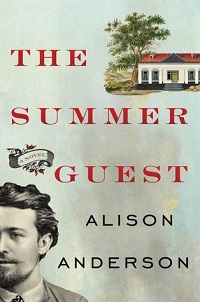
The Summer Guest by Alison Anderson

A young doctor who is going blind, Zinaida Lintvaryova, befriends a young man from Moscow, Anton Chekhov, when his family rents a dacha on her estate in eastern Ukraine (based on real-life history). This drama set in 1888 gets juxtaposed against a modern woman reading Zinaida's diaries. [see on Goodreads]

Odessa, Odessa by Barbara Artson

To escape anti-Semitic pogroms in their shtetl near Odessa, members of a Jewish family decide to emigrate to America, but assimilating into the culture of their new country isn't easy. A novel of persecution, generational differences, and resilience. [see on Goodreads]


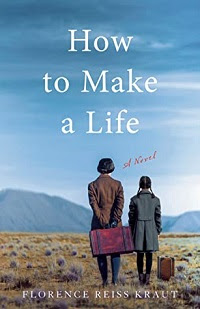
How to Make a Life by Florence Reiss Kraut


A young Jewish mother hopes to make a new start in America by emigrating in 1905 with her two surviving daughters after the rest of their family was killed in pogroms in Ukraine, but memories of their trauma remain; this saga spans four generations. [see on Goodreads]

The Memory Keeper of Kyiv by Erin LittekenIn her forthcoming debut, conceptualized well before the events of today, the author dramatizes the terrible events of the Holodomor of the 1930s, the man-made famine instituted by Stalin in which millions of Ukrainians died. The story is told from the viewpoint of a 16-year-old girl as she comes of age during this horrible time, and that of her granddaughter 70 years later. Out in May. [see on Goodreads]
The Diamond Eye by Kate QuinnThe heroine of Kate Quinn's latest historical thriller is Lyudmila "Mila" Pavlichenko, a Ukrainian library researcher who trains in marksmanship and becomes history's most accomplished female sniper, using her sharp-eyed skills as part of the Soviet army against the Nazis during WWII. There are echoes of today in seeing Ukrainians' indefatigable fight to defend their homeland. Based on a true story. This novel is published next week. [see on Goodreads]

A Boy in Winter by Rachel Seiffert

Seiffert, whose novel The Dark Room was shortlisted for the Booker Prize, has written a wrenching Holocaust novel about a diverse cast of characters in WWII-era Ukraine, as Nazi soldiers invade a small town. [see on Goodreads]


The Little Russian by Susan Sherman

Susan Sherman's novel The Little Russian takes its title from an older (and imperialist) nickname for Ukraine which was in use at the time the story takes place, the turn of the 20th century. She based her main character on her grandmother, a young Jewish woman who struggles to keep herself and her family alive in a time of political turmoil.  Read the guest post she wrote for my site back in 2012. [see on Goodreads]

The House with the Stained-Glass Window by Zanna SloniowskaThis slim literary novel opens in 1989, as an opera singer is murdered in the streets of Lviv while fighting for Ukrainian independence from the Soviets. The narrator, her daughter, takes readers on a journey encompassing the history of her maternal ancestors and of her beloved, politically troubled city. Translated by Antonia Lloyd Jones.  [see on Goodreads]

Like a River from its Course by Kelli Stuart
The publisher's blurb for this emotional historical novel says the author based her story on intensive research and interviews with Ukrainian WWII survivors.  Told from four individuals' viewpoints during the Nazi invasion of the Soviet Union and the bombing of Kyiv, it reveals not only the darkness and cruelty of the time but also people's resiliency and hope.  [see on Goodreads]


Mark Sullivan's The Last Green Valley, also a novel of Ukraine during WWII, is inspired by the true story of a family of German heritage, farmers in the Ukrainian countryside, forced into a dangerous, life-altering decision in 1944, as Stalin's Red Army approaches their home. [see on Goodreads]


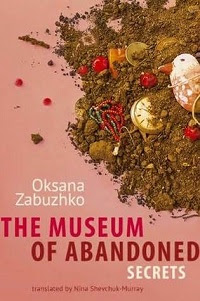
The Museum of Abandoned Secrets by Oksana Zabuzhko

From Ukrainian novelist Oksana Zabuzhko comes a complex, 700-page epic covering six decades in Ukraine, beginning in the pre-WWII years and focusing on three women. They including a brave member of the Ukrainian Insurgent Army killed by Stalin's forces in 1947 and a journalist researching her life years later. Translated by Nina Shevchuk-Murray.  [See on Goodreads]

Tuesday, March 15, 2022

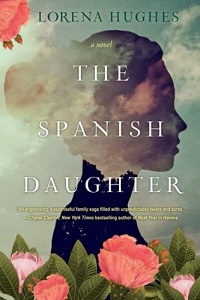
Lorena Hughes' The Spanish Daughter takes readers to vibrant 1920s coastal Ecuador

Lorena Hughes’ second novel drops a murder mystery into a simmering tale of sibling rivalry, gender-bending impersonation, and chocolate, and the result is scrumptiously readable. As in her debut, The Sisters of Alameda Street (2017), The Spanish Daughter vibrantly recreates the author’s native Ecuador.

In 1920, the coastal city of Vinces is known for its European architecture and cacao production. An experienced chocolatier, María Purificación de Lafont y Toledo, called Puri, sails from Seville to claim an inheritance from her late father, cacao plantation owner Don Armand, who had abandoned her and her mother decades earlier. She discovers, to her shock, that someone wants her dead.

Aboard the ship to Ecuador, Puri’s husband Cristóbal is killed in an attack meant for her, and so Puri disguises herself as Cristóbal—lowering her voice, wearing his clothes, and donning false facial hair—to determine who wanted to steal her rightful legacy. Puri surprisingly learns that her father had a second family, but while her half-siblings are resentful over Don Armand’s will, they treat “Don Cristóbal” with respect and don’t seem especially murderous.

This family has secrets aplenty, though, and Puri must sneak around the hacienda without letting her disguise slip, a challenge when she’s not comfortable riding horses, and when the dashing plantation administrator takes her drinking and to visit prostitutes (these scenes and Puri’s reactions are hilarious). The story explores gender roles with thought-provoking understanding. The plot feels initially jumpy when the viewpoint switches to Puri’s half-sisters at different times in the past, but these segments serve to illustrate family dynamics while adding to the puzzle.

It almost seems impossible there could be a satisfying ending to this complex state of affairs, but there is, very much so, and the novel’s atmosphere is as rich as Puri’s chocolate recipes.

The Spanish Daughter was published last December by Kensington, and I reviewed it from NetGalley for the Historical Novels Review. I'd also reviewed The Sisters of Alameda Street when it came out and look forward to more works by this author.

Wednesday, March 09, 2022

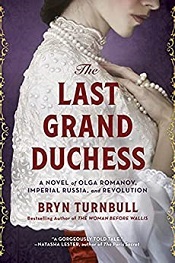
Discussing Bryn Turnbull's The Last Grand Duchess on the Off the Shelf videocast

I had a great time yesterday evening chatting about Bryn Turnbull's The Last Grand Duchess on Off the Shelf, a videocast hosted by authors Barb Wallace, Renee Ryan, and Donna Alward. Thanks to Barb, Renee, and Donna for inviting me as a guest and for letting me choose this episode's discussion book!

The Last Grand Duchess, subtitled "A Novel of Olga Romanov, Imperial Russia, and Revolution," looks at the last years of the Russian imperial family through the eyes of the Tsar and Tsarina's oldest daughter, Olga. As she comes of age, her eyes begin opening to the reality of the political situation around her, and her parents' role in creating it. 

It's a dual-timeline novel that contrasts an era of opulent balls, tea parties, and the advent of WWI with scenes taking place several years later, beginning in 1917, after Nicholas II's forced abdication of the throne and the family's subsequent captivity and exile. Everyone had opinions on the split-timeline aspect, which made for a good discussion.

The program's just under an hour. It's embedded below and also available by visiting YouTube.


Off the Shelf is an offshoot of the Step into the Story Facebook group (which I'm part of), and the show has regular episodes with discussions about intriguing historical novels and aspects of the writing process.  I'm glad to have been a part of it!

Saturday, March 05, 2022

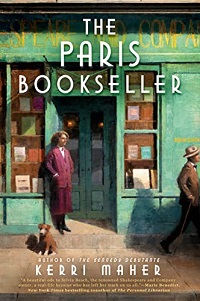
Kerri Maher's The Paris Bookseller celebrates Sylvia Beach, publisher and bookshop owner in 1920s literary Paris

In a novel exuberant, bittersweet, and reflective by turns, Maher explores the life of Sylvia Beach, doyenne of the American expat literary scene during the interwar years as proprietress of the English-language bookstore Shakespeare and Company. Unlike many writers whose work she championed, Beach may not be a household name, but the story gives her her due, recognizing that it takes a special talent to create a space where art can thrive.

In 1919, Sylvia arrives in the French capital, content to breathe the air of this “most rare and wonderful of places.” She finds a spiritual home at the bookshop of Adrienne Monnier, a young raven-haired Parisian to whom she’s attracted. Adrienne is already attached, but she and her partner welcome Sylvia to their literary life.

An admirer of the unabashed honesty of Kate Chopin and James Joyce, Sylvia discovers her true métier lies in supporting the power of art to “be new, to make change, to alter minds.” Establishing her own bookstore and lending library sets her on this path, making her store a magnet for the literati.

The atmosphere feels effervescent with creativity, though after obstacles to Sylvia’s dreams fall away (she and Adrienne become a couple at last), the story lacks conflict. Momentum increases once Sylvia takes up the challenge of publishing the manuscript of Joyce’s Ulysses herself, since the work is deemed obscene in the United States.

The ways she and her friends circumvent would-be censors to get the book into American readers’ hands are brilliant. Joyce may be a genius, but he has definite character flaws, and the story offers a deep look at their complicated relationship and Sylvia’s own emotions as she questions how much she should give of herself in indulging him. In the end, readers will emerge with sincere appreciation for the artistic spirit and courage of a remarkable woman.

The Paris Bookseller was published by Berkley last month, and I reviewed it from NetGalley for the Historical Novels Review.  Historical fiction about librarians and booksellers has become popular; unsurprisingly, readers love reading about other people who appreciate books and literature. Read more about the story behind the book in Trish MacEnulty's interview with the author for the same HNR issue.

Monday, February 28, 2022

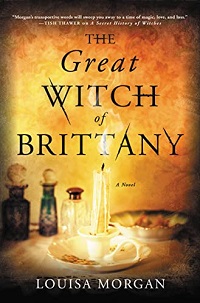
Louisa Morgan's The Great Witch of Brittany tells a tale of women's magic in rural 18th-century France

Morgan wrote this book in response to reader requests for more about Ursule Orchière, the elderly matriarch from A Secret History of Witches. At the beginning of that novel, Grandmère Ursule used a tremendous feat of magic to protect her descendants from witch-hunters and point their way to a safer home across the sea.

The Great Witch of Brittany
is an expansive saga that should satisfy her fans’ expectations for a prequel and then some. Like the menhirs on the field where the Orchières rest their caravan, it also stands proudly on its own.

In 1763, in a Romani settlement outside Carnac-Ville in northwest France, Ursule is a plain, dark-eyed thirteen-year-old who assists her fortune-teller mother, Agnes. Although the Orchière women have a heritage of witchcraft, none among their large clan can work magic until Ursule’s latent abilities awaken during puberty. When Ursule unknowingly blurts out a hidden truth about a client, the situation turns dangerous, forcing Ursule to flee and leave the travelers’ life behind.

We know that Ursule will become a mother and grandmother, but not how that came about. Suffice it to say that in ensuring the continuation of her line, Ursule must weigh whether to use her knowledge of spells and tonics toward this purpose. Unsurprisingly, she also faces prejudice due to her skin color throughout her long life.

Aside from repercussions from the French Revolution, historical events don’t intrude much, although the scenes of pagan festivals and daily life in the pre-industrial Breton countryside are skillfully illustrated. The book spans nearly sixty years, and Ursule and her family comes to feel like old friends as she moves from maiden to mother to crone with guidance from her ancient grimoire, scrying stone, a raven familiar, and the voices of her predecessors. For fans of feminist historical fantasy, this tale of women’s stories, power, and mysteries will greatly appeal.

The Great Witch of Brittany was published by RedHook this month, and I'd reviewed it from NetGalley for the Historical Novels Review.  I actually enjoyed it more than the original book, which I'd reviewed in 2017.

Saturday, February 19, 2022

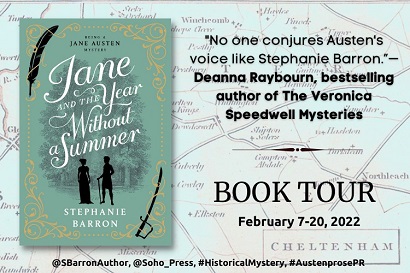
Jane and the Year Without a Summer by Stephanie Barron takes Jane Austen to the spas of Cheltenham in 1816

In May 1816, Jane Austen and her beloved sister, Cassandra, embark on a two-week stay in the fashionable English spa town of Cheltenham to take the waters and stroll about the streets. Sadly, Jane has been plagued by illness, with little appetite, and suffering from backaches, fatigue, and an odd sallow complexion. If she can manage to distract herself from her poor health and her brothers’ personal problems, maybe Jane will find time to work on her manuscript-in-progress, “The Elliots,” while she’s away.

She and Cassandra take lodgings at Mrs. Potter’s, a boarding house on the High Street whose other guests are an eccentric and motley bunch, including a beautiful invalid heiress with a waspish temper, the companion who attends her in her wheeled chair, a middle-aged brother-sister pair whose self-centeredness knows no bounds, a young woman who gives elocution lessons to actors, and more. Meanwhile, Jane has trouble setting aside thoughts of Mr. Raphael West, a handsome past admirer, and wonders why he hasn’t renewed their acquaintance.

In her fourteenth Jane Austen mystery, Stephanie Barron smoothly interweaves real events from Jane Austen’s life with a fictional crime scenario involving her fellow lodgers, at least one of whom has murder in mind. You may be excused for forgetting, early on, about the novel’s intended genre, since the plot ambles along nicely for a while without any deadly happenings.
author Stephanie Barron

Jane and Cassandra sample the waters at the Pump House (which taste absolutely vile!), and her visit to a local physician gets her blood boiling, a reaction that women especially will identify with. The Austen sisters become curious about the mysterious “Beauty in the Bath Chair” and her reasons for being in Cheltenham. Make no mistake, though, this genteel mystery has teeth, and Jane, with her famously astute observations on human nature, is there to untangle it all.

The novel is written in the form of a period piece authored by Jane herself, complete with Regency-era diction, vocabulary, and spellings, plus historical footnotes contributed by the book’s “editor.” Through them, we’re told (or reminded, for those in the know) about the meaning of the title: following the eruption of Mt. Tambora in the Dutch East Indies the previous year, the weather across Europe in 1816 was unnaturally cold and dismal. Footnotes in historical fiction only work well in certain instances, and this is one of them.

Despite Jane’s literary brilliance (and deductive success, as imagined here), it’s impossible, while reading this story, to set aside the sorrowful fact that her life—and by implication, perhaps this series as well—is drawing to a close. The ending, while bittersweet, feels just right for the book, and for readers who haven’t sampled Jane’s previous adventures, there are thirteen others to anticipate.

Stephanie Barron's Jane and the Year Without a Summer is published by Soho Press this month (I reviewed it from a NetGalley copy for the author's blog tour).


Jane book tour banner

Thursday, February 17, 2022

Eva Stachniak's The School of Mirrors presents a new view of 18th-century women's lives at Versailles

Stachniak casts empathetic light on a French mother and daughter whose lives are affected by royal privilege.

By 1755, Louis XV, weary of court formalities and dramas, has become a “connoisseur of innocence,” so his valet de chambre procures untouched teenage girls for his pleasures. Believing she’ll be entering domestic service, pretty, lower-class Véronique Roux arrives at a house near the Versailles palace and gets instructed in the courtesan’s arts. Her patron’s identity is kept concealed, and Véronique loses access to their daughter, Marie-Louise, after her birth.

Marie-Louise becomes a skilled midwife though often wonders about the parents she never knew. As revolutionary fervor builds, her secret royal heritage could become a liability if it’s discovered.

Stachniak combines a delicately embroidered historical world with enduring situations, like the exploitation of the less fortunate and parent-child relationships. Her multifaceted approach also showcases Queen Marie Leszczyńska’s charity work and a fascinating cloth mannequin used to train midwives.

The theme of illusion versus authenticity emerges in subtle ways. This accomplished novel should enthrall Francophiles and women’s history enthusiasts.

The School of Mirrors will be published next week by William Morrow; I turned in this review for Booklist, and the final review was published in their January 1st issue.

Some background information:

- The house where Véronique resides during her time as a mistress-in-training (and later mistress in fact) was a real place called Parc-aux-Cerfs, or Deer Park, as it's called in the novel. Read more about it at the This Is Versailles blog.

- Angelique Marguerite Le Boursier du Coudray, known as Madame du Coudray, was a pioneering midwife who trained other women across France in her profession.  Her cloth mannequin, called the "machine," is a cloth anatomical model used to demonstrate the birthing process, and a photo can be found on her Wikipedia page. Stachniak shares more information in her author's note about Madame du Coudray's revolutionary teaching methods, and how they gave young women agency in a world dominated by powerful men.

- Stachniak is also the author of other recommended historical novels about historical women, including The Chosen Maiden about choreographer Bronislava Nijinska; The Winter Palace and Empress of the Night about Catherine the Great; and Garden of Venus, about 19th-century courtesan, and later countess, Sophie Potocka.


Monday, February 14, 2022

Some romantic historical reads for Valentine's Day

In a comment to a recent post, Tiffany asked about “some recommendations or your favorite romances for some good Valentine's Day reading.” I pondered this for a while, since I don’t currently read a lot of genre romances; I enjoy them, but my reviewing schedule doesn’t allow me to dive into these books as much as I’d like.

 But if we’re talking about love stories across the entire historical fiction spectrum, I can easily provide some recommendation on that score. Many of these novels are best described as historical fiction with romantic elements. I tend to go for deeper themes in my romances, rather than lighter, fluffier fare. Also, most are older titles that could be described as classics.

These are in no particular order. Please share your own favorites in the comments.

Jojo Moyes, The Last Letter from Your Lover, a dual-period romantic mystery, set in 1960 and over forty years later, about a woman who developed amnesia after a terrible car accident, and who starts questioning the truth about her marriage after finding a mysterious love letter. The movie adaptation (which I thought was just okay) oversimplified the story and omitted one of my favorite parts. This prompted me to reread the novel, which was as good as I remembered.

Madeline Hunter’s medieval romances, including By Arrangement and By Design, set in 14th-century London and which feature characters from different social classes. I wish medieval romances were still in vogue so we could see more like this.

Overseas by Beatriz Williams, her first novel, a complex time-travel story about a modern American woman and a British officer in the Great War. Julian Ashford is a wonderful, honorable hero in this timeless love story.

Tempest by Beverly Jenkins, a mail-order bride romance with plenty of surprises, featuring African American characters in the Old West.

Meredith Duran’s Duke of Shadows, another first novel (from 2008), a meaty Victorian romance with a biracial hero, set in India and England, with exquisite writing which is unafraid to delve into darker issues.

Jeannie Lin’s My Fair Concubine, part of her Tang Dynasty series, a nuanced love story about honor, duty, and class differences with a new take on the classic “My Fair Lady” scenario.

Passing Glory by Reay Tannahill, one of my favorites of her sprawling romantic sagas, which begins in early 20th century England and spans fifty years. It won the Romantic Novelists’ Association’s Novel of the Year, and the ending is most definitely earned.

The Dutch Girl by Donna Thorland, which I read last year; it’s a full-bodied historical novel of American Revolution-era New York, with strong romantic elements and a plotline involving adventure, secret identities, and the history of Dutch settlement in America. The attention to historical detail is impressive.

Piper Huguley’s Home to Milford College series, romantic historical fiction set in the Reconstruction-era South, about the love story between two African American characters who found a fictional historically Black college. Start with The Preacher’s Promise.

Pamela Belle’s Heron Saga, a family saga and star-crossed love story of 17th-century England, published in the 1980s and reissued by Lume Books, so new readers will get a chance to discover them. The Moon in the Water is book one.

Beau Crusoe by Carla Kelly, a Regency romance involving a troubled hero suffering from PTSD and a widow struggling to overcome a scandalous past. I first wrote about it here.

Friday, February 11, 2022

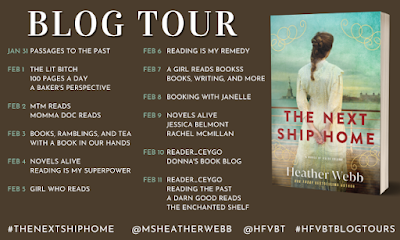
Interview with Heather Webb, author of The Next Ship Home: A Novel of Ellis Island

Thanks to author Heather Webb for stopping by Reading the Past for an interview about her new novel The Next Ship Home (Sourcebooks, Feb. 2022), which offers a unique lens on the American immigration story. Through the perspectives of two young women in the early 20th century -- aspiring translator Alma, the daughter in a German family who becomes a matron at Ellis Island, and Francesca, a newly arrived Italian immigrant -- I was quickly drawn into a sweeping story about cultural prejudice, corruption, the complications of family, and a surprising friendship.

I’ve read many historical novels dealing with immigration to America, but yours is the first that centered on operations at Ellis Island itself. All the details were fascinating to read about. What inspired you to focus your attention on what took place there?


The very first time I visited Ellis Island I was a high school teacher on a field trip with students. I was absolutely riveted by the place. There’s a real presence in those halls…so many people, so many stories to be told. I think, also, being a lover of language and culture—and a military brat—has always made the study of those trying to assimilate to a culture not their own has always fascinated me. I could relate in many ways. It’s funny that when I first started writing, I knew I wanted to write a book about Ellis Island but I also knew I wasn’t ready. Something inside me warned me that I needed to practice more, try other books and ideas, before it was time to sit down and tackle such a grand, challenging topic. I’m glad I listened to my intuition.

What resources did you use to re-create the duties and mindset of Alma, a matron at Ellis Island whose job involved assisting female immigrants and families?

I read several books about the operations at Ellis Island and I also mined information from a ton of immigrant interviews. Though there weren’t a lot of specifics on the day-to-day of a matron, there was just enough that I could glean the basics and fill in the rest. I also found helpful information on the plaques and in the videos at the immigration center on Ellis Island.

As a language aficionado myself, I rooted for Alma and her yearning to become a translator. I also enjoyed seeing her improve her repertoire of world languages, and the theme of how languages are a bridge to cultural understanding. How did you get interested in this topic?

I’m a former French and Spanish teacher and I thoroughly love language-learning in all its forms. I’m really fascinated by the way language reflects culture and how, in kind, culture shapes language. I enjoy studying how language has changed over time as well. I suppose you could say Alma was my ode to the language teacher inside me.

How did you decide on the approach to tell the story from two women’s alternating perspectives?

I knew I wanted to explore different classes of Americans from the newly-arrived immigrants to the first-generation Americans, as well as the wealthy, more established. As well, I wanted to depict the opposing perspectives of immigrant and worker to show the complexity of the immigration system. It’s very rarely a simple thing.

Ellis Island is enshrined in many family histories as a place of hope and new beginnings. Human nature being what it is, I shouldn’t have been surprised at the corruption and abuse that took place at Ellis Island, and which the immigrant characters unfortunately deal with. Were there any facts that took you by surprise as you researched this aspect of the novel?

author Heather Webb
Many! I really enjoyed reading about Teddy Roosevelt’s place in shaping immigration reform as well as his visit to the island in the fall of 1903. It was a horrible, stormy day and the boat carrying him and his staff nearly capsized in the swell of the bay. When he arrived to the island, very late to the elaborate lunch they’d planned, the food was cold but they did manage to serve oysters for which the Hudson Bay used to be famous, and also champagne. There are so many more facts, too, about the anarchists like Emma Goldman, President McKinley’s assassination, and much more. In truth, I had a hard time narrowing down what the story was truly about during the first few drafts.

Reproducing international languages and accents in dialogue can be tricky, because the effect can easily be overdone, but this isn’t the case with Francesca. Everything read as very natural to me. What suggestions do you have for other authors about writing dialogue for characters still gaining fluency in English?

First of all, thank you for the compliment. It’s not an easy thing and yet, I think it’s important to distinguish differences in the characters’ language. I’m a freelance editor and teacher as well so I usually recommend to my students to think of dialect and foreign language as a seasoning in a dish. Salt makes a dish delicious with just the right amount but it must be sprinkled with caution. Too much makes the dish inedible.

Since The Next Ship Home takes place in the United States, did you find the research any easier or different than it was for your previous novels?

Overall, I’d say it wasn’t easier because I’m always interested in international travel and I’m the first one on that plane, but it’s certainly true that living not far from New York City made my research much more accessible (and cheaper!). I took many trips to Ellis Island and into the city itself, and I also used the public library and its archives in the city to gather information and photos, trinkets, etc.

The Next Ship Home blog tour banner

About the author:

Heather Webb is a USA Today bestselling and award-winning author of historical fiction. In 2017, Last Christmas in Paris won the Women’s Fiction Writers Association award, and in 2019, Meet Me in Monaco was shortlisted for both the RNA award in the UK and also the Digital Book World Fiction prize. Heather’s new solo novel The Next Ship Home is about unlikely friends that confront a corrupt system, altering their fates and the lives of the immigrants who come after them. When not writing, Heather flexes her foodie skills, geeks out on pop culture and history, or looks for excuses to head to the other side of the world. For more information, please visit Heather’s website

Sunday, February 06, 2022

The Magnolia Palace by Fiona Davis offers an exciting, artistic escape into New York City's past

Fiona Davis’s novels offer the vicarious pleasures of getting an exclusive tour of New York City’s iconic landmarks. Her latest work centers on the Henry Clay Frick House, once a Gilded Age mansion, now a public museum and art library. While envisioning the gorgeous paintings, sculptures, and other precious objects inside the building (whose Fifth Avenue garden is adorned by large magnolias) is a highlight, the colorful personalities could carry the novel on its own.

By 1919, Lillian Carter has spent six years posing for public sculptures across New York under the name “Angelica.” While she’s enjoyed contributing to the city’s art scene, a murder scandal involving her landlord forces her to go into hiding.

A twist of fate propels Lillian into the role of private secretary to Helen Clay Frick, the industrialist’s mercurial 31-year-old daughter, who’s torn between pursuing her own interests and seeking her critical father’s approval. Lillian proves remarkably successful in her tasks, but while she dreams of a silent movie career, a secret assignment, one that’s too temptingly profitable to resist, ensnares her in longstanding Frick family tensions.

Decades later, in 1966, English model Veronica Weber secures a lucrative modeling assignment at the Frick Collection, but after the job turns sour, she finds herself accidentally trapped in the building overnight alongside a handsome African American museum intern. Initially watchful of one another, they team up to follow clues in a scavenger hunt created long ago.

The pages breeze by as potential romances develop (maybe not the ones you’d expect) and a mystery involving the whereabouts of the Magnolia Diamond unfolds. Deeper issues also undergird both narratives, which confront stereotypes about models and explore how a tragedy can warp family relationships years later. The two narratives dovetail in a satisfying way. Mystery and art lovers should relish this exciting escape into New York’s past.

The Magnolia Palace was published by Dutton in January; I reviewed it from NetGalley for February's Historical Novels Review.

The Frick Collection
Credit: Gryffindor, CC BY-SA 3.0, via Wikimedia

Read more about the Frick Collection at their website. Although I've been to NYC many times, I hadn't been familiar at all with this institution or the personalities surrounding it before reading this book. Now I have a long list of places to visit once travel is possible again.

Tuesday, February 01, 2022

The Books of Jacob by Olga Tokarczuk, her magnum opus about a controversial 18th-century Jewish figure and his world

Described as Polish Nobel laureate Tokarczuk’s magnum opus, this impressively sprawling story reveals the life and times of Jacob Frank, an 18th-century Jewish messianic figure. Frank is enigmatically charismatic and incredibly disruptive: a self-described “simpleton,” sporting Turkish garb, who violates social norms.

Opening in 1752 in Rohatyn, a Polish market town, and passing through numerous other European and Ottoman locales, the narrative expertly delves into the circumstances that shaped and elevated him. Forbidden from buying land and overburdened by taxes, many Jews seek deliverance. In this bizarre, intricate journey based in history, Frank and his followers come to reject the Talmud and, eventually, convert to Catholicism.

With language that’s engaging, erudite, and spiced with witty colloquialisms and wonderful turns of phrase via Jennifer Croft’s supple translation, Tokarczuk explores the state of being an outsider in places with fixed cultural boundaries and how Frank tries to work the system to advantage. Among the intriguing, diverse cast are Nahman, Frank’s ardent supporter, and Yente, a dying woman whose spirit views events from above.

There’s so much fine quotidian detail you’ll feel you’ve stepped into the novel’s canvas, while the overarching threads connect brilliantly. With its length, dozens of characters (some of whom adopt new names), and theological discussions, this panoramic tale requires commitment, but it’s masterfully done.

The Books of Jacob is published today by Riverhead in the US; it appeared in the UK last year from Fitzcarraldo Editions. I submitted this review for Booklist, and it was published (in shorter form) in the Dec. 1, 2021 issue.

This book is 992pp long, and the lengthiest novel I've ever read on my Kindle (I got it from NetGalley). It took me three weeks to read, and my Goodreads challenge definitely suffered.  A note from the publisher says:  "In a nod to books written in Hebrew, The Books of Jacob is paginated in reverse, beginning on p. 955 and ending on p. 1 – but read traditionally, front cover to back." This wasn't apparent from my copy, but it's an appropriate and cool feature. The translation from Polish by Jennifer Croft reportedly took seven years to complete.

As you can imagine, writing a 200-odd word review of a nearly thousand-page historical novel necessitates leaving out a lot, so tough decisions had to be made on what to include in my writeup. I was given a choice as to what I might like to review and selected The Books of Jacob because (1) the historical period is one I knew very little about beforehand; (2) a branch of my family comes from the area where part of this book takes place; (3) I couldn't resist the opportunity to be among the first to read this internationally acclaimed novel in English, as I'd heard a lot about it; and (4) after reading through the first chapter of the NetGalley copy, I was sold and wanted to continue.

Jacob Frank is a historical character, and his story as presented by Tokarczuk is utterly strange and based in truth. His story, and that of religious and social life at the time, is related through the eyes of numerous other characters, and it's left to interpretation as to whether Jacob is a charismatic con artist or a shrewd observer who determines an ingenious, unorthodox way to raise the Jews' status in society. There are no references to Jacob himself until a good ways in.  You may find yourself wondering when he'll finally make an appearance on the page, but by the time he does, you'll have a detailed picture of the unique circumstances surrounding him and the movement he creates.

Reviewing for the New York Times, Dwight Garner calls it "sophisticated and overwhelming," both of which are true. His conclusion also agrees with my experience.  Read his take on the novel here.

Saturday, January 29, 2022

More historical fiction award news: Langum Prize and National Jewish Book Awards

It seems to be the season for book awards. The honorees for the 2021 Langum Prize in American Historical Fiction were announced earlier this week, and the 2022 winners of the National Jewish Book Awards were named last week. Here are the details relevant for historical fiction readers.

The Langum Prize:

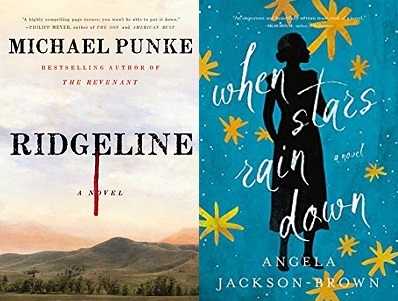
Ridgeline and When Stars Rain Down


Ridgeline by Michael Punke, which revisits the scene of the Fetterman massacre, a violent clash between white settlers and the Lakota in 1866 Wyoming, is the winner of the 2021 Langum Prize.

The Langum Prize finalist for 2021 is When Stars Rain Down by Angela Jackson-Brown, the coming-of-age story of a young Black woman in Depression-era Georgia.  Read my earlier review of this excellent novel.


National Jewish Book Awards:

National Jewish Book Award historical fiction winners


Sponsored by the Jewish Book Council, the National Jewish Book awards are presented annually for Jewish literature in a wide variety of categories. Links lead to the reviews or descriptions at the JBC website.

In the Book Club category, the winner is Helene Wecker's The Hidden Palace, a sequel to her historical fantasy novel The Golem and the Jinni, a cross-cultural immigrant story set in early 20th-century NYC.

Finalists in the Book Club category are Weina Dai Randel's The Last Rose of Shanghai (an epic love story of WWII Shanghai that I reviewed earlier) and Yaniv Iczkovits' (trans. Orr Scharf) The Slaughterman's Daughter (about a young woman's disappearance in the Pale of Settlement in the late 19th century).

For Debut Fiction, the winner is Jai Chakrabarti's A Play for the End of the World, which moves from the Warsaw Ghetto to India in the 1970s as it examines the themes of friendship, love, and the purpose of art.

Lori Banov Kaufmann's Rebel Daughter, a young woman's perspective on the destruction of Jerusalem in 70 CE, won the award for Young Adult Literature.

If you've read any, I'd love to hear your thoughts.  Congratulations to all the honorees!

Monday, January 24, 2022

Historical fiction award winners announced at the 2022 American Library Association LibLearnX conference

Yesterday afternoon, I tuned in to watch the 2022 Book & Media Award announcements from the American Library Association's RUSA Division. The event was broadcast on Facebook and YouTube (which my husband set up so I could watch on our TV). Our tortie cat Cocoa helped, or rather mostly got in the way of the screen.  LibLearnX is the new conference that takes the place of ALA Midwinter.

The graphic below with the book covers of four winners, coincidentally, is highly orange!


There were three major awards in which historical novels received recognition, so without further ado:

The winner for the Carnegie Medal for Excellence in Fiction was Tom Lin's The Thousand Crimes of Ming Tsu, about a Chinese orphan turned assassin in the post-Civil War West.

On the Notable Books List are several other works of historical fiction:

Jaime Cortez's Gordo, a short story collection set amid a California migrant workers' camp in the '70s (if you count the era as sufficiently historical);
Lauren Groff's Matrix, imagining the life of Marie de France, a French-born abbess in 12th-century England;
Honorée Fanonne Jeffers' The Love Songs of W. E. B. Du Bois, an expansive story tracing the heritage of a young woman's African American family;
and Anthony Doerr's Cloud Cuckoo Land, a historical-futuristic literary epic set partly in 15th-century Constantinople.

And for the Reading List, the ALA's annual awards in eight genre fiction categories, the award for Historical Fiction went to The Sweetness of Water by Nathan Harris, about the unusual friendship between enslaved brothers and a Georgia plantation couple in the post-Civil War years, and a subsequent tragedy.

On the Historical Fiction shortlist are:

Daughters of Sparta by Claire Heywood (a Greek myth retelling):
Leonora in the Morning Light by Michaela Carter (on 20th-century painter Leonora Carrington);
The Rose Code by Kate Quinn (suspense before and after Bletchley Park, WWII);
and A Tip for the Hangman by Allison Epstein (spy thriller with Christopher Marlowe).

Congrats to all the honorees!

Cocoa the cat and the ALA Notable Books
Miss Cocoa acting as live awards emcee

Thursday, January 20, 2022

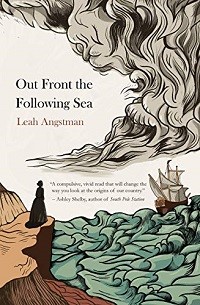
Out Front the Following Sea by Leah Angstman, a tale of female strength and survival in early New England

Hang on tight for a bracing read about a young woman’s strength in the wilderness and towns of late 1680s New England.

The courageous heroine of Leah Angstman’s debut novel is Ruth Miner, just sixteen when she’s forced to endure the frigid winter temperatures while caring for her elderly grandmother, suffering from dementia, in their spartan cabin near Shrewsbury, East Jersey Province. Considered an outcast following suspicion that she killed her parents through witchcraft, Ruth knows she must shoulder her burdens alone. Being an independent woman in this time and place, though, is dangerous, a theme carried through the entire novel.

Ruth’s one initial ally is a sea captain’s half-French son, Owen Townsend, who knows the truth about her past. After her grandmother’s inevitable death, Ruth knows she needs to flee a mob of angry townspeople and wangles a spot aboard Owen’s ship, the Primrose, as freight (not a fun prospect!) since all the passenger slots are filled.

Arriving in the coastal settlement of Stonington in Connecticut Colony, Ruth finds a quasi-home with a Quaker couple, though pressure mounts for her to find a husband. Owen, however, must be off on another voyage just as an older merchant comes seeking her hand. Meanwhile, despite a prevailing treaty, tensions between the English and French are heating up in the colonies, leading ultimately to King William’s War.

The atmosphere feels raw, the setting untamed, the characters stubborn and full of purpose. The author’s muscular language does much heavy lifting in evoking the time through original expressions and an impressive command of period vocabulary. Many insults are worth jotting down for future use (“You fewmet of a boar!” “Ale-soused applejohn!”).

Fast-paced action, an emotional love story, race relations, and international political intrigue intermingle in a compelling way. The author makes some impressively daring choices with her characters’ lives. At times the narrative feels whittled down from a longer book, since there are some gaps where we don’t get to see how characters got from point A to point B.

Few novels depict this troubled time in American colonial history, or early Connecticut, for that matter, and Ruth is a heroine well worth following on her dramatic journey of survival.

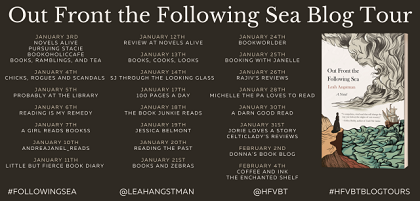
Out Front the Following Sea was published in January by Regal House; I reviewed it from an Edelweiss e-copy as part of the tour for Historical Fiction Virtual Book Tours.

Out Front the Following Sea tour banner

Monday, January 17, 2022

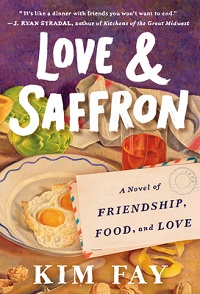
Love & Saffron by Kim Fay, an epistolary novel of food and women's friendship in 1960s America

Fiction and culinary travel writer Fay (The Map of Lost Memories, 2012) has crafted a delectable second novel showing how food can bring people together, even across distances and cultures.

In October 1962, Joan Bergstrom, an unmarried 27-year-old from L.A., sends an admiring fan letter to Mrs. Imogen Fortier, author of a magazine column on Pacific Northwest island life. To thank her, Joan shares a favorite mussels recipe and encloses a saffron packet.

The story is mostly told via the women’s warm-hearted correspondence. They become close while exchanging thoughts on food, their personal lives, and contemporary society.

Their connection nurtures them during tough times and draws in others as well. Imogen’s WWI-veteran husband, Francis, impresses her with his newfound interest in French cooking, while Joan’s friendship with her neighbors’ Mexican carpenter, begun over a shared meal, develops into something more.

Fay’s emotionally generous novel demonstrates how people’s worlds can expand when they open themselves to new possibilities. Readers will be touched by this enriching tale and inspired to embark on their own international culinary adventures.

Love & Saffron will be published by Putnam (US) on February 8th; I reviewed it for the Nov. 1, 2021 issue of Booklist.  The novel is 192pp long, and you can read it in an afternoon (which I did).  There are many scrumptious-sounding dishes described within, so prepare to start googling for recipes. 

This novel is very different in style and tone from her first novel, a quest-adventure set in 1920s Shanghai and Cambodia, and which I'd also reviewed back in 2012. I'd also interviewed Kim Fay about The Map of Lost Memories, and she spoke then about her interest in food and cooking.

Wednesday, January 12, 2022

In Love, In War: a guest post by Margaret Walker, author of Through Forests and Mountains

I'm happy to welcome Australian novelist Margaret Walker for a guest post about the background to her latest historical fiction work, Through Forests and Mountains (Penmore, 2021), which focuses on the Partisan women in WWII Yugoslavia. 

~

In Love, In War
by Margaret Walker

How many women do you know who commence an historical novel based on their shoe size? Or their head circumference? Or their height? When I was growing up in Sydney in the 1960s, all three were expected to be British, and the British were small.

I was an eight-pound twin. I was adopted at birth and my mother came from Yugoslavia, the home of large people.

I grew up hating shoes. All they ever did was hurt. I hated shopping. Nothing fitted, and I developed an early and permanent fixation about my size.

Then, in 1970, something wonderful happened. My adoptive mother told me about the women of the Yugoslav Partisans in World War 2 who had battled the Nazis alongside the men. She did it to console me – even at ten I could tell that – and with that heightened sense of romanticism that novelists are born with, I just knew that my biological mother had hurled grenades at cowering Germans. I felt a fierce pride that half of me had been involved in the Struggle for National Liberation, as it was called and, from that day, I was on a mission to teach my small-footed, small-headed world the history that justified every pair of shoes that had ever given me blisters. But first I treated my disproportionate self to a tour of the old Yugoslavia where, at long last, I met women my size.

Margaret in Belgrade vs Margaret in Sydney

My first novel His Most Italian City, about the persecution of my birth mother’s family under Mussolini, was published by Penmore Press in Arizona in 2019 and, with the confidence that gave me, I began to write Through Forests and Mountains about the Partisan women. In 2015, Jelena Batinić published a fabulous book called Women and Yugoslav Partisans, and in 2018 I bought a book of Partisan poems in Croatian, of which I translated about forty. "A Woman Under Arms" by Franjo Mraz is my favourite:

Oh, my rifle, I will never part with you!
You will be with me at the end of my wrist until the last day
Protecting the paths of freedom along which the conquered are moving.
Tremble, look, and listen to the woman warrior, the woman partisan!

So, like me, you want to tell the world about your obsession? You are in distinguished company, and I suggest that two things are essential. One, make your readers care about your protagonist from the first page. You must carry them along emotionally. Two: be such a sensational writer that you can make your reader passionate about carburettors, sushi and Tibetan Mastiffs.

Not interested in the Yugoslav Partisans?

I’m going to make you interested. Great style, emotional characters, racy plot, and a seriously nasty villain.

In the planning stages, I considered what the premise of a novel about women fighters ought to be and, after a few false starts, I decided to tell the story of a man who, in the ordinary course of his life, has trouble with women. He’s mechanical. He’s hopeless at female games. His love life is a series of brief, shallow relationships. However, as the war progresses, he finds himself in a position where he is forced to deal with women fighters.

How he responds to this provides the conflict, and conflict is important in novel writing. It gives the reader interest. In order to resolve it, I toyed with the idea of introducing romantic elements between him and the female protagonist.

Here I encountered a problem.

The Yugoslav Partisans were not allowed romance. The Anti-Fascist struggle was too important. The women who fought became hardened until they were almost like eunuchs. Their periods stopped. If they had children, they left them in the care of others and went off to fight.

Then I discovered the poems of Josip Cazi, a political commissar with the Partisans. As I read his verses, a picture emerged of a soldier whom I imagined might ‘lay his rifle tenderly next to hers’. So many of his poems were about his relationships with women, and their style is remarkably sentimental for wartime.

‘Jelice, my apple girl in blue. My partisan rose with the wild hair in the blushing dawn, in pearls of dew. My small hero.’

If he can do it, I can do it, I thought. (And, despite the rules, there must have been some fun and games amongst the Partisans because Jelena Batinić includes a quote from a German who observed that many of the women were pregnant.)

From that moment, my male protagonist was doomed to be smitten, poor fellow, and I hope I have made this clear to the reader from the beginning of the novel. By the time my manuscript assessor suggested that I might like to develop my dot-pointed romance, the horse had bolted, and honestly it was so much fun to write that I almost considered going in for the whole Mills and Boon thing – Her Gun at his Heart, A War on More Fronts Than He Anticipated, Surrender! – and so forth.

'I have spoken with the commissar,' Anton began, 'who has given us permission to marry. If you'd like,' he added.

'Oh...' said Mara and put a hand to her lips. 'Oh.'

Anton waited for her to say something else. When she didn't it was obvious, even to him, that her mind had not been on love.

In an effort to emphasise to her the uniqueness of the privilege granted them he said, 'They don't generally allow it.' Still no reply. He added desperately, 'The commissar's reply ran along the lines of what he thought would be in my best interests, or rather, you understand, our best interests.'

'I understand,’ said Mara.

'What he meant was, I can't go back to sea, so...'

'Marriage might be a sweetener?'

'Well, yes, I expect you could put it like that.’

She started to laugh. That thoughtless, girlish laugh that had so often wounded him. He felt lonelier than ever. He was aware, by then, that he had blown his chance of getting her that little bit closer to him for a longer time, instead of always being part of an army on the move. What might happen tomorrow? Where would they be sent? When would he see her again? What sort of struggle against the Axis powers might it be for him if he no longer had access to her heart? If only he could start again and ask her properly in a way that any young woman would like to be asked. But had he? No. He’d just done it his way, as usual.

But she stopped laughing and looked up at him fondly.

'Of course, I'll marry you, Anton,’ she said. ‘What would I do if you weren’t here?'


Note: Quotations from the poems, translated by Margaret Walker, are from Po Šumama i Gorama, Pjesme Boraca Narodnooslobodilačkog Rata [Through Forests and Mountains, poems of the fighters in the war of national liberation], published in Zagreb in 1952.

 ~

Margaret Walker is a teacher. She has a Bachelor of Science degree from the University of Sydney, and diplomas in Education and Professional Communication. Her short stories have been published in Australia and England.  Visit her author website at:  https://www.mwalkeristra.com.

Thursday, January 06, 2022

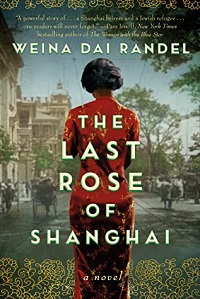
The Last Rose of Shanghai by Weina Dai Randel, an epic love story set in Japanese-occupied Shanghai

Set amid the maelstrom that was Japanese-occupied Shanghai beginning in 1940, Weina Dai Randel’s third novel is charged with incident and emotion matching its setting. It reads as if the author poured every ounce of creativity and feeling into her writing, and based on her comments at the end, this was the case.

At its essence, The Last Rose of Shanghai (named after the female lead’s favorite jazz song) tells the love story between Aiyi Shao, a young, sophisticated heiress who owns a nightclub called One Hundred Joys, and Ernest Reismann, the Jewish pianist she hires to attract new customers to her once-popular venue.

Ernest is newly arrived by ship from Nazi Germany with his younger sister, Miriam, and desperate for work after learning that Shanghai – the only port not requiring an entry visa – is flooded with other refugees. His foreignness is the problem, not specifically his religion; many Shanghainese, including Aiyi, are unaware of the antisemitism over in Europe. That remains true until it isn’t. When Japan forms an alliance with Germany, the Britons in Shanghai’s International Settlement become the enemy, and restrictions eventually tighten against the Jews.

The backgrounds of Aiyi and Ernest are gradually layered: she is reluctantly engaged to her conservative cousin, Cheng, yet despite her independent streak, she understands the importance of family. Ernest faithfully sends funds home for his parents to join him, not realizing until later that his efforts are futile (of course, the reader knows this). Their love affair is fiery and necessarily furtive. These passionate characters are flawed individuals who sometimes act out of selfishness, but with the world stacked against them in so many ways, it’s easy to root for their happiness.

The historical background comes alive with full-bodied color and sound, plenty of twists in the action, and brilliantly painted word-images: “… all of us Chinese in Shanghai were like trapped fish in a sunless marsh. To avoid the hook of death and go on living, we had no choice but to remain unseen under water,” Aiyi says. The author also weaves in cultural information, like the tones used to pronounce Aiyi’s name correctly (which Ernest never quite masters) and the bat mitzvah ceremony young Miriam prepares for. Anyone seeking an original focus on the frequently dramatized WWII era should pick up this book for a gripping emotional journey.

The Last Rose of Shanghai was published by Lake Union in 2021; I read it from NetGalley.