Friday, March 20, 2015

A gallery of new and recent historical novels by Australasian women writers


Now that I have a new sun porch, and thus more room for bookcases in the house, I've set aside one shelf for historical novels from Australasian authors and publishers.  Just because most are hard to find in this corner of the world – I don't let 10,000 miles stand between me and a book I want to read.

The margins on this blog are pretty narrow, so I also have a larger image of the shelf linked up.

Because they can be expensive to obtain in print, I get a fair number of these titles on Kindle, also.  I'm always interested in discovering new historical fiction writers and being transported via fiction to new locales.  I've also been following along with the Australian Women Writers' Challenge in an attempt to keep up with what's coming out and may join the challenge myself next year.

Which brings me around to the topic of the Historical Novel Society's first Australasian conference, which kicked off yesterday in Sydney.  This is a significant and very exciting undertaking, and I extend my congrats to the organizers for their hard work in pulling everything together.  I wish I was there in person and hope all attendees are having a wonderful time.

Since I've been celebrating Women's History Month here at the blog, this seems like a good time to showcase historical novels by Australasian women authors.  The books (15 in all) are set all over the place, and since there are a lot of them, I'm just giving brief notes on the settings of each.  For those like me who don't live in the region, I recommend Fishpond.com for print editions (they offer free shipping worldwide) and also suggest checking your local Amazon to see if Kindle editions are for sale.  

Also, since I don't have the opportunity to see these books in stores locally, there are going to be many titles I'm missing.  Please feel free to recommend others in the comments so we can all add them to our TBRs. 


The inner workings of President Franklin D. Roosevelt's White House, seen through the eyes of a teacher who gets a job with the First Lady.  Hachette Australia, July 2014.


A female brewer strives to make a go of her profession in medieval England.  Harlequin MIRA Australia, October 2014.


Third in Challinor's Convict Girls series, this is the story of three women determined to make new lives for themselves after being transported to Sydney Town in 1830.  HarperCollins Australia, November 2014.
 

This Victorian-set novel focuses on the disintegrating marriage of Sir George Grey: explorer, governor of South Australia, and later governor of New Zealand.  Random House New Zealand, forthcoming July 2015.


A dual-time saga set amidst the Australian goldfields in the 1860s and in the present, and featuring a young woman with paranormal abilities.  Harlequin MIRA Australia, March 2014; ebook out this month (with this cover).


Set in early 19th-century Germany, the story of Dortchen Wild, who fell in love with Wilhelm Grimm, one of the famous scholars who collected old fairy tales -- and Dortchen's many contributions to the Grimm brothers' endeavor. Random House Australia, March 2013.  A US edition of this book will be out in July, but here's the original Australian cover.


The latest entry in the mystery series involving Rowland Sinclair, artist and gentleman in pre-WWII Australia; secrets from his past may affect him personally.  Pantera Press, 2014.


A time-slip novel set in the beautiful Scottish borders region, set now and in medieval times. It's also newly out from Atria in the US (this is the original cover).  Simon & Schuster Australia, April 2015.


A love story between two unconventional people, set in Sydney during the Depression years.  Macmillan Australia, May 2014.


This saga traces the journeys of four individuals who "confront the complexity of being Moriori, Maori, and Pakeha" (of European descent) in 1880s New Zealand and a century later.  Vintage Books New Zealand, March 2014.


Martyn's home ground is medieval England, and her newest centers on two strong women from the Wars of the Roses:  Elysabeth Woodville, the future wife of Edward IV, and his cousin Kate Neville.  Harlequin MIRA Australia, August 2014.


An epic WWI-era saga involving three families living on the rural outskirts of Sydney.  Thanks to Yvonne from A Darn Good Read for alerting me to this book.  Harlequin MIRA Australia, March 2015.


Winner of the Australian/Vogel's Literary Award in 2014, this literary novel follows a Japanese doctor  as he's interned as an enemy alien in WWII Australia.  Allen & Unwin, April 2014.


Sawyer has written a number of well-received historical epics, but this is her first historical mystery, a police procedural set in the countryside of 18th-century France.  I believe this is self-published via Amazon, February 2015.


An Irish-Australian family saga in which secrets dating from WWI reverberate into the present.  Macmillan Australia, March 2015.

Wednesday, March 18, 2015

From the archives: The Toss of a Lemon by Padma Viswanathan, a saga of 20th-century India

With an assured voice and a deep understanding of her characters’ moral values, Viswanathan breathes life into the social changes that swept through early- to-mid-twentieth-century Tamil Nadu, India.

In 1896 10-year-old Sivakami becomes the child bride of a healer predicted to die young. Left a widow at 18, she dutifully obeys her Brahmin heritage’s millennia-old customs—strict rules dictating her appearance, food preparations, even whom she may speak with or touch.

Sivakami devotes her life to her family, but her decisions on daughter Thangam’s marriage and son Vairum’s secular education occasionally have heartbreaking results.  Janaki, Sivakami’s similarly conservative granddaughter, later grows to adulthood in an India that comes to view Brahmins not as a proud, mutually supportive people but as racially pure bigots—an opinion her uncle Vairum shares.

Despite the saga’s length, there are no dull moments or extraneous scenes. Most impressively, Viswanathan immerses readers in the realities of the caste system from both sides; in telling a universal story of generational differences on a personal level, she makes a vanished world feel completely authentic. Superbly done.

Padma Viswanathan's The Toss of a Lemon was published in paperback by Mariner in 2009 (trade pb, 636pp).  It's out of print in hard copy but readily available used, at PaperbackSwap, and through your local library. You can also buy it as an ebook now ($9.99 on Kindle).  This review first appeared in Booklist in August 2008.

To mix things up while I put together another long gallery of titles, and figuring readers would be interested in hearing about excellent historical novels even if they aren't new releases, I decided I'd post from time to time about older titles that are worth seeking out.  This one definitely is, and it's also a perfect choice for Women's History Month.  The author, who is Canadian, based her saga on family stories told by her grandmother about her own grandmother's life.

Sunday, March 15, 2015

Reading the Past's 9th anniversary celebration: reflections and giveaway


It's hard to believe that another blogiversary has come along.  Reading the Past turns nine this month.  I've thoroughly enjoyed chatting about historical fiction with everyone who visits this site.  Thank you all for reading! 

The past nine years have seen numerous changes in the book blogosphere.  Many blogger friends have moved on to other interests, while new readers and bloggers have joined in.  Reading challenges are still hanging in there but aren't as prevalent as they used to be.  Comments are down overall, so I'm appreciative of readers who choose to comment, and I aim to respond to them all.

With regard to this blog specifically, I've implemented a few changes since the start of the year.  For one, I decided to concentrate on content that I'd written myself, so you'll be seeing a higher percentage of new reviews and previews of forthcoming books.  You may have noticed there have been fewer guest posts.  I'm proud to have published the guest essays that I have and am grateful to all of the authors for their contributions.  They have all offered a firsthand perspective on writing and researching historical fiction, and there have been some excellent pieces submitted.

However, with the number of requests I was receiving, the time involved in responding to emails, scheduling, and layout for the essays I accepted was more than I could handle.  I'm still debating a policy on guest posts going forward and would welcome people's thoughts on this.  With the wide range of historical novels available to readers, I prefer not to feature the same authors too frequently, so if I do decide to start accepting more guest posts, it'll be with this in mind.  I do have a couple of previously arranged essays coming up in the next couple of months, from some terrific historical novelists, and I look forward to including their words here.

I plan to do the occasional giveaway as well, focusing on those books I've read myself and can personally recommend.

Which brings me to today's celebration.  Over the past two months, I've received extra copies of the following four books, all previously reviewed here, so I thought I'd share the wealth.


(1)  Fiercombe Manor, by Kate Riordan (new ARC)
(2)  Girl on the Golden Coin, by Marci Jefferson (new in pb)
(3)  My Name Is Resolute, by Nancy E. Turner (new in pb)
(4)  The Siege Winter, by Ariana Franklin and Samantha Norman (new ARC)

The hyperlinked titles lead to my reviews.  Please fill out the form below for a chance to win.  Each book will have a different winner; one entry per person, please.  International entrants are welcome.  Deadline Sunday, March 22nd.  Good luck!

Update:  The giveaway has ended. Thanks to all who entered.

Wednesday, March 11, 2015

New & upcoming historical novels in celebration of Women's History Month, part 1

March is widely known as Women's History Month.  In acknowledgment and celebration of the lives and accomplishments of women throughout history, I'm putting together several guides to new and upcoming historical novels by and about women.  To which one might respond: that's nice, but this blog already features women's stories a lot.  Very true!  However, because time doesn't permit me to read and review everything that catches my attention, I wanted to highlight a collection of titles that personally intrigued me.

Here are twelve initial selections, in order by author surname.  At least one more post in this series will be going online this month.  Please let me know of any other recommended titles in the comments. 


A young woman's life enclosed in a small cell within a village church in 13th-century England proves to be surprisingly intense and dramatic.  FSG, May.


She was fated to be known in myth and legend as Helen of Troy, but in this inspired retelling of her early life, Helen aims to flee her predestined life with the help of Theseus, the son of Poseidon. Lake Union, April.


The setting is 13th-century Bohemia, which is fabulous in itself, but also of interest is the storyline: a young woman, possibly with supernatural abilities, becomes the personal healer to King Ottakar while figuring out the mystery of her origins.  Pegasus, November.


The Australian author's first mainstream historical novel depicts Napoleonic France from the viewpoint of an English baronet's daughter who becomes an unwitting spy.  William Morrow, June 30.


The first novel in Courtney's Queens of the Conquest trilogy, which I've been highly anticipating, focuses on Edyth, the granddaughter of Lady Godiva, and her unexpected path to power during the last days of Saxon England.  Macmillan UK, May.


Curry's debut novel traces the life of Sai Jinhua, a late 19th-century courtesan who left a controversial legacy due to her role in influencing China's relationship with the West. Dutton, September.


Dallas, a favorite chronicler of western fiction about strong women, sets her newest novel in a small Colorado mining town in 1880, when a trusted midwife must defend herself against a murder charge.
St. Martin's, September 30.


Sensuality, decadence, and self-discovery as a young Italian woman in 1913 Buenos Aires disguises herself as a man to pursue her dream of playing the violin in a troupe of tango musicians.  Knopf, July.


A new novel from Sara Donati, who's been absent from the literary scene for a few years, is reason to celebrate in itself.  Here she continues her family saga with two young women, both physicians in 1880s New York, who are forced to make tough life decisions.  Berkley, September.


From the author of Queenmaker, Wisdom's Daughter, and Delilah, three compelling and historically authentic novels of biblical women, comes a re-interpretation of the ancient story of Vashti and Esther in the court of King Ahasuerus.  St. Martin's, September.


Subtitled "a novel of love and rebellion," this is the love story of Katharina von Bora, a nun in 16th-century Germany who fled her cloistered life, and Martin Luther, leader in the Protestant Reformation.  Hedlund is an acclaimed inspirational historical novelist.  WaterBrook, October.


Hoffman's literary novel recounts the little-known story of impressionist painter Camille Pissarro's mother, Rachel, a Jew growing up on the isle of St. Thomas in the early 19th century.  Simon & Schuster, August.

Monday, March 09, 2015

Alexis Landau's The Empire of the Senses, an absorbing saga about a mixed-faith family in WWI and late '20s Berlin

A top-notch literary saga with a gripping plotline, Landau’s debut explores the complex questions of loyalty and ethnic identity in its depiction of a mixed-faith family living through social change during WWI and late 1920s Berlin.

Lev Pearlmutter and his gentile wife, Josephine, have a strained relationship even before he enlists. When he returns, having been emotionally transformed by his service in a close-knit Russian village, he has more reason to regret his marriage, but he loves his two children, Franz and Vicki.  Lev always considers himself more German than Jewish, and by 1927, they are a family of affluence that mixes well in society, or so it seems.

However, disconnection from their heritage affects each of the Pearlmutters differently. Even as anti-Semitic sentiment increases, ebullient Vicki is romantically drawn to a Jewish man. For Franz, a repressed gay man desperate for belonging, generational rebellion manifests itself in a particularly insidious way.

Each perfectly crafted individual is fully involved in the surrounding world. In Landau’s hands, even a simple trip to the barber, in which Lev muses on his own and the country’s problems, becomes meaningful and illustrative of the novel’s themes. The characters’ actions and thoughts are so three-dimensionally human that readers may forget they’re reading fiction and not experiencing their real lives alongside them.

The Empire of the Senses will be published on March 17th by Pantheon (hb, 496pp, $27.95).  This starred review first appeared in Booklist's January issue.  Back in December, I had listed it as one of a dozen favorite historical novels that I'd read in 2014; I wanted to hold off reposting the review until the publication date was closer. 

The publisher's blurb states:  "Unlike most historical novels of this kind, The Empire of the Senses is not about the Holocaust but rather about the brew that led to it, and about why it was unimaginable to ordinary people like Lev and his wife."  An accurate assessment, imho.

Thursday, March 05, 2015

Book review: Sandra Byrd, Mist of Midnight

With her latest novel, Sandra Byrd switches from stories of Tudor ladies-in-waiting to a Victorian gothic romance, presented here with several new twists.

She elevates the traditional form of the “woman-in-danger” mystery by adding period-appropriate religious concerns and details on India’s diverse cultural heritage – and by crafting a courageous heroine with hidden talents who’s capable of saving herself.

When Miss Rebecca Ravenshaw returns to England in 1858, the sole survivor of her family after her missionary parents were killed in the Indian mutiny, she confronts an unusual dilemma.

A distant relative, Captain Luke Whitfield, has taken up residence at her family home of Headbourne House in Hampshire, England, believing himself to be the rightful heir. Even worse, everyone thinks Rebecca is an imposter. A young woman with an Indian maid had previously assumed Rebecca’s name and inheritance, died unexpectedly months later, and was buried in a lonely grave on the Headbourne estate at midnight. Who was she?

Rebecca knows she has a tough road ahead to prove her identity, but she isn’t without confidence. “That someone had posed as me, and was now dead, was truly startling, but I had been through much worse in the Uprising,” she says. Her mother had educated her well, and she knows that safeguarding her home is her responsibility.

As she awaits formal proof of her claim to Headbourne to arrive from India, which could take months, she must depend on the charity of the handsome, kind Captain Whitfield. She must also navigate through a sea of uncertainty – especially regarding her social-climbing French maid and Whitfield himself – to decide who she to trust, learn who the young imposter was, and why and how she died.

All of the novel’s mysteries, these and others, are resolved in a satisfying way. The religious references are naturally inserted, and the romance is warmly sensual without being explicit. The story also impresses upon readers that in this time and place, when women’s financial security and personal happiness were so dependent on the type of men they married, choosing the right husband was such an important decision – and required an immense leap of faith. Recommended for readers who enjoy a strong historical flavor with their gothic romances.

Mist of Midnight is published by Howard Books/Simon & Schuster this month (trade pb, 384pp, $14.99).  This is first in a new series entitled Daughters of Hampshire, and I'll be reading the rest, too.

Thanks to the publisher for enabling my access to the e-ARC via Edelweiss.  This review is part of the book's virtual tour with Historical Fiction Virtual Book Tours.


Monday, March 02, 2015

Creating a Mosaic: Adventures in Research and Writing, an essay by Margaret Redfern

Margaret Redfern, whose novel Flint I highly recommended back in 2009, is here with an essay that takes readers through the often serendipitous research process involved in writing her latest book.  Flint told the story of two brothers, Will and Ned, making their way across 13th-century England to Wales as part of King Edward I's campaign to build fortresses in the land he plans to subjugate, and the second book is set two generations later.  In The Storyteller's Granddaughter, which begins in Turkey in 1336, a young woman encounters numerous adventures and obstacles as she makes her way to England in search of Will, her storyteller grandfather.

Margaret's own journey in search of details on how her characters lived is equally fascinating, and she has provided many gorgeous photos of historic sites in Turkey.  Flint was published by Honno in 2009 (£6.99), and The Storyteller's Granddaughter, also published by Honno (£8.99), appeared in 2014. 

~

Creating a Mosaic: Adventures in Research and Writing
Margaret Redfern

The process of writing – my writing – is a bit like creating a mosaic: lots of little coloured stones that have to be shaped and ordered to create an imagined picture. So where do these 'stones' come from? I wanted to separate this into 'headings', nice and orderly, but it doesn't work that way. Everything is interconnected. Maybe serendipity plays a part, or synchronicity...

The Storyteller's Granddaughter (SGD) is a sequel to Flint, 60 years later but flicking back in time to various points in the characters' stories, that ill-assorted group of travellers heading for Antalya and the autumn sailing to Venice. There’s more of Will's story, the narrator of Flint.

Flint’s central theme was of music, in the Welsh bardic tradition; SGD's is storytelling, in the Chaucerian tradition, but also the more ancient tradition of the Welsh bards and Oghuz Turks.

Everyone has a story to tell: everyone has secrets.

At the end of Flint Will, the legendary storyteller, says, 'for all I know I've a brat or two in this world.' So the idea for a sequel came about, sixty years from the end of Flint, two generations later. The central character is the granddaughter of Will, but where Will told stories, the granddaughter elicits them from those around her.

The setting is Turkey, a country I've known since the early 1970s: then (my first teaching job in a girls’ lise in Adana) it was the old southern Turkey of dancing bears in the street and nomads coming down in camel train from the mountains in September for the cotton harvest…

My travellers came in through this gateway. Walled, then, of course. The
fountain is just beyond, in the process of being excavated.

I made a special recce in 2012 to Antalya, and a pilgrimage to Konya and the Turkish Lakes. Antalya and that part of the coast is now very much in the 21st century, with dual carriageway and heaving traffic – until you are inside the Kaleici, the Walled City, and then you are in the Antalya that Kazan and Dafydd and their friends visit. Inland, Beyşehir (SGD uses its old name of Viranşehir, which itself means ‘the desolate city’) is old world, almost the 1970s Turkey of my memory. The Eşrefoğlu Mosque is real, a remarkable – and rare – wooden mosque over 700 years old.

Inside Eşrefoğlu Mosque
Turkey retains the same hospitality I remember from my first time there, and that described by the traveller Ibn Battuta, the Man from Tangiers, in his Travels, 1325 – 1354. He travelled further and for longer than Marco Polo, and his account of Turkey is first-hand evidence. I gave Ibn Battuta a walk-on part, and Dafydd became the translator Battuta mentions, the one who leaves him in Turkey.

Eşrefoğlu Mosque, Taken from the women's gallery

Jehann Yperman is another ‘real person’. I wanted a character with a harelip: Rémi. I Googled ‘medieval harelip’ and came up with the name of Jehann Yperman. He is remarkable, and so sadly bypassed. His books on surgery – written by choice in Flemish not Latin – deserve recognition. At the time I met a check-out girl in my local Tesco. I saw the unmistakeable lines of harelip reparation. She was more than happy to talk about her operation, her speech therapy…and so, synchronicity being alive and well, I was able to think through the life of my character Rémi, minus the speech therapy. A battered copy of Medieval Prose came in handy too; it had a section on the elaborate hand signs used by Benedictine monks.

Couldn't resist this one, looking westwards from Antalya.
Freya Stark explored those mountains.

There was a problem. I'd chosen a time which is an eye-blink in Turkish history. After the end of the Seljuk Empire but at the very beginning of the Ottoman Empire, for less than 100 years, Turkey was governed by beyliks of small 'states'. It’s a piece of history too complicated to tell tourists and casual historians. I've always liked 'in-between' times and places, but now there seemed little information.


Not a very inspiring photo, but this is the water pool in the mosque. There
is a light well above and a Turkish couple explained to me (in Turkish!)
that the stars were reflected in the water, and astronomers could thus study
the heavens.

And here is where synchronicity again comes knocking: Cambridge University Press had just published a History of Turkey, and volume 1 covered 'my time'. A million blessings on the head of Kate Flett, the editor, and also for her own book, with the snappy title of European and Islamic Trade in the Early Ottoman State. From that, it was a tiny step to find Nomads in Archaeology by Roger Cribb.

Another book that was bedtime reading was Peter Brears' fantastic Cooking and Dining in Medieval England. I had met Peter Brears in Bangor at a weekend symposium, The Impact of Edward I's Castles in Wales, just in time for the final draft of Flint. Brears must have been finalising his book as it was published soon after, in time for my research on SGD.

Another connection to that is the annual Lincoln Christmas Market. Last year I found the spice stall in the Bishop's Palace. Fabulous. I'd puzzled over Grains of Paradise and here they were, also the long black pepper I'd never heard of and that was going out of fashion in the 14th century. It tastes quite different from peppercorns.

Me doing the Turkish bit, head covered with Turkish shawl - a modern one
though I have traditional white muslin ones with beautiful beaded edges -
some of them over 40 years old now.

Food is important because 1315-1322 in Europe were years of terrible weather, bad harvests, animal fatalities, starvation and death for thousands. I was researching this in 2010, when we had a desperate winter and spring and a sodden summer. The first haymaking was in August; cereal crops were ruined; root crops rotted; there was talk of a grain price-hike, shortages…how did those people of the 14th century survive?

Dai the Welshman is the grandson of Dic, the rescuer at the Mawddach Falls in Flint. He has no gift for storytelling. He says, 'my Welsh tongue is tied if I try'. This is a reference to an ancient Welsh poem. Throughout Flint and SGD, I include ‘implags’ – implanted plagiarisms – references to other writers as part of the narrative. Not plagiarism but a nod to ghosts, and a tease for the reader. I love the idea, and include references not only to Dede Korkut but old Welsh verse, the Bible, Nasreddin Hodja, the Mevlana – all these as well as the chapter headings. (The same is true of Flint but that also references the symbolism of numbers.) Mostly we learn Dai’s story from others, and from the narrative, and his thoughts. He is a mystery: he seems quiet but others call him ‘dangerous’. He is a compassionate man with a terrible past. It is compassion that forces him to tell Kazan and Niko part of his story, and even then we learn of it partly through his memory, not his words, and partly through the other characters who lived in those famine years.

Beysehir - the Viransehir of the story - lakeside with boats and reeds.

The girl Kazan is the central character, the Storyteller's granddaughter. I deliberately didn’t give her a name at first. It's an ancient idea that you have to earn your name. She was named Sophia after her Nene (Turkish), her Nain (north Wales), her Nan (northern England), but she's never called Sophia. Her mother's name was Çiçek (Turkish); Fflur (Welsh); Flower (English). The connection is with the old stories of the Oghuz Turks, and the story of Bamsi Beyrek and the Lady Çiçek who can out-ride and out-shoot and out-wrestle any man except Bamsi Beyrek. I wanted some of the old traditions of storytelling, interspersing the prose with song or verse. It's a Welsh bardic tradition, prose studded with englyns, and also a Turkish tradition. Kazan is a male name, from the stories of the Oghuz Turks.

The road along the lakeside leading to Egirdir (old name is Egridir)

There was a problem of the clichéd girl masquerading as a boy, and how to explode it. She could not travel alone so I questioned where she would sleep; go to the loo; wash, because this was the hamam tradition of Anatolia and not mucky England. I used this problem to create an intimacy between Dafydd and Kazan. There is a very useful and informative website on the hans of Turkey (www.turkishhan.org) that proved an invaluable guide – I got to visit some of the real ones too, as well as the virtual.

Konya - the Mevlana museum and centre - easily identified by the turquoise
tower/dome which replaced the original after the time of SGD

As well as ‘real people’ having ‘walk-on’ parts, there is the influence of the travellers’ tales and the astonishing maps, especially the Mappa Mundi held at Hereford Cathedral. Created by a Lincolnshire man, ‘Richard of Haldingham or Lafford' (Holdingham or Sleaford) recent research suggests a date of about 1300. There may have been a second map kept in Lincoln – certainly Lincoln is clearly depicted on the map, Steep Hill, houses, cathedral. I saw the Mappa Mundi for the first time a few years ago; a small group of us were standing there in awe and the woman next to me said, 'Is that it?' The rest of us became a lynching squad.

Blue the Fenman is not blue with Lincolnshire woad because it wasn't a centre for woad-making back in the 14th century. I had fun with his dialect. It was not possible to keep it purely 'fenland', so it is an amalgam of Lincolnshire dialects, trying to avoid obvious anachronism but trying also to include superstition, such as the ‘shivery spiders’ as an antidote to fever.

Konya skyline, looking towards the two breast-shaped mountains.

One other connection amongst so many not noted here is that of Ontario. I was staying over Christmas and the New Year with my son and Canadian daughter-in-law. I had already found that the best book ever on the history of Flanders was in Chatham Ontario Library. Now I realised that a different country means different websites and there was a report on the Toronto archaeological excavation of Alahan, that site in Turkey that I longed to explore but knew I couldn’t, and that Kazan and her Nene visited to reap herbs, and where she found the amethyst ring that was listed in archaeological finds from an excavation, Chatham library ordered the entire report, express from Toronto, and it arrived on the eve of my departure. Skim reading and note taking has never been so rapid. But what a find!

Synchronicity is alive and well.

Margaret Redfern, February 2015

(Margaret Redfern’s last book in the ‘Storyteller’ series, The Heart Remembers, is to be published by Honno in August 2015)

Friday, February 27, 2015

Looking at the 2015 Walter Scott Prize longlist

As has been reported in other sources, the longlist for the Walter Scott Prize for Historical Fiction has been revealed for the first time ever.  In past years, readers have gotten to see only the shortlist and the eventual winner. 

Per the BBC:  "Judges said this reflected the 40% increase in entries for the prize as well as the 'high quality of historical fiction' currently being published."  An excellent sign for the genre a 40% increase is significant.  In addition, now that the prize has reached its 6th year, knowledge about it has become even more widespread, and publishers are no doubt paying attention and submitting more titles than ever.

The longlist includes:

The Zone of Interest by Martin Amis (Holocaust in Germany)
The Temporary Gentleman by Sebastian Barry (20th-c Ireland and Africa)
The Miniaturist by Jessie Burton (17th-c Amsterdam)
The Lie by Helen Dunmore (WWI England)
Viper Wine by Hermione Eyre (17th-c England; out in April in the US)
In the Wolf's Mouth by Adam Foulds (North Africa and Sicily, WWII)
Mr Mac and Me by Esther Freud (1914 England)
Arctic Summer by Damon Galgut (India in 1912)
Wake by Anna Hope (1920s England)
The Wake by Paul Kingsnorth (11th-c England)
The Undertaking by Audrey Magee (WWII Germany)
A God in Every Stone by Kamila Shamsie (WWI and after; Turkey, England, Peshawar)
The Architect's Apprentice by Elif Shafak (16th-c Istanbul; out in April in the US)
The Ten Thousand Things by John Spurling (14th-c China)
The Paying Guests by Sarah Waters (1922 London)

When I posted about the list on the Historical Novel Society's Facebook group on Tuesday, the reaction was enthusiastic about the award itself, mixed about the choices.  No one had read all of them, or close, which is to be expected.  The three I've read were books I enjoyed, for the most part, but I wouldn't put them on a favorites list.

Author Douglas Jackson noted on FB that the books were historical fiction of the literary sort, which is a good point.  Apart from The Miniaturist, they would seem to fit more closely with literary (elegantly written, character-centered, more slowly paced) historical fiction than with the "genre" variety. 

I've linked up my reviews of the three I'd read (I can thank Booklist for assigning the books to me).   Which ones have you read?  Feel free to leave links in the comments if you've reviewed them.  Which are you rooting for, if any?  Would you put any on your list of top reads for 2014/5?

Wednesday, February 25, 2015

Tony Hays, Historical Mystery Writer: A Remembrance

I've occasionally noted the passing of other historical novelists on this site, but this post is different because it's a more personal remembrance and thus both easier to write (because there's so much that could be said) and much harder.

Historical mystery writer Tony Hays passed away suddenly a month ago, on January 25, 2015, from complications of diabetes while on vacation in Luxor, Egypt.  He'd been taking a short holiday from his job, which involved teaching English to Saudi airmen in Saudi Arabia for an American defense contractor. His obituary is online via the funeral home's website.

Among his other published works, Tony was the author of the Arthurian Mystery series, which includes four novels and one novella set in 5th-century Britain, and will have a new historical mystery, Shakespeare No More, appearing this September from Perseverance Press.  He was 57 and had plans to write many more novels.

I'll be writing a different profile, more focused on Tony's work, for August's Historical Novels Review, but that's still a while away, and I didn't want his passing to go unremarked here.

Tony was a big supporter of this blog and my two books and had appeared here several times.  I first interviewed him about books 1 and 2 of his Arthurian mysteries, The Killing Way and The Divine Sacrifice, back in 2010.  He had told me it was his favorite interview; I especially liked how it came out because it shows his sense of humor as well as his expertise on post-Roman Britain.  I reviewed his third book, The Beloved Dead, when it came out in early 2011, and he contributed a guest post on writing about well-known historical figures in 2012, when The Stolen Bride was published.

We became good friends over the past four years, chatting about our experiences with teaching and higher education (he'd taught English at universities and community colleges for 20+ years), the ups and downs of the publishing industry, his many active writing projects, and animal rescue, among other things.  He used to take in and rehabilitate former puppy mill dogs for the local animal shelter at his home in Savannah, Tennessee, and had many great stories to tell about how they were adjusting.

For more on his background, including his time as an intelligence operative in Kuwait (Tony loved traveling the world and led a fascinating life), read his interview with Publishers Weekly from 2012. He was always modest about his accomplishments, and although he was hugely knowledgeable about many historical eras, his manner was the opposite of intimidating.  He was generous with his time and knowledge and eager to help support newer writers.

It was rare for a day or two to go by without a short note or reply from himhe wrote such lively and interesting emails and he often sent me stuff to read and comment on.  Although I don't normally look at unpublished manuscripts, I was pleased to have been an early reader for Tony's soon-to-be-published historical crime novel, set in the Jacobean era.  It's a terrific book, and he was thrilled about its upcoming publication.  I only wish Tony was able to see it in print.

In the course of our conversations, Tony had given me travel suggestions (when my husband Mark and I visited Glastonbury, England, in fall 2011, we stayed at a great B&B he recommended) and helped me out with advice a number of other times.  We met in person at two of the Historical Novel Society conferences and had planned to meet up last July when I was in Nashville for an HNS chapter meeting; he was going to take me around to see The Hermitage and other local sites.  Unfortunately, he had a home repair emergency come up and couldn't make it, so we put it off until a later date.

News of Tony's unexpected death came as a terrible shock. After never getting a reply to my last email, I checked his Facebook page expecting to see vacation pictures and found instead many recent tributes from family and friends, mourning him and celebrating his life.  It's been hard to process that he's no longer there at the other end of the keyboard, excited about a new topic for a novel or checking in from one of his travels.

While he left this world much too soon, I'm grateful for his friendship, support, and the many hours of entertaining reading his novels provided me.  I hope new readers will continue to discover them, too.

Monday, February 23, 2015

Book review: The Siege Winter, by Ariana Franklin and Samantha Norman

Franklin’s final novel, skillfully completed by her daughter after her death, recounts two young women’s courage during a dark, chaotic era.

As civil war devastates mid–twelfth century England, Maud, the 16-year-old chatelaine of Kenniford, weds a boorish older man to save her people. Raped and discarded, Em, a peasant girl from the Cambridgeshire fens, is rescued by an aging mercenary and becomes an expert archer under his tutelage. Their stories converge as Matilda, the previous king’s heir, escapes her rival, King Stephen, and seeks shelter at Kenniford.

The event-filled plotline includes themes of vengeance and coming-of-age, a hint of romance, and a mystery about a piece of parchment that Em’s attacker will kill to repossess. Her slow recovery from emotional trauma is especially touching.

The cheeky wit and precise descriptions that were Franklin’s hallmarks are as sharp as ever, and the major characters are delightfully human. The book also has a genuine feel for medieval life and times. This unique collaboration is a worthy conclusion to one remarkable career and a promising beginning to another.

This review first appeared in Booklist's January 1st issue.  The Siege Winter is published by Morrow this week in hardcover ($25.99, 352pp) and as an ebook.  In the UK, the book is titled Winter Siege.

I've reviewed several of Ariana Franklin's (aka Diana Norman) books previously on this blog - Fitzempress' Law, her first novel from 1980, and King of the Last Days, which is about as hard to find.  My favorite, though, is Shores of Darkness, historical suspense-adventure set during the time of Queen Anne.  It's an outstanding romp through the late Stuart era.

Friday, February 20, 2015

Spotlight on the historical fiction of Lake Union and some self-published success stories

Today I'm shining a spotlight on Amazon Publishing's Lake Union imprint, which publishes historical and contemporary fiction along with selected nonfiction.  Over the past few months, the number of self-published historical novels being picked up by Lake Union for re-release caught my attention.  The folks in Editorial there are clearly paying attention to sales and reviews for indie novels on Amazon and carefully choosing high-quality titles to acquire for reissue.  The process typically involves editorial revisions as well as a cover redesign.

(Lake Union acquires many original titles, too, including I Am Livia by Phyllis T. Smith, who was interviewed here a year ago.)

Here's a look at some of these formerly self-pubbed titles with their cover makeovers.  A few of these  have featured on this site previously. It's great to see many historical novels getting wider distribution and attention in this way, and I love the broad range of periods and subjects represented. 


The story of Rose Wilder Lane, daughter of Laura Ingalls Wilder, and the collaboration that produced the Little House books.  This was one of my favorites of 2013 (see my earlier review).  The new release date is March 17th, 2015.


A woman is secretly trained by her father in painting in 14th-century Tuscany.  The new edition with this beautiful cover was published in December 2014.


A young midwife in 1775 Boston becomes a spy for the patriot cause and discovers a conspiracy against her good friend Abigail Adams and her family.  The new edition is out on April 7th, 2015.  Jodi Daynard guest posted here in 2013 about her in-depth research into the period.


Here's longtime historical novelist Colin Falconer's story of Isabella of France and her troubled marriage to Edward II of England, which sets her on the path to political rebellion.  New edition out April 21, 2015.


In this decades-spanning saga set in the antebellum South, a strong bond develops between a privileged young woman and the enslaved woman who was her wet nurse.  The revised edition was out in August 2014.


A beautiful maid of honor at Henry VIII's court tries to avert the unwelcome advances of a notorious philanderer by asking the king himself for help.  New edition was released January 2015.


In 406 BC, a young Roman woman marries an Etruscan nobleman to secure a truce between their warring cities. When the political ties between Rome and the Etruscan city of Veii break down, Caecilia has a difficult choice to make.  New edition out April 28, 2015.

Originally published by Pier 9/Murdoch Books in Australia, the book was later self-published on Kindle and print in the US... and subsequently acquired by Lake Union (along with the next two in the series).  Read my reviews of The Wedding Shroud and book 2, The Golden Dice, as well as Elisabeth's guest post on feminine power in Etruscan society.

~

In addition to the titles above, Libbie Hawker's Tidewater (about Pocahontas; May 17th reissue) and Carol Bodensteiner's Go Away Home (a woman's coming of age, set on the WWI home front in Iowa; June reissue) were picked up by Lake Union, but their new cover art isn't online yet.  As Lavender Ironside, Libbie Hawker has written a series of Egyptian-set novels, beginning with The Sekhmet Bed (which I reviewed in 2012).   Read more about Lake Union's acquisition of Go Away Home at Jenny Quinlan's Historical Editorial blog.

If I'm missing any others, please mention them in the comments.

Monday, February 16, 2015

Review of Fiercombe Manor by Kate Riordan, a dual-period gothic saga

An isolated house allegedly filled with ghostly presences. Two women mired in restrictive social circumstances and linked over a generation. Secrets from the past reawakened years later. Atmospheric and resonant with emotion, Kate Riordan’s saga has many elements of the traditional gothic novel but is in other ways a refreshing departure.

Fiercombe Manor in Gloucestershire, a Tudor-era dwelling crafted of golden stone, sits at the base of a valley “so steep that it’s like an amphitheatre.” As Alice Eveleigh wanders the grounds and gets to know her temporary home during the languid summer of 1933, her observations form an inviting travelogue of this hidden corner of the Cotswolds.

Left pregnant after a brief affair with a married man, Alice is forced by her parents to leave London to stay with her mother’s old friend, Edith Jelphs, the housekeeper at Fiercombe, until the baby is born – after which it will be taken away and brought to an orphanage. Away from her mother’s disapproval, Alice thrives in her new environment, though her pretense of being a widow proves to be tiring. Mrs. Jelphs is kindly but cautiously watchful, more so as Alice begins quietly uncovering a local mystery.

A previous mistress of the estate, Lady Elizabeth Stanton was a dark-haired beauty who lived in nearby Stanton House in the late 19th century and who was pressured to produce a son.  Why was Stanton House dismantled, and what became of Elizabeth and her daughter Isabel?

Hints of tragedy, inherited madness, and restrictions placed upon women wind through this dual-period novel, but while it offers occasional frissons of suspense, it lacks the terrifying menace typically found in the genre. The pacing is leisurely, and despite a past that holds overwhelming sadness, Fiercombe is a lovely setting in which to linger. If you google “Owlpen Manor,” the place that inspired it, you can visualize its charm.

Fiercombe Manor will be published by Harper tomorrow in hardcover ($26.99, 416pp).  The UK title is The Girl in the Photograph.  Thanks to the publisher for enabling access via Edelweiss.  This review first appeared in February's Historical Novels Review.

This is Kate Riordan's second novel; the first, Birdcage Walk, is a murder mystery based on a real-life Edwardian crime.  It's available in the US on Kindle for a mere $2.99, so I snapped it up.

And here's a pic of Owlpen Manor, to save you the extra step of googling.  I would love to visit this beautiful place in person. Its website is here, and the owners even offer holiday cottages (very tempting!).

Owlpen Manor at front right, Holy Cross Church in background. 
© Copyright Derek Harper, licensed for reuse under this Creative Commons Licence

Saturday, February 14, 2015

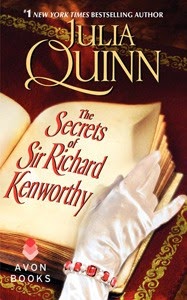
Book review: The Secrets of Sir Richard Kenworthy, by Julia Quinn

Sir Richard Kenworthy has some big secrets – does he ever. For his own private reasons, he travels south from Yorkshire to London to convince some eligible young lady to wed him at short notice. Quinn’s impressive romance, set in the post-Regency era, details the unusual courtship of Richard and Miss Iris Smythe-Smith both before and after his motives are revealed.

The fourth of five daughters, Iris is a sensible woman who doesn’t attract attention, so she’s puzzled but quietly pleased when Richard asks to call on her. He’s handsome and kind, but what’s the hurry to get married? When he deliberately steals a kiss from her in sight of her aunt, he forces her hand – and when Iris learns his true purpose, her anger is justified.

While the premise feels a bit over-the-top, this novel is rooted in the conventions of its time, when one careless decision could mean social ruin. Both gentle yet witty, Richard and Iris are a well-matched pair. Quinn also accomplishes the near-impossible by redeeming Richard’s character in the eyes of Iris and the reader and by crafting a believable reconciliation.

There are some lovely descriptions of the Yorkshire countryside, and fans of the series (this is book #4) can look forward to more terrible music from the Smythe-Smith string quartet.

Here's a special feature for Valentine's Day: my first review of a historical romance here.  If you've read this novel, what did you think?  According to other reviews I've read, Richard is one of Quinn's more controversial heroes; you'll have to read the novel to see exactly why.

I wrote this review for February's Historical Novels Review; thanks to the publisher for granting me access via Edelweiss.  The Secrets of Sir Richard Kenworthy was published by Avon in 2015 (384pp, $7.99 / $9.99 Can).  The UK publisher is Piatkus (£8.99).  It was named to the LibraryReads list for February.

Monday, February 09, 2015

Charles Todd's A Fine Summer's Day, an Ian Rutledge prequel set in pre-WWI England

This 17th novel in the Ian Rutledge mystery series follows the successful pattern used in many of the previous books. An inspector at Scotland Yard, Rutledge puts considerable mileage on his motorcar, driving all over England interviewing villagers while cunningly assembling clues to track down a killer. His presence is alternately welcomed and resented by the local police, and his wits prove to be as sharp as ever. The difference? This entry turns back the clock six years, just prior to the wartime service that will leave him a haunted, shell-shocked veteran.

In this prequel set in June 1914, Rutledge is just 23, a young policeman with a bright future in the Yard – if he can endure the Chief Superintendent’s antipathy. He’s naïve when it comes to women, though. Newly engaged, he thinks his pretty fiancée Jean Gordon will make him happy, while his sister and friends are doubtful. When he gets called to investigate a hanging in Yorkshire, he finds himself befuddled. The dead man was a successful furniture maker with no known enemies. Before long, Rutledge is assigned to investigate two other murders in different corners of the country, and the victims have similarly unblemished reputations.

Readers are shown the perpetrator at the beginning, but even after Rutledge figures things out, there’s still plenty of mystery left. The story becomes an exciting cat-and-mouse thriller as he pursues his man while determining the “how” and the “why.” Tension and atmosphere are added via Britain’s increasing slide towards war, Jean’s pressure on him to enlist, and his need to clear an innocent man before it’s too late. Despite one outlandish coincidence, this is a suspenseful mystery that grips one’s attention until the end.

A Fine Summer's Day was published in January by William Morrow in hardcover ($25.99 or Can$33.50, 352pp).  This review first appeared in February's Historical Novels Review.

Some other notes:

- If you haven't already noticed, the "elegant country house" cover is on its way to becoming as prevalent as the "headless woman" cover.  This doesn't indicate, in either case, that the books are all the same or even close to similar style-wise, though. 

- Yes, this is 17th in a series, but because it's a prequel, you can read it first without any trouble.  (I'm not one who needs to read series books in order, but I know others prefer to do that.)  I've read many books in the Ian Rutledge series so far, including #1, 15, and 16, but not all of them yet.


Saturday, February 07, 2015

Lawrence Hill's bestselling The Book of Negroes, coming to American TV in mid-February

Hill’s third novel, a Canadian bestseller, is a masterful example of historical storytelling, one both heartbreaking and hopeful.

When slavers wrest 11-year-old Aminata Diallo from her West African village in 1745, she vows to remember everything. After enduring the harrowing Middle Passage, she becomes the property of a South Carolina indigo farmer whose overseer notes her intelligence and secretly teaches her to read.

Whether keeping books for a Jewish businessman in Revolutionary-era Manhattan, documenting her fellow Black Loyalists before their transport to Nova Scotia (reflecting Hill’s original title, The Book of Negroes), or joining the British colony of Freetown, Sierra Leone, Aminata retains her self-respect. Throughout her life, she holds tightly to the idea of freedom for everyone forced into slavery, and to her love for the African husband from whom she’s constantly separated.

By the time Aminata journeys to London in 1802 as a symbol of the abolitionist movement, readers will have witnessed the dehumanizing slave trade from inside and out. An unforgettable epic, seen through the eyes of a sharply realized, indomitable heroine.

The review above first appeared in Booklist's 10/15/2007 issue.  The book's U.S. edition was published by Norton under the title Someone Knows My Name. (For background on how that came about, read the author's piece in the Guardian, "Why I'm Not Allowed My Book Title.") And for the record, the "Book of Negroes" is an important historical document, one that lists the over 3000 black refugees who arrived in Nova Scotia following the American Revolution.

I had mentioned the original title in the review to honor the writer's choice and to alert readers that Someone Knows My Name and The Book of Negroes were the same book.

The Book of Negroes, which won the Rogers Writers' Trust Fiction Prize and the Commonwealth Writers' Prize, was selected for Canada Reads in 2013 and has become a modern classic.

Norton has re-released the novel in trade paperback (image at top left) to coincide with the American premiere of the six-part TV miniseries based on the book, which stars Cuba Gooding Jr., Jane Alexander, Louis Gossett, Jr., and Aunjanue Ellis as Aminata.  It will be shown on BET on February 16, 17, and 18; check your local listings for times.  My DVR is set to record it.  For the Canadian readers who have been watching it on CBC, what did you think?

Wednesday, February 04, 2015

Mystery meets the Manhattan Project: Diane Fanning's Scandal in the Secret City

The high-security, covert area known as Oak Ridge, Tennessee – over 50,000 acres of land set aside by the U.S. government for the development of a nuclear bomb – has great potential as the setting for a historical mystery. Fanning’s intricate and smart new novel makes excellent use of the material.

Libby Clark, a recent UPenn grad with a master’s in analytical chemistry, is thrilled to get a job offer from Eastman Kodak since there aren’t many employers in 1942 who’d hire a female scientist. The utter secrecy under which she’s ordered to carry out her tasks turns sinister, though, when her former roommate’s sister is murdered.

Irene Nance was an easygoing young woman with an active love life. When Irene’s body is mysteriously moved (something the authorities deny doing), Libby suspects a cover-up but doesn’t know the reasons why. Having promised Irene’s family to seek justice for her, Libby gets stonewalled at every turn and takes a huge risk by pursuing an investigation. That’s on top of dealing with sexist remarks from coworkers with less technical knowledge than she has.

The timeline feels a little awkward in the beginning with its multiple-flashback structure, but this is a minor issue. The geographical layout and high-pressure atmosphere of Oak Ridge are re-created in extensive detail, as is the curious plight of its scientists, who are simultaneously proud of their work for the war effort and concerned about what they believe is their project’s end result.

Libby herself is a brave and admirable career woman, and seeing her in action, carefully hunting the truth while refusing to play down her expertise, makes for a very satisfying story. There are enough clues for readers to guess the killer well before Libby does, but even so, her appearance in future volumes in the series is eagerly awaited.

Scandal in the Secret City was published by Severn House in 2014 in hardcover ($28.95 or £19.99, 256pp).  Thanks to the publisher for approving my NetGalley access.  This review first appeared in February's Historical Novels Review.

Sunday, February 01, 2015

Congratulations to the historical fiction winners of the 2015 ALA RUSA awards

I was in the audience when the winners of this year's book and media awards from the American Library Association's RUSA (Reference & User Services Association) were announced earlier tonight in Chicago.  Congratulations to all of the winning and short-listed authors! 

Because of this blog's focus, I'll specifically list just the winners that fit with the genre of historical fiction.

Among the 2015 selections for the Reading List, the year's best in genre fiction:

In Historical Fiction, the winner was Kate Forsyth's Bitter Greens (Thomas Dunne, 2014), a retelling of "Rapunzel" set in 17th-century France and a century earlier in Italy.  Read my interview with Kate, which was based on the original Australian edition.  It's great to see the novel receiving such acclaim in the US.

The Historical Fiction shortlist included Amy Belding Brown's Flight of the Sparrow (colonial New England); Nicola Griffith's Hild (Anglo-Saxon England); James Lee Burke's Wayfaring Stranger (1940s US); and Ariel Lawhon's The Wife, the Maid and the Mistress (Jazz Age Manhattan).

In Mystery, the winner was Ashley Weaver's Murder at the Brightwell (Minotaur, 2014), a Golden Age-style murder mystery set at a resort in '30s England.  Read my review from last fall.

On the Mystery shortlist was Bruce Holsinger's historical thriller A Burnable Book.

Among the 26 titles on ALA's list of Notable Books, a best-of list for adult readers, was Anthony Doerr's All the Light We Cannot See (WWII France) and Richard Flanagan's The Narrow Road to the Deep North (WWII-era POWs in southeast Asia; the recent Booker Prize winner).

Congrats also to my Booklist editor, Brad Hooper, for winning the 2015 Louis Shores Award for book reviewing.  Very well deserved!