
Friday, March 08, 2013

Guest post by Jodi Daynard, author of The Midwife's Revolt

My guest today, Jodi Daynard, has contributed an enlightening essay covering her research discoveries about early America, as exemplified through period letters and recipes and relevant photographs.  Her novel The Midwife's Revolt, a semi-finalist in Amazon's Breakthrough Novel Awards, was published this past January.  Her protagonist Lizzie Boylston is a midwife, widowed at Bunker Hill, who develops a close friendship with Abigail Adams and becomes a spy for the patriot cause. Publishers Weekly has called the novel “A charming, unexpected, and decidedly different take on the Revolutionary War.”

Jodi will be speaking at the 2013 Historical Novel Society conference on the "American Experience" panel on Sunday morning, June 23rd.  To read more about her work, go to www.jodidaynard.com.

~

Things you never learned in School about our Founding Fathers and Mothers.

Tiny Houses, Big Dreams:  After reading the letters of Abigail and John Adams, I was expecting to find that they lived in a fine house, one befitting a distinguished lawyer and his family. I was struck dumb when I saw the cramped, rustic abode in which this illustrious pair lived so much of their lives.


 The dichotomy between the physical meanness and the intellectual exaltedness of the Adamses moved me. It drove home the wildly idealistic nature of their dream of independence from Britain. And yet, two hundred and thirty-one years after the enormous edifice of British rule has toppled, these humble farmhouses remain.

Money Matters: The State of Continental currency.
Writing The Midwife’s Revolt, I understood that money was scarce, and that my midwife would have to barter her services for food and other goods. But I didn’t really understand why. The story of Continental paper money is amusing, in a tragi-comic way: the Continental Congress needed money to pay for the war, so they produced it in great quantities. Unfortunately, the money was not backed by anything—not gold, not silver, certainly not taxes. No, it was backed by hope and prayer: hope that God was on our side, prayer that He would let us win the war. Only then might our states squeeze enough taxes out of its citizens to pay back the debt.

What’s more, these bills were easy to forge, and their growing worthlessness was hurried along by British and Tory counterfeiters like Mr. Stephen Holland, who makes an appearance in my novel.

Here is an example of one of these worthless bills, beautifully designed by Paul Revere: notice that it’s dated 1779. It is made out for eight pence and gives the bearer the right to redeem it eight years later. With any luck, the bearer would be dead by then.


Abigail Adams: “Farmeress” or First Lady?

Reading the letters of Abigail’s letters, I was able to infer some interesting things about her. For this discussion, I will refer to her letter of May 14, 1776, to John Adams, who was then in Philadelphia.

May 14, 1776
I set down to write you a Letter wholy Domestick without one word of politicks or any thing of the Kind, and tho you may have matters ofinfinately more importance before you, yet let it come as a relaxation to you. Know then that we have had a very cold backward Spring, till about ten days past when every thing looks finely. We have had fine Spring rains which makes the Husbandary promise fair -- but the great difficulty has been to procure Labourers. There is such a demand of Men from the publick and such a price given that the farmer who Hires must be greatly out of pocket. A man will not talk with you who is worth hireing under 24 pounds per year. Col. Quincy and Thayer give that price, and some give more. Isaac insisted upon my giving him 20 pounds or he would leave me. …I am still in quest of a Man by the year, but whether I shall effect it, I know not. I have done the best I could. We are just now ready to plant, the barly looks charmingly, I shall be quite a Farmeriss an other year.


Our Little Flock send duty. I called them seperately and told them Pappa wanted to send them something and requested of them what they would have. A Book was the answer of them all only Tom wanted a picture Book and Charlss the History of king and Queen. It was natural for them to think of a Book as that is the only present they ever Pappa has been used to make them.
Adieu -- Yours,
Hermitta

First observation: poor Abigail couldn’t spell. But then, nobody could back then. The men, given at least some formal education, fared slightly better, but there were no standards with regard to punctuation and capitalization. Thus, Everything, especially Nouns, always seemed slightly larger than Life!

Abigail took pride in her farming. In boasting to John that she will be “quite a little farmeress,” she wishes not only to relieve his anxiety about her but to assure him that she’s on board with a popular value at that time: homespun self-sufficiency. What money she has is nearly worthless; her farm hand’s an incompetent drunk. But, by golly, she is going to get the job done—singlehandedly, if necessary.

It is jarring to tour Abigail’s later house, Peacefield, which the couple bought in 1787 and which Abigail immediately enlarged and renovated, ordering furniture from France to fill it. The later house matched their increased wealth and status, but the Gilbert Stuart portrait of Abigail, begun in 1800, will always strike me as disingenuous. Gone, it seems, is the proud “farmeress.” But I suppose that’s American upward mobility for you.

Finally, Abigail had a wonderful way of needling John Adams. Unlike even some of the world’s greatest statesmen, she was fearless of him. Her letter concludes with a transparent reproach: that he is forever buying books for the children, when presumably they would like something less intellectual now and then.

George Washington, Terrorist

In an earlier letter, dated March 31 of that year, Abigail famously teases John:

I desire you would Remember the Ladies, and be more generous and favourable to them than your ancestors. Do not put such unlimited power into the hands of the Husbands. Remember all Men would be tyrants if they could.
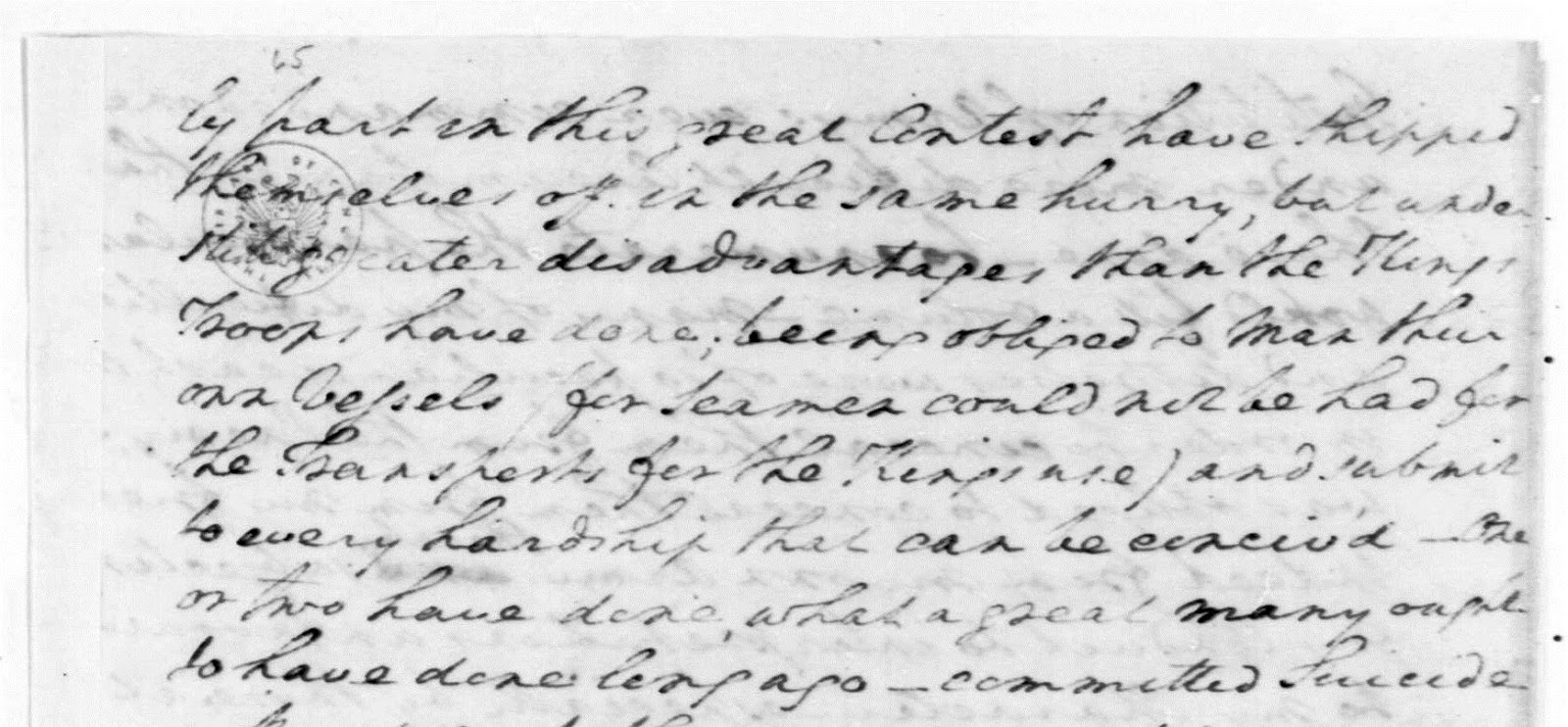
The discovery that amazed me, however, was not Abigail’s letter of March 31st but another, penned on the same day. This second letter was written by His Excellency George Washington to his brother John, and presents an eerie correspondence with Abigail’s own. Writing from Boston, Washington writes,


March 31, 1776 …all those who took upon themselves the Style, and title of Government Men in Boston, in short, all those who have acted an unfriendly part in this great Contest have Shipped themselves off in the same hurry, but under still greater disadvantages than the King's Troops have done; being obliged to Man their own Vessels (for Seamen could not be had for the Transports for the Kings use) and submit to every hardship that can be conceiv'd. One or two have done, what a great many ought to have done long ago, committed Suicide.
While I knew Washington to have little sympathy for traitors, and hung people without a shred of remorse, I was shocked to discover just how venomous he could be. His was a steely radicalism that shared more with the likes of Robespierre or even Bin Laden than, say the compassionate and inwardly conflicted Abraham Lincoln. I was soon to find reverberations of Washington’s radicalism rippling out from the epicenter: in confiscation acts that took Tories’ homes and goods, in the banishments and death threats. As the war progressed, these acts took on the dangerous cast of ideological fundamentalism.

The Oyster that Ate Manhattan

On a lighter note, the abundance of New England’s wildlife at the time is astonishing. Clearly, we fought not only for independence but for the primacy of our species in this relatively new land: bears occasionally roamed the farms of Cambridge, Massachusetts. Oysters were so large that a couple could feed on a single one for dinner.


Lobsters the size of human beings were reported. Indeed, lobster was so abundant in New England waters that savvy servants wrote it into their contracts that they were not to be fed lobster more than twice a week. In January of 1779, in Braintree, the crow population grew so large that the air looked like something out of Hitchcock’s “The Birds.” Braintree’s selectmen offered its citizens 6 shillings for an old crow and 2 for a young one. By May, that offer had risen to 30 shillings for an old crow. This fact appears in a few scenes of my novel.

I conclude my wildlife section with a recipe from Revolutionary War Period Cookery, by Robert W. Pelton. It was John Adams’s favorite oyster recipe, and calls for a quart of shucked oysters. Skip it if you are not rolling in cash!

Chicken and Oysters – An Adams Family Favorite
½ cup butter
½ cup flour
1 tsp salt
1 cup spinach, chopped
¼ tsp pepper
4 cups cooked chicken, diced
4 cups cream
1 quart oysters, drained
1 cup celery, chopped fine

Put butter in cast iron skillet and melt. Add salt, pepper and cream. Blend well. Slowly stir in flour so as not to lump. Then add spinach and cooked chicken pieces. Mix everything thoroughly. Lastly add the oysters. Let mixture simmer until oysters are nice and plump. Sprinkle over nicely with fine chopped celery and serve immediately.  

Strange Bedfellows

Finally, a fact that moved me most of all to discover was the physical intimacy of the time. Individuals did not feel entitled to have a great wall of space around them, as we do now. Coaches, church pews, markets, and beds were shoulder-to-shoulder crowded. Men and women had few issues with touching, kissing, and sleeping with someone of the same sex. Tolerance for odors was certainly much higher than ours—people generally bathed once a month, washed their clothing once a year. Beds were expensive and families often slept in one bed, as did travelers. Life stank.

And on this note, I’ll close with a famous story about the time John Adams and Ben Franklin were forced to share a bed while traveling from Philadelphia to Staten Island. Here is an excerpt from John Adams’s journal entry:

Sept. 6, 1776

The Taverns were so full We could with difficulty obtain Entertainment. At Brunswick, but one bed could be procured for Dr. Franklin and me, in a Chamber little larger than the bed, without a Chimney and with only one small Window….

… The Doctor then began an harrangue, upon Air and cold and Respiration and Perspiration, with which I was so much amused that I soon fell asleep…

I have often conversed with him since on the same subject: and I believe with him that Colds are often taken in foul Air, in close Rooms: but they are often taken from cold Air, abroad too. I have often asked him, whether a Person heated with Exercise, going suddenly into cold Air, or standing still in a current of it, might not have his Pores suddenly contracted, his Perspiration stopped, and that matter thrown into the Circulations or cast upon the Lungs which he acknowledged was the Cause of Colds. To this he never could give me a satisfactory Answer. And I have heard that in the Opinion of his own able Physician Dr. Jones he fell a Sacrifice at last, not to the Stone but to his own Theory; having caught the violent Cold, which finally choaked him, by sitting for some hours at a Window, with the cool Air blowing upon him.

For me, this letter reveals so much: not just about John Adams’s thorny character but about the profound closeness that could be achieved at the time. It wasn’t a good closeness; it wasn’t a bad closeness. It was an “I love you/hate you/accept you/you’re in my face” kind of closeness that is unmistakably real, unmistakably human, and that I feel, in this age of Tweetchats with cyber-strangers, more than a little nostalgic for.

The physical intimacy of these two outsize personalities is the stuff of high comedy to us now. Adams professes boredom with Franklin’s harangue, but that doesn’t mean he let the matter drop. No, he continued to argue with Franklin—for years—about the cause of the common cold. And when he reveals that Dr. Franklin finally succumbed to a bad one from “sitting hours at a window, with the cool Air blowing upon him,” his glee is obvious. John Adams always had to have the last word. And he always did—unless he happened to be speaking to his wife, Abigail.

~

Jodi Daynard is the author of The Midwife's Revolt, a novel, and The Place Within: Portraits of the American Landscape by 20 Contemporary Writers. Her stories and essays have appeared in The New York Times Book Review, The Paris Review, The Harvard Review, Harvard Magazine, The Boston Globe, Agni, The New England Review, and elsewhere. She taught writing in the Expository Writing Program at Harvard University, at M.I.T., and in the MFA program at Emerson College. The Midwife's Revolt was published by Opossum Press in January 2013 ($18.95 trade pb / $4.95 ebook, 440pp). 

Tuesday, March 05, 2013

An examination of Claire Holden Rothman's The Heart Specialist

Although I'm using the next month to devote attention to small press historical novels, March is best known as Women's History Month. As such, I thought The Heart Specialist would be a good selection for both events.

Claire Holden Rothman's quasi-biographical novel about one of the first female physicians in Canada provides an eye-opening perspective on the obstacles that modern medicine's founding mothers had to overcome. 

Rothman bases her lead character on Maude Abbott, who graduated from a Montreal medical school in 1894 and became a world-renowned expert on congenital heart disease. I decided not to link to any online articles about her because then the career path of Agnes White, Dr. Abbott's fictional counterpart, would hold no surprises. However, because she's writing about an invented character, the author has greater freedom in developing Agnes's personal life, which she has creatively imagined.

Agnes is an unfashionable woman who takes interest in an unfashionable field of medicine, since few cures were possible for her unfortunate patients at that time.  We first meet her in 1882 as a curious child who would rather be performing dissections than playing dress-up.

Her mother is dead, and her father Honoré Bourret, formerly a physician at McGill University, had abandoned the family in the wake of scandal after his sister's murder.  Agnes believes him innocent and looks for him in every older man she sees.  She and her fragile younger sister, Laure, are brought up in the Québecois village of St. Andrews East by their indomitable grandmother, who changed their last name to her own name of White.

One bright spot in Agnes's childhood is her governess, Miss Skerry, herself a woman of science and learning. There were limited choices open to educated women at the time: they could become governesses, schoolteachers, or, preferably, wives and mothers  There are no true role models for "unnatural" girls like Agnes, who must blaze her own trail and face the consequences.

Writing with empathy and conviction, Rothman takes us through Agnes's pioneering journey: the long hours of study, the intellectual triumphs, and the contemptuous doctors who are her only hope for a professional education but who refuse to let her advance. Even as a middle-aged physician during the WWI years, Agnes must take the back stairway, the one reserved for "waiters and women," when meeting a colleague for dinner at McGill's University Club. The unfairness of it all comes through powerfully.

For that reason, some of the author's choices are frustrating in a different way.  For the early part of her career, Agnes has a strong narrative voice, but she's given little dialogue with which to share it.  When her male colleagues and superiors speak, she mostly nods, smiles, or stutters.  Her emergence as an outspoken feminist wouldn't have helped her career; all the same, her excessive verbal passivity doesn't suit her ambitions or academic prowess, and I felt myself wanting to pull words out of her.

Likewise, while it gives her an appealing vulnerability, Agnes's social awkwardness is overemphasized, and her scientific detachment from her emotions edges close to stereotype.  The novel's title has an ironic double meaning that plays out predictably: she has experience aplenty with cardiology but fails to recognize love when it's under her nose.

Several intertwining forces shadow Agnes throughout the novel: her desire to please her long-absent father by following in his footsteps; the guiding influence of her mentor, one of her father's former students; and a defective three-chambered heart, stored and preserved in a glass jar.  At novel's end, the mysteries associated with all three are resolved in a realistic manner.

Agnes's tireless efforts are finally vindicated, and seeing her accomplishments publicly acknowledged, in the end, makes for a satisfying story.  Reading this book left me with immense respect for the brave women who were the first to break out of their strictures, as well as the struggles they endured in order to be taken seriously.

In the US, The Heart Specialist was published by Soho Press out of New York in 2011 ($25.00, hb, 325pp).  Cormorant Books, which specializes in new literary fiction, published it in Canada in 2009 ($21.00, pb).  This was a personal purchase.

Monday, March 04, 2013

Guest post by Justin Swanton, author of Centurion's Daughter

Today I'm pleased to welcome Justin Swanton, a South Africa-based novelist and illustrator, who has contributed a detail-rich essay about the twilight of Roman Gaul and the corresponding rise of the Franks under Clovis in the late 5th century.  In his novel Centurion's Daughter, Aemilia, a young woman of seventeen, gets caught up in the war between the last unconquered Roman provinces and the Frankish alliance.  How do you research a period that's historically important but in which the primary sources are maddeningly few?  Below, Justin explains his process and the conclusions he drew from what he learned.

~

Centurion’s Daughter is set in an era that has hardly been touched by fiction: Gaul at the end of the fifth century, when the last provinces of the Western Roman Empire were attacked by a Frankish confederation under Clovis. It is a fascinating period and an important one, as everything that happened here would determine the nature of the Middle Ages that followed.

Besides the history, you would think the personages and events would bring novelists out in droves. On one side you have Afranius Syagrius, 57, Roman aristocrat and general, epitomizing everything the old order had stood for. On the other side there is Clovis, 20, young and dynamic, who would acquire a Catholic wife he deeply respected and, later on, her religion, making him so much the future of western Europe. Clovis was a man to take incredible risks when necessary. At the Battle of Vouille he confronted a vastly superior Visigothic cavalry. What other general would have gathered his personal guards, charged straight at the Visigothic king Alaric, killed him personally in hand-to-hand combat, then galloped back to his lines with the entire enemy cavalry in hot pursuit? Riveting stuff.

So why is the period almost untouched? The problem as I found out is the research. Just things like discovering that Syagrius’s first name was Afranius was quite an achievement. Putting together a coherent picture of the time took me years and involved a careful reading of the primary sources, as well as abandoning several popular misconceptions. Let me give a few details of what I uncovered.

1. The Roman army survived the official fall of Rome. Procopius, personal secretary to the Byzantine General Belisarius, describes as something remarkable the fact that formations of the Western Imperial army had endured right up to his time, the middle of the sixth century, with their standards, uniforms and traditions intact. These were the units – former legions – that Syagrius had led with confidence against Clovis. After Syagrius fell, they were maintained by rich Roman aristocrats as bucellarii, or private troops.

Credit: Letavia
2. The Roman nobility also survived the official fall of Rome. A popular conception of the fall of the Empire consists of hordes of barbarians marauding over the countryside, pillaging and burning, ending the Roman way of life forever. The truth was very different. In places like Britain, parts of Spain and north Africa, society did descend into anarchy, but this came more from internal dissolution than barbarian influence. The greater part of the former Roman territories, however, kept their societal structures intact, which meant the wealthy landed class – rich senators – remained in possession of their estates, even under barbarian rule. It is a complicated period. The new barbarian masters worked with the entrenched Roman ruling class, they did not displace it.

3. It took Clovis ten years to conquer the last Roman provinces. This is my own conclusion, after comparing primary sources like Gregory of Tours, Procopius, the Life of St Genovefa, the Liber Historiae Francorum, and other works. To sum up the history, Clovis was a foederatus, or subordinate ally of Syagrius, who initially gave him the title to Belgica II, one of the four provinces he controlled. Time passed and Syagrius decided to reassert his authority over the province, setting up his capital in Soissons. In 486 Clovis gathered an alliance of Salian Franks and fought Syagrius near Soissons, defeating him. The Roman governor was deposed by his realm and forced to flee to the Visigoths, who later handed him over to Clovis for execution. The three Roman provinces not under Clovis’s control made their stand and stopped the Frankish king dead in his tracks for ten years. It was during this time that Paris was besieged and, under the leadership of St Genevieve, successfully held out against the Franks.


In 493 Clovis married St. Clotilde, a Burgundian princess whose father and mother had been murdered by her uncle. She was a Catholic and immediately set out to convert her pagan husband, partly because it was the only way to end the war between the Franks and Gallo-Romans, who would never accept a pagan ruler. Clovis loved her and allowed her to baptize their children, but only became Catholic himself when his army was on the brink of rout in a battle against the Alamans in 496. He promised the God of Clotilde he would convert if he won. The Franks rallied and went on to victory, and Clovis kept his word and was baptized on Christmas Eve that year or the year following. With Clovis a Catholic a peace could finally be brokered and the last provinces of Rome came under Frankish rule, with the exception of Brittany which remained semi-independent.

Credit: Letavia
My own novel covers the time just before, during and after the battle near Soissons between Syagrius and Clovis. Personally I like sticking to the old Greek drama rule of having everything happen in one place during a limited period of time. Centurion’s Daughter takes place in or near Soissons over the space of a year.

A lot of time went into researching Gallo-Roman daily life at the end of the fifth century. Again, it wasn’t easy. I couldn’t find a book that covered clothing, eating habits, furniture and housing arrangements of Gallo-Romans at the very end of the Empire, all under one cover. It was very much a case of uncovering a bit here and a bit there. Gallo-Romans, for example, had wickerwork high-backed chairs and usually ate at tables, not lying on couches like the Romans of Italy. Money was really problematic. I didn’t have too much difficulty finding out what coins were in use, but deducing to what extent the monetary system had collapsed and been replaced by barter was much less straightforward. Coin and barter both exist in my novel. In the end I had to use educated guesswork for a number of the details.

Now that the research is substantially done I intend to use it for a number of future novels of which one is already in the pipeline, taking place near the end of the ten-year war described above. It is an exciting era, and I don’t regret the effort I put into it. I hope you enjoy the result.

~

Justin Swanton is a graphic designer and manager in a small printing firm in South Africa. Centurion’s Daughter is his first novel. He has a website and a blog. Besides writing, his interests are computer and hand drawn illustration and wargaming.

Centurion's Daughter was published by Arx in 2011 (list price $17.95, heavily discounted on Amazon; trade pb; 336pp). The Kindle edition sells for $5.97.

Friday, March 01, 2013

Anne-Marie Drosso's In Their Father's Country, thoughtful reflections on 20th-century Cairo

Anne-Marie Drosso's In Their Father's Country presents a sensitive and bracingly honest view of modern Egyptian history, as seen through the eyes of a woman whose life spans nearly the entire 20th century.

This setting may seem very foreign to Western readers, but Claire Sahli and her older sister Gabrielle are modern women growing up in the cosmopolitan city of Cairo, which makes the mental transition relatively smooth.

The novel opens in 1924, when Claire is fourteen and Gabrielle fifteen.  Their beloved father Selim, an experienced lawyer who is a proud crusader for the working classes, is succumbing to kidney disease.  His death leaves his wife and daughters vulnerable and forces them to turn to his brother Yussef for their livelihoods.

Claire and Gabrielle's mother is Italian, and Claire can't help but wonder why her father's obituary omits the name of his wife.  Was it because of her desire for privacy, or something more?  As the novel progresses, secrets from her parents' history are slowly exposed, leaving Claire to decide how to react to what she learns.

The novel's title is apt.  Egypt was Selim's homeland, but over time, his Greek Catholic family finds themselves increasingly pushed to the margins of Cairo society.  They are privileged, but not rich, and the nationalist movement is gaining ground.  Although the Sahlis favor Egypt's independence from Britain, the country's mid-20th century focus on Arab solidarity, under Nasser's rule, threatens to leave them behind altogether.

She remembered the twenties as a time when just about everyone around her was touched by nationalist fervor.  Now, in her circles, many of her friends and acquaintances were saying that that the new generation of nationalists was becoming rudderless and uncontrollable.  Was the current political agitation perceived in those circles as posing a fundamental threat to their existence?

Through Claire and her relatives' experiences, readers get an informative glimpse at Egypt's volatile politics and varied social values, which mix the surprisingly liberated with the very traditional.  Married when she's barely out of school to a man who's considerably older, Claire later takes lovers; meanwhile, her cousin's husband stirs up conflict with his desire for a second wife. 

Claire's story is spliced into segments, each of which brings an important period of her life to the forefront: the death of a past lover in 1941, the birth of her son in 1947, her unwilling job transfer to the city of Minya in 1968, a decision forced upon her by her supervisor because of political pressure.  Claire moves there because she wants to keep her retirement pension, but with her high salary and lack of fluent Arabic, she is strongly resented by her coworkers.

The changing relationships between Claire and members of her large, extended family, which includes close friends and servants, figure prominently.  The tensions between warm, gregarious Claire and Gabrielle, who is described as "neither tender nor nurturing," only grow as the sisters age.  Because the plot jumps from one time period to another, readers are left to fill in some gaps themselves.  In particular, I wish Drosso had allowed us to glimpse Claire's formative years—she skips straight from 1924 to 1941—so we could see how her personality formed.

Many chapters revolve around a relative's death, which creates a nostalgic, thoughtful feel.  Adding to this sense are the different forms of literary expression included in the text, such as personal letters, journal entries, and a short memoir written by one of Claire's daughters.

In Their Father's Country is an absorbing, reflective portrait of a resilient woman, her country, and how they weathered the external forces affecting them both.  It was published by Telegram Books, an independent publisher of international literary fiction, in 2009 (£7.99, US $13.95, Can $15.50, trade pb, 227pp including glossary).  This was a personal purchase.

Welcome to Small Press Month at Reading the Past

Individualistic.  Specialized.  Risk-taking.  Independent.  These are some words that come to mind when speaking about small presses.

Last year around this time, I started seeing bookseller reports and bloggers' posts about Small Press Month, which was traditionally held during March.  I decided then that I wanted to participate the next time March rolled around.  Unfortunately, the national celebration of this event seems to have fallen by the wayside for 2013 – perhaps funding was lost? – but I decided to forge ahead with my plans regardless!

Starting today, and over the next 30 days, Reading the Past will be looking exclusively at historical novels from small presses.  Definitions for this term can vary, but I'll be using it to include those publishers outside of the Big Six that are independently run and not part of large conglomerates.  Many of them specialize in certain types of works (literary fiction, regional settings, particular genres, and so forth).  There's even a growing number of small presses that publish only historical novels, something I find very exciting.

Because they may have more modest sales expectations than the industry big boys, they can afford to take chances on topics and styles that lie outside the mainstream or which may not have huge audiences.  However, while small presses may not feel as much pressure to follow trends, they can find themselves creating or shaping them.  Some examples of small press titles that became breakout hits for their authors: Charles Frazier's Cold Mountain (Algonquin Books of Chapel Hill), Sara Gruen's Water for Elephants (ditto), Michel Faber's The Crimson Petal and the White (Canongate), Peter Behrens' The Law of Dreams (House of Anansi), and John Shors' Beneath a Marble Sky (McPherson & Co).

Historical novels have thrived in the world of small and independent presses, and I've always enjoyed seeing the diversity they offer readers.  In fact, they're a necessary part of the industry, especially now, a time when many excellent mid-list authors are being dropped by their Big Name publishers for not meeting high sales goals – or for other more nebulous or arbitrary reasons.

I have a great selection of guest posts, reviews, and previews of small press titles lined up over the course of the next month, and I hope you'll enjoy reading along and seeing what's in store.

Wednesday, February 27, 2013

Guest post by Tanis Rideout, author of Above All Things

Tanis Rideout is stopping by Reading the Past today with a wonderful original essay about her research process – specifically on the artifacts that informed her work and helped her reach back and touch the past.

Her debut novel, Above All Things, intertwines the viewpoints of English mountaineer George Mallory, as he makes his third and final attempt to scale Mt. Everest in 1924, and that of his wife, Ruth, who was left behind in Cambridge with their children.  Above All Things will be published on March 7th by Viking Penguin (UK), and it has already been receiving many accolades in Canada and the US.  I'll be posting a review later this spring, and this post has definitely whetted my appetite for more. 

~

Viking Penguin ed. (March 2013)
Part of what first drew me to the story of George Mallory’s 1924 attempt on Everest was the mystery and mythology. How could I not be fascinated by all of it? George was one of the last of the classic English explorers – athlete, scholar, a writer with ties to the Bloomsbury group; a romantic figure whose friends called him Galahad and whose admirers compared him to a Greek statue. He’s the root of the enigmatic quote that we use as a culture to explain away our strange drives to do things – Because it’s there – and he tragically, mysteriously disappeared.

But myth and mystery are simply beginnings. I began to read everything I could get my hands on about Everest and George Mallory – scouring the local library, used bookstores, and online speciality booksellers. One of the many wonderful things about writing in the internet age are the vast online resources of materials – images, films, essays – that are at a writer’s fingertips. Still, nothing is quite a meaningful or useful as the real thing.

A draft or so into the novel I received a grant from the Canadian government. This one not only provided me with time to write but also had money attached for travel and research. I packed my bags and headed for England, where I spent time at the Samuel Pepys Library at Magdalene College in Cambridge, The Alpine Club and the Royal Geographical Society (the RGS).

One of the things I love about well-executed historical fiction is the way in which the era seems to soak the pages – as though they have been immersed in it. A certain age can breathe on the page in a well written work. The job of the writer is to conjure that time and place a reader in it without, ideally, either of them being bogged down by details and ephemera. This was what I was faced with at these extraordinary collections – more detail than I had ever thought was possible. How was I to choose?

Putnam US/Amy Einhorn ed.
(Feb. 2013)
The RGS in particular, with their boxes and boxes of files, holding every scrap of paper that was associated with the expedition, was a treasure trove. While each file was labelled according to dates with some indication what would be in it, often there was a great deal more than what I was expecting. There were photographs I’d never seen before, and long elegant strips of Tibetan calligraphy on onion skin paper with a tiny notation in the corner indicating it was a receipt for ponies. There was a fragile notebook from Camp IV indicating the weather, who had been at camp and how they were feeling. As I carefully peeked under the barely open cover, not wanting to crack and break the old spine, I imagined George jotting down stomach ailments and headaches, snow skirmishes and sunny days.

There were a number of items that I found that stuck with me, and either found their way directly in to the book or became jumping off points for an event or scene. The first was a massive ledger – a manifest of everything that had been packed in to crates and sent across the great Himalayan plateau – everything that was needed for the expedition to survive so far from home for long, isolated months. One item in particular caught my attention. There was a listing for six Hudson Bay Blankets (not to be used by coolies). I’m sure part of me stopped at the line because of its Canadian content – Hudson Bay Blankets are a familiar item to most Canadians – their iconic stripes and warmth decorate many northern cottages – but there was so much captured in that one line. It wasn’t just the kind of materials they took with them, but also the hierarchy with which they could be used. It allowed me to imagine what other items might be used with such conditions.

Another was the telegram. I’d seen photos of the telegram before, seen the text in books, but here it was – the actual telegram that was delivered to the RGS announcing the deaths of George and Sandy. There was the hard type with a superscript in pencil translating it. I could begin to imagine the distance it travelled, the clerk or assistant receiving it at the office, the translation of the code. All of the details added colour and texture to my imagined world.

McClelland & Stewart ed.,
Canada (June 2012)
The last was a letter. I’d probably already read hundreds of letters when I came across this one, maybe even thousands, but this one stopped me before I even picked it up. Letters were different in the early part of the twentieth century, that’s the first thing you need to know. They were often written on pamphlet style pages, a larger sheet of paper that had been folded in two, so that you had a small four page booklet to write on. Usually a person’s address would be already printed at the top. If the person writing was in mourning the edges of the pages would be printed black. That was what I had noticed first – and I knew immediately whose letter I would be reading. It was a letter from Ruth to a friend of both her and George – and it was painful and generous and sad and brave. As a writer though, it wasn’t just the content of the letter that grabbed me – it was the paper, the ink, the black edge.

It’s these physical objects and all the meaning and coding of a time and place that help both the reader and writer conjure the era and its inhabitants. These are the details to build a fictional world on.

~


Tanis Rideout's work has appeared in numerous publications and been shortlisted for several prizes, including the Bronwen Wallace Memorial Award for Emerging Writers and the CBC Literary Award. In 2006, she was named the Poet Laureate for Lake Ontario by the environmental advocacy group Lake Ontario Waterkeeper and joined Gord Downie of Canadian rock band, The Tragically Hip on a tour to promote environmental justice on the lake. Born in Belgium, Tanis grew up in Bermuda and in Kingston, Ontario, and now lives in Toronto. She recently received her MFA from the University of Guelph-Humber. Her first novel, Above All Things, will be published by Viking Penguin (UK) on 7th March.

Monday, February 25, 2013

Time's Echo by Pamela Hartshorne, a time-slip set in Tudor-era and modern York

Hartshorne’s engaging time-slip opens with one chilling scene after another. Hawise, a young Elizabethan woman, is drowned as a witch on All Hallows’ Eve, the bells of York Minster ringing in the background. As the River Ouse drags her skirts down, she dies in fear, knowing she’s leaving her daughter Bess in the hands of an evil man.

In the present, Grace Trewe awakens in her late godmother Lucy’s house in York, having dreamt of Hawise’s last moments. Or perhaps she’s having flashbacks to past trauma, as a survivor of the ´04 tsunami. After traveling from Asia to claim her surprising inheritance, she hopes to move on quickly but finds herself caught by Hawise’s life. Grace’s neighbor, single father Drew Dyer, is a local historian who offers his help. He’s not quite handsome, but she finds his solidity and strength attractive.

There’s no mistaking this novel’s genre. In the first 40 pages, Grace experiences déjà vu, sees an apparition, and has multiple visions of a long-ago time. Rotting apples mysteriously appear, along with their putrid scent (a unique and eerie touch). The supernatural elements feel overdone initially, and some words in the text repeat too often, but the two women’s stories are equally gripping and deftly blended together. In 1577, Hawise is a mercer’s servant whose future turns unexpectedly bright, but her unconventional habits and an unwanted suitor’s obsession lead to her downfall. As Grace and Drew grow closer, Hawise’s presence becomes more intrusive. Is Grace possessed or suffering from PTSD? Will she die from drowning, just like Hawise and Lucy?

A novel of jealousy, passion, revenge, witchcraft, and coming to grips with the past, Time’s Echo is haunting and dramatic, with a sterling sense of place. Tudor York comes marvelously alive with its bustling marketplace, cobblestone streets, and plenty of interesting details on running a household. Enjoyable escapist reading.

Time's Echo was a personal purchase of mine in late 2012, and I wrote up my thoughts on it for February's Historical Novels Review.  It was published last September by Pan in paperback (£7.99, 467pp).  It's one of six titles on the 2013 shortlist for the Romantic Novelists' Association's Historical Romantic Novel.  The winner will be announced tomorrow, February 26th, in London.

Friday, February 22, 2013

Barbara Lazar's The Pillow Book of the Flower Samurai, about a woman's quest in Heian-era Japan

There’s nothing like fiction set in 12th-century Buddhist Japan to shake up one’s notions about feminine strength and bravery.

Kozaishō, the narrator for Lazar’s well-researched epic, is an uncommon heroine who has little freedom and few choices but whose powerlessness increases her resolve. Born the fifth daughter to rural peasants, she is just a child when her impoverished father trades her away for more land. Even then, she knows her responsibility to honor her family. The novel’s strongest attribute is its adherence to period values; it immerses readers in a foreign culture in which respect, dignity, and obedience are paramount. These aren’t always easy concepts for Western readers to grasp, but as Kozaishō pointedly states, “Submission is not surrender.”

Although she is quite young for a good part of the book, this is definitely an adult story, one with intensely rendered scenes of elegance and cruelty. It also defies expectations in another way. Kozaishō’s early rivalry with an older girl looks to move into Memoirs of a Geisha territory, but this doesn’t last very long. Tashiko becomes her best friend and more as they train as dancers at a remote shōen (estate) and later become Women-for-Play – prostitutes – under a brutal mistress’s supervision.

Thanks to favorable omens, Kozaishō gets tutored in the samurai arts, and she also becomes a talented storyteller whose pillow-talk to powerful clients reaps influential benefits. Her poems and stories, included in the text, lend it an authentic feel. Kozaishō’s voice has a compelling intimacy, but as her universe widens, and she learns more about the Taira and Minamoto clan wars, it sometimes gets lost amid the larger political picture.

With her debut novel, Lazar creates a striking portrait of an unfamiliar time, and of a valiant woman determined to avenge a terrible wrong and overcome the odds stacked against her.

The Pillow Book of the Flower Samurai was published by Headline in January at £7.99 (pb, 560pp, cover at right).  The hardcover is also available (£16.99, cover at top left).  American readers can preorder it via the US distributor, Trafalgar Square, who will make it available this June in hardcover ($24.95, heavily discounted at Amazon).  I bought a copy at Waterstones in London just before the Historical Novel Society conference last October.  This review appears in the Feb 2013 issue of the Historical Novels Review.

Wednesday, February 20, 2013

Morgan Llywelyn's After Rome, her newest novel of the passionate Celts

Through her carefully imagined novels, Morgan Llywelyn has traversed nearly three millennia of Celtic history, with The Horse Goddess's ancient pagan mysticism at one end of the spectrum and 1999, the last volume in her five-book Irish Century series, at the other.

The title of her newest, After Rome, makes it easy to place on a timeline.  The Romans have fled early 5th-century Britain to defend their home city from barbarian attacks.  The educated Britons they had trained as civil servants are left to pick up the pieces.

Governmental foundations have collapsed, and order has broken down.  Roads have deteriorated, physicians are nonexistent, and nobody knows how to work many of the engineering marvels so prevalent in Roman daily life.  Britain has become a chaotic, desolate place full of abandoned ruins and lingering memories, not all of which are pleasant.

This is a history-driven novel, meaning that Llywelyn has developed characters to fill specific roles and dramatize two opposing paths taken by the native Romano-British in re-civilizing their homeland. Mature and responsible Cadogan, living in self-imposed isolation in the woods, becomes the reluctant leader of a group of survivors after Saxons sack and burn his home city of Viroconium.

His cousin Dinas, restless and ambitious, seizes an opportunity for leadership by gathering together a cadre of would-be warriors to conquer the land — wanting to make himself their king in the process. Antagonism runs blood-deep between their branches of the family after a love affair turned deadly.

The secondary characters in After Rome are a quirky and oddball bunch: the scrawny and feisty Quartilla, who claims to be a centurion's daughter and who Cadogan finds alternately annoying and helpful; his estranged father, old Vintrex, Viroconium's chief magistrate; and the motley members of Dinas's growing band, which include one injured, saintly man who isn't mentally all there and another with an uncommon rapport with animals.

As the men and their followers struggle to regroup and establish bases of power, the Saxons are equally eager to drive them apart and crush them.  One particularly vivid scene sees Cadogan and his fellow refugees sitting nervously in the darkness of Viroconium's public bathhouse while marauding tribes slaughter everyone outside.  In the parallel story involving his wanderer of a cousin, the remote peaks of Eryri, in what will one day be Wales, appear in stark, haunting detail:

By the close of day the land was engulfed in purple shadows.  One last flare of gold and crimson from the west, then darkness.  Dinas drew rein.  "Night in these mountains can be as black as the inside of a cow," he warned his companions ... He led the way beneath an overhanging shelf of rock, then onto a narrow ridge that climbed toward the sky.  A million stars blazed over them.

This is sharp and evocative writing, but on other occasions, Llywelyn drifts away from her story for a pages-long history lesson.  While these are informative, it feels startling to wake up from an involving tale to find oneself inside an encyclopedia.

After Rome doesn't have the same consistently engaged style as her earlier works.  However, readers drawn to the post-Roman, pre-Arthurian period will want to pick it up for its energetic yet thoughtful recreation of this transitional stage in Britain's history, and of a proud people who formed the bedrock of a new nation.

After Rome was published on February 19th by Forge in hardcover ($24.99 or C$28.99, 332pp).

Monday, February 18, 2013

Guest post by David Gillham: Watch, Listen, Eat

How can historical novelists make their chosen eras feel tangible and vibrant?  David Gillham, author of the acclaimed debut novel City of Women, is stopping by the blog with an essay about how he re-created the atmosphere of 1943 Berlin—the city of his heroine, Sigrid Schröder—by spicing his narrative with descriptions of period films, music, and food.
~

One way I tried to build the atmosphere of Sigrid’s Berlin was by introducing wartime movies, music, and food into the narrative. Of course, when Sigrid attends the cinema, it not really to watch a movie. She’s looking for a small space of privacy, which is why she favors war movies. These didn’t do very well at the box office in Berlin; the audiences for them were usually sparse. The average Berliner was less interested in seeing propaganda films such as Soldiers of Tomorrow than Heinz Rühmann in escapist fare such as The Gas Man, or Gustaf Gründgens in a lavish eighteenth-century costume drama. For more recent movies that capture either the essence of Berlin or the stunning contradictions of the war years, I’d recommend Cabaret and Europa, Europa.

You can still find a lot of popular music from the time period. In the book, Sigrid’s mother-in-law is listening to Lale Andersen singing on the radio. Andersen’s number-one wartime success was the ubiquitous “Lili Marleen”—a song that created such a stir that even British forces fighting in North Africa adopted it as one of their favorite tunes.

Naturally, classical music was still at the top of German radio playlists during the war: Beethoven, Mozart, Bach—though the music of all Jewish composers was banned from the airwaves. If you’re interested in the antic, often slightly loopy music of pre-Nazi Berlin, which Sigrid would have listened to while growing up, there are still recordings available of entertainers such as Margo Lion, the famously hilarious cabaret singer, or the popular ensemble known as the Comedian Harmonists. Marlene Dietrich was “falling in love again” in the golden twenties and early thirties, and later recorded a number of her songs from the era in English. The internationally acclaimed chanteuse Ute Lemper has released renditions of cabaret songs that were all the rage in Berlin between the wars, in both English and the original German (“Ich Bin ein Vamp!” for example). Max Raabe and the Palast Orchester are phenomenal at re-creating the music of that time (from “Fräulein, Pardon” to “Mein Gorilla.”)

For those interested in what the average Berliner Hausfrau was serving at the table during the war, I recommend Gisela McBride’s Memoirs of a 1000-Year-Old Woman. Her autobiography stretches from the late twenties to the war’s end, and is chock-full of details illuminating everyday life, including recipes. (I cannot vouch for the healthfulness of any of these dishes, or the taste, but if you need recipes for cabbage dumplings, cabbage fish rolls, cabbage pie, or cabbage strudel, you’ll find them there.)

~

City of Women by David Gillham is published by Fig Tree in the UK (pb, £12.99, 400pp) and Amy Einhorn/Putnam in the US (hb, $25.95).

Saturday, February 16, 2013

Rosemary McLoughlin's Tyringham Park, a dramatic Irish saga

I first came across Rosemary McLoughlin's debut novel in the publisher's catalog, which included a blurb from Irish women's magazine Woman's Way. "The Last September meets Downton Abbey," it was called. 

Tyringham Park takes a few pages from the Downton playbook in that it mostly takes place on an enormous country estate during and after WWI, though the setting is Ireland's County Cork rather than rural England.  However, while wartime troubles and the painful Anglo-Irish relations of the era play a small role, they take a back seat to the tragedies that blight the aristocratic Blackshaw family over the span of 26 years.

McLoughlin certainly knows how to spin a dramatic story.  Her classic Gothic soap opera is filled with depictions of pastimes among the rich and privileged, petty jealousies, cross-class lust, shocking twists, unexpected triumphs, and nasty characters you'll love to hate.

The early sections are the hardest to read, with disturbing images of the physical and verbal abuse inflicted upon the young Blackshaw sisters.  Their mother Edwina ignores them, their absent father prefers spending time at London's War Office, and their cruel nanny Nurse Dixon takes her pent-up frustrations out on her charges.

Eight-year-old Charlotte turns mute for a time after her toddler sister Victoria, "the pretty one," disappears one day in 1917. Rumors fly that Victoria was abducted by Tyringham Park's former seamstress, Teresa Kelly, who loved her but who had left to marry a farmer in New South Wales.  The kidnapping of a child is a scenario no family should ever endure, but such was her toxic home environment that I hoped Teresa had succeeded. Teresa proves untraceable, so Victoria's fate remains unknown.

Charlotte bears the brunt of her mother's displeasure because she's plain and overweight.  She grows up troubled and unhappy until kindly servants and family friends take an interest in her and encourage her brilliant talents in horsemanship and painting.  Still, her parents' neglect and the twisted pain of her childhood hang heavily over her during her adolescence, and her loneliness and lack of self-confidence lead her to make dumb decisions about her future.  I turned the pages avidly, unaware of where the plot might be leading and watching for signs that Charlotte would find the strength to escape.

Later scenes move the storyline along to Dublin, Paris, and the Australian countryside, while flashbacks provide perspective on Edwina's heartless attitude and Nurse Dixon's violent vindictiveness.  Tyringham Park is very good at depicting the patterns of misery that repeat over generations, and with their tendencies toward arranged marriages, this affects the wealthy the most.  There are many characters here that deserve readers' pity, and comparatively few to admire, but McLoughlin is a fluid storyteller, and I found it addictive escapism all the same.

Tyringham Park was published by Penguin UK in February 2013 at £7.99 (514pp, paperback).  Thanks to the publisher for sending me a copy at my request.

Monday, February 11, 2013

Book review: The Passing Bells, by Phillip Rock

Readers should be forgiven if they delve into Phillip Rock’s former bestseller and initially find themselves picturing Downton Abbey’s famous cast. The book has a similar premise — a noble English family and their servants have their lives upended by World War I — and more resemblances abound. The Countess of Stanmore is American, and her overseas relative disturbs the careful social hierarchy at their Surrey estate. Below stairs, a new housemaid learns her place. Their personalities come alive via elegant parties and cross-class love affairs.

But the Grevilles aren’t the Crawleys, and as its new cover reminds us, The Passing Bells was here first. While equally as engrossing and full of nuanced characterizations, it offers an even meatier story, traveling places the show never ventured and addressing period issues through realistic, heartfelt drama.

The plot follows the younger generation almost exclusively. Charles, the Greville heir, timidly pursues rich businessman’s daughter Lydia Foxe, knowing his father disapproves, while Lydia and family friend Fenton Wood-Lacy deny their attraction. When war breaks out, all see their lives transformed. Chicago cousin Martin Rilke becomes the novel’s Everyman — his candid written observations on English aristocrats bring their differences home sharply — as his journalistic talents lead him to the front lines. The devastation at Gallipoli and the Somme has that much more impact when characters we care about are involved. Even Alexandra Greville, the pampered social-butterfly daughter, has a shocking coming-of-age.

From busy London newsrooms to a Yorkshire factory to the trenches, Rock is especially good at scene-setting and dialogue, and while his themes are unmissable, the characters’ engagement with their changing world is strong and moving. For some, war is futile, while for others, it gives their lives purpose. This fabulous reissue is tailor-made for post-Edwardian aficionados, who will be thrilled to know that two more volumes follow.

Originally published in 1978, The Passing Bells was reissued by William Morrow in trade paperback in December 2012 at $15.99.  I enjoyed it so much that I requested the subsequent two titles for review, too.  This writeup first appeared in the Historical Novels Review in February as an "online exclusive."

Saturday, February 09, 2013

Book review: Maria and the Admiral, by Rachel Billington

“We all have a story at our core that we may disown or admit. It is often about love.”

In 1822, Maria Graham is a travel writer, illustrator, and English ship captain’s widow. Although the latter status gains her entry into society, she takes greater pride in her intellect. After her husband dies while they’re rounding Cape Horn, she settles in at his intended destination of Valparaiso, Chile, exhilarated at the thought of beginning anew. She’s confident her future will involve Admiral Lord Cochrane, the Napoleonic war hero who helped win Chile its independence.

Cochrane has a wife back home, but Maria sees herself as his ideal companion, and her lofty tone is entertainingly witty. “When society tutted that I had ‘set my cap’ at Lord Cochrane,” she writes, “I cocked a snook at them – I never wore anything but a turban.” The novel presents her recollections about their affair and her interactions with native Chileans (she prefers the company of foreigners to other expats), as well as her observations on South America’s volatile politics and gorgeous scenery. The changing colors of the majestic Andes are beautifully described.

Indeed, one could imagine this novel was the real woman’s authentic memoir – it adopts a period-appropriate formality – if not for the fact that this fictional Maria, supposedly writing from beyond the grave, sometimes breaks in to address modern audiences directly. Free from the constraints of 19th-century morality, she expands upon her published journals, which are silent on the true nature of her relationship with Cochrane.

Readers who can adjust to this conceit should enjoy her travelogue, which later sees her accompanying Cochrane to Brazil, a country she finds vulgar because its economy depends on slavery. Maria Graham never let society’s rules sway her opinions or desires, and with insightful skill, Billington has brought her adventurous heroine back into the limelight.

Maria and the Admiral was published in 2012 by Orion (UK) at £18.99 (hb, 350pp), and the paperback will be out in May 2013.  I bought a copy in a shop on London's Charing Cross Rd while I was overseas for the HNS Conference last October.  This review also appears in February's Historical Novels Review.

Thursday, February 07, 2013

Book review: The Typewriter Girl, by Alison Atlee

Alison Atlee's The Typewriter Girl offers a multiplicity of attractions.  In addition to the activities and engineering marvels of the Victorian seaside resort where it takes place, it has a strong, compelling voice and interesting characters with dilemmas anchored in their time. 

Betsey Dobson stands out from the get-go, and not just because she's "alarmingly tall."  Having been fired from her job as a typist at a London insurance firm after she's caught writing herself a fake reference, she boards a train to the coast where a new start awaits her, or so she hopes.  

A Welshman named John Jones has decided to employ her as the manager of the new excursions scheme for the Idensea Pier & Seaside Pleasure Building Company; he sees something in her that nobody else has. She needs this opportunity, since with no means of support or even sufficient travel fare, it's the only thing she has left. 

Betsey may be inexperienced, but she's smart, bold, and good with numbers. Her self-assurance sometimes fades, though, when she discovers all the obstacles she's up against.  Already dubious about opening his upscale venue to day-trippers on corporate outings, resort owner Sir Alton Dunning is baffled by females in the workplace, especially this particular "manageress" (a term Betsey hates).  At one point, she must give a presentation defending the value of the excursions program before members of the all-male board — who don't know what to make of a "woman without a tray." Her frustration is palpable.

This debut novel is literary fiction of a unique sort, one in which social issues and tough female characters combine with elegant turns of phrase and angsty romance.  Betsey and John form an alliance that develops into mutual lust, or maybe even love, but she sees no future for them.  John wants to "marry up," and rich and snobby hotel guest Miss Lillian Gilbey is his best chance to do so.  For her part, Betsey is too proud to settle for a dalliance, despite her sexual history.  She's had other lovers and once lived with another man, and shocks John by revealing that fact.

The text is rich in period details, much like an exquisitely designed turn-of-the-century scrapbook. At times it feels a bit overstuffed, and the pacing can be correspondingly slow in places, but Atlee's characters have many layers, and it's worth the time getting to know them.  Turn the pages too quickly, and you might miss something important. The dialogue feels consistently fresh and real.  Betsey has a mouth on her, letting drop the occasional curse, and it's impossible not to cheer on a character whose personality doesn't fit with stiff Victorian propriety.  John doesn't come from an exalted background either, which becomes another link drawing them together.  

The romantic tension between them has an intense emotional pull, and his belief in her allows her to "dream wildly, without boundaries."  Isn't that a terrific way of putting things?  In this uncompromising era, a penniless woman like Betsey shouldn't expect anything good to come her way, but she charts her own future regardless.  The ending, while satisfying, leaves a question or two unanswered, just a slight false note in this enjoyable novel of a determined woman who refuses to sell herself short.
~

The Typewriter Girl was published by Gallery/Simon & Schuster in February ($15.00/C$17.00, trade paperback, 367pp).

Tuesday, February 05, 2013

For the TBR Pile Challenge: Esmeralda Santiago, Conquistadora

Entry in the 2013 TBR Pile Challenge:  #2 out of 12

Years on TBR: 1.5

Edition owned: Knopf, 2011 (ARC, 410pp).

Since the TBR Challenge includes 12 titles, my plan is to read and review one each month during 2013.  I chose Conquistadora as my second selection because while I love the Downton readalikes, I really do, I needed to escape turn-of-the-century England and read something different.  An epic literary historical set in mid-19th century Puerto Rico suited my purposes nicely.  My copy is a signed ARC, which I received at BEA in 2011.  I spotted the paperback on a Barnes & Noble display table last weekend, so it's still pretty current.

The female lead of Conquistadora is Ana Larragoity Cubillas, a strong-willed girl who grows into an even more determined woman.  Her life is chronicled simultaneously with that of the land, Puerto Rico, she claims for her own.  To provide a more rounded treatment of its history and culture, and perhaps to give readers a periodic break from Ana's selfish mindset, Santiago allows equal time for the perspectives of others — relatives, associates, African slaves — whose lives intersect with hers.

As a young girl in Spain, Ana dreams of following in the footsteps of an ancestor, Don Hernán, who voyaged to the 15th-century Caribbean with Ponce de León.  He left behind journals about his adventures that hold her enthralled.  When she meets twin brothers Ramón and Inocente Argoso, heirs to a sugar plantation, they become the means to an end.  She weds Ramón and is surprised to learn they expect her to act as Inocente's wife, too. (Quite a lot of bed-hopping occurs in this book.)

Her ambition drives the Argoso family (the brothers; their parents; and their cousin, Elena, Ana's first lover) across the ocean.  Not long after they arrive, 18-year-old Ana and the men separate from the others.  They travel along an overgrown, bug-infested trail to settle in at a rustic, under-performing, remote estate they name Hacienda los Gemelos ("of the Twins").  The rest of the family remains in sunny San Juan, where they set up new lives and worry about Ana's bad influence on the men. 

Ana devotes herself to the plantation with an all-consuming intensity; it legally belongs to her father-in-law, who grants them five years to make a success of the place.  By all accounts, they should fail, since they have too few people for their large acreage, but he doesn't count on Ana and her insistence on squeezing every last drop of work out of the slaves.  Although she treats "her people" well, by the era's standards, the estate depends heavily on slave labor, and for that reason Ana will fight to her last breath to keep the cruel institution alive.

One of the points the novel brings home most forcefully is the fact that by 1844, nearly all of Spain's colonies had gained independence and abolished slavery... all but Cuba and Puerto Rico.  The personal stories about the ethnic heritage of many slaves, such as the Mbuti housemaid called Flora, add considerable interest and diversity to the storyline.  From time to time the plot slips into information dumps, though, relaying facts and figures on the Caribbean slave trade more ponderously than a fictional work should.

Conquistadora has been described as a Puerto Rican Gone with the Wind, which I found was somewhat valid.  Ana has all the obstinacy and intelligence of Scarlett, and she holds onto the land just as tightly, but she doesn't have the same charm.  Although I never really found myself gripped by the story, I read it with interest, up to a point.  That point came about 100 pages from the end, when Ana's personality began to grate, and she and her household members' fates became progressively more predictable.

So, a mixed report on this one.  Definitely worth reading if you know little about Puerto Rican history or appreciate heroines who defy stereotypes and cultural expectations.  However, the isolated plantation setting, as full of life as it is, works to the novel's detriment, as doesn't give Ana enough space to grow or change.  The finale leaves room for a potential sequel, and if that's the case, I hope it gives Ana a greater opportunity to shine.

Sunday, February 03, 2013

Guest post by Mary F. Burns: The Painting That Started Me Writing

Mary F. Burns, author of the newly released Portraits of an Artist: A Novel about John Singer Sargent, is my guest at Reading the Past today.  Readers often wonder where writers get their ideas, and on this note, Mary has contributed a lively essay describing how one of Sargent's paintings inspired her book and drew her toward writing fiction in the first place.  Welcome, Mary!

~

The Painting That Started Me Writing...
Mary F. Burns

It was November, 1999. I was about to turn fifty (in six months) and I could feel my literary clock ticking— if I didn’t start writing seriously now, it wasn’t going to happen. When my husband took a business trip to Washington, D.C. that month, I went with him, and strolled over to the National Gallery while he was in meetings. Fate and Chance and Serendipity all smiled down upon me that day—the largest-ever exhibit of John Singer Sargent paintings happened to be there that week. I went three times. I bought the exhibition catalog. I had never seen his work before, and I was stunned.

The painting that intrigued me the most was the enormous (7 x 7 foot) "Portraits d’Enfants," also known as the "Daughters of Edward Darley Boit." Seen in person, up close, the painting is haunting and mysterious, with heavily laid-on swashes of pure white paint that leap out of the utter darkness of shadows in the background.


The oldest daughter, Florence—I was to learn all their names in time—is more in shadow than light, her face not even visible. What kind of portrait was that? In fact, it isn’t even clear that the two girls standing in the back (next to Florence is Jane) are "daughters"—they’re dressed more like servants, with the younger two girls—Mary Louisa standing with her arms "at ease" and baby Julia on the floor—looking like stiff, dressed-up dolls. I kept thinking, there’s a story here, there’s some dark, uncanny, psychological tale hidden—and exposed—by all this paint. Who was this artist, and why did he paint a portrait like this?

I wanted to write a novel that told this story, whatever it was. But I realized that, quite frankly, I didn’t know how to write fiction. Oh, I wrote what I called "corporate fiction" in my daily work life (PR and communications) but it was time to do the real thing. I had just left my corporate job that year, and had time on my hands. I wrote a short story and submitted it to the Mendocino Coast Writers Conference—and was accepted! The story took third place! It was a fabulous four days of talking about nothing but writing—what joy! Four years later I was invited to the Squaw Valley Community of Writers program, a draft of a novel under my arm as I attended their excellent sessions. Six years after that my first historical novel was published: J—The Woman Who Wrote the Bible. And finally, finally, I turned back to my idea about John Singer Sargent and his mysterious portrait of the Daughters.

Upon doing a little online research, I found to my dismay that there was already a work of fiction about this painting! How often has that happened! (About four times, for me, with various topics.) Happily, it was a very short YA story that included ghosts and paranormal activities, so I didn’t think that would be a problem. But in researching the Boit family, I found a very interesting quote by Sister Wendy Beckett of PBS Art fame, referring to Sargent’s portrait of the girls:

"There’s something sad about the picture, and when I discovered that these four pretty, wealthy girls never married, not one of them, one begins to feel that Sargent had intuited something of that… Sargent was superb in showing what a person looked like. And we tend to forget that, even at 26, as he was then, he was able to suggest what a person was like, and what their future might be."

That, I felt, was the core of what my novel was going to show. With that idea of Sargent’s intuitive painting in my mind, I read numerous biographies of him and his friends and contemporaries, and the people whose portraits he painted. I studied his paintings, thinking and imagining who these people were, and how they had been portrayed in the painting, what was hidden and what was revealed. Then I finally had to put all the books and papers and websites aside and start writing.

It took two years and many drafts of the book. I changed the point of view from first person to third person to multiple persons; I added and dropped characters; I lost my way a few times and found it again. And in the end, I discovered that I had unearthed a plausible story, a believable mystery that ‘fit’ with the haunted look of those four girls, and the man who painted their portrait—in addition to imaginatively chronicling other critical events in Sargent’s life, like the scandal of the "Madame X" portrait that compelled him to leave Paris for London.

It was a very different story from what I had imagined early on it might be—all writers know how those characters take hold after a bit and start telling their own tale, despite what the author thinks she wants to do! But it was one that I think—believe—hope—feels true to life, and that if Sargent were alive now and were to read it, he might nod his head in agreement that there’s something to it, after all.

~ 

Mary Burns lives in San Francisco with her husband Stu. She is a member of and reviewer for the Historical Novel Society, and she is on the planning board for the North American HNS Conference to be held in St. Petersburg, Florida in mid-June.

Mary's novel Portraits of an Artist was published on February 1, 2013 by Sand Hill Review Press. Please visit her blog about all things Sargent as well as her book trailer.

Friday, February 01, 2013

Book review: The Midwife's Tale, by Sam Thomas

Historian Sam Thomas’s debut novel introduces an appealing pair of female sleuths operating within a creatively original setting: York, England, during the country’s civil war. It’s 1644, and Parliamentary rebels are besieging the city, but within its walls, life carries on as usual.

Lady Bridget Hodgson, one of York’s official midwives, must continue with her duties while finding a murderer. One of her close friends, Esther Cooper, has been convicted of poisoning her husband and will be burned at the stake unless Bridget pulls out all the stops to clear her.

The atmosphere feels tense in this swiftly-paced mystery, since it might not even matter if she succeeds. Although other suspects abound – Stephen Cooper had many enemies – he held Puritan sympathies, and the Lord Mayor knows it wouldn’t look good to let a Parliamentary supporter’s wife go free.

This makes for a great setting for a mystery. Bridget knows that in these troubled times, there’s no guarantee justice will be served. She has help, though, from a servant who turns up on her doorstep. Martha Hawkins comes with a lot of baggage, but her street-smarts and ingenuity come in handy, and the women form a solid partnership.

Although she’s only 30, Bridget is a formidable presence. A twice-widowed gentlewoman, she has the authority that comes with her position and a self-confidence derived from her rank. She reveals a vulnerable side, too, since she suffers the pain of having lost two children herself.

Bridget’s methods can be shockingly aggressive, but it’s all part of her job. A midwife’s tasks don’t begin or end in the birthing chamber, and this eye-opening look at their role is one of the book’s most intriguing aspects. Bridget must force unmarried pregnant women to name their children’s fathers since the city doesn’t want to pay for their bastards. She advocates for women, too, participating in both christenings and funerals at the sad (and sadly frequent) times when the babies fail to thrive. It’s also captivating to observe the network formed within the city – each woman has “gossips” who share her secrets and support her at times of need – and the havoc created when one of the links is broken.

As Bridget and Martha sort through a growing number of suspects and motives for the killing, both political and personal, the layout of bustling York comes into sharp focus, from the shadows of the Minster to its creepy alleyways to the wards where its rich leaders reside. The River Ouse flows steadily along throughout, full of the stink of the city’s waste.

There are some inconsistencies with forms of address (she is alternately called Lady Bridget and Lady Hodgson), but regardless, she’s a heroine well worth following here and on future adventures. The Midwife’s Tale is an accomplished and entertaining debut from a talented writer. Enhancing the fictional story is the fact that Bridget is based on a real person. For readers interested in learning more, the author’s website takes a detailed and spoiler-free look at the historical woman’s life and background.

The Midwife's Tale was published by Minotaur in January (hb, $24.99/C$28.99, 310pp).  This is the final day for the author's blog tour with Historical Fiction Virtual Book Tours.