Monday, February 23, 2015

Book review: The Siege Winter, by Ariana Franklin and Samantha Norman

Franklin’s final novel, skillfully completed by her daughter after her death, recounts two young women’s courage during a dark, chaotic era.

As civil war devastates mid–twelfth century England, Maud, the 16-year-old chatelaine of Kenniford, weds a boorish older man to save her people. Raped and discarded, Em, a peasant girl from the Cambridgeshire fens, is rescued by an aging mercenary and becomes an expert archer under his tutelage. Their stories converge as Matilda, the previous king’s heir, escapes her rival, King Stephen, and seeks shelter at Kenniford.

The event-filled plotline includes themes of vengeance and coming-of-age, a hint of romance, and a mystery about a piece of parchment that Em’s attacker will kill to repossess. Her slow recovery from emotional trauma is especially touching.

The cheeky wit and precise descriptions that were Franklin’s hallmarks are as sharp as ever, and the major characters are delightfully human. The book also has a genuine feel for medieval life and times. This unique collaboration is a worthy conclusion to one remarkable career and a promising beginning to another.

This review first appeared in Booklist's January 1st issue.  The Siege Winter is published by Morrow this week in hardcover ($25.99, 352pp) and as an ebook.  In the UK, the book is titled Winter Siege.

I've reviewed several of Ariana Franklin's (aka Diana Norman) books previously on this blog - Fitzempress' Law, her first novel from 1980, and King of the Last Days, which is about as hard to find.  My favorite, though, is Shores of Darkness, historical suspense-adventure set during the time of Queen Anne.  It's an outstanding romp through the late Stuart era.

Friday, February 20, 2015

Spotlight on the historical fiction of Lake Union and some self-published success stories

Today I'm shining a spotlight on Amazon Publishing's Lake Union imprint, which publishes historical and contemporary fiction along with selected nonfiction.  Over the past few months, the number of self-published historical novels being picked up by Lake Union for re-release caught my attention.  The folks in Editorial there are clearly paying attention to sales and reviews for indie novels on Amazon and carefully choosing high-quality titles to acquire for reissue.  The process typically involves editorial revisions as well as a cover redesign.

(Lake Union acquires many original titles, too, including I Am Livia by Phyllis T. Smith, who was interviewed here a year ago.)

Here's a look at some of these formerly self-pubbed titles with their cover makeovers.  A few of these  have featured on this site previously. It's great to see many historical novels getting wider distribution and attention in this way, and I love the broad range of periods and subjects represented. 


The story of Rose Wilder Lane, daughter of Laura Ingalls Wilder, and the collaboration that produced the Little House books.  This was one of my favorites of 2013 (see my earlier review).  The new release date is March 17th, 2015.


A woman is secretly trained by her father in painting in 14th-century Tuscany.  The new edition with this beautiful cover was published in December 2014.


A young midwife in 1775 Boston becomes a spy for the patriot cause and discovers a conspiracy against her good friend Abigail Adams and her family.  The new edition is out on April 7th, 2015.  Jodi Daynard guest posted here in 2013 about her in-depth research into the period.


Here's longtime historical novelist Colin Falconer's story of Isabella of France and her troubled marriage to Edward II of England, which sets her on the path to political rebellion.  New edition out April 21, 2015.


In this decades-spanning saga set in the antebellum South, a strong bond develops between a privileged young woman and the enslaved woman who was her wet nurse.  The revised edition was out in August 2014.


A beautiful maid of honor at Henry VIII's court tries to avert the unwelcome advances of a notorious philanderer by asking the king himself for help.  New edition was released January 2015.


In 406 BC, a young Roman woman marries an Etruscan nobleman to secure a truce between their warring cities. When the political ties between Rome and the Etruscan city of Veii break down, Caecilia has a difficult choice to make.  New edition out April 28, 2015.

Originally published by Pier 9/Murdoch Books in Australia, the book was later self-published on Kindle and print in the US... and subsequently acquired by Lake Union (along with the next two in the series).  Read my reviews of The Wedding Shroud and book 2, The Golden Dice, as well as Elisabeth's guest post on feminine power in Etruscan society.

~

In addition to the titles above, Libbie Hawker's Tidewater (about Pocahontas; May 17th reissue) and Carol Bodensteiner's Go Away Home (a woman's coming of age, set on the WWI home front in Iowa; June reissue) were picked up by Lake Union, but their new cover art isn't online yet.  As Lavender Ironside, Libbie Hawker has written a series of Egyptian-set novels, beginning with The Sekhmet Bed (which I reviewed in 2012).   Read more about Lake Union's acquisition of Go Away Home at Jenny Quinlan's Historical Editorial blog.

If I'm missing any others, please mention them in the comments.

Monday, February 16, 2015

Review of Fiercombe Manor by Kate Riordan, a dual-period gothic saga

An isolated house allegedly filled with ghostly presences. Two women mired in restrictive social circumstances and linked over a generation. Secrets from the past reawakened years later. Atmospheric and resonant with emotion, Kate Riordan’s saga has many elements of the traditional gothic novel but is in other ways a refreshing departure.

Fiercombe Manor in Gloucestershire, a Tudor-era dwelling crafted of golden stone, sits at the base of a valley “so steep that it’s like an amphitheatre.” As Alice Eveleigh wanders the grounds and gets to know her temporary home during the languid summer of 1933, her observations form an inviting travelogue of this hidden corner of the Cotswolds.

Left pregnant after a brief affair with a married man, Alice is forced by her parents to leave London to stay with her mother’s old friend, Edith Jelphs, the housekeeper at Fiercombe, until the baby is born – after which it will be taken away and brought to an orphanage. Away from her mother’s disapproval, Alice thrives in her new environment, though her pretense of being a widow proves to be tiring. Mrs. Jelphs is kindly but cautiously watchful, more so as Alice begins quietly uncovering a local mystery.

A previous mistress of the estate, Lady Elizabeth Stanton was a dark-haired beauty who lived in nearby Stanton House in the late 19th century and who was pressured to produce a son.  Why was Stanton House dismantled, and what became of Elizabeth and her daughter Isabel?

Hints of tragedy, inherited madness, and restrictions placed upon women wind through this dual-period novel, but while it offers occasional frissons of suspense, it lacks the terrifying menace typically found in the genre. The pacing is leisurely, and despite a past that holds overwhelming sadness, Fiercombe is a lovely setting in which to linger. If you google “Owlpen Manor,” the place that inspired it, you can visualize its charm.

Fiercombe Manor will be published by Harper tomorrow in hardcover ($26.99, 416pp).  The UK title is The Girl in the Photograph.  Thanks to the publisher for enabling access via Edelweiss.  This review first appeared in February's Historical Novels Review.

This is Kate Riordan's second novel; the first, Birdcage Walk, is a murder mystery based on a real-life Edwardian crime.  It's available in the US on Kindle for a mere $2.99, so I snapped it up.

And here's a pic of Owlpen Manor, to save you the extra step of googling.  I would love to visit this beautiful place in person. Its website is here, and the owners even offer holiday cottages (very tempting!).

Owlpen Manor at front right, Holy Cross Church in background. 
© Copyright Derek Harper, licensed for reuse under this Creative Commons Licence

Saturday, February 14, 2015

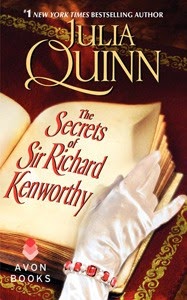
Book review: The Secrets of Sir Richard Kenworthy, by Julia Quinn

Sir Richard Kenworthy has some big secrets – does he ever. For his own private reasons, he travels south from Yorkshire to London to convince some eligible young lady to wed him at short notice. Quinn’s impressive romance, set in the post-Regency era, details the unusual courtship of Richard and Miss Iris Smythe-Smith both before and after his motives are revealed.

The fourth of five daughters, Iris is a sensible woman who doesn’t attract attention, so she’s puzzled but quietly pleased when Richard asks to call on her. He’s handsome and kind, but what’s the hurry to get married? When he deliberately steals a kiss from her in sight of her aunt, he forces her hand – and when Iris learns his true purpose, her anger is justified.

While the premise feels a bit over-the-top, this novel is rooted in the conventions of its time, when one careless decision could mean social ruin. Both gentle yet witty, Richard and Iris are a well-matched pair. Quinn also accomplishes the near-impossible by redeeming Richard’s character in the eyes of Iris and the reader and by crafting a believable reconciliation.

There are some lovely descriptions of the Yorkshire countryside, and fans of the series (this is book #4) can look forward to more terrible music from the Smythe-Smith string quartet.

Here's a special feature for Valentine's Day: my first review of a historical romance here.  If you've read this novel, what did you think?  According to other reviews I've read, Richard is one of Quinn's more controversial heroes; you'll have to read the novel to see exactly why.

I wrote this review for February's Historical Novels Review; thanks to the publisher for granting me access via Edelweiss.  The Secrets of Sir Richard Kenworthy was published by Avon in 2015 (384pp, $7.99 / $9.99 Can).  The UK publisher is Piatkus (£8.99).  It was named to the LibraryReads list for February.

Monday, February 09, 2015

Charles Todd's A Fine Summer's Day, an Ian Rutledge prequel set in pre-WWI England

This 17th novel in the Ian Rutledge mystery series follows the successful pattern used in many of the previous books. An inspector at Scotland Yard, Rutledge puts considerable mileage on his motorcar, driving all over England interviewing villagers while cunningly assembling clues to track down a killer. His presence is alternately welcomed and resented by the local police, and his wits prove to be as sharp as ever. The difference? This entry turns back the clock six years, just prior to the wartime service that will leave him a haunted, shell-shocked veteran.

In this prequel set in June 1914, Rutledge is just 23, a young policeman with a bright future in the Yard – if he can endure the Chief Superintendent’s antipathy. He’s naïve when it comes to women, though. Newly engaged, he thinks his pretty fiancée Jean Gordon will make him happy, while his sister and friends are doubtful. When he gets called to investigate a hanging in Yorkshire, he finds himself befuddled. The dead man was a successful furniture maker with no known enemies. Before long, Rutledge is assigned to investigate two other murders in different corners of the country, and the victims have similarly unblemished reputations.

Readers are shown the perpetrator at the beginning, but even after Rutledge figures things out, there’s still plenty of mystery left. The story becomes an exciting cat-and-mouse thriller as he pursues his man while determining the “how” and the “why.” Tension and atmosphere are added via Britain’s increasing slide towards war, Jean’s pressure on him to enlist, and his need to clear an innocent man before it’s too late. Despite one outlandish coincidence, this is a suspenseful mystery that grips one’s attention until the end.

A Fine Summer's Day was published in January by William Morrow in hardcover ($25.99 or Can$33.50, 352pp).  This review first appeared in February's Historical Novels Review.

Some other notes:

- If you haven't already noticed, the "elegant country house" cover is on its way to becoming as prevalent as the "headless woman" cover.  This doesn't indicate, in either case, that the books are all the same or even close to similar style-wise, though. 

- Yes, this is 17th in a series, but because it's a prequel, you can read it first without any trouble.  (I'm not one who needs to read series books in order, but I know others prefer to do that.)  I've read many books in the Ian Rutledge series so far, including #1, 15, and 16, but not all of them yet.


Saturday, February 07, 2015

Lawrence Hill's bestselling The Book of Negroes, coming to American TV in mid-February

Hill’s third novel, a Canadian bestseller, is a masterful example of historical storytelling, one both heartbreaking and hopeful.

When slavers wrest 11-year-old Aminata Diallo from her West African village in 1745, she vows to remember everything. After enduring the harrowing Middle Passage, she becomes the property of a South Carolina indigo farmer whose overseer notes her intelligence and secretly teaches her to read.

Whether keeping books for a Jewish businessman in Revolutionary-era Manhattan, documenting her fellow Black Loyalists before their transport to Nova Scotia (reflecting Hill’s original title, The Book of Negroes), or joining the British colony of Freetown, Sierra Leone, Aminata retains her self-respect. Throughout her life, she holds tightly to the idea of freedom for everyone forced into slavery, and to her love for the African husband from whom she’s constantly separated.

By the time Aminata journeys to London in 1802 as a symbol of the abolitionist movement, readers will have witnessed the dehumanizing slave trade from inside and out. An unforgettable epic, seen through the eyes of a sharply realized, indomitable heroine.

The review above first appeared in Booklist's 10/15/2007 issue.  The book's U.S. edition was published by Norton under the title Someone Knows My Name. (For background on how that came about, read the author's piece in the Guardian, "Why I'm Not Allowed My Book Title.") And for the record, the "Book of Negroes" is an important historical document, one that lists the over 3000 black refugees who arrived in Nova Scotia following the American Revolution.

I had mentioned the original title in the review to honor the writer's choice and to alert readers that Someone Knows My Name and The Book of Negroes were the same book.

The Book of Negroes, which won the Rogers Writers' Trust Fiction Prize and the Commonwealth Writers' Prize, was selected for Canada Reads in 2013 and has become a modern classic.

Norton has re-released the novel in trade paperback (image at top left) to coincide with the American premiere of the six-part TV miniseries based on the book, which stars Cuba Gooding Jr., Jane Alexander, Louis Gossett, Jr., and Aunjanue Ellis as Aminata.  It will be shown on BET on February 16, 17, and 18; check your local listings for times.  My DVR is set to record it.  For the Canadian readers who have been watching it on CBC, what did you think?

Wednesday, February 04, 2015

Mystery meets the Manhattan Project: Diane Fanning's Scandal in the Secret City

The high-security, covert area known as Oak Ridge, Tennessee – over 50,000 acres of land set aside by the U.S. government for the development of a nuclear bomb – has great potential as the setting for a historical mystery. Fanning’s intricate and smart new novel makes excellent use of the material.

Libby Clark, a recent UPenn grad with a master’s in analytical chemistry, is thrilled to get a job offer from Eastman Kodak since there aren’t many employers in 1942 who’d hire a female scientist. The utter secrecy under which she’s ordered to carry out her tasks turns sinister, though, when her former roommate’s sister is murdered.

Irene Nance was an easygoing young woman with an active love life. When Irene’s body is mysteriously moved (something the authorities deny doing), Libby suspects a cover-up but doesn’t know the reasons why. Having promised Irene’s family to seek justice for her, Libby gets stonewalled at every turn and takes a huge risk by pursuing an investigation. That’s on top of dealing with sexist remarks from coworkers with less technical knowledge than she has.

The timeline feels a little awkward in the beginning with its multiple-flashback structure, but this is a minor issue. The geographical layout and high-pressure atmosphere of Oak Ridge are re-created in extensive detail, as is the curious plight of its scientists, who are simultaneously proud of their work for the war effort and concerned about what they believe is their project’s end result.

Libby herself is a brave and admirable career woman, and seeing her in action, carefully hunting the truth while refusing to play down her expertise, makes for a very satisfying story. There are enough clues for readers to guess the killer well before Libby does, but even so, her appearance in future volumes in the series is eagerly awaited.

Scandal in the Secret City was published by Severn House in 2014 in hardcover ($28.95 or £19.99, 256pp).  Thanks to the publisher for approving my NetGalley access.  This review first appeared in February's Historical Novels Review.

Sunday, February 01, 2015

Congratulations to the historical fiction winners of the 2015 ALA RUSA awards

I was in the audience when the winners of this year's book and media awards from the American Library Association's RUSA (Reference & User Services Association) were announced earlier tonight in Chicago.  Congratulations to all of the winning and short-listed authors! 

Because of this blog's focus, I'll specifically list just the winners that fit with the genre of historical fiction.

Among the 2015 selections for the Reading List, the year's best in genre fiction:

In Historical Fiction, the winner was Kate Forsyth's Bitter Greens (Thomas Dunne, 2014), a retelling of "Rapunzel" set in 17th-century France and a century earlier in Italy.  Read my interview with Kate, which was based on the original Australian edition.  It's great to see the novel receiving such acclaim in the US.

The Historical Fiction shortlist included Amy Belding Brown's Flight of the Sparrow (colonial New England); Nicola Griffith's Hild (Anglo-Saxon England); James Lee Burke's Wayfaring Stranger (1940s US); and Ariel Lawhon's The Wife, the Maid and the Mistress (Jazz Age Manhattan).

In Mystery, the winner was Ashley Weaver's Murder at the Brightwell (Minotaur, 2014), a Golden Age-style murder mystery set at a resort in '30s England.  Read my review from last fall.

On the Mystery shortlist was Bruce Holsinger's historical thriller A Burnable Book.

Among the 26 titles on ALA's list of Notable Books, a best-of list for adult readers, was Anthony Doerr's All the Light We Cannot See (WWII France) and Richard Flanagan's The Narrow Road to the Deep North (WWII-era POWs in southeast Asia; the recent Booker Prize winner).

Congrats also to my Booklist editor, Brad Hooper, for winning the 2015 Louis Shores Award for book reviewing.  Very well deserved! 

Wednesday, January 28, 2015

Two new and substantial historical novel reissues: Zemindar and Csardas

Reissues can bring new life and many new readers to older, classic novels.  Both Valerie Fitzgerald's Zemindar (1981) and Diane Pearson's Csardas (1975) were bestsellers in their day: massive, sweeping epics set during volatile historical eras.  Both have been compared to Gone with the Wind in terms of their scope and the quality of their storytelling.

Zemindar, a novel of adventure and romance set against the backdrop of a troubled 1850s India, won the Historical Novel Prize in Memory of Georgette Heyer as an unpublished manuscript and was published by The Bodley Head shortly thereafter.  When I was pulling together a list of the prize's winners in 2010, I wrote that it was a "prime candidate for reissue."  Zemindar, the author's only novel, was based on her grandmother's experiences during the Sepoy Mutiny.

Csardas, named after a traditional Hungarian folk dance, tells the story of two aristocratic Hungarian sisters whose lives and fortunes change dramatically during the two world wars.  Pearson, who has been writing since 1967, was president of the UK's Romantic Novelists Association for 25 years.

Both Zemindar and Csardas were reissued by the UK publisher Head of Zeus in trade paperback in 2014.  Check out the gorgeous new packaging!  My copy of the 1985 mass market paperback of Zemindar (which is in great condition but has teeny tiny print) stands in the background.


I'm looking forward to reading them both and would welcome the thoughts of anyone who's already read them. At the moment, American readers will have to order them from elsewhere, but I'll update you if there's more news on that score.  I'll provide some links here because there are multiple out of print editions on bookseller sites, which can make it hard to find the new ones.  Here are the UK buying options for Zemindar and Csardas on Head of Zeus's page (both are £15.00).  At other sites, such as Chapters.ca and Amazon.ca, I recommend searching by ISBN to find the right ones:  9781781857519 (Csardas), or 9781781859544 (Zemindar).

All of the books in the pic above were personal purchases.

Valerie Fitzgerald, who's in her 80s and living in Ottawa, recently gave an interview with the Ottawa Citizen in celebration of the re-release, speaking about her childhood in India, her writing career, and her thoughts looking back on Zemindar 34 years later. 

Since I'd written about Zemindar previously on the blog, her grandson's wife recently got in touch to tell me about the new edition, the newspaper interview, and another interview that Valerie Fitzgerald would be doing with CBC Radio.  That interview aired yesterday afternoon and is available at the CBC site.  It's 13 minutes long, and I found it completely fascinating to hear her discuss her life, the background to the book, some fun stories about the industry, and why she never wrote another novel.  I highly recommend taking the time to listen to it.

Monday, January 26, 2015

An interview with Gary Inbinder, author of The Devil in Montmartre

Today I'm hosting an interview with novelist Gary Inbinder.  His third novel The Devil in Montmartre,  released last month, brings readers into the bustling fine art scene and dark underworld of Paris in 1889.  As the city is flooded with tourists during the Universal Exposition, Inspector Achille Lefebvre, a young but highly regarded member of the Sûreté, investigates the murder of a young woman who danced the Can-Can at the Moulin Rouge.

~

The Devil in Montmartre stands well on its own, but one of your protagonists, the talented artist Marcia Brownlow – probably my favorite character – also featured in The Flower to the Painter. What made you decide to bring Marcia back for an encore appearance?

Marcia Brownlow is one of my favorite characters. After I finished The Flower to the Painter I had the idea of using her, and some of the other characters, in another novel. A fin de siècle Paris setting appealed to me, as did the idea of a murder mystery with references to Jack the Ripper.

The action in the novel unfolds through many different viewpoints. How difficult of a process was it to piece together and structure the novel in this way? 

I had used a first person narrative in earlier novels, but I found the single perspective too limiting for this particular story. On the other hand, using multiple first person narrators seemed too complicated and potentially confusing. So, I struck a balance by using a third person narrative with multiple points of view. Once I got into it, it seemed to flow quite naturally.

I’d love to know more about your research into Montmartre in 1889, since I felt fully immersed in the setting. Based on the depth of detail, I’m guessing you know French and have spent time walking around Paris in person, though please correct me if I’m wrong!

Two admissions. First, I had two years of college French. I can still read French fairly well, but I wouldn't attempt to write or speak it. Second, my knowledge of 1889 Paris is dependent on imagination and years of reading histories and period literature, studying old photographs, paintings, drawings, maps and so forth. Of course, for months prior to writing The Devil in Montmartre, I added to my knowledge with additional research.

Your detective, Achille Lefebvre, is well-respected by his fellow detectives and known even in less reputable circles to be a trustworthy fellow. He’s not just an admirable character, though, but a likeable one. How did you come up with his personality? Will we be seeing more of him in future books?

I'm glad you liked Achille. I particularly enjoyed writing his scenes and dialogue. He combines traits of my favorite fictional detectives, including Simenon's Maigret and Sherlock Holmes. However, I tried to "humanize" him by focusing on his domestic life, especially his relationship with his wife, little daughter, and difficult mother-in-law. As for future books, there's a sequel in the works but it's a bit premature to say anything more about it.

Achille runs into some resistance when he advocates for the use of fingerprinting as an aid in solving crimes. Why was this viewed as such a radical development?

At the time, no major police force had used fingerprinting for identification purposes. However, the English anthropologist, Sir Francis Galton, published his system for fingerprint identification in the late 1880s, something I mention in the novel. In 1892, Juan Vucetich, a Croatian detective working for the Argentine police, made the first positive identification of fingerprints in a criminal case. Vucetich based his identification and classification system on Galton's writings, but it took more than a decade before police departments worldwide adopted it.

Interestingly, Samuel Clemens, aka Mark Twain, anticipated the use of a fingerprint to solve a crime in a chapter of Life on the Mississippi (1883) and he revisited the subject in The Tragedy of Puddn'head Wilson (1894).

Your three novels convey some of the same themes – artistic creation, for one – and are set in historical times, but are a bit different genre-wise. What prompted your move into historical crime?

I'm a retired lawyer, I've had some experience working with law enforcement, and I'm partial to good historical fiction and classic crime novels. The historical mystery/crime genre offered a good vehicle in which to express my varied interests, and I just decided it was the right time to give it a try.

What originally inspired your interest in French art during the late 19th century? Do you have any favorite painters, post-Impressionist or otherwise?

I grew up with art. My late brother was a fine artist and art teacher, and my older sister majored in Art History and did some of her post graduate work at The Sorbonne. As I recall, among the first books that caught my attention when I was learning to read—or perhaps even before I could read—was a set of illustrated biographies of the painters, including Manet, Monet, Renoir, Van Gogh, Gauguin and Toulouse-Lautrec. My parents took me to the Art Institute of Chicago when I was very young. The paintings fascinated me, and the museum has a fine collection of French Impressionist and post-Impressionist paintings, including Seurat's A Sunday on La Grande Jatte.

In addition, I saw the films Lust for Life, the story of Van Gogh with Kirk Douglas, and John Huston's version of Moulin Rouge with Jose Ferrer as Toulouse-Lautrec. These have remained favorites, which I've returned to over the years. As a result, I have many sources to draw upon when visualizing scenes for my novels.

~

Gary Inbinder's The Devil in Montmartre was published by Pegasus Crime in December (hardcover, $25.95, 256pp).  Visit the author's blog at http://garyinbinder.blogspot.com.

Saturday, January 24, 2015

Greer Macallister's The Magician's Lie, an involving tale of deception, female agency, and fin-de-siècle magic

A while back, in the comments I made following my review of Timothy Schaffert’s The Swan Gondola, I confessed that I don’t usually go for novels about circuses and fairs and things of that nature. Although I loved that particular book.

Then I read and reviewed Rosie Thomas’ The Illusionists, about a troupe of magicians in Victorian London, and enjoyed that one, too.

Now, when presented with a 3rd recent historical novel about magic and magicians, I had no qualms about picking it up, and I’m very glad I did. The storyline grabbed me from the first paragraph, and the pacing and narrative tension remained strong through the end. Although I had correctly guessed part of the conclusion, other aspects were a surprise.

Guess it’s time for me to revisit my reading preferences – at least in terms of magicians.  (I still don't like circuses.)

Set amid the alluring world of stage magic at the turn of the 20th century, Greer Macallister’s The Magician’s Lie is a novel about reality and illusion, love and betrayal, wealth and destitution, confidence and fear, truth and deception – and how quickly one can transform into the other.

The premise is thus. In Waterloo, Iowa, one evening in 1905, hours after the renowned female magician known as the Amazing Arden performs a unique variation on her controversial “Halved Man” trick, the bloodied body of a man – her husband – is found stuffed into a smashed wooden container beneath the stage. Had she killed him before the crowd as part of her act? Seizing the opportunity, Virgil Holt, a down-on-his-luck police officer from the nearby town of Janesville, catches the beautiful young woman during her planned escape and carts her into the station for questioning.

Arden claims not to know that anyone was murdered, but Holt doesn’t believe her. She insists he’ll be killing her if he doesn’t let her go. Not convinced, but willing to listen, he handcuffs her wrists to a chair to prevent her from fleeing and demands to know the truth.

And so she spins a tale about her life and career that takes her from Tennessee farm country to the vaudeville circuit and on to national fame as a brilliant and daring performer. (There’s plenty more, but I won’t be giving it away.) Is it fact or fancy or some of each? Either way, her story is so diverting that it’s easy to forget the author behind the curtain.

Edgy and exciting, The Magician’s Lie is a fast-moving historical novel that I would also recommend as a “gateway book” for introducing historical fiction to newcomers. Arden’s voice is fresh, appealing, and (seemingly) sympathetic. Without overburdening them with details, Macallister offers readers many informative new tidbits, such as the inner workings of specific magic tricks. She also presents the life of an itinerant performer in the late 19th century from an unusual viewpoint: that of a woman.

In the “conversation with the author” at the end (please save it until later if you plan to read the book!), Macallister says that since she was new to historical fiction, the writing process took about five years from initial idea to final draft. It may have required a lot of time and effort, but I think she got the difficult balance of fact and fiction pretty much right.

The Magician’s Lie is published by Sourcebooks Landmark this month (312pp, $23.99 hardcover, $9.60 on Kindle). It was on the LibraryReads list for January. I picked it up as an ARC at the publisher’s BEA booth last summer.

Wednesday, January 21, 2015

Historical fiction at ALA Midwinter: galleys, authors, signings

I've been an American Library Association member for 20 years, but this year will be the first time I'll be attending ALA Midwinter.  The conference will be held in Chicago on January 30 - February 3, so it's relatively close by.  I'm looking forward to catching up with other librarians, cruising the exhibit hall, and reviewing job seekers' resumes in the Placement Center.  Needless to say I'm hoping for decent weather.

Here's what I've managed to gather together as far as historical novels and novelists present at the show.  Sources include Library Journal, publisher announcements, and the ALA Midwinter site.

~Galleys available~

Barbara Hoffert of Library Journal has already put together an amazing galley guide for Midwinter, so I'm not going to copy over all of the relevant HF info; just click on over to visit the LJ site.  The guide is very detailed and lists settings for most of the historical novels being given away at publishers' booths, so you should be able to pick them out easily.

I have a number of galleys already thanks to publishers, Booklist, and Edelweiss, but just a few of the others I'm particularly eager about are:  Shona Patel's Flame Tree Road (MIRA, June), set in late 19th-century India, which she says on her FB page is about Dadamoshai, Layla's grandfather from Teatime for the Firefly; Jami Attenberg's Saint Mazie (Grand Central, June), set in NYC's Lower East Side during the Jazz Age; Anna Freeman's The Fair Fight (Riverhead, April), female boxers in 18th-c England (have heard great reports about it); and Susanna Kearsley's A Desperate Fortune (Sourcebooks, April), another Scottish-set romantic timeslip.

~Author appearances and signings~

Elizabeth Berg, The Dream Lover
French novelist George Sand looks back on her long, eventful, controversial life.
Monday 2/2, United for Libraries Gala Author Tea, 2-4pm, Hilton Chicago, Williford Room.  Tickets required; check for prices and details.

Elizabeth Blackwell, While Beauty Slept
A retelling of "Sleeping Beauty" set in a kingdom based on medieval Europe.
Saturday 1/31, author appearance 11:00 am–12:00 pm, Pop Top Science Fiction/Fantasy Panel, McCormick Place West; signing 2:00-3:00 pm, Penguin booth 4823.

C. W. Gortner, Mademoiselle Chanel
Imagines the life of iconic 20th-century designer Coco Chanel.
Sunday 2/1, signing 9-10am, HarperCollins booth 4526; also 2/1, author appearance 10-11am, "stories of women pursuing their destiny," Pop Top Stage, McCormick Place West.

Marci Jefferson, Enchantress of Paris
Fiction about Marie Mancini in the court of the Sun King.
Friday 1/30, signing 5:30-7pm, Macmillan booth 4613.

Renee Rosen, What the Lady Wants
Subtitled "a novel of Marshall Field and the Gilded Age."
Saturday 1/31, signing 1-2pm, Penguin booth 2823; Monday 2/2, 10-11am, author appearance at Pop Top Local Author Panel, McCormick Place West.

Mary Doria Russell, Epitaph
Novel of Wyatt Earp and Doc Holliday in the Old West.
Monday 2/2, signing 11am-noon, HarperCollins booth 4526.

What galleys are you looking forward to the most, and what else am I missing?  I know Chicago's not known as a hot spot in January, but even so, this seems like a short list.  Please leave a comment if you know of other signings or author appearances. The list is correct as far as I'm aware, but suggestions for corrections/changes are very welcome. 

Sunday, January 18, 2015

Book review, with notes: Kate Alcott's A Touch of Stardust

Alcott should entrance large audiences with her stellar historical novel, which follows fictional Indiana native Julie Crawford after she moves to Los Angeles in 1938 to become a screenwriter. Readers expecting a rehash of a familiar plotline, however—that of a young hopeful becoming disillusioned by the emptiness beneath Hollywood’s glitzy veneer—will find something more nuanced and substantive.

Working as an assistant to exuberant blonde actress Carole Lombard, who hails from her hometown, Julie gets pulled into the activity surrounding the filming of Gone with the Wind, costarring Clark Gable, the still-married man Carole loves (and vice versa). On and off the set, considerable drama unfolds; all the actors and crew are subjected to the single-minded vision of its controlling producer, David Selznick.

Both Carole and diminutive brunette Vivien Leigh light up the page in their scenes, and Julie’s story line holds its own alongside theirs. As she sheds her midwestern naïveté and works hard on a screenplay in her free time, her romance with a Jewish assistant producer draws in themes of prejudice and hypocrisy.

The briskly paced narrative captivates as it lets readers view the creation of silver-screen magic, and it’s also a terrific tribute to the industry pioneers, like screenwriter Frances Marion, who helped others jump-start their dreams.

~

A Touch of Stardust will be published by Doubleday next month ($25, hardcover, 304pp).  I wrote this starred review for Booklist's November 15th issue.  Some additional notes:

- "Kate Alcott" is a pseudonym for veteran novelist and journalist Patricia O'Brien, and this is the only novel of hers written under this name that I've read (the first, a breakout hit, was The Dressmaker).

- However, I thoroughly enjoyed her earlier novel written as O'Brien, Harriet & Isabella, about the relationship between 19th-century sisters Harriet Beecher Stowe and Isabella Beecher Hooker as they revisit the adultery trial of their brother, charismatic preacher Henry Ward Beecher.  Apparently this book didn't perform well sales-wise, which eventually led to her adoption of a pseudonym, but I suspect that had less to do with the quality of the story than the fact that the Beecher family are no longer household names.  I love this period in American history, though, and highly recommend this underrated novel.  I interviewed O'Brien about Harriet & Isabella here back in 2008.

- In addition to everything I mentioned in the review, Alcott also smoothly intertwines a secondary thread involving the African-American actors (Hattie McDaniel and Butterfly McQueen) in GWTW, particularly their conflict between the breakout opportunity the film was for them and the demeaning roles they played.  Although they were respected as professionals by their fellow actors, this wasn't the case everywhere.  In the novel, as in history, Clark Gable was outraged and outspoken on their behalf when they experienced instances of segregation on set and at the time of the film's premiere.

- The cover design has changed since the ARC; the final one, above, is an improvement in my opinion.  Very classy.

-  A Touch of Stardust is one of 10 titles on the February 2015 LibraryReads list.  These are the top 10 reads for a given month selected by public library staff members across the U.S. (as an academic librarian, unfortunately I can't participate in this initiative, but I enjoy seeing what this group comes up with).  I've read three of the ten for February and will be posting reviews of the remaining two (The Siege Winter and The Secrets of Sir Richard Kenworthy) shortly.

Friday, January 16, 2015

The 2014 Langum Prize for American Historical Fiction: Winner and Honorees

The winner of the 2014 David J. Langum, Sr. Prize for American Historical Fiction is Kimberly Elkins' What Is Visible (Twelve, 2014).

From the judges' remarks in the press release:

"This novel lyrically revives a significant and intriguing figure in the history of disability. Laura Bridgman (d. 1889) was a celebrity in her lifetime. Stripped of sight, hearing, taste and smell by scarlet fever in her childhood, Bridgman served as a poster child for the Perkins School for the Blind and various intellectual causes such as phrenology and anti-Calvinism.

"What sets this novel apart is the author’s ability to imagine Laura Bridgman’s world and to give her a powerful narrative voice. With skill and compassion, Elkins portrays Bridgman as a complicated character whose strengths and flaws grow more complex as the story progresses. Historical details enrich the story, and the author deftly exposes the care and treatment of the disabled during the 1800s. This is American historical fiction at its best."

The 2014 Honorable Mention went to Catherine Bell's Rush of Shadows (Washington Writers’ Publishing House, 2014), a "sparsely but beautifully written novel" that focuses on farmers of Northern California’s Sacramento Valley and their encounters with the native Digger Indians in the 1850s.

From the judges' comments: "This is truly fresh material. The Trail of Tears is well-known, but Indian removals in California are relatively obscure. The characters are well-drawn and the descriptions vivid. A beautiful book."

Finally, Laila Lalami's The Moor's Account (Pantheon, 2014) was named as the Director's Mention for 2014.

"While The Moor's Account does not fully meet the requirements for the prize," the judges note, it is praised as an "extraordinary, pitch-perfect work of historical fiction about the Narváez expedition in Florida."

For more on the prize and the full announcement of this year's honorees, see the Langum Charitable Trust. To submit a novel for consideration, view the directions available at the site; the Trust has also issued guidelines used by their readers and selection committee, which authors should find useful as well. The prize is awarded annually to the "best book in American historical fiction that is both excellent fiction and excellent history."

Past years' winners include Gary Schanbacher's Crossing Purgatory, Ron Rash's The Cove, Julie Otsuka's The Buddha in the Attic, Ann Weisgarber's The Personal History of Rachel DuPree, Edward Rutherfurd's New York, and Kathleen Kent's The Heretic's Daughter.

Tuesday, January 13, 2015

Citizens Creek by Lalita Tademy, a little-known American story worth learning

Whether you read historical fiction to be educated, entertained, or both, Citizens Creek will get you squared away.

The title refers to a people rather than a place, just one of the many aspects of the novel that will make you think. It spans almost a century in the lives of Cow Tom and his granddaughter Rose, from his youth as a slave and hilis haya (healer) of cattle on an Upper Creek chief’s Alabama plantation through her later years as an Oklahoma rancher and family matriarch.

Their struggles and rise to prominence make for a classic American success story, and it’s especially inspiring because the characters are based on historical people. They deserve to be more widely known, and Tademy has done well in resurrecting them in her latest work of fiction.

In 1822, when he’s twelve years old, Cow Tom’s mentor, Old Turtle, tells him: “Owned by tribe’s not the same as tribe.” One of Cow Tom’s lifelong goals is to secure freedom and tribal citizenship for all people of African descent living within the Creek Nation. He has a talent for languages, which puts him in demand as a translator during the whites’ Indian wars and their harsh Removal policy, in which tribes living east of the Mississippi were displaced to lands in the West.

Cow Tom also remains determined to find his mother, who was stolen away by Seminoles when he was a child, and uses every possible opportunity on his assignments in Florida to locate her. His achievements on behalf of other African Creeks are impressive (I won’t spoil the details for those who don’t know them), but he also does some things he’s ashamed of. For Rose, being chosen years later as the recipient and bearer of his personal history is equally an honor and a burden.

This is the type of novel that’s best read slowly and carefully. Sometimes one chapter will follow closely upon another, while at other times they’re set years apart. The author’s admirable aim of covering such a wide stretch of years gives the book an episodic feel in places. There are so many people in it with interesting stories and backstories, though. Cow Tom’s wife Amy, for instance, is a smart, tough woman who could easily have starred in a novel herself.

In turning up slices of history unknown to most readers, Tademy has written a stirring work about endurance, liberty, family, and belonging. Cow Tom’s own words to Rose in the novel describe his journey best:

“From early, I had to aim higher than my name, an offhand thing tossed out to make it easier for someone to call me. The name fit, far as it went, but I was more than a tender of cows. I was a tender of words, and of people, and master of myself.”

Citizens Creek was published by Atria/Simon & Schuster in November ($26.00, hardcover, 432pp). Thanks to the publisher for granting me access via Edelweiss.

Monday, January 12, 2015

Etowah: Trade Center of the Mississippian Culture, a guest post by Kristin Gleeson

When Kristin Gleeson first mentioned her idea to contribute an essay about Etowah, I was intrigued and expressed interest in learning more.  Here she presents an introduction to it and other large American cities that flourished across the continent before the Europeans arrived.

 ~

Etowah: Trade Center of the Mississippian Culture
Kristin Gleeson

Twelfth-century America is the setting for a large portion of my novel, Along the Far Shores, which uses the legend of Prince Madog of Wales’ voyage to America as a framework for the plot. The legend puts Madog/Madoc in Mobile Bay and up along the Mississippian Valley, in Southeastern part of North America, an area and time period virtually unknown to most people.

Mention the Aztec, Maya and Inca, whose existence overlapped in this time, and so many images come to mind: pyramid temples, gold hoards, bloody sacrifices, elaborate sculptures and ball games where the losing sides were sacrificed. There is also the well-known story of the Aztec chief, Montezuma, who was captured and eventually killed by the Spaniards in the 15th century. Few people, however, would know about the Mississippian culture, which flourished for almost 900 years, c. 600-1500 A.D., and, like the more well-known Central and South American counterparts, had great urban centers, some of them more populous than any city of Europe at the time.

It was along the fertile valleys of the Mississippi and its tributaries that these cities arose. Ocmulgee, Etowah, Cahokia, Moundville and Spiro were some of the biggest cities. The region stretched from the Atlantic coast to Arkansas and Oklahoma and up as far as Wisconsin. A new strain of maize and later Mexican beans and squash supported this growing population that previously had been limited by dependence for food on game or fish that might be scarce in any given year. With a reliable food source, these communities were able to turn their attention to fashioning pottery, pipes, cups, jewelry, head ornaments of feathers and copper, wooden and stone sculptures, woven articles, cloth and copper products. The pipes, for example, used often for ceremonial purposes, were elaborately carved from materials like obsidian or bauxite into mythical figures such as Big Boy, the warrior priest dressed in a falcon costume, who also appeared on shells and copper plates. Or like the two sculpted marble figures, a man and a woman, nearly 3 feet tall found at Etowah.

Marble effigies from the Etowah Mound C, ca. 1375.  Source: Herb Roe via Wikimedia Commons

All these items Etowah and other cities traded along with raw commodities like obsidian, gold, silver and conch shells. Trade grew into important networks that linked much of the Midwest and East. Such links offered many chances for sharing and improving skills, acquiring or modifying languages, religious and cultural practices.

Etowah, located in north central Georgia, was one of the largest cities of the Mississippian culture, and its remains are still evident. Surrounded by a moat and a bastioned wooden palisade, it had six earthen mounds that loomed over the city. The three largest mounds were grouped around a large plaza, the most central one rising 61 feet with a base that covered about 3 acres. Its flattened top extended to about ¾ size of a football field and commanded an impressive view of the surrounding plain. A second plaza, paved with clay was to the east and had a ramp that extended from the plaza to the summit of the first mound.

A pic of the Etowah Mound Site in Cartersville, Ga.  Source: Herb Roe via Wikimedia Commons

In later centuries a small elite, The Nobles/Honored Men, lived on top of the mounds near to the all-important temple. Their houses were colorfully painted and decorated with elaborate designs and housed richly carved items. The commoners living in the plains below the nobles dubbed “the Stinkards.” The Great Sun was the leader and his relatives, known as Suns, held the city’s administrative positions. The political dominance of this elite group usually extended beyond the city to the surrounding areas, where lesser chiefs ruled small towns. All members of the region and the city were obligated to send tribute to the Great Sun periodically. Once the Great Sun died, this strong regional network often fragmented if there wasn’t a strong person to replace him.

Etowah and the other cities remained largely autonomous, but extensive economic and kin ties created far-flung alliances and rivalries so that the competition for power and prestige gradually intensified over the centuries. Ancestral obligations became more important, as did celebrations of successful harvests, hunts and warfare.

Other rituals, like ball games, became increasingly important and had deep religious connections. It is possible these ball games may have been the origin of the popular Boskita and Chunkey played in parts of the Southeast in later times. Boskita was like an earlier form of lacrosse with up to 60 players on each side, with up to five squads. Players carried two sticks shaped somewhat like a tennis rackets strung with deer hide thongs. The field was nearly a quarter of a mile long with a goal at each end formed by two uprights and a crossbar. Chunkey, on the other hand, was played with a disk, 3 to 6 inches in diameter, made from stone. These ball games appear to have had various meanings, some of them representing man and the cosmos.

With the arrival of De Soto and other Europeans in the 1500s, disease and disorder overtook the Mississippian cities that weren’t already in decline and decimated the population. There were too few people to construct massive earthworks, host elaborate rituals and celebrations or pay tribute to an exalted leader on the scale of previous time periods. Smaller bands and communities survived and eked their living to the best of their ability while only remnants of rituals and crafts remained.

~

Originally from Philadelphia, Kristin Gleeson lives in Ireland, in the West Cork Gaeltacht, where she teaches art classes, plays harp, sings in an Irish choir and runs two book clubs for the village library. She combines her love of myths with her harp playing and performed as a professional harper/storyteller at events in Britain, America and Ireland. She holds a Masters in Library Science and a Ph.D. in history, and for a time was an administrator of a national archives, library and museum in America. Her newest novel, Along the Far Shores, was published in November by An Tig Beag ($12.99 pb, $2.99 ebook).

Thursday, January 08, 2015

Galápagos Regained by James Morrow, a satirical romp through 19th-century South America

Morrow’s newest cheerfully provocative epic stars the intrepid Chloe Bathurst, who takes a job as Charles Darwin’s assistant zookeeper after getting fired from the Victorian theater. To raise cash to free her indebted father from the workhouse, she decides to enter the Shelley Society’s lucrative contest, which aims to settle the “pesky God question” for good.

When her employer declines to use his unpublished evolutionary theory to grab the winnings for himself, Chloe secretly copies his treatise, secures funding and a ship, and heads for the Galápagos isles to gather evidence for his Tree of Life. As she and her eccentric fellow travelers descend into the Amazon jungle while traversing South America, they encounter many obstacles.

The lofty narrative tone lends period authenticity, and there are some great comic moments as the characters undergo crises of faith. Fans of quest adventures may find the pacing exasperatingly sluggish, as the plot often gets buried under numerous details and digressions. For those fascinated by the meeting point between theology and science, though, it should be a rewarding expedition.

Galápagos Regained was published this week in hardcover by St. Martin's (496pp, $27.99).  This review first appeared in Booklist's December 15th issue.

Some notes:

- I loved James Morrow's The Last Witchfinder, which (like this one) is a picaresque adventure novel about a woman's quest. It's set in Restoration England and 18th-century America and takes on the themes of bigotry and superstition during the age of witch-hunting.  From the first sentence ("May I speak candidly, fleshling, one rational creature to another, myself a book and you a reader?" – it's narrated by the Principia Mathematica, you see), I was captured by the writing, humor, and originality.  Definitely recommended.  I reviewed it for Booklist in 2006; it was my first starred review for them.

- Galápagos Regained started out promisingly for me as well.  The scenes on Darwin's estate in England are terrific, and the author's wit is as sharp and clever as always, but other parts were, well, simply too long and detailed.  Reviews are mixed; Kirkus wasn't keen, Library Journal loved it, and Publishers Weekly admired its sense of fun but also said it was overlong.  I cautiously recommend it and would be interested to hear what others think, if you decide to read it.


Monday, January 05, 2015

Book review: Tessa Arlen's Death of a Dishonorable Gentleman

Combining the pleasurable dramas of the English country house novel and the richly detailed, tense atmosphere of a historical mystery, this involving debut features the unusual detective partnership between an aristocrat and her housekeeper. That said, the Countess of Montfort and Mrs. Jackson are not exactly BFFs. Tessa Arlen is too attuned to early 20th-century class distinctions to let that happen. When asked by her desperate employer to observe conversations below stairs at Iyntwood and report back, Mrs. Jackson is appalled, but her allegiance to the family she serves prods her along.

The murder victim of the title is Teddy Mallory, the spoiled only son of Lord Montfort’s sister. While everyone is horrified by the circumstances of his death (he’s found hanging from a gamekeeper’s gibbet the morning after the Montforts’ renowned summer party), he wasn’t well-liked. The mostly-unlamented Teddy has a long history of disreputable behavior, some of which is yet undiscovered. Even more curiously, two women, one a houseguest and one a new maid named Violet, vanished the same day.

The arrival of an aggressive Scotland Yard investigator with no respect for his betters throws the household into even more disarray. Because the Montforts’ heir, Harry, was seen having a vicious argument with Teddy, he appears guilty at first. However, his mother, Clementine, believes in his innocence and enlists Mrs Jackson to keep her ears to the ground.

Among the houseguests are a dizzying bevy of socialites, introduced for the most part all at once. The characters have the advantage here, since they know who’s who better than readers will, but over the course of the novel, their distinctive personalities sort themselves out.

The shifting rapport between the central pair of allies – an unconventional yet privileged noblewoman and an upper servant whose brusque efficiency and “hierarchical cast of mind” belie her relative youth – is one of the novel’s high points. Arlen has a firm grasp on period mindsets and, as expected of any novel set in England in 1913, she inserts relevant details on the changes sweeping the country, such as women’s suffrage – a movement many female characters resist.

The lovely descriptions of the rolling green countryside around Iyntwood place us right into that glorious setting. Through its master’s thoughtful reflections on his “still-feudal way of life” while on a morning’s ride around his estates, we also get a solid sense of his family’s long-entrenched relationship with the land and his protectiveness toward his servants – even though, he admits, he “wasn’t terribly sure what Violet looked like.” The book is full of these small but telling details.

In this not-quite cozy mystery, the resolution to the crime unfolds in a logical manner. Sufficient clues are planted to let readers guess the culprit a bit early. Since they make an impressive and successful team, I hope Lady Montfort and Mrs. Jackson will join their wits again in future volumes – in particular, it should be interesting to see how much the characters relax their social attitudes as World War I gets underway.

~

Death of a Dishonorable Gentleman will be published by Minotaur/St. Martin's Press tomorrow in hardcover ($25.99, 320pp).  This post is among the first out of the gate for the blog tour hosted by Historical Fiction Virtual Book Tours.  Thanks to the publisher for approving my NetGalley copy.


Wednesday, December 31, 2014

Looking back on 2014: A dozen excellent historical reads

This is another of those "favorite books" posts that have been springing up on numerous blogs at the end of the year.  I thought about coming up with 10, but that was too difficult, so I decided on a dozen – and choosing even those was a challenge.

According to Goodreads, I read 109 books during 2014, and most were strong, good-looking, and above average.  A fair many were excellent, and if I thought about my picks even more, I might have come up with a different list.  These are all books I read during the last year, even if they were published earlier, or will be published later.

I found it interesting to see there isn't much overlap with the Goodreads list for Best Historical Fiction, as voted on by readers.  I've read only five of the 20 finalists, and just two (My Name Is Resolute and Secret Life of Violet Grant) made it to my list.  Another, Emma Donoghue's Frog Music, was outstanding, but I read it as an ARC in 2013. 

Hope you all had a good reading year, and I'm looking forward to the new crop of books in 2015. Thanks for reading along with me.

And now for the list.  The links lead to my reviews of the books, if they exist.

Joseph Boyden, The Orenda (Knopf, 2014). Boyden’s mesmerizing third novel sits at the confluence of three civilizations in 17th-century Ontario: the French, the Iroquois, and the Huron (Wendat). Despite the cultures’ disparate beliefs, the author remains clear-sighted and impartial, and the scenes of Native spirituality are beautifully rendered.

Alix Christie, Gutenberg’s Apprentice (Harper, 2014). This gorgeously written debut, an inspiring tale of ambition, camaraderie, betrayal, and cultural transformation set in the cathedral city of fifteenth-century Mainz, dramatizes the creation of the Gutenberg Bible. I hadn’t heard of Peter Schoeffer or his important historical role before this, and it was a revelation.

Charles Finch, The Laws of Murder (Minotaur, 2014). Set in 1876 London and featuring gentleman detective Charles Lenox as he gets pulled into a Scotland Yard investigation with links to his own past, this stellar mystery is chock full of atmosphere and twisty, dramatic surprises. I jumped into Finch's series with this 8th volume without much trouble.

C. W. Gortner, Mademoiselle Chanel (William Morrow, 2015). Disclaimer: the author is a good friend, and I read this as a manuscript. That said, I honestly feel this is his best novel yet, an engrossing story of 20th-century designer Coco Chanel: her career successes, her love affairs, her hidden vulnerabilities. For those weary of “famous guy’s wife” novels, many of which explore unfulfilled ambitions, this convincing vision of a driven, powerful woman is an ideal antidote.

Alexis Landau, Empire of the Senses (Pantheon, 2015). I’ll be reviewing this later on so won’t say very much about it now. This ARC arrived with little fanfare (plain tan cover, no other material), but I was immediately swept into an absorbing saga about a family of mixed faith living in WWI-era and late 1920s Berlin.

Laurie Loewenstein, Unmentionables (Akashic, 2014). This warmhearted, involving work, situated gracefully in small-town Illinois and overseas during the WWI years, depicts a wide range of social concerns as people's minds are opened to new, previously hidden possibilities.

Rett MacPherson, Sleeping the Churchyard Sleep (Word Posse, 2014). When Olivia VanBibber and her brother bring a plate of their great-aunt’s fried chicken over to the home of a newly arrived stranger, their surprising friendship transforms her world – and eventually pulls her into a genealogical mystery. A warm-hearted, stereotype-free portrait of 1950s West Virginia, and the witty, forthright narrative voice of Olivia (a polio survivor who uses a wheelchair) is irresistible.

Marschel Paul, The Spirit Room (Wasteland Press, 2013). This epic about two teenage sisters’ coming of age in 1850s New York State, set against a vivid backdrop of quirky social fads and dark situations, is a fabulous read for fans of American women’s history. I picked this up on a whim when I was supposed to be reading something else and got drawn right in.

Stephanie Thornton, The Tiger Queens (NAL, 2014). A lengthy, immersive read about the extraordinary women who supported Genghis Khan and strengthened his kingdom. It’s full of fascinating detail about 12th-century Mongolia yet the plot moves forward with unstoppable momentum.

Nancy E. Turner, My Name Is Resolute (St. Martin’s, 2014). Resolute Catherine Eugenia Talbot (a fictional character) reveals the story of her eventful life, from her Jamaican childhood through her involvement in the lead-up to the American Revolution. Full of adventure, romance, and unexpected surprises, her account remains captivating throughout its nearly 600 pages.

Various, A Day of Fire (Knight Media, 2014). Six well-known historical authors – Stephanie Dray, Ben Kane, E. Knight, Sophie Perinot, Kate Quinn, and Vicky Alvear Shecter – got together to collaborate on a high-concept novel set in Pompeii at the time of its destruction in 79 AD. This gets my vote for “most creative.” Their stories interlock perfectly, and if you seek out fiction set in the ancient world, it’s not to be missed.

Beatriz Williams, The Secret Life of Violet Grant (Putnam, 2014). A dual-period novel – you might call it a historical mystery-thriller-romance – set in WWI-era Oxford and Berlin and also in 1960s Manhattan. The cheeky, whip-smart voice of Vivian Schuyler, a young woman caught up in solving the mystery of her the great-aunt she never knew, won me over completely.


Sunday, December 28, 2014

A look at Kate Sedley's The Christmas Wassail

Although December 25th has come and gone, Kate Sedley’s The Christmas Wassail still made for a timely read after the holidays.  It’s set in and around Bristol, England, opening on the day before Christmas Eve in the year 1483 and wrapping up after Epiphany, or Twelfth Night.

All of the religious observations and traditional folk customs held over the twelve days of Christmas are included, which creates a rich cultural atmosphere. On Christmas Day, Roger the Chapman, his wife, and their blended family of four children attend three separate masses. There’s much merriment and drinking of “lamb’s wool” as people travel from house to house during their wassailing, and a group of mummers has come to town to perform.

Amid all the activity, including his investigation of a growing number of murders (since this is a mystery, after all), Roger is charged with finding a suitably large Yule log and keeping it burning for nearly a fortnight.

The crime aspect is introduced through the stabbing death of a city alderman who was a good friend of the wealthy Sir George Marvell, an ornery old man with a healthy libido and a multitude of family problems. Roger finds the victim right before he dies and hears his puzzling last word.

To the dismay of his wife, Adela, Roger has the habit of getting drawn into solving murders, both in Bristol itself and on his many peddling excursions around the countryside. It’s the second marriage for both of them, and their loving but sometimes acrimonious banter is fun to watch. Strong-willed, efficient Adela runs a tight household, or would, if Roger wasn’t away so much, meeting with friends in his favorite tavern or following wherever his curiosity leads him. Roger’s past service on behalf of the Duke of Gloucester, now Richard III, has helped his family rise in the world, so she can’t resent his work too much.

Although The Christmas Wassail is the 22nd (!) volume in the Roger the Chapman series, I didn’t feel disoriented. Enough backstory is provided so that the characters’ relationships are clear. The occasional reference to specific events from earlier volumes flew over my head, but that wasn’t a big deal. There’s enough detail on late medieval life to satisfy historical fiction readers, even those who don’t seek out mysteries. The book was published last year, and so far it marks Roger’s last appearance in fiction, which makes me wonder if there will be any others.  Kate Sedley (a pseudonym) also wrote many novels set in the Middle Ages as Brenda Honeyman and Brenda Clarke, her maiden and married names.

The Christmas Wassail appeared from Severn House in 2013 ($29.95 hb, $9.99 ebook).  I read it from a library copy, and wrote this review on my trip back to Illinois after spending Christmas in Orlando with my in-laws.  Hope you're all having a nice holiday season!

Tuesday, December 23, 2014

Book review: Jane Austen's First Love by Syrie James

As you can guess from the title, this gently and lovingly told novel imagines young Jane Austen’s first experience with romance, but I would have picked it up for the setting alone. An invitation to spend the summer of 1791 amid fine company at a grand manor in the English countryside was hard to resist.

Fifteen-year-old Jane adores her siblings, including sister Cassandra and brother Edward – who had the good fortune to be adopted by wealthy relatives, and whose upcoming marriage to Elizabeth Bridges, a baronet’s daughter, will serve him well socially. In June, several family groups gather to celebrate their engagement, as well as that of Elizabeth’s sister Fanny. Goodnestone Park in Kent, the ancestral home of the Bridges family, is the center of all the festivities, which include balls, a strawberry-picking excursion, and other distracting pastimes.

Jane, who hasn’t yet “come out” into society (but who has her family's permission to socialize with others within this small group), can’t help but be awed by Edward Taylor, the Bridges’ handsome neighbor. Although he’s only a year older, Mr. Taylor has a wide range of life experiences and has hobnobbed with European nobility. Most of Jane’s knowledge of the wider world comes from book-learning, but her powers of observation are sharp even as a sheltered teenager.

The scenarios that play out at Goodnestone are the author’s invention, though James has ensured that her characters’ backgrounds and personalities reflect the historical evidence. Jane’s growing affections for Edward in the novel are based on a few sentences in letters the author wrote to her sister, referring to Edward Taylor as a man with “beautiful dark eyes” upon whom she “had once fondly doated.”

Her irrepressible and impetuous wit is well evident in James’s writing, which follows Jane at a critical juncture in her young life, a time when she learns for herself not to rely on outer appearances.  Beyond the sweet romance, some deeper issues are touched upon, such as the importance of individuality, the serious meaning behind silly fashion trends, and the inner struggle between ambitions that are achievable and those that aren’t.

Although I found the scenes involving the young people’s amateur theatrics to be too drawn out, I enjoyed this lighthearted excursion into a beloved author’s enigmatic past. It’s especially recommended for fans of Austen-themed fiction and country house sagas.

Jane Austen's First Love was published by Berkley in September (trade paperback, $16.00/Can$18.00, 384pp).

Thursday, December 18, 2014

What’s in a Name? Prostitution in Shakespeare’s England, a guest post by Sam Thomas

Sam Thomas is back with a yet another entertaining post marking the paperback release of The Harlot’s Tale, the second book in the Midwife Mystery series. This essay, the second of two, deals with prostitutes in Shakespearean times; his first post, from Tuesday, detailed how he researched their trade in early modern England.

The first book in the series, The Midwife’s Tale is currently available as an E-book for $2.99. (The link is to Amazon, but it’s available in other formats as well. Click here for more buying options.)

~

What’s in a Name? Prostitution in Shakespeare’s England
Sam Thomas

As in so many matters touching on the darker side of human behavior, the language of prostitution included all manner of synonyms and euphemisms for the simple word “prostitute.” There was meretrix (from the Latin), putain (French), strumpet, whore, stew (from the infamous brothels, known as “stews of Rome”), quean (or, in many cases, abominable quean!), and harlot.

When I started writing The Harlot’s Tale, I had no idea what I would call it. It was pretty clear that it would be Somebody’s Tale, but whose? I ran through a number of possibilities, most of which had the down-side of hinting at (or announcing!) the identity of the killer. I didn’t want to do this, because Rule #1 of Mystery Writing is: “Do not give away the identity of the killer in the title of your book.”


I ultimately settled on The Harlot’s Tale, both because I liked the Biblical feel of the word, and because the book is set in the aftermath of the Puritan capture of the city of York, when the godly were riding high. But as I did more research on prostitution in medieval and early modern England, names for individual prostitutes came to light, and it turns out that these individuals could be quite creative in establishing pseudonyms.


The first I discovered was "Spanish Jane," who – you will not be surprised to learn – was in no way Spanish. More alarming was "Claire Clatterbollocks." (If you are unfamiliar with the term ‘bollocks’ they are a rather coarse term for a man’s delicate bits.) Finally, there was a sex-worker whose given name was John Rykener, but worked under the name "Eleanor." The historical record is regrettably silent on the question of what John/Eleanor’s clients thought they were getting for their money! 

~


Sam Thomas is the author of The Midwife Mysteries.  To win a copy of The Harlot’s Tale, leave a comment on this page, head over to his Facebook page, or send him an email. For more information on the history and mystery of midwifery, visit Sam’s website.