Thursday, August 16, 2012

An interview with Elizabeth Caulfield Felt, author of Syncopation: A Memoir of Adèle Hugo

Musically gifted and passionate, yet born into an era that grants women few opportunities, Victor Hugo's daughter Adèle chooses to pursue life on her own terms... and meets a world that isn't ready for her.

Elizabeth Caulfield Felt's Syncopation is a fictional autobiography written in a nontraditional style.  Adèle Hugo tells her story in the third person, mingling true events with imagined reminiscences and occasional wishful thinking.  In a less creative writer's hands, the deliberate blurring of history and fiction might be confusing or off-putting, but here it's the perfect vehicle for imagining a character like Adèle, a woman who delights in sparking outrage.  The snippets in which she breaks away from her account to speak with her sister, Didine, explain her reasons for wanting to reinterpret parts of her life.

As Adèle grows to adulthood in mid-19th-century Paris and Guernsey, she has several love affairs, ones that would shock her family if they knew.  She refuses to marry any of her suitors, though, because it would mean giving up her freedom.

Readers who have seen François Truffaut's well-known 1975 film The Story of Adèle H. (L'Histoire d'Adèle H.) may think of Adèle Hugo as a beautiful, intense woman whose mind became unhinged due to unrequited love.  I won't give away more of the plot of Syncopation, other than that her depiction here is somewhat different but just as psychologically complex.  In the following interview, I asked Elizabeth Caulfield Felt about her writing inspiration, research, and characterizations.  Please read on!

You write in the acknowledgments that your starting point was Victor Hugo's poem "Demain dès l'Aube," which he wrote for his elder daughter, Léopoldine ("Didine" in the novel). What drew you away from their story and on to Adèle's?

Quite simply, Adèle's story is much more interesting. But without the poem, I never would have discovered Adèle.

I first read "Demain dès l'Aube" as a teenager. I hadn't known the history behind the poem, and so the end came as a complete surprise to me. Admittedly, this may have been because I struggled a little with the French and didn't pick up on clues for how the poem would end. "Demain dès l'Aube" led me to other works by Victor Hugo, and I fell in love with him—he wrote so beautifully; his work was so romantic. My senior year in college, I took a French class that required a research paper, and I chose Victor Hugo as my subject. Unfortunately, when I dug deeper into his life, I discovered his infidelities and his generally poor view of the abilities and intellect of women. I was left with a bad taste in my mouth for Victor Hugo. As for "Demain dès l'Aube," I still loved it but wished it had been written by someone else.

About twenty years later, I was asked if I had memorized any poems as a student, and, to my surprise, "Demain dès l'Aube" fell from my lips. I still wished it had been written by someone else, and I began pondering this question. What if someone else had written it? Who would that person be? I knew a little about Adèle, having researched Victor and having seen François Truffaut's film about her. Once I started looking into the story of her life, I was blown away. Why aren't there hundreds of historical novels about her, like there are about Anne Boleyn? I was afraid someone would publish her story before I got a chance—but, as far as I know, Syncopation is the first historical novel about Adèle Hugo.

What sources did you find the most useful or persuasive in helping you flesh out Adèle's character?

Leslie Smith Dow's wonderful biography of Adèle called Adèle Hugo: La Misérable, gave me the details of Adèle's life and an idea for her personality. After reading Dow, I discovered that Adèle's personal journals were published in 1968, edited/translated by Frances Vernor Guille. Adèle kept a journal for most of her life, and she wrote it in code—talk about fodder for a novelist! Once I began reading her diary, her character became real to me. I found every detail of her life fascinating and took piles of notes and attempted to drop all this enchanting minutiae into my novel. Finally, I realized that these details were messing up the story. Adèle's character had come to me. I knew what happened to her, so it was time to put the journals to the side and let the fictional Adèle talk.

The novel shows a wonderful sensitivity to the importance of music in Adèle's life; her talent for the piano is beautifully described. What is your own musical training? How does music influence your writing, or what you choose to write about?

I played the flute poorly for several years as a child, so I can read music, but I am not musical. I cannot sing in tune or clap to a beat. My husband grew up in a musical family, and we decided that the same would be true for our children. When our first child turned three, we registered him for Suzuki violin lessons, changing my life and forming his. The Suzuki method for learning music is a way of life—the child practices every day, the parent helps, and specific musical pieces are listened to constantly. For the past thirteen years, I've been swimming in music.

My inability to be musical has given me a fascination with music and musicians, and so it is a topic I enjoy exploring. My other published novel is The Stolen Goldin Violin, a children's mystery (co-written with my family) about four Suzuki musicians.

The sections at the end of many chapters in which Adèle converses with her sister were fabulous. They transformed the book from a traditional historical novel into something much more complex; they had me thinking about the nature of fiction and memoir and the choices that writers make. How did you come up with this technique?

Adèle Hugo (1830-1915)
credit: Philippe Landru
To be honest, I can't remember making the decision to create those Adèle and Didine conversations. I do know that when I first started writing Syncopation, I was thinking about how two people can experience the same event and remember it differently. One of the first scenes I wrote described a childhood event from three points of view: how Adèle remembered it, how Didine remembered it, and how her brother Toto remembered it. Their three memories were similar but different; each person understood what happened from their own egocentric point of view, noticing what was important to them as a child and ignoring the details that they didn't care about. The facts were the same, but the interpretations were vastly different. That scene didn't make the final version of Syncopation, but it helped to lay a thematic foundation for me.

I always knew that in my novel, Adèle's version of her life story was not going to be the one history gave her, but at the same time I wanted to remain true to the facts of her life, realizing that different interpretations are possible. When I began writing, and the character Adèle moved into my head, I found her very argumentative. She had a strong personality, and I found that she didn't care so much about the truth. I struggled with how much imagination I could use in a historical novel, and I wanted the reader to understand this struggle. I believe that the conversations between Didine and Adèle illustrate this. They help create a balance between fiction and fact, truth and memory.

Additionally, the conversations work as a sort of barometer of Adèle's sanity. In a way, the conversations became the backbone of the entire novel, something I hadn't planned in the beginning.

Adèle writes about the frustrating difference between her father's public persona and what he's truly like to live with. Did your own opinion about Victor Hugo change in the course of your research?

As I explained above, my early research gave me a strong negative opinion of him long before I wrote this book. Adèle and her father had a complicated relationship (as all family relationships are), and as Syncopation is Adèle's story, it gives readers a one-sided look at a difficult relationship. Strangely, as I wrote this story I found that I felt a little sorry for Victor and how negatively Adèle portrayed him. Still, I felt more sorry for Adèle. Victor Hugo was a great man in many ways, but he was not perfect, and his treatment of women, and Adèle in particular, shows this.

Cornerstone is a unique type of publishing house, and from what I've seen, the student staff have some really creative ideas. What were some of the most exciting or memorable parts of the publication process?

Elizabeth Caulfield Felt
For readers who don't know, Cornerstone Press is both a small press and a university course (English 349) offered at the University of Wisconsin Stevens Point. At the beginning of the semester, students read through the submitted manuscripts and vote on the one they will publish. The editing, design, marketing, sales strategy, etc, all happen in about four months.

Cornerstone was fabulous to work with. Because I was the only author, all of their energy was spent on me and my book. Not many authors get that kind of attention from a publisher. I'll admit I was skeptical about how much help students would be as editors. I teach part-time at the university, and I've seen the quality (or lack thereof) of student writing. I couldn't have been more wrong. The content editors caught some very embarrassing mistakes, and the line-editing was amazing. I feel like every awkward sentence I'd submitted was turned into poetry by the editing team. And the cover art! The design team's work is gorgeous. I couldn't be more pleased with the final result.

~

Thank you, Elizabeth!

Syncopation: A Memoir of Adèle Hugo was published by Cornerstone Press in April in trade paperback ($13.00, 235pp, including author's note).  To purchase, see the University Store at UW-Stevens Point (they will ship internationally).

Monday, August 13, 2012

Book review: Cascade, by Maryanne O'Hara

Have I mentioned the number of standout debut historicals appearing this August? Maryanne O'Hara's Cascade can be added to this growing list. Set primarily in small-town New England during the 1930s, it tells a gripping story about art; the impermanence of earthly things; and the importance, nonetheless, of creating a meaningful, memorable life.

There is a sense of carpe diem from the outset: the author establishes her characters and premise within the first few pages. By late 1934, the heyday of Cascade, Massachusetts, has passed. Formerly a classy summer resort town whose Shakespeare theater attracted Hollywood's brightest stars, it has fallen victim to the Depression. The crowds have dispersed, having moved on to Lenox in the Berkshires, and rumors spread that Cascade may be flooded to create a water source for distant Boston.

Desdemona Hart Spaulding, an up-and-coming artist who had studied in Boston and Paris, was forced to return to Cascade when her family's fortunes vanished. She has married dull but reliable Asa, a man desperate to have children, to provide her and her ailing father with a place to live. Dez passes her time in a state of numbing sameness: cooking Asa's meals, dreaming about reopening her father's playhouse, and reminiscing about the past while secretly tracking her fertile days to avoid getting pregnant. Like her art-school friend Abby advises her, "No babies means you can leave."

Her father dies months into her marriage, leaving Dez feeling desolate and stuck... until Jacob Solomon, a traveling salesman, starts stopping by to chat. Jacob is a fellow artist for whom Dez feels an instant attraction, but Asa doesn't like him hanging around his wife.

The cast has been assembled; the scene is set. From this initial arrangement, one might expect a classic love triangle to play out amidst village drama. There is some of that, but it doesn't take into account the complexity of these characters – Dez in particular. She is hardly faultless (Jacob is Jewish, and despite their growing closeness, she doesn’t show much interest in his religion) but her desire to escape and join the New York art scene is palpable, especially knowing the roadblocks she faces.

Happily, Cascade doesn’t follow a predictable route.  The plot moves with the authenticity of real life.  Big cities have a habit of muscling in on the affairs of smaller places – this is universal – and when a Massachusetts Water Authority representative arrives to scope out Cascade for a possible reservoir site, tensions rise, and its residents start feeling the reverberations of anti-Semitism as it spreads throughout Europe and America. Dez’s talent gets noticed in a big way, too, leaving her with a moral dilemma. (Not a spoiler; the jacket blurb reveals more than this.)

The 1930s ambiance is re-created perfectly, with its drugstore soda fountain, nosy phone operators, pin-curl hairstyles, and the stifling environment for women who resist the wifely ideal. Dez knows she couldn’t obtain a divorce without Asa’s permission.

O’Hara’s prose has a beautiful melancholy air:

Their once-fashionable resort town with its pleasant waters was looking more and more like the ghost valley that was invading dreams and even the pages of her sketchpad. She had done half a dozen studies: the drowning person’s blurred upward view from the bottom of a flooded place. The bleary, uncertain light. The smooth stones, long grasses, and someone struggling through thick river mud, Ophelia-like, trying to find a place to breathe. 

Dez’s nostalgia for a bygone era vies with her strong desire for independence. When she finds a way of combining both with her paintings, the story truly begins to soar.

Cascade is framed around a historical incident, which lends it even more poignancy. When the Quabbin Reservoir was created in the 1930s, several central Massachusetts towns were disincorporated and flooded. For those people who can’t ever go home again, art and memory take on a critical significance – one of many themes explored in this excellent first novel.

Cascade is published by Viking in hardback on August 20th ($25.95 or $27.50 in Canada, 353pp). If the novel sounds like it might intrigue you, take a look at the trailer for Cascade. It’s among the best I've seen, combining images from the plot with an on-site author interview.

Saturday, August 11, 2012

Langum Prize in American Historical Fiction for 2012: Shortlist announced

The Langum Charitable Trust has announced a shortlist for the 2012 Langum Prize in American Historical Fiction. 

For the first half of 2012, the shortlisted titles are:

The Cove by Ron Rash, about a doomed love affair between a lonely young woman and a mysterious stranger in the North Carolina Appalachians during the World War I years; and

A Good Man by Guy Vanderhaeghe, about a man living in the borderlands between the American and Canadian West in the late 19th century as tensions between the U.S. government and Indians reach the boiling point.

The final shortlist, to be announced later this year, will cover novels published in July through December.

For more on the prize see the Langum Charitable Trust.  To submit a novel for consideration, view the directions available at the site.

The prize is awarded annually to the "best book in American historical fiction that is both excellent fiction and excellent history."  Past years' winners include Julie Otsuka's The Buddha in the Attic, Ann Weisgarber's The Personal History of Rachel DuPree, Edward Rutherfurd's New York, and Kathleen Kent's The Heretic's Daughter.

Wednesday, August 08, 2012

Book review: The House of Serenades, by Lina Simoni

Based on the title and elegant cover, you may expect to find a quiet and unassuming tale of literary fiction, perhaps with an Italian lilt, within the pages of Lina Simoni's newest novel.  If so, you'd have the setting right, but the message is far from gentle.  Many scenes of high drama and class struggles unfold before the palazzina on Corso Solferino becomes known as the House of Serenades.

In 1910 in the hills of the bustling port city of Genoa, a disturbing scandal has just hit one of its wealthiest, most prominent families.  When lawyer Giuseppe Berilli begins receiving anonymous poison-pen letters, not even a painful back injury stops him from tracking down the sender.  But strangely, in this place where everybody knows everyone else's dirty business, nobody seems to be talking.

Giuseppe's suspicions fall on several men from his past who he thinks would see him ruined, given the chance.  He shares his thoughts with the police, which leads to the revelation of many unpleasant secrets which he, his family, and his associates had hoped were carefully concealed.

It takes gumption to give these people starring roles – Giuseppe and his elderly sister are both disagreeable snobs – but all of the characters, even the seemingly minor ones, have important tales to contribute as well.  Despite her faults, it's hard not to root for Giuseppe's long-suffering wife, Matilda, who had been trapped into marriage because of a presumed indiscretion.  The story's emotional center is the star-crossed romance between baker's son Ivano Bo, a talented mandolin player, and Caterina, the Berillis' golden-haired daughter, whose life had been cut tragically short.

The House of Serenades will suit readers who enjoy novels filled with passionate feelings and theatrical twists. To its credit, it has a consistently entertaining plot, and the sad plight of women in that day and age is an ever-present theme. Some historical novels take a nostalgic glance back at the past, but you won't find this here.  Instead, it's a colorful, oftentimes heartbreaking look at social conflict, the misfortunes it can engender, and the strength and love required to overcome it.

The House of Serenades appeared from Moonleaf Publishing, a California-based small press, in June 2012 (trade pb, 314pp, $14.99).  Lina Simoni's earlier book The Scent of Rosa's Oil (Kensington, 2008) is a romantic historical novel also set in Genoa of 1910, but among the lower classes.

Sunday, August 05, 2012

On Barbara Wood's The Divining, set in the 1st-century Roman Empire and beyond

Barbara Wood's newest historical, about a woman’s spiritual journey through the 1st-century Roman world, is a mixed effort. The segmented approach impedes the story’s flow, but she succeeds in illuminating a time in which Christianity hasn’t yet taken root and populates it with dynamic characters.

The Divining stands alone yet also works as the sequel to Soul Flame (1987), which followed a Roman healer named Selene. In 54 CE, Ulrika, Selene’s 19-year-old daughter, begins seeing mysterious visions that draw her away from Rome. She joins a caravan to Germania, her father’s homeland, in hopes of saving his people from a Roman ambush and learning more about her heritage. She falls in love with the caravan’s leader, Galician trader Sebastianus Gallus, although their romance must wait until their separate missions are over. As Ulrika travels on to Antioch and Babylon on her quest to control her gift, Sebastianus obtains orders from the despotic new emperor, Nero, to open diplomatic ties with distant China, a trip marked by deception.

Oddly for a novel about a journey, little time is spent on the road; one would expect travel to be more complicated and arduous than it is here. Despite the narrative’s jumpiness, though, it provides a nice panoramic view of the era. “Deities, Ulrika realized, were as diverse and various as the people who worshipped them,” Wood writes, which captures the book’s greatest strength. The cultures Ulrika encounters are fascinating, and her openness to spiritual discovery means the reader approaches their beliefs – some ancient and others newly born – in a similar way at first. Everyone Ulrika meets has a tale worth hearing, and her story creatively intertwines with that of the earliest Christian saints.

For those who share the author’s wide-ranging interest in women’s lives through history, Turner has also reissued sixteen titles from her backlist, all with gorgeous covers (see on Amazon).

The Divining appeared from Turner Publishing in May at $26.95, or $29.95 in Canada (hb, 373pp).  This review appeared first in August's Historical Novels Review. In looking through my review index, I discovered I'd reviewed her Woman of a Thousand Secrets, set in 14th-century Mesoamerica, almost exactly four years ago. 

Saturday, August 04, 2012

Bits and pieces

I've been delinquent in announcing a winner of the giveaway for Kathy Hepinstall's Blue Asylum, which ran through July 31st.  Out of 48 entries, the number generator at Random.org selected #34 - Carol Kubala.  Congratulations, Carol!  I'll drop you a note to get your address.  Hope you enjoy the book, and thanks to everyone who entered.

The reviews from August's Historical Novels Review have been posted - all 316 of them, plus a number of indie reviews which appear online only.  Please take a look!  I've been an editor with the HNR for the past dozen years, and August marks a personal anniversary; this is the 50th issue I've worked on.  In addition, the year 2012 is the 15th anniversary for the Historical Novel Society, an event which will be celebrated in the next magazine issue and on the website.

Will anyone else be coming to the London HNS conference in September?  It's selling out quickly, with 30-odd places remaining out of 300 total.  I look forward to seeing old friends and meeting new ones there!

In addition, the Historical Novel Society's 5th North American conference, to be held in St. Petersburg, Florida, next June, has posted a call for proposals.  If you're interested in speaking at the event, the deadline is August 15th.

For those of you who track forthcoming titles, if you're not already a fervent reader of Library Journal's Prepub Alert, you should be.  Barbara Hoffert's July 9th post looks at seven historical fiction debuts with buzz which are coming out in January 2013.

Also of note is the Weekly Wishlist feature at Tanzanite's Castle Full of Books, which previews (among other things) Bernard Cornwell's newest Thomas of Hookton medieval adventure, 1356, and Edward Rutherfurd's millennia-spanning historical epic, Paris: The Novel.  I'll be listing my own picks for upcoming seasons in due course.

Thursday, August 02, 2012

A short review of Jennie Fields' The Age of Desire

August is here at last!  Over the last few months, I've been busy reviewing eight historical novels scheduled to come out in August.  While I don't often repost previously published material, I want to highlight some of these books here as their publication dates roll by—including Jennie Fields' new novel The Age of Desire, literary biographical fiction about Edith Wharton's mid-life love affair, and how it affected her relationship with her closest friend.

The reviews I write for Booklist are exercises in concise writing; I have a limit of 175-200 words.

Edith Wharton lived in the glittering world of the moneyed elite she wrote about, although she never experienced her characters’ lustful motivations herself until she met American journalist Morton Fullerton. Fields bases her perceptive novel on Wharton’s own diaries and letters.  By 1907, Edith is tired of husband Teddy’s gaucheness and depressive episodes and succumbs to the charms of Fullerton, whom she encounters at a French dinner party. It’s hard not to pity her—he is obviously a cad—but she displays a touching vulnerability, opening herself to passion for the first time at 45, and her anguish at Fullerton’s inconstancy is deeply felt.  Readers also observe them from the viewpoint of Anna Bahlmann, the literary secretary and longtime friend Edith sometimes carelessly takes for granted. Gentle Anna doesn’t approve of the affair, which drives her and Edith apart for a time.  While the novel concentrates more on the emotional than the intellectual sphere, it sheds welcome light on the little-known private life of a famous woman and her closest relationships in early-twentieth-century Europe and America.

For two more (slightly longer) takes on the novel, see the Historical Novels Review and Unabridged Chick.

The Age of Desire is published in August 2012 by Pamela Dorman/Viking in hardcover (352pp, $27.95).  In the UK, the publisher is Ebury Press. My review first published in Booklist's July 2012 issue; reprinted with permission.

Tuesday, July 31, 2012

Guest post from Kathy Leonard Czepiel: When History Comes to Life

Did you know that at the end of the 19th century, New York's Hudson Valley was known as the violet capital of the world?  I grew up not far from the region, but this is a bit of history I'd never come across before.  Kathy Leonard Czepiel, author of A Violet Season (Simon & Schuster, July 2012, $15.00), has contributed a thought-provoking essay about her research, and about the moments when we realize how history has touched us personally.  Welcome, Kathy!  For additional stops on her blog tour, visit http://a-violet-season.blogspot.com.

When History Comes to Life
 
I grew up in the 1970s on a spur of the old Albany Post Road that had been cut off from the highway when it was straightened. There, off the beaten path, is a hamlet that dates to the eighteenth century and is still a little bit older and quieter than the world around it. At one end of what was known as Old Post Road, I grew up in the Victorian parsonage of the church where my father was the minister. At the other end, among the many neighbors we knew, lived Mr. and Mrs. Brenzel, an older couple who were members of our church. In my child’s memory, they are both smiling, friendly people. They must have enjoyed children, though they had none of their own.

I mention the Brenzels because Mrs. Brenzel played an important but entirely unintended role in the research of my novel, A Violet Season. The novel is set in 1898 on a violet farm in my native Hudson Valley and tells the story of a fictional family, the Fletchers, and their struggles to save their share of the family farm. In the course of my research, I wanted to know what hymns might have been sung in the church at that time, so my father loaned me an 1897 hymnal. Its brown cover was embossed with a chancel design and the pages retained a decorative red edging, but the cover of its spine was missing. Most of the hymns were surprisingly unfamiliar, and difficult to read because the music was separated from the lyrics. Inside the front cover was a penciled list of names, which my father speculated might have been the names of the members of the choir. Among them was the name “Miss Grace Lasher.”


Grace Lasher was born in 1884 and grew up at the Eureka Hotel on the Village Green, a small, triangular piece of land at one end of Old Post Road. A 1901 photograph shows her standing on the hotel steps with her sister Margaret beside her, a hand resting on Grace’s shoulder. Their parents, dressed in black, sit in chairs at the foot of the steps, and standing to their right are their sister Fannie, her husband and their little daughter in a smocked dress with ribbons in her hair. At the age of 21, Grace fell in love with and married 54-year-old neighbor Will Knickerbocker and moved across the street to his family homestead, which he had recently repurchased. By all accounts, they were happily married until his death in 1922. He was 70, and she was 38. Three years later, in 1925, she married Raymond Brenzel, who was fifteen years her junior, and became Mrs. Brenzel. I knew her through most of her eighties; she died when I was eight years old.

The moment when I realized who “Grace Lasher” in that century-old hymnal was, I also realized for the first time what I was doing. I wasn’t writing “historical fiction.” I was writing about people just like the people I had known, people whose lives had begun in the nineteenth century, but intersected with my own. My characters, though creations of my own imagination, were no longer from a distant, imagined time. They were part of my time.

It is like this for readers as well. We sometimes imagine we are reading fiction from a distance, peeking through a keyhole at a world beyond us. In truth, we are all living in the same world, part of one continuous time that overlaps with our own. Holding that hymnal in my hands reminds me of that fact. It reminds me that I am not just playing a make-believe game. I am telling the story of not only a place, but of a time that in many ways belongs to me.


~
   
Kathy Leonard Czepiel
(credit: Chris Volpe)
Kathy Leonard Czepiel is the author of A Violet Season, a historical novel set on a Hudson Valley violet farm on the eve of the twentieth century. She is the recipient of a 2012 creative writing fellowship from the National Endowment for the Arts, and her short fiction has appeared in numerous literary journals including Cimarron Review, Indiana Review, CALYX, Confrontation, and The Pinch. Czepiel teaches in the First-Year Writing Program at Quinnipiac University in Connecticut, where she lives with her husband and their two daughters.

Learn more about her at www.kathyleonardczepiel.com, like her on Facebook, or follow her on Twitter at @KLCzepiel.

Friday, July 27, 2012

On Carlos Ruiz Zafón's The Prisoner of Heaven, and my approach to reading series

Sometimes I like reading novels in series out of order. Curiously, this ties in with my interest in historical fiction. Not only do I enjoy following characters and their adventures in their proper chronological progression, but I also like starting with the newest volume and learning later about the characters' past histories – which sit waiting for me to discover them via earlier books.  When I do this, I know there will be references I won't pick up on, but if the author has done a good job, they'll intrigue rather than perplex me.

Despite the fact that many friends name The Shadow of the Wind as an all-time-favorite, I hadn't read anything by Carlos Ruiz Zafón until now. A note at the beginning of The Prisoner of Heaven describes it as an "independent, self-contained tale" and that "each individual instalment in the Cemetery of Forgotten Books series can be read in any order." In other words, starting with volume three is fair game, so that's what I did.

The novel opens in a place where any bibliophile would feel comfortable. It's Christmastime in Barcelona of 1957, where Daniel Sempere lives with his beautiful wife Bea, his new baby son, and his father.  Times are tough, and the Sempere & Sons bookshop needs to bring in more business. When an elderly stranger with a heavy limp drops in to buy an expensive illustrated copy of The Count of Monte Cristo, however, Daniel finds his troubles have only begun. The visitor has a message for Daniel's good friend Fermín Romero de Torres which he leaves inscribed in the book – and which has dark implications for Fermín, he of the normally jovial outlook and deliciously phrased ripostes. I love how Ruiz Zafón can present Fermín’s appearance in just a few words; who can resist knowing more about a funny guy whose “body seemed mostly composed of cartilage and attitude”?

Fermín’s backstory is exactly what the novel proceeds to reveal. This story-within-a-story is set toward the end of Spain’s Civil War, circa 1939, deep within Montjuïc Castle: a fortress overlooking Barcelona where political prisoners languish, die, and rot, forgotten by most, and with no realistic hope of escape. With a setting out of a sinister nightmare, and a crafty, compelling plotline with a strong nod to Dumas, the pages essentially turn themselves. As they all speak amongst themselves in their dank, filthy cells, the personalities of Fermín and his fellow “tenants”– which include a novelist named David Martín – spring forth with grim, sarcastic humor. It’s a testament to the author’s storytelling prowess that I found my attention transfixed by these characters while simultaneously wanting to get the hell out of there.

That’s all I’ll say about what happens. Does the novel stand on its own? Well, yes and no. While The Prisoner of Heaven does tell a self-contained story, it begins amid a larger tale and doesn’t end at the end, either. (There will be a fourth novel; I’m not giving anything away by saying that.) As a short book with a swift-moving 278 pages, it feels very much like an interlude rather than the full experience. The “Cemetery of Forgotten Books” hinted at within the initial note is mentioned, although this mysterious place didn’t have anywhere near the impact on this newcomer I felt it would have, if I had read the The Shadow of the Wind and The Angel’s Game first.

If the point to my reading it was to whet my appetite for the earlier books, though, it did the trick. I'll be getting to them sooner now rather than later.  I also can’t help but think how much fun this novel must have been to write, and to translate. (Lucia Graves' skillful translation is anything but stiff.) It’s a novel for those who love words, inventive turns of phrase, and literature as a whole.

The Prisoner of Heaven was published by Harper on July 10th at $25.99 in hardcover; in the UK, the publisher is Weidenfeld & Nicolson (£16.99).

Wednesday, July 25, 2012

Back to Backstory: Guest post by Lisa Jensen, author of The Witch from the Sea

What can authors do with plot snippets they can't use in their novels?  Today historical novelist Lisa Jensen is stopping by to speak about how the web gave her a place to showcase her heroine's backstory, which had been trimmed from the US edition of her first novel.  The Witch from the Sea tells a nautical adventure story from the viewpoint of a young woman who casts off the restrictions of early 19th-century Boston by disguising herself as a boy and running away to sea.  Welcome, Lisa!

~

Most authors will tell you that editing one's own manuscript can be like amputating a limb. It's especially painful after the book is in print, if readers start asking questions about the material you've left on the cutting-room floor.

It's not that the procedure isn't necessary, especially if the offending appendage has lost its usefulness. Which is how I came to think of the first 50 pages or so of my first novel, a 19th-century swashbuckler then called Blesséd Providence, as my agent repeatedly tried and failed to sell it to a US publisher.

Pirate stories have always been my favorite guilty pleasure. But I could never see myself as the typical, disapproving heroine of the genre, flouncing around in her petticoats while the guys go off and have all the fun. I thought it would be more interesting to imagine a woman as a working member of the crew, who joins up for the same reasons as a man—for the freedom and independence she can't find ashore.

My heroine, Victoria MacKenzie, grows up on a remote Massachusetts farm in the early 1800s with her white father and Mohawk Indian mother. But young Tory loses her family, and a distant aunt abandons her to an oppressive Female Academy in Boston, where she realizes what an outsider she is. In desperation, she runs away to sea.

Foreign rights were snapped up by a German-language publisher who brought out the first edition in hardcover with a beautiful original painting on the jacket. (The German title, Die Heimliche Piratin, translates more or less as The Secret Female Pirate.) Two years later, when the equally gorgeous German trade paperback edition came out—but  still, unfortunately, in a language neither I nor my potential readers could read—I decided to do something drastic.

Namely, I got a grip and deleted some 50 manuscript pages of backstory that I perceived as cluttering up my first few chapters. These were solid, character-building scenes, but were they essential to the plot? On second thought, I decided they were slowing down the action in that crucial opening story arc. So—carefully, with the proverbial scalpel, not a meat axe—I cut them out.

It must have been the right thing to do. The first U.S. publisher I sent it to, small independent Beagle Bay Books, bought it immediately, and published it under my new title, The Witch From the Sea. The story got up and running so much faster this way, but I still had to mask an interior twinge once or twice when an interviewer or book critic mused that they wished there'd been more material about Tory's backstory. D'oh!

Recently, I noticed on Goodreads that new readers continue to discover my book for the first time, I started to envision a dedicated site for The Witch beyond the single page on my publisher's website, a place to delve more deeply into the life and culture of the era that so obsesses me.

The 1820s were a fascinating period in the West Indies. The War of 1812 was over and the fledgling US Navy was looking for something to do. The Spanish-speaking islands were in revolt against colonial Spain, and the waters were full of ships and sailors trying to make their fortunes—transporting sugar, or slaves, or privateering against Spain. The sea lanes were thronging with dreamers, gold diggers, revolutionaries, con-artists, and, yes, pirates of all races and nations looking to make their fortune in the Indies; in particular, there was a great upsurge in piracy in the shipping lanes around Cuba.

There is also plenty of historical evidence on women in the 18th and 19th centuries who dressed as men and became soldiers or went to sea, to join a husband or lover who was going to war, or simply to escape their own constricted female lives. I thought this was the perfect setting for a coming-of-age story about a young woman trying to free herself from the conventional "rules" of gender, race and class.

Of course, I'm not exactly Steve Jobs when it comes to tech-savviness. ("Luddite" is the polite term to describe my skills set at the computer.) But I do know that the only kind of site so idiot-proof even I can build it is a blog. So I set one up that includes images, historical background, reviews,  samples, and links of interest. But there was still that gaping black hole in the middle of the home page waiting for blog entries.

Gee, how could I possibly fill it?

That's when I remembered my 50 pages of backstory. The book is written in Tory's voice, writing down her adventures in a purloined ship's logbook while at sea, and I realized the blogspace was the perfect opportunity to leak in entries about her life before the action in the novel begins. These new bits, "From Tory's Log," serve as a sort of patchwork prequel to events in the book.

Let's be honest; not all of what I cut out  the first time deserves to be resurrected. And what snippets are worth reviving can always stand a little tweaking. But  I'm more than thrilled to have this chance to answer readers' questions about Tory's past life at long last.

~

Lisa Jensen might have been a pirate in a previous life; either that or she watched too many old Errol Flynn movies on TV in her formative years. Lisa is a veteran film critic, book critic, and newspaper columnist from Santa Cruz, CA. Her swashbuckling historical novel, The Witch From The Sea, was published in 2001.The story Proserpina's Curse, an excerpt from her forthcoming novel, Alias Hook, was published in the Summer, 2006, issue of Paradox Magazine. Sample her arts and entertainment blog at ljo-express.blogspot.com, or visit the Witch website at witchfromsea.blogspot.com.

Sunday, July 22, 2012

Book review and giveaway: Kathy Hepinstall, Blue Asylum

Kathy Hepinstall’s Blue Asylum tells an unusual story of wartime love, injustice, and female determination.

Sanibel Island, Florida, in 1864 is a place of sunshine, beautiful white beaches, clear blue water, hermit crabs, sawgrass, alligators, and gumbo limbo trees. It’s also home to one of America’s most elite lunatic asylums, and the residents’ idiosyncrasies and maladies somehow fit the quirky ecology.

The newest patient, Iris Dunleavy, knows she isn’t insane. She’s being punished for embarrassing her spiteful husband, a Virginia plantation owner who cruelly treats his slaves.

Although it claims to be modern, the facility’s methods are often as absurd as the behavior of the supposed lunatics. Superintendent Dr. Henry Cowell equates women’s suffrage with hysteria, his neglected wife takes laudanum, and then there’s the “water treatment” the matron darkly hints at. Despite the serene seaside atmosphere, nobody is content.

Iris’s arrival throws the atmosphere into disarray. Dr. Cowell is perplexed by her defiance yet attracted against his better judgment. As Iris fights for a way to free herself, she becomes close to Ambrose Weller, a tormented Confederate soldier who’s been taught to calm himself by thinking of the color blue.

With everyone convinced of her madness, Iris’s only hope lies in Wendell, Dr. Cowell’s curious and lonely adolescent son. However, her emotional bond with Ambrose will tie her to the island unless she can finagle an escape for them both.

From the very beginning, with Iris's transportation to Sanibel on a ship full of doomed cattle, colorful situations and creative metaphors add to the novel’s originality.  But as Iris’s and Ambrose’s personal histories are exposed, a growing sense of dread becomes paramount. The convergence of personalities, locale, and timeframe means that almost anything can happen, and it’s impossible not to feel angry at the terrible treatment and awful choices these characters faced.

Blue Asylum might seem to take a sidelong approach to the horrors of the Civil War, but in the end it makes its points head on. In this effective depiction of a world gone topsy-turvy, the difference between crazy and sane is as hard to explain as the war itself: “Just a sea of delusion, blue at high tide, gray at low.”

Blue Asylum was published by HMH in April at $24.00 (hb, 270pp). I have a nice hardcover copy to give away to an interested blog reader. To enter, fill out the form below.  Deadline Tuesday, July 31st.  This contest is open internationally.


Thursday, July 19, 2012

Magdeburg by Heather Richardson: a powerful sketch of the Thirty Years' War

Every once in a while, someone on Amazon or Goodreads or a library discussion site will ask for historical novels set during the Thirty Years' War.  This was a series of conflicts fought between the Catholic Holy Roman Empire and Protestant German states and their allies between 1618 and 1648.  There aren't many such books, at least in English-language historical fiction... probably because English-speaking countries weren't directly involved.

Titles frequently mentioned include A.L. Berridge's André de Roland series (Honour and the Sword, In the Name of the King) and Arturo Pérez-Reverte's Captain Alastriste books, especially The Sun Over Breda.  All are swashbuckling adventure novels.  Eric Flint has an alternate history series, too, which I haven't read.  I'm sure you'll help me think of others!

For those of us who didn’t know much about the Thirty Years' War beyond how long it lasted, I highly recommend experiencing Heather Richardson's Magdeburg, which is set in 1630-31.  The heroine is a young German woman, Christa Henning, a printer's daughter whose days are occupied with the family trade and domestic concerns, such as her best friend Gertrude's pregnancy and hasty marriage and caring for her “touched” younger sister, Elsbeth.  Although the Hennings are Lutherans, the religious situation in Magdeburg is realized with nuanced complexity. Christa's father prints Catholic leaflets on the side, and discord is sown in the house when an ultra-pious pastor comes to stay with them.

Richardson also gives us the alternating viewpoint of the male lead (who I'll avoid calling the hero).  Lukas Weinsburg is a sergeant marching with an imperial regiment as it makes its approach on Magdeburg.  These scenes include all you'd expect of soldiers anywhere, not just the camaraderie, spitefulness, and excessive drinking but also the tedious routine and inaction.

Magdeburg’s residents go about their tasks while enduring the siege, determined to resist what they know is coming, and hoping that Sweden's king, Gustavus Adolphus, can arrive with his forces in time to save them.  He doesn't.

War is a messy, chaotic business, but the author provides a lucid illustration of the larger political and religious picture as one group overtakes the other.  I feel obligated to say something about the novel’s eleventh chapter, which is a haunting, poetic masterpiece.  It opens: "It was midnight, but no one knew it." The perspective becomes omniscient as it roams away from Lukas and Christa to survey the city as a whole at its darkest hour.  In a mere three pages of careful glimpses, Richardson conveys the enormity of the devastation, both material and personal. 

I won’t reveal more of the plot, save to affirm that things don't end on that doleful note.  Magdeburg's survivors struggle to regain their city and a sense of themselves.  The characters are devoid of cliché, and whatever their views on religion, it's central to their lives.  They don’t react like 21st-century people would, but our generation isn’t exactly free of violence springing from faith-based differences, either.

Magdeburg was published by Belfast's Lagan Press in 2010 (trade pb, 349pp).  You can snag it from Amazon UK or other online bookstores, or do what I did and order it directly from the publisher for £9.99 – which as I recall included postage.

Monday, July 16, 2012

Book review: Four Sisters, All Queens, by Sherry Jones

Family and politics are inextricably tangled in Sherry Jones's Four Sisters, All Queens, which examines feminine power in 13th-century England and Europe. One could expect no less in a novel about the four daughters of the resolute Beatrice of Savoy, Countess of Provence, who narrates the prologue. Marguerite, Eléonore, Sanchia, and Beatrice may not have been the only quartet of sisters to become queens, but they may have left the grandest legacy, having shaped their world both with and without their husbands’ support.

Each chapter of this sparkling literary epic starts by listing the viewpoint, location, year, and age of each protagonist. This makes it easy to keep track of events, which proceed from Marguerite’s adolescence in 1233 through her middle age in 1271. She has the distinction of achieving her mother’s aspirations first, becoming queen to France’s Louis IX.

Despite Marguerite’s status, being married to an overly pious mama’s boy and future saint is no walk in the park, especially when her proud and jealous mother-in-law, the “White Queen” Blanche de Castille, denigrates her and refuses to let them consummate their marriage. “She simply loves power too much to share it with a husband. Or with her son, I hear,” Marguerite is warned before her coronation. Clever and clear-sighted, Marguerite demonstrates her bravery while fighting for her promised dowry: her Provençal homeland.

All four girls are reminded by their mother that “family comes first,” a theme that repeats throughout the book, but it’s Eléonore’s husband who exemplifies this most publicly. Kind but weak, Henry III of England angers his barons by placing Eléonore’s Savoyard uncles and his own Lusignan half-brothers in high posts. A determined woman who aims to prove herself to her adopted country, Eléonore knows her husband adores her but is forced to endure the label of “foreigner” and raise her family in an unwelcoming place.

Sanchia and Beatrice don’t marry kings but the younger brothers of their elder sisters’ husbands and are caught up in their battles to gain crowns of their own. Shy, beautiful Sanchia fails to achieve her greatest desire. She longs for the convent but, to please her family, weds a man who spouts such affectionate lines as “Love is the delicate oil, but marriage the vinegar.” Beatrice, to her surprise, finds that her husband’s ambitions neatly mirror hers, but one of her father’s actions sets her up for a lifelong conflict with her eldest sister. With Marguerite’s and Eléonore’s personalities so forceful, it would be easy for her and Sanchia to fade into the background, but both have a vivid presence on the page.

Each woman has a hard road to tread; throughout their lives, they achieve small triumphs but meet with many setbacks. Their tale not only encompasses sibling rivalry but its accompanying struggles for political supremacy and also religious intolerance, with both England’s Jews and France’s Cathars meeting with much worse than ordinary prejudice. Put simply, this isn’t a happy story overall, but Jones stays refreshingly true to the realism of the age while depicting each courageous woman’s unsung heroism.

Rather than producing a standard family saga, she focuses on the sisters’ generation and their emotional connections over time. While this makes the large cast more manageable for the reader, their many children can feel blurred and indistinct as a result – even the future monarchs among them. (Henry and Eléonore’s beloved daughter Katherine is a memorable exception.) The genealogical charts at the beginning are numerous and necessary.

The action sweeps from the magnificent cathedrals of northern France to the Egyptian port of Damietta on the bloody Seventh Crusade to the glittering chill of Aachen, Germany, but the impressions the women formed in their childhood home, with its troubadours and trobairitz and “days of wine and poetry,” continue to influence them. The novel’s elegant language has a subtle lyricism about it, as if to emphasize that they carry Provence with them wherever they go.

Four Sisters, All Queens was published by Gallery/Simon & Schuster in May at $15.99/C$18.99 in trade paperback (434pp + epilogue and readers' guide).

Friday, July 13, 2012

So you want to write a novel about King Arthur? Tony Hays on writing and reading about well-known historical figures

Tony Hays is stopping by today with a provocative essay on the advantages and perils of writing about famous names from history.  He knows whereof he speaks, having constructed a series of novels around one of England's most legendary heroes.   

The Stolen Bride (Forge, April 2012), volume four of his Arthurian Mysteries, tells a self-contained story while adding to his ongoing saga about Malgwyn, counselor to King Arthur in a gritty 5th-century Britain.  Sent to the distant western realm of King Doged to broker a truce, Malgwyn finds himself asked to help solve his elderly host's murder.  Doged's enigmatic young widow, Ysbail, ultimately joins Arthur's longtime consort, Guinevere, as one of the stronger female figures in Arthurian retellings. This excellent series has been getting stronger with each new entry.  Hope you  will enjoy Tony's post!

~

So you want to write a novel about King Arthur, or Queen Elizabeth I, or Joan of Arc, or Guinevere, or Merlin, or Abraham Lincoln or Richard the Lionhearted, or Genghis Khan? Certainly a noble endeavor. Everyone loves a book about Arthur or the Tudors or the saintly Joan. Publishers may immediately think of such figures’ perennial popularity. But, the first thing you have to remember is that hundreds, if not thousands, of authors have already gone where you are about to tread. And millions of readers have already tested those waters, and they have already formed a mental picture of each of those characters, an image with which yours may or may not jibe. And if your characterization doesn’t coincide with their own, readers will let you know, quickly and loudly. Sailing into such well-traveled waters as Arthurian or Tudor legend is often akin to sailing into a mine-laden Subic Bay during World War II.

Different is good. Different interpretations of historical figures make readers think. As long as the interpretation doesn’t take liberties with the facts. While Abraham Lincoln, Vampire Hunter may have sold millions of copies, nobody I know considers it a historical novel. No, it’s a gimmick intended to tap the sometimes inexplicable interest people have in vampires. My friend C.W. Gortner, in his book The Last Queen about Queen Juana of Castile, took a woman whose nickname was “la Loca” or “The Mad” and presented her in a convincing, accurate, yet sympathetic way. It worked. But C.W. didn’t have a lot of fictional representations already out there to compete with. That takes nothing away from his achievement; it just lets him breathe a little easier.

I always thought that Gore Vidal did a great job with Lincoln because he opted to never pretend to know what the great man was thinking. He let other characters tell the tale, and his Lincoln comes across as shrewd, folksy and, ultimately, enigmatic. Oh, and there’s no hint of vampire hunting in his background. Someday, I’d like to write a YA mystery series set in Lincoln’s White House, where Lincoln uses his two boys and their friends, the Taft children, as sort of Baker Street Irregulars, or perhaps it should be Pennsylvania Avenue Irregulars. And, if I do, I will owe much to Vidal’s characterization, not to mention Sir Arthur Conan Doyle.

In my own Arthurian mystery series, I take different views of just about every character, and I don’t have any breathing space. Everybody has heard of King Arthur, Guinevere, Merlin and the gang. They may have read Thomas Malory or T.H. White or just seen The Sword in the Stone. But nearly everybody has a preconceived notion. Guinevere is portrayed as either a wide-eyed innocent ala The First Knight, or a seasoned adulterer. I chose not to go that way. I wanted a Guinevere who was strong, independent. I needed an Arthur who was strong, idealistic, but not quite as clueless as some portrayals. I have no magic. My Arthur is a man who walks the ground, gets dirty and sometimes smells. And I have no Lancelot. My Arthurian universe nestles next to reality. Lancelot never existed.

I have paid a price for ignoring Malory, Chretien de Troyes, Wace and T.H. White. One reviewer took me to task very profanely for dismissing the later romance writers. But I knew that was a possibility before I started. In general, I’ve found that American readers are less willing to countenance new interpretations of old characters. The British, for whom Arthur is a national hero, are generally far more accepting.

My point is this. If you are a writer, don’t play fast and loose with historical fact to accommodate your interpretation of a historical character; readers of historical fiction are demanding ones, and they will call you out if you make errors. If you are a reader, don’t let preconceived notions of historical figures color how you react to a new characterization. You could learn something new about the person and the period. And we lovers of historical fiction yearn for two things. We want to be entertained, yes. But we also want to be educated as we go.

Saturday, July 07, 2012

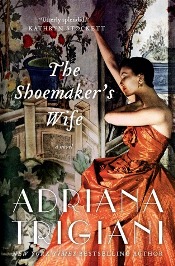
Book review: The Shoemaker's Wife, by Adriana Trigiani

Adriana Trigiani's The Shoemaker’s Wife is an immense, and immensely enjoyable, epic that personalizes the immigrant experience in early 20th-century America. Through the story of Enza Ravanelli and Ciro Lazzari, characters based on her grandparents, she presents an affectionate portrait of how newcomers to these shores adjusted to a completely different way of life. Strong and determined, they not only achieved their own dreams but helped their families back home realize theirs.

Teenagers Enza and Ciro first meet over a gravesite in the village of Schilpario in the Italian Alps, which establishes ties that will last their lifetimes. The year is 1910, and money is tight. With his widowed mother unable to care for them, Ciro and his older brother have been raised in a convent by caring nuns – an arrangement which lasts until Ciro catches the priest in a compromising position. The nuns find a new situation for him, although it means he and his brother will be separated.  Enza, the eldest daughter in a close family with financial problems, wisely knows better opportunities lie overseas and emigrates with her father shortly afterward.

Their stories proceed in parallel as Enza becomes a servant and factory worker in Hoboken, New Jersey, and then a seamstress for the Metropolitan Opera, while Ciro finds his calling as an apprentice shoemaker in New York City.

Ciro is handsome, strongly built, and popular with women, and Trigiani shows how his childhood abandonment makes him shy away from romantic commitment. (For a novel about a ladies’ man, the love scenes are quite clean.) Enza is smart and self-sacrificing, mailing nearly all of her earnings back to Italy to help her mother and siblings build a new home.  There are several poignant moments as she realizes she’s allowed to live for herself, too. Neither Enza nor Ciro forgets the other, and circumstances – war, overlapping circumstances, random chance – draw them first together and then apart until they reunite at last and marry.

From the magnificent slopes of Italy’s Pizzo Camino to the Met’s impressively vast costume shop to the small mining towns of Minnesota’s Iron Range, the profuse amount of detail serves to enliven the plot. For immigrants who start out with little, so much about America feels awe-inspiring and new, and readers experience these sensations alongside them.

And the food! No novel celebrating Italian heritage would be complete without it, and the meal Enza and her Irish best friend, Laura, prepare for Enrico Caruso – gnocchi with sage, green salad, and wine – sounds scrumptious. He may be a world-famous opera star, but not even Caruso forgets where he came from.

The short sections covering Ciro’s WWI involvement feel sparse compared to the rest, especially considering the impact it has on him and his family. In the grand scheme of things, though, this may have been a wise move; it gives the novel a tighter focus.

Trigiani writes with a warm, comforting tone; her novel reads like the labor of love it is, one filled with the spirit of togetherness. Although Ciro and Enza are forced to become independent, neither is ever alone. They form enduring friendships with others who give them strength and become their second families. These connections help them endure the tragedies they face.

Seeing as it spans two continents and many decades, The Shoemaker’s Wife is a lengthy and immersive novel. Fortunately, the storytelling doesn’t drag, and the author’s thorough approach results in a deep look at Italian immigrant life and traditions and the seemingly little moments that define her characters’ event-filled lives.

-----

The Shoemaker’s Wife was published by Harper in April at $26.99 in hardcover (475pp), including one of the most detailed acknowledgments sections I’ve seen! In addition to providing food for thought about the people who helped Enza and Ciro (and others like them) adjust to their new country, the novel concluded by making me ponder the family members, researchers, editors, agents, publicists, and more who aided the author over the 25 years it took her to create and publish her work.

And as a sidenote on unexpected connections, the Minnesota city where the Lazzaris settle was immediately recognizable to me as the place where a character from one of my favorite movies lived (someone based on a real person). It gave me a major “squee” moment to see him appear in the book.

At 475 pages, The Shoemaker's Wife qualifies for the Chunkster Challenge.

Monday, July 02, 2012

Spanish queens, history, and character: An interview with C.W. Gortner, author of The Queen's Vow

The following interview is based upon a phone conversation I had with novelist C.W. (Christopher) Gortner about his latest biographical novel, The Queen's Vow, which presents a new and eye-opening perspective on Isabella of Castile. 

Readers will remember Isabella for her sponsorship of Christopher Columbus's expedition in 1492 and her role in bringing the Inquisition to Spain.  Although her marriage to King Ferdinand of Aragon (Fernando in the book) is also well known, before reading this book I hadn't known about Isabella's impoverished childhood or her complicated struggle to be proclaimed the heir to her half-brother's throne.

Isabella isn't the author's first royal heroine, although she's cast in a different mold from his earlier protagonists - and one thing I admire is how he aims to stay true to the historical essence of each woman he writes about.  Also, as he grew up in Spain, he provides his views on the country's history and culture and how his background knowledge influenced his character development... among other things.  Christopher is a good friend as well as an excellent writer, and he always has articulate, insightful things to say about history and about writing - as anyone who's seen him on a Historical Novel Society conference panel will know.  Hope you'll enjoy the discussion!

You’ve taken on some tough subjects in your three biographical novels. First in The Last Queen, you have Juana of Castile, with her supposed madness; then later Catherine de Medici, with her ruthlessness and rumors that she might have incited the St. Bartholomew’s Day Massacre. Now with The Queen’s Vow, you’ve taken on Isabella, who reestablished the Inquisition and expelled the Jews and Moors from Spain. Which of these women – or situations – did you find most challenging to write about? 
 
Each one presented its own challenges. With Juana, I had to deal with a character who outwardly appears helpless, a victim, and it’s always challenging in the modern day to write a character like that. We have so many preconceptions now about female empowerment; everyone wants that kick-ass heroine, Lara Croft in a gown. In portraying Juana, the challenge was to show a woman who had a lot of inner courage but none of the benefits of modern-day liberation. It’s hard for us to realize that many women, particularly royal ones, often found themselves in these terrifying situations. I had to figure out how to make Juana accessible to the modern-day reader without making her look like a doormat.

With Catherine de Medici, it was easier in that respect, because she exercised power; she’s no push-over. But then we have the controversy: she’s been segregated into the role of a sexless, reptilian being who rules through her children, without redeeming qualities. It was challenging to reveal the flesh-and-blood woman behind her legend and take the risk of showing some of the things she sacrifices for power. Again, to this day women do this; they give up certain things to have other things, though we’re bombarded by media slogans that promise we can have it all–the high-octane career, the perfect family, eternal beauty, and unending wealth. The media makes it look effortless, but real life, whether in the 21st or the 16th century, doesn’t work that way. Very few of us get to have it all; instead, we get to make choices.

That said, overall Isabella has been the most challenging, because she’s so polarizing. She was both exceptional for her times and a product of her times, and I haven’t written a female character until now with such extreme duality. She’s extraordinary in her vision of a united country, in how she wants women to be educated; and yet, in her religious view, she’s very much of the 15th century. Part of what you must do as a writer is set aside personal preferences as to what you believe a character should be, and search that character for what motivates and moves them. For me, the challenge with Isabella was to be true to her ideology, though I don’t agree with it.  

When I first heard about the novel, I certainly didn’t know anything about – and believe most people won’t know anything about – Isabella’s childhood and the struggles she had to establish herself as queen, and that she was never expected to be queen at all. We only hear about her involvement with Columbus, the Inquisition, and her marriage to Fernando, which united Spain. When did you first hear about her youth? Growing up in Spain, had you learned this about her?

I grew up with the standard story: she conquered Spain and kicked out the Moors. I didn’t hear a lot about the Jews growing up. It was the last years of Franco’s regime and I was educated by Jesuits, so I didn’t learn about that aspect of history; it wasn’t hidden but it wasn’t discussed, either. It wasn’t until I started researching my first novel, The Last Queen, that I discovered the controversy surrounding Isabella. She’s quite a strong character in that book, though I focus on the final years of her reign, as seen through her daughter’s eyes. Isabella has already accomplished her best and her worst.

It was while writing that book, however, that I discovered the relatively unknown story of Isabella’s tumultuous ascent to the throne and struggle to assert herself as queen. I remember thinking, Wow. She had such a difficult path. So, when I decided to write The Queen’s Vow I returned to the original sources and then to some newer ones; that’s how I discovered, for example, that she’d had such a rudimentary education. Comparing her education to that of Elizabeth I, for example, the contrast is marked. People may not have believed Elizabeth would ever rule but she was certainly prepared as if she might be. On the other hand, Isabella had only the basics. She was literate but she didn’t even speak Latin, which was the language of diplomacy at the time, and the emphasis was on her preparation for being a wife, a consort.

The more I discovered about the challenges that she faced not only politically and dynastically but also personally, I realized I had a great story. And unlike the deeds she’s so well-known for—Columbus, the Inquisition, the conquest of Granada—her youth is something we rarely hear about. We always imagine her somber and ordering people about, dressed in dour clothes. We don’t get a sense of who she was before. I wanted to explore how she became the queen and woman we all think we know.  

Let me ask about transitioning between The Last Queen and The Queen’s Vow. Neither is a sequel to the other – they both stand alone – but at the same time, I’d think you’d have to establish a kind of continuity between them to keep the characters consistent. Did you come across any special challenges, especially with regard to Fernando?

Part of the great thing about writing The Last Queen first was that I had the opportunity to write Isabella and Fernando as older characters. I didn’t want to repeat the same events from that book, so having already established this part of their lives freed me to focus on the story I wanted to tell. The Queen’s Vow covers Isabella’s life up to the pivotal year of 1492; in a sense, it backs into The Last Queen and her last twelve years. As I’d developed her in my first novel as the older queen it informed my depiction of her as the younger one, and more importantly, as the beleaguered princess. None of us are born fully developed; we are shaped by our experiences. In The Last Queen, Isabella has been transformed by personal tragedy, by loss and responsibility and declining health. She is not the woman we meet in The Queen’s Vow, and yet the seeds of who she will become are there. It was wonderful, actually, because I had the vision of this character firmly in my head.

Much the same happened with Juana. In The Last Queen, we hear her story from her point of view. But in The Queen’s Vow, we see her as child through Isabella’s eyes. It was fun to play with these different portrayals of her, for the way Isabella interprets her daughter is very different from how Juana will interpret herself.

In The Last Queen, Fernando is the older king; sly, duplicitous, a man who many believe was the model for Machiavelli’s The Prince. In The Queen’s Vow, he too carries these seeds of who he will eventually become, but again, his experiences shape him. I loved portraying him as a young, brash prince, who knows he’s considered his wife’s inferior as far as power and the size of his kingdom are concerned. He’s out to prove himself. He loves Isabella but also wrestles with his sense of inadequacy. I also discovered that in the early years of their marriage, he was very much the spur behind Isabella’s caution. Her experiences taught her to weigh all the odds before acting; she wasn’t an impulsive decision-maker. Fernando goaded her for both bad and good. So, it wasn’t challenging in the sense that I had to remember to stay true to his character; I had the advantage that I’d met him before, as I had Isabella, and so things just clicked as I wrote. Also, in this novel, we get to see how he and Isabella started their marriage; it weathered trials and became one of mutual passion and understanding, a rarity for the era.  

That’s interesting – it sounds like it gave you a good opportunity to explore their motivations, to see how they became that way.

Yes, it actually worked in reverse. Fernando turned out to be something of a revelation because the man he became at the end of his life is quite different than the man he started out as, though when we go back and trace his experiences, we can see exactly how and why the changes occur. He’s the most transformative of my characters, while Isabella stays consistent for the most part. She has a steadfast personality, even as she turns more and more to her faith as she suffers losses; she also loses some of her spontaneity and innocence, but the moments that shape her are all there.

With regard to the shaping of Isabella’s character, there’s one point in the book where she muses on Spain’s history. She remembers that there had been other female rulers of Castile, but that they’d “encountered relentless opposition” and that “none had lived a happy life.” Who were some of them, and what lessons would they have taught Isabella?  

Queen Urraca [1079-1126] was one of the most famous Castilian queens. Castile was divided; it and León were separate kingdoms for a long historical period. In my novels, I don’t mention León because by then it’s been incorporated into Castile. Urraca’s reign straddled both kingdoms. She faced incredible opposition as a female ruler, and because of the division in the country as a whole. The Moors were also much stronger during her era; they held almost all of southern Spain. She had the constant challenge of pacifying and solidifying Castile and León while dealing with the Moors and her treacherous nobles. Some readers may be surprised that the Reconquest didn’t begin with Isabella and Fernando; they completed the task but every Christian ruler before them had taken it up and pushed the Moors further back, so that by Isabella and Fernando’s reign, the Moors held a small corner of their previous domain: the kingdom of Granada. Urraca managed to overcome these challenges to a certain extent, but she didn’t have a happy ending. Another later queen, Maria de Molina [1265-1321], served as a regent for her son and dealt with tremendous upheaval. Like Isabella, these ladies faced the prejudice of being a sovereign queen. Castile didn’t abide by Salic Law, but misogyny was alive and well.

Their examples probably taught Isabella what not to do. She grew up in a rural environment with a mother who was delusional (probably a manic depressive); she lacked education and training, but she showed an early interest in history. She must have realized at some point that in order to rule successfully, she would need a supportive king at her side. I think she had this innate sense of what Fernando could bring the table. She might also have been motivated by a romantic angle; we know, for example, that she asked for portraits of Fernando. Their first meeting in the book, in Segovia, is fictional, because I had to establish them as characters earlier, before the night of their wedding. But she’d been watching him for years and they’d been betrothed in early childhood for a time; he was not a complete stranger to her. It is possible they met before and it wasn’t recorded it because no one thought it important. Isabella had a very Spanish aversion to marrying a foreigner. She wanted someone of her caliber, who understood her world. She couldn’t imagine leaving Spain and that’s something about her that I really responded to.  

This was actually one of the questions I meant to ask later on – what are some of the things that, to you, make a character quintessentially Spanish?

author C.W. Gortner
It’s something you feel, deep inside, when you’re from Spain. It’s not something you can get from just visiting the country or reading books about it. You have to know that Spaniards – we have this deep attachment to our land. Most the Spaniards I’ve met in the United States have either eventually returned home or re-created a piece of Spain here, even if they’ve been away for years. You can curse the country to high heaven, criticize it, swear up and down that you’ll never live there again, that there are so many things that are wrong and you don’t like, and yet…

The other thing that makes a character quintessentially Spanish is this ingrained duality. Some of the most famous characters in Spanish history, they’re both deeply religious and highly motivated by acquisition, always seeking to expand the boundaries of their kingdom. Isabella, Charles V, Philip II: these are imperialistic rulers. Some would also say they’re fanatics. This contrast between nobility and brutality, between faith and beauty: I find it to be uniquely Spanish. To me, it’s embodied in bullfighting – the painstaking ritual, the costume, the drama: these are all beautiful, and yet the act itself is savage.

In your bibliography at the end, I noticed that half of your resources are in Spanish, and you’ve alerted readers to this, too. What were some things you wouldn’t have known otherwise, if you weren’t able to read Spanish? 

I wouldn’t have understood the complexity of some of the deliberations around the establishment of the Inquisition. Many of the reports that went back and forth between Isabella and the Ecumenical Council that she organized dealt with entwined socio-cultural, political, and religious issues unique to the time. When Isabella came to the throne, the Spanish Church was in shambles. We can sort of compare it to what [Thomas] Cromwell said he unearthed in the monasteries in England; we don’t find strict Catholicism being practiced, but rather a curious, almost hybridization of Spain’s three prevailing faiths: Jewish, Muslim, and Christian. We also see blatant simony, bribery, the selling of favors and indulgences: all the usual stuff. These reports that were forwarded to Isabella also cited that in one out of every two parishes, the priest had a concubine living with him. They called these women ‘barrangas.’ I didn’t even know what the term meant at first!

Isabella requested that this Council investigate corruption in the church, as it was deemed, as well as reports of non-conformity among conversos – Jews who’d converted to Christianity, most of them under duress during an intense period of persecution in the medieval era. She was troubled by ongoing rumors that many conversos were practicing Christianity at face-value or combining Judaism with Christian practices. Some, it was said, hadn’t really converted at all. To Isabella, this would have been gravely disturbing. The souls of her subjects, the very spiritual health of her kingdom, were at risk. Yet again, at first caution overrode even her piety. It took her almost four years to implement the papal bull that granted her permission to authorize the Inquisition’s revival. She instituted a program of spiritual education, dispatching trained priests to guide her subjects back to the ‘proper’ way of worship; it failed, but I did not make this up. If I hadn’t seen those reports in Spanish, I wouldn’t have understood the complexity of what she faced. I’m not condoning her role in the Inquisition, of course; I think she made a horrifying mistake that unleashed a monstrous wave of terror and suffering, but I do believe she agonized over her decision. I think she believed she had done everything she could to avoid persecution.

I can see that, and like you said, these are things people just don’t know. And I understand that you can’t include every little fact into the book. 

Fernando and Isabella, wedding portrait
Yes, you have to choose how much to impart. Also, Isabella wasn’t being naïve when she turned to this council for advice; it’s what rulers did, and still do. They seek experts to guide them; they set up meetings; they have people who report to people who report back to them. It’s misguided to think she sat down with a fully formed plan to implement the Inquisition. That would have been contrary to her nature, both as a person and queen. In the end, she felt the church was so corrupted there was no other way to tackle the problem of non-conformity. I think she was naïve, however, in her belief that she could control it. And there is evidence to suggest that Fernando pushed hard for the Inquisition, that he wanted it set up sooner than she did, because of the revolt of the Moors in Granada. He used the start of the crusade as justification to compel Isabella to say yes, because they would be away from Castile for long stretches of time and who knew what those conversos might get up to in their absence?

I’ve read – and based on my knowledge of the field, this is true – that The Queen’s Vow is the first English-language novel about Isabella in about 40 years, just as The Last Queen was the first novel about Juana in some time.

Yes, Jean Plaidy wrote a trilogy of novels on Isabella and her daughters; and Lawrence Schoonover wrote a novel called The Queen’s Cross. Also, Norah Lofts wrote Crown of Aloes.  

All of my copies of those are out-of-print ratty paperbacks! In many ways, then, your novels will be English-language readers’ first full introductions to these women. Did you feel pressured in any way while you were writing, knowing you would be representing them to the reading public?

No, not really. I didn’t feel any specific pressure because of the length of time between a past novel and mine. My pressure stemmed from my desire to portray these women as true to their era, true to what is known about them, while recreating their hidden sides, who they may have been, so readers would understand both what they faced and why they acted as they did. I wanted to describe their unique set of circumstances and that of the times, to give an accurate and fair portrayal of their struggles and triumphs. In the end, I do write fiction. These are novels, not biographies. My primary function is to entertain, but I still take the task of bringing these women to life seriously. I don’t want to defame them.

Thank you so much for having me, Sarah. It’s always an honor to visit your blog. I hope your readers enjoy The Queen’s Vow. To find out more about me and my work, please visit www.cwgortner.com.


For other stops on C.W. Gortner's virtual tour, see the tour schedule.  The Queen's Vow was published in June by Ballantine in hardcover ($25.00, 400pp).

Friday, June 29, 2012

A look at 90 years of Greek history via Victoria Hislop's The Thread

In late 2010 I reviewed Victoria Hislop's The Island for the A-Z in Historical Fiction challenge. It twined through the history of Spinalonga, an isle off the Cretan coast which was kept as a leper colony, but the overall message was more uplifting than tragic.  When I learned that Hislop was returning to Greece with her newest book, The Thread, I awaited it with anticipation.  And then it was sent to me for review... a nice surprise!

Although I haven't read her middle book yet (The Return, about the Spanish Civil War) I agree with reviewers who speak of the great improvement in her writing style over time. The Thread unites her already firm storytelling skills and historical sensibility with nuanced characterizations.  It's an epic story that never drags, one full of devastation and hope - and yes, it would make a good book club choice.  Don't let this description scare you off, though.  I dislike sappy novels, and fortunately The Thread isn't one of them.

Combining a keen eye for detail with her usual fluid writing style, Hislop presents an engrossing excursion to Thessaloniki, Greece’s second-largest metropolis, a relatively unexplored setting for fiction. By the novel’s end, however, readers will be intimately acquainted with its troubled politics and rich cultural heritage.

The Thread begins in 1917 and spans 90 years, tracing the lives of Dimitri, son of a wealthy, coldhearted cloth merchant, and Katerina, who arrives as a child refugee from Smyrna after the Greco-Turkish War and becomes a skilled embroiderer in a Jewish family’s workshop. Circumstances place them in the same neighborhood on Irini Street, whose kindly residents make up for its lack of affluence.

Childhood friends, Dimitri and Katerina eventually fall in love and marry, an event foreshadowed by the novel’s modern frame. Their interwoven stories skillfully incorporate Greece’s Nazi occupation and civil war, in which Dimitri takes a risky antigovernment stance.

This fast-moving, touching saga about tragedy, recovery, and the real meaning of family is full of dramatic incidents demonstrating the city’s transformation and resilience.

The Thread is published in July by Harper in trade pb at $14.99 (400pp). In the UK, the publisher is Headline Review, from whom it appeared in hardcover last October; the trade pb appeared in May at £7.99. Around the same time, the author wrote an article for The Telegraph about her passion for Greece (where her books are huge bestsellers, and where The Island was adapted into a miniseries) and her sad observations on the financial crisis plaguing the country.

Portions of this post were previously published in the May 15th issue of Booklist.

Thursday, June 21, 2012

Book review: The Woman at the Light, by Joanna Brady

Joanna Brady’s good-natured and satisfying first novel is set in and around Key West during its first years under American control – nearly a century before Hemingway and other literati made the sleepy little city their own.

In 1839, Emily Lowry’s husband is the caretaker of the lighthouse on Wreckers' Cay, a remote neighbor isle in southwestern Florida. When Martin fails to return from a boating trip, she and her three (soon to be four) children are left to fend for themselves.  A light-skinned black man who appears on their island months later, after escaping a Caribbean-bound slave ship, turns out to be the answer to their prayers: Andrew is polite, strong, and handy with tools.  He's not bad looking, either.

With her pregnancy far advanced, Emily shows Andrew how to tend the light that alerts ships away from the shallow waters and coral reefs.  Far from the rigid society of her New Orleans birthplace, Emily lets her guard down and allows herself to fall in love with this charismatic man while hiding him from occasional visitors and persistent would-be suitors.

Keeping to antebellum-era realities, Brady knows their peaceful idyll can’t last and throws many obstacles their way, even more than the ones you’d expect.  Some of the plot turns are fanciful, and I found myself wanting to reach back 170 years to remind idealistic Emily to be more cautious. Her openness and spunk give her an appealing personality, though, and she deserves some happiness in her life. Her narrative also reveals the full history of her marriage to Martin, which isn’t the great love match she hoped for.

Her entertaining story is filled with mystery (What really happened to Martin?  Will Andrew be discovered?  How did he make it off the ship while still in shackles?) as well as romance, episodes of tragedy, and bursts of clever humor.  Emily's children play active roles, too.  The historical details are sufficient without being overwhelming, and the novel provides an enjoyable glimpse of the 19th-century Florida Keys, with its bustling mélange of American, Bahamian, and Cuban influences. Emily sails to and tours around Cuba – how times have changed! – and its importance to Spanish industry is highlighted.

Keeping a lighthouse in top shape was a strenuous, important task, and in explaining all the work involved – climbing the many stairs, trimming the wick daily, polishing the glass, and more – Brady also honors the real-life female lightkeepers on whom Emily is modeled.

The Woman at the Light will be published by St. Martin's Press on July 3rd at $14.99/$16.99 CAN in trade paperback (322pp).  I snagged this one from LibraryThing's Early Reviewers program after reading the description and the many glowing Amazon reviews of the previous self-published edition.