Saturday, January 24, 2009

Contest winner, and a Brigid Knight bibliography

Congratulations to C.W. Gortner, the winner of the Cloister and the Citadel book giveaway contest! I've sent you an email, and I hope you enjoy the book. I drew the winning entry at midnight EST on Friday from among the valid submissions, via an online random number generator.

Thanks to my fellow literary bloggers for spreading the word about Cloister by posting about it on your own blogs. This giveaway saw a record turnout (and I've hit a record for most comments on a single post as well). I've been enjoying browsing many of your sites over the last week and will be adding a bunch of them to my sidebar in the near future.

Brigid Knight is no longer with us, and her books are long out of print, so neither she nor her publisher can personally benefit from the associated publicity. However, for those of you who aren't familiar with her work and would like to investigate her novels further (something I would recommend), you can find them secondhand via Bookfinder.com and/or Amazon UK. If you so desire, you can easily locate several other copies of Cloister, which are quite reasonably priced. Her books are obscure, true, but they're not hard to find or expensive if you know where to look. They're good choices if you enjoy reading novels about the historical Netherlands and South Africa, settings few authors today are writing about.

Cloister is the third book of hers I've read, and all are written in the same clear, measured style. Brief descriptions of her other books follow.

Anne Marie and the Pale Pink Frock. An illustrated children's novel of the Great Trek in South Africa.

The Citadel is Yours. Contrary to the title, it has nothing to do with Cloister and the Citadel and is a modern medical novel.

The Covenant. "The adventures of a South African family of British descent during the Boer War and afterwards." (from a review in Time and Tide)

Dark Star. A historical novel set in 17th-century England.

The House of the Seagull and The House of the Swan. I know nothing about them other than the setting: the Netherlands in the 16th and 17th centuries, respectively. There seems to be a third novel, The House of the Bird of Paradise, though it's not listed in the bibliography I own.

I Shall Maintain. This is third in a trilogy of novels about the Van Bredas of 17th-century Holland, following after I Struggle and I Rise and Old Amsterdam. It centers on Pieter's daughter and heiress, Hélène, who brings her father's great trading dreams to fruition.

I Struggle and I Rise. A family saga set in Amsterdam in the late 16th and early 17th centuries, focusing on the indomitable Anna Van Breda. The American title is The Valiant Lady; it was published in hardcover by Doubleday and in paperback by Popular Library in 1948.

Not by Any Single Man. A novel set on the coast of Kent during the French Revolution and Napoleonic Wars. A review in The Observer compared it to the best of Du Maurier.

Old Amsterdam. A sequel to I Struggle and I Rise, it follows the fortunes of the Van Breda family in the 17th century, particularly one of Anna's grandsons, Pieter, a Dutch financier who falls in love with a distant relation. It has a lovely old-timey cover, pictured at above left.

Pattern of Escape. One bookseller lists it as a historical romance.

The Piping on the Wind. Another South Africa-set novel.

Portrait of a Woman. Per the review quoted on the back of another novel's jacket, it seems to be a a modern crime thriller.

Sea Dog of Holland. A bookseller's description: "The story of a boy and his dog who do their bit to help throw out the hated enemy - the Spanish, during the invasion of the Netherlands."

The Seventh Square. This direct sequel to The Cloister and the Citadel begins in the aftermath of the assassination of William the Silent, Prince of Orange. It follows the life of Maurice of Nassau, William's son by his second wife Anna of Saxony, a brilliant soldier who strived to carry out his father's legacy. Like Cloister, it's not a military novel, but it gives an excellent portrait of the political landscape of the Dutch Republic between 1585 and 1625.

The Sun Climbs Slowly. "A novel of life in South Africa during the time of the Jameson Raid and up to the outbreak of the South African War." (per a review in The Queen)

The Sword Between. No idea of the subject.

Walking the Whirlwind. A family saga centered on a woman and a house in early 19th-century Cape Town and environs, based on the reminiscences of the author's grandmother.

Westward the Sun
. Novel set in South Africa at the turn of the 20th century; it may be a sequel to The Sun Climbs Slowly.

Do you like seeing these bibliographies of older historical novels? Please let me know.

Saturday, January 17, 2009

An obscure sort of giveaway


I'm still mired in indexing, so more informative content will have to wait another week, but for now I have a special contest for blog readers.

Last September, in my "reviews of obscure books" series, I covered Brigid Knight's The Cloister and the Citadel, a little-known novel about Charlotte de Bourbon-Montpensier, a little-known Renaissance princess. While surveying my shelves last week, I was very surprised to come across a 2nd copy of the book. This happens more often than I want to admit.

So, rather than tease with another review of a novel you're unable to find, I thought it fitting to offer this duplicate copy as a giveaway. It's in excellent shape for a 50-year old novel, a 1st edition hardcover with a clean, undamaged dustjacket only slightly browning with age. The original list price was 15 shillings.

To enter, leave a comment on this post, or email me (address on left sidebar) with the subject line "Cloister giveaway," by the end of the day next Friday, January 23rd. Good luck!

Saturday, January 10, 2009

Short takes on some recent reads

Happy new year, everyone! I've been overburdened with work and other projects, so I haven't blogged in ages, but I hope to get back to speed as soon as my final round of proofreading is done in two weeks. In the meanwhile, I have a guest post up at Historical Tapestry as part of their "Why I Love" series. Thanks again, Marg, for the invitation!

Here are some brief reviews of historical novels I read over the holiday break.

Tony Pollard's The Minutes of the Lazarus Club - George Phillips, an up-and-coming surgeon, gets drawn into 1850s London's most exclusive secret society, a club made up of the most prominent scientific minds of the age, and becomes embroiled in the race to catch a serial killer. Wonderful atmosphere, and I especially liked "meeting" technological genius Isambard Kingdom Brunel and crusading nurse Florence Nightingale, but parts of it dragged, and Phillips's bland personality couldn't compete with that of his newfound compatriots. This wasn't an issue in my subsequent read, however:

Louis Bayard's The Black Tower - I'd been meaning to get a copy ever since I read Susan's review from the Historical Novels Review. Hector Carpentier, a medical student in Paris of 1818, discovers his family's unexpected connection to the lost dauphin after Eugène François Vidocq, France's premier police detective, turns up on his doorstep. Although Vidocq remains in a class by himself, Hector is a quick study and more than holds his own in Vidocq's world. The novel serves as proof that authors don't need infodumps to convey historical atmosphere, and Bayard's astute turns of phrase made me sit up and take notice.

Vanora Bennett's Figures in Silk - The two daughters of noted silkweaver John Lambert pave their own paths to fortune and define success on their own terms. Beautiful Jane annuls her unconsummated marriage to her drab husband and pursues a liaison with dashing King Edward IV, while Isabel binds herself into apprenticeship to her ambitious mother-in-law and determines to break Italy's monopoly on the silk trade. Thoroughly enjoyable, though not quite as much as her Portrait of an Unknown Woman was for me -- mostly because Isabel's longtime liaison with another English royal (the author's invention) felt contrived. On the other hand, I liked Bennett's original depictions of several Wars of the Roses notables, and the descriptions of late medieval silkweaving techniques were a highlight.

Diana Gaines's Nantucket Woman - I dived eagerly into what promised to be a biographical novel of Kezia Coffin, a scandalously successful businesswoman in 18th-century Nantucket (a historical character about whom I'd known nothing). The author's use of language felt absolutely real, as did the historical detail, so I settled in for an engrossing period read... but then things got weird, in a way that just didn't fit the characters. If you enjoy reading unique and very explicit sex scenes written in authentic Quaker plain speech, this is the novel for you. I gave it points for originality but put it down after p.50. Publishers Weekly gave it a rave review after its original 1976 publication, so what do I know.

Thursday, December 18, 2008

Do reviews sell books?

I have Google alerts set up to email me with any mentions of the HNS or the Historical Novels Review, and this evening's mailing turned up an interesting link. Authors often wonder if reviews actually sell books, but the answer can be hard to quantify.

You may remember Jeri Westerson's appearance as a guest blogger here in early November. Joshua Bilmes of the JABberwocky Literary Agency, Jeri's agent, recently looked at the difference in sales in the Boston and Richmond markets after positive reviews of Veil of Lies ran in the Boston Globe and Richmond Times-Dispatch. Then he reported the results on his blog.

Although the numbers don't seem to indicate an enormous increase in sales, every little bit helps, and that's 50-odd people who may not have heard of the author or title before the reviews appeared. Veil of Lies is a debut mystery, after all. Both papers post their book reviews online as well; this is convenient for people like me, for example, who used to live in the Boston area and still read the Globe via the web. So I would expect the word has gotten out more widely than just among the locals.

Wednesday, December 17, 2008

A visual preview of the summer season

In the past two weeks, I've had two computers crash (work and home), which meant getting them fixed/replaced... then the usual end-of-semester craziness happened, HNR reviews started pouring in, and my copyedited manuscript arrived, due back right after the holidays. I haven't had any time to blog. But I hope to make up for this long silence by providing a preview of some exciting-sounding forthcoming titles. Given that it's 20 degrees out with a sheet of ice coating the driveway, I figure this is the perfect time to look forward to next summer. Why not?

The following information comes from publishers' catalogs and from Amazon. Cover images and pub dates are subject to change, but this is the latest info I have. They're listed alphabetically by author.

Literary psychological suspense set in Edinburgh in 1763, in which John Boswell plots to take murderous revenge against his older brother, James, and Samuel Johnson, author of the famed dictionary, for presumed slights. Soho, May.


Literary Southern Gothic about a 19th-century Bostonian woman who finds mystery at her late grandmother's former home in Louisiana. Previously independently published in the US, this novel was released in 2006 by Snowbooks (UK) and will soon be available again for the American market. The Berkley catalog also indicates that her Sand Daughter, which sees the Crusades from the viewpoint of a young Bedouin woman, will be out in October (great news; it's an excellent novel). This one's out from Berkley, August.


A young married woman finds her life transformed after she's charged with ensuring proper conduct at the Egyptian belly dancing exhibition at the 1893 World's Fair in Chicago. Berkley, July.

First in a new series of historical mysteries set in Berlin during the rise of the Nazis, and featuring hardened crime reporter Hannah Vogel as detective. From Forge in May.


Two sisters of Syrian descent grow up in 1920s Cairo, a land rocked by violent anti-British demonstrations. Telegram, June.


Miss Susan Rose, a plucky lower-class woman in Victorian England, becomes a professional wet nurse and discovers her new employer's home harbors sinister secrets. Putnam, August.


Picks up the story of Lydia Ivanova, heroine of The Russian Concubine, in 1929, when she learns that her father--thought killed by the Bolsheviks--is imprisoned in Stalin-controlled Russia. Berkley, June.


A novel about Emily Brontë, her family, and her unconsummated romance with William Weightman, an idealistic clergyman who champions poor mill workers' rights. Norton, July.


A biographical saga about, you guessed it, John the Baptist, drawing on both ancient and modern sources. Literary historical fiction. From Norton, June.


Based on the title, I guessed the subject was Hatshepsut, but this is a biographical novel about Ankhesenamun, the newly widowed wife of the murdered Tutankhamun, who proves willing to marry her country’s ancient foe in order to save her crown. Kunati, May.


A woman who prefers to live a simple life in her small Puritan community in colonial Massachusetts finds that her beauty attracts attention from the town's wealthiest bachelor. Mitchell's Chateau of Echoes, about a widow who finds the journals of a 15th-century noblewoman after she purchases a chateau in Brittany, is well worth reading. Bethany House, June.


Biographical fiction about poet Elizabeth Barrett and her secret romance with Robert Browning. Though published by a Christian publishing house, Moser's novels aren't preachy and can easily be enjoyed by mainstream readers. Bethany House, June.


I've been waiting to read the next Silver Rush mystery ever since Iron Ties was published in 2006. No hint on the storyline yet, but these are meaty historical mysteries set in the silver mining boomtown of Leadville, Colorado, in the 1880s. Try them even if you think you don't like westerns. Poisoned Pen Press, July.


The long-awaited new historical novel from Pears, author of An Instance of the Fingerpost (which I thought was brilliant). Another doorstopper at 880pp, Stone's Fall moves backward in time from 1909 London to 1867 Venice as it uncovers the mystery surrounding the death of a wealthy financier. Spiegel & Grau, May.


Pell, a young woman in 1850s rural England, flees her home on horseback on the day she’s to marry her childhood sweetheart, and heads for the Salisbury Fair. Viking, August.

The third of Scott's biographical novels about the mistresses of Charles II, each told in her own voice. This entry covers Louise de Keroualle, Duchess of Portsmouth. NAL, July.


Debut novel from a Woolf scholar that imagines the lifelong relationship between sisters Vanessa Bell and Virginia Woolf from Vanessa's point of view. If you can't guess from the cover art, this is literary fiction. Houghton Mifflin, May.

The story of two ladies-in-waiting to Queen Elizabeth I... Lady Katherine Grey (yep, Jane's younger sister) and Mistress Mary Rogers. The first mainstream historical in a while for Westin, whose most recent works have been Restoration-era romances (Lady Anne's Dangerous Man, etc). NAL, August.

Saturday, November 29, 2008

Announcements, announcements

At long last, registration for the next Historical Novel Society conference is open. It will be held June 12-14, 2009, at the Hyatt Regency Woodfield in Schaumburg, Illinois, in Chicago's northwestern suburbs.

Julianne posted about it on Writing the Renaissance last week, but I've been so busy lately processing registrations and fixing up the website that I neglected to announce this on my own blog! In less than a week, we already have over thirty people signed up. I'm looking forward to seeing everyone in person.

Three other librarians and readers' advisors (two of whom are my editors) and I will be presenting a session on some of the best historical novels we've read since the last conference. Alas, it's scheduled opposite two other programs that sound really interesting, so I hope people who attend (or are speaking at) one of the others will report back.

Also, while scanning my publisher's website, I noticed that not only do I have a publication date and price for Historical Fiction II: A Guide to the Genre, my forthcoming reference book, but it has a cover - and it's headless! Publication will be March 30, 2009. The copyedited manuscript arrives within two weeks, so I'll be proofreading over the holidays.

Finally, some recent historical novel deals from Publishers Marketplace. Additional information, added by me, is indicated in brackets below.

Fiona Mountain's LADY OF THE BUTTERFLIES, a sweeping historical novel -- with love triangles, armed rebellion, and murder by poison -- based on the life of Lady Eleanor Glanville, a 17th century naturalist and butterfly collector, to Rachel Kahan at Putnam, for publication in 2010, by Jane Kirby at Random House UK (US).

[Fiona Mountain has a website, with a short paragraph describing the new novel. I haven't read either of her mysteries, but highly recommend her earlier Isabella, a sweeping love story about Fletcher Christian and his cousin Isabella Curwen, and the untold reasons behind the mutiny on the Bounty. Has anyone else read it?]

Kate Quinn's BLOOD FOR BLOOD, an epic novel of ancient Rome, pitched as Bernard Cornwell for women, in which a slave girl falls in love with the greatest gladiator of the time, all culminating in a conspiracy to assassinate the Emperor Domitian, to Jackie Cantor at Berkley, for publication in 2010, by Pam Strickler (NA).

Vanitha Sankaran's WATERMARK, set in 1320 in Narbonne, France, when church-controlled parchment made paper making a near-heresy, told by a young albino mute woman, the literate daughter of a papermaker imprisoned when the Inquisition finds her using paper to write troubadour poetry about courtly love, to Lucia Macro at Avon, by Marly Rusoff at Marly Rusoff & Associates (NA).

[The author's website has an excerpt of her upcoming novel, which will be on my TBR as soon as it appears.]

Kathryn Wagner's DANCING FOR DEGAS, the story of Degas and his ballerina muse; in the tradition of Girl with a Pearl Earring, showing the opulence of late 19th century Paris, as told through the eyes of a young Parisian ballerina, to Caitlin Alexander at Bantam Dell, in a very nice deal, for publication in Spring 2010, by Kirsten Manges at Kirsten Manges Literary (NA).

Ron Rash's THE INNOCENTS, set during World War I, about a deserter taken in by a young Appalachian woman who knows nothing of his past, to Lee Boudreaux at Ecco, in a good deal, by Marly Rusoff at Marly Rusoff & Associates (NA).

Janet Woods's HEARTS OF GOLD, the story of a girl abandoned on the Australian goldfields, and of the man who rescued her, to Amanda Stewart at Severn House, in a nice deal, for publication in April 2009, by Pat Hornsey at International Scripts.

[Woods has written many romantic sagas; her website is here.]

Ghostwalk author Rebecca Stott's THE CORAL THIEF, set in 1815 Paris about a group of radical philosopher-thieves on a mission to reclaim art and paintings stolen by Napoleon, to Cindy Spiegel at Spiegel & Grau, for publication in fall 2009, by Emma Sweeney.

[Author's website here, with information on her first novel, Ghostwalk.]

Sunday, November 16, 2008

Yes, we're back to looking at cover art again

What can I say, the topic fascinates me. I was at the B&N in Champaign last weekend, scanning the new book displays up front, and noticed that some historical novels published in hardcover last year were recently released in trade paperback (or mass market in the case of House of Lanyon), with new cover designs. Some of the changes are slight, but others are completely different. You'll notice that women were added to three of them.

The "before" is on the left, the "after" on the right.


Which do you prefer? Would the paperback covers make you take a second look at these books?

Tuesday, November 11, 2008

Tacky Tuesday

While going through my bookshelves last weekend, I found another bunch of vintage historical novels whose covers (and blurbs) are the epitome of tackiness.

I don't think anything can quite match the tackiness of the first batch, though. Has anyone actually read any of these?

"To restore the honor of Rome and of his own family, Severus Varus left the decadent life of Rome... his only hope was to join the barbarians."

From the back cover: "Violence, desire, and royal intrigue! With the clash of swords and the thrust of spears, The Purple Quest builds to an exciting climax in the city of Tyre and aboard the ships that for five hundred years had carried the Phoenicians to the farthest corners of the ancient world..."

"Godiva... beautiful but unhappy. Tom was a cautious man -- he never meant to spy..."

"Jezebel, whose bewitching beauty was a deadly weapon, would stop at nothing to further her greed for power. One man among many who came under her spell was Prince Michael of Judah."

"The tumult of battle and the decadent luxuries of harem life are all vividly recreated in this lusty novel of 16th century Turkey."

"Barbaric Greeks storm the walls of the great city, hungry for the wealth of the rich and highly cultured Trojan civilization."

"A magnificent, ringing novel of the days when lusty Northmen raped and plundered the civilized world."

"Unholy love! Amid the soft, scented corruption of the royal court, the mighty Cardinal Richelieu had held himself aloof... but when this steel-nerved man beheld the young Queen Anne, his body betrayed him, and for the first time his brilliant mind became a servant to his lust."

Monday, November 03, 2008

Guest post from Jeri Westerson

Today Jeri Westerson, author of the medieval mystery Veil of Lies, is stopping by on her blog tour to speak about the appeal of history and historical fiction. Welcome, Jeri!

Veil of Lies is a November release from St. Martin's Minotaur; it was named an Editors' Choice title in November's Historical Novels Review. Jeri's blog is Getting Medieval.

Enthralled By History

Why are we enthralled by history? What makes those long-ago days so intriguing? For some, it started with an inspiring teacher who knew how to involve their students in the times and places in the past (alternately, I hear from people who said how much they hated history because their teachers were so dull). I was lucky. I grew up with the stuff at home.

My mother was a dedicated Anglophile, and my father was after a medieval history degree to teach before he was waylaid by those new-fangled inventions called the computer. Needless to say, anything I wanted to know about England in the middle ages was at my fingertips. Our bookshelves at home were better than Google. They groaned with the classics of historical fiction: Thomas B. Costain, Jean Plaidy, Anya Seton, Norah Lofts, Mary Stewart. But there was also Beowulf and The Canterbury Tales. In fact, we had a children's version of The Canterbury Tales and I have the book still! And my mother played a record album with an actor reciting some of the stories in Middle English. I was possibly the only kindergartner in South Central Los Angeles in the 60's—anywhere?—who could recite the first few lines of the Prologue in Middle English.

Such was my life. And history was always a part of it. I enjoyed looking back at the past and finding the threads that lead to how we shape our lives today, how something so distant could have such an impact centuries later. And it always amazes me how political leaders fail to learn from the past—even the recent past. Maybe they had lousy history teachers.

Many of us are in the enviable position of loving historical fiction. And now—thanks to pioneers like Ellis Peters with her Brother Cadfael series—we can also enjoy our history blended with mystery. I remember the first time I discovered this. It was in the early nineties and I was in an independent bookshop which, sadly, is no longer there. All they stocked were mysteries (and this was the first time I had seen that. I have since learned that there are many such bookshops all over the United States devoted solely to mysteries) and I had a yearning to read a medieval mystery, wondering if such a thing existed. Did it! There was Ellis Peters and many other authors as well. I discovered something wonderful. It was historical fiction but it had the added benefit of being a mystery!

I love immersing myself in a different place and time. The smell of the streets of London, the smokiness from hearths, the raw smells of butchered meats hanging in open stalls, the sharp tang of young wine, the dank odors of the Thames whispering on its rocky banks.

What was it like? What did the people think about in their daily lives?

How did they deal with murder?

But talking about the "Middle Ages" as one unit can be a bit deceiving. Which part are we focusing on? Depending on where we turn our eye, we concentrate on completely different experiences. Generally, when speaking of the "medieval period", scholars distinguish that portion of history from 500 to 1500 A.D. (Incidentally, no historian of any repute would be caught dead calling those earlier years the "Dark Ages." They were called the "Early Middle Ages.") As you can see, that is a tremendous span of time beginning from the fall of the Roman Empire and finishing with the dawn of what we call the Renaissance. Technology, clothing and hair styles, mores, customs, languages—a host of experiences—went through immense changes in that timeframe of one thousand years. What then do most people re-imagine as the "Middle Ages"?

I think King Arthur has a lot to do with our romantic imagery of this period. Tournaments, shining armor, flapping banners, long gowns with pointy sleeves, conical hats with transparent veils, honor, chivalry, courtly love. And yet, the historic Arthur—if ever there was one—appeared far earlier than this version of the middle ages that most diners of the Medieval Times dinner theatre are seeking. The period we're thinking of would be considered the "High Middle Ages"—the 11th, 12th, and 13th centuries. Once the barbarian invasions ceased, Europe settled in and—despite the occasional forays into one's neighbors' domains—country borders took form and the idea of nation-states was burgeoning, along with a rise of artistic and intellectual ventures not seen before. It was an intense period of religious ideology blending with everyday life; it was the start of the crusades, forging a Eurocentric set of principles and beliefs that would march through the centuries, influencing our religious and nationalistic ethics to this very day.

The "Late Middle Ages"—the period I like to write about—was truly the dawn of national identity. In England, the language of the court was English (where before it had been French, the language of the Normans). The 14th century was the time of Chaucer, where even the popular literature was in Middle English, our precursor to modern English. It was the time of the aftermath of the Plague (some forty years prior to the action of the story), tournaments, battles, a boy king who, at the end of the century, is deposed and murdered.

Falling in love with history is usually a lifelong obsession. I know there are the minority of historical fiction readers who only concentrate on one period of time. But the majority won't turn their nose up at an Egyptian novel and sneer at a Roman story. No, we history lovers love it all, whether it's the foreignness of the setting as in Simon Levack's Aztec mysteries, or a story of ancient Japan as in I.J. Parker's mystery series, or something in the western European tradition that we find familiar. My particular brand of mystery is a medieval noir called VEIL OF LIES. My protagonist, Crispin Guest, is a disgraced knight turned detective on the mean streets of 14th century London. Not only do I get to immerse myself in all the intricacies of England in the 1300s, but I also derive a bit of the style from the noir and hard-boiled novels of the 1930s and '40s. What's not to like about that?

You can read the first chapter of VEIL OF LIES at my website http://www.jeriwesterson.com/.

Wednesday, October 22, 2008

Coming soon to bookstores near you

This past summer, the editor of Bookmarks Magazine asked me if I'd like to write a followup to the "best historical fiction" piece I wrote for them three years ago. (If you click on the link, that's a photo of editor Jon Phillips at the top, not me.)

So this afternoon I was browsing the website of Bookmarks and was very excited to see the cover of their November/December issue.

I love it, needless to say, and can't wait to see what they did with the interior layout.

Bookmarks gave me the opportunity to conceptualize the article, within the general parameters of "great historical fiction." I decided to highlight a dozen very current trends in the genre, the novels that inspired them, and some of the best examples of each category. If you get hold of the article, I hope you enjoy reading the result, even if you don't agree with all of my choices!

Copies should be available in bookstores and subscribers' mailboxes in early November; they can also be ordered through their website if your bookstore doesn't carry it.

Sunday, October 19, 2008

Reviews of obscure books:
Lion Feuchtwanger's Raquel: The Jewess of Toledo

Feuchtwanger, Lion. Raquel: The Jewess of Toledo. New York: Messner, 1956. 433pp. Translated from the German by Ernst Kaiser and Eithne Wilkins.

The first hint I got that this novel held any great significance was several years ago. I received an email from a gentleman who was searching through LibraryThing and saw that I owned a copy. He said he’d been trying to find it for years, and would I like to sell it? I did not, and thought it nervy of him to ask! Then, in the comments on one of my blog posts from December 2006, Elena Maria Vidal mentioned she’d read Raquel: The Jewess of Toledo in college. She called it “a great love story between Alfonso King of Castile, who was married to Eleanor of Aquitaine’s daughter, and his Jewish mistress. It was a fascinating look at the Jews in Spain... a tremendous book."

Given the author’s stature and popularity during his lifetime, it’s perhaps surprising that his novels, at least in English, have fallen into obscurity today. Lion Feuchtwanger (1884-1958) was a German Jew whose religion, Jewish literary themes, and outspoken anti-Nazi sentiments led to his persecution at home. Through the efforts of the Emergency Rescue Committee (an activist group dedicated to providing exit visas to high-profile political refugees in occupied France), Feuchtwanger was rescued from a French concentration camp, disguised in women’s clothing, and brought to the United States with his wife. They settled in southern California, where he continued his literary career. Raquel is one of his later works. While his historical novels have been out of print and hard to find in the United States and Great Britain for decades, they’re still in print in Germany. See the German cover of Raquel at right.

Raquel: The Jewess of Toledo opens in the year 1187 or thereabouts. Alfonso VIII, the very Christian king of Castile, has just failed in his attempt to conquer Seville, in the Muslim-controlled southern half of Spain. His coffers are near bankrupt, and he needs to restore prosperity to his suffering realm. To this end he selects a wealthy merchant, Ibrahim of Seville, as his new Minister of Finance. Although Ibrahim was forced to convert to Islam as a young man and has many connections among high-ranking Muslims in Andalús, he was born a Jew and has never forgotten his origins. When he relocates to Toledo, he reverts to his birth name of Yehuda Ibn Esra and re-establishes himself in his family’s hereditary castillo. He makes it his mission not only to collect taxes for King Alfonso and manage his finances but also to serve as a protector of his fellow Jews in the likely case of another Holy War. With Don Yehuda comes his family friend Musa Ibn Da’ud, a Muslim physician who’s part of his household; his fourteen-year-old son, Alazar; and his seventeen-year-old daughter, Rechya, who adopts the Castilian name of Raquel.

Although Alfonso lives in relative contentment with his wife Doña Leonor, daughter of Henry II of England and Eleanor of Aquitaine, beautiful Raquel quickly attracts his attention. She intrigues him when she forthrightly states she prefers the comfort and Andalusian-influenced décor of her father’s castillo to Alfonso’s cold stone fortress at Burgos. Raquel is presented an intelligent and clever young woman, literate in Arabic and Hebrew yet unused to proclaiming her Jewish faith so openly. When Alfonso asks Yehuda if Raquel will become his mistress, Yehuda faces a tough decision. He knows he must leave Castile for good if he doesn’t agree. Despite the disgrace to her family’s name, Raquel consents. Thus begins a seven-year affair in which King Alfonso, enraptured by Raquel’s charms, neglects his wife and the greater workings of his kingdom, leaving Yehuda to gain influence at court – as well as many enemies.

Despite being the title character, Raquel can’t really be called the protagonist, as we rarely see anything through her eyes. The novel is no feminist re-imaging of historical events. Raquel comes to view Alfonso as her chivalrous knight in shining armor and endeavors to see the best in him, despite his restless nature and occasional anti-Jewish prejudices. Throughout the novel, the point of view shifts between Yehuda, Alfonso, and some of the secondary characters, such as Don Rodrigue, secretary to Toledo’s archbishop and one of Alfonso's privy councillors; Doña Leonor; and Don Ephraim Bar Abba, head of the Aljama, Toledo’s Jewish community. For readers who can’t get enough of Eleanor of Aquitaine, you’ll be pleased to see she makes her appearance three-quarters of the way through. Eleanor steals every scene she’s in, though the advice she gives her jealous daughter feels petty and beneath her.

For the greater part of the novel, as Alfonso grows ever more tempted by the possibility of dissolving Castile’s neutrality -- which would let its men participate in the Pope’s new Crusade -- Yehuda continues urging him towards peace. Unsurprisingly, given the author's background, religious tolerance and mutual understanding is the novel’s strongest theme, best personified by Yehuda, Musa Ibn Da’ud, and Don Rodrigue, who become close friends. In this sense, the novel can be read as a morality tale.

Despite the 50+ years since it was published, the translation still reads smoothly, aside from the occasional distractions of having multiple exchanges of dialog within the same paragraph. This is a novel that demands concentration, especially if you’re unfamiliar with 12th-century Spain. Feuchtwanger throws a lot of historical detail into the first chapter, and there are many characters to track. On the plus side, it rewards readers’ efforts. It’s a worthwhile introduction to the politics and religions of the period, particularly if you appreciate medieval characters whose faith shapes their worldview.

From what I’ve been able to determine, the truth behind Raquel: The Jewess of Toledo fits somewhere in the intersection between history and legend. (Note: clicking on the following link reveals major spoilers!) The Jewish Encyclopedia reports that Alfonso X, in his writings, related his grandfather’s love for a Jewess known as “la Fermosa” (the beautiful) as fact. Another article in Medieval Iberia: An Encyclopedia relegates the tale to legend and traces occurrences of it over the centuries. I wasn’t able to find any historical data on Yehuda Ibn Esra, which leads me to believe he may be fictional. This isn’t my area of expertise, but I did find what might be a historical error relating to Alfonso and Leonor’s daughter, Berengaria (Berenguela), and who she ends up marrying.

If you'd like to get hold of a copy (and don't read German), you might try interlibrary loan, as the prices for used copies in English can be ridiculous. (I bought my copy at a used book sale at least a decade ago.) Raquel: The Jewess of Toledo is well worth reading, and on a timely subject to boot. Maybe if we’re lucky it will be reprinted one day.


Friday, October 17, 2008

Giveaway winners!

As it's 5pm here, it's time to do the drawing for this week's giveaway. This is the biggest turnout I've ever had for a contest, and I appreciate everyone's interest.

And the winners are...

For Company of Liars - Alex from Paris, France.

For Nefertiti (since the publisher was very generous with copies, turns out I have two extras to give away rather than one) - Amanda and Katherine, both from NYC.

For Christ and Saints - Margaret D.

For Time and Chance - Virginia from Virginia.

For Devil's Brood - Teje.

For The Memorist - Teabird.

If you're one of the winners, I've dropped you a note about what you've won. Please email me back (sljohnson2@eiu.edu) with your mailing address and I'll get your book out to you. Hope you enjoy them!

Sunday, October 12, 2008

Lots of free stuff

Would you like to help me with my overflowing bookshelves? I have six historical novels up for grabs this week. I recommend them all. They're duplicates from my collection, and I'd just as soon see them go to readers who want them - and maybe get the authors a little extra publicity at the same time.

They are as follows:

Karen Maitland, Company of Liars (ARC)
Michelle Moran, Nefertiti (ARC)
Sharon Kay Penman, Devil's Brood (ARC, part 3 in Plantagenet trilogy; all can stand alone)
Sharon Kay Penman, Time and Chance (new pb, part 2 in Plantagenet trilogy)
Sharon Kay Penman, When Christ and His Saints Slept (new pb, part 1 in Plantagenet trilogy)
M.J. Rose, The Memorist (ARC)

A couple of the ARCs are pre-read (by me), but I've treated them well! I will mail them anywhere. To enter - leave a comment on this post by 5pm on Friday 10/17 telling me which ones you're interested in, or email me at sljohnson2@eiu.edu with the same information. I'll do a random drawing on Friday night and determine the winners. If by chance someone comes up the winner for more than one book, I'll email you and ask which one you prefer, then move on to a runner-up for the other.

Good luck and happy reading!

Tuesday, October 07, 2008

Back in the blogosphere

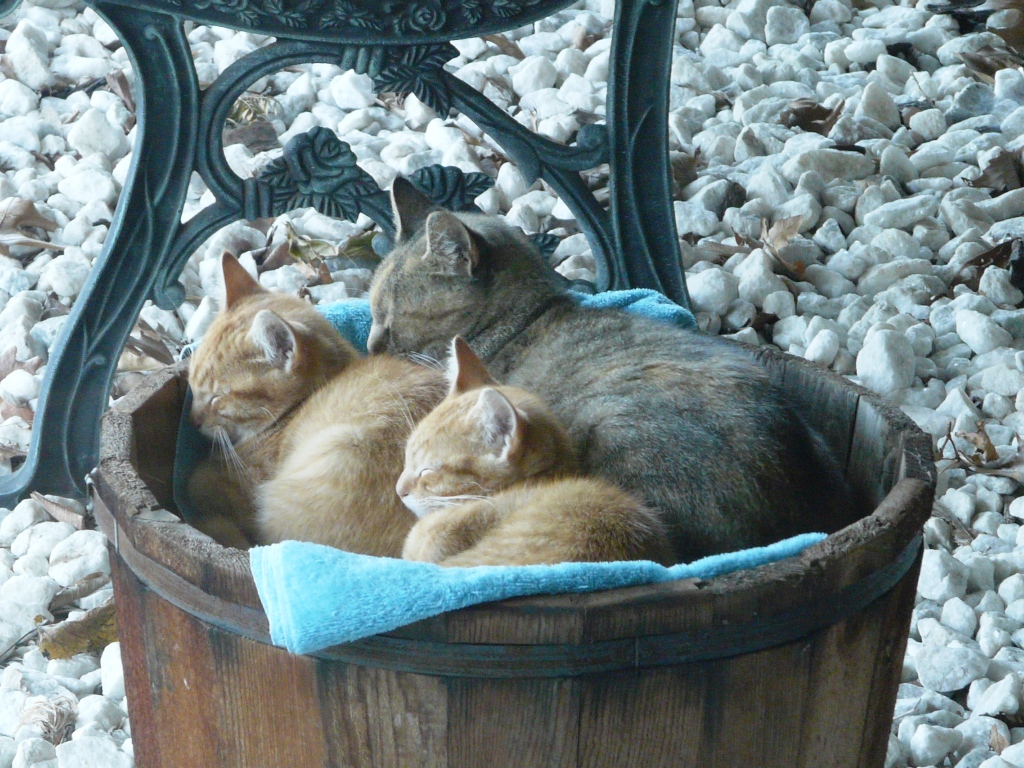
To make up for my silence of the past two weeks, I thought I'd post a cute kitty picture. The neighborhood strays like napping in the planter in our front yard.

Anyway, I've been dealing lately with a heavy workload at the library, HNR deadlines, and severe allergies to the local harvest (corn and soybeans). As a result I haven't felt much like blogging or even reading. I got 50 pages into one book I'd hoped to cover here, but ran out of time before another deadline hit, so had to put it aside temporarily.

In the meanwhile, book arrivals are piling up next to my desk.

You'll notice they're two deep - the pile further back includes everything I got at BookExpo Canada in June, as I'm totally out of shelf space. It's a problem.

Until I get my thoughts together for a real post, here are some historical deals from the last week, from Publishers Marketplace.

Oxford University Press editor Matt Gallaway's THE METROPOLIS CASE, the sweeping tale of unlikely quartet, bound together by the strange, spectacular history of Richard Wagner's masterpiece opera, Tristan and Isolde, to Suzanne O'Neill at Crown, by Bill Clegg at William Morris Agency (NA).

Julie Lessman's REFUGE FROM THE STORM, in which a privileged woman at first thrives on the glitz and glamour of The Roaring Twenties until her world crashes in the Great Depression forcing her to work with a man who is the bane of her existence, FAR FROM RUBIES, and BESIDE THE STILL WATERS, to Lonnie Hull Dupont at Revell, by Natasha Kern at Natasha Kern Literary Agency (World).

Bestselling author of Loving Frank Nancy Horan's new novel, again to Libby McGuire and Susanna Porter at Ballantine, in a major deal, by Lisa Bankoff at ICM (world). [no plot description available]

Award-winning author of The Physician of London and Marrying Mozart Stephanie Cowell's THE GREEN DRESS, a wonderful re-imagining of the tragic love story between the young, ambitious Claude Monet and his muse, Camille Doncieux, to Suzanne O'Neill at Crown, in a good deal, for publication in Spring 2010, by Emma Sweeney at Emma Sweeney Agency (NA).

Robin Maxwell's O, JULIET, O, JULIET, the follow-up to MADEMOISELLE BOLEYN and the forthcoming SIGNORA DA VINCI, in which the historical Juliet from Shakespeare's play is imagined as a young woman living in early Renaissance Florence during the rule of Cosimo de Medici, when inter-family warfare was at its bloody height, to Kara Cesare at NAL, in a very nice deal, by David Forrer and Kimberly Witherspoon at Inkwell Management (NA).

Julianne Lee's BLOODY MARY, about Mary Tudor, to Ginjer Buchanan at Berkley, in a nice deal, by Ginger Clark at Curtis Brown (NA).

Ariel Allison Lawhon's EYE OF THE GOD, the world's most spectacular museum heist, a cursed jewel, and a romance doomed to fail, all tied together with stunning historical fact, create the vast and intricate setting for the first-ever novel about the Hope Diamond, to Barbara Scott at Abingdon Press, for publication in Fall 2009, by Jonathan Clements at The Nashville Agency.

William Ryan's THE HOLY THIEF, first of historical detective series set in 1930s Russia, to Maria Rejt at Macmillan, in a good deal, in a three-book deal, for publication in spring 2010, by Andrew Gordon at David Higham Associates.