Tuesday, April 27, 2021

A "patchwork of souls": Dangerous Women by Hope Adams

On April 5, 1841, the convict ship H.M.S. Rajah set sail from England for Van Diemen's Land (modern Tasmania). In addition to the captain and crew, on board were 180 women, convicted of petty crimes, who were sentenced to transportation. Accompanying them was young matron Miss Kezia Hayter, who was responsible for providing the women with practical skills for their new lives on the other side of the world.

During the three-month voyage, a selection of women, under Miss Hayter's guidance, stitched an impressively detailed quilt. It was presented to Jane, Lady Franklin, wife of the Lieutenant-Governor of Van Diemen's Land, upon their arrival. The quilt was returned to Britain, lost for a time, then rediscovered in 1989. It now resides in the National Gallery of Australia. Due to its fragile condition, it's made available for public viewing just once annually.

public domain photo of the Rajah quilt (via Wikimedia Commons)

Dangerous Women
, a new novel by Hope Adams (pseudonym for veteran novelist Adele Geras), embroiders a fictional mystery plot onto the Rajah's real-life voyage. Kezia Hayter is a principal character, and other real-life figures, like Captain Charles Ferguson, play important roles. As Adams reveals in her afterword, the names of the convict women were changed, as they have descendants living in Australia.

The novel works as a combination of locked room-style crime novel (although aboard ship) and thought-provoking adventure story. Both of these elements are evenly balanced. 

Toward the end of the journey, one of Kezia's needlewomen, Hattie Matthews, the mother of a young son, is stabbed while standing at the railing on deck. The motive is unknown, and Hattie is too badly wounded to reveal who did it. One of the women, though, is hiding her past and impersonating someone else; we know her birth name, Clara, but not the name she assumed on board. There are plenty of secrets stirring.

The story then looks back to follow the women as they settle into their cramped quarters, form alliances, and find ways of passing the time. Two seem to be in a sexual relationship, and drama unfolds after one of them acts on her attraction to another. As the crew's investigation continues, everyone feels on edge since the attacker could easily strike again. Multiple perspectives show the backgrounds of some of the women who, Kezia realizes, "were often victims... women who'd fallen into petty crime through association with criminal men, or had been put to work as thieves by brutal husbands and fathers."

The chapters, labeled "Then" and "Now," alternate between the beginning of the voyage and the aftermath of the crime. I had to pay close attention to the labels and dates in the chapter openings or risk getting confused.

Despite the terrible circumstances some women endure, Hattie included, this is ultimately a hopeful story about new beginnings and what disparate women can accomplish when working toward a common goal. As one of them remarks: "We're many small pieces, each of us different but now stitched together. A patchwork of souls."

Dangerous Women was published in February by Berkley; I read it from an OverDrive copy through my library.

Sunday, April 25, 2021

Researching a conspiracy: an essay by Alan Bardos, author of The Dardanelles Conspiracy

Today, on the 106th anniversary of the Gallipoli landing, I'm welcoming author Alan Bardos to Reading the Past. He contributes an essay about researching the historical backdrop for his newly released historical novel The Dardanelles Conspiracy, a thriller set during the WWI era.

~

Researching a Conspiracy
Alan Bardos

In January 1915, Captain ‘Blinker’ Hall, Director of British Naval Intelligence, launched an operation to bribe members of the Ottoman Government into making peace. It was hoped that would open the Dardanelles Strait to the Allies. Allowing them to supply Russia and bypass the stalemate on the Western front. It was however superseded by the Allies attempt to open the Straits by force. The ensuing naval and land campaigns resulted in a second stalemate in the East.

My novel The Dardanelles Conspiracy charts these missed opportunities through the eyes of Johnny Swift, a disgraced soldier and diplomat. Swift finds himself in the middle of the attempts to open the Straits, by both negotiation and force. It was the attempt at a negotiated peace that attracted me to the story and caused the greatest amount of difficulty in researching the novel. This was because it’s a fairly obscure footnote to what is largely considered to be a disastrous ‘side show’ to the Western Front.

It was in the footnotes of Gallipoli by James Robert Rhodes that I got the first big break in my research. He made reference to two articles in the Royal United Service Institution Journal, from 1963. The first was called ‘A Ghost from Gallipoli’ by Captain G.R.G. Allen. The second was a response to this article written by Admiral Sir William James. My other break was that a friend of mine could actually get hold of the articles for me.

These articles gave a detailed overview of the negotiations and why they failed, but did not give a great deal of colour about the ins and outs of the discussions. I was able to find further details in books about naval intelligence in the First World War, most notably in two biographies of Hall written by Admiral James and David Ramsay.

However, they did not contain any further information about the negotiations themselves, which appear to have been conducted rather vicariously. ‘Blinker’ Hall sent two emissaries to bribe Talat Pasha, the Turkish Minister of the Interior. The delegation was unable to gain entry to Turkey and had to use the Grand Rabbi of Constantinople as an intermediary, corresponding via messengers.

I had hoped to read this correspondence and gain a greater insight into the negotiations by studying the old Admiralty files. I spent a day or so at the National Archive in Kew, searching the old Foreign Office FO37 card index, which was where the Admiralty files had been archived.

National Archive
National Archive (photo by the author)

I found a number of references on the index cards that could have been interesting, but when I searched the actual files they related to, the documents had been removed. When I queried this I was told that files are often subject to ‘worming’, where documents not thought to be of value are removed.
author Alan Bardos

Unable to gather any firsthand material, I invented the scenes where the Grand Rabbi and Talat Pasha negotiate, dropping my lead character into the mix. While doing this I located another firsthand source in the memoir of Henry Morgenthau. Morgenthau was the American Ambassador in Constantinople in 1915 and had negotiated with Talat Pasha. His descriptions of this and of Talat’s home really helped enrich these scenes. Geoff Berridge’s biography, Gerald Fitzmaurice (1865-1939), Chief Dragoman of the British Embassy in Turkey, also had details of the negotiation strategies employed by British diplomats when dealing with Ottoman officials, which helped build tension in these scenes.

Ultimately the negotiations failed, because of promises made to Russia about the future of Constantinople. This was where my trip to the National Archive came into its own. I was able to find some interesting cabinet papers around the future of Constantinople and War Council minutes, about the decision to open the Dardanelles Strait by force. This is when Johnny Swift’s troubles really begin.

About The Dardanelles Conspiracy:

January 1915. The Western Front has descended into trench warfare. In the East an opportunity arises for the Allies to bypass the stalemate. Desperate to preserve a truce in his sector of the front and with it the lives of his men, Johnny Swift a reckless former diplomat is caught warning the Germans of a trench raid. Sir George Smyth, Swift’s former superior has negotiated a stay of execution. In return, Swift is dispatched to Constantinople on a perilous mission to bribe the Turkish government and open the backdoor into Germany. This does not stop the disgraced diplomat enjoying the delights of the orient, while trying to negotiate the labyrinthine power struggles within the Turkish government.

Swift uses all his guile to complete his mission, but finds his efforts blocked by his old friend and nemesis Lazlo Breitner, now an official at the Austro-Hungarian Embassy. The agent moves from the drinking dens at the crossroads of the world to the opening battles of the Gallipoli campaign - and with it a chance to redeem his reputation.  See more at: Amazon.com | Amazon UK

About the Author:

Alan Bardos studied an MA in TV Script Writing at De Montfort University. He has experimented in different genres and media, and has found his voice in writing historical fiction.

Friday, April 23, 2021

Historical novels in verse, in celebration of National Poetry Month

National Poetry Month is celebrated in the US each April, and 2021 marks the event's 25th anniversary. For all the time this blog's been in existence, I haven't posted about historical novels taking the form of poetry, so I figured it was time to take a closer look.

The form, though, really hasn't been very popular in adult historical fiction. I knew of two examples, neither of which is recent, and searched WorldCat to see what else was out there (not much).  

Darlington's Fall
 by Brad Leithauser (Knopf, 2002) follows the travels and complex personal relationships of a fictional naturalist, Russel Darlington, born in the late 19th century.  Growing up in Indiana, he pursues his interest in the natural world out West, where he also finds himself pulled toward a woman seemingly out of his reach. It's a novel about the love of nature and science, self-discovery, and the mysteries they hold.

The Marlowe Papers by English writer Ros Barber (St. Martin's Press, 2013) takes place further back in time. It takes as premise that Christopher Marlowe was the true author of Shakespeare's works, and that he faked his death to evade arrest and execution for heresy. I haven't read this novel, which was longlisted for the 2013 Women's Prize for Fiction.

Historical novels in verse are more on-trend in the Young Adult arena. In terms of YA titles, a favorite is Blood Water Paint (Dutton, 2018) by Joy McCullough, which I'd read from my library's copy.  Italian Renaissance painter Artemisia Gentileschi narrates an empowering tale about the joy she finds in art, her rape by her father's apprentice, and her strength in proclaiming the truth about this terrible event to the world. This is all based on historical fact. This novel can be appreciated by adults equally well.

Other powerfully written YA novels in verse include Kip Wilson's White Rose, about young German anti-Nazi political activist Sophie Scholl; Allan Wolf's The Watch That Ends the Night, which gives voice to many people involved in the Titanic tragedy; Patricia Hruby Powell and Shadra Strickland's Loving vs. Virginia, about the interracial love story between Richard and Mildred Loving in the '50s; and Karen Hesse's award-winning Out of the Dust, set in Oklahoma during the Great Depression.

Have you read any of these, or other historical novels written in verse?  Does the form appeal to you?


Tuesday, April 20, 2021

A Man at Arms by Steven Pressfield, a novel of danger and faith in the 1st century Roman Empire

Telamon of Arcadia, an unaffiliated mercenary, gets caught up in matters of urgent importance to early Christianity in Pressfield’s latest, which sees the celebrated historical novelist returning to territory in the ancient world after a long absence. The dark, violent atmosphere and spiritual overtones create an unusual and intriguing mix. 

In 55 CE Jerusalem, Telamon is hired to find a courier with an epistle written by Paul the Apostle to members of his fledgling church at Corinth, since its contents threaten the Roman Empire’s supremacy. However, after encountering and getting to know the messenger, the Nazarene Michael, and the nonverbal girl accompanying him, Telamon surprisingly decides to help them. 

The journey and its treacherous obstacles are uncompromisingly realistic and evoke the region’s diverse landscapes and peoples. Pressfield also impresses upon readers the physical agility and mental discipline required for the warrior’s art. 

The omniscient viewpoint allows him to drop in background information about history, geography, and weaponry. Not everything gets explained, but such is the nature of communion and faith in this well-wrought, meaningful tale.

A Man at Arms was published by W.W. Norton in March, and I'd reviewed it from an e-copy for Booklist's Feb. 1 issue this year.  Pressfield is renowned for his military fiction set in the ancient world, including the 1998 novel Gates of Fire, about the Battle of Thermopylae. This novel is partly action-oriented, but it also has a strong spiritual/religious element. 

Telamon of Arcadia has been described by the author as a "recurring fictional character." He also appears as a solitary mercenary, a man who believes in fighting "for the fight alone," in Pressfield's Tides of War (the story of Alcibiades, ancient Greek hero) and The Virtues of War (about Alexander the Great). No mention is made here of his supposed immortality, and you can easily read this book without having read any of the others.

Sunday, April 18, 2021

Women in the margins: Pip Williams' The Dictionary of Lost Words

Some historical novels forever change the way you think about their subjects. Pip Williams’ debut novel is one of these.

Moving from the late Victorian period through the suffrage movement, World War I, and after, The Dictionary of Lost Words examines with a questioning eye the painstaking process involved in producing the Oxford English Dictionary. Scholars are so used to regarding this masterwork as an authoritative reference for meanings and etymologies that it’s easy to forget that, as a product of human labor, its contents reflected the fallibility and biases of its compilers and its era.

The narrator, Esme Nicoll, is the daughter of one of the OED’s lexicographers. Her mother had died in childbirth, so Esme’s father, Harry, is obliged to bring her with him to his office in Oxford. As Harry and his male colleagues collect words, definitions, and quotes on slips of paper, young Esme spends her days concealed under their worktables in the Scriptorium (a building resembling a garden shed) near the house of the dictionary’s principal editor, James Murray.

When one slip floats down to her on the floor, forgotten, she claims it, reads the word – “bondmaid” – and learns what it means. (This word really did slip through the cracks.) Thus begins Esme’s private collection of words omitted from the dictionary. She becomes attuned to the reasons that words are left out: for example, if they’re quoted only in books written by women (and considered of lower importance), or if they have the potential to offend (such as those referring to female body parts). Slang only spoken aloud doesn’t get included, either.

As she grows up, Esme takes it upon herself to gather as many of these “lost words” as possible, using the local community of women as her informants. These include the Murrays’ illiterate maid, Lizzie, who loves her like a younger sister, and Mabel O’Shaughnessy, a poor, shabbily dressed woman with a raunchy vocabulary who has a stall at the Covered Market. These women, terrific characters both, have their own hard-earned wisdom. Who’s to say that their words aren’t worth recording?

Esme’s journey is not just an intellectual exercise but also an emotional one, related with deep empathy by the author. She soaks up life along with the words describing it, feeling their joys and many sorrows. Meanwhile, work on the OED continues, and Esme yearns to be a full contributor. Pip Williams also manages to create an overtly feminine-centered narrative without stereotyping its men. Harry Nicoll obviously loves his daughter, encourages her curiosity, and supports her in times of strife. Sometimes the story is almost too sad to bear, but there’s beauty within the melancholy, and hope shines through at the end.

Esme is a fictional character, but her presence in this historically based story isn’t too much of an imaginative stretch. Women did play roles in the OED’s creation, although they didn’t receive proper acknowledgment. In The Dictionary of Lost Words, Pip Williams lifts them out of the margins of the OED and gives them, and their words, the recognition they deserve.

If you’ve read this far, and are curious to learn more, please jump over to the author’s website to read her blog post on the real history, Reflecting on the work of women in compiling the Oxford English Dictionary.

The Dictionary of Lost Words is published by Ballantine this month in the US. In Australia, where it became a bestseller, the publisher is Affirm Press. I read it from a NetGalley copy.

Tuesday, April 13, 2021

The Ballad of Hattie Taylor, a romantic coming-of-age novel set in early 20th-century Oregon

Around the turn of the 20th century, an eleven-year-old red-headed orphan arrives in a small town, and her irrepressible curiosity and outspokenness shake things up. There are echoes of Anne of Green Gables in Andersen’s first historical novel, which is both a spirited romance and a complex coming-of-age story, but it aims to comment primarily on how societal pressures stifle women – with mixed results.

In 1899, young Hattie Taylor travels to Mattawa, Oregon, to stay with a distant cousin, Aurelia Murdock. Aurelia’s 22-year-old son, Jake, a lawyer and rancher, is charmed by the petite firebrand, whom he treats like a sister. He guides her through puberty – nobody, even his mother, informs her about her changing body – and becomes her trusted confidant. Her only other friend is a male schoolmate, Moses Marks, and their closeness causes tongues to wag, too. 

As Hattie turns eighteen, her childhood crush on Jake continues, and Jake, unhappily married to a gentle woman who fears intimacy, begins seeing Hattie’s passionate nature in a startling, uncomfortable new light. When Jake takes a drastic action intending to protect Hattie, it has awful consequences.

As a feminist romance, the story offers conflicting messages. Hattie is a multifaceted, resilient character who credibly works through personal pain and emerges even stronger. Yet a subplot about her beloved career goes unaddressed, and part of the conclusion is disconcerting for many reasons. Descriptions overemphasize the brawny physicality of both Jake and Moses, and for a sensitive friend, Jake can be inexcusably clueless; he doesn’t feel like Hattie’s intellectual equal. 

To the author’s credit, though, the story holds nothing back, however awkward the situation. This blatantly honest approach is admirable, and the strong plot keeps the pages turning despite the inconsistencies. By turns, it will have you grinning, cringing, shaking your head in sorrow, and swelling with pride at Hattie’s courage.

The Ballad of Hattie Taylor was published by Berkley this winter; I'd reviewed it for February's Historical Novels Review.

So, yes, I was conflicted by this novel, which was an awkwardly compelling read. In many ways, it felt like a throwback to historical novels published decades ago. Has anyone else read it?  I'd love to hear your thoughts.  I tried to avoid spoilers in the review, but feel free to mention the plot/characters/themes in more depth in the comments.

Saturday, April 10, 2021

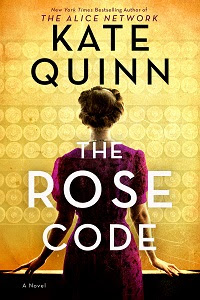
Revisiting Bletchley Park through Kate Quinn's The Rose Code

In July 2019, my husband and I took a week's trip to London, back when vacations were a thing. On a friend's suggestion, we planned a visit to Bletchley Park in Milton Keynes, Buckinghamshire, taking the London Northwestern Railway from Euston Station. After arriving at the Bletchley stop, we walked down a long flight of stairs, exited the station, crossed the street, and the entrance to Bletchley Park was a short walk away.

From watching The Bletchley Circle, I knew what had taken place during WWII at Bletchley, the center of codebreaking activities, and the heroic acts of the thousands of very smart people employed there during the war, most of them women. Their work was key to the Allied victory and reportedly shortened the length of the war by two years.

Bletchley Park mansion from a distance, and small lake, which
appears in the story early on. Photo taken by me (7-15-19)

So of course when I first heard about Kate Quinn's The Rose Code, I knew I'd have to read it. When I had a break between review assignments this past week, I dived right in.

The Rose Code is a smart, character-driven historical thriller about three women who become unlikely friends and allies while working at Bletchley during the war, and the terrible betrayals that destroyed their strong bond. 


Desk in Bletchley Park hut
Work tables inside one of the huts

Mab Churt is a tall, self-sufficient East Ender worried about her mother and younger sister in London. Canadian-born Osla Kendall, a character based on Osla Benning, an early girlfriend of Prince Philip, runs in elite social circles and has led a relatively sheltered life. She has a talent for languages and wants the world to know she's more than a "silly deb." Lastly, shy Beth Finch, a whiz with puzzles, escapes her overbearing mother's insults and abuse when she discovers, to her astonishment, that she fits in with the other codebreakers at Bletchley. Their work is so secret that each worker only knows their own task.

Alternating chapters set in 1947, in the days leading up to the royal wedding, follow the trio as they're forced to reunite, with one of them held against her will in a sanitarium, in order to unmask a spy within their earlier ranks.

Bombes at Bletchley Park
Exhibit on operating the Bombes

The story takes you right inside the huts at Bletchley where all the codebreaking takes place and also inside the characters' heads as they try to crack the codes used by the Germans. You feel their exhaustion as they push themselves to their physical and mental limits, and rejoice when they succeed in finding the right pattern. Mab becomes one of the women operating the decryption machine known as the Bombe (image above).  When I visited in summer, the huts were cool, but all of the rooms are fairly small, with narrow corridors connecting them. One could easily imagine how hot and cramped they were, with the women constantly in motion as they put the heavy drums in their slots and adjusted the wires to keep the Bombe running.

The setup at Bletchley, in July 2019, made it appear as if the huts' occupants had just stepped away from their desks for lunch.

The story makes for compulsive reading as it interweaves the women's friendships with several poignant love stories and the intense race-against-time atmosphere of the earlier and later timelines.

Inside the Bletchley Park mansion
The office inside the Bletchley Park mansion

It does feel rather startling to have just finished this novel as Prince Philip's death was announced, as he's a major character.  In The Rose Code he's the dashing and tanned Prince Philip of Greece, Royal Navy officer and distant relative of the British royals. He and his girlfriend, Osla, set up by a mutual friend, share the feeling of having no real home. His depiction feels realistic and respectful.

I'd love to see the novel as a film, and with the recent announcement of a TV adaptation, hopefully that will happen in the near future.  Both a visit to Bletchley and the novel itself are definitely recommended.  (Thanks to the publisher, William Morrow, for approving an e-copy via Edelweiss.)

Wednesday, April 07, 2021

While Paris Slept by Ruth Druart, a novel of family and courage in Nazi-occupied France

To what lengths would you go to ensure your child’s survival? What would you sacrifice in yourself to preserve their well-being? With her accomplished first novel, Druart penetrates to the heart of these emotional questions, exploring them in multiple ways through the interlinked stories of two couples. 

In 1953 Santa Cruz, California, Jean-Luc and Charlotte Beauchamps are the proud parents of a son, Sam, who loves burgers and chocolate-chip cookies as much as any American kid. They’ve strived to adapt to their new country, speaking only English, and never revisiting the trauma they fled in Paris nine years earlier. The tone is ominous as a car pulls up to their house. Inspectors take Jean-Luc in for questioning, and his carefully built life begins unraveling.

Back in March 1944, Jean-Luc maintains tracks for the French national railway, now under German control. He’s nervous after being transferred to the Drancy station, as rumors float about forced deportations of Jews. He never sees any trains, but evidence left on the platform – a stuffed toy, a broken shoe, and something much worse – implies passengers are being transported to a dreadful end. Jean-Luc feels he must act but doesn’t know how. Then one day a train does stop, and a frantic young mother, Sarah Laffitte, thrusts her weeks-old son into his arms.

Druart keeps suspense thrumming throughout, even with readers’ prior knowledge about some characters’ fates. The crushing weight of the Nazi occupation and its impact on Sarah and husband David, as well as Jean-Luc and Charlotte, a nurse he meets at a German hospital, come through clearly. Sam’s physical and emotional reactions are particularly convincing. It catches at the heart that there are no villains among the five main characters, but their choices cause pain, nonetheless. The ending is as beautiful as one could wish.

While Paris Slept was published by Grand Central in February; I'd reviewed it for February's Historical Novels Review.  It's also published in the UK by Headline Review, and in Australia by Hachette.

Friday, April 02, 2021

A historical fiction microtrend: World War II, librarians, and books

Historical fiction's enduring focus on World War II has been good for my profession. No longer stereotyped as prim and mousy spinsters, librarians in today's novels are multifaceted heroes who work tirelessly to preserve the written word and undertake other daring exploits. Within the collage of nine novels below, I've also included WWII-set fiction about booksellers, book clubs, the publishing industry, and literature's power to endure.


When We Meet Again by Caroline Beecham (Putnam, Jul. 2021), her first novel to be published in the US, focuses on a woman employed in London's publishing industry in 1943 and her plight following an unintended pregnancy. Antonio Iturbe's The Librarian of Auschwitz (2017), marketed towards YAs but suitable for adults as well. reveals the story of Holocaust survivor Dita Kraus who, as a teenager, courageously guarded eight books within the Auschwitz death camp. Nancy Mitford, one of the famous Mitford sisters, stars in Michelle Gable's The Bookseller's Secret (Graydon House, Aug.), a multi-period novel which depicts her time as a bookshop manager and literary salon hostess in 1940s London.


So many of these novels are set in London and Paris!  Janet Skeslien Charles' The Paris Library (Atria, Feb. 2021) reveals the heroic actions of the staff at the American Library in Paris during the Nazi occupation. Third in her Sunrise at Normandy series, The Land Beneath Us by Sarah Sundin (Revell, 2020) tells the romantic story of a library worker at Camp Forrest, Tennessee, who exchanges letters with her new husband after he's sent to fight overseas. And Mario Escobar's The Librarian of Saint-Malo (Thomas Nelson, June 2021) takes place in Nazi-occupied Brittany and a woman who dares to save books that the Nazis are purging from St.-Malo's libraries.


Kristin Harmel's multi-period The Book of Lost Names (Gallery, Jul. 2020), like the previous book, focuses on Nazi soldiers' looting of European libraries; in contemporary times, a librarian comes across a book that holds codes only she can decipher.  Mary Ann Shaffer and Annie Barrows' The Guernsey Literary and Potato Peel Pie Society (2008), now a modern classic with a film version, revolves around a book club on Guernsey during wartime and celebrates how books can unite people. Lastly, Madeline Martin's The Last Bookshop in London (Hanover Square, Apr. 2021), set during the Blitz, centers on a young bookshop employee and how storytelling can keep hope alive.

Tuesday, March 30, 2021

Delights of a Research Trip to Paris, an essay by M. K. Tod, author of Paris in Ruins

Please join me in welcoming M. K. (Mary) Tod to the blog with an essay about her research trip to Paris for her new novel, Paris in Ruins, which is published today.  The idea of visiting Paris at any time is very appealing, but especially now, when travel has ground to a halt. I enjoyed envisioning all the sights through the descriptions Mary provides.

~

Delights of a Research Trip to Paris
M. K. Tod  

Paris In Ruins
is set during the Franco-Prussian War, the Siege of Paris, and the Paris Commune. I arrived at these momentous events not by design but by calculating when two characters from an earlier novel, Lies Told In Silence, would be roughly twenty years old. I had imagined a novel about friendship between these very different women with a dash of romance and perhaps some tangled family dynamics. However, when I discovered a war, a siege, and a bloody insurrection, the plot took on much more drama.

Three earlier novels dealt with World War I, an era recent enough that I knew people (my grandparents) who had lived through it, and once augmented with sound research, could imagine their lives and how that war had affected them. But 1870 Paris required a different approach in order for the time and place to come alive. What did Paris look like? What were the norms and expectations for young women of the upper class? Where did they live and shop? What entertainment was available? How did they travel? What clothing styles were prevalent? What did they talk about? Where did they get their news? Layered on top of that were questions about politics and government, military matters, life under siege, and the origins of unrest and rebellion.

During the early months of 1870, Prussia engineered a crisis that threatened the security of France. By the middle of July, the two countries were at war. The Prussian army had superior numbers, leadership, and technology, and on September 2nd, Napoleon III surrendered after huge losses at the Battle of Sedan. By September 15th, the Prussian army reached the outskirts of Paris. By the 19th, Paris was totally surrounded. The siege lasted until the end of January 1871, but the turmoil continued and two months later, radical republicans overthrew the government and established the Paris Commune. For ten weeks, the Commune carried out acts of murder, assassination, pillage, robbery, blasphemy, and terror, until finally expiring in blood and flames.

“We have to go to Paris,” I said to my husband. “I need to walk the streets, watch the people, explore the history, and get a feel for living there.” 

We’d been to Paris before, but never for more than a few days. What I was imagining was something more intense, a chance to live almost like Parisians do. Fortunately, my husband jumped at the opportunity and soon, he had rented an apartment in the 17th arrondissement for three weeks and booked our flights. By this time, I had many chapters written and a solid outline for the rest. With the story concept in hand, I created a master list of places to see and things to do and the topics I needed to further understand.

After a day of settling in, buying groceries, wine and other important items, and exploring our local neighborhood, we began to tackle my list. Armed with a map, a slim guidebook, and our cameras, each day we walked for miles, taking pictures at what seemed like every street corner. We visited museums and beautifully restored grand homes. We went to Versailles. We climbed the hill to Montmartre and walked its narrow streets. We went to the top of the Pantheon and the Arc de Triomphe. We visited a fan museum. While browsing in a used bookstore on the Left Bank, I found and purchased a book titled Fashion Design: 1850-1895. Another prize from that trip is a map of Paris 1871 which was on sale at one of the museums and now hangs in a lovely frame beside my desk. I used the map regularly to understand the city’s layout as well as the existence of particular streets during the time of Paris in Ruins.

For a look at military matters, we wandered through a museum in Montmartre that featured scenes from the Paris Commune and visited Musée De l’Armée, the National Military Museum, where a display featuring women who participated in the Commune gave me the idea of having a woman become a soldier in the National Guard.

We sat in cafés and watched the comings and goings of Parisians, the way they talked, their gestures and body language. We had lunch at Restaurant Polidor, a wood-paneled place with thick beams holding up the ceiling and a cluttered bar at the back and simple tables and chairs. Le Polidor dates from 1845 and just might have been the place where radicals gathered to plot an attempted coup in October 1871. We admired a display at the Louvre that featured gowns, suits, accessories, furniture, and photographs from the 1870s. We walked in and out of shops that had been built before 1870. We climbed to the top of the Pantheon where Camille and Mariele went to watch one of the battles and the Arc De Triomphe where Camille watched the conflagration and wondered whether Andre would survive. We stood where the Tuileries Palace once was and tried to imagine its splendor before it was burned by the Commune, never to be rebuilt.

We walked the wide boulevards and the narrow side streets of almost every arrondissement. We strolled along the Seine and saw the chestnut trees with their conical white or pink blossoms and walked through the Luxembourg gardens where the Medici Fountain glistened in the sun. On one sublime afternoon, we listened to a concert while sitting amid the sparkle of the stunning stained-glass windows of Sainte-Chapelle.

Of particular interest were the hotel particuliers – grand homes – we visited: Musée Cognacq-Jay, Musée Jacquemart-Andre, Musée Carnavalet, and Musée Nissim de Camondo. I wanted to understand how my two main characters, both from wealthy Parisian families, might have lived including the layout of such homes, the décor, the furnishings, the paintings and other accoutrements of their lives. The splendour and luxury were astonishing and although these home inspired only a few brief descriptions in the novel, they gave me images that I carried around in my head as I wrote.

Musée D’Orsay never disappoints. It’s home to a superb collection of impressionist works of art. However, on this visit, I looked for paintings done in the late 1860s and early 1870s, paintings of Paris, of fashion, of homes and cafés that might spark a scene and help me imagine the lives of both rich and poor. Frédéric Bazille, Claude Monet, Henri Fantin-Latour, Berthe Morisot, and others provided such inspiration. Three weeks of immersion in the world of Paris was not only a spectacular trip but also a wonderful way to absorb the feel of the city, to watch the people interact, to listen to the language, to see the trees and flowers in bloom, and to let my imagination roam. A lingering sense of being there continued to guide the writing of Paris In Ruins.

I’m grateful to Sarah Johnson for having me on her blog today. I know I speak for many other authors in expressing gratitude for Sarah’s ongoing efforts to promote the presence and enjoyment of historical fiction.

~

About Paris in Ruins:  

A few weeks after the abdication of Napoleon III, the Prussian army lays siege to Paris. Camille Noisette, the daughter of a wealthy family, volunteers to nurse wounded soldiers and agrees to spy on a group of radicals plotting to overthrow the French government. Her future sister-in-law, Mariele de Crécy, is appalled by the gaps between rich and poor. She volunteers to look after destitute children whose families can barely afford to eat.

Somehow, Camille and Mariele must find the courage and strength to endure months of devastating siege, bloody civil war, and great personal risk. Through it all, an unexpected friendship grows between the two women, as they face the destruction of Paris and discover that in war women have as much to fight for as men.

War has a way of teaching lessons—if only Camille and Mariele can survive long enough to learn them.

About the author:

M.K. (Mary) Tod writes and blogs about historical fiction. Her latest novel, Paris in Ruins is available  on AmazonUS, AmazonCanada, Kobo and Barnes & Noble. She can be contacted on Facebook, Twitter and Goodreads or on her website www.mktod.com.

Monday, March 29, 2021

Winner and finalist for the 2020 Langum Prize in American Historical Fiction

An announcement of the winner and finalist for the 2020 Langum Prize in American Historical Fiction just dropped into my inbox, and here are the details:

The winner is The Cold Millions by Jess Walter (Harper, 2020), set in the early 20th century.  From the selection committee's commendation:

"Jess Walter’s The Cold Millions is a novel of the burgeoning Pacific Northwest that presents history through an engaging storytelling voice brimming with both humor and pathos.... The history of this period of labor unrest is woven seamlessly into the plotting, allowing The Cold Millions to illuminate an era that is often overlooked. Walter’s characterization and multiple narrative perspectives, from Pinkertons to burlesques, add even more color to an already vibrant portrayal of the tramp lifestyle amid the industrialization of the Pacific Northwest. The result is an entertaining and riveting read."

And the finalist for 2020 is The Book of Lost Light by Ron Nyren (Black Lawrence Press).  From the commendation:

"Set in San Francisco and surrounding areas at the turn of the 19th century, this novel portrays the activities of an eccentric tiny family.... The prose is engaging and the descriptive passages illuminative. We read a vivid description of the San Francisco earthquake and its effects on the everyday citizenry of San Francisco. There is much here on the history of photography. There is considerable discussion of [Eadweard] Muybridge and his and other early photographers’ work, and this gives the reader a good sense of the period and a feel for technological innovation in photography during this period. The book feels fresh."

Congratulations to both authors!

The Langum Prize celebrates the "best book in American historical fiction that is both excellent fiction and excellent history."  For more information, please see the Langum Foundation website.

Saturday, March 27, 2021

An Extravagant Death by Charles Finch sends his Victorian detective overseas to Gilded Age Newport

In this fourteenth volume of his Charles Lenox mysteries, Finch changes things up by sending his refined detective-hero on a jaunt to America.

In 1878, following Lenox’s successful exposure of a corruption scandal at the heart of Scotland Yard, Prime Minister Benjamin Disraeli judges it politically prudent for Lenox to be out of the country when the trial gets underway, so he engineers an overseas tour in which Lenox will meet with American law enforcement about current methods of detection. With his successful business and growing family (including infant daughter Clara), Lenox never got the opportunity to explore the world as he'd once dreamed. His wife Lady Jane, always a wise and steadying influence, encourages him to go.

Then his train trip from Manhattan to Boston gets derailed (figuratively) when the bodyguard for William Schermerhorn IV boards Lenox’s car and requests that he investigate a crime in Newport, Rhode Island, the summer residence of New York’s moneyed elite. The body of Miss Lily Allingham, a noted beauty, was found below a cliff in the wee hours following a fancy-dress ball. Her two suitors are the most likely suspects. The request disconcerts Lenox, since it smacks of entitlement: he doesn’t like acting at anyone’s beck and call.

Lenox is immensely likeable, always a plus in a series with a recurring protagonist. His methodology is thoughtful, he loves his family and has many dear friends, and he’s a witty observer of (and participant in) the social rituals of Victorian England – both city and countryside. Gilded Age America has its own unofficial aristocracy, though, and Lenox’s mental adjustments to the differences from England are fun to observe. Between the Knickerbockers with their Old-World city wealth and the enormous but tightly packed “cottages” gracing Newport’s coastline, Lenox is simply agog at the ostentatious opulence.

Lenox gains a potential protégé, a rich man’s son who yearns to be a detective, and sees his own past reflected in the younger fellow. Also tying this book together neatly with the recent prequel trilogy is a character Lenox meets up with in Newport, someone who made their first appearance in The Last Passenger, set over two decades earlier.

The mystery plot proceeds apace, but the culprit isn’t obvious. Few can imagine anyone who wanted Miss Allingham out of the picture. The solution, when it arrives, doesn’t feel wholly satisfying for several reasons, but Lenox is such good company that this shouldn’t deter anyone from pursuing his future adventures.

An Extravagant Death was published by Minotaur in February; thanks to the publisher for the review copy.

Thursday, March 25, 2021

Reading the Past turns 15 years old today


I first started blogging regularly at Reading the Past on March 25, 2006, so today the blog is celebrating its 15th birthday.  

Over this time, the blog has had over 1600 posts, over 1.9 million pageviews, and over 11,000 comments, which kind of blows my mind.  Every so often I debate moving to a new platform, but as anyone who collects physical books knows, the process of moving becomes more difficult the more content you accumulate.

In acknowledgment of the anniversary, I changed out the header image for the blog recently with a new photo, this time of Fountains Abbey in North Yorkshire... and I'm looking forward to being able to travel again someday.

While blogging has diminished in popularity over time, I'm glad to see new historical fiction blogs continuing to pop up and think (hope!) there'll always be spaces for book lovers to congregate online, share reviews and opinions, and post thoughts about what they're reading.

Although it's a bit hard to get in a celebratory mood with everything that's been going on in the U.S. and world recently, I did want to mark the occasion somehow.  Look for a giveaway sometime in the near future.

As a look back to this blog's extended history, I thought I'd share details on what the most popular posts have been over time.  Counting down from #15 to #1, we have:

#15: The late T.D. (Tim) Griggs' guest post about the Boer War.

#14: Listing of the bestselling historical novels from 2009.

#13: Listing of the bestselling historical novels from 2011. Publishers Weekly no longer collates these annual roundups, alas.

#12: Historical fiction picks from BookExpo America from 2011.

#11: Zenobia Neil's guest post about diversity in the ancient world.

#10: Analysis of the so-called  "Puritan Maiden's Diary," a supposed primary source from the 17th century which turned out to be a fake written in the 19th century.

#9: My review of Sarita Mandanna's novel Tiger Hills, set in 19th- and 20th-century India.

#8: Guest post from Victoria Wilcox about point of view in historical fiction. If you haven't read her trilogy about Doc Holliday, I highly recommend it.

#7: Guest post from Frances Hunter about Fanny Clark O'Fallon, sister of  George Rogers Clark and William Clark, a character in their novel The Fairest Portion of the Globe.

#6: My thoughts on the similarities between two Pack Horse Librarian historical novels. I'm surprised these rumors haven't died down by now, but the post continues to get traffic, week after week.

#5: David J. Cord's guest post on Aristotle and accuracy in historical fiction.

#4: Listing of the bestselling historical novels from 2012

#3: C. W. Gortner's guest post about Marlene Dietrich, subject of his novel Marlene.

#2: Barbara J. Taylor's guest post about the Billy Sunday snowstorm in Philadelphia in 2014.

#1:  My 1000th blog post, from 2014, with looked at another blog milestone and included a preview of ten new and upcoming historicals.

Thanks to all the readers who've been following my posts, whether you're new arrivals or longtime subscribers, and to all the authors who've contributed essays and written books that I've covered here.  I appreciate it!  If you've found new reads or authors via this blog, I'd love to hear about it.

Monday, March 22, 2021

The Role of Minor Characters in Historical Fiction, an essay by Julieta Almeida Rodrigues, author of Eleonora and Joseph: Passion, Tragedy, and Revolution in the Age of Enlightenment

I'm pleased to present the following essay by Portuguese-born historical novelist and scholar Julieta Almeida Rodrigues. Her debut, Eleanora and Joseph: Passion, Tragedy, and Revolution in the Age of Enlightenment, published last July by New Academia Publishing, takes place at the turn of the 19th century in Europe and America and explores the dramatic political changes of the era. My thanks to the author for contributing this piece. Visit her author website for more details.

~

The Role of Minor Characters in Historical Fiction
Julieta Almeida Rodrigues 

About Eleanora and Joseph:

As the novel opens, aristocratic Eleonora Fonseca Pimentel pleads with the High Court of Naples to be beheaded instead of hanged like a criminal. One of the leading revolutionaries of her time, Eleonora contributed to the establishment of the Neapolitan Republic, based on the ideals of the French Revolution. Imprisoned in 1799 after the return of the Bourbon Monarchy – due to her work as editor-in-chief of Il Monitore Napoletano – and while waiting to be sentenced, she writes a memoir. Here, she discusses not only her revolutionary enthusiasm, but also the adolescent lover who abandoned her, Joseph Correia da Serra. While visiting Monticello many years later, Joseph discovers Eleonora's manuscript in Thomas Jefferson's library. Now retired, Jefferson is committed to founding the University of Virginia and entices Correia with a position when the institution opens. As the two philosophes explore Eleonora's writing through the lens of their own lives, achievements, and follies, they share many intimate secrets.

Told from Eleonora and Joseph's alternating points of view, the interwoven first-person narratives follow the characters from the elegant salons of Naples to the halls of Monticello, from the streets of European capitals such as Lisbon, London, and Paris to the cultured new world of Philadelphia and the chic soirées in Washington. Eleonora and Joseph were both prominent figures of the Southern European Enlightenment. Together with Thomas Jefferson, they formed part of The Republic of Letters, a formidable network of thinkers who radically influenced the intellectual world in which they lived - and which we still inhabit today.

~   

I still do not fully comprehend why I have such fondness for the three minor characters I created in Eleonora and Joseph. Maybe the reason is that I see them as stepping-stones to connect the novel’s dots. As I was writing the book, these characters seemed to have a life of their own, popping out of my mind to solve plot issues I needed to address. We know how a novel thrives on conflict between major protagonists to advance to its conclusion. Those minor figures, however, far from conflicting, helped shape the narrative’s details. As a result, I developed a sense of wonder about them. Like in a magician’s show, they emerged from my imagination as stars from inside a top hat.

Two of these figures existed: Eduardo (Edward) José Correia da Serra (1803-?) – son of Joseph, a Portuguese abbot – and Louis René Latouche-Tréville (1745-1804). I needed them for my plot, and they were there for me! Suor Amadea della Valle, a nun, is a person belonging to a ubiquitous social group in eighteenth-century Naples but a character of my imagination.

I will address Eduardo as Edward – the English translation of his name I use throughout the book. I would have enjoyed meeting this young man in real life! Edward seems to have had a formidable Parisian education and to have enjoyed his stay in America. Most probably he had ambivalent feelings about his paternity when he was young; but the Abbé certainly visited often mother and son while he was in Paris. The bond developed between the two men at that time must have been the basis for a satisfying relationship later on. Correia da Serra arrives in America in 1812, therefore Edward lived alone with his mother after the age of nine. The name Esther (Delavigne) suggests Edward’s mother was Jewish.

Abbé Correia, by Domenico
Pellegrini (1759–1840)
In the so-called “Memórias” of the Academy of Sciences of Lisbon, there is a letter where Correia thanks a Parisian friend for lending him some money for Esther and Edward. The letter is written in New York and dated of 1813. The writing is in French and he addresses Edward as his ‘petit filleul’, “little godson’. It is not known when Edward arrived in America to be with his father, but in 1817 he is at St. Mary’s College in Baltimore. Before that, father and son lived in a boarding house in Philadelphia. In the correspondence below, Edward speaks fondly of their occupants. At one point, he says he has been to Monticello with his father and that he recalls how Jefferson loathed newspapers in the later part of his life. This is the reason why I included in my novel a description of one of Edward’s visits to Monticello.

At the end of The Abbé Correa in America (1812-1820) – a book about the correspondence between Correia da Serra and Jefferson – Richard Beale Davis includes a few letters that Edward wrote to several people in America after father and son left the country. Almost all I know about Edward comes from these letters. The tone is polite, deferential, intelligent, and liberal.

As I proceeded to explore his character, I kind of worried for Edward. Beale describes how he was introduced as his father’s secretary or nephew in America. How horrible Edward must have felt! The family secret, however, must have been disclosed to Thomas Jefferson during an intimate conversation in Monticello. When encouraging his friend to accept, one day, a teaching position at the University of Virginia, Jefferson tells Correia to settle in Virginia with his family. Moreover, he offers his house for the family to stay.


I also wondered what Edward thought about his father’s confession to the inquisition. In his letters, Edward mocks the provinciality of life in Lisbon, the despotism of priests, and the inquisition’s instruments of torture. If so, how would he view his father’s confession, once he found out about it? Even if the Catholic Church kept those documents undisclosed, Edward was bound to find out about them one way or another. What a stain in his father’s character! This is why I conceived a paragraph or two at the end of the novel where Correia considers the best way to discuss the issue with his son. He wants to ask for Edward’s forgiveness, and is undecided as to the best way to proceed. Would it be better to have a conversation with him, or write a letter his son could read after his death?

Curiously, Edward mentions in one of his letters a job he holds for a while in the Department of Foreign Affairs in Lisbon. He hates the job, considering it beneath his capability. Moreover, he describes how pleasing it is that the building where he works – a public building now – had been in the past an Inquisition palace. I quote Edward: “an ancient temple of cruel superstition.” He is keen to leave Lisbon and move to Paris to study medicine, he wants to have the same profession his grandfather once held.

Edward seems to get along quite well with his famous father, another endearing trait.

~   

Louis René Latouche-Tréville is the dashing French Admiral who, in real life, arrived at the bay of Naples in late 1792 commanding a French squadron at the head of a warship, the Languedoc. As he announced, he was ready to reduce Naples to “rubble,” as the French Republic took offense on a diplomatic incident with the Kingdom of Naples. Latouche-Tréville was a French aristocrat who early on had joined the French Revolution, and was elected a deputy to the Tiers-État, in 1789. He renounced his title to serve the French Republic and fight for the sans-culottes, the people!

Besides this stupendous credential, of the outmost importance to the Neapolitan revolutionaries, the Admiral had served in the American War of independence. The French had given him the immense privilege of transporting aboard L’Hermione the Marquis de Lafayette during his second voyage to America. The frigate also carried supplies, munitions and troops to help Americans fight for their independence.

Eleonora goes on board when the admiral decides to provoke the king and queen of Naples and invites the Neapolitan Jacobins to a banquet aboard the Languedoc on January 12, the king’s birthday. Daring as she had become, Eleonora attends the festivities with her compatriots, the only woman among, maybe, two hundred guests! She feels she has nothing to lose at this point in her life.

In the novel, Eleonora ends up falling in love with the French naval hero and, for her, the meeting is transformational. She says that since the time she was in love with Correia da Serra, she hadn’t felt that way. Latouche-Tréville had her sit at the main table, to his right, and they discussed the current political events in both their nations. As the conversation proceeds, they fervently smiled and glanced at each other. Among Phrygian caps and tricolor cockades, the two end up the evening dancing on the warship’s deck at the sound of patriotic songs the French sailors chant.

After this moment there is no going back for Eleonora. She is fully committed to a radical change, and to help install a Republican government in Naples. She has learned in the flesh that, if the French revolutionaries can change a government, so can Neapolitans if they so chose. When in prison later, she dreams of the flamboyant French admiral and his invitation to see him in France. When she is in the Bay of Naples ready to go into exile, it is him who comes into her mind as she envisions a new life. At this point in the novel, the political and the romantic reverie became for her, truly, one.

I feel very pleased to have imagined Eleonora falling in love late in life; in 1793 she was forty-one years old. But, this, of course, is totally within her character.

~    

I put in Suor Amadea della Valle’s words what the diarist Carlo de Nicola ‒ someone who recorded the Neapolitan Republic in great detail between 1798 and 1800 ‒ said about Eleonora the day she was hanged. She is in the crowd in Piazza Mercato watching the event.

Suor Amadea is a character of my imagination. I made her the Madre Superiore, the nun in charge of the Vicaria Prison, the women’s section. Not an unlikely situation, since many religious orders were involved in public and community work, devoting their lives to ameliorating the condition of the destitute.

Sour Amadea had to enter the novel at an early stage so that she and Eleonora could develop a close relationship throughout the years. So I had her pay a visit to Queen Carolina when Eleonora is the queen’s librarian. As the Madre Superiore, Suor Amadea had to be literate (as only members of the high classes of Naples were). She goes to the Royal Palace to ask for royal assistance in helping the prisoners acquire the rudiments of reading and writing. The majority of Neapolitans were illiterate, it being common to sign one’s name by making the sign of the cross.

Queen Carolina and her children

As Eleonora writes her memoir in secrecy while in her filthy prison cell – awaiting her sentence – her account must be found later, after she dies. Suor Amadea had placed her old friend in a cell by herself, and had given her a table to write, parchment paper, a quill pen, and a jug of ink. She shows Eleonora the table’s secret compartment, where she advises her to hide all those objects. Given the appalling conditions of a Neapolitan prison in the late eighteenth century, only a devoted friend would provide Eleonora with such luxuries.

I see Suor Amadea as one of the nuns portrayed by Saverio della Gatta, which I have also included in the Gallery page of my website. She is the one fully dressed in the olive green habit, with the matching green hood. She is plump, and friendly, and warm-hearted. Like Eleonora, Suor Amadea is also of Portuguese descent, a link both women discuss when they originally meet at the Royal Palace.

Amadeu Lopes Sabino calls Suor Amadea a feminist avant la lettre, someone ahead of her times. And this is exactly how I see her. Her sense of solidarity towards Eleonora, despite her official position as the prison head, is palpable throughout the novel.

Suor Amadea understands Eleonora both at a human and a spiritual level. She offers comfort to her friend, she is kind and compassionate – even if there is really nothing she can do to alter the course of events. She acts courageously, albeit covertly, while Eleonora is at the Vicaria prison under her official surveillance. She is surrounded by nuns, and she knows some are cruel and ruthless; one among them could denounce her for aiding a convict. Eleonora is not a common prisoner; she is a political prisoner who risked defying the Neapolitan monarchy. Suor Amadea’s discretion is imperative to bring her own plan to fruition: if Eleonora is to die, her memoir must survive. To find out what she does, one must read my novel!


Friday, March 19, 2021

Cloudmaker by Malcolm Brooks, a coming-of-age novel about the frontier of flight in '30s Montana

Brooks (Painted Horses, 2014) evokes rural Montana’s magnificent beauty in his coming-of-age novel set during aviation’s Golden Age, an era marked by technical ingenuity and the allure of wide-open skies. 

In the small town of Big Coulee in 1937, fourteen-year-old Houston “Huck” Finn yearns to build and fly an airplane and has the chops to achieve it. With his Pop’s support and the help of a new machinist, “Yak” McKee, Huck works diligently while hiding the project from his overprotective, religious mother. 

His sophisticated eighteen-year-old cousin, Annelise, a pilot-in-training banished from California to preserve her reputation after a romantic liaison, arrives expecting dreary exile but instead finds her excitement rekindled by Huck’s enterprise. Danger and mystery enhance the plot when gangsters seek to reclaim an expensive watch Huck had pulled off a dead man found in a local creek. 

The cast and their interactions are wonderful, and digressions into their personal stories deepen the characterizations and historical backdrop. An entrancing tale about the challenges of pursuing one’s dreams and of American frontiers, old and new.

Cloudmaker was published this month by Grove.  I'd read the novel earlier this winter and wrote this draft for Booklist (the review ran in the 2/15/21 issue).

Friday, March 12, 2021

A historical fiction microtrend: World War II and fashion

When a historical period becomes fashionable, microtrends develop. Such is the case with novels set in and around the Second World War, focusing on seamstresses, designers, and other fashion trendsetters. These nine novels, mixing recent releases with older selections, dramatize women's creative ingenuity during challenging times.


If you search for "dressmaker" on Goodreads, you'll find mostly historical fiction. Two of these are Kristy Cambron's new release The Paris Dressmaker, focusing on women who used fashion as a tool for Resistance work during the Nazi occupation, and Mary Chamberlain's The Dressmaker's War (UK title The Dressmaker of Dachau), about a naïve young British dressmaker taken prisoner and forced to work for the Nazis. María Dueñas' debut novel, The Time in Between, recounts the journey of a Spanish seamstress in Morocco during the Spanish Civil War and back in Europe during the lead-up to WWII. I've had this one on my TBR for way too long.


The full life of designer and businesswoman Coco Chanel is envisioned in C. W. Gortner's Mademoiselle Chanel, while Pamela Binnings Ewen's The Queen of Paris centers on the controversies surrounding Chanel's WWII-era life in Paris. Sofia Grant's The Dress in the Window, set just after the war in America, focuses on the relationship between two designer sisters.


Georgia Kauffman's The Dressmaker of Paris sweeps from Italy to Switzerland, Paris, Rio, and New York as its heroine reveals her unusual story.  As you can guess from the covers, the remaining two novels also evoke the City of Light: Natasha Lester's The Paris Seamstress is a dual-time novel set in WWII-era Paris and contemporary times. The Dressmaker's Gift by Fiona Valpy, another multi-time saga, follows three intrepid seamstresses, the secrets they keep, and how these mysteries reverberate two generations later.

Monday, March 08, 2021

An Unofficial Marriage by Joie Davidow portrays an operatic, real-life love triangle from 19th-century Europe

Author and opera singer Davidow crafts her own dramatic production around a real-life love triangle that played out across mid-nineteenth-century Europe. 

Its principal figures are mezzo-soprano Pauline Viardot-Garcia, who lacks beauty but possesses an angelic voice; Ivan Turgenev, pampered Russian aristocrat and future literary star, who adores her immediately while watching her perform in 1843 St. Petersburg; and her older husband, Louis, who worships her too much to deny her heart’s desire, at least most of the time. 

Louis befriends the affable Ivan, and the Viardots become Ivan’s adopted family. Despite Pauline’s growing attachment to Ivan, though, she won’t leave Louis. Underlying the story’s emotional surges is the moving reality that there’s no real antagonist, only three passionate individuals caught in an impossible situation marked by self-sacrifice and periods of unfulfilled longing. 

Readers will be swept along with the trio, and Davidow writes beautifully about the artistic vision and technical demands involved in singing opera. The varied settings feel exquisitely vibrant, from chic, restful Baden-Baden, in Germany’s Black Forest, to politically fraught Paris during France’s Second Republic.

Joie Davidow's An Unofficial Marriage is published on March 16th by Arcade; I reviewed it initially for Booklist's February 1 issue. I've pasted in the book trailer below, which includes portraits of the cast and images of the novel's locales, accompanied by piano and the author's soaring soprano voice.


Thursday, March 04, 2021

W. S. Winslow visits small-town Maine across the 20th century in The Northern Reach

There’s a large genealogical chart at the beginning of W. S. Winslow’s debut novel, a collection of integrated stories set in and around the small coastal town of Wellbridge, Maine, across the twentieth century and beyond. The timeline for this saga is as original as the many individuals populating it. The tales move forward and back in time, sometimes zipping along the chart on the diagonal as they center on separate families – the Lawsons, Moody, Baineses, and Martins – linked by blood, marriage, and illicit relationships.

The Northern Reach recounts how the unforgiving environment molds its characters, who have mixed or antagonistic reactions to their hometown. The austerity of the locale suffuses many lives, and happiness can be as fleeting as the summer temperatures. Perhaps it’s not surprising that the hero of one story ends up as the villain in a tale set a generation later.

The most sympathetic characters are those who consider themselves outsiders – those who escape from Wellbridge or want to. Among them are Liliane, a Frenchwoman who in 1958 meets fisherman Mason Baines, a handsome sailor in the merchant marines, marries him, and raises two children. Her foreign ways are denigrated by her narrow-minded mother-in-law, Edith. Edith appears as an elderly woman in the opening story, her mind fading as she stares out to sea following her husband’s and favorite son’s deaths in a boating accident.

Winslow incorporates dark humor in the tale of Victoria Moody, who returns to Wellbridge after ten years’ absence to attend her father’s funeral. Relieved to have left her fiancé back in Portland, away from the “horror show” of her embarrassing family, she finds it impossible to leave the past behind. Another insightful story shows a woman’s ghost coming face to face with her children’s true feelings, learning details they never spoke in her presence during her lifetime.

In the earliest accounts, especially, the bleakness can be overwhelming, but the descriptions create memorable images nonetheless: “Above the reach low clouds sleepwalk across the February sky. Today they are fibrous, striated, like flesh being slowly torn from bone.” Other observations about troubled lives pique the imagination with their realness. Admirers of character-centered historical fiction will find much to like in these introspective stories.

The Northern Reach is published by Flatiron this month; thanks to the publisher for the e-copy.

Monday, March 01, 2021

An interview with the London Monster, a guest post by Donna Scott

Today Donna Scott, author of The London Monster (Atlantic Publishing, 2020) presents a guest post as written by her lead character, Sophie Carlisle, a journalist in late 18th-century London. Disguised as a man, she seeks to tell stories about the darker, seedier side of the city at a time when a disturbing figure nicknamed the London Monster has been attacking women on the streets. These incidents (and the London Monster himself) are taken from history.  

~

An Interview with the London Monster
By Sophie Carlisle c1790

I was granted an interview with the elusive London Monster on several conditions:
--We would speak in a small room set up with an opaque screen between us.
--I had to enter our little room first—prior to his arrival—and leave only after his departure.
--I had to keep my back to the screen at all times, for he guarded his identity as if it were a precious stone.
-- I was not permitted to ask any personal questions which might lead to his capture.


Sophie: Thank you for agreeing to speak with me today.
My pleasure, I assure you.

Sophie: What have you done to earn the moniker ‘The London Monster’?

I don’t particularly care for that title. I am most certainly not a monster. I simply adore women. The curve of their breasts above their low necklines, their slender waists, their promising lips. I find it all quite provocative. I am pulled toward them like the tides to the moon. I might approach a woman and offer a kind word or two and then a proposition. The circumstances—whether the object of my affection sways her hips when she walks or strides forward with impatience and arrogance—will determine how I choose my words. The lady who entertains me first with the rhythmic swish of her skirts as I follow behind her, will always get the kinder introduction. Perhaps a compliment before I express my true wishes. But it is the haughty jilt who will take the brunt of it. I might whisper a vulgarity in her delicate pink ear, comment on my growing arousal or the bounce of her breasts. What brings me the most pleasure is that first gasp, the initial moment of shock which registers in her raised brow and parted lips, a sure sign I have offended. After that, it is not exactly pleasure I feel, but anger that burns my chest—a building rage. Every desire I’ve ever had spills freely from my tongue and coats her like the soot on a hearth’s bricks. She might fight to get away—most of them do—but I am stronger, faster. And it is only then that I draw my blade. I presume that is what has earned me the name.

Sophie: The papers have described you as a miscreant, wretch, and villain. Do you agree with their assessments?
You would do better to stay away from the papers, especially the Morning Chronicle and the Oracle. Both are shameful in their descriptions of me. Actually, the World is the most accurate and purports the women as the real monsters. Their histrionics have placed all men in danger, for any man could be accused of being me with one wrong look or harmless suggestion.

author Donna Scott

Sophie: How many women have you attacked? Some reports are as high as 56.

Is that so? I daresay that number is a bit high. You forget that there are imitators, charlatans, if you will, who desire my notoriety and, therefore, inflict harm upon some women in order to get it. They even work in groups or pairs, as I understand it. That is most certainly not my style. I only approach the fairest, so if a lady should return home with a scratch and torn skirts, she instantly gains in popularity and acquires the prestige of being one of my beauties. And you forget the fact some women claim being attacked simply for the celebrity it brings them. It is also a clever way of getting their husbands to pay for a new bolt of cloth to replace the ripped garments. So, you may attribute perhaps 45 or so attacks to me. I am not one to count that sort of thing.

Sophie: Are you ever afraid of getting caught?

At times, when I sit alone and wait for darkness to fall, my mind wanders into those dark places. I’ll enjoy a brandy or perhaps port and, in the quiet, that irrational fear may enter my thoughts. Will I be recognized or caught? But when I think of the wonderful possibilities of the night ahead, those thoughts flit away like a bird called by the chirp of a paramour. The truth is that I have tipped my hat to the police—Bow Street Runners—on many occasions as they search the dark for ‘the monster’. They are quite noticeable, wearing bright red waistcoats and carrying truncheons emblazoned with authoritative bronze crests, and therefore easy to avoid, if necessary. I do admit, I find the closeness of danger exhilarating.

Even as we speak, I know I am being hunted. And I know by whom. But those who pursue me are looking for a thin vulgar-looking man, or a short narrow-faced man with regular features, or a big-nosed man with curly hair. I have been said to wear all black clothing or a brown greatcoat or a blue silk coat. I wear a cocked hat with or without a cockade, my hair worn loose down my back or in a queue. Essentially, I look like everyone or no one at all. So, you ask if I think I might be caught... Never.


Both renderings represent the Monster attacking women in the streets of London.


About The London Monster by Donna Scott:

In 1788, exactly one hundred years before Jack the Ripper terrorizes the people of London, a sexual miscreant known as the London Monster roams the streets in search of his next victim… 

Thomas Hayes, having lost his mother in a vicious street assault, becomes an underground pugilist on a mission to rid the streets of violent criminals. But his vigilante actions lead to him being mistaken for the most terrifying criminal of all. 

Assistance arrives in the form of Sophie Carlisle, a young journalist with dreams of covering a big story, though she is forced to masquerade as a man to do it. Trapped in an engagement to a man she doesn’t love, Sophie yearns to break free to tell stories that matter about London’s darker side—gaming, prostitution, violence—and realizes Tom could be the one to help. Together, they come up with a plan. 

Straddling the line between his need for vengeance and the need to hide his true identity as a politician’s son becomes increasingly difficult as Tom is pressured to win more fights. The more he wins, the more notoriety he receives, and the greater the chance his identity may be exposed—a revelation that could jeopardize his father’s political aspirations and destroy his family’s reputation.

Sophie is also in danger as hysteria spreads and the attacks increase in severity and frequency. No one knows who to trust, and no one is safe—Tom included, yet he refuses to end the hunt. Little does he realize, the monster is also hunting him.

About the Author:

Donna Scott is an award-winning author of 17th and 18th century historical fiction. Before embarking on a writing career, she spent her time in the world of academia. She earned her BA in English from the University of Miami and her MS and EdD (ABD) from Florida International University. She has two sons and lives in sunny South Florida with her husband. Her first novel, Shame the Devil, received the first place Chaucer Award for historical fiction and a Best Book designation from Chanticleer International Book Reviews. Her newest novel, The London Monster, was released in November 2020. To learn about new releases and special offers, please sign up for Donna’s newsletter.