Sunday, August 28, 2016

A visual preview of historical novels for early 2017

Blurbs for historical novels set to come out next winter and spring are starting to appear, so I've been periodically adding more to my wishlist.  Here are ten which have descriptions and covers, along with details on why they sound enticing.


In post-WWII Greece, a woman who sings laments for the dead reveals her own story as her traditional way of life comes to an end.  Per the author's bio, he spent a decade living and working in Greece.  This sounds like a unique story.  Berkley, April 2017.


Sometimes I find out about new novels via social media, and this one came to my attention via a Facebook post.  It's the story of Freydis, daughter of Erik the Red in early 11th-century Greenland, intertwined with a modern thread. I like historical novels that pull little-known women from the record and make them the focus.  Lake Union, February 2017.


I've been glad to see a number of new novels set in historical China.  Chang's second novel (after Three Souls) takes place in early 20th-century Shanghai and follows a Eurasian orphan's unusual coming of age.  William Morrow, January 2017.


I enjoyed Alyssa Cole's romance novella Agnes Moor's Wild Knight, about a Black woman in the Scottish court of James IV (based on a historical incident), so am looking forward to this full-length novel about spies and forbidden love during the US Civil War.  Kensington, February 2017.


Margaret George's novels only appear every few years, but these biographical epics are worth waiting for.  Her latest, the first since The Autobiography of Henry VIII (1986) to feature a male protagonist, promises to show a less familiar angle on the well-known Roman emperor.  Berkley, March 2016.


Like the novel above, this one is set in ancient Rome, but its focus is quite different.  This story of a 1st-century gourmet (Marcus Gavius Apicius, a real person) sounds like a foodie's delight. Touchstone, April 2017.


The WWI era is still a favorite, and not just because of the Downton Abbey connection. Kinghorn's story about the dramatic changes of the era centers on a lady's maid who travels alongside her aristocratic mistress and forms an unusual friendship with her.  Berkley, January 2017.


This sweeping epic should offer an in-depth look at the immigrant experience; it's a generational story of a Korean family in Japan, beginning in the 1930s.  Somehow I missed picking this one up at BEA. Grand Central, February 2017.


The premise reminds me somewhat of Home Fires, a TV series I'd like to see more of; it centers on women in an English village who band together while their men are away fighting in WWII. The cover design is superb.  Just when I was wondering how to get my hands on a copy, I found one waiting on my porch on Friday evening.  Crown, February 2017.


From the title and cover image, you can guess the timeframe.  Described as a "literary historical thriller," it's set in 1640s England - a dark time of rampant superstitions - and stars Alice Hopkins, older sister of the country's Witchfinder General, whose terrible actions are not to her liking. Ballantine, April 2017.

Tuesday, August 23, 2016

An ordinary, extraordinary life: Brad Watson's Miss Jane

Partway through Brad Watson’s beautifully contemplative second novel, there’s a scene that speaks a powerful truth about its lead character and theme. Mrs. Ida Chisolm, concerned about the health and future of her teenage daughter, Jane, braves possible social disapproval by going into her small Southern town and consulting a psychic:

“I want to know if she will ever be better. Normal, like other girls. Women.”

After a time, the fortune-teller, Mrs. Eugenia Savell, responds.

“I don’t see a change,” she said then.
“Will she die?”
“Not young.”
Ida nodded again.
“She is strong, even stronger than you,” Mrs. Eugenia said then. “She may even be relatively happy in life. Unlike you.”
Ida then laughed a curt laugh of her own.
“Nothing to do about that, I suppose.”
“We are what we are,” Mrs. Eugenia said.

In rural east Mississippi in 1915, Jane Chisolm is born to a taciturn farmer and his wife, a dispirited woman still grieving an earlier child who’d died. It’s a normal delivery, and she’s a healthy baby, aside from one thing: young Jane has a rare genital anomaly that leaves her incontinent and will make sex and childbearing practically impossible.

Richly imagined based on thorough research and family memories of Watson’s great-aunt, who had the same condition, Jane’s story is told with plainspoken simplicity and grace. She’s a naturally observant child, and she extends her curiosity about her environment – the herbs and mushrooms she gathers in the woods, the actions of animals on the farm – to the appearance of her own body. She knows that she’s not built like other girls but, without knowing what “normal” looks like, she can’t picture exactly how.

Guiding Jane from childhood on is Ed Thompson, the physician who brought her into the world. (Switching viewpoints, which the novel does on occasion, we get invited into a country doctor's life; in one illustrative scene, he finds a "sagging, ragged group" of sick and wounded people waiting on his porch after he gets home from delivering Jane.)  The doctor becomes her good friend and a wise, supportive voice. He’s realistic about her prognosis, since medicine hasn’t advanced enough yet to remedy her condition through surgery, but communicates regularly with professional colleagues and makes sure Jane knows she can approach him with questions.

From Dr. Thompson, who she calls by his first name when they’re both adults, she learns kindness and understanding. Any child would be fortunate to have a friendship such as theirs.

Jane may be destined for a life without a partner – a youthful romance she shares with a neighbor boy can only go so far, to her regret – but as she demonstrates, solitude doesn’t have to equal emptiness. Women led hard lives in this place and time, and Watson sketches out numerous examples. Jane has only to look at her unsatisfied mother, her rebellious older sister, or the wife of the sharecropper who rents from her family to see that sex and marriage don’t always lead to contentment.  Who’s to say she'd have been any happier if her body had been created differently?

Dr. Thompson keeps peacocks on his property, and their presence in the novel (and on its gorgeous cover) becomes a symbol of Jane's proud spirit.  Following Jane's journey toward acceptance of her rightful place in the world, and her determination to forge ahead with her life as it stands, makes for an enriching experience.

Miss Jane was published by W.W. Norton in July in hardcover ($25.95/C$33.95, 284pp).  Thanks to the publisher for sending me a copy at my request.

Friday, August 19, 2016

Anna Solomon's Leaving Lucy Pear, about a child and two mothers in 1920s New England

In 1927, Lucy Pear Murphy is nearly ten, a kind and strong-willed girl whose black hair and dark eyes mark her as a misfit in her family. Her unusual name reflects the secret circumstances behind her upbringing.

A decade earlier, late one night on Cape Ann, Massachusetts, her desperate birth mother, 18-year-old Beatrice Haven, had left her in her uncle’s pear orchard for Irish poachers to find and raise, and Emma Murphy had absorbed the newborn into her large clan. The two women’s stories become entwined again thanks to aspiring politician (and rum-runner) Josiah Story, a local quarry owner who doesn’t know of their shared past but has his own motives for bringing them together.

His act has profound implications for all involved, including Lucy herself.

Leaving Lucy Pear works extremely well on multiple levels. The setting of Prohibition-era New England gently permeates the novel, with its firm social barriers, temperance ladies pushing their views, and everyone riled up by the Sacco and Vanzetti trial verdict. But the real highlights are its characters and the author’s clear empathy for them.

Although they’re not much alike, Beatrice and Emma are products and victims of their time, and both find themselves trapped in unhealthy patterns. Daughter of a prominent Jewish family, Beatrice, a talented pianist who dropped out of Radcliffe, now devotes herself to social causes and caring for her invalid uncle. Emma, a loving mother of nine, risks losing her reputation when she begins an affair with Josiah. With delicate precision, Solomon illustrates their desires and fears, both voiced and unvoiced.

Although her prose has a melancholy tone in places, it doesn’t succumb to it. With greater knowledge of ourselves and one another, she intimates, we can discover where we best belong – and can start anew.

Leaving Lucy Pear was published by Viking in July (hb, $26, 336pp).  This review was first published in August's Historical Novels Review.  This is the author's second novel, after The Little Bride, which I haven't read, but it also features Jewish American characters.

Wednesday, August 17, 2016

Interview with M.K. Tod, author of Time and Regret

I recently had the opportunity to speak with M.K.(Mary) Tod about her third novel, which was published yesterday by Amazon's Lake Union imprint.   Time and Regret is a multi-period story, alternating between the WWI years and the 1990s.  Recent divorcee Grace Hansen journeys to northern France in search of long-buried secrets about her grandfather, Martin Devlin, plus we also travel to the front lines of the Great War through Martin's experiences.  There's more than a hint of suspense – Grace sees someone following her but doesn't know why – as well as some romance, which begins when Grace meets a Frenchman named Pierre.

Based in Toronto, Mary is known in the historical fiction field not only for her novels but also for the reader surveys she's conducted on the genre.  She reviews for the Historical Novels Review and the Washington Independent Review of Books.  In 2011, she contributed a guest post for Reading the Past on the different facets to her WWI research.  In that piece, she wrote: "While sitting in a cafe having dinner one night, my third novel was born. You never know what a glass or two of French wine will inspire!"  Now that Time and Regret has been published, the writing process has come full circle.

Hope you'll enjoy this interview.

One of the common elements running through your novels is war’s impact not just on individuals, but on marriages and families. What draws you to this theme? 

Great question, Sarah. I have two answers. The first is that I began writing by investigating the lives of my maternal grandparents and as such, I came to see both sides – male and female – of a time with such dreadful consequences. Not only did men go to war, but women also ‘went to war’ on the home front and I wanted to share that perspective. The second reason is that I hope to tell stories that engage both men and women. Too much war and you lose the female audience; too much romance and you lose the men.

People’s transformative and tragic experiences in WWI have figured in your previous two novels as well. What attracted you back to this era for your third novel?

I was never a student of history and so I was startled to find researching WWI so fascinating. However, fascination was followed by anger, sorrow and bewilderment—anger at the incredible ineptitude of military and political leaders and sorrow for what soldiers and everyday citizens had to endure. My bewilderment centered on questions of humanity. Why did soldiers put up with unspeakable conditions for so long? How could leaders use such appalling measures as poison gas? How could parents bear the loss of more than one son? How could officers send their men ‘over the top’ time after time when they knew death would greet so many? I shake my head even now. My novels honor the sacrifice, courage and endurance of the men and women who lived in those times.

However, I have decided to move on. My next novel is underway and it will feature 1870s Paris.

In the afterword to Time and Regret, you discuss your research trip to northern France, tracing Grace’s own research journey in person. Could you share some of the more useful or more fascinating discoveries that you made there?

I could write a five-page essay on this topic! However, let me give two examples. One is the Musee de la Grande Guerre in Peronne, France – a museum dedicated to WWI. I’ve been in many war museums, but the stark simplicity of the one in Peronne affected me profoundly. The museum is housed in a medieval chateau. On the floor, surrounded by wooden frames, are the uniforms and kits for French, British, Canadian and German soldiers. Powerful statements in and of themselves. Similar wooden frames house items like rifles, ammunition clips, light trench mortars, medical instruments, ambulance supplies, signaling equipment, and camouflage materials. Small signs itemize the contents of each frame; the atmosphere is hushed. In another room were two rough tables full of debris and a sign explaining that every item had been found in the trenches and battlefields of the Somme—helmets, boots, canteens, bully tins, pickaxes, knives, shovels, petrol cans, breastplates, barbed wire. Looking at these, I felt as though someone had punched me in the gut. I have tried to convey the emotional impact of the experience through a scene in Time and Regret.

A second example is the somber tolling of the names of soldiers who died at Passchendaele through loudspeakers that line the path to the museum – an eerie experience, also included in the novel.

Martin’s diary has a blank entry for the brief time he spends at Chumley Park, where he undergoes rehabilitation for the stress he’d been under at the Somme. How did you research his time at this (fictional) facility?

Although I read reports concerning shell shock in World War One and the treatments given to soldiers, the entire Chumley Park episode is a figment of my imagination.

You seem equally adept in writing from both male and female viewpoints; both Martin’s wartime diary entries and Grace’s journey to find answers came across as realistic. Do you have a preference for writing from either viewpoint?

What a lovely compliment, Sarah! Writing a female character is in many ways easier. The challenge is to make the voices distinctive and avoid having them all sound like me. I truly enjoyed creating Martin’s voice and read many diaries, letters, and novels in order to convey a man’s perspective and experience of war. I’ve also had a few men read the final draft and I remember asking my son what a group of soldiers who had been at sea for ten days would be thinking of when they disembarked. He replied without hesitation: booze, food and women. That too is in the novel.

You recently blogged about how the results of the reader surveys you’ve conducted influenced your own writing. In particular, you’d noted how you “reshaped the plot for Time and Regret” to enhance its appeal to female readers. Can you provide any more details on how you’d tweaked the plotline? How do you balance the demands of the story you want to tell with reader expectations?

The most significant change I made to Time and Regret was to strip out some of the content devoted to Martin’s WWI experience. Originally, the story had too many diary entries and too many scenes in the chaos of war. But I also worked hard to make Grace come across as a strong, feisty person—I think she was a bit bland in earlier drafts—and to heighten the romance between Grace and Pierre.

In terms of balance, like many authors, I enjoy telling the kind of stories I like to read. Fortunately, the survey data suggest there’s a good market for such stories, although I certainly don’t consult the data before embarking on a new project  :)

Following two successful indie-published historical novels, Time and Regret is being published by Lake Union. How did this development come about, and what has your publishing journey been like?

An online author friend of mine had been picked up by Lake Union at a time when this publishing house was securing the rights to already self-published novels. She kindly recommended me to her editor; however, when I wrote the editor about my self-published novels, Unravelled and Lies Told in Silence, I was informed that Lake Union had changed its policy. “But, but, but,” I said. “I have another novel almost ready to go.” And the editor graciously agreed to look at Time and Regret a few months later.

As for my journey, in 2010, after many, many rejections, I secured a Toronto-based agent for Lies Told in Silence. I was thrilled. But, like many other authors, two years later the novel had received a bit of attention from publishers but no deals. So, frustrated with the traditional process, I decided to self-publish Unravelled and a year later, parted company with my agent and self-published Lies Told in Silence as well. Being an indie author has been a fabulous experience; the best part is knowing that readers have enjoyed my stories.

I’m very excited to be with Lake Union and I’m keeping my fingers crossed that Time and Regret will reach even more readers.

Thanks, Mary, for taking the time to answer my questions!

About M.K. Tod: Time and Regret is M.K. Tod’s third novel. She began writing while living as an expat in Hong Kong. What started as an interest in her grandparents’ lives turned into a full-time occupation writing historical fiction. Her novel Unravelled was awarded Indie Editor’s Choice by the Historical Novel Society. In addition to writing historical novels, she blogs about reading and writing historical fiction at www.awriterofhistory.com

Thursday, August 11, 2016

Three for Thursday: medieval England, 1920s India, and 20th-century Jerusalem

Summer's given me some time to catch up with reading. Here are three historical novels I'm recommending. The first two are from my own collection, and the third was sent by the publisher (thanks!).

In the year 1353, life isn’t always easy for a bookshop owner on Oxford’s High Street. Money’s tight, with over half of the city’s residents dead from the recent plague; town-gown rivalries are common; and the university’s slow to pay its bills. “It was irksome,” says narrator Nicholas Elyot, “but the position of official bookseller to the university had the advantage of bringing in a regular income.” In Swinfen’s lively medieval mystery The Bookseller’s Tale (Shakenoak Press, 2016), Nicholas is a youthful widower raising his son and daughter with the help of his sister, Margaret, who runs a tight household; both siblings had lost their spouses to the Black Death. Nicholas goes into crime-solving mode after finding the body of a student and former employee floating in the river Cherwell while walking home from an excursion to buy new quills. Why was William Farringdon wandering in the countryside so far from school, and who stabbed him in the back?

Nicholas is an upright fellow with serious responsibilities, but he loves his children dearly. He’s also an expert in the book business and happily shares his knowledge about quality parchments, manuscript illumination, and smart sales techniques. He’s an inexperienced investigator, though. While some of the scrapes he gets into are very funny, others pose needlessly dangerous risks to himself and his family. He’s aided in his search for justice by his friend Jordain Brinkylsworth, Warden of Hart Hall, where William had lived. Swinfen illustrates merchant and university life in medieval Oxfordshire with a sure hand, and she gives Nicholas an intriguing backstory: he had left the celibate life of a scholar behind to marry a “shopkeeper’s wench,” his late wife, Elizabeth. Despite her early death and the resentment of some at the university, he doesn’t regret his decision. I wish this series a long and successful life.

Imagine being born into a society in which you’re not only unwanted but expected to be a burden on everyone. This is the case for Serafina and Mary MacDonald, daughters of a British tea planter and the Indian teenager he takes as his concubine and installs on a hidden part of his estate in the mountains of Assam, a region with an intense, almost unparalleled beauty. It’s impossible not to root for these girls as they grow up unaware of the reality of their father’s outward life. They’re forced to confront the horrible bigotry aimed at them not only from the English but also from Indian men who cruelly mock them for their mixed-race birth. Even in their isolated environment, they see firsthand how their society discards its women by watching the helpless fury of their mother, the beautiful Chinthimani. (She's led from the beginning to believe she’s James’s wife, not his secret mistress.) While Mary is good-natured and makes friends easily, Serafina, two years older and more reserved than her sister, holds herself apart.

Set between the 1920s and 2006, The Secret Children (Orion, 2012) is a gripping novel of survival and the struggle for self-determination that also poses thoughtful questions on the meaning of home. The girls find a few allies as they become young women, and despite his despicable behavior and cowardice, their father, James, is hardly a caricature; he loves them both, but knowledge of their existence would damage his career. Alison McQueen based this work, her first historical novel, on events from her mother’s past, and you can read more in a piece she wrote for the Guardian. I’ve been following the television drama Indian Summers and found this “readalike” novel equally gripping.

When Rosa Ermosa calls her oldest daughter the “beauty queen of Jerusalem,” it’s not really meant as a compliment. Even as a wife and young mother, Luna is a gorgeous fashionista more concerned with Hollywood stars and her appearance than her own mother or daughter’s feelings. Sarit Yishai-Levi’s first novel was an international bestseller, and after reading it, I can see why. It drew me fully into the daily lives, hopes, and sufferings of four generations of women in a Sephardi Jewish family in Jerusalem from the Turkish occupation of Palestine through the British Mandate, the Arab-Israeli War, and the 1970s. Many readers in the author’s native Israel will be familiar with Sephardi culture and traditions, but I hadn’t been. Through the characters’ experiences, I absorbed new information, such as the longtime rivalry between Israeli Jews of Sephardic and Ashkenazi heritage – intermarriage between them is practically forbidden – and the former’s Ladino language, which is similar to Spanish. Generational strife, forbidden love, family obligation, and coming of age are all universal themes, but in The Beauty Queen of Jerusalem (Thomas Dunne/St. Martin’s, 2016), they’re indelibly imprinted by the culture to which the characters belong.

 The novel swirls with family stories and reads like you’re hearing anecdote after entertaining anecdote passionately retold by a talented storyteller. The narrator is Gabriela Siton, Luna’s daughter, who asks her Nona Rosa and her Tia Allegra, her grandfather’s sister, to tell her about her family’s history. Maybe then she’d learn why Luna, who died when Gabriela was eighteen, had always seemed so cold and spiteful. The jacket blurb mentions a “family curse” that links the women, since they’ve been destined to marry men who don’t love them. There’s nothing supernatural about it, though, and each woman’s story is different. Her two sisters are wonderful people, but Luna’s story is among the most poignant. She may not be likeable, but in the end, I felt like I understood her.

Tuesday, August 09, 2016

Elisabeth Storrs' Call to Juno, last in a trilogy set in ancient Rome and Etruria

In Elisabeth Storrs’ Call to Juno, set during the closing years of the wars between Rome and Etruscan Veii in the 4th century BC, the gods play important roles, influencing people’s behavior and thoughts, even though the deities never take form on the page.

On the day he’s crowned as lucumo (king) of Veii, Vel Mastarna paints his face with vermilion dye to honor Tinia, the Etruscans’ principal god. His wife, Queen Caecilia, who was born of the Roman aristocracy, knows that she’s defied the Roman goddess Fortuna after choosing her husband and his city over her homeland – and she fears retribution. And Artile, Vel’s estranged brother, may be considered a traitor for aiding the Roman cause, but there’s no denying that his talents as priest and haruspex are uncannily perceptive.

The history and culture of these ancient peoples are presented in exquisite detail, from the finer aspects of religious belief to politics, art, and the mechanisms of warfare. They serve to anchor the narrative in its time without overwhelming readers. Although the settings may be foreign to modern readers, the characters exhibit traits and emotions recognizable to us all.

I’d previously reviewed the earlier volumes of the Tale of Ancient Rome series for this site. The first, The Wedding Shroud, saw Caecilia married off to Vel as a treaty-bride, and the second, The Golden Dice, depicts her plight in Veii after the truce between their lands, which sit a mere 12 miles apart across the Tiber, finally broke down. As Call to Juno opens, Caecilia, now a firm enemy of Rome, is watched with suspicion by the Veientanes, at least until she takes a public stance that startles her husband and puts him in a tough position.

As Vel leaves on campaign, Caecilia, her four children, and their servants stay behind in the citadel of Veii, which sits atop a high cliff. They and others endure plague and starvation during Rome’s siege of their city, which makes for uncomfortable reading at times.

The overall tale is revealed from four perspectives. On the Etruscan side, we have Caecilia and Semni, her children’s wet nurse, who’s in love with a Phoenician slave with a dangerous responsibility. On the Roman side, the protagonists are Pinna, a former tomb whore, now concubine of General Camillus; and Marcus, a Roman tribune and Caecilia’s estranged cousin, whose unspoken love for his best friend, Drusus, is a constant torment.

The two cities are set up in contrast. The restrictive mores of Rome are vastly different than those of wealthy Veii, with its rich material culture and decadent rites meant to honor the wine god, Fufluns. I particularly liked the scenes in which members of the Roman contingent express curiosity about the Rasenna – as the Veientane people call themselves – before they clash in their final encounter. When Pinna hears that their enemy honors their ancestors and reveres women, she starts questioning everything she’s been taught about them.

Although the author can’t change history, the plot refrains from obvious twists along the way, and the characters’ struggles are valiant as they try their utmost to control their fates.

Call to Juno was published by Amazon's Lake Union imprint in April. As I was writing up the review, I caught a social media mention that all three books in the series are $1.99 apiece as ebooks during August. This is my 3rd post for the 2016 Australian Women Writers Challenge.

Friday, August 05, 2016

Catherine Banner's The House at the Edge of Night, a magical Italian saga

An island can be a secluded place of refuge. For those who spend their lives there, islands can also turn claustrophobic and isolating. Both hold true in Catherine Banner’s marvelous debut novel, a near-century-spanning epic set on the fictional isle of Castellamare, a five-mile-wide heap of rock off the Sicilian coast – a place with a founding myth of its own, and where the gossip flows like the limoncello at the Espositos’ bar, the evocatively named House at the Edge of Night. Amid this picturesque Mediterranean milieu, its residents interact with one another, the world outside, and the cultural heritage that surrounds them.

The focus falls on four generations of Espositos, and their stories unfold in the lively style of a folk tale but with the realism of a meaty historical saga. The combination makes for reading enchantment. It begins as the future patriarch, Amedeo, arrives at Castellamare in 1914 to become the island’s first-ever doctor. Scandal arises when his intelligent dark-haired wife, former schoolteacher Pina, and Carmela, estranged spouse of the wealthy conte, give birth to boys on the same night – half-brothers, perhaps.

Many well-defined characters play roles, including Maria-Grazia, a fragile child who becomes a determined woman; Robert, the Englishman from the sea; fishermen, poets, and entrepreneurs; even Gesuina, the near-blind midwife whose passing marks an era’s finale. Both world wars transform the island’s inhabitants, as does the 2008 financial crisis. Rivalries develop; secrets are revealed; tender love affairs form; relatives are lost and found. There are a treasure trove of stories and many fabulous turns of phrase (“a face like bad weather”).

The novel dares to take its time, to remarkable effect. Incidents gain near-mythic status as the decades pass, and the large scope lets readers see the original events and, much later, the legends they create. In Banner’s gifted hands, both are equally absorbing, and equally magical.

The House at the Edge of Night was published by Random House in July ($27 hb/$13.99 ebook, 432pp).   The UK publisher is Hutchinson.  This review ran in August's Historical Novels Review. The book is a great summer read, and I love the cover.

And here's the postcard the publicist sent along with the book.  Very clever.


Tuesday, August 02, 2016

La Belle Époque, a flourishing setting in new historical fiction

Francophiles, rejoice! Novels inspired by French history are surging in popularity, in particular those set during the Belle Époque. This period, which translates as “the beautiful age,” spanned roughly from the end of the Franco-Prussian War in 1871 through the beginning of WWI in 1914. The era, which mirrored the Gilded Age period in American history, encompassed industrial growth, political stability, scientific advancement, and the flourishing of artistic and literary expression. That said, despite the economic and cultural prosperity experienced by the middle and upper classes in France, the country’s impoverished citizens saw little change in their circumstances.

A broad palette of topics is represented in historical novels about the Belle Époque: impressionist painters and their circle, the construction of the Eiffel Tower, the Expositions Universelles (World's Fairs) of 1889 and 1900, the Dreyfus Affair, and the stark contrasts between the city’s rich and poor. The discovery in 2010 of an apartment once owned by demimondaine Marthe de Florian – which had remained untouched since her granddaughter fled Paris during WWII – invigorated interest in the elegant glamour of the period. Madame de Florian’s abandoned apartment has directly inspired several multi-period novels so far, including Michelle Gable’s A Paris Apartment and Ella Carey’s Paris Time Capsule.

Many of these novels present a cross-section of French society rather than focusing exclusively on the wealthy elite. For readers enchanted by this vibrant historical period, here are 13 recent and upcoming novels to look for.


While caring for her ill grandmother, a young woman finds herself compelled to discover the provenance of a broken sculpture that depicts a woman from the Belle Époque. Multi-period.   Ballantine, September 2016.


A family saga about a female artist, her adopted brother’s mysterious disappearance, and a heap of surprising secrets, set in Paris of the 1870s. St. Martin’s, July 2016.


After finding a letter written by Belle Époque courtesan Marthe de Florian that references her great-great-aunt Louisa, a modern art curator jets over to Paris in search of answers. A multi-period novel, set now and in the 1890s. Lake Union, October 2016.


This literary novel set in 1870s Paris, over ten years in the writing, follows a talented American-born soprano who is shocked to find hints to her dark and long-concealed past in an opera libretto. Houghton Mifflin Harcourt, February 2016.


This love story between an impoverished lady’s companion and an engineer of higher birth plays out during the construction of the Eiffel Tower. Flatiron, November 2016.


At the hospital of Saint-Paul-de Mausole in Provence of 1889, the warden’s wife carefully observes the latest arrival, a painter whom many say is mad. Virago, June 2016.


The little-known story of Eva Gouel, seamstress at the Moulin Rouge, and her passionate affair with up-and-coming artist Pablo Picasso during the later years of the Belle Époque in the early 20th century. MIRA, August 2014.


In this second in the Achille Lefebvre mystery series set in fin-de-siècle Paris, the inspector gets called away from a holiday with his wife to investigate a murder in a public park. See my interview with the author about book 1, The Devil in Montmartre. Pegasus, August 2016.


This romantic mystery, set in France of 1909 and Cambridge of 1988, centers on a star-crossed love affair taking place against the backdrop of a famous Parisian bakery, the Patisserie Clermont. St. Martin’s, September 2016.


Emily Cabot, the protagonist of five previous historical mysteries, travels to Paris in 1900 in the company of society matron Bertha Palmer, whose necklace is stolen.  Additional crimes ensue. Allium Press of Chicago, September 2016.


When an Englishwoman travels to Paris to pursue her art in the year 1909, she soon finds herself destitute. After she finds a position as a companion, she gets drawn into her new employers’ dark secrets. St. Martin’s, November 2014.


This first novel in the Daughters of La Lune series set in 1890s Paris is a dark Gothic tale about art, passion, family secrets, and a mysterious haunting. Atria, March 2015.


Opening in the year 1881, Webb’s biographical novel reveals the love affair between sculptors Auguste Rodin and Camille Claudel, whose artistic talents were tragically eclipsed by his. Plume, January 2015.

Friday, July 29, 2016

An early look at Emma Donoghue's The Wonder, literary suspense set in rural 19th-c Ireland

In her outstanding new psychologically intense and suspenseful novel, Donoghue (Frog Music, 2014) plunges readers deeply into her protagonist’s confounding situation and its ethical consequences.

In 1859, Lib Wright, an English nurse trained by Florence Nightingale herself, is tasked with an unsettling mission: watching over Anna O’Donnell, an 11-year-old girl in a small Irish village who, so it’s claimed, hasn’t ingested any nourishment in four months. While Anna doesn’t appear to be starving, neither is she blooming with health. Her devoutly religious mother acts proud of her seemingly miraculous restraint.

Believing this “extraordinary wonder” to be a lucrative scam, Lib determines to locate Anna’s secret food source and expose her as a fake. She has two weeks to do so. However, Anna, an unforgettable character, is a delightful, curious child who awakens Lib’s protective nature, increasingly so as Anna’s well-being deteriorates.

Donoghue excels at evoking the social and religious atmosphere that proves difficult for the secular-minded Lib to penetrate. Fervent Catholic piety intermingles with folk superstitions, and the confined setting of the O’Donnells’ meager cabin feels tangibly immediate.

The mystery about Anna forces readers to weigh every word for clues, while the creeping tension compels them to read faster, with a growing sense of urgency. Exploring the nature of faith and trust with heartrending intensity, Donoghue’s superb novel will leave few unaffected.

This starred review first appeared in Booklist's July issue and was their review of the day on Wednesday of this week.  The Wonder will be published in September by Little, Brown (304pp, $27).

Some other notes:

These days Donoghue is best known for her novel Room, but my first experience reading her work was when I was assigned to review Frog Music for Booklist two years ago (you can read that review here).  Both Frog Music and The Wonder fit the category of literary fiction yet also work very well as mysteries or thrillers (personally I'd love to see it nominated for a mystery award or two).  The books have significant cross-genre appeal.  The Wonder's premise is based on historical cases of "fasting girls" in Victorian-era Ireland and elsewhere.  What do you think of the cover?  It's uncomplicated, yet very effective in my opinion.

Tuesday, July 26, 2016

Book review: The Ninja's Daughter, by Susan Spann

“Last night I killed a girl and left her body by the river.”

Such a shocking confession from a young man would normally compel an immediate response, but Hattori Hiro foresees only trouble if the Portuguese priest he’s been hired to protect, Father Mateo, agrees to get involved.

The year is 1565 in Kyoto, Japan. By this 4th volume in Susan Spann’s mystery series, Hiro and Father Mateo have become known for their crime-solving skills, to Hiro's dismay. Father Mateo’s willingness to help people in need interferes with Hiro’s duties as a covert shinobi (highly-trained ninja spy): “Investigations attracted more attention than he liked.”

Jiro, the merchant’s apprentice who sought the priest’s help, doesn’t actually know if he was the girl’s killer. He had drunk too much sake and woke up to find his would-be lover dead. Although 16-year-old Emi had told him she was a teahouse entertainer, she was really an actor’s daughter. Her low social status makes her death unimportant: the authorities won’t investigate what happened to her.

Father Mateo bristles at this injustice and determines to uncover the truth. After he meets Emi’s family, Hiro finds himself compelled by professional and family loyalty to do the same.

Hiro and Father Mateo make a resourceful team; their partnership works well for their detection and also contributes to readers’ knowledge about the historical setting. Hiro acts as the Jesuit’s Japanese translator (although his fluency is excellent) but in this strict feudal society, Hiro’s role as a cultural translator is equally valuable.

Their investigation takes them from the banks of the Kamo River, whose wooden bridges are guarded by fierce armored samurai, to the inner workings of nō theatre, which has its own social hierarchy. As Hiro explains the finer aspects of Japanese culture to his companion/friend, readers are clued in as well.

This is an era when it pays to be especially careful, with the country in turmoil as rival daimyo vie for power after the shogun’s death. Father Mateo is being pressured to leave Kyoto for his own safety, which adds to the tension. The situation is amusingly lightened on occasion through the comments of the household’s maid, Ana, and the presence of Gato, their cat.

The Ninja’s Daughter is a complex and well-balanced mystery, with enough background included for series newbies and plenty of enticement to continue with the next book. It also comes with an undeniably powerful, setting-appropriate ending.

The novel is published by Seventh Street in trade paperback and ebook on August 2nd (230pp).  Follow the rest of the tour at Historical Fiction Virtual Book Tours.


Friday, July 22, 2016

Irina Reyn's The Imperial Wife, a sharply written tale about female ambition

How do high-powered women navigate their world? What concessions should they make to achieve domestic harmony?

Reyn (What Happened to Anna K., 2008) raises these important questions through the parallel tales of Tanya Kagan Vandermotter, head of Russian art at a New York auction house, and Catherine the Great, the intelligent German princess who deposed her ineffectual husband to claim Russia’s throne for herself.

Feeling obliged to compensate for her modest Russian Jewish immigrant background, Tanya is ultracompetent at her job, and coordinating an auction for a medallion that probably belonged to the empress would cement her career. However, her bestselling-writer husband chooses that moment to flee, seemingly threatened by her success.

Readers are treated to fabulous set pieces as the plot moves from the glittering Saint Petersburg court in the eighteenth century to an opulent party in the company of Russian oligarchs along the modern Côte d’Azur. With its sharp characterizations and unexpected twists, Reyn’s novel keeps readers on their toes. Both women elicit compassion due to their position as outsiders, and their stories intertwine in playful and profound ways.

The Imperial Wife is published this month by Thomas Dunne, an imprint of St. Martin's Press ($25.99, hb, 288pp). This review first appeared in Booklist's June 1st issue.

Some more thoughts:

The ARC that I read had a different cover than the one above, and I think it suits the story of The Imperial Wife better, as it has a more contemporary feel.  This may be because I've read fiction about Catherine the Great before (most recently Eva Stachniak's The Winter Palace), but I found the modern story the more memorable of the two.

This is an atypical multi-period novel in that the two plotlines are primarily related by theme.  Also (there wasn't enough room to say this in a short review) the fictional sections about Catherine the Great are taken from the bestselling novel that made Tanya's writer husband famous.

Finally, some people will dislike the ending, but I thought it was appropriate.

Tuesday, July 19, 2016

Book review: Monterey Bay by Lindsay Hatton

Margot Fiske is a combustible mix of intellectual shrewdness and emotional need. Tall and appearing older than 15, she has lived an unsettled life alongside her quirky father.

In 1940, his latest “industrial transformation” scheme brings them to the Monterey Bay coast, where she meets real-life biologist Ed Ricketts. She initiates an affair with this tequila-swilling nonconformist, infuriating her father. Attempting to tie Ricketts to her, Margot convinces him of her value as his sketch artist, but his heart isn’t easily captured.

In this world of economic ambition and competitive jealousy, sea creatures are tragic commodities, trapped for food or killed and sold as specimens. In scenes set in 1998, their wonders are exhibited at the Monterey Bay Aquarium (its origins creatively imagined), where Margot is administrator.

A product of her neglectful upbringing, Margot exhibits an unfeeling attitude toward almost everything except Ricketts, making her a challenging heroine. Debut novelist Hatton’s authoritative writing elicits strong emotions, and in this biographically shaped historical novel she brings to life the realm of John Steinbeck’s Cannery Row, including Steinbeck himself, Ricketts’ brooding patron.

This review first appeared in Booklist's June 1st issue. Lindsay Hatton's Monterey Bay is published today by The Penguin Press ($27, hb, 320pp).   Some more thoughts below.

Ed Ricketts was a real-life marine biologist who inspired the character "Doc" in John Steinbeck's Cannery Row (1945), which I hadn't read beforehand.  Knowledge of the novel isn't necessary for appreciation of the book, although those with greater familiarity with Cannery Row should pick up on additional nuances.

As for Margot, I have to say that I disliked her intensely.  Although I don't need to feel an affinity with protagonists in order to enjoy a book – it's more important that they be well-developed and interesting her attitude and later actions made the novel an uncomfortable read. I did feel sorry for her, though. Unlike Ricketts and Steinbeck, Margot is fictional.  You can read more about the author's background and inspirations for her characters in her interview with the Monterey Herald last Saturday.

For another viewpoint, see the starred review from Kirkus, which is relatively spoiler-free. I liked its description of Margot's "jagged coming of age."

Friday, July 15, 2016

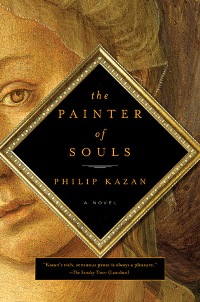
The Painter of Souls by Philip Kazan, a novel about the young Fra Filippo Lippi

“No matter how stained something is, there’s always something bright underneath.”

Pippo Lippi, the young Florentine who becomes the Carmelite friar Fra Filippo Lippi, has the innate gift of seeing into people’s purest selves and representing them in art. Philip Kazan’s first US-published novel is first in a projected series that imagines the life journey of the renowned painter, and there’s considerable joy in reading about an artist with an eye for the world’s beauty.

However, despite the glorious frescoes that adorn its convent walls and ceilings, Florence in the early 15th century hardly resembles paradise. Boys band together in the streets, essentially raising themselves while stealing food, and later, if they survive adolescence, selling their bodies to older men. Young Pippo, who’d fled his home after his father's death and his mother’s subsequent mental collapse, scrounges vellum from the trash, employing what tools he can to express his artistic talents.

The Painter of Souls is a novel of contrasts: the grim poverty of the inner city versus the quiet sanctity of religious houses; Filippo’s dual roles as friar and painter, which he never expected would be possible; the choice between chastity and carnal pleasures; and the unsavory realities of life, set against people’s dreams of heaven. More than that, though, it evokes the inner and outer struggles of a man who comes to bridge these disparate worlds through his magnificent art.

His isn’t a story without controversy. It’s one thing to show the humanity of biblical figures, but another to model their faces on ordinary, sinful people.

Filippo has guidance along his unusual path. He has several mentors (maestros) who nurture his talent, including the painters Masolino and Masaccio – the similarities in names occasionally gets confusing, but they’re based in history – and two understanding religious leaders, Fra Antonio in Pisa and Prior Pietro in Florence. The words used to describe one could fit the other as well: “He sees the world as clearly as he sees Heaven.”

Over five centuries have passed since Filippo Lippi lived, but in keeping with its characters’ depictions, their dialogue is down-to-earth and accessible. There’s humor in the telling, too, which suits Filippo's personality:

“He is soaked and frozen, but although by rights he should be miserable, he is feeling strangely virtuous. This, perhaps, is the penance the prior should have given him. As he trudges into the town he is even hoping that tomorrow’s weather will be even more vile. That way, he can positively bathe in virtuous suffering.”

This is a rewarding story that draws readers fully into its place and time. For those wanting a close-up view of artists at work, too, the novel will have strong appeal.

The Painter of Souls was published in the US by Pegasus in May ($24.95, hardcover, 272pp).  The UK publisher is Orion.  Thanks to the publisher for sending me a copy at my request.

Monday, July 11, 2016

Some recent essays about historical fiction

I've recently come across three thought-provoking essays on the historical fiction genre and thought I'd share the links.

First is Francis Spufford's "It Feels More Honest to Write Fiction."  This article for the Guardian, by the British author of the debut novel Golden Hill, explores his transition from nonfiction history to historical fiction and the shift in thought processes that this involved.  As he discovered, it's a daring, unsettling task to move from using facts as a constant reference point to relying on one's own imagination and assumptions in order to tell stories.

Here's just a snippet:  "What I notice now, is that I hardly seem to be writing in words, the way I used to. I mean, of course I am. A novel is a long, long string of words; is made of no other material at all. But that’s what it ends by being. It begins as a set of decisions about character, and time, and angle of vision, all taken before the final embodiment of those things in words... Good writing in fiction is always doing an impossibly large number of things at the same time, and most of that happens beneath the surface, where the reader never sees it directly."

For the popular History Girls blog (which is celebrating its 5th anniversary), Australian historian and writer Gillian Polack surveys the changes we've been seeing in history and fiction in an essay entitled Treasuring History Through Fiction.  "Two decades ago," she writes, "there was a vast gulf between historians and fiction writers. This hasn’t always been the case. It wasn’t so much the case in the time of Walter Scott. And it’s not the case right now. It’s now socially far more acceptable to read certain types of fiction as part of enjoying history. The way history is written into many novels has changed: it’s more sophisticated, more aware and far more researched."

For those who pay attention to the genre, this is an important read that focuses on the state of historical fiction today, and how people think about history -- and what this means for both readers and writers. She bases her conclusions on research she's conducted, including interviews with historical novelists.  I'm in the process of reading her new academic book on the subject (mentioned in the article).

And for Fiction Writers Review, Mary Volmer (whose new novel Reliance, Illinois I'll be reviewing shortly) has a piece called "The Tourist, the Expat, and the Native: A Traveler's Approach to Crafting Historical Fiction."  

She writes: "Although historical novelists write from research, rather than personal experience, about places in time that we cannot physically explore, we employ a traveler’s hunger for discovery, her sense of wonder and displacement; we apply her reflective instinct. The work of the historical novelist is an ever-deepening process of immersion, from tourist to expat to native."  And she details the changes that writers undergo as they become more fluent in the world their characters inhabit.

Don't just go by my summaries, though; it's best to read the pieces linked above in full.  You may find yourself mentally underlining apt phrasings while taking in their insights.  Or you may disagree, of course, but the issues raised are worth pondering.

Saturday, July 09, 2016

The aftermath of loss: Ashley Hay's The Railwayman's Wife

Ashley Hay’s The Railwayman’s Wife is a novel tailor-made for librarians and book lovers (like me) who enjoy literary fiction. Set in the Australian seaside town of Thirroul beginning in 1948, it navigates the emotional changes in a young woman, Anikka Lachlan, over the course of her first year as a widow.

UK & Australian cover
After her Scottish-born husband, Mac, dies in a railway accident, it’s suggested that Ani replace the librarian in Thirroul’s Railway Institute Library after her retirement. Ani has always loved to read – Jane Eyre is her favorite novel – and although her new work schedule disrupts her routine with her 10-year-old daughter, Isabel, she finds comfort in helping her fellow townspeople find the right books.

During this painful time, she develops friendships with some of her neighbors, including Roy McKinnon, who fears that his gift for poetry deserted him in peacetime, and Frank Draper, a doctor who can’t escape his past failure to prevent the deaths of recently liberated concentration camp victims. Ani is taken aback by Frank’s occasional brusqueness but comes to realize where it comes from.

This is a bittersweet, introspective novel that follows people’s search for hope and understanding even in the most trying circumstances. It evokes Ani’s feelings not only of loss also but of frustration at life’s unfairness, since she and Mac had come through years of war unscathed only for him to die tragically young anyway. It’s also understandably strange for her to spend her days surrounded by the sound of trains, one of which killed her husband.

US cover
Ani holds onto her memories of Mac, reflecting on the fact that they’ll have no more conversations with one another: “It still throws her to realize she’ll learn nothing more directly from her husband, only secondhand anecdotes about him. And such things can never be hers to claim.” Through others’ stories, Ani discovers a side to Mac she probably wouldn’t have ever known otherwise.

Chapters about their married life, but seen from Mac’s viewpoint, add to the story’s poignancy and originality. Through these sections – which feel shocking when first encountered, because one doesn’t expect to reach the minds of the dead – we learn how much Mac strived to make himself feel worthy of her.

The Railwayman’s Wife is too deep and multilayered of a book to offer simple answers, but eloquently describes how people seek their own paths out of bereavement and loss.

This was a personal purchase; I’d bought the UK edition (Allen & Unwin, 2014) back when it came out, before I heard that a US edition would be published (Atria/Simon & Schuster, April 2016, $26). This is my second entry in the 2016 Australian Women Writers Challenge.

For background on the story, see Ashley Hay's essay in Library Journal: Reading the Rails: How Australia's Historic Railway Libraries Inspired a Novel.

Wednesday, July 06, 2016

Jessie Burton's The Muse, an original, art-infused historical mystery

Like her best-selling The Miniaturist (2014), Burton’s second novel is a smart blend of literary and commercial fiction with intriguing characters and a compelling mystery at its center.

In 1967 London, Odelle Bastien, a Trinidadian émigré with literary aspirations, begins dating a man who inherited an unusual portrait of two girls from his late mother. Its discovery excites and shocks Odelle’s employers at the Skelton Institute of Art, since few works by the elusive left-wing painter Isaac Robles, who vanished during the Spanish Civil War, are known to exist.

In 1936 Andalusia, Isaac and his half sister, Teresa, become involved with the wealthy Schloss family, who are renting a nearby villa. Knowing that her own artistic efforts would be slighted by her art-dealer father, daughter Olive keeps them secret, a choice that has profound aftereffects.

Both historical settings are deftly evoked, and the alternating story lines enhance the charged atmosphere. Burton creatively infuses historical fiction with mystery in her exploration of the far-reaching consequences of deception, the relationship between art and artist, and the complex trajectory of women’s desires.

The Muse will be published later this month by Ecco, an imprint of HarperCollins ($27.99 hb/$14.99 ebook, 432pp).  In the UK, where the book was published on June 30th, the publisher is Picador (£12.99).  This review first appeared in Booklist's June issue.

I reviewed The Miniaturist two years ago and remarked on its original concept, underutilized setting (17th-century Amsterdam), and use of language.  It was a mega-bestseller that won a variety of prizes (see toward the bottom of the author's website).  The Miniaturist was very good, but The Muse is even better.  I admired how she shook up the traditional "art mystery" plotline, and after I finished it, I had a new appreciation for the title.


Sunday, July 03, 2016

Past and present: historical novels with parallel narratives

Novels that alternate between historical and contemporary stories are hugely popular.  As modern characters explore their relationships to people and events from the past, readers are taken along on their journeys. We also get to see the historical events firsthand, through the perspectives of characters who lived through an earlier era.

The ten books shown below, all from 2016, fall into the "parallel narratives" category.  This is only a selection of what's available. I find it interesting to see how the cover designs position them in the marketplace.  Some emphasize the historical aspects, while for others, you'd have little idea from the outward appearance that a good chunk of the book was historical fiction.  Of note: the novels in this post were all written by women.  None by male authors come to mind immediately, though there must be a few out there.


1888 and 2014; literary fiction centering on a diary kept by blind doctor Zinaida Lintvaryova about her friendship with Anton Chekhov.


1885 and present-day; psychological suspense surrounding a real-life murder case from 19th-century New England, and a woman now living in the house that was the scene of the crime.


2010, 1945, and 1783: stories set in three historical periods intertwine in a tale about Jewish history and a long-lost manuscript for a mysterious Bach cantata.


2015 and 1955, the small-town Midwest and glamorous Hollywood, as a young Ohio woman learns the background to her mysterious, controversial inheritance.


1897 and today; while caring for her ill grandmother, a young woman finds herself compelled to discover the provenance of a broken sculpture she finds that depicts a woman from the Belle Epoque.


1919 and 1999; a woman trapped in a difficult marriage is inspired by her grandmother's bold, carefree life during the Jazz Age.


The WWII years and 2010; at her grandfather's request, a woman travels to Germany to recover something hidden there over 70 years ago, learning about her family heritage in the process.


1888 and present day; two young women over a century apart share a connection to the tragic Johnstown Flood, as well as genealogical link.


Present day and WWII; a modern journalist uncovers the shady history of a Portuguese town by reading a decades-old novel, whose story may not be fiction.


Present day and 18th-century; a high-powered Russian art expert and Catherine the Great, Empress of Russia, are ambitious women in different centuries experiencing problems with their marriages.