



As has been reported in other sources, the longlist for the Walter Scott Prize for Historical Fiction has been revealed – for the first time ever. In past years, readers have gotten to see only the shortlist and the eventual winner.
Per the BBC: "Judges said this reflected the 40% increase in entries for the prize as
well as the 'high quality of historical fiction' currently being
published." An excellent sign for the genre – a 40% increase is significant. In addition, now that the prize has reached its 6th year, knowledge about it has become even more widespread, and publishers are no doubt paying attention and submitting more titles than ever.
The longlist includes:
The Zone of Interest by Martin Amis (Holocaust in Germany)
The Temporary Gentleman by Sebastian Barry (20th-c Ireland and Africa)
The Miniaturist by Jessie Burton (17th-c Amsterdam)
The Lie by Helen Dunmore (WWI England)
Viper Wine by Hermione Eyre (17th-c England; out in April in the US)
In the Wolf's Mouth by Adam Foulds (North Africa and Sicily, WWII)
Mr Mac and Me by Esther Freud (1914 England)
Arctic Summer by Damon Galgut (India in 1912)
Wake by Anna Hope (1920s England)
The Wake by Paul Kingsnorth (11th-c England)
The Undertaking by Audrey Magee (WWII Germany)
A God in Every Stone by Kamila Shamsie (WWI and after; Turkey, England, Peshawar)
The Architect's Apprentice by Elif Shafak (16th-c Istanbul; out in April in the US)
The Ten Thousand Things by John Spurling (14th-c China)
The Paying Guests by Sarah Waters (1922 London)
When I posted about the list on the Historical Novel Society's Facebook group on Tuesday, the reaction was enthusiastic about the award itself, mixed about the choices. No one had read all of them, or close, which is to be expected. The three I've read were books I enjoyed, for the most part, but I wouldn't put them on a favorites list.
Author Douglas Jackson noted on FB that the books were historical fiction of the literary sort, which is a good point. Apart from The Miniaturist, they would seem to fit more closely with literary (elegantly written, character-centered, more slowly paced) historical fiction than with the "genre" variety.
I've linked up my reviews of the three I'd read (I can thank Booklist
for assigning the books to me). Which ones have you read? Feel free to leave links in the comments if you've reviewed them. Which are you
rooting for, if any? Would you put any on your list of top reads for
2014/5?
Friday, February 27, 2015


Wednesday, February 25, 2015
Tony Hays, Historical Mystery Writer: A Remembrance
I've occasionally noted the passing of other historical novelists on this site, but this post is different because it's a more personal remembrance – and thus both easier to write (because there's so much that could be said) and much harder.
 Historical mystery writer Tony Hays passed away suddenly a month ago, on January 25, 2015, from complications of diabetes while on vacation in Luxor, Egypt. He'd been taking a short holiday from his job, which involved teaching English to Saudi airmen in Saudi Arabia for an American defense contractor. His obituary is online via the funeral home's website.
Among his other published works, Tony was the author of the Arthurian Mystery series, which includes four novels and one novella set in 5th-century Britain, and will have a new historical mystery, Shakespeare No More, appearing this September from Perseverance Press. He was 57 and had plans to write many more novels.
I'll be writing a different profile, more focused on Tony's work, for August's Historical Novels Review, but that's still a while away, and I didn't want his passing to go unremarked here.
Tony was a big supporter of this blog and my two books and had appeared here several times. I first interviewed him about books 1 and 2 of his Arthurian mysteries, The Killing Way and The Divine Sacrifice, back in 2010. He had told me it was his favorite interview; I especially liked how it came out because it shows his sense of humor as well as his expertise on post-Roman Britain. I reviewed his third book, The Beloved Dead, when it came out in early 2011, and he contributed a guest post on writing about well-known historical figures in 2012, when The Stolen Bride was published.
We became good friends over the past four years, chatting about our experiences with teaching and higher education (he'd taught English at universities and community colleges for 20+ years), the ups and downs of the publishing industry, his many active writing projects, and animal rescue, among other things. He used to take in and rehabilitate former puppy mill dogs for the local animal shelter at his home in Savannah, Tennessee, and had many great stories to tell about how they were adjusting.
For more on his background, including his time as an intelligence operative in Kuwait (Tony loved traveling the world and led a fascinating life), read his interview with Publishers Weekly from 2012. He was always modest about his accomplishments, and although he was hugely knowledgeable about many historical eras, his manner was the opposite of intimidating. He was generous with his time and knowledge and eager to help support newer writers.
It was rare for a day or two to go by without a short note or reply from him – he wrote such lively and interesting emails – and he often sent me stuff to read and comment on. Although I don't normally look at unpublished manuscripts, I was pleased to have been an early reader for Tony's soon-to-be-published historical crime novel, set in the Jacobean era. It's a terrific book, and he was thrilled about its upcoming publication. I only wish Tony was able to see it in print.
In the course of our conversations, Tony had given me travel suggestions (when my husband Mark and I visited Glastonbury, England, in fall 2011, we stayed at a great B&B he recommended) and helped me out with advice a number of other times. We met in person at two of the Historical Novel Society conferences and had planned to meet up last July when I was in Nashville for an HNS chapter meeting; he was going to take me around to see The Hermitage and other local sites. Unfortunately, he had a home repair emergency come up and couldn't make it, so we put it off until a later date.
News of Tony's unexpected death came as a terrible shock. After never getting a reply to my last email, I checked his Facebook page expecting to see vacation pictures and found instead many recent tributes from family and friends, mourning him and celebrating his life. It's been hard to process that he's no longer there at the other end of the keyboard, excited about a new topic for a novel or checking in from one of his travels.
While he left this world much too soon, I'm grateful for his friendship, support, and the many hours of entertaining reading his novels provided me. I hope new readers will continue to discover them, too.
Among his other published works, Tony was the author of the Arthurian Mystery series, which includes four novels and one novella set in 5th-century Britain, and will have a new historical mystery, Shakespeare No More, appearing this September from Perseverance Press. He was 57 and had plans to write many more novels.
I'll be writing a different profile, more focused on Tony's work, for August's Historical Novels Review, but that's still a while away, and I didn't want his passing to go unremarked here.
Tony was a big supporter of this blog and my two books and had appeared here several times. I first interviewed him about books 1 and 2 of his Arthurian mysteries, The Killing Way and The Divine Sacrifice, back in 2010. He had told me it was his favorite interview; I especially liked how it came out because it shows his sense of humor as well as his expertise on post-Roman Britain. I reviewed his third book, The Beloved Dead, when it came out in early 2011, and he contributed a guest post on writing about well-known historical figures in 2012, when The Stolen Bride was published.
We became good friends over the past four years, chatting about our experiences with teaching and higher education (he'd taught English at universities and community colleges for 20+ years), the ups and downs of the publishing industry, his many active writing projects, and animal rescue, among other things. He used to take in and rehabilitate former puppy mill dogs for the local animal shelter at his home in Savannah, Tennessee, and had many great stories to tell about how they were adjusting.
For more on his background, including his time as an intelligence operative in Kuwait (Tony loved traveling the world and led a fascinating life), read his interview with Publishers Weekly from 2012. He was always modest about his accomplishments, and although he was hugely knowledgeable about many historical eras, his manner was the opposite of intimidating. He was generous with his time and knowledge and eager to help support newer writers.
It was rare for a day or two to go by without a short note or reply from him – he wrote such lively and interesting emails – and he often sent me stuff to read and comment on. Although I don't normally look at unpublished manuscripts, I was pleased to have been an early reader for Tony's soon-to-be-published historical crime novel, set in the Jacobean era. It's a terrific book, and he was thrilled about its upcoming publication. I only wish Tony was able to see it in print.
In the course of our conversations, Tony had given me travel suggestions (when my husband Mark and I visited Glastonbury, England, in fall 2011, we stayed at a great B&B he recommended) and helped me out with advice a number of other times. We met in person at two of the Historical Novel Society conferences and had planned to meet up last July when I was in Nashville for an HNS chapter meeting; he was going to take me around to see The Hermitage and other local sites. Unfortunately, he had a home repair emergency come up and couldn't make it, so we put it off until a later date.
News of Tony's unexpected death came as a terrible shock. After never getting a reply to my last email, I checked his Facebook page expecting to see vacation pictures and found instead many recent tributes from family and friends, mourning him and celebrating his life. It's been hard to process that he's no longer there at the other end of the keyboard, excited about a new topic for a novel or checking in from one of his travels.
While he left this world much too soon, I'm grateful for his friendship, support, and the many hours of entertaining reading his novels provided me. I hope new readers will continue to discover them, too.
Monday, February 23, 2015
Book review: The Siege Winter, by Ariana Franklin and Samantha Norman

As civil war devastates mid–twelfth century England, Maud, the 16-year-old chatelaine of Kenniford, weds a boorish older man to save her people. Raped and discarded, Em, a peasant girl from the Cambridgeshire fens, is rescued by an aging mercenary and becomes an expert archer under his tutelage. Their stories converge as Matilda, the previous king’s heir, escapes her rival, King Stephen, and seeks shelter at Kenniford.
The event-filled plotline includes themes of vengeance and coming-of-age, a hint of romance, and a mystery about a piece of parchment that Em’s attacker will kill to repossess. Her slow recovery from emotional trauma is especially touching.
The cheeky wit and precise descriptions that were Franklin’s hallmarks are as sharp as ever, and the major characters are delightfully human. The book also has a genuine feel for medieval life and times. This unique collaboration is a worthy conclusion to one remarkable career and a promising beginning to another.
This review first appeared in Booklist's January 1st issue. The Siege Winter is published by Morrow this week in hardcover ($25.99, 352pp) and as an ebook. In the UK, the book is titled Winter Siege.
I've reviewed several of Ariana Franklin's (aka Diana Norman) books previously on this blog - Fitzempress' Law, her first novel from 1980, and King of the Last Days, which is about as hard to find. My favorite, though, is Shores of Darkness, historical suspense-adventure set during the time of Queen Anne. It's an outstanding romp through the late Stuart era.
Friday, February 20, 2015
Spotlight on the historical fiction of Lake Union and some self-published success stories
Today I'm shining a spotlight on Amazon Publishing's Lake Union imprint, which publishes historical and contemporary fiction along with selected nonfiction. Over the past few months, the number of self-published historical novels being picked up by Lake Union for re-release caught my attention. The folks in Editorial there are clearly paying attention to sales and reviews for indie novels on Amazon and carefully choosing high-quality titles to acquire for reissue. The process typically involves editorial revisions as well as a cover redesign.
(Lake Union acquires many original titles, too, including I Am Livia by Phyllis T. Smith, who was interviewed here a year ago.)
Here's a look at some of these formerly self-pubbed titles with their cover makeovers. A few of these have featured on this site previously. It's great to see many historical novels getting wider distribution and attention in this way, and I love the broad range of periods and subjects represented.

The story of Rose Wilder Lane, daughter of Laura Ingalls Wilder, and the collaboration that produced the Little House books. This was one of my favorites of 2013 (see my earlier review). The new release date is March 17th, 2015.

A woman is secretly trained by her father in painting in 14th-century Tuscany. The new edition with this beautiful cover was published in December 2014.

A young midwife in 1775 Boston becomes a spy for the patriot cause and discovers a conspiracy against her good friend Abigail Adams and her family. The new edition is out on April 7th, 2015. Jodi Daynard guest posted here in 2013 about her in-depth research into the period.

Here's longtime historical novelist Colin Falconer's story of Isabella of France and her troubled marriage to Edward II of England, which sets her on the path to political rebellion. New edition out April 21, 2015.

In this decades-spanning saga set in the antebellum South, a strong bond develops between a privileged young woman and the enslaved woman who was her wet nurse. The revised edition was out in August 2014.

A beautiful maid of honor at Henry VIII's court tries to avert the unwelcome advances of a notorious philanderer by asking the king himself for help. New edition was released January 2015.

In 406 BC, a young Roman woman marries an Etruscan nobleman to secure a truce between their warring cities. When the political ties between Rome and the Etruscan city of Veii break down, Caecilia has a difficult choice to make. New edition out April 28, 2015.
Originally published by Pier 9/Murdoch Books in Australia, the book was later self-published on Kindle and print in the US... and subsequently acquired by Lake Union (along with the next two in the series). Read my reviews of The Wedding Shroud and book 2, The Golden Dice, as well as Elisabeth's guest post on feminine power in Etruscan society.
In addition to the titles above, Libbie Hawker's Tidewater (about Pocahontas; May 17th reissue) and Carol Bodensteiner's Go Away Home (a woman's coming of age, set on the WWI home front in Iowa; June reissue) were picked up by Lake Union, but their new cover art isn't online yet. As Lavender Ironside, Libbie Hawker has written a series of Egyptian-set novels, beginning with The Sekhmet Bed (which I reviewed in 2012). Read more about Lake Union's acquisition of Go Away Home at Jenny Quinlan's Historical Editorial blog.
If I'm missing any others, please mention them in the comments.
(Lake Union acquires many original titles, too, including I Am Livia by Phyllis T. Smith, who was interviewed here a year ago.)
Here's a look at some of these formerly self-pubbed titles with their cover makeovers. A few of these have featured on this site previously. It's great to see many historical novels getting wider distribution and attention in this way, and I love the broad range of periods and subjects represented.
The story of Rose Wilder Lane, daughter of Laura Ingalls Wilder, and the collaboration that produced the Little House books. This was one of my favorites of 2013 (see my earlier review). The new release date is March 17th, 2015.
A woman is secretly trained by her father in painting in 14th-century Tuscany. The new edition with this beautiful cover was published in December 2014.
A young midwife in 1775 Boston becomes a spy for the patriot cause and discovers a conspiracy against her good friend Abigail Adams and her family. The new edition is out on April 7th, 2015. Jodi Daynard guest posted here in 2013 about her in-depth research into the period.
Here's longtime historical novelist Colin Falconer's story of Isabella of France and her troubled marriage to Edward II of England, which sets her on the path to political rebellion. New edition out April 21, 2015.
In this decades-spanning saga set in the antebellum South, a strong bond develops between a privileged young woman and the enslaved woman who was her wet nurse. The revised edition was out in August 2014.
A beautiful maid of honor at Henry VIII's court tries to avert the unwelcome advances of a notorious philanderer by asking the king himself for help. New edition was released January 2015.
In 406 BC, a young Roman woman marries an Etruscan nobleman to secure a truce between their warring cities. When the political ties between Rome and the Etruscan city of Veii break down, Caecilia has a difficult choice to make. New edition out April 28, 2015.
Originally published by Pier 9/Murdoch Books in Australia, the book was later self-published on Kindle and print in the US... and subsequently acquired by Lake Union (along with the next two in the series). Read my reviews of The Wedding Shroud and book 2, The Golden Dice, as well as Elisabeth's guest post on feminine power in Etruscan society.
~
In addition to the titles above, Libbie Hawker's Tidewater (about Pocahontas; May 17th reissue) and Carol Bodensteiner's Go Away Home (a woman's coming of age, set on the WWI home front in Iowa; June reissue) were picked up by Lake Union, but their new cover art isn't online yet. As Lavender Ironside, Libbie Hawker has written a series of Egyptian-set novels, beginning with The Sekhmet Bed (which I reviewed in 2012). Read more about Lake Union's acquisition of Go Away Home at Jenny Quinlan's Historical Editorial blog.
If I'm missing any others, please mention them in the comments.
Monday, February 16, 2015
Review of Fiercombe Manor by Kate Riordan, a dual-period gothic saga

Fiercombe Manor in Gloucestershire, a Tudor-era dwelling crafted of golden stone, sits at the base of a valley “so steep that it’s like an amphitheatre.” As Alice Eveleigh wanders the grounds and gets to know her temporary home during the languid summer of 1933, her observations form an inviting travelogue of this hidden corner of the Cotswolds.
Left pregnant after a brief affair with a married man, Alice is forced by her parents to leave London to stay with her mother’s old friend, Edith Jelphs, the housekeeper at Fiercombe, until the baby is born – after which it will be taken away and brought to an orphanage. Away from her mother’s disapproval, Alice thrives in her new environment, though her pretense of being a widow proves to be tiring. Mrs. Jelphs is kindly but cautiously watchful, more so as Alice begins quietly uncovering a local mystery.
A previous mistress of the estate, Lady Elizabeth Stanton was a dark-haired beauty who lived in nearby Stanton House in the late 19th century and who was pressured to produce a son. Why was Stanton House dismantled, and what became of Elizabeth and her daughter Isabel?
Hints of tragedy, inherited madness, and restrictions placed upon women wind through this dual-period novel, but while it offers occasional frissons of suspense, it lacks the terrifying menace typically found in the genre. The pacing is leisurely, and despite a past that holds overwhelming sadness, Fiercombe is a lovely setting in which to linger. If you google “Owlpen Manor,” the place that inspired it, you can visualize its charm.
Fiercombe Manor will be published by Harper tomorrow in hardcover ($26.99, 416pp). The UK title is The Girl in the Photograph. Thanks to the publisher for enabling access via Edelweiss. This review first appeared in February's Historical Novels Review.
This is Kate Riordan's second novel; the first, Birdcage Walk, is a murder mystery based on a real-life Edwardian crime. It's available in the US on Kindle for a mere $2.99, so I snapped it up.
And here's a pic of Owlpen Manor, to save you the extra step of googling. I would love to visit this beautiful place in person. Its website is here, and the owners even offer holiday cottages (very tempting!).
 |
| Owlpen Manor at front right, Holy Cross Church in background. © Copyright Derek Harper, licensed for reuse under this Creative Commons Licence |
Saturday, February 14, 2015
Book review: The Secrets of Sir Richard Kenworthy, by Julia Quinn
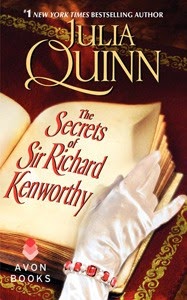
The fourth of five daughters, Iris is a sensible woman who doesn’t attract attention, so she’s puzzled but quietly pleased when Richard asks to call on her. He’s handsome and kind, but what’s the hurry to get married? When he deliberately steals a kiss from her in sight of her aunt, he forces her hand – and when Iris learns his true purpose, her anger is justified.
While the premise feels a bit over-the-top, this novel is rooted in the conventions of its time, when one careless decision could mean social ruin. Both gentle yet witty, Richard and Iris are a well-matched pair. Quinn also accomplishes the near-impossible by redeeming Richard’s character in the eyes of Iris and the reader and by crafting a believable reconciliation.
There are some lovely descriptions of the Yorkshire countryside, and fans of the series (this is book #4) can look forward to more terrible music from the Smythe-Smith string quartet.
Here's a special feature for Valentine's Day: my first review of a historical romance here. If you've read this novel, what did you think? According to other reviews I've read, Richard is one of Quinn's more controversial heroes; you'll have to read the novel to see exactly why.
I wrote this review for February's Historical Novels Review; thanks to the publisher for granting me access via Edelweiss. The Secrets of Sir Richard Kenworthy was published by Avon in 2015 (384pp, $7.99 / $9.99 Can). The UK publisher is Piatkus (£8.99). It was named to the LibraryReads list for February.
Monday, February 09, 2015
Charles Todd's A Fine Summer's Day, an Ian Rutledge prequel set in pre-WWI England

In this prequel set in June 1914, Rutledge is just 23, a young policeman with a bright future in the Yard – if he can endure the Chief Superintendent’s antipathy. He’s naïve when it comes to women, though. Newly engaged, he thinks his pretty fiancée Jean Gordon will make him happy, while his sister and friends are doubtful. When he gets called to investigate a hanging in Yorkshire, he finds himself befuddled. The dead man was a successful furniture maker with no known enemies. Before long, Rutledge is assigned to investigate two other murders in different corners of the country, and the victims have similarly unblemished reputations.
Readers are shown the perpetrator at the beginning, but even after Rutledge figures things out, there’s still plenty of mystery left. The story becomes an exciting cat-and-mouse thriller as he pursues his man while determining the “how” and the “why.” Tension and atmosphere are added via Britain’s increasing slide towards war, Jean’s pressure on him to enlist, and his need to clear an innocent man before it’s too late. Despite one outlandish coincidence, this is a suspenseful mystery that grips one’s attention until the end.
A Fine Summer's Day was published in January by William Morrow in hardcover ($25.99 or Can$33.50, 352pp). This review first appeared in February's Historical Novels Review.
Some other notes:
- If you haven't already noticed, the "elegant country house" cover is on its way to becoming as prevalent as the "headless woman" cover. This doesn't indicate, in either case, that the books are all the same or even close to similar style-wise, though.
- Yes, this is 17th in a series, but because it's a prequel, you can read it first without any trouble. (I'm not one who needs to read series books in order, but I know others prefer to do that.) I've read many books in the Ian Rutledge series so far, including #1, 15, and 16, but not all of them yet.
Saturday, February 07, 2015
Lawrence Hill's bestselling The Book of Negroes, coming to American TV in mid-February

When slavers wrest 11-year-old Aminata Diallo from her West African village in 1745, she vows to remember everything. After enduring the harrowing Middle Passage, she becomes the property of a South Carolina indigo farmer whose overseer notes her intelligence and secretly teaches her to read.
Whether keeping books for a Jewish businessman in Revolutionary-era Manhattan, documenting her fellow Black Loyalists before their transport to Nova Scotia (reflecting Hill’s original title, The Book of Negroes), or joining the British colony of Freetown, Sierra Leone, Aminata retains her self-respect. Throughout her life, she holds tightly to the idea of freedom for everyone forced into slavery, and to her love for the African husband from whom she’s constantly separated.
By the time Aminata journeys to London in 1802 as a symbol of the abolitionist movement, readers will have witnessed the dehumanizing slave trade from inside and out. An unforgettable epic, seen through the eyes of a sharply realized, indomitable heroine.
 The review above first appeared in Booklist's 10/15/2007 issue. The book's U.S. edition was published by Norton under the title Someone Knows My Name. (For background on how that came about, read the author's piece in the Guardian, "Why I'm Not Allowed My Book Title.") And for the record, the "Book of Negroes" is an important historical document, one that lists the over 3000 black refugees who arrived in Nova Scotia following the American Revolution.
 I had mentioned the original title in the review to honor the writer's choice and to alert readers that Someone Knows My Name and The Book of Negroes were the same book.
The Book of Negroes, which won the Rogers Writers' Trust Fiction Prize and the Commonwealth Writers' Prize, was selected for Canada Reads in 2013 and has become a modern classic.
Norton has re-released the novel in trade paperback (image at top left) to coincide with the American premiere of the six-part TV miniseries based on the book, which stars Cuba Gooding Jr., Jane Alexander, Louis Gossett, Jr., and Aunjanue Ellis as Aminata. It will be shown on BET on February 16, 17, and 18; check your local listings for times. My DVR is set to record it. For the Canadian readers who have been watching it on CBC, what did you think?
Wednesday, February 04, 2015
Mystery meets the Manhattan Project: Diane Fanning's Scandal in the Secret City

Libby Clark, a recent UPenn grad with a master’s in analytical chemistry, is thrilled to get a job offer from Eastman Kodak since there aren’t many employers in 1942 who’d hire a female scientist. The utter secrecy under which she’s ordered to carry out her tasks turns sinister, though, when her former roommate’s sister is murdered.
Irene Nance was an easygoing young woman with an active love life. When Irene’s body is mysteriously moved (something the authorities deny doing), Libby suspects a cover-up but doesn’t know the reasons why. Having promised Irene’s family to seek justice for her, Libby gets stonewalled at every turn and takes a huge risk by pursuing an investigation. That’s on top of dealing with sexist remarks from coworkers with less technical knowledge than she has.
The timeline feels a little awkward in the beginning with its multiple-flashback structure, but this is a minor issue. The geographical layout and high-pressure atmosphere of Oak Ridge are re-created in extensive detail, as is the curious plight of its scientists, who are simultaneously proud of their work for the war effort and concerned about what they believe is their project’s end result.
Libby herself is a brave and admirable career woman, and seeing her in action, carefully hunting the truth while refusing to play down her expertise, makes for a very satisfying story. There are enough clues for readers to guess the killer well before Libby does, but even so, her appearance in future volumes in the series is eagerly awaited.
Scandal in the Secret City was published by Severn House in 2014 in hardcover ($28.95 or £19.99, 256pp). Thanks to the publisher for approving my NetGalley access. This review first appeared in February's Historical Novels Review.
Sunday, February 01, 2015
Congratulations to the historical fiction winners of the 2015 ALA RUSA awards
I was in the audience when the winners of this year's book and media awards from the American Library Association's RUSA (Reference & User Services Association) were announced earlier tonight in Chicago. Congratulations to all of the winning and short-listed authors!
Because of this blog's focus, I'll specifically list just the winners that fit with the genre of historical fiction.
 Among the 2015 selections for the Reading List, the year's best in genre fiction:
In Historical Fiction, the winner was Kate Forsyth's Bitter Greens (Thomas Dunne, 2014), a retelling of "Rapunzel" set in 17th-century France and a century earlier in Italy. Read my interview with Kate, which was based on the original Australian edition. It's great to see the novel receiving such acclaim in the US.
The Historical Fiction shortlist included Amy Belding Brown's Flight of the Sparrow (colonial New England); Nicola Griffith's Hild (Anglo-Saxon England); James Lee Burke's Wayfaring Stranger (1940s US); and Ariel Lawhon's The Wife, the Maid and the Mistress (Jazz Age Manhattan).
In Mystery, the winner was Ashley Weaver's Murder at the Brightwell (Minotaur, 2014), a Golden Age-style murder mystery set at a resort in '30s England. Read my review from last fall.
On the Mystery shortlist was Bruce Holsinger's historical thriller A Burnable Book.
Among the 26 titles on ALA's list of Notable Books, a best-of list for adult readers, was Anthony Doerr's All the Light We Cannot See (WWII France) and Richard Flanagan's The Narrow Road to the Deep North (WWII-era POWs in southeast Asia; the recent Booker Prize winner).
Congrats also to my Booklist editor, Brad Hooper, for winning the 2015 Louis Shores Award for book reviewing. Very well deserved!
Because of this blog's focus, I'll specifically list just the winners that fit with the genre of historical fiction.
In Historical Fiction, the winner was Kate Forsyth's Bitter Greens (Thomas Dunne, 2014), a retelling of "Rapunzel" set in 17th-century France and a century earlier in Italy. Read my interview with Kate, which was based on the original Australian edition. It's great to see the novel receiving such acclaim in the US.
The Historical Fiction shortlist included Amy Belding Brown's Flight of the Sparrow (colonial New England); Nicola Griffith's Hild (Anglo-Saxon England); James Lee Burke's Wayfaring Stranger (1940s US); and Ariel Lawhon's The Wife, the Maid and the Mistress (Jazz Age Manhattan).
In Mystery, the winner was Ashley Weaver's Murder at the Brightwell (Minotaur, 2014), a Golden Age-style murder mystery set at a resort in '30s England. Read my review from last fall.
On the Mystery shortlist was Bruce Holsinger's historical thriller A Burnable Book.
Among the 26 titles on ALA's list of Notable Books, a best-of list for adult readers, was Anthony Doerr's All the Light We Cannot See (WWII France) and Richard Flanagan's The Narrow Road to the Deep North (WWII-era POWs in southeast Asia; the recent Booker Prize winner).
Congrats also to my Booklist editor, Brad Hooper, for winning the 2015 Louis Shores Award for book reviewing. Very well deserved!
Wednesday, January 28, 2015
Two new and substantial historical novel reissues: Zemindar and Csardas
Reissues can bring new life and many new readers to older, classic novels. Both Valerie Fitzgerald's Zemindar (1981) and Diane Pearson's Csardas (1975) were bestsellers in their day: massive, sweeping epics set during volatile historical eras. Both have been compared to Gone with the Wind in terms of their scope and the quality of their storytelling.
Zemindar, a novel of adventure and romance set against the backdrop of a troubled 1850s India, won the Historical Novel Prize in Memory of Georgette Heyer as an unpublished manuscript and was published by The Bodley Head shortly thereafter. When I was pulling together a list of the prize's winners in 2010, I wrote that it was a "prime candidate for reissue." Zemindar, the author's only novel, was based on her grandmother's experiences during the Sepoy Mutiny.
Csardas, named after a traditional Hungarian folk dance, tells the story of two aristocratic Hungarian sisters whose lives and fortunes change dramatically during the two world wars. Pearson, who has been writing since 1967, was president of the UK's Romantic Novelists Association for 25 years.
Both Zemindar and Csardas were reissued by the UK publisher Head of Zeus in trade paperback in 2014. Check out the gorgeous new packaging! My copy of the 1985 mass market paperback of Zemindar (which is in great condition but has teeny tiny print) stands in the background.

I'm looking forward to reading them both and would welcome the thoughts of anyone who's already read them. At the moment, American readers will have to order them from elsewhere, but I'll update you if there's more news on that score. I'll provide some links here because there are multiple out of print editions on bookseller sites, which can make it hard to find the new ones. Here are the UK buying options for Zemindar and Csardas on Head of Zeus's page (both are £15.00). At other sites, such as Chapters.ca and Amazon.ca, I recommend searching by ISBN to find the right ones: 9781781857519 (Csardas), or 9781781859544 (Zemindar).
All of the books in the pic above were personal purchases.
Valerie Fitzgerald, who's in her 80s and living in Ottawa, recently gave an interview with the Ottawa Citizen in celebration of the re-release, speaking about her childhood in India, her writing career, and her thoughts looking back on Zemindar 34 years later.
Since I'd written about Zemindar previously on the blog, her grandson's wife recently got in touch to tell me about the new edition, the newspaper interview, and another interview that Valerie Fitzgerald would be doing with CBC Radio. That interview aired yesterday afternoon and is available at the CBC site. It's 13 minutes long, and I found it completely fascinating to hear her discuss her life, the background to the book, some fun stories about the industry, and why she never wrote another novel. I highly recommend taking the time to listen to it.
Zemindar, a novel of adventure and romance set against the backdrop of a troubled 1850s India, won the Historical Novel Prize in Memory of Georgette Heyer as an unpublished manuscript and was published by The Bodley Head shortly thereafter. When I was pulling together a list of the prize's winners in 2010, I wrote that it was a "prime candidate for reissue." Zemindar, the author's only novel, was based on her grandmother's experiences during the Sepoy Mutiny.
Csardas, named after a traditional Hungarian folk dance, tells the story of two aristocratic Hungarian sisters whose lives and fortunes change dramatically during the two world wars. Pearson, who has been writing since 1967, was president of the UK's Romantic Novelists Association for 25 years.
Both Zemindar and Csardas were reissued by the UK publisher Head of Zeus in trade paperback in 2014. Check out the gorgeous new packaging! My copy of the 1985 mass market paperback of Zemindar (which is in great condition but has teeny tiny print) stands in the background.
I'm looking forward to reading them both and would welcome the thoughts of anyone who's already read them. At the moment, American readers will have to order them from elsewhere, but I'll update you if there's more news on that score. I'll provide some links here because there are multiple out of print editions on bookseller sites, which can make it hard to find the new ones. Here are the UK buying options for Zemindar and Csardas on Head of Zeus's page (both are £15.00). At other sites, such as Chapters.ca and Amazon.ca, I recommend searching by ISBN to find the right ones: 9781781857519 (Csardas), or 9781781859544 (Zemindar).
All of the books in the pic above were personal purchases.
Valerie Fitzgerald, who's in her 80s and living in Ottawa, recently gave an interview with the Ottawa Citizen in celebration of the re-release, speaking about her childhood in India, her writing career, and her thoughts looking back on Zemindar 34 years later.
Since I'd written about Zemindar previously on the blog, her grandson's wife recently got in touch to tell me about the new edition, the newspaper interview, and another interview that Valerie Fitzgerald would be doing with CBC Radio. That interview aired yesterday afternoon and is available at the CBC site. It's 13 minutes long, and I found it completely fascinating to hear her discuss her life, the background to the book, some fun stories about the industry, and why she never wrote another novel. I highly recommend taking the time to listen to it.
Monday, January 26, 2015
An interview with Gary Inbinder, author of The Devil in Montmartre
Today I'm hosting an interview with
novelist Gary Inbinder. His third novel The Devil in Montmartre, released last month, brings readers into the bustling fine art scene and dark underworld of Paris in 1889. As the city is flooded with tourists during the Universal Exposition, Inspector Achille Lefebvre, a young but highly regarded member of the Sûreté, investigates the murder of a young woman who danced the Can-Can at the Moulin Rouge.
The Devil in Montmartre stands well on its own, but one of your protagonists, the talented artist Marcia Brownlow – probably my favorite character – also featured in The Flower to the Painter. What made you decide to bring Marcia back for an encore appearance?
Marcia Brownlow is one of my favorite characters. After I finished The Flower to the Painter I had the idea of using her, and some of the other characters, in another novel. A fin de siècle Paris setting appealed to me, as did the idea of a murder mystery with references to Jack the Ripper.
 The action in the novel unfolds through many different viewpoints. How difficult of a process was it to piece together and structure the novel in this way?
I had used a first person narrative in earlier novels, but I found the single perspective too limiting for this particular story. On the other hand, using multiple first person narrators seemed too complicated and potentially confusing. So, I struck a balance by using a third person narrative with multiple points of view. Once I got into it, it seemed to flow quite naturally.
I’d love to know more about your research into Montmartre in 1889, since I felt fully immersed in the setting. Based on the depth of detail, I’m guessing you know French and have spent time walking around Paris in person, though please correct me if I’m wrong!
Two admissions. First, I had two years of college French. I can still read French fairly well, but I wouldn't attempt to write or speak it. Second, my knowledge of 1889 Paris is dependent on imagination and years of reading histories and period literature, studying old photographs, paintings, drawings, maps and so forth. Of course, for months prior to writing The Devil in Montmartre, I added to my knowledge with additional research.
Your detective, Achille Lefebvre, is well-respected by his fellow detectives and known even in less reputable circles to be a trustworthy fellow. He’s not just an admirable character, though, but a likeable one. How did you come up with his personality? Will we be seeing more of him in future books?
I'm glad you liked Achille. I particularly enjoyed writing his scenes and dialogue. He combines traits of my favorite fictional detectives, including Simenon's Maigret and Sherlock Holmes. However, I tried to "humanize" him by focusing on his domestic life, especially his relationship with his wife, little daughter, and difficult mother-in-law. As for future books, there's a sequel in the works but it's a bit premature to say anything more about it.
Achille runs into some resistance when he advocates for the use of fingerprinting as an aid in solving crimes. Why was this viewed as such a radical development?
At the time, no major police force had used fingerprinting for identification purposes. However, the English anthropologist, Sir Francis Galton, published his system for fingerprint identification in the late 1880s, something I mention in the novel. In 1892, Juan Vucetich, a Croatian detective working for the Argentine police, made the first positive identification of fingerprints in a criminal case. Vucetich based his identification and classification system on Galton's writings, but it took more than a decade before police departments worldwide adopted it.
 Interestingly, Samuel Clemens, aka Mark Twain, anticipated the use of a fingerprint to solve a crime in a chapter of Life on the Mississippi (1883) and he revisited the subject in The Tragedy of Puddn'head Wilson (1894).
Your three novels convey some of the same themes – artistic creation, for one – and are set in historical times, but are a bit different genre-wise. What prompted your move into historical crime?
I'm a retired lawyer, I've had some experience working with law enforcement, and I'm partial to good historical fiction and classic crime novels. The historical mystery/crime genre offered a good vehicle in which to express my varied interests, and I just decided it was the right time to give it a try.
What originally inspired your interest in French art during the late 19th century? Do you have any favorite painters, post-Impressionist or otherwise?
I grew up with art. My late brother was a fine artist and art teacher, and my older sister majored in Art History and did some of her post graduate work at The Sorbonne. As I recall, among the first books that caught my attention when I was learning to read—or perhaps even before I could read—was a set of illustrated biographies of the painters, including Manet, Monet, Renoir, Van Gogh, Gauguin and Toulouse-Lautrec. My parents took me to the Art Institute of Chicago when I was very young. The paintings fascinated me, and the museum has a fine collection of French Impressionist and post-Impressionist paintings, including Seurat's A Sunday on La Grande Jatte.
In addition, I saw the films Lust for Life, the story of Van Gogh with Kirk Douglas, and John Huston's version of Moulin Rouge with Jose Ferrer as Toulouse-Lautrec. These have remained favorites, which I've returned to over the years. As a result, I have many sources to draw upon when visualizing scenes for my novels.
Gary Inbinder's The Devil in Montmartre was published by Pegasus Crime in December (hardcover, $25.95, 256pp). Visit the author's blog at http://garyinbinder.blogspot.com.
~
The Devil in Montmartre stands well on its own, but one of your protagonists, the talented artist Marcia Brownlow – probably my favorite character – also featured in The Flower to the Painter. What made you decide to bring Marcia back for an encore appearance?
Marcia Brownlow is one of my favorite characters. After I finished The Flower to the Painter I had the idea of using her, and some of the other characters, in another novel. A fin de siècle Paris setting appealed to me, as did the idea of a murder mystery with references to Jack the Ripper.
I had used a first person narrative in earlier novels, but I found the single perspective too limiting for this particular story. On the other hand, using multiple first person narrators seemed too complicated and potentially confusing. So, I struck a balance by using a third person narrative with multiple points of view. Once I got into it, it seemed to flow quite naturally.
I’d love to know more about your research into Montmartre in 1889, since I felt fully immersed in the setting. Based on the depth of detail, I’m guessing you know French and have spent time walking around Paris in person, though please correct me if I’m wrong!
Two admissions. First, I had two years of college French. I can still read French fairly well, but I wouldn't attempt to write or speak it. Second, my knowledge of 1889 Paris is dependent on imagination and years of reading histories and period literature, studying old photographs, paintings, drawings, maps and so forth. Of course, for months prior to writing The Devil in Montmartre, I added to my knowledge with additional research.
Your detective, Achille Lefebvre, is well-respected by his fellow detectives and known even in less reputable circles to be a trustworthy fellow. He’s not just an admirable character, though, but a likeable one. How did you come up with his personality? Will we be seeing more of him in future books?
I'm glad you liked Achille. I particularly enjoyed writing his scenes and dialogue. He combines traits of my favorite fictional detectives, including Simenon's Maigret and Sherlock Holmes. However, I tried to "humanize" him by focusing on his domestic life, especially his relationship with his wife, little daughter, and difficult mother-in-law. As for future books, there's a sequel in the works but it's a bit premature to say anything more about it.
Achille runs into some resistance when he advocates for the use of fingerprinting as an aid in solving crimes. Why was this viewed as such a radical development?
At the time, no major police force had used fingerprinting for identification purposes. However, the English anthropologist, Sir Francis Galton, published his system for fingerprint identification in the late 1880s, something I mention in the novel. In 1892, Juan Vucetich, a Croatian detective working for the Argentine police, made the first positive identification of fingerprints in a criminal case. Vucetich based his identification and classification system on Galton's writings, but it took more than a decade before police departments worldwide adopted it.
Interestingly, Samuel Clemens, aka Mark Twain, anticipated the use of a fingerprint to solve a crime in a chapter of Life on the Mississippi (1883) and he revisited the subject in The Tragedy of Puddn'head Wilson (1894).
Your three novels convey some of the same themes – artistic creation, for one – and are set in historical times, but are a bit different genre-wise. What prompted your move into historical crime?
I'm a retired lawyer, I've had some experience working with law enforcement, and I'm partial to good historical fiction and classic crime novels. The historical mystery/crime genre offered a good vehicle in which to express my varied interests, and I just decided it was the right time to give it a try.
What originally inspired your interest in French art during the late 19th century? Do you have any favorite painters, post-Impressionist or otherwise?
I grew up with art. My late brother was a fine artist and art teacher, and my older sister majored in Art History and did some of her post graduate work at The Sorbonne. As I recall, among the first books that caught my attention when I was learning to read—or perhaps even before I could read—was a set of illustrated biographies of the painters, including Manet, Monet, Renoir, Van Gogh, Gauguin and Toulouse-Lautrec. My parents took me to the Art Institute of Chicago when I was very young. The paintings fascinated me, and the museum has a fine collection of French Impressionist and post-Impressionist paintings, including Seurat's A Sunday on La Grande Jatte.
In addition, I saw the films Lust for Life, the story of Van Gogh with Kirk Douglas, and John Huston's version of Moulin Rouge with Jose Ferrer as Toulouse-Lautrec. These have remained favorites, which I've returned to over the years. As a result, I have many sources to draw upon when visualizing scenes for my novels.
~
Gary Inbinder's The Devil in Montmartre was published by Pegasus Crime in December (hardcover, $25.95, 256pp). Visit the author's blog at http://garyinbinder.blogspot.com.
Saturday, January 24, 2015
Greer Macallister's The Magician's Lie, an involving tale of deception, female agency, and fin-de-siècle magic

Then I read and reviewed Rosie Thomas’ The Illusionists, about a troupe of magicians in Victorian London, and enjoyed that one, too.
Now, when presented with a 3rd recent historical novel about magic and magicians, I had no qualms about picking it up, and I’m very glad I did. The storyline grabbed me from the first paragraph, and the pacing and narrative tension remained strong through the end. Although I had correctly guessed part of the conclusion, other aspects were a surprise.
Guess it’s time for me to revisit my reading preferences – at least in terms of magicians. (I still don't like circuses.)
Set amid the alluring world of stage magic at the turn of the 20th century, Greer Macallister’s The Magician’s Lie is a novel about reality and illusion, love and betrayal, wealth and destitution, confidence and fear, truth and deception – and how quickly one can transform into the other.
The premise is thus. In Waterloo, Iowa, one evening in 1905, hours after the renowned female magician known as the Amazing Arden performs a unique variation on her controversial “Halved Man” trick, the bloodied body of a man – her husband – is found stuffed into a smashed wooden container beneath the stage. Had she killed him before the crowd as part of her act? Seizing the opportunity, Virgil Holt, a down-on-his-luck police officer from the nearby town of Janesville, catches the beautiful young woman during her planned escape and carts her into the station for questioning.
Arden claims not to know that anyone was murdered, but Holt doesn’t believe her. She insists he’ll be killing her if he doesn’t let her go. Not convinced, but willing to listen, he handcuffs her wrists to a chair to prevent her from fleeing and demands to know the truth.
And so she spins a tale about her life and career that takes her from Tennessee farm country to the vaudeville circuit and on to national fame as a brilliant and daring performer. (There’s plenty more, but I won’t be giving it away.) Is it fact or fancy or some of each? Either way, her story is so diverting that it’s easy to forget the author behind the curtain.
Edgy and exciting, The Magician’s Lie is a fast-moving historical novel that I would also recommend as a “gateway book” for introducing historical fiction to newcomers. Arden’s voice is fresh, appealing, and (seemingly) sympathetic. Without overburdening them with details, Macallister offers readers many informative new tidbits, such as the inner workings of specific magic tricks. She also presents the life of an itinerant performer in the late 19th century from an unusual viewpoint: that of a woman.
In the “conversation with the author” at the end (please save it until later if you plan to read the book!), Macallister says that since she was new to historical fiction, the writing process took about five years from initial idea to final draft. It may have required a lot of time and effort, but I think she got the difficult balance of fact and fiction pretty much right.
The Magician’s Lie is published by Sourcebooks Landmark this month (312pp, $23.99 hardcover, $9.60 on Kindle). It was on the LibraryReads list for January. I picked it up as an ARC at the publisher’s BEA booth last summer.
Wednesday, January 21, 2015
Historical fiction at ALA Midwinter: galleys, authors, signings
I've been an American Library Association member for 20 years, but this year will be the first time I'll be attending ALA Midwinter. The conference will be held in Chicago on January 30 - February 3, so it's relatively close by. I'm looking forward to catching up with other librarians, cruising the exhibit hall, and reviewing job seekers' resumes in the Placement Center. Needless to say I'm hoping for decent weather.
Here's what I've managed to gather together as far as historical novels and novelists present at the show. Sources include Library Journal, publisher announcements, and the ALA Midwinter site.
~Galleys available~
Barbara Hoffert of Library Journal has already put together an amazing galley guide for Midwinter, so I'm not going to copy over all of the relevant HF info; just click on over to visit the LJ site. The guide is very detailed and lists settings for most of the historical novels being given away at publishers' booths, so you should be able to pick them out easily.
I have a number of galleys already thanks to publishers, Booklist, and Edelweiss, but just a few of the others I'm particularly eager about are: Shona Patel's Flame Tree Road (MIRA, June), set in late 19th-century India, which she says on her FB page is about Dadamoshai, Layla's grandfather from Teatime for the Firefly; Jami Attenberg's Saint Mazie (Grand Central, June), set in NYC's Lower East Side during the Jazz Age; Anna Freeman's The Fair Fight (Riverhead, April), female boxers in 18th-c England (have heard great reports about it); and Susanna Kearsley's A Desperate Fortune (Sourcebooks, April), another Scottish-set romantic timeslip.
~Author appearances and signings~
Elizabeth Berg, The Dream Lover
French novelist George Sand looks back on her long, eventful, controversial life.
Monday 2/2, United for Libraries Gala Author Tea, 2-4pm, Hilton Chicago, Williford Room. Tickets required; check for prices and details.
Elizabeth Blackwell, While Beauty Slept
A retelling of "Sleeping Beauty" set in a kingdom based on medieval Europe.
Saturday 1/31, author appearance 11:00 am–12:00 pm, Pop Top Science Fiction/Fantasy Panel, McCormick Place West; signing 2:00-3:00 pm, Penguin booth 4823.
C. W. Gortner, Mademoiselle Chanel
Imagines the life of iconic 20th-century designer Coco Chanel.
Sunday 2/1, signing 9-10am, HarperCollins booth 4526; also 2/1, author appearance 10-11am, "stories of women pursuing their destiny," Pop Top Stage, McCormick Place West.
Marci Jefferson, Enchantress of Paris
Fiction about Marie Mancini in the court of the Sun King.
Friday 1/30, signing 5:30-7pm, Macmillan booth 4613.
Renee Rosen, What the Lady Wants
Subtitled "a novel of Marshall Field and the Gilded Age."
Saturday 1/31, signing 1-2pm, Penguin booth 2823; Monday 2/2, 10-11am, author appearance at Pop Top Local Author Panel, McCormick Place West.
Mary Doria Russell, Epitaph
Novel of Wyatt Earp and Doc Holliday in the Old West.
Monday 2/2, signing 11am-noon, HarperCollins booth 4526.
What galleys are you looking forward to the most, and what else am I missing? I know Chicago's not known as a hot spot in January, but even so, this seems like a short list. Please leave a comment if you know of other signings or author appearances. The list is correct as far as I'm aware, but suggestions for corrections/changes are very welcome.
Here's what I've managed to gather together as far as historical novels and novelists present at the show. Sources include Library Journal, publisher announcements, and the ALA Midwinter site.
~Galleys available~
Barbara Hoffert of Library Journal has already put together an amazing galley guide for Midwinter, so I'm not going to copy over all of the relevant HF info; just click on over to visit the LJ site. The guide is very detailed and lists settings for most of the historical novels being given away at publishers' booths, so you should be able to pick them out easily.
I have a number of galleys already thanks to publishers, Booklist, and Edelweiss, but just a few of the others I'm particularly eager about are: Shona Patel's Flame Tree Road (MIRA, June), set in late 19th-century India, which she says on her FB page is about Dadamoshai, Layla's grandfather from Teatime for the Firefly; Jami Attenberg's Saint Mazie (Grand Central, June), set in NYC's Lower East Side during the Jazz Age; Anna Freeman's The Fair Fight (Riverhead, April), female boxers in 18th-c England (have heard great reports about it); and Susanna Kearsley's A Desperate Fortune (Sourcebooks, April), another Scottish-set romantic timeslip.
~Author appearances and signings~
Elizabeth Berg, The Dream Lover
French novelist George Sand looks back on her long, eventful, controversial life.
Monday 2/2, United for Libraries Gala Author Tea, 2-4pm, Hilton Chicago, Williford Room. Tickets required; check for prices and details.
Elizabeth Blackwell, While Beauty Slept
A retelling of "Sleeping Beauty" set in a kingdom based on medieval Europe.
Saturday 1/31, author appearance 11:00 am–12:00 pm, Pop Top Science Fiction/Fantasy Panel, McCormick Place West; signing 2:00-3:00 pm, Penguin booth 4823.
C. W. Gortner, Mademoiselle Chanel
Imagines the life of iconic 20th-century designer Coco Chanel.
Sunday 2/1, signing 9-10am, HarperCollins booth 4526; also 2/1, author appearance 10-11am, "stories of women pursuing their destiny," Pop Top Stage, McCormick Place West.
Marci Jefferson, Enchantress of Paris
Fiction about Marie Mancini in the court of the Sun King.
Friday 1/30, signing 5:30-7pm, Macmillan booth 4613.
Renee Rosen, What the Lady Wants
Subtitled "a novel of Marshall Field and the Gilded Age."
Saturday 1/31, signing 1-2pm, Penguin booth 2823; Monday 2/2, 10-11am, author appearance at Pop Top Local Author Panel, McCormick Place West.
Mary Doria Russell, Epitaph
Novel of Wyatt Earp and Doc Holliday in the Old West.
Monday 2/2, signing 11am-noon, HarperCollins booth 4526.
What galleys are you looking forward to the most, and what else am I missing? I know Chicago's not known as a hot spot in January, but even so, this seems like a short list. Please leave a comment if you know of other signings or author appearances. The list is correct as far as I'm aware, but suggestions for corrections/changes are very welcome.
Sunday, January 18, 2015
Book review, with notes: Kate Alcott's A Touch of Stardust

Working as an assistant to exuberant blonde actress Carole Lombard, who hails from her hometown, Julie gets pulled into the activity surrounding the filming of Gone with the Wind, costarring Clark Gable, the still-married man Carole loves (and vice versa). On and off the set, considerable drama unfolds; all the actors and crew are subjected to the single-minded vision of its controlling producer, David Selznick.
Both Carole and diminutive brunette Vivien Leigh light up the page in their scenes, and Julie’s story line holds its own alongside theirs. As she sheds her midwestern naïveté and works hard on a screenplay in her free time, her romance with a Jewish assistant producer draws in themes of prejudice and hypocrisy.
The briskly paced narrative captivates as it lets readers view the creation of silver-screen magic, and it’s also a terrific tribute to the industry pioneers, like screenwriter Frances Marion, who helped others jump-start their dreams.
~
A Touch of Stardust will be published by Doubleday next month ($25, hardcover, 304pp). I wrote this starred review for Booklist's November 15th issue. Some additional notes:
- "Kate Alcott" is a pseudonym for veteran novelist and journalist Patricia O'Brien, and this is the only novel of hers written under this name that I've read (the first, a breakout hit, was The Dressmaker).
- However, I thoroughly enjoyed her earlier novel written as O'Brien, Harriet & Isabella, about the relationship between 19th-century sisters Harriet Beecher Stowe and Isabella Beecher Hooker as they revisit the adultery trial of their brother, charismatic preacher Henry Ward Beecher. Apparently this book didn't perform well sales-wise, which eventually led to her adoption of a pseudonym, but I suspect that had less to do with the quality of the story than the fact that the Beecher family are no longer household names. I love this period in American history, though, and highly recommend this underrated novel. I interviewed O'Brien about Harriet & Isabella here back in 2008.
- In addition to everything I mentioned in the review, Alcott also smoothly intertwines a secondary thread involving the African-American actors (Hattie McDaniel and Butterfly McQueen) in GWTW, particularly their conflict between the breakout opportunity the film was for them and the demeaning roles they played. Although they were respected as professionals by their fellow actors, this wasn't the case everywhere. In the novel, as in history, Clark Gable was outraged and outspoken on their behalf when they experienced instances of segregation on set and at the time of the film's premiere.
- The cover design has changed since the ARC; the final one, above, is an improvement in my opinion. Very classy.
- A Touch of Stardust is one of 10 titles on the February 2015 LibraryReads list. These are the top 10 reads for a given month selected by public library staff members across the U.S. (as an academic librarian, unfortunately I can't participate in this initiative, but I enjoy seeing what this group comes up with). I've read three of the ten for February and will be posting reviews of the remaining two (The Siege Winter and The Secrets of Sir Richard Kenworthy) shortly.
Friday, January 16, 2015
The 2014 Langum Prize for American Historical Fiction: Winner and Honorees
 The winner of the 2014 David J. Langum, Sr. Prize for American Historical Fiction is Kimberly Elkins' What Is Visible (Twelve, 2014).
From the judges' remarks in the press release:
"This novel lyrically revives a significant and intriguing figure in the history of disability. Laura Bridgman (d. 1889) was a celebrity in her lifetime. Stripped of sight, hearing, taste and smell by scarlet fever in her childhood, Bridgman served as a poster child for the Perkins School for the Blind and various intellectual causes such as phrenology and anti-Calvinism.
"What sets this novel apart is the author’s ability to imagine Laura Bridgman’s world and to give her a powerful narrative voice. With skill and compassion, Elkins portrays Bridgman as a complicated character whose strengths and flaws grow more complex as the story progresses. Historical details enrich the story, and the author deftly exposes the care and treatment of the disabled during the 1800s. This is American historical fiction at its best."
 The 2014 Honorable Mention went to Catherine Bell's Rush of Shadows (Washington Writers’ Publishing House, 2014), a "sparsely but beautifully written novel" that focuses on farmers of Northern California’s Sacramento Valley and their encounters with the native Digger Indians in the 1850s.
 From the judges' comments: "This is truly fresh material. The Trail of Tears is well-known, but Indian removals in California are relatively obscure. The characters are well-drawn and the descriptions vivid. A beautiful book."
Finally, Laila Lalami's The Moor's Account (Pantheon, 2014) was named as the Director's Mention for 2014.

For more on the prize and the full announcement of this year's honorees, see the Langum Charitable Trust. To submit a novel for consideration, view the directions available at the site; the Trust has also issued guidelines used by their readers and selection committee, which authors should find useful as well. The prize is awarded annually to the "best book in American historical fiction that is both excellent fiction and excellent history."
Past years' winners include Gary Schanbacher's Crossing Purgatory, Ron Rash's The Cove, Julie Otsuka's The Buddha in the Attic, Ann Weisgarber's The Personal History of Rachel DuPree, Edward Rutherfurd's New York, and Kathleen Kent's The Heretic's Daughter.
Tuesday, January 13, 2015
Citizens Creek by Lalita Tademy, a little-known American story worth learning

The title refers to a people rather than a place, just one of the many aspects of the novel that will make you think. It spans almost a century in the lives of Cow Tom and his granddaughter Rose, from his youth as a slave and hilis haya (healer) of cattle on an Upper Creek chief’s Alabama plantation through her later years as an Oklahoma rancher and family matriarch.
Their struggles and rise to prominence make for a classic American success story, and it’s especially inspiring because the characters are based on historical people. They deserve to be more widely known, and Tademy has done well in resurrecting them in her latest work of fiction.
In 1822, when he’s twelve years old, Cow Tom’s mentor, Old Turtle, tells him: “Owned by tribe’s not the same as tribe.” One of Cow Tom’s lifelong goals is to secure freedom and tribal citizenship for all people of African descent living within the Creek Nation. He has a talent for languages, which puts him in demand as a translator during the whites’ Indian wars and their harsh Removal policy, in which tribes living east of the Mississippi were displaced to lands in the West.
Cow Tom also remains determined to find his mother, who was stolen away by Seminoles when he was a child, and uses every possible opportunity on his assignments in Florida to locate her. His achievements on behalf of other African Creeks are impressive (I won’t spoil the details for those who don’t know them), but he also does some things he’s ashamed of. For Rose, being chosen years later as the recipient and bearer of his personal history is equally an honor and a burden.
This is the type of novel that’s best read slowly and carefully. Sometimes one chapter will follow closely upon another, while at other times they’re set years apart. The author’s admirable aim of covering such a wide stretch of years gives the book an episodic feel in places. There are so many people in it with interesting stories and backstories, though. Cow Tom’s wife Amy, for instance, is a smart, tough woman who could easily have starred in a novel herself.
In turning up slices of history unknown to most readers, Tademy has written a stirring work about endurance, liberty, family, and belonging. Cow Tom’s own words to Rose in the novel describe his journey best:
“From early, I had to aim higher than my name, an offhand thing tossed out to make it easier for someone to call me. The name fit, far as it went, but I was more than a tender of cows. I was a tender of words, and of people, and master of myself.”
Citizens Creek was published by Atria/Simon & Schuster in November ($26.00, hardcover, 432pp). Thanks to the publisher for granting me access via Edelweiss.
Monday, January 12, 2015
Etowah: Trade Center of the Mississippian Culture, a guest post by Kristin Gleeson
When Kristin Gleeson first mentioned her idea to contribute an essay about Etowah, I was intrigued and expressed interest in learning more. Here she presents an introduction to it and other large American cities that flourished across the continent before the Europeans arrived.
~Etowah: Trade Center of the Mississippian Culture
Kristin Gleeson
Twelfth-century America is the setting for a large portion of my novel, Along the Far Shores, which uses the legend of Prince Madog of Wales’ voyage to America as a framework for the plot. The legend puts Madog/Madoc in Mobile Bay and up along the Mississippian Valley, in Southeastern part of North America, an area and time period virtually unknown to most people.

It was along the fertile valleys of the Mississippi and its tributaries that these cities arose. Ocmulgee, Etowah, Cahokia, Moundville and Spiro were some of the biggest cities. The region stretched from the Atlantic coast to Arkansas and Oklahoma and up as far as Wisconsin. A new strain of maize and later Mexican beans and squash supported this growing population that previously had been limited by dependence for food on game or fish that might be scarce in any given year. With a reliable food source, these communities were able to turn their attention to fashioning pottery, pipes, cups, jewelry, head ornaments of feathers and copper, wooden and stone sculptures, woven articles, cloth and copper products. The pipes, for example, used often for ceremonial purposes, were elaborately carved from materials like obsidian or bauxite into mythical figures such as Big Boy, the warrior priest dressed in a falcon costume, who also appeared on shells and copper plates. Or like the two sculpted marble figures, a man and a woman, nearly 3 feet tall found at Etowah.
 |
| Marble effigies from the Etowah Mound C, ca. 1375. Source: Herb Roe via Wikimedia Commons |
All these items Etowah and other cities traded along with raw commodities like obsidian, gold, silver and conch shells. Trade grew into important networks that linked much of the Midwest and East. Such links offered many chances for sharing and improving skills, acquiring or modifying languages, religious and cultural practices.
Etowah, located in north central Georgia, was one of the largest cities of the Mississippian culture, and its remains are still evident. Surrounded by a moat and a bastioned wooden palisade, it had six earthen mounds that loomed over the city. The three largest mounds were grouped around a large plaza, the most central one rising 61 feet with a base that covered about 3 acres. Its flattened top extended to about ¾ size of a football field and commanded an impressive view of the surrounding plain. A second plaza, paved with clay was to the east and had a ramp that extended from the plaza to the summit of the first mound.
 |
| A pic of the Etowah Mound Site in Cartersville, Ga. Source: Herb Roe via Wikimedia Commons |
In later centuries a small elite, The Nobles/Honored Men, lived on top of the mounds near to the all-important temple. Their houses were colorfully painted and decorated with elaborate designs and housed richly carved items. The commoners living in the plains below the nobles dubbed “the Stinkards.” The Great Sun was the leader and his relatives, known as Suns, held the city’s administrative positions. The political dominance of this elite group usually extended beyond the city to the surrounding areas, where lesser chiefs ruled small towns. All members of the region and the city were obligated to send tribute to the Great Sun periodically. Once the Great Sun died, this strong regional network often fragmented if there wasn’t a strong person to replace him.
Etowah and the other cities remained largely autonomous, but extensive economic and kin ties created far-flung alliances and rivalries so that the competition for power and prestige gradually intensified over the centuries. Ancestral obligations became more important, as did celebrations of successful harvests, hunts and warfare.
Other rituals, like ball games, became increasingly important and had deep religious connections. It is possible these ball games may have been the origin of the popular Boskita and Chunkey played in parts of the Southeast in later times. Boskita was like an earlier form of lacrosse with up to 60 players on each side, with up to five squads. Players carried two sticks shaped somewhat like a tennis rackets strung with deer hide thongs. The field was nearly a quarter of a mile long with a goal at each end formed by two uprights and a crossbar. Chunkey, on the other hand, was played with a disk, 3 to 6 inches in diameter, made from stone. These ball games appear to have had various meanings, some of them representing man and the cosmos.
With the arrival of De Soto and other Europeans in the 1500s, disease and disorder overtook the Mississippian cities that weren’t already in decline and decimated the population. There were too few people to construct massive earthworks, host elaborate rituals and celebrations or pay tribute to an exalted leader on the scale of previous time periods. Smaller bands and communities survived and eked their living to the best of their ability while only remnants of rituals and crafts remained.
~
Originally from Philadelphia, Kristin Gleeson lives in Ireland, in the West Cork Gaeltacht, where she teaches art classes, plays harp, sings in an Irish choir and runs two book clubs for the village library. She combines her love of myths with her harp playing and performed as a professional harper/storyteller at events in Britain, America and Ireland. She holds a Masters in Library Science and a Ph.D. in history, and for a time was an administrator of a national archives, library and museum in America. Her newest novel, Along the Far Shores, was published in November by An Tig Beag ($12.99 pb, $2.99 ebook).
Thursday, January 08, 2015
Galápagos Regained by James Morrow, a satirical romp through 19th-century South America

When her employer declines to use his unpublished evolutionary theory to grab the winnings for himself, Chloe secretly copies his treatise, secures funding and a ship, and heads for the Galápagos isles to gather evidence for his Tree of Life. As she and her eccentric fellow travelers descend into the Amazon jungle while traversing South America, they encounter many obstacles.
The lofty narrative tone lends period authenticity, and there are some great comic moments as the characters undergo crises of faith. Fans of quest adventures may find the pacing exasperatingly sluggish, as the plot often gets buried under numerous details and digressions. For those fascinated by the meeting point between theology and science, though, it should be a rewarding expedition.
Galápagos Regained was published this week in hardcover by St. Martin's (496pp, $27.99). This review first appeared in Booklist's December 15th issue.
Some notes:
- I loved James Morrow's The Last Witchfinder, which (like this one) is a picaresque adventure novel about a woman's quest. It's set in Restoration England and 18th-century America and takes on the themes of bigotry and superstition during the age of witch-hunting. From the first sentence ("May I speak candidly, fleshling, one rational creature to another, myself a book and you a reader?" – it's narrated by the Principia Mathematica, you see), I was captured by the writing, humor, and originality. Definitely recommended. I reviewed it for Booklist in 2006; it was my first starred review for them.
- Galápagos Regained started out promisingly for me as well. The scenes on Darwin's estate in England are terrific, and the author's wit is as sharp and clever as always, but other parts were, well, simply too long and detailed. Reviews are mixed; Kirkus wasn't keen, Library Journal loved it, and Publishers Weekly admired its sense of fun but also said it was overlong. I cautiously recommend it and would be interested to hear what others think, if you decide to read it.
Monday, January 05, 2015
Book review: Tessa Arlen's Death of a Dishonorable Gentleman
Combining the pleasurable dramas of the English country house novel and the richly detailed, tense atmosphere of a historical mystery, this involving debut features the unusual detective partnership between an aristocrat and her housekeeper. That said, the Countess of Montfort and Mrs. Jackson are not exactly BFFs. Tessa Arlen is too attuned to early 20th-century class distinctions to let that happen. When asked by her desperate employer to observe conversations below stairs at Iyntwood and report back, Mrs. Jackson is appalled, but her allegiance to the family she serves prods her along.
 The murder victim of the title is Teddy Mallory, the spoiled only son of Lord Montfort’s sister. While everyone is horrified by the circumstances of his death (he’s found hanging from a gamekeeper’s gibbet the morning after the Montforts’ renowned summer party), he wasn’t well-liked. The mostly-unlamented Teddy has a long history of disreputable behavior, some of which is yet undiscovered. Even more curiously, two women, one a houseguest and one a new maid named Violet, vanished the same day.
The arrival of an aggressive Scotland Yard investigator with no respect for his betters throws the household into even more disarray. Because the Montforts’ heir, Harry, was seen having a vicious argument with Teddy, he appears guilty at first. However, his mother, Clementine, believes in his innocence and enlists Mrs Jackson to keep her ears to the ground.
Among the houseguests are a dizzying bevy of socialites, introduced for the most part all at once. The characters have the advantage here, since they know who’s who better than readers will, but over the course of the novel, their distinctive personalities sort themselves out.
The shifting rapport between the central pair of allies – an unconventional yet privileged noblewoman and an upper servant whose brusque efficiency and “hierarchical cast of mind” belie her relative youth – is one of the novel’s high points. Arlen has a firm grasp on period mindsets and, as expected of any novel set in England in 1913, she inserts relevant details on the changes sweeping the country, such as women’s suffrage – a movement many female characters resist.
The lovely descriptions of the rolling green countryside around Iyntwood place us right into that glorious setting. Through its master’s thoughtful reflections on his “still-feudal way of life” while on a morning’s ride around his estates, we also get a solid sense of his family’s long-entrenched relationship with the land and his protectiveness toward his servants – even though, he admits, he “wasn’t terribly sure what Violet looked like.” The book is full of these small but telling details.
In this not-quite cozy mystery, the resolution to the crime unfolds in a logical manner. Sufficient clues are planted to let readers guess the culprit a bit early. Since they make an impressive and successful team, I hope Lady Montfort and Mrs. Jackson will join their wits again in future volumes – in particular, it should be interesting to see how much the characters relax their social attitudes as World War I gets underway.
Death of a Dishonorable Gentleman will be published by Minotaur/St. Martin's Press tomorrow in hardcover ($25.99, 320pp). This post is among the first out of the gate for the blog tour hosted by Historical Fiction Virtual Book Tours. Thanks to the publisher for approving my NetGalley copy.

The arrival of an aggressive Scotland Yard investigator with no respect for his betters throws the household into even more disarray. Because the Montforts’ heir, Harry, was seen having a vicious argument with Teddy, he appears guilty at first. However, his mother, Clementine, believes in his innocence and enlists Mrs Jackson to keep her ears to the ground.
Among the houseguests are a dizzying bevy of socialites, introduced for the most part all at once. The characters have the advantage here, since they know who’s who better than readers will, but over the course of the novel, their distinctive personalities sort themselves out.
The shifting rapport between the central pair of allies – an unconventional yet privileged noblewoman and an upper servant whose brusque efficiency and “hierarchical cast of mind” belie her relative youth – is one of the novel’s high points. Arlen has a firm grasp on period mindsets and, as expected of any novel set in England in 1913, she inserts relevant details on the changes sweeping the country, such as women’s suffrage – a movement many female characters resist.
The lovely descriptions of the rolling green countryside around Iyntwood place us right into that glorious setting. Through its master’s thoughtful reflections on his “still-feudal way of life” while on a morning’s ride around his estates, we also get a solid sense of his family’s long-entrenched relationship with the land and his protectiveness toward his servants – even though, he admits, he “wasn’t terribly sure what Violet looked like.” The book is full of these small but telling details.
In this not-quite cozy mystery, the resolution to the crime unfolds in a logical manner. Sufficient clues are planted to let readers guess the culprit a bit early. Since they make an impressive and successful team, I hope Lady Montfort and Mrs. Jackson will join their wits again in future volumes – in particular, it should be interesting to see how much the characters relax their social attitudes as World War I gets underway.
~
Death of a Dishonorable Gentleman will be published by Minotaur/St. Martin's Press tomorrow in hardcover ($25.99, 320pp). This post is among the first out of the gate for the blog tour hosted by Historical Fiction Virtual Book Tours. Thanks to the publisher for approving my NetGalley copy.
Subscribe to:
Posts (Atom)