My review of Caleb's Crossing was published in Canada's Globe and Mail newspaper on August 6th. For some reason it was never posted online, so I have no link to the original, but this is the version as it appeared in print. (The headline was their choice, and I like it.)
Moving Heathen and Earth in New England
The title of Caleb's Crossing refers to two related happenings: a young Wampanoag man's journey to the Massachusetts mainland from his home on Martha's Vineyard, and his gradual assumption of English ways. His story is filtered through the narration of Bethia Mayfield, a minister's daughter.
The two meet by chance when she is 12. Her friendship with the youth she calls Caleb blossoms as they talk about their daily lives and religious beliefs - all of which Bethia hides from her father and brother.
Pulitzer Prize winner Geraldine Brooks (March, in 2005) situates her riveting tale of cross-cultural exploration in Puritan America on a few slim facts. In 1665, Caleb Cheeshahteaumauk became the first Native American to graduate from Harvard. His letter to his English benefactors, reproduced on the novel's endpapers, is especially remarkable; it was written in Latin.
"Listening, not speaking, has been my way," writes Bethia, a perceptive and careful chronicler of their lives, an intellectual in a society that believes women are capable of domestic duty and not much else. She also has a shameful secret. She finds Caleb's heathen faith too appealing for her own good. Although she repents, she is Puritan enough to think she's damned, having caused her mother's death with her desire for "forbidden fruit."
When Bethia's father discovers the extent of Caleb's knowledge, he decides to instruct him further in the Gospel and the classics, as any good Calvinist missionary would. Caleb sees a way of improving his people's lot and comes to live with the Mayfields, which leads to a spiritual battle of sorts between Mayfield and Caleb's uncle, the pawaaw (religious leader) of the Wampanoag.
Caleb's and Bethia's paths take them from Martha's Vineyard to Cambridge. Both sets of surroundings are superbly evoked through Bethia's admittedly biased viewpoint. The island is an isolated haven of sun-dappled beaches and swirling mists, a paradise on Earth despite the tenuousness of life there. In contrast, she finds Cambridge an "unlovely town" that reeks of animals and too many people, and whose closely constructed houses don't let her spirit breathe. What is the purpose of progress, she wonders, if you have to leave your true self behind?
Bethia's account has an early American formality, with just enough period syntax to feel authentic (and enough old-fashioned usage of "loose," instead of "lose," to drive a copy editor mad). Terms like "friggling" and "cackhanded" aren't exactly everyday lingo, but the prose falls on the ear in a natural way.
As always, Brooks treads the dividing line between literary and popular fiction with confidence. Her work is strongly plotted, full of twists and surprises: life-changing disappointments, sudden opportunities, unexpected crossroads. The language is as fresh and crisp as the salt-tinged air, and her characters are, for the most part, ripened to their fullest potential. The one exception is Caleb himself. We get to know his personality and mettle, but he is kept at a distance. There are times - fortunately rare - when he reads more as symbol than flesh and blood.
In fact, the novel is much more Bethia's than his. She is one of Brooks's most rounded creations; her character, unlike Caleb's, is completely fictional. Bethia is no feisty anachronism but a woman of her era, and her yearning to achieve more than society grants her is achingly real.
Higher education has changed over time; students aren't expected to converse in Latin, and they can't pay for their tuition with sacks of grain. Still, the intellectual craving expressed by these 17th-century characters comes through clearly to our modern mindsets. This is a brilliantly composed novel full of wit, spiritual contemplation and the deep love of learning. At the same time, Caleb's Crossing makes us feel the full impact of what these people went through to bring their dreams to fruition.
----
Caleb's Crossing was published by Viking in May at $26.95 in the US, or $31.00 in Canada (hardcover, 301pp).
Monday, November 28, 2011
Saturday, November 19, 2011
Harem winners
A quick note to announce that the winners of Colin Falconer's Harem are Sarah Other Librarian and Meg at A Bookish Affair. Congratulations - I'll be in touch with you via email!
Wednesday, November 16, 2011
An interview with Ann Chamberlin, author of The Woman at the Well - plus giveaway
I'm so pleased to bring you this interview with internationally bestselling author Ann Chamberlin. Ann's historical novels span a wide range of settings, from ancient Israel to medieval France to the harems of the 16th- and 17th-century Ottoman Empire. Her latest book, The Woman at the Well, is an epic literary work that will introduce most readers to a new and unfamiliar place: 7th-century Arabia during the first years of Islam and the time slightly before.
The novel opens at the house of the turpentine sellers in Tadmor, Syria, in the year 643 AD. A blue-eyed orphan named Rayah studies her Koran while simultaneously feeling the first glimmerings of the power she inherited from her female ancestors, strong women who worshipped the goddess of the evening star, Al-Uzza, and led their tribes through the Arabian desert.
This is also the story of Rayah's mother, Sitt Sameh, who has hidden her true identity for too long; her grandmother, Bint Zura, a young woman who finds a sacred camel; and her great-grandmother, Umm Taghlib, who is cast out of her tribe for being a kahinah, or witch. Many of the era's women bear the names of their male relations, though they also have hidden names of their own. The male viewpoint is introduced via the tale of Khalid ibn al-Walid, the Prophet Muhammad's most famous general, who reveals his past history to a eunuch scribe and searches for a connection to his long-lost daughter, Sitt Sameh.
The Woman at the Well is a deep and involving multi-generational novel about a fascinating land in the midst of religious and cultural transformation. From the Kirkus review: "Chamberlin beautifully captures the depth of Rayah's awakening to her heritage, emotionally and spiritually... impeccable research and haunting, poetic language create a lush tale to be lingered over and savored."
The Woman at the Well was published in July by Epigraph Press at $27.00 in hardcover, $16.95 in trade paperback, or $9.99 as an e-book (378pp). Please read to the end for a giveaway opportunity, too.
You write that you spent thirty years working on The Woman at the Well. Why did you feel this was a story that needed to be told? How did the novel deepen or transform over this time?
Thirty years ago, no one had heard of Salman Rushdie. Kamran Pasha and Sherry Jones had not written their books about the women of early Islam. In fact, no one seemed to have Islam, the religion of close to a quarter of the world's population, on their radar screen. I have a rejection note (a yellow Post-It) I keep pinned above my computer that says, "Dear Ann, Why Islam? Thanks but no thanks." I did not think this ignorance was a good thing. I still don't.
After 9/11, my son got me to take Arabic classes with him at a local Muslim school. This is how I deal with crisis, with ignorance. I educate myself through my stories, and I wanted my question answered, "What were people thinking at the time of the Prophet Muhammad?" Not that I'm suggesting they were simple-minded people or anything. I never think people in the past were stupider than we are. Usually I think the opposite, when I get to know them. It's just that, such world-changing events cannot help but have affected people at that time to their very core. Like events to do with Islam have done in our time.
Recent events have deepened my story. So has the suggestion someone gave me "to tell the women's stories." Hard as it may be to believe, first drafts only had Khalid's version of the tale. I guess I thought there wasn't enough of women in the history even to reconstruct a tale. My astute critiquer was right, especially since that has been the course of my writing, to tell women's stories that are usually ignored. And there's plenty to work with, for a novelist.
If it's true that winners write the history, as Sitt Sameh tells Rayah (with gentle sarcasm, I felt) in the novel, how were you able to look beyond long-held traditions to learn the hidden stories of people from pre-Islamic Arabia?
There's quite a lot of interest in pre-Islamic Arabia among Arab historians, even though many would call it the Time of Ignorance and dismiss it. Like some young Americans would dismiss time before the computer as irrelevant. Victorians Brits who were trying to rule the place also had an interest. Especially since the publication in the 1970's of Patricia Crone and Michael Cook's radical rewriting called Hagarism, there's been a resurgence of interest in the West. Where did Muhammad come from, this time called Ignorance? All these historians were trying to answer that.
I had a very powerful experience during ten days I camped with the Bedouin in the Sinai (also during the 70s). I fell in love with these people and the way they deal with one of the most inhospitable environments on earth. When what we know of pre-Islamic history failed me, I fell back on the anthropology of the Bedouin.
I should also mention that the University of Utah Dr. Aziz Atiya Middle East Library, where I work part time, is one of the most important collections in the world, especially of early Islamic papyrus. I get to rub shoulders with scholars in this field every day, and I am indebted to them.
In the opening scene, Rayah discovers her power when she brings her young cousin back to life. This isn't your first instance of crossing historical fiction with elements of the fantastic. Why was it important for you to start the book this way? What can fantasy bring to historical fiction?
Rayah's arc is a struggle to decide what to do with her own power which goes back to her mothers in a world where the new religion is trying to supplant everything that went before, where Muhammad was the Seal of the Prophets and his successors are trying to pull an ever-increasing empire in by the hearts and minds. This has always been a pivotal question for me having grown up in a Mormon world where the words haunting a young woman's mind were condemned as evil if they countered the words of a living prophet.
To my mind, a historical novelist fails to capture the period if that period believed in magic, jinn, fairies or whatever and this sort of stuff doesn't happen or couldn't happen to her characters. Passages in the Quran concerning jinn would indicate you couldn't be a good Muslim if you didn't believe in these beings of fire. Like the reader of certain passages in the Torah couldn't believe that book if he didn't believe in witches, and that they shouldn't be allowed to live.
Besides, I don't think you can sit around a campfire in a desert night or see a mirage shimmering across the horizon and not believe in powerful spirits.
Much of your fiction writing centers on the Middle East. How did your interest in this place develop?
My Mormon upbringing, again. I found I couldn't deal with our own prophets, patriarchy, polygamy and deserts. I was too close, my fiction "too bitter" as one critique said. Trying to understand my surroundings, I studied Hebrew. My first trip to the Holy Land full of pious zeal ran into those ten days in the Sinai, into Arabic and another far-from-perfect world built on idealism. So one book led to another as I stumbled into one fascinating corner after another on one trip after another.
The Woman at the Well has many memorable characters, both historical and fictional. Khalid ibn al-Walid will be the best known, yet for many Western readers, your novel may be the first introduction to him. How did you address this issue as you developed his character?
The ever-present struggle against the data dump. Clavell's Shogun remains a great example of how to introduce the modern reader to a strange world—drop a very modern, or at least more familiar, character into your strange world. Everything has to be explained to the stranger in a strange land. Without resorting to a time machine as part of the plot, I couldn't do that. Even a 7th-century Roman would have a world too strange and in need of explanation in need of explanation to my reader. Personally, I like the first-person narrative, and I like this bit I stumbled on where Khalid tells his tale to a scribe not of his world. And then the scribe gets to tell it to Rayah and her mother and her mother Sitt Sameh gets to put her own spin on it. So there are multiple chances to sneak in explanations.
The novel has several examples of parents and children who have lost their connections with one another - it's not your usual type of family story. Why did you choose this as one of your themes?
One of my tropes is that Islam—like most new religions (early Christianity, Protestantism, Mormonism) even non-religious movements like Marxism for example—began first as an attempt to pry apart the existing power structure—which meant a strong clan system. If you believe, you have a great excuse, even commandment, to leave your stifling family ties for this new community in the making. Islam went on to depend on government by trained slaves in the Mamluk and Ottoman empires, men ripped from all family. Khalid attempted this, but finds in old age his attempts are futile. He wishes for the family he neglected, and Islam in the form of his cousin Omar ibn al-Khattub the caliph and new/old strictures on women really hasn't escaped. The United States continues to have this tension between wanting a free individual, but then expecting family values unsupported by government to raise children, care for the sick and elderly, etc.
Besides, the novel is the narrative form for the individual alienated from the world, the hero on a quest away from home and family.
The scenario of a man meeting a woman at a well can be found in both the Old and New Testaments. What about this theme resonated with you?
Returning to sources of spiritual enlightenment. Every day. Like a woman has to go for water every day. And wells are few and far between in the desert. Knowledge of where they are and how to approach them is a matter of life and death.
Where did you first come across pre-Islamic poetry, and why has it captured your attention to such a degree?
Poetry still has a big place in Middle Eastern society, from Rumi on. A generally illiterate society that condemns representational art and which is so focused on the Holy Word would naturally resort to this art form. Early Muslim historians themselves took quite an interest in recording this poetry. Once they got over the beginning concerns that poets and poetry detracted from the Quran, they were interested in gleaning these snippets especially when they clarified the language of the Quran or Islam's rise. Any attempt to recreate pre-Islamic Arabia is dependent on these verses, and I found them early in my research. I want to cite several collections I depended on: AJ Arberry's Seven Odes, Charles Lyall's Translations of Ancient Arabic Poetry, and Michael Sells' Desert Tracings.
I've had people shrug and tell me, "Well, something must have been lost in translation," but to me the images evoke the world of the desert so powerfully. And the poet's usual format—we usually have only male poets' verses, although there are some women poets recorded—was to begin by evoking a lost love.
----
And for your chance to win a copy...
I'd like to thank Ann for taking the time to answer my questions in such depth. We have three copies of The Woman at the Well available for giveaway. To enter the contest, please leave a comment on this post (include your email if it's not in your profile or on your blog). This giveaway is open to all blog readers worldwide; deadline Friday, December 2nd.
The novel opens at the house of the turpentine sellers in Tadmor, Syria, in the year 643 AD. A blue-eyed orphan named Rayah studies her Koran while simultaneously feeling the first glimmerings of the power she inherited from her female ancestors, strong women who worshipped the goddess of the evening star, Al-Uzza, and led their tribes through the Arabian desert.
This is also the story of Rayah's mother, Sitt Sameh, who has hidden her true identity for too long; her grandmother, Bint Zura, a young woman who finds a sacred camel; and her great-grandmother, Umm Taghlib, who is cast out of her tribe for being a kahinah, or witch. Many of the era's women bear the names of their male relations, though they also have hidden names of their own. The male viewpoint is introduced via the tale of Khalid ibn al-Walid, the Prophet Muhammad's most famous general, who reveals his past history to a eunuch scribe and searches for a connection to his long-lost daughter, Sitt Sameh.
The Woman at the Well is a deep and involving multi-generational novel about a fascinating land in the midst of religious and cultural transformation. From the Kirkus review: "Chamberlin beautifully captures the depth of Rayah's awakening to her heritage, emotionally and spiritually... impeccable research and haunting, poetic language create a lush tale to be lingered over and savored."
The Woman at the Well was published in July by Epigraph Press at $27.00 in hardcover, $16.95 in trade paperback, or $9.99 as an e-book (378pp). Please read to the end for a giveaway opportunity, too.
You write that you spent thirty years working on The Woman at the Well. Why did you feel this was a story that needed to be told? How did the novel deepen or transform over this time?Thirty years ago, no one had heard of Salman Rushdie. Kamran Pasha and Sherry Jones had not written their books about the women of early Islam. In fact, no one seemed to have Islam, the religion of close to a quarter of the world's population, on their radar screen. I have a rejection note (a yellow Post-It) I keep pinned above my computer that says, "Dear Ann, Why Islam? Thanks but no thanks." I did not think this ignorance was a good thing. I still don't.
After 9/11, my son got me to take Arabic classes with him at a local Muslim school. This is how I deal with crisis, with ignorance. I educate myself through my stories, and I wanted my question answered, "What were people thinking at the time of the Prophet Muhammad?" Not that I'm suggesting they were simple-minded people or anything. I never think people in the past were stupider than we are. Usually I think the opposite, when I get to know them. It's just that, such world-changing events cannot help but have affected people at that time to their very core. Like events to do with Islam have done in our time.
Recent events have deepened my story. So has the suggestion someone gave me "to tell the women's stories." Hard as it may be to believe, first drafts only had Khalid's version of the tale. I guess I thought there wasn't enough of women in the history even to reconstruct a tale. My astute critiquer was right, especially since that has been the course of my writing, to tell women's stories that are usually ignored. And there's plenty to work with, for a novelist.
If it's true that winners write the history, as Sitt Sameh tells Rayah (with gentle sarcasm, I felt) in the novel, how were you able to look beyond long-held traditions to learn the hidden stories of people from pre-Islamic Arabia?
There's quite a lot of interest in pre-Islamic Arabia among Arab historians, even though many would call it the Time of Ignorance and dismiss it. Like some young Americans would dismiss time before the computer as irrelevant. Victorians Brits who were trying to rule the place also had an interest. Especially since the publication in the 1970's of Patricia Crone and Michael Cook's radical rewriting called Hagarism, there's been a resurgence of interest in the West. Where did Muhammad come from, this time called Ignorance? All these historians were trying to answer that.
I had a very powerful experience during ten days I camped with the Bedouin in the Sinai (also during the 70s). I fell in love with these people and the way they deal with one of the most inhospitable environments on earth. When what we know of pre-Islamic history failed me, I fell back on the anthropology of the Bedouin.
I should also mention that the University of Utah Dr. Aziz Atiya Middle East Library, where I work part time, is one of the most important collections in the world, especially of early Islamic papyrus. I get to rub shoulders with scholars in this field every day, and I am indebted to them.
In the opening scene, Rayah discovers her power when she brings her young cousin back to life. This isn't your first instance of crossing historical fiction with elements of the fantastic. Why was it important for you to start the book this way? What can fantasy bring to historical fiction?
Rayah's arc is a struggle to decide what to do with her own power which goes back to her mothers in a world where the new religion is trying to supplant everything that went before, where Muhammad was the Seal of the Prophets and his successors are trying to pull an ever-increasing empire in by the hearts and minds. This has always been a pivotal question for me having grown up in a Mormon world where the words haunting a young woman's mind were condemned as evil if they countered the words of a living prophet.
To my mind, a historical novelist fails to capture the period if that period believed in magic, jinn, fairies or whatever and this sort of stuff doesn't happen or couldn't happen to her characters. Passages in the Quran concerning jinn would indicate you couldn't be a good Muslim if you didn't believe in these beings of fire. Like the reader of certain passages in the Torah couldn't believe that book if he didn't believe in witches, and that they shouldn't be allowed to live.
Besides, I don't think you can sit around a campfire in a desert night or see a mirage shimmering across the horizon and not believe in powerful spirits.
Much of your fiction writing centers on the Middle East. How did your interest in this place develop?
My Mormon upbringing, again. I found I couldn't deal with our own prophets, patriarchy, polygamy and deserts. I was too close, my fiction "too bitter" as one critique said. Trying to understand my surroundings, I studied Hebrew. My first trip to the Holy Land full of pious zeal ran into those ten days in the Sinai, into Arabic and another far-from-perfect world built on idealism. So one book led to another as I stumbled into one fascinating corner after another on one trip after another.
The Woman at the Well has many memorable characters, both historical and fictional. Khalid ibn al-Walid will be the best known, yet for many Western readers, your novel may be the first introduction to him. How did you address this issue as you developed his character?
The ever-present struggle against the data dump. Clavell's Shogun remains a great example of how to introduce the modern reader to a strange world—drop a very modern, or at least more familiar, character into your strange world. Everything has to be explained to the stranger in a strange land. Without resorting to a time machine as part of the plot, I couldn't do that. Even a 7th-century Roman would have a world too strange and in need of explanation in need of explanation to my reader. Personally, I like the first-person narrative, and I like this bit I stumbled on where Khalid tells his tale to a scribe not of his world. And then the scribe gets to tell it to Rayah and her mother and her mother Sitt Sameh gets to put her own spin on it. So there are multiple chances to sneak in explanations.
The novel has several examples of parents and children who have lost their connections with one another - it's not your usual type of family story. Why did you choose this as one of your themes?
One of my tropes is that Islam—like most new religions (early Christianity, Protestantism, Mormonism) even non-religious movements like Marxism for example—began first as an attempt to pry apart the existing power structure—which meant a strong clan system. If you believe, you have a great excuse, even commandment, to leave your stifling family ties for this new community in the making. Islam went on to depend on government by trained slaves in the Mamluk and Ottoman empires, men ripped from all family. Khalid attempted this, but finds in old age his attempts are futile. He wishes for the family he neglected, and Islam in the form of his cousin Omar ibn al-Khattub the caliph and new/old strictures on women really hasn't escaped. The United States continues to have this tension between wanting a free individual, but then expecting family values unsupported by government to raise children, care for the sick and elderly, etc.
Besides, the novel is the narrative form for the individual alienated from the world, the hero on a quest away from home and family.
The scenario of a man meeting a woman at a well can be found in both the Old and New Testaments. What about this theme resonated with you?
Returning to sources of spiritual enlightenment. Every day. Like a woman has to go for water every day. And wells are few and far between in the desert. Knowledge of where they are and how to approach them is a matter of life and death.
Where did you first come across pre-Islamic poetry, and why has it captured your attention to such a degree?
Poetry still has a big place in Middle Eastern society, from Rumi on. A generally illiterate society that condemns representational art and which is so focused on the Holy Word would naturally resort to this art form. Early Muslim historians themselves took quite an interest in recording this poetry. Once they got over the beginning concerns that poets and poetry detracted from the Quran, they were interested in gleaning these snippets especially when they clarified the language of the Quran or Islam's rise. Any attempt to recreate pre-Islamic Arabia is dependent on these verses, and I found them early in my research. I want to cite several collections I depended on: AJ Arberry's Seven Odes, Charles Lyall's Translations of Ancient Arabic Poetry, and Michael Sells' Desert Tracings.
I've had people shrug and tell me, "Well, something must have been lost in translation," but to me the images evoke the world of the desert so powerfully. And the poet's usual format—we usually have only male poets' verses, although there are some women poets recorded—was to begin by evoking a lost love.
----
And for your chance to win a copy...
I'd like to thank Ann for taking the time to answer my questions in such depth. We have three copies of The Woman at the Well available for giveaway. To enter the contest, please leave a comment on this post (include your email if it's not in your profile or on your blog). This giveaway is open to all blog readers worldwide; deadline Friday, December 2nd.

Friday, November 11, 2011
Séance in Sepia giveaway winner
... take two. After waiting a week with no response from the initial winner, I've decided to start over and draw another name for the signed copy of Michelle Black's Séance in Sepia. (If you enter contests, you have to give me a way to contact you, especially if you don't read this site regularly. Just sayin'...)
But without further ado, the book will be going to Rachel Wallen! Congratulations - I'll drop you a line to obtain your mailing address, and I hope you'll enjoy reading it.
Wednesday, November 09, 2011
Guest post from Colin Falconer (with giveaway):
The Harem
Historical fiction writer Colin Falconer is stopping by today with a detailed essay about the historical reality behind the myth of the harem. His novel Harem (which appeared in the US as The Sultan's Harem), a love story between Suleiman the Magnificent and his concubine Russelana, has just been re-released in Kindle format. Please read on... there's an opportunity to win a copy of the e-version at the end of this post.
The Harem
The myth of the Harem has always loomed large in western imagination. Is it really the ultimate male fantasy? Or was reality a little less than sublime behind the Sublime Porte?
The Harem dated back to the time when the Osmanli Turks were just nomads living on the wild plains of Anatolia. The idea was borrowed from the Persians, a convenience for warriors who were away from the tribe for long months at a time.
By the time the Osmanlis gave up the open plains and created their capital at Constantinople - which they renamed Stamboul - the Harem was no longer just a tent full of sex slaves. It had become an institution in itself, a rigid hierarchy with its own protocols and government.
The girls were either captured in war - mainly Christians from the Balkans - or were recruited from within the Empire itself. They were brought to the Harem at a young age and educated in palace protocols. Their only avenue for betterment and family was through the Sultan.
The first step on the ladder was to somehow find a way into his bed - not as easy as it seemed, for many of the Sultans tended to have favourites and did not do the rounds every night picking winners like a beauty pageant. The first step was to become gözde - lucky enough to catch the Sultan's eye and invited to his bed. If they were asked back often enough they became iqbal, a favourite, and would get their own apartment and slaves.
If the girl conceived a male child she then became kadin - and there were only a maximum of four. One of these four slave girls would become the mother of the next Sultan and thus became the Valide Sultan, head of the harem and the most powerful woman in the Ottoman Empire.
The stakes then were high. Yes, there were beautiful and sensuous women in the harem. Yes there were opulent surroundings. But it was no male paradise. This was a snakepit.
The descriptions of the old Stambouli harem paints a grim picture of a twilight world of dark panelled rooms where the sun seldom penentrated. Ancient grime coated the dusty lanterns and baroque mirrors, and sloe-eyed women with rubies in their hair glided like ghosts through the warren of corridors.
What must life have been like for such women, left in this gilded prison, ungratified and forgotten? Is there a chance some women might become bitter or even vengeful?
History says yes.
This outstanding example; during the eighteenth century some British soldiers in India conspired to break into a mughal's harem one night on the misguided belief that there were hordes of women inside who were just panting for a man. It didn't occur to them that these women might not feel warm and fuzzy to the gender that had enslaved and imprisoned them their whole lives.
The Mughal's personal guard spent the next morning picking up pieces of British soldier left lying around the haremlik. The women had torn them apart with their bare hands.
Which leads us to the story of Suleiman the Magnificent and his favourite, Hurrem. On the face of it, it was the perfect love story. He had the most beautiful women in the empire at his disposal - yet he chose just one. The remarkable Hurrem - it means 'Laughing One' - was the first concubine to legally marry an Ottoman Sultan and move into his palace - an astonishing break with tradition. He even retired his entire harem for her! It shows a total devotion and commitment - at least on Suleiman's part.
But what about her? Was the laughing one really laughing on the inside? Perhaps not.
She later conspired to have Suleiman order the death of his best friend and chief adviser Ibrahim, as well his son Mustapha, two of the most talented men in his administration. She then engineered her own son to succeed him; 'Selim the Sot' was an alcoholic and a lecher with few redeeming qualities. Indeed some scholars have even speculated that Suleiman's bloodline was broken. How ironic if the woman to break it had been the woman he devoted his life to!
Suleiman had more power and women than the Prime Minister of Italy. Yet this is what he wrote just before his death in 1566:
"What men call empire is worldwide strife and ceaseless war. In all the world the only joy lies in a hermit's rest."
His story is one of his time for all time. Beware of wanting everything. You just might get it.
Colin Falconer has been published widely in the UK, US and Europe and his books have been translated into seventeen languages. You can find him at his blog at http://www.colin-falconer.blogspot.com or his web page at http://www.colinfalconer.net.
HAREM is available on Amazon US or Amazon UK.
To enter to win one of two Kindle copies of HAREM, please leave a comment on this post - and include your email address if it's not readily available in your profile or on your blog/website. Deadline Friday Nov 18th. This contest is open to all. Good luck!
The Harem
The myth of the Harem has always loomed large in western imagination. Is it really the ultimate male fantasy? Or was reality a little less than sublime behind the Sublime Porte?
The Harem dated back to the time when the Osmanli Turks were just nomads living on the wild plains of Anatolia. The idea was borrowed from the Persians, a convenience for warriors who were away from the tribe for long months at a time.
By the time the Osmanlis gave up the open plains and created their capital at Constantinople - which they renamed Stamboul - the Harem was no longer just a tent full of sex slaves. It had become an institution in itself, a rigid hierarchy with its own protocols and government. The girls were either captured in war - mainly Christians from the Balkans - or were recruited from within the Empire itself. They were brought to the Harem at a young age and educated in palace protocols. Their only avenue for betterment and family was through the Sultan.
The first step on the ladder was to somehow find a way into his bed - not as easy as it seemed, for many of the Sultans tended to have favourites and did not do the rounds every night picking winners like a beauty pageant. The first step was to become gözde - lucky enough to catch the Sultan's eye and invited to his bed. If they were asked back often enough they became iqbal, a favourite, and would get their own apartment and slaves.
If the girl conceived a male child she then became kadin - and there were only a maximum of four. One of these four slave girls would become the mother of the next Sultan and thus became the Valide Sultan, head of the harem and the most powerful woman in the Ottoman Empire.
The stakes then were high. Yes, there were beautiful and sensuous women in the harem. Yes there were opulent surroundings. But it was no male paradise. This was a snakepit.
The descriptions of the old Stambouli harem paints a grim picture of a twilight world of dark panelled rooms where the sun seldom penentrated. Ancient grime coated the dusty lanterns and baroque mirrors, and sloe-eyed women with rubies in their hair glided like ghosts through the warren of corridors.
What must life have been like for such women, left in this gilded prison, ungratified and forgotten? Is there a chance some women might become bitter or even vengeful?
History says yes.
This outstanding example; during the eighteenth century some British soldiers in India conspired to break into a mughal's harem one night on the misguided belief that there were hordes of women inside who were just panting for a man. It didn't occur to them that these women might not feel warm and fuzzy to the gender that had enslaved and imprisoned them their whole lives.
The Mughal's personal guard spent the next morning picking up pieces of British soldier left lying around the haremlik. The women had torn them apart with their bare hands.
Which leads us to the story of Suleiman the Magnificent and his favourite, Hurrem. On the face of it, it was the perfect love story. He had the most beautiful women in the empire at his disposal - yet he chose just one. The remarkable Hurrem - it means 'Laughing One' - was the first concubine to legally marry an Ottoman Sultan and move into his palace - an astonishing break with tradition. He even retired his entire harem for her! It shows a total devotion and commitment - at least on Suleiman's part.
But what about her? Was the laughing one really laughing on the inside? Perhaps not.
She later conspired to have Suleiman order the death of his best friend and chief adviser Ibrahim, as well his son Mustapha, two of the most talented men in his administration. She then engineered her own son to succeed him; 'Selim the Sot' was an alcoholic and a lecher with few redeeming qualities. Indeed some scholars have even speculated that Suleiman's bloodline was broken. How ironic if the woman to break it had been the woman he devoted his life to!
Suleiman had more power and women than the Prime Minister of Italy. Yet this is what he wrote just before his death in 1566: "What men call empire is worldwide strife and ceaseless war. In all the world the only joy lies in a hermit's rest."
His story is one of his time for all time. Beware of wanting everything. You just might get it.
~
Colin Falconer has been published widely in the UK, US and Europe and his books have been translated into seventeen languages. You can find him at his blog at http://www.colin-falconer.blogspot.com or his web page at http://www.colinfalconer.net.
HAREM is available on Amazon US or Amazon UK.
To enter to win one of two Kindle copies of HAREM, please leave a comment on this post - and include your email address if it's not readily available in your profile or on your blog/website. Deadline Friday Nov 18th. This contest is open to all. Good luck!
Sunday, November 06, 2011
Women at War: A Novel Bibliography
I've been trying to pay attention to current trends in historical novels. For a long while, novels about women during World War II were out of fashion in the US, although wartime sagas have flourished overseas for some time. Male espionage thrillers and action-adventure fiction set during the war always found an audience, too, but there were considerably fewer novels about the feminine experience.
Over the last year and more, though, American readers have seen (and will see) a bumper crop of historical fiction on this subject. Many of these books arrived in my mailbox for review, so I've been reading and learning about the war from many different angles.
The trend's benchmark titles - hugely popular bestsellers - include Mary Ann Shaffer and Annie Barrows' The Guernsey Literary and Potato Peel Pie Society, Sarah Blake's The Postmistress, Pam Jenoff's bestselling romantic thrillers, and Irène Némirovsky's Suite Française... can you think of other recent titles that fit?
The novels below all have US publication dates between April 2011 and April 2012. These women are spies, nurses, office clerks, resistance leaders, and average citizens whose courage comes to the forefront when they're caught up in difficult times. The settings range from Czechoslovakia, Germany, Italy, Poland and Spain to California, Washington, DC, and the far-flung islands of the South Pacific.

Maria Dueñas, The Time In Between (Atria, Nov 2011). In this international bestselling epic, a Spanish seamstress works undercover for the Allies during Spain's civil war and World War II.

Anna Funder, All That I Am (Harper, Feb 2012). This debut novel brings to life the heroic German women and men who took a stand against the Nazis in the 1930s; based on historical people.

Kate Furnivall, The White Pearl (Berkley, Mar 2012). In 1941 Malaya, a bored plantation owner's wife finds her life upended when the Japanese invade.

Amanda Hodgkinson, 22 Britannia Road (Pamela Dorman, Apr 2011). A Polish father, mother, and son struggle to reunite as a family in England following their devastating wartime experiences.

Sarah Jio, The Bungalow (Plume, Dec 2011). A young woman in the Army Nurse Corps on Bora-Bora in 1942 begins an affair with a mysterious soldier.

Margaret Leroy, The Soldier's Wife (Hyperion, July 2011). Fans of Shaffer/Barrows can return to Guernsey in this tale of a housewife who falls for a soldier in the occupying German army - which leads to some tough decisions.

Susan Elia MacNeal, Mr. Churchill's Secretary (Bantam, April 2012). A debut historical mystery starring Maggie Hope, the newest typist at 10 Downing Street in 1940, who discovers that her position brings her innumerable opportunities as well as the potential for life-threatening danger.

Kristina McMorris, Bridge of Scarlet Leaves (Kensington, Mar 2012). The author follows up her epistolary WWII-era romantic novel, Letters from Home, with the story of a violinist who marries a Japanese man and voluntarily accompanies him when he's forced into an internment camp in 1941.

Alison Pick, Far to Go (Harper Perennial, Apr 2011). This Booker-longlisted novel is a saga about a Jewish Czechoslovakian family who flee their country with their governess after the Nazis invade.

Alyson Richman, The Lost Wife (Berkley, Sept. 2011). Two young lovers in pre-war Prague are separated after the Nazi invasion, and their memories of each other help them survive until they're reunited by chance many decades later.

Sarah R. Shaber, Louise's War (Severn House, Aug. 2011). In this historical mystery, Louise, a young widow who's the newest clerk in the Office of Strategic Services in 1942 Washington, DC, sees an opportunity to help an old friend flee occupied France.

Lynn Sheene, The Last Time I Saw Paris (Berkley, May 2011). A naive New York socialite arrives in Paris during the Occupation and gets drawn into the resistance movement.
Also, the cover art for this one isn't final yet, but Margaret Wurtele's The Golden Hour (Berkley, Feb. 2012) details the coming-of-age of a young Tuscan woman who falls in love with a Jewish member of the partisan army.
Over the last year and more, though, American readers have seen (and will see) a bumper crop of historical fiction on this subject. Many of these books arrived in my mailbox for review, so I've been reading and learning about the war from many different angles.
The trend's benchmark titles - hugely popular bestsellers - include Mary Ann Shaffer and Annie Barrows' The Guernsey Literary and Potato Peel Pie Society, Sarah Blake's The Postmistress, Pam Jenoff's bestselling romantic thrillers, and Irène Némirovsky's Suite Française... can you think of other recent titles that fit?
The novels below all have US publication dates between April 2011 and April 2012. These women are spies, nurses, office clerks, resistance leaders, and average citizens whose courage comes to the forefront when they're caught up in difficult times. The settings range from Czechoslovakia, Germany, Italy, Poland and Spain to California, Washington, DC, and the far-flung islands of the South Pacific.
Maria Dueñas, The Time In Between (Atria, Nov 2011). In this international bestselling epic, a Spanish seamstress works undercover for the Allies during Spain's civil war and World War II.
Anna Funder, All That I Am (Harper, Feb 2012). This debut novel brings to life the heroic German women and men who took a stand against the Nazis in the 1930s; based on historical people.
Kate Furnivall, The White Pearl (Berkley, Mar 2012). In 1941 Malaya, a bored plantation owner's wife finds her life upended when the Japanese invade.
Amanda Hodgkinson, 22 Britannia Road (Pamela Dorman, Apr 2011). A Polish father, mother, and son struggle to reunite as a family in England following their devastating wartime experiences.
Sarah Jio, The Bungalow (Plume, Dec 2011). A young woman in the Army Nurse Corps on Bora-Bora in 1942 begins an affair with a mysterious soldier.
Margaret Leroy, The Soldier's Wife (Hyperion, July 2011). Fans of Shaffer/Barrows can return to Guernsey in this tale of a housewife who falls for a soldier in the occupying German army - which leads to some tough decisions.
Susan Elia MacNeal, Mr. Churchill's Secretary (Bantam, April 2012). A debut historical mystery starring Maggie Hope, the newest typist at 10 Downing Street in 1940, who discovers that her position brings her innumerable opportunities as well as the potential for life-threatening danger.
Kristina McMorris, Bridge of Scarlet Leaves (Kensington, Mar 2012). The author follows up her epistolary WWII-era romantic novel, Letters from Home, with the story of a violinist who marries a Japanese man and voluntarily accompanies him when he's forced into an internment camp in 1941.
Alison Pick, Far to Go (Harper Perennial, Apr 2011). This Booker-longlisted novel is a saga about a Jewish Czechoslovakian family who flee their country with their governess after the Nazis invade.
Alyson Richman, The Lost Wife (Berkley, Sept. 2011). Two young lovers in pre-war Prague are separated after the Nazi invasion, and their memories of each other help them survive until they're reunited by chance many decades later.
Sarah R. Shaber, Louise's War (Severn House, Aug. 2011). In this historical mystery, Louise, a young widow who's the newest clerk in the Office of Strategic Services in 1942 Washington, DC, sees an opportunity to help an old friend flee occupied France.
Lynn Sheene, The Last Time I Saw Paris (Berkley, May 2011). A naive New York socialite arrives in Paris during the Occupation and gets drawn into the resistance movement.
Also, the cover art for this one isn't final yet, but Margaret Wurtele's The Golden Hour (Berkley, Feb. 2012) details the coming-of-age of a young Tuscan woman who falls in love with a Jewish member of the partisan army.
Monday, October 31, 2011
Book review: Sarah Kernochan's Jane Was Here
Novels about reincarnation don't take up a large category. The dual scenarios - past and present - can help these works branch out to a wider readership, though, and historical events can impose on present-day happenings more directly than they can in a straightforward historical novel. That's one reason I like them.
As you can surmise from the cover art, Sarah Kernochan's Jane Was Here takes the form of a supernatural thriller. When a young woman calling herself Jane arrives in the glass factory town of Graynier, Massachusetts, everyone whose life she touches finds their life transformed in some way. Jane has memories of Graynier and says she's lived there before, though it no longer looks quite the way she remembers.
Not everyone is keen on having Jane around, especially when food starts disappearing from people's houses. Brett Sampson is the exception. A summer resident trying to reconnect with his son, he feels unexpectedly protective towards Jane and gives her a place to stay in his rented Victorian home (to his son's dismay). The town floozy and a deceitful handyman get drawn into Jane's web after her sudden appearance in the middle of the road leads to a car accident. The children of an Indian family who owns the local motel get entangled in the mix, too.
Brett starts researching who Jane really is, as well as who she claims to be. There are many subplots, but everything is sharply delineated amid the rising suspense. As Jane slowly regains what seem to be memories of a tragic past life, she unwittingly sets in motion a plan to exact revenge on those who wronged her long ago.
By now you may be wondering about the book's historical aspect. Without giving too much away: Part 2 reveals the intimate letters of an impressionable 19th-century young woman who pursues her avid interest in an odd sect and its charismatic representative. "Gabriel Nation" is fictional, but with so many other peculiar religious revivals sprouting up in 1850s America, it fits right in.
Jane Was Here can be as quirky and eccentric as the people who inhabit its pages. The author has obviously poured a lot of attention into her characters, although she seems to care for them more than they care for each other (they aren't exactly society's most upstanding citizens). Jane's formality and propriety contrasts well with their careless lifestyles, though, and although I wasn't chilled by the creepy storyline, I followed it with great interest. Readers who enjoyed Brunonia Barry's The Lace Reader and M. J. Rose's Reincarnationist series may want to give this one a close look, too.
Jane Was Here was published by Grey Swan Press in June at $24.95 (hb, 296pp).
Tuesday, October 25, 2011
Giveaway opportunity: Michelle Black's Séance in Sepia
Thanks to author Michelle Black, I have a new giveaway for readers of the blog. She will be offering a signed hardcover copy of Séance in Sepia, which I reviewed here on Sunday, to a randomly selected blog visitor.
To enter, please leave a comment on this blog post, or on the associated post on this site's Facebook page if you prefer. Deadline is Friday, November 4th. This giveaway is open to all.
Best of luck to all entrants!
To enter, please leave a comment on this blog post, or on the associated post on this site's Facebook page if you prefer. Deadline is Friday, November 4th. This giveaway is open to all.
Best of luck to all entrants!
Sunday, October 23, 2011
Book review: Séance in Sepia, by Michelle Black
For her sixth historical novel, Michelle Black trades the vast landscapes of the historical and modern West for the social reforms and spiritualist beliefs of mid-19th century Chicago.
When Flynn Keirnan spies a mysterious old photo at an estate sale, she immediately offers to buy it, believing the proceeds will help her dad's struggling used book business. The sepia-toned image of an unconventional dark-haired woman and two men appears to be a “spirit photograph.” Back in the 1870s, séances were all the rage, as were photographers who claimed to be able to capture ghostly images on film.
Flynn lists the photo on eBay and sparks a bidding war. Startled, she does some research and learns about the trio’s association with the scandalous “Free Love Murders.” In 1875 Chicago, up-and-coming architect Alec Ingersoll was accused of killing the two people he loved most: Medora Lamb, his bohemian artist wife, and his best friend, Cameron Langley. All three lived together in the same house, which caused rumors to fly.
As Flynn uncovers their stories, with the help of a cute attorney with a family connection to the murder trial, a second woman over a century earlier is following a similar path. In exchange for an exclusive jailhouse interview with Ingersoll for her radical paper, notorious feminist Victoria Woodhull agrees to conduct a séance to learn the truth about how Medora and Cam died. An outspoken lecturer and advocate for sexual freedom, Victoria finds her investigation has unexpected repercussions for her personal life. “Free love,” as it turns out, isn't so free after all.
The plot unfolds through a collection of scenes which include courtroom transcripts, journal entries, and straightforward narratives from both timelines. While some of them may seem tangentially related at first, all are cleverly drawn together just in time for a suspenseful finale. Along the way, the novel provides fascinating tidbits on episodes from 19th-century social history, from the unorthodox practices of New York’s Oneida Community to early photography techniques.
The best part of the novel, though, is in seeing how the complex relationships between the characters play out on the page. Michelle Black has a gift for crafting realistic dialogue that highlights their personalities. Her close attention to detail, from the opulence of the Palmer House hotel where Victoria takes up residence to the snappy banter of her modern protagonists, makes both settings feel equally real.
Michelle Black's Séance in Sepia was published on October 21st by Five Star at $25.95 (hardcover, 322pp). Visit the author's website as well as her blog on the Victorian West.
When Flynn Keirnan spies a mysterious old photo at an estate sale, she immediately offers to buy it, believing the proceeds will help her dad's struggling used book business. The sepia-toned image of an unconventional dark-haired woman and two men appears to be a “spirit photograph.” Back in the 1870s, séances were all the rage, as were photographers who claimed to be able to capture ghostly images on film.
Flynn lists the photo on eBay and sparks a bidding war. Startled, she does some research and learns about the trio’s association with the scandalous “Free Love Murders.” In 1875 Chicago, up-and-coming architect Alec Ingersoll was accused of killing the two people he loved most: Medora Lamb, his bohemian artist wife, and his best friend, Cameron Langley. All three lived together in the same house, which caused rumors to fly.
As Flynn uncovers their stories, with the help of a cute attorney with a family connection to the murder trial, a second woman over a century earlier is following a similar path. In exchange for an exclusive jailhouse interview with Ingersoll for her radical paper, notorious feminist Victoria Woodhull agrees to conduct a séance to learn the truth about how Medora and Cam died. An outspoken lecturer and advocate for sexual freedom, Victoria finds her investigation has unexpected repercussions for her personal life. “Free love,” as it turns out, isn't so free after all.
The plot unfolds through a collection of scenes which include courtroom transcripts, journal entries, and straightforward narratives from both timelines. While some of them may seem tangentially related at first, all are cleverly drawn together just in time for a suspenseful finale. Along the way, the novel provides fascinating tidbits on episodes from 19th-century social history, from the unorthodox practices of New York’s Oneida Community to early photography techniques.
The best part of the novel, though, is in seeing how the complex relationships between the characters play out on the page. Michelle Black has a gift for crafting realistic dialogue that highlights their personalities. Her close attention to detail, from the opulence of the Palmer House hotel where Victoria takes up residence to the snappy banter of her modern protagonists, makes both settings feel equally real.
Michelle Black's Séance in Sepia was published on October 21st by Five Star at $25.95 (hardcover, 322pp). Visit the author's website as well as her blog on the Victorian West.
Thursday, October 20, 2011
Winner of The Countess...
Earlier this week I drew the winning entry for Rebecca Johns' The Countess... and then forgot to post it on the blog. Oops - pardon my delay. One paperback copy will be going out to lucky commenter #1 - Amy! Congratulations, Amy, and I hope you'll enjoy the read.
Sunday, October 16, 2011
A look at The Ballad of Tom Dooley, by Sharyn McCrumb
Sharyn McCrumb’s series of Ballad novels about the strong-minded residents and the scenic beauty of North Carolina’s Blue Ridge Mountains usually make a point of debunking regional stereotypes. In its bleak and honest presentation of the roots of a local legend, The Ballad of Tom Dooley takes the opposite tack, showing many examples of why these stereotypes exist.
At the story’s center are Tom Dula, a scrawny Confederate veteran with a talent for the fiddle and not much else, and Ann Foster Melton, his dark-haired (and married) lover, the most beautiful and most self-absorbed woman in all of Wilkes County. When plain-faced Pauline Foster comes down the mountain in 1866, offering to work for her Cousin Ann as a servant while getting treatment for syphilis, she deliberately spreads around resentment, jealousy, and lies along with her disease. The twisted chain of events eventually leads to the stabbing death of Laura Foster, a drab waif of a girl who’s a distant cousin to both Ann and Pauline.
Living in these isolated mountains, nobody pays much attention to morality. Although Tom and Ann have been drawn to one another since childhood, neither is faithful or sees the need to be. James Melton, Ann’s husband, is too bewitched by her beauty to care about her affair. Left to care for her siblings after her mother's death, Laura sleeps around with many men, Tom included, because there’s nothing much better to do.
Zebulon Vance shares narration duties with Pauline, which provides some relief from her sociopathic viewpoint. In an attempt to bolster his legal career, he takes the case pro bono when Tom and Ann are jailed for Laura’s murder. The Confederate ex-governor of North Carolina, Vance is a former mountain boy himself, though he took a different path in life than his clients. Looking back on events 20 years later, he speaks several times about his opposition to secession, his status as a U.S. Senator, and his reasons for choosing the woman he married; while he may be the only one in the bunch with brains and decency, he comes across as a bit of a snob.
The novel’s sense of history is paramount, and McCrumb deftly evokes the violence that the end of the Civil War failed to suppress in the poverty-ridden Appalachians. However, with her primary narrator, Pauline, “not much moved by the beauty of nature,” the gorgeous depictions of the region normally expected from her work aren’t found to the same degree in this one.
A century of the folk process transformed this story into the classic murder ballad “Tom Dooley,” which was made famous by the Kingston Trio in 1958. That version pinned the crime on Tom, but he isn’t the perpetrator here – and the real killer shouldn’t come as a surprise. Although this is a novel about a crime, it’s not meant to be a mystery.
This scrupulously researched account gives a plausible scenario for how Laura Foster’s murder may have happened – the author’s note is generous and satisfying – and is worth reading for its re-creation of a real historical event. But with no reason to care about these lazy excuses for people, the promised tale of star-crossed romance just isn’t there. Finally, knowing the reality behind the legend, one can’t help but wonder if this sordid tragedy really deserved as much attention as it got. “That is the burden of this story,” Vance himself says in the beginning, and although McCrumb is a talented writer, not even she manages to overcome it.
The Ballad of Tom Dooley was published by St. Martin's Press in September at $24.99 ($28.99 in Canada) in hardcover. The ARC was sent to me as part of LibraryThing's Early Reviewers program.
At the story’s center are Tom Dula, a scrawny Confederate veteran with a talent for the fiddle and not much else, and Ann Foster Melton, his dark-haired (and married) lover, the most beautiful and most self-absorbed woman in all of Wilkes County. When plain-faced Pauline Foster comes down the mountain in 1866, offering to work for her Cousin Ann as a servant while getting treatment for syphilis, she deliberately spreads around resentment, jealousy, and lies along with her disease. The twisted chain of events eventually leads to the stabbing death of Laura Foster, a drab waif of a girl who’s a distant cousin to both Ann and Pauline.
Living in these isolated mountains, nobody pays much attention to morality. Although Tom and Ann have been drawn to one another since childhood, neither is faithful or sees the need to be. James Melton, Ann’s husband, is too bewitched by her beauty to care about her affair. Left to care for her siblings after her mother's death, Laura sleeps around with many men, Tom included, because there’s nothing much better to do.
Zebulon Vance shares narration duties with Pauline, which provides some relief from her sociopathic viewpoint. In an attempt to bolster his legal career, he takes the case pro bono when Tom and Ann are jailed for Laura’s murder. The Confederate ex-governor of North Carolina, Vance is a former mountain boy himself, though he took a different path in life than his clients. Looking back on events 20 years later, he speaks several times about his opposition to secession, his status as a U.S. Senator, and his reasons for choosing the woman he married; while he may be the only one in the bunch with brains and decency, he comes across as a bit of a snob.
The novel’s sense of history is paramount, and McCrumb deftly evokes the violence that the end of the Civil War failed to suppress in the poverty-ridden Appalachians. However, with her primary narrator, Pauline, “not much moved by the beauty of nature,” the gorgeous depictions of the region normally expected from her work aren’t found to the same degree in this one.
A century of the folk process transformed this story into the classic murder ballad “Tom Dooley,” which was made famous by the Kingston Trio in 1958. That version pinned the crime on Tom, but he isn’t the perpetrator here – and the real killer shouldn’t come as a surprise. Although this is a novel about a crime, it’s not meant to be a mystery.
This scrupulously researched account gives a plausible scenario for how Laura Foster’s murder may have happened – the author’s note is generous and satisfying – and is worth reading for its re-creation of a real historical event. But with no reason to care about these lazy excuses for people, the promised tale of star-crossed romance just isn’t there. Finally, knowing the reality behind the legend, one can’t help but wonder if this sordid tragedy really deserved as much attention as it got. “That is the burden of this story,” Vance himself says in the beginning, and although McCrumb is a talented writer, not even she manages to overcome it.
The Ballad of Tom Dooley was published by St. Martin's Press in September at $24.99 ($28.99 in Canada) in hardcover. The ARC was sent to me as part of LibraryThing's Early Reviewers program.
Saturday, October 08, 2011
Giveaway opportunity: Rebecca Johns' The Countess
Thanks to the Crown Publishing Group, I have the opportunity to offer a giveaway of Rebecca Johns' The Countess, biographical fiction about Erzsébet Báthory. It's newly out in trade paperback from Broadway ($15, 304pp).
The Countess was a surprise hit for me when I read and reviewed it here last November. Erzsébet Báthory was the 16th-century Hungarian noblewoman for whom the term "bloodbath" could have been coined—rumors had it that she killed hundreds of her female servants and bathed in their blood—but Johns' novel is more of a creepy exploration of her psyche than a gory recounting of her supposed exploits. Read it and see how much you believe of her first-person story.
One copy is up for grabs. Please leave a comment on this post to enter; deadline Monday, October 17th, so that you should hopefully have it in time for Halloween. This giveaway is open to US and Canadian residents. Good luck to all!
The Countess was a surprise hit for me when I read and reviewed it here last November. Erzsébet Báthory was the 16th-century Hungarian noblewoman for whom the term "bloodbath" could have been coined—rumors had it that she killed hundreds of her female servants and bathed in their blood—but Johns' novel is more of a creepy exploration of her psyche than a gory recounting of her supposed exploits. Read it and see how much you believe of her first-person story.
One copy is up for grabs. Please leave a comment on this post to enter; deadline Monday, October 17th, so that you should hopefully have it in time for Halloween. This giveaway is open to US and Canadian residents. Good luck to all!
Monday, October 03, 2011
Book review: Death of Kings, by Bernard Cornwell
“It was Yule, 898, and someone was trying to kill me.
I would kill them instead.”
Uhtred of Bebbanburg, the Saxon-born, Danish-raised warrior who has reluctantly become a fighter for Alfred of Wessex, is back in this sixth volume of the Saxon Stories. With his usual blend of confidence, physical strength, and gleeful sarcasm at the ready, he recounts a critical period in the making of England – and his involvement therein.
King Alfred is finally dying. The Danes lie in wait, eager to invade and tear apart the Christian realm he worked so hard to build. Uncertainty and suspicion are present from the outset, an effect that nicely mirrors the soon-to-be-fractured state of the kingdom. After foiling a murder attempt at his winter residence up north, Uhtred must return to duty when Alfred asks him to negotiate a treaty with King Eohric of East Anglia. The meeting place seems oddly chosen, and Uhtred smells something fishy.
Uhtred has grown to admire Alfred over time, but he doesn’t feel the same loyalty toward Alfred’s heir, the ætheling Edward. Not only does Edward mistrust him, but Uhtred knows he will have a hard time convincing him that peace-making isn’t the way to create a united Saxon country. Treachery and lies abound, not just from the enemy Danes but also from a rival claimant to the throne. While he faces Alfred’s slow but impending demise as well as numerous threats to his own safety, Uhtred makes up his mind about his ultimate goal – and how he will attain it.
If this were purely an adrenaline-based saga, Death of Kings would be an impressively entertaining read. The strategies are laid out clearly, and the action is brutal and vigorous. Cornwell excels at depicting the “battle-joy” that comes over Uhtred as he prepares to face down a deadly foe. Even pacifists may find themselves caught up in the moment! The historical background is solid and vividly described, with authentic place names giving the setting a realistic feel.
Some of Uhtred’s choices are wickedly clever, and they have his enemies running in frustrated circles. He delights in causing trouble, which makes for hilarious scenes. His taunting of the Danes at Snotengaham is meant solely to enhance his already fearsome reputation. He also has an excellent sense of how to annoy the ubiquitous priests who believe that victory can be won by prayer.
Death of Kings encompasses more than military encounters, however, and we experience a full range of emotions along with Uhtred: the assurance with which he leads his trusted men, the solemnity of his king’s final moments, and the tenderness and pride Uhtred has for Æthelflaed, Alfred’s daughter, whom he loves dearly. And while he always greets the possibility of war with eager anticipation, his encounter with a pagan sorceress in her otherworldly lair makes him shake in his boots. The consummate skill with which Cornwell evokes every aspect of Uhtred’s story and character transforms an already exciting book into a truly outstanding one.
Death of Kings is published in October by HarperCollins UK at £18.99 (hardcover, 335pp). It will appear in the US next January from Harper at $25.99 (and good luck waiting that long).
I would kill them instead.”
Uhtred of Bebbanburg, the Saxon-born, Danish-raised warrior who has reluctantly become a fighter for Alfred of Wessex, is back in this sixth volume of the Saxon Stories. With his usual blend of confidence, physical strength, and gleeful sarcasm at the ready, he recounts a critical period in the making of England – and his involvement therein.
King Alfred is finally dying. The Danes lie in wait, eager to invade and tear apart the Christian realm he worked so hard to build. Uncertainty and suspicion are present from the outset, an effect that nicely mirrors the soon-to-be-fractured state of the kingdom. After foiling a murder attempt at his winter residence up north, Uhtred must return to duty when Alfred asks him to negotiate a treaty with King Eohric of East Anglia. The meeting place seems oddly chosen, and Uhtred smells something fishy. Uhtred has grown to admire Alfred over time, but he doesn’t feel the same loyalty toward Alfred’s heir, the ætheling Edward. Not only does Edward mistrust him, but Uhtred knows he will have a hard time convincing him that peace-making isn’t the way to create a united Saxon country. Treachery and lies abound, not just from the enemy Danes but also from a rival claimant to the throne. While he faces Alfred’s slow but impending demise as well as numerous threats to his own safety, Uhtred makes up his mind about his ultimate goal – and how he will attain it.
If this were purely an adrenaline-based saga, Death of Kings would be an impressively entertaining read. The strategies are laid out clearly, and the action is brutal and vigorous. Cornwell excels at depicting the “battle-joy” that comes over Uhtred as he prepares to face down a deadly foe. Even pacifists may find themselves caught up in the moment! The historical background is solid and vividly described, with authentic place names giving the setting a realistic feel.
Some of Uhtred’s choices are wickedly clever, and they have his enemies running in frustrated circles. He delights in causing trouble, which makes for hilarious scenes. His taunting of the Danes at Snotengaham is meant solely to enhance his already fearsome reputation. He also has an excellent sense of how to annoy the ubiquitous priests who believe that victory can be won by prayer.
Death of Kings encompasses more than military encounters, however, and we experience a full range of emotions along with Uhtred: the assurance with which he leads his trusted men, the solemnity of his king’s final moments, and the tenderness and pride Uhtred has for Æthelflaed, Alfred’s daughter, whom he loves dearly. And while he always greets the possibility of war with eager anticipation, his encounter with a pagan sorceress in her otherworldly lair makes him shake in his boots. The consummate skill with which Cornwell evokes every aspect of Uhtred’s story and character transforms an already exciting book into a truly outstanding one.
Death of Kings is published in October by HarperCollins UK at £18.99 (hardcover, 335pp). It will appear in the US next January from Harper at $25.99 (and good luck waiting that long).
Thursday, September 29, 2011
Guest post from Monika Schröder: Obituaries, Advertisements, and War Bulletins...
Today's guest post from Monika Schröder speaks to the historical background of her novel My Brother's Shadow, reviewed here on Tuesday. How did her archival research with Berlin newspapers inform her work, and how did she consult these primary sources while living half a world away? As a librarian who likes helping researchers with requests for older material, I found her essay especially enjoyable.
Obituaries, Advertisements, and War Bulletins – How Reading Berlin Newspapers from the Fall of 1918 helped me write My Brother's Shadow, by Monika Schröder
My new novel of historical fiction, My Brother's Shadow (Frances Foster Books/Farrar Straus Giroux, September, 2011), is set in Berlin 1918 during the last months of World War One. The book explores how war and the political transition following WWI affected regular people and children in particular.
From reading secondary sources I had gained basic information about the situation among German civilians, but I needed to find more details of daily life in Berlin. A few excerpts of the Berliner Tageblatt and Morgenpost were available online, but most of those consisted of the front pages announcing important events such as the Kaiser’s abdication or the armistice. I didn’t find any searchable database that would give me access to the original Berlin newspapers of the year 1918.
When I contacted the German Newspaper Archive in Berlin, I learned that the digitization of most of the papers I was interested in had not been completed. The nice lady at the front desk invited me to visit the archive, explained which subway stop to get off and how much it would cost to make copies. I told her that I lived in New Delhi and wouldn’t be able to come personally to the archive until the following summer.
But I needed those papers right away. I must have sounded desperate as she connected me to the director of the archive to whom I explained my predicament. I expected a tart ‘no’; instead he told me that the archive had finished digitizing through the end of 1919 the Vossische Zeitung, an important liberal paper, published in Berlin. That was good news!
But when he asked how I could get to access the Vossische Zeitung from October 1918 to January 1919 he told me that they were not available online yet.
Now so close to my goal I was not ready to give up. “If you have them in digital format,” I said. “Could you burn them onto a CD and send them to me?"
After a pause, he said, “That would be very expensive.”
“How much?” I asked.
I won’t disclose the sum. Let’s just say he was right in his cost estimation, but I ordered them right away and three weeks later I was delighted to receive a package in the mail with the digitized editions of the Vossische Zeitung from October 14, 1918 to January 20, 1919.
I loved reading the newspaper. The official war report was printed daily on the front page, usually under an upbeat headline. But by the middle of October a discerning reader could see that the army leadership slowly began to disclose more and more of the German Army’s dismal situation. The paper also printed obituaries. Every day numerous black framed notices informed the reader of the death of a young Karl or Friedrich who died “in honor of the fatherland” in France, Russia or Belgium.
I also studied the advertisements, which were very interesting and revealing. Due to the British blockade of the German harbors, Germany experienced severe food shortages. By 1918 many raw materials like coffee or cocoa were not available, and the lack of these products forced Germans to be inventive. Many “ersatz” (replacement) products were advertised. For example, I found an ad offering a class for housewives who wanted to learn how to make coffee from chicory and other ingredients. There were also numerous official calls for the collection of raw materials, such as metal, rubber, and cardboard. Others asked children to bring cherry and plum pits for a “Make Oil from Fruit Pits” campaign.
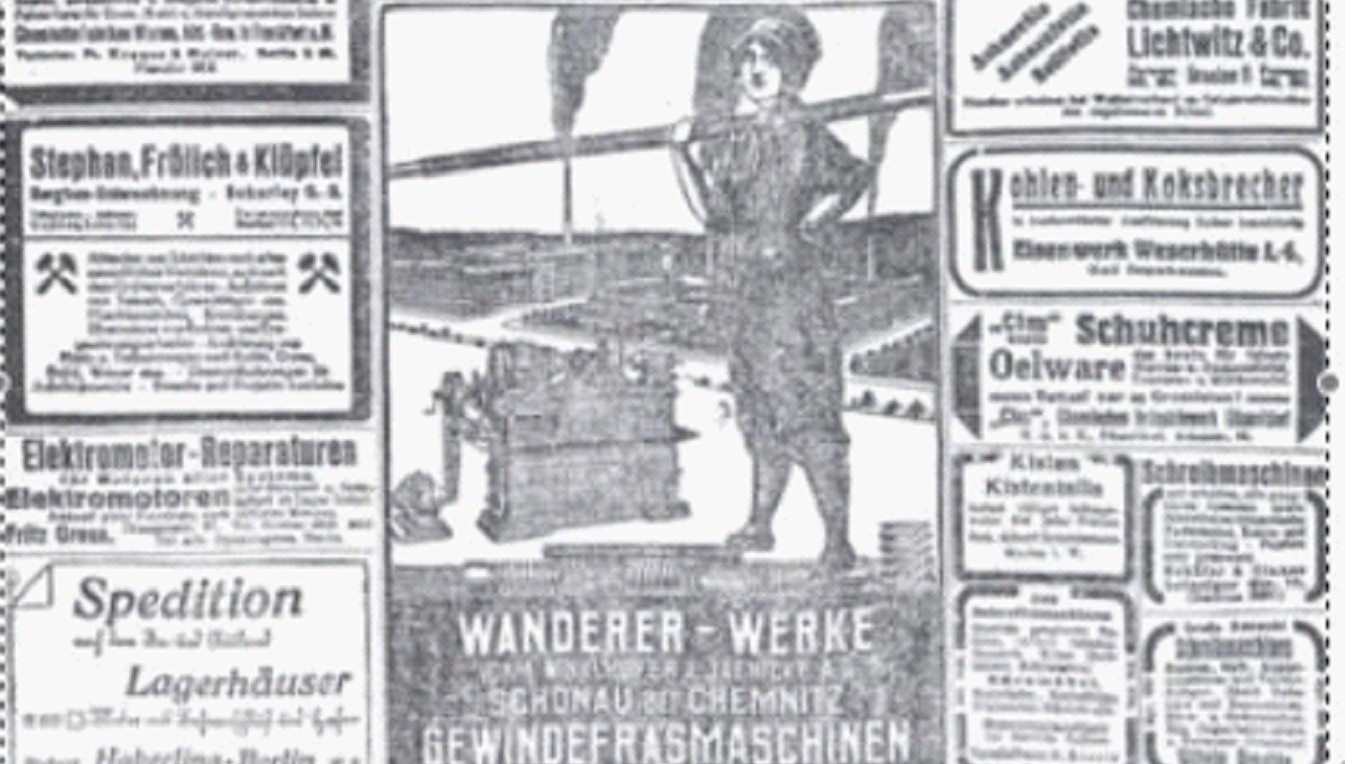
Commercial ads also illustrated the changing role of women in the war economy following the shortage of men. Traditionally considered the “weaker gender,” women now were drafted to work in ammunition factories and conducted streetcars, and delivered milk and mail or moved heavy equipment as the woman in the following advertisement.
I was so fascinated by what I had read that the newspaper became an important part in the story. As an apprentice in a print shop of a Berlin newspaper, Moritz, the main character, reads the headlines of the paper he just helped print and thereby informs the readers of the state of affairs in Germany, October 1918. On the first page of the novel Moritz studies an official war report, knowing that the government is not allowing the truth to come out. He then meets Herr Goldman, a journalist who works for the paper and who takes a liking to Moritz and ultimately helps him to fulfill his dream to become a reporter like himself. When Moritz is sent out to report on an illegal demonstration he sees his mother among the speakers. He witnesses the police disturb the meeting, disperse the crowd and arrest the leaders. What happened to Moritz’s mother? Read My Brother's Shadow to find out.
Obituaries, Advertisements, and War Bulletins – How Reading Berlin Newspapers from the Fall of 1918 helped me write My Brother's Shadow, by Monika Schröder
My new novel of historical fiction, My Brother's Shadow (Frances Foster Books/Farrar Straus Giroux, September, 2011), is set in Berlin 1918 during the last months of World War One. The book explores how war and the political transition following WWI affected regular people and children in particular.
From reading secondary sources I had gained basic information about the situation among German civilians, but I needed to find more details of daily life in Berlin. A few excerpts of the Berliner Tageblatt and Morgenpost were available online, but most of those consisted of the front pages announcing important events such as the Kaiser’s abdication or the armistice. I didn’t find any searchable database that would give me access to the original Berlin newspapers of the year 1918.
When I contacted the German Newspaper Archive in Berlin, I learned that the digitization of most of the papers I was interested in had not been completed. The nice lady at the front desk invited me to visit the archive, explained which subway stop to get off and how much it would cost to make copies. I told her that I lived in New Delhi and wouldn’t be able to come personally to the archive until the following summer.
But I needed those papers right away. I must have sounded desperate as she connected me to the director of the archive to whom I explained my predicament. I expected a tart ‘no’; instead he told me that the archive had finished digitizing through the end of 1919 the Vossische Zeitung, an important liberal paper, published in Berlin. That was good news!
But when he asked how I could get to access the Vossische Zeitung from October 1918 to January 1919 he told me that they were not available online yet.
Now so close to my goal I was not ready to give up. “If you have them in digital format,” I said. “Could you burn them onto a CD and send them to me?"
After a pause, he said, “That would be very expensive.”
“How much?” I asked.
I won’t disclose the sum. Let’s just say he was right in his cost estimation, but I ordered them right away and three weeks later I was delighted to receive a package in the mail with the digitized editions of the Vossische Zeitung from October 14, 1918 to January 20, 1919.
I loved reading the newspaper. The official war report was printed daily on the front page, usually under an upbeat headline. But by the middle of October a discerning reader could see that the army leadership slowly began to disclose more and more of the German Army’s dismal situation. The paper also printed obituaries. Every day numerous black framed notices informed the reader of the death of a young Karl or Friedrich who died “in honor of the fatherland” in France, Russia or Belgium.
I also studied the advertisements, which were very interesting and revealing. Due to the British blockade of the German harbors, Germany experienced severe food shortages. By 1918 many raw materials like coffee or cocoa were not available, and the lack of these products forced Germans to be inventive. Many “ersatz” (replacement) products were advertised. For example, I found an ad offering a class for housewives who wanted to learn how to make coffee from chicory and other ingredients. There were also numerous official calls for the collection of raw materials, such as metal, rubber, and cardboard. Others asked children to bring cherry and plum pits for a “Make Oil from Fruit Pits” campaign.
Commercial ads also illustrated the changing role of women in the war economy following the shortage of men. Traditionally considered the “weaker gender,” women now were drafted to work in ammunition factories and conducted streetcars, and delivered milk and mail or moved heavy equipment as the woman in the following advertisement.
I was so fascinated by what I had read that the newspaper became an important part in the story. As an apprentice in a print shop of a Berlin newspaper, Moritz, the main character, reads the headlines of the paper he just helped print and thereby informs the readers of the state of affairs in Germany, October 1918. On the first page of the novel Moritz studies an official war report, knowing that the government is not allowing the truth to come out. He then meets Herr Goldman, a journalist who works for the paper and who takes a liking to Moritz and ultimately helps him to fulfill his dream to become a reporter like himself. When Moritz is sent out to report on an illegal demonstration he sees his mother among the speakers. He witnesses the police disturb the meeting, disperse the crowd and arrest the leaders. What happened to Moritz’s mother? Read My Brother's Shadow to find out.
Tuesday, September 27, 2011
Book review: My Brother's Shadow, by Monika Schröder
In her young adult novel My Brother’s Shadow, Monika Schröder creates a starkly realistic vision of Berlin at the end of World War I.
In 1918, sixteen-year-old Moritz Schmidt works as a printer for the Berliner Daily, which is obliged to publish patriotic bulletins from the German Reich even though its people know they’re losing the war. With food rationing in place, a hearty meal is a distant memory. Instead, citizens stand in lines for bread and stretch their supplies by consuming turnip soup and ersatz coffee.
Moritz's home life is difficult. His father was killed at Verdun, his older brother Hans is off fighting at the Western Front, and his frail Oma (grandma) suffers from dementia. At the same time, his mother and sister attend secret meetings of the Social Democrats, who work to bring down the Kaiser and his oppressive regime. This introduces a note of hope into the narrative but causes confusion for Moritz, who doesn’t know who to believe.
Succumbing to peer pressure and missing his brother, Moritz joins Hans’s old gang, a group of bullies and thieves. After they threaten trouble for a new friend of his, a Jewish girl named Rebecca, his conscience begins to awaken. He also starts paying attention to his mentor at the paper, who sees potential in him as a journalist, and who considers his mother a hero for her outspoken stance. Then Hans comes home – crippled, angry, and eager to find a scapegoat for his and Germany’s losses.
Moritz narrates the tale in a non-intrusive present tense. His innocence can make him seem younger than his years, but his honesty and openness draw readers into his gripping story. The pacing is brisk, and tension builds out of the bleak atmosphere.
Not surprisingly given the author’s background (she grew up in Germany), she paints a detailed picture of the local geography and culture. Teenagers may find Moritz’s coming-of-age journey and growing romance with Rebecca the most compelling, but adult readers may discover that Anna Schmidt, the woman he calls Mama, steals the show. She is strong, courageously optimistic, and devoted to her family, but not even she knows how to cure her wounded elder son.
This wise and provocative read doesn’t offer up easy answers, which may be its greatest strength. The sobering ending makes it plain that for these characters and for Germany, the tale is far from over.
My Brother's Shadow was published today by Frances Foster Books/Farrar Straus & Giroux at $16.99 (hardcover, 217pp, with detailed author's note on the historical background). Look for a guest post by Monika Schröder later this week about the research process for her book.
In 1918, sixteen-year-old Moritz Schmidt works as a printer for the Berliner Daily, which is obliged to publish patriotic bulletins from the German Reich even though its people know they’re losing the war. With food rationing in place, a hearty meal is a distant memory. Instead, citizens stand in lines for bread and stretch their supplies by consuming turnip soup and ersatz coffee.
Moritz's home life is difficult. His father was killed at Verdun, his older brother Hans is off fighting at the Western Front, and his frail Oma (grandma) suffers from dementia. At the same time, his mother and sister attend secret meetings of the Social Democrats, who work to bring down the Kaiser and his oppressive regime. This introduces a note of hope into the narrative but causes confusion for Moritz, who doesn’t know who to believe.
Succumbing to peer pressure and missing his brother, Moritz joins Hans’s old gang, a group of bullies and thieves. After they threaten trouble for a new friend of his, a Jewish girl named Rebecca, his conscience begins to awaken. He also starts paying attention to his mentor at the paper, who sees potential in him as a journalist, and who considers his mother a hero for her outspoken stance. Then Hans comes home – crippled, angry, and eager to find a scapegoat for his and Germany’s losses.
Moritz narrates the tale in a non-intrusive present tense. His innocence can make him seem younger than his years, but his honesty and openness draw readers into his gripping story. The pacing is brisk, and tension builds out of the bleak atmosphere.
Not surprisingly given the author’s background (she grew up in Germany), she paints a detailed picture of the local geography and culture. Teenagers may find Moritz’s coming-of-age journey and growing romance with Rebecca the most compelling, but adult readers may discover that Anna Schmidt, the woman he calls Mama, steals the show. She is strong, courageously optimistic, and devoted to her family, but not even she knows how to cure her wounded elder son.
This wise and provocative read doesn’t offer up easy answers, which may be its greatest strength. The sobering ending makes it plain that for these characters and for Germany, the tale is far from over.
My Brother's Shadow was published today by Frances Foster Books/Farrar Straus & Giroux at $16.99 (hardcover, 217pp, with detailed author's note on the historical background). Look for a guest post by Monika Schröder later this week about the research process for her book.
Sunday, September 18, 2011
Langum Prize for American Historical Fiction: 1st shortlist announced
The Langum Charitable Trust, sponsor of the annual Langum Prize for American Historical Fiction, has announced a change in procedure. They have begun a shortlist process; the first shortlist will cover novels published in January-June of the prize year, and a second list will cover novels published in July-December.For the first half of 2011, the shortlisted titles are:
Geraldine Brooks' Caleb's Crossing, set in 1660s Martha's Vineyard and Cambridge, Massachusetts, and centering on the friendship between a minister's daughter and a young man of the Wampanoag tribe;
Susan Vreeland's Clara and Mr. Tiffany, about Clara Driscoll, Louis Comfort Tiffany's chief designer at his New York glass studio in the 1890s.For more on both books, see the Langum Charitable Trust. To submit a novel for consideration, view the directions available at the site.
The prize is awarded annually to the "best book in American historical fiction that is both excellent fiction and excellent history." Recent past winners include Ann Weisgarber's The Personal History of Rachel DuPree, Edward Rutherfurd's New York, and Kathleen Kent's The Heretic's Daughter.
Monday, September 12, 2011
An Australia & New Zealand historical fiction showcase
This post is thanks to Marg because in the comments for one of my recent posts, she told me about FishpondWorld, an online Aussie bookstore that ships free internationally. The one thing that's prevented me from buying more historical novels from Australia and New Zealand is the outrageous postage charges, which are often higher than the books' cover price. Getting them via interlibrary loan isn't really practical from the US. So, having just gotten paid for an article I wrote, I clicked onto this new site and went to town.
A couple of these were actually recent purchases from Bookcloseouts, but they fit the subject and I figured I'd add them to the pile.

The books look even more appealing when you see the covers, so here they are below.

This is a huge trade paperback, 550pp long. Belinda Alexandra is an Australian historical novelist who has set her novels all over the world. I'd call them romantic epics. Tuscan Rose centers on a young woman living in Florence, Italy, in the 1930s and '40s, who is compelled to uncover her true identity at a time when Fascism takes hold of her country. HarperCollins Australia, 2010.

An unlikely love story unfolds in the gold rush settlement of Arrowtown in 19th-century New Zealand, as a young Chinese woman named Ming Yuet disguises herself as a miner. Penguin New Zealand, 2008.

This is another gold rush-era romantic story set in Old Ballarat, a mining boomtown near Melbourne. I won't reveal more of the storyline, because this is 3rd in a series after Kitty and Amber, tales of strong women during the early days of Australia and New Zealand. HarperCollins New Zealand, 2010.

I just love this cover design. The tagline says: "A daring heroine tests her wits against secrets, spies, and smugglers on a remote Australian island." Mary Watson was a real person from 1879 Queensland, an adventure-seeking woman who left behind a few brief diary entries hinting at her fate. This literary fiction novel picks up where those fragments leave off. 4th Estate, 2011.

This compact little novel (311pp but dense in terms of weight) tells the historically-based story of the migrations from Nova Scotia to Australia in 1817, and the colony's subsequent settlement in New Zealand in 1854, under the leadership of Norman McLeod. Kidman tells the story from the viewpoint of three generations of women, whose stories date from 1812 to 1953. Vintage New Zealand, 1988.

This is one of the most gorgeous covers I've seen anywhere, and it's on a book I'd been looking to buy for over a year. Fiona McIntosh is best known as a fantasy writer, and this is her first installment of a family saga based on her the history of her ancestors. It begins at the end of the Great War. "From the windswept clifftops of the Cornish coast to the goldmines of southern India, this is a page turning story of high adventure, devastating tragedy and enduring love." Penguin Australia, this edition 2011.

And here is the back cover, which is just as spectacular.

I first read about La Rochelle's Road at Cat's blog Tell Me a Story; she's a NZ blogger who specializes in historical fiction. In 1866, Hester Peterson discovers the journal of a past resident of her family's home - Etienne La Rochelle, who caused a scandal by taking a Maori lover. What she learns sets her on a dangerous path of beauty, darkness, and illicit love. Black Swan (NZ), 2011.
Now which one should I read first?
A couple of these were actually recent purchases from Bookcloseouts, but they fit the subject and I figured I'd add them to the pile.
The books look even more appealing when you see the covers, so here they are below.
This is a huge trade paperback, 550pp long. Belinda Alexandra is an Australian historical novelist who has set her novels all over the world. I'd call them romantic epics. Tuscan Rose centers on a young woman living in Florence, Italy, in the 1930s and '40s, who is compelled to uncover her true identity at a time when Fascism takes hold of her country. HarperCollins Australia, 2010.
An unlikely love story unfolds in the gold rush settlement of Arrowtown in 19th-century New Zealand, as a young Chinese woman named Ming Yuet disguises herself as a miner. Penguin New Zealand, 2008.
This is another gold rush-era romantic story set in Old Ballarat, a mining boomtown near Melbourne. I won't reveal more of the storyline, because this is 3rd in a series after Kitty and Amber, tales of strong women during the early days of Australia and New Zealand. HarperCollins New Zealand, 2010.
I just love this cover design. The tagline says: "A daring heroine tests her wits against secrets, spies, and smugglers on a remote Australian island." Mary Watson was a real person from 1879 Queensland, an adventure-seeking woman who left behind a few brief diary entries hinting at her fate. This literary fiction novel picks up where those fragments leave off. 4th Estate, 2011.
This compact little novel (311pp but dense in terms of weight) tells the historically-based story of the migrations from Nova Scotia to Australia in 1817, and the colony's subsequent settlement in New Zealand in 1854, under the leadership of Norman McLeod. Kidman tells the story from the viewpoint of three generations of women, whose stories date from 1812 to 1953. Vintage New Zealand, 1988.
This is one of the most gorgeous covers I've seen anywhere, and it's on a book I'd been looking to buy for over a year. Fiona McIntosh is best known as a fantasy writer, and this is her first installment of a family saga based on her the history of her ancestors. It begins at the end of the Great War. "From the windswept clifftops of the Cornish coast to the goldmines of southern India, this is a page turning story of high adventure, devastating tragedy and enduring love." Penguin Australia, this edition 2011.
And here is the back cover, which is just as spectacular.
I first read about La Rochelle's Road at Cat's blog Tell Me a Story; she's a NZ blogger who specializes in historical fiction. In 1866, Hester Peterson discovers the journal of a past resident of her family's home - Etienne La Rochelle, who caused a scandal by taking a Maori lover. What she learns sets her on a dangerous path of beauty, darkness, and illicit love. Black Swan (NZ), 2011.
Now which one should I read first?
A look at Elle Newmark's The Sandalwood Tree
Elle Newmark's The Sandalwood Tree is an engrossing novel set during two pivotal periods in the history of colonial India.
Evie Mitchell arrives in India in 1947 with her historian husband, Martin, and their five-year-old son, Billy. The recipient of a Fulbright Fellowship, Martin is eager to document firsthand the last days of the British Raj. Evie hopes that their staying together as a family in this unfamiliar land will repair their strained marriage and teach Billy about respecting other countries' beliefs.
Things don't turn out as she planned. Martin refuses to discuss his wartime experiences with Evie and, with the timeline for India's Partition moved up unexpectedly, worries about their safety. Evie doesn't fit in with the bigoted expatriate community and is left to her own devices. Tired of what she feels is Martin's paranoia, she feels lonely and restless.
Then, concealed within their bungalow in the village of Masoorla, just outside Simla, Evie discovers fragments of personal letters between Felicity and Adele, two Victorian-era friends who lived in her house 90 years before. She gets caught up in their lives and determines to find out what happened to them. Their story, a tale of daring female adventure and several instances of forbidden love, is revealed piece by piece and intertwines neatly with Evie's narrative.
Newmark's vibrant portrait of India details its opulent beauty, its appalling poverty, and the difficult paths to cross-cultural understanding. The tension level rises as the relaxing atmosphere of remote Masoorla braces up against the violent Muslim-Hindu conflicts before Partition in the later timeline, and the tragic aftermath of the Sepoy Mutiny in the earlier one.
This isn't the type of historical novel that glorifies unconventional behavior during a restrictive time. It's more realistic than that. Both Felicity and Adele flout their families' expectations, each choosing personal happiness over society's approval. As she learns more about them, Evie comes to admire them as trailblazers, but they're considered scandalous by their contemporaries.
I read The Sandalwood Tree in just over a day, immersed in the Indian setting and the dilemmas faced by all three women. Sadly, the quote at the very beginning of the novel, Adele's remark that "death steals everything but our stories," could be the author's epitaph. She passed away in June after a two-year illness. Newmark became a successful author late in life, and her journey from aspiring writer to self-published novelist to international bestseller is truly inspiring.
The Sandalwood Tree was published by Atria in April at $25.99 ($29.99 in Canada) and by Black Swan (UK) in August at £7.99.
Evie Mitchell arrives in India in 1947 with her historian husband, Martin, and their five-year-old son, Billy. The recipient of a Fulbright Fellowship, Martin is eager to document firsthand the last days of the British Raj. Evie hopes that their staying together as a family in this unfamiliar land will repair their strained marriage and teach Billy about respecting other countries' beliefs.
Things don't turn out as she planned. Martin refuses to discuss his wartime experiences with Evie and, with the timeline for India's Partition moved up unexpectedly, worries about their safety. Evie doesn't fit in with the bigoted expatriate community and is left to her own devices. Tired of what she feels is Martin's paranoia, she feels lonely and restless.
Then, concealed within their bungalow in the village of Masoorla, just outside Simla, Evie discovers fragments of personal letters between Felicity and Adele, two Victorian-era friends who lived in her house 90 years before. She gets caught up in their lives and determines to find out what happened to them. Their story, a tale of daring female adventure and several instances of forbidden love, is revealed piece by piece and intertwines neatly with Evie's narrative.
Newmark's vibrant portrait of India details its opulent beauty, its appalling poverty, and the difficult paths to cross-cultural understanding. The tension level rises as the relaxing atmosphere of remote Masoorla braces up against the violent Muslim-Hindu conflicts before Partition in the later timeline, and the tragic aftermath of the Sepoy Mutiny in the earlier one.
This isn't the type of historical novel that glorifies unconventional behavior during a restrictive time. It's more realistic than that. Both Felicity and Adele flout their families' expectations, each choosing personal happiness over society's approval. As she learns more about them, Evie comes to admire them as trailblazers, but they're considered scandalous by their contemporaries.
I read The Sandalwood Tree in just over a day, immersed in the Indian setting and the dilemmas faced by all three women. Sadly, the quote at the very beginning of the novel, Adele's remark that "death steals everything but our stories," could be the author's epitaph. She passed away in June after a two-year illness. Newmark became a successful author late in life, and her journey from aspiring writer to self-published novelist to international bestseller is truly inspiring.
The Sandalwood Tree was published by Atria in April at $25.99 ($29.99 in Canada) and by Black Swan (UK) in August at £7.99.
Saturday, September 10, 2011
The Borgia Betrayal contest winner
I'll be posting more later today or tomorrow, but for now -- I've just drawn the winner of Sara Poole's The Borgia Betrayal, with the help of Random.org. Congrats to Sam from Tiny Library! Looks like this copy will be winging its way over to the UK soon.
In her comment, Sam wrote that she's my newest follower (thanks for reading the site!). After reading her recent review of Elle Newmark's The Sandalwood Tree, I decided to pick it up next. The review copy's been on my pile for a few months, and it looked like a good book to lose myself in after a very busy work week.
Monday, September 05, 2011
Book review: Deborah Lawrenson's The Lantern
In her modern Gothic mystery, her first novel to be published in America, Deborah Lawrenson plunges readers into the atmosphere of rural Provence, a place both entrancing and chilling.
When Eve, a young freelance translator, meets Dom, an older musician, at a chateau along Lake Geneva, both are at low points in their lives. They unexpectedly fall in love, and together they purchase a huge, crumbling farmhouse, Les Genévriers, nestled in the Luberon Mountains of southern France. Here they delight in the pleasures of the region and in each other, but as the seasons change, shadows appear in their relationship. Dom refuses to speak about his former wife, Rachel, and withdraws more and more into himself. His coldness arouses Eve’s curiosity and alarm and incites her to search for answers.
In alternating chapters that don’t mark the change of narrator (but which aren't confusing for the switch), an elderly woman named Bénédicte Lincel speaks of growing up at Les Genévriers in the 1930s and 40s. Her glorious childhood is marred only by the cruelty of her older brother, Pierre, and her family’s decline into poverty during the postwar years. Both Eve and Bénédicte catch glimpses of what they believe are ghosts on the property, and apprehension builds as the tragedies in their lives are slowly uncovered.
Reflecting the bounty of the land, the language is ripe and sensual (tomatoes are "as ribbed and plump as harem cushions"). The regional specialties, like vin de noix – sweet walnut liqueur – sound mouth-wateringly delicious. Armchair travelers will revel in Lawrenson’s lush descriptions of the lavender harvest, an event in which Bénédicte participates in order to share the experience with her blind sister, Marthe, who grows up to be a renowned parfumeuse. The cycle of life is evoked in full, from birth and growth through death and decay – as it affects local crops, the structure of Les Genévriers, and the affairs of its human inhabitants.
The Lantern is setting-driven before it becomes character-driven, as if to imply that one must get to know the terrain before knowing its people. Everyone is holding something back, and Eve herself acknowledges the uncanny similarities between her life and the plot of Rebecca. To enhance the parallels even more, “Eve” is merely Dom’s nickname for the modern narrator; her real name is never given.
A few scenes take the easy way out during an otherwise complex reading experience. Pierre is a stereotypical bully, and his malicious actions can be predicted from miles away. But apart from this, the author displays smart plotting and a good sense of timing. She gently manipulates readers along a suspenseful path, culminating in an astonishing revelation that Du Maurier couldn’t have imagined.
Those who enjoy Kate Morton’s novels and other Gothic family sagas should enjoy this book as well, although its pacing is more drawn out in the beginning, and its phrasings have more of a literary flair. Darkly evocative, beautifully written, and overflowing with the sights and scents of the Provençal countryside, The Lantern takes a powerful look at the haunting presence of the past.
The Lantern was published by Harper in September at $25.99 (hardcover, 384pp). In the UK, it's available from Orion in either hardcover (£18.99) or paperback (£7.99), with a very similar cover.
When Eve, a young freelance translator, meets Dom, an older musician, at a chateau along Lake Geneva, both are at low points in their lives. They unexpectedly fall in love, and together they purchase a huge, crumbling farmhouse, Les Genévriers, nestled in the Luberon Mountains of southern France. Here they delight in the pleasures of the region and in each other, but as the seasons change, shadows appear in their relationship. Dom refuses to speak about his former wife, Rachel, and withdraws more and more into himself. His coldness arouses Eve’s curiosity and alarm and incites her to search for answers.
In alternating chapters that don’t mark the change of narrator (but which aren't confusing for the switch), an elderly woman named Bénédicte Lincel speaks of growing up at Les Genévriers in the 1930s and 40s. Her glorious childhood is marred only by the cruelty of her older brother, Pierre, and her family’s decline into poverty during the postwar years. Both Eve and Bénédicte catch glimpses of what they believe are ghosts on the property, and apprehension builds as the tragedies in their lives are slowly uncovered.
Reflecting the bounty of the land, the language is ripe and sensual (tomatoes are "as ribbed and plump as harem cushions"). The regional specialties, like vin de noix – sweet walnut liqueur – sound mouth-wateringly delicious. Armchair travelers will revel in Lawrenson’s lush descriptions of the lavender harvest, an event in which Bénédicte participates in order to share the experience with her blind sister, Marthe, who grows up to be a renowned parfumeuse. The cycle of life is evoked in full, from birth and growth through death and decay – as it affects local crops, the structure of Les Genévriers, and the affairs of its human inhabitants.
The Lantern is setting-driven before it becomes character-driven, as if to imply that one must get to know the terrain before knowing its people. Everyone is holding something back, and Eve herself acknowledges the uncanny similarities between her life and the plot of Rebecca. To enhance the parallels even more, “Eve” is merely Dom’s nickname for the modern narrator; her real name is never given.
A few scenes take the easy way out during an otherwise complex reading experience. Pierre is a stereotypical bully, and his malicious actions can be predicted from miles away. But apart from this, the author displays smart plotting and a good sense of timing. She gently manipulates readers along a suspenseful path, culminating in an astonishing revelation that Du Maurier couldn’t have imagined.
Those who enjoy Kate Morton’s novels and other Gothic family sagas should enjoy this book as well, although its pacing is more drawn out in the beginning, and its phrasings have more of a literary flair. Darkly evocative, beautifully written, and overflowing with the sights and scents of the Provençal countryside, The Lantern takes a powerful look at the haunting presence of the past.
The Lantern was published by Harper in September at $25.99 (hardcover, 384pp). In the UK, it's available from Orion in either hardcover (£18.99) or paperback (£7.99), with a very similar cover.
Subscribe to:
Posts (Atom)