Monday, October 31, 2011

Book review: Sarah Kernochan's Jane Was Here


Novels about reincarnation don't take up a large category.  The dual scenarios - past and present - can help these works branch out to a wider readership, though, and historical events can impose on present-day happenings more directly than they can in a straightforward historical novel. That's one reason I like them.

As you can surmise from the cover art, Sarah Kernochan's Jane Was Here takes the form of a supernatural thriller.  When a young woman calling herself Jane arrives in the glass factory town of Graynier, Massachusetts, everyone whose life she touches finds their life transformed in some way.  Jane has memories of Graynier and says she's lived there before, though it no longer looks quite the way she remembers.

Not everyone is keen on having Jane around, especially when food starts disappearing from people's houses. Brett Sampson is the exception.  A summer resident trying to reconnect with his son, he feels unexpectedly protective towards Jane and gives her a place to stay in his rented Victorian home (to his son's dismay).  The town floozy and a deceitful handyman get drawn into Jane's web after her sudden appearance in the middle of the road leads to a car accident.  The children of an Indian family who owns the local motel get entangled in the mix, too.

Brett starts researching who Jane really is, as well as who she claims to be. There are many subplots, but everything is sharply delineated amid the rising suspense.  As Jane slowly regains what seem to be memories of a tragic past life, she unwittingly sets in motion a plan to exact revenge on those who wronged her long ago.

By now you may be wondering about the book's historical aspect.  Without giving too much away: Part 2 reveals the intimate letters of an impressionable 19th-century young woman who pursues her avid interest in an odd sect and its charismatic representative.  "Gabriel Nation" is fictional, but with so many other peculiar religious revivals sprouting up in 1850s America, it fits right in.

Jane Was Here can be as quirky and eccentric as the people who inhabit its pages.  The author has obviously poured a lot of attention into her characters, although she seems to care for them more than they care for each other (they aren't exactly society's most upstanding citizens).  Jane's formality and propriety contrasts well with their careless lifestyles, though, and although I wasn't chilled by the creepy storyline, I followed it with great interest.  Readers who enjoyed Brunonia Barry's The Lace Reader and M. J. Rose's Reincarnationist series may want to give this one a close look, too.

Jane Was Here was published by Grey Swan Press in June at $24.95 (hb, 296pp).

Tuesday, October 25, 2011

Giveaway opportunity: Michelle Black's Séance in Sepia

Thanks to author Michelle Black, I have a new giveaway for readers of the blog.  She will be offering a signed hardcover copy of Séance in Sepia, which I reviewed here on Sunday, to a randomly selected blog visitor.

To enter, please leave a comment on this blog post, or on the associated post on this site's Facebook page if you prefer.  Deadline is Friday, November 4th.  This giveaway is open to all.

Best of luck to all entrants!

Sunday, October 23, 2011

Book review: Séance in Sepia, by Michelle Black

For her sixth historical novel, Michelle Black trades the vast landscapes of the historical and modern West for the social reforms and spiritualist beliefs of mid-19th century Chicago.

When Flynn Keirnan spies a mysterious old photo at an estate sale, she immediately offers to buy it, believing the proceeds will help her dad's struggling used book business. The sepia-toned image of an unconventional dark-haired woman and two men appears to be a “spirit photograph.” Back in the 1870s, séances were all the rage, as were photographers who claimed to be able to capture ghostly images on film.

Flynn lists the photo on eBay and sparks a bidding war. Startled, she does some research and learns about the trio’s association with the scandalous “Free Love Murders.” In 1875 Chicago, up-and-coming architect Alec Ingersoll was accused of killing the two people he loved most: Medora Lamb, his bohemian artist wife, and his best friend, Cameron Langley.  All three lived together in the same house, which caused rumors to fly.

As Flynn uncovers their stories, with the help of a cute attorney with a family connection to the murder trial, a second woman over a century earlier is following a similar path. In exchange for an exclusive jailhouse interview with Ingersoll for her radical paper, notorious feminist Victoria Woodhull agrees to conduct a séance to learn the truth about how Medora and Cam died. An outspoken lecturer and advocate for sexual freedom, Victoria finds her investigation has unexpected repercussions for her personal life. “Free love,” as it turns out, isn't so free after all.

The plot unfolds through a collection of scenes which include courtroom transcripts, journal entries, and straightforward narratives from both timelines. While some of them may seem tangentially related at first, all are cleverly drawn together just in time for a suspenseful finale. Along the way, the novel provides fascinating tidbits on episodes from 19th-century social history, from the unorthodox practices of New York’s Oneida Community to early photography techniques.

The best part of the novel, though, is in seeing how the complex relationships between the characters play out on the page. Michelle Black has a gift for crafting realistic dialogue that highlights their personalities. Her close attention to detail, from the opulence of the Palmer House hotel where Victoria takes up residence to the snappy banter of her modern protagonists, makes both settings feel equally real.

Michelle Black's Séance in Sepia was published on October 21st by Five Star at $25.95 (hardcover, 322pp).  Visit the author's website as well as her blog on the Victorian West.

Thursday, October 20, 2011

Winner of The Countess...

Earlier this week I drew the winning entry for Rebecca Johns' The Countess... and then forgot to post it on the blog.  Oops - pardon my delay.  One paperback copy will be going out to lucky commenter #1 - Amy!  Congratulations, Amy, and I hope you'll enjoy the read.

Sunday, October 16, 2011

A look at The Ballad of Tom Dooley, by Sharyn McCrumb

Sharyn McCrumb’s series of Ballad novels about the strong-minded residents and the scenic beauty of North Carolina’s Blue Ridge Mountains usually make a point of debunking regional stereotypes. In its bleak and honest presentation of the roots of a local legend, The Ballad of Tom Dooley takes the opposite tack, showing many examples of why these stereotypes exist.

At the story’s center are Tom Dula, a scrawny Confederate veteran with a talent for the fiddle and not much else, and Ann Foster Melton, his dark-haired (and married) lover, the most beautiful and most self-absorbed woman in all of Wilkes County. When plain-faced Pauline Foster comes down the mountain in 1866, offering to work for her Cousin Ann as a servant while getting treatment for syphilis, she deliberately spreads around resentment, jealousy, and lies along with her disease. The twisted chain of events eventually leads to the stabbing death of Laura Foster, a drab waif of a girl who’s a distant cousin to both Ann and Pauline.

Living in these isolated mountains, nobody pays much attention to morality. Although Tom and Ann have been drawn to one another since childhood, neither is faithful or sees the need to be. James Melton, Ann’s husband, is too bewitched by her beauty to care about her affair. Left to care for her siblings after her mother's death, Laura sleeps around with many men, Tom included, because there’s nothing much better to do.

Zebulon Vance shares narration duties with Pauline, which provides some relief from her sociopathic viewpoint. In an attempt to bolster his legal career, he takes the case pro bono when Tom and Ann are jailed for Laura’s murder. The Confederate ex-governor of North Carolina, Vance is a former mountain boy himself, though he took a different path in life than his clients. Looking back on events 20 years later, he speaks several times about his opposition to secession, his status as a U.S. Senator, and his reasons for choosing the woman he married; while he may be the only one in the bunch with brains and decency, he comes across as a bit of a snob.

The novel’s sense of history is paramount, and McCrumb deftly evokes the violence that the end of the Civil War failed to suppress in the poverty-ridden Appalachians. However, with her primary narrator, Pauline, “not much moved by the beauty of nature,” the gorgeous depictions of the region normally expected from her work aren’t found to the same degree in this one.

A century of the folk process transformed this story into the classic murder ballad “Tom Dooley,” which was made famous by the Kingston Trio in 1958. That version pinned the crime on Tom, but he isn’t the perpetrator here – and the real killer shouldn’t come as a surprise. Although this is a novel about a crime, it’s not meant to be a mystery.

This scrupulously researched account gives a plausible scenario for how Laura Foster’s murder may have happened – the author’s note is generous and satisfying – and is worth reading for its re-creation of a real historical event. But with no reason to care about these lazy excuses for people, the promised tale of star-crossed romance just isn’t there. Finally, knowing the reality behind the legend, one can’t help but wonder if this sordid tragedy really deserved as much attention as it got. “That is the burden of this story,” Vance himself says in the beginning, and although McCrumb is a talented writer, not even she manages to overcome it.

The Ballad of Tom Dooley was published by St. Martin's Press in September at $24.99 ($28.99 in Canada) in hardcover.  The ARC was sent to me as part of LibraryThing's Early Reviewers program.

Saturday, October 08, 2011

Giveaway opportunity: Rebecca Johns' The Countess

Thanks to the Crown Publishing Group, I have the opportunity to offer a giveaway of Rebecca Johns' The Countess, biographical fiction about Erzsébet Báthory.  It's newly out in trade paperback from Broadway ($15, 304pp).

The Countess was a surprise hit for me when I read and reviewed it here last November.  Erzsébet Báthory was the 16th-century Hungarian noblewoman for whom the term "bloodbath" could have been coinedrumors had it that she killed hundreds of her female servants and bathed in their bloodbut Johns' novel is more of a creepy exploration of her psyche than a gory recounting of her supposed exploits. Read it and see how much you believe of her first-person story.

One copy is up for grabs.  Please leave a comment on this post to enter; deadline Monday, October 17th, so that you should hopefully have it in time for Halloween.  This giveaway is open to US and Canadian residents.  Good luck to all!

Monday, October 03, 2011

Book review: Death of Kings, by Bernard Cornwell

“It was Yule, 898, and someone was trying to kill me.
I would kill them instead.”

Uhtred of Bebbanburg, the Saxon-born, Danish-raised warrior who has reluctantly become a fighter for Alfred of Wessex, is back in this sixth volume of the Saxon Stories. With his usual blend of confidence, physical strength, and gleeful sarcasm at the ready, he recounts a critical period in the making of England – and his involvement therein.

King Alfred is finally dying. The Danes lie in wait, eager to invade and tear apart the Christian realm he worked so hard to build. Uncertainty and suspicion are present from the outset, an effect that nicely mirrors the soon-to-be-fractured state of the kingdom. After foiling a murder attempt at his winter residence up north, Uhtred must return to duty when Alfred asks him to negotiate a treaty with King Eohric of East Anglia. The meeting place seems oddly chosen, and Uhtred smells something fishy.

Uhtred has grown to admire Alfred over time, but he doesn’t feel the same loyalty toward Alfred’s heir, the ætheling Edward. Not only does Edward mistrust him, but Uhtred knows he will have a hard time convincing him that peace-making isn’t the way to create a united Saxon country. Treachery and lies abound, not just from the enemy Danes but also from a rival claimant to the throne. While he faces Alfred’s slow but impending demise as well as numerous threats to his own safety, Uhtred makes up his mind about his ultimate goal – and how he will attain it.

If this were purely an adrenaline-based saga, Death of Kings would be an impressively entertaining read. The strategies are laid out clearly, and the action is brutal and vigorous. Cornwell excels at depicting the “battle-joy” that comes over Uhtred as he prepares to face down a deadly foe. Even pacifists may find themselves caught up in the moment!  The historical background is solid and vividly described, with authentic place names giving the setting a realistic feel.

Some of Uhtred’s choices are wickedly clever, and they have his enemies running in frustrated circles. He delights in causing trouble, which makes for hilarious scenes. His taunting of the Danes at Snotengaham is meant solely to enhance his already fearsome reputation. He also has an excellent sense of how to annoy the ubiquitous priests who believe that victory can be won by prayer.

Death of Kings encompasses more than military encounters, however, and we experience a full range of emotions along with Uhtred: the assurance with which he leads his trusted men, the solemnity of his king’s final moments, and the tenderness and pride Uhtred has for Æthelflaed, Alfred’s daughter, whom he loves dearly. And while he always greets the possibility of war with eager anticipation, his encounter with a pagan sorceress in her otherworldly lair makes him shake in his boots. The consummate skill with which Cornwell evokes every aspect of Uhtred’s story and character transforms an already exciting book into a truly outstanding one.

Death of Kings is published in October by HarperCollins UK at £18.99 (hardcover, 335pp).  It will appear in the US next January from Harper at $25.99 (and good luck waiting that long).

Thursday, September 29, 2011

Guest post from Monika Schröder: Obituaries, Advertisements, and War Bulletins...

Today's guest post from Monika Schröder speaks to the historical background of her novel My Brother's Shadow, reviewed here on Tuesday.  How did her archival research with Berlin newspapers inform her work, and how did she consult these primary sources while living half a world away?  As a librarian who likes helping researchers with requests for older material, I found her essay especially enjoyable.

Obituaries, Advertisements, and War Bulletins – How Reading Berlin Newspapers from the Fall of 1918 helped me write My Brother's Shadow, by Monika Schröder

My new novel of historical fiction, My Brother's Shadow (Frances Foster Books/Farrar Straus Giroux, September, 2011), is set in Berlin 1918 during the last months of World War One. The book explores how war and the political transition following WWI affected regular people and children in particular.

From reading secondary sources I had gained basic information about the situation among German civilians, but I needed to find more details of daily life in Berlin. A few excerpts of the Berliner Tageblatt and Morgenpost were available online, but most of those consisted of the front pages announcing important events such as the Kaiser’s abdication or the armistice. I didn’t find any searchable database that would give me access to the original Berlin newspapers of the year 1918.

When I contacted the German Newspaper Archive in Berlin, I learned that the digitization of most of the papers I was interested in had not been completed. The nice lady at the front desk invited me to visit the archive, explained which subway stop to get off and how much it would cost to make copies. I told her that I lived in New Delhi and wouldn’t be able to come personally to the archive until the following summer.

But I needed those papers right away. I must have sounded desperate as she connected me to the director of the archive to whom I explained my predicament. I expected a tart ‘no’; instead he told me that the archive had finished digitizing through the end of 1919 the Vossische Zeitung, an important liberal paper, published in Berlin. That was good news!

But when he asked how I could get to access the Vossische Zeitung from October 1918 to January 1919 he told me that they were not available online yet.

Now so close to my goal I was not ready to give up. “If you have them in digital format,” I said. “Could you burn them onto a CD and send them to me?"

After a pause, he said, “That would be very expensive.”

“How much?” I asked.

I won’t disclose the sum. Let’s just say he was right in his cost estimation, but I ordered them right away and three weeks later I was delighted to receive a package in the mail with the digitized editions of the Vossische Zeitung from October 14, 1918 to January 20, 1919.


I loved reading the newspaper. The official war report was printed daily on the front page, usually under an upbeat headline. But by the middle of October a discerning reader could see that the army leadership slowly began to disclose more and more of the German Army’s dismal situation. The paper also printed obituaries. Every day numerous black framed notices informed the reader of the death of a young Karl or Friedrich who died “in honor of the fatherland” in France, Russia or Belgium.

I also studied the advertisements, which were very interesting and revealing. Due to the British blockade of the German harbors, Germany experienced severe food shortages. By 1918 many raw materials like coffee or cocoa were not available, and the lack of these products forced Germans to be inventive. Many “ersatz” (replacement) products were advertised. For example, I found an ad offering a class for housewives who wanted to learn how to make coffee from chicory and other ingredients. There were also numerous official calls for the collection of raw materials, such as metal, rubber, and cardboard. Others asked children to bring cherry and plum pits for a “Make Oil from Fruit Pits” campaign.

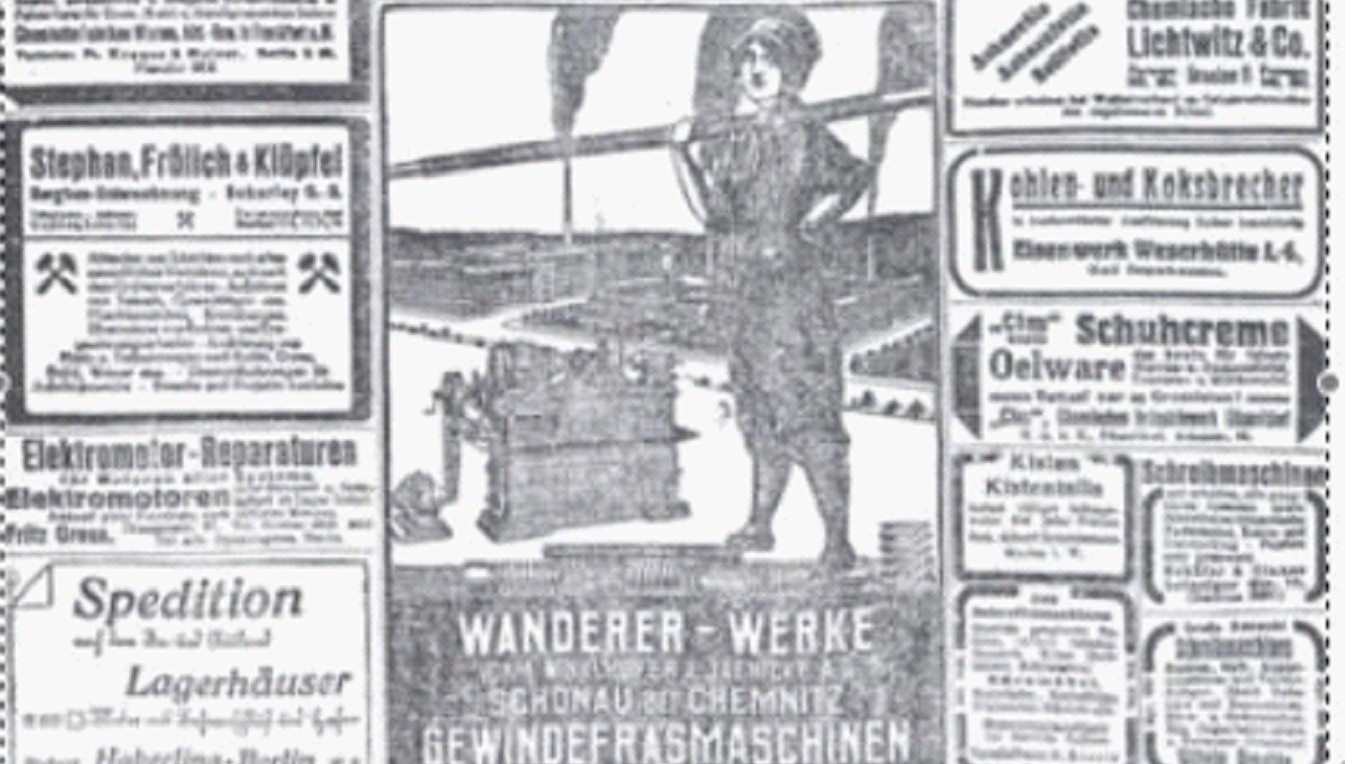
Commercial ads also illustrated the changing role of women in the war economy following the shortage of men. Traditionally considered the “weaker gender,” women now were drafted to work in ammunition factories and conducted streetcars, and delivered milk and mail or moved heavy equipment as the woman in the following advertisement.


I was so fascinated by what I had read that the newspaper became an important part in the story. As an apprentice in a print shop of a Berlin newspaper, Moritz, the main character, reads the headlines of the paper he just helped print and thereby informs the readers of the state of affairs in Germany, October 1918. On the first page of the novel Moritz studies an official war report, knowing that the government is not allowing the truth to come out. He then meets Herr Goldman, a journalist who works for the paper and who takes a liking to Moritz and ultimately helps him to fulfill his dream to become a reporter like himself. When Moritz is sent out to report on an illegal demonstration he sees his mother among the speakers. He witnesses the police disturb the meeting, disperse the crowd and arrest the leaders. What happened to Moritz’s mother? Read My Brother's Shadow to find out.

Tuesday, September 27, 2011

Book review: My Brother's Shadow, by Monika Schröder

In her young adult novel My Brother’s Shadow, Monika Schröder creates a starkly realistic vision of Berlin at the end of World War I.

In 1918, sixteen-year-old Moritz Schmidt works as a printer for the Berliner Daily, which is obliged to publish patriotic bulletins from the German Reich even though its people know they’re losing the war. With food rationing in place, a hearty meal is a distant memory. Instead, citizens stand in lines for bread and stretch their supplies by consuming turnip soup and ersatz coffee.

Moritz's home life is difficult. His father was killed at Verdun, his older brother Hans is off fighting at the Western Front, and his frail Oma (grandma) suffers from dementia. At the same time, his mother and sister attend secret meetings of the Social Democrats, who work to bring down the Kaiser and his oppressive regime. This introduces a note of hope into the narrative but causes confusion for Moritz, who doesn’t know who to believe.

Succumbing to peer pressure and missing his brother, Moritz joins Hans’s old gang, a group of bullies and thieves. After they threaten trouble for a new friend of his, a Jewish girl named Rebecca, his conscience begins to awaken. He also starts paying attention to his mentor at the paper, who sees potential in him as a journalist, and who considers his mother a hero for her outspoken stance. Then Hans comes home – crippled, angry, and eager to find a scapegoat for his and Germany’s losses.

Moritz narrates the tale in a non-intrusive present tense. His innocence can make him seem younger than his years, but his honesty and openness draw readers into his gripping story. The pacing is brisk, and tension builds out of the bleak atmosphere.

Not surprisingly given the author’s background (she grew up in Germany), she paints a detailed picture of the local geography and culture. Teenagers may find Moritz’s coming-of-age journey and growing romance with Rebecca the most compelling, but adult readers may discover that Anna Schmidt, the woman he calls Mama, steals the show. She is strong, courageously optimistic, and devoted to her family, but not even she knows how to cure her wounded elder son.

This wise and provocative read doesn’t offer up easy answers, which may be its greatest strength. The sobering ending makes it plain that for these characters and for Germany, the tale is far from over.

My Brother's Shadow was published today by Frances Foster Books/Farrar Straus & Giroux at $16.99 (hardcover, 217pp, with detailed author's note on the historical background).  Look for a guest post by Monika Schröder later this week about the research process for her book.

Sunday, September 18, 2011

Langum Prize for American Historical Fiction: 1st shortlist announced

The Langum Charitable Trust, sponsor of the annual Langum Prize for American Historical Fiction, has announced a change in procedure.  They have begun a shortlist process; the first shortlist will cover novels published in January-June of the prize year, and a second list will cover novels published in July-December.

For the first half of 2011, the shortlisted titles are:

Geraldine Brooks' Caleb's Crossing, set in 1660s Martha's Vineyard and Cambridge, Massachusetts, and centering on the friendship between a minister's daughter and a young man of the Wampanoag tribe;

Susan Vreeland's Clara and Mr. Tiffany, about Clara Driscoll, Louis Comfort Tiffany's chief designer at his New York glass studio in the 1890s.

For more on both books, see the Langum Charitable Trust.  To submit a novel for consideration, view the directions available at the site.

The prize is awarded annually to the "best book in American historical fiction that is both excellent fiction and excellent history."  Recent past winners include Ann Weisgarber's The Personal History of Rachel DuPree, Edward Rutherfurd's New York, and Kathleen Kent's The Heretic's Daughter.

Monday, September 12, 2011

An Australia & New Zealand historical fiction showcase

This post is thanks to Marg because in the comments for one of my recent posts, she told me about FishpondWorld, an online Aussie bookstore that ships free internationally.  The one thing that's prevented me from buying more historical novels from Australia and New Zealand is the outrageous postage charges, which are often higher than the books' cover price.  Getting them via interlibrary loan isn't really practical from the US.  So, having just gotten paid for an article I wrote, I clicked onto this new site and went to town.

A couple of these were actually recent purchases from Bookcloseouts, but they fit the subject and I figured I'd add them to the pile.


The books look even more appealing when you see the covers, so here they are below.


This is a huge trade paperback, 550pp long.  Belinda Alexandra is an Australian historical novelist who has set her novels all over the world.  I'd call them romantic epics.  Tuscan Rose centers on a young woman living in Florence, Italy, in the 1930s and '40s, who is compelled to uncover her true identity at a time when Fascism takes hold of her country.  HarperCollins Australia, 2010.


An unlikely love story unfolds in the gold rush settlement of Arrowtown in 19th-century New Zealand, as a young Chinese woman named Ming Yuet disguises herself as a miner.  Penguin New Zealand, 2008.


This is another gold rush-era romantic story set in Old Ballarat, a mining boomtown near Melbourne.  I won't reveal more of the storyline, because this is 3rd in a series after Kitty and Amber, tales of strong women during the early days of Australia and New Zealand.  HarperCollins New Zealand, 2010.


I just love this cover design.  The tagline says: "A daring heroine tests her wits against secrets, spies, and smugglers on a remote Australian island."  Mary Watson was a real person from 1879 Queensland, an adventure-seeking woman who left behind a few brief diary entries hinting at her fate.  This literary fiction novel picks up where those fragments leave off.  4th Estate, 2011.


This compact little novel (311pp but dense in terms of weight) tells the historically-based story of the migrations from Nova Scotia to Australia in 1817, and the colony's subsequent settlement in New Zealand in 1854, under the leadership of Norman McLeod.  Kidman tells the story from the viewpoint of three generations of women, whose stories date from 1812 to 1953.  Vintage New Zealand, 1988.


This is one of the most gorgeous covers I've seen anywhere, and it's on a book I'd been looking to buy for over a year.  Fiona McIntosh is best known as a fantasy writer, and this is her first installment of a family saga based on her the history of her ancestors. It begins at the end of the Great War.  "From the windswept clifftops of the Cornish coast to the goldmines of southern India, this is a page turning story of high adventure, devastating tragedy and enduring love."  Penguin Australia, this edition 2011.


And here is the back cover, which is just as spectacular.


I first read about La Rochelle's Road at Cat's blog Tell Me a Story; she's a NZ blogger who specializes in historical fiction.  In 1866, Hester Peterson discovers the journal of a past resident of her family's home - Etienne La Rochelle, who caused a scandal by taking a Maori lover. What she learns sets her on a dangerous path of beauty, darkness, and illicit love.  Black Swan (NZ), 2011.

Now which one should I read first?

A look at Elle Newmark's The Sandalwood Tree

Elle Newmark's The Sandalwood Tree is an engrossing novel set during two pivotal periods in the history of colonial India.

Evie Mitchell arrives in India in 1947 with her historian husband, Martin, and their five-year-old son, Billy.  The recipient of a Fulbright Fellowship, Martin is eager to document firsthand the last days of the British Raj.  Evie hopes that their staying together as a family in this unfamiliar land will repair their strained marriage and teach Billy about respecting other countries' beliefs.

Things don't turn out as she planned.  Martin refuses to discuss his wartime experiences with Evie and, with the timeline for India's Partition moved up unexpectedly, worries about their safety.  Evie doesn't fit in with the bigoted expatriate community and is left to her own devices.  Tired of what she feels is Martin's paranoia, she feels lonely and restless.

Then, concealed within their bungalow in the village of Masoorla, just outside Simla, Evie discovers fragments of personal letters between Felicity and Adele, two Victorian-era friends who lived in her house 90 years before.  She gets caught up in their lives and determines to find out what happened to them.  Their story, a tale of daring female adventure and several instances of forbidden love, is revealed piece by piece and intertwines neatly with Evie's narrative.

Newmark's vibrant portrait of India details its opulent beauty, its appalling poverty, and the difficult paths to cross-cultural understanding. The tension level rises as the relaxing atmosphere of remote Masoorla braces up against the violent Muslim-Hindu conflicts before Partition in the later timeline, and the tragic aftermath of the Sepoy Mutiny in the earlier one.

This isn't the type of historical novel that glorifies unconventional behavior during a restrictive time.  It's more realistic than that.  Both Felicity and Adele flout their families' expectations, each choosing personal happiness over society's approval.  As she learns more about them, Evie comes to admire them as trailblazers, but they're considered scandalous by their contemporaries.

I read The Sandalwood Tree in just over a day, immersed in the Indian setting and the dilemmas faced by all three women.  Sadly, the quote at the very beginning of the novel, Adele's remark that "death steals everything but our stories," could be the author's epitaph.  She passed away in June after a two-year illness.  Newmark became a successful author late in life, and her journey from aspiring writer to self-published novelist to international bestseller is truly inspiring.

The Sandalwood Tree was published by Atria in April at $25.99 ($29.99 in Canada) and by Black Swan (UK) in August at £7.99.

Saturday, September 10, 2011

The Borgia Betrayal contest winner

I'll be posting more later today or tomorrow, but for now -- I've just drawn the winner of Sara Poole's The Borgia Betrayal, with the help of Random.org.  Congrats to Sam from Tiny Library!  Looks like this copy will be winging its way over to the UK soon.

In her comment, Sam wrote that she's my newest follower (thanks for reading the site!).  After reading her recent review of Elle Newmark's The Sandalwood Tree, I decided to pick it up next.  The review copy's been on my pile for a few months, and it looked like a good book to lose myself in after a very busy work week.

Monday, September 05, 2011

Book review: Deborah Lawrenson's The Lantern

In her modern Gothic mystery, her first novel to be published in America, Deborah Lawrenson plunges readers into the atmosphere of rural Provence, a place both entrancing and chilling.

When Eve, a young freelance translator, meets Dom, an older musician, at a chateau along Lake Geneva, both are at low points in their lives. They unexpectedly fall in love, and together they purchase a huge, crumbling farmhouse, Les Genévriers, nestled in the Luberon Mountains of southern France. Here they delight in the pleasures of the region and in each other, but as the seasons change, shadows appear in their relationship. Dom refuses to speak about his former wife, Rachel, and withdraws more and more into himself. His coldness arouses Eve’s curiosity and alarm and incites her to search for answers.

In alternating chapters that don’t mark the change of narrator (but which aren't confusing for the switch), an elderly woman named Bénédicte Lincel speaks of growing up at Les Genévriers in the 1930s and 40s. Her glorious childhood is marred only by the cruelty of her older brother, Pierre, and her family’s decline into poverty during the postwar years. Both Eve and Bénédicte catch glimpses of what they believe are ghosts on the property, and apprehension builds as the tragedies in their lives are slowly uncovered.

Reflecting the bounty of the land, the language is ripe and sensual (tomatoes are "as ribbed and plump as harem cushions"). The regional specialties, like vin de noix – sweet walnut liqueur – sound mouth-wateringly delicious. Armchair travelers will revel in Lawrenson’s lush descriptions of the lavender harvest, an event in which Bénédicte participates in order to share the experience with her blind sister, Marthe, who grows up to be a renowned parfumeuse. The cycle of life is evoked in full, from birth and growth through death and decay – as it affects local crops, the structure of Les Genévriers, and the affairs of its human inhabitants.

The Lantern is setting-driven before it becomes character-driven, as if to imply that one must get to know the terrain before knowing its people. Everyone is holding something back, and Eve herself acknowledges the uncanny similarities between her life and the plot of Rebecca. To enhance the parallels even more, “Eve” is merely Dom’s nickname for the modern narrator; her real name is never given.

A few scenes take the easy way out during an otherwise complex reading experience. Pierre is a stereotypical bully, and his malicious actions can be predicted from miles away. But apart from this, the author displays smart plotting and a good sense of timing. She gently manipulates readers along a suspenseful path, culminating in an astonishing revelation that Du Maurier couldn’t have imagined.

Those who enjoy Kate Morton’s novels and other Gothic family sagas should enjoy this book as well, although its pacing is more drawn out in the beginning, and its phrasings have more of a literary flair. Darkly evocative, beautifully written, and overflowing with the sights and scents of the Provençal countryside, The Lantern takes a powerful look at the haunting presence of the past.

The Lantern was published by Harper in September at $25.99 (hardcover, 384pp).  In the UK, it's available from Orion in either hardcover (£18.99) or paperback (£7.99), with a very similar cover.

Wednesday, August 31, 2011

Book review and giveaway: Sara Poole's The Borgia Betrayal

Sara Poole's historical thriller The Borgia Betrayal begins with a poisoning, not an uncommon occurrence during the deadly power games of the Italian Renaissance, but two things set it apart.  First, the perpetrator is a woman, Pope Alexander VI's court poisoner Francesca Giordano, and she seems – almost to have compassion for the poor fellow who dies.  Keeping her boss safe is her mission, and she'll do what she has to.

For her newest assignment, Francesca must find a discreet way of killing off Cardinal della Rovere, the Borgia pope's main rival.  The story is hastened forward by several subplots that seem, at first, to be distractions from the main event. 

While Borgia fights to keep Spain as a firm ally against the unruly French, Spain pressures him to break off his daughter Lucrezia's betrothal to Giovanni Sforza of Milan and to banish the Jews from Rome.  He doesn't plan to do either. Rumors are spreading about the impending arrival of the fanatical monk from Florence, Savonarola. Amid the political tumult, Francesca refuses to abandon her personal quest: killing the mad priest, Bernando Morozzi, who masterminded her father's death.

Francesca fancies herself an outcast, an unnatural woman who enjoys her job a little too much and doesn't want the darkness inside her to touch anyone else.  Although it's true that most people around the Vatican fear her (for good reason), she has more friends than she thinks.  Among them are the handsome glassmaker she won't let herself get close to; her fellow members of the Lux, a secret society of free-thinkers; and her lover Cesare Borgia, the pope's son, whose lusts and dark leanings match her own. 

Poole's depiction of Cesare is refreshing and suitably complex.  Just seventeen in the year 1493, Cesare is more than just a power-hungry, immoral adolescent.  He truly cares for Francesca, and their developing relationship
as well as his with his father will be worth watching in future books.

Francesca's first-person voice has a sarcastic directness that comes as a nice change in an era where one's feelings are best kept hidden.  Despite the many tangled strands of the plot, the narrative speeds along smoothly, and the author displays an intimate familiarity with this dangerous time and place.  The Borgia Betrayal is second in a series after Poison.  It works well as a standalone, although there are enough intriguing references to events from the first book for newcomers to regret not having read it.

The Borgia Betrayal was published by St. Martin's Griffin in June at $14.99 ($16.99 in Canada) in trade paperback (389pp, plus bonus material including an author interview, historical essay, and timeline).

Interested in winning a copy for yourself?  I have one up for grabs.  To enter, leave a comment on this post.  Deadline Friday, September 9th.  This contest is open internationally.  Good luck!

Monday, August 29, 2011

Bits and pieces

Thanks to whoever chose to nominate this site for "best historical fiction blog" in the Book Blogger Appreciation Week annual awards.  It's much appreciated, and congrats to my fellow nominees.  If anyone's curious, here are the posts I selected for the judging.  At least I think they're what I put down.  The fall semester started a week ago and I'm lucky I know which way is up.

In other news, I established a new Facebook page for the blog, so please join me there if you're able:  http://www.facebook.com/readingthepastblog

And for some historical novel deals, from Publishers Marketplace's Lunch Deluxe reports:

Linda Holeman's untitled book, pitched as 'Anna Karenina meets Downton Abbey', and set in 1861 Imperialist Russia in the aftermath of the Emancipation of the Serfs, a sweeping tale of how the political turmoil of the country affects one landowner's family, to Anne Collins at Random House Canada, in a very nice deal, in a two-book deal, for publication in spring 2012, by Sarah Heller at the Helen Heller Agency.  [and I'd actually gone looking to her website when putting together my Canadian preview to see if she had a new book coming out - ask and ye shall receive]

Stephanie Dray's DAUGHTER OF THE NILE, the final book in the author's trilogy tracing the ambitious and passionate life of Selene -- daughter of Cleopatra, princess of Egypt, Queen of Mauretania, and disciple of Isis, to Cindy Hwang at Berkley, by Jennifer Schober at Spencerhill Associates (NA).  [I'll be reading this; here's my review of book one.]

Carlene Bauer's FRANCES & BERNARD, an epistolary novel imagining the friendship, discussions of faith and art, and bittersweet romance between two writers in late 1950s New York, inspired by Flannery O'Connor and Robert Lowell, to Jenna Johnson at Houghton Mifflin Harcourt, in a pre-empt, for publication in Fall 2012, by PJ Mark at Janklow & Nesbit (World English).

Author of WILDFLOWER HILL Kimberley Freeman's ISABELLA'S GIFT, spanning centuries about two women connected by a secret hidden in the walls of a family lighthouse, to Sally Kim for Touchstone, for publication in summer 2012, by Airlie Lawson at Hachette Australia.

Christine Wade's THE BOWER WIFE, a retelling of the first American folk tale in which a woman's husband mysteriously vanishes, abandoning her and her children on their farm at the foot of the Catskills, and a dark story begins to circulate in the small frontier community near which the family lives, as the Revolutionary War fast approaches, to Sarah Durand at Atria, by Eleanor Jackson at Markson Thoma (World). [folk tale about the early Revolutionary period? I'm there]

The Darling Strumpet and The September Queen author Gillian Bagwell's MY LADY BESS, based on the life of Bess of Hardwick, 1527-1608, the formidable four-times widowed Tudor dynasty who began life in genteel poverty and ended as the richest and most powerful woman in England after Queen Elizabeth; built Chatsworth House and Hardwick Hall; and is the forebear of numerous noble lines including the current royal family of Britain, to Kate Seaver at Berkley, by Kevan Lyon at Marsal Lyon Literary Agency (NA). [about time for a new fictional retelling of Bess of Hardwick's life!]

Saturday, August 27, 2011

A Canadian historical fiction showcase, part 2

I've been getting a lot of visitors to my first visual preview of Canadian historical fiction so decided to do a followup.  Most of these historical novels will be appearing in fall 2011.

In addition, no cover art is available for this one yet, so I haven't listed it below, but I wanted to make a special note of one book I'm highly anticipating.  Michael Ennis (author of the fabulous Duchess of Milan) will have a new novel out in late January from McClelland & Stewart.  A Most Beautiful Deception is a fact-based historical thriller set in the world of Niccolò Machiavelli and Leonardo da Vinci.  Ennis isn't Canadian, but the novel doesn't appear to be published elsewhere.

Happy browsing.  Did I miss any important titles?  Let me know! 


In a series of connected short stories spanning 1901 to 1999, DeGrace takes readers through a century of change in the company of a large cast of characters.  The setting moves through the vast Canadian landscape, from early 20th-century Ontario to 1920s Montreal to Depression-era Saskatchewan and beyond.  McArthur & Co., Sept.


The story of Molly Norton, the half-native daughter of the governor of Hudson's Bay Company in 18th-century Manitoba, and Samuel Hearne, the explorer she married.  A sensitive rendering of a tragic clash of cultures that took place over two centuries ago.  The characters are based on historical figures. HarperCollins Canada, March (it's already out, and my copy arrived in yesterday's mail).


The love triangle between novelist Victor Hugo; Hugo's long-suffering wife, Adèle; and Hugo's would-be friend, French journalist and literary critic Charles Sainte-Beuve, set during the reign of Napoleon III.  HarperCollins Canada, Sept.; published in the UK in July by Serpent's Tail.


Maureen Jennings' Detective Murdoch mysteries set in late 19th-century Toronto are hugely popular in Canada.  Season of Darkness, first in her new series, takes place in rural Shropshire a year into WWII.  A detective who expected to be bored by his seemingly dull assignment finds himself investigating the death of a land girl.  Read the review from the NY Times.  McClelland & Stewart, Aug.


Another of Johnston's literary epics, this time set in late 19th-century Newfoundland, New Jersey, and North Carolina. When his personal circumstances turn sour, a man turns to his wealthy former Princeton classmate, George "Van" Vanderluyden, for help, and gets drawn into his deceitful net. (Van is based on George Washington Vanderbilt II, who constructed Biltmore.)  Knopf Canada, Aug.


It's been four years since McKay's debut, The Birth House, her celebrated and bestselling novel about the trials of a determined young midwife in an early 20th-century Nova Scotia fishing village.  Expect plenty of demand for The Virgin Cure, which was inspired by her great-great-grandmother's story.  Moth grows up in the slums of New York's Bowery district, where she befriends a female physician and become wise to the cruel ways of the adult world.  Knopf Canada, Oct; to be pub by HarperCollins US in Feb 2012.


The Forgetful Shore by Newfoundlander Trudy Morgan-Cole reveals the stories of two friends, closer than sisters, who grow up in a small coastal town in the early 20th century.  Although they remain in touch after their adult lives diverge, their friendship abruptly changes when a long-held secret emerges.  The author has also written novels about biblical women as well as The Violent Friendship of Esther Johnson, about a shadowy woman who was Jonathan Swift's good friend and possibly more. Breakwater, Sept.


Gayla Reid is a multi-award winning Australian-Canadian writer, and her latest work incorporates elements from the history of both countries.  It tells the story of an Australian nurse longing for news of her Canadian lover, a volunteer on the Republican side of the Spanish Civil War.  While she waits, she reveals her life story to her daughter.  Cormorant, Aug.


Polish-Canadian writer Stachniak's third work of fiction is an epic historical novel about Catherine the Great's rise to power in mid-18th century Russia, as seen from the viewpoint of her servant, Varvara.  The US publisher is gearing up for promotion already (my copy arrived last week) and I'm sure we'll be seeing much more of it this winter.  Let's hope this means Russian settings are on the upswing.  Doubleday Canada, Dec; also Bantam US, January, and Doubleday UK, January.


Vanderhaeghe, an author of significance in modern Canadian literature, presents his 3rd epic of the American and Canadian West in the late 19th century.  The first two books in this loosely formed trilogy are The Englishman's Boy and The Last Crossing.  McClelland & Stewart, Sept., and Atlantic Monthly (US), Jan.


In 1788, Lt. George Cartwright's trading expedition set out to make peaceful contact with the Beothuk, the native inhabitants of Newfoundland, in 1768.  Literary historical adventure along the early Canadian frontier.  Breakwater, Sept.

Monday, August 22, 2011

A look at Karleen Koen's Before Versailles

Karleen Koen’s lush and literary fourth novel takes place over the six-month period, March through September 1661, when Louis XIV of France transformed himself into an absolute monarch. Reading it provides complete immersion into the elaborate rituals and gorgeous décor at the French royal court. While the atmosphere at the Château de Fontainebleau may seem light and carefree on the surface, however, cruel power games play out behind the scenes.

France’s greatest administrator, Cardinal Mazarin, has just died, and rival statesmen are moving in to fill the void. With the country’s recent civil wars (the Fronde) never far from his mind, 22-year-old King Louis must decide who pledges their true loyalty and who intrigues against him. The omniscient viewpoint ensures a comprehensive portrait of the place and time. Readers get to see the inner thoughts and motives of all the major players, from the worries and ambitions of the queen mother, Anne of Austria, to the lusty schemes of Catherine, Princess of Monaco, all without losing sight of the larger story.

As Louis solidifies his grip on the reins of power, he begins to understand that some choices simply aren’t open to him. Even a king can’t have everything he wants, especially if one of them is Henriette, his younger brother Philippe’s fun-loving and flirtatious wife. Fortunately, before the court erupts in scandal over their forbidden love affair, his eye turns to someone new.

Louise de la Baume le Blanc is a kind, gentle, and shy maid of honor, and in a court full of hidden agendas, Louis appreciates a woman who won’t play him false. Their connection is deep and passionate, and, as Koen alludes, on his side it will be temporary – but it feels no less poignant for that. Louise also has a curious streak. One day while out riding in the woods, she spies a boy wearing an iron mask, not realizing her quest to discover his secret has the potential to shake the kingdom.

With its richly decadent setting, Before Versailles is a dazzling feast for the visual imagination. The abundance of detail can be too much to take in all at once (you wouldn’t expect to see all of Fontainebleau in a single day, would you?) so prepare for a leisurely read. In addition, the novel is a skilled evocation of one man’s determination to take control of the land he was born to rule.

Before Versailles was published by Crown in late June at $26.00 / $31 in Canada (hardcover, 460pp).

Thursday, August 18, 2011

Guest post from Elisabeth Storrs: Snail Mail, Rome and Ursula Le Guin

I'm so pleased to present this guest post from Elisabeth Storrs, whose excellent historical novel of ancient Etruria, The Wedding Shroud, I reviewed last December.  While the paperback version is currently available only in Australia, it's newly out in ebook format worldwide and can be purchased on Amazon, iBookstore and Kobo.  Visit her website for links.

Elisabeth's post will be of interest to writers as well as readers.  How does a debut novelist approach a well-known author for an endorsement?  Please read on!

Snail Mail, Rome and Ursula Le Guin

Old fashioned courtesy can go a long way. And so, too, can snail mail. When I requested Ursula Le Guin to endorse my novel I used both.

Last year my first novel, The Wedding Shroud, was published in Australia (and has now been released as an e-book world wide). The book is set in C5th BCE at a time when Rome was still scrapping for ascendancy over its Latin neighbours. The book compares the intolerant insular Romans with its enemies, the Etruscans, a people whose highly sophisticated civilisation spread throughout Italy and across the Mediterranean into northern Europe. My protagonist is a young Roman girl married to an Etruscan nobleman to seal a truce. Leaving behind a righteous society, she is determined to remain true to Roman virtues while living among the sinful Etruscans. Instead she finds herself tempted by a mystical, hedonistic culture which offers pleasure and independence to women.

As an unknown writer I faced the daunting task of gaining publicity and credibility amid a plethora of new releases in the market place. My publisher suggested I have the book endorsed by a well known author. Sounded like a great idea. Only problem was to find one who would do it!

My immediate thought was to find an historical fiction author whom I admired. There was no lack of these. I also thought it would be best if I could identify someone who was interested in the subject matter of my novel not just in history per se.

Around this time, a friend of mine mentioned that Ursula Le Guin’s Lavinia had been released to rave reviews. I was fascinated by this as I only knew her as the eminent author of amazing fantasy novels. I was also intrigued by the title of her book as I recognised it as the name of the wife of Aeneas, the hero of The Aeneid, an epic written by the Roman poet Vergil.

I read Lavinia and was transported back to a time when Rome was yet to be founded and a war weary Trojan wanderer fell in love with the daughter of Latium’s king. The character of Lavinia is not developed in The Aeneid but Ursula Le Guin created a complex woman whose love for a stranger started a war.

As a school girl I loved translating The Aeneid and it struck me that Ursula Le Guin must have a similar affection. In her Author’s Note I read how she had visited the area in Italy where ancient Latium was situated. Her delight in walking the same land upon which her characters had dwelt was clear. Her enthusiasm resonated with me. I also had dreams of standing in the ruins of Veii, the Etruscan city in which my novel is set.

I looked at Ursula Le Guin’s website and found that she was prepared to write blurbs for books but would only respond to letters i.e. snail mail. With a gentle sense of humour she also specified that overseas correspondents should include an international reply coupon if they expected a response due to the fact she would have to bear the costs of mailing a reply. As she personally answered her own correspondence this could take some time. In her own words ‘Silence means I'm sorry: Art is long, life is short, and I want to get on with my own book.’

On the premise of ‘she can only say no’ or more to the point - reply with silence, I wrote her a letter. In it I explained how much I enjoyed Lavinia because of my fondness for Vergil’s The Aeneid. I also provided a one page synopsis of my novel and explained how I, too, wished to walk upon ancient land in reality as well as in my imagination.

I have a vivid memory of hurrying to my local post office and asking for an international reply coupon before slipping the letter into the big red mailbox and crossing my fingers. To my utter astonishment, she responded only a few weeks later to say that she had always been fascinated by the Etruscans and would like to visit ancient Veii through reading my book. Imagine my excitement when she then agreed to endorse it! I still find it hard to believe she was gracious enough to reply let alone write a blurb.

Only Ursula Le Guin can tell why she was prepared to give her time and endorsement to an unknown Australian writer but in the end I believe that, in this world of Twitter, Facebook and email, the old fashioned courtesy of taking time to write and post a letter with a self addressed envelope and a reply coupon must have helped. It was also fate, too, because not longer after this Australia Post phased out international reply coupons. So maybe the Etruscan gods were smiling upon me. I’m certainly glad they did.

~Elisabeth Storrs

Elisabeth Storrs graduated from the University of Sydney in Arts Law, majoring in English and having studied Classics. She lives with her husband and two sons in Sydney and over the years has worked as a solicitor, corporate lawyer, senior manager and company secretary.

Elisabeth's first novel, The Wedding Shroud, is set in early Rome and Etruria, and was researched and written over a period of ten years. It is now available as an ebook world wide. She is currently writing the sequel which will be released by Pier 9 / Murdoch Books in 2012.

Monday, August 15, 2011

Guest post from Nancy Means Wright: An 18th-century Feminist Takes on an Unfair, Feudal Practice

Today author Nancy Means Wright is visiting the blog to discuss the historical practice of primogeniture -- in particular as it figured in the lives of her heroine Mary Wollstonecraft, Mary's contemporaries, and their fictional creations.  If you read novels with historical British settings, you'll want to understand the concepts of inheritance law explained in this informative post!

------

An 18th-century Feminist Takes on an Unfair, Feudal Practice
by Nancy Means Wright

“Property, ” Mary Wollstonecraft wrote in her flaming Vindication of the Rights of Man (1790), “should be fluctuating, which would be the case if it were more equally divided amongst all the children of a family. Else it is an everlasting rampart, in consequence of a barbarous feudal institution that enables the elder son to overpower talents and depress virtue.”

The “feudal institution” Mary decried in her rebuttal to the reactionary Edmund Burke, was the law of primogeniture. In practice since the Norman conquest, a father’s fortune would go directly to the eldest son, and so on down the male line—the objective being to keep estates intact from generation to generation.

“Security of property: Behold in a few words, the definition of English ‘liberty,’” was Mary’s ironic reply to Burke, who not only upheld the practice but had attacked Mary’s mentor, Unitarian Dr. Richard Price who like Mary, was thrilled with the Liberté, Égalité ideals of the French Revolutionaries.

“To this selfish principle (primogeniture),” she declared, “every nobler one is sacrificed!”

The practice was ensured by means of entail, a legal arrangement under which the father had only an allowance and life interest in the estate, which was then entailed to the eldest son. Any sale of the property was prevented by law, resulting in vast estates owned by extravagantly rich families. By the mid-19th century, one quarter of all British land was held by a mere 701 individuals. Primogeniture, they insisted, was the only way to ensure political and economic stability, and so remained on the law books until 1925!

Mary’s grandfather had amassed a small fortune as master silk weaver, but her father squandered it in his attempt to become a gentleman farmer. He failed at every move, and drank away much of the inheritance. Mary’s autocratic brother Ned didn’t inherit enough money to became a man of leisure, like many elder brothers, but he did practice law, and kept for himself the small legacy assigned to his six siblings. So after her mother’s death, elder daughter Mary was left with no money, but all the responsibility for her younger brothers and sisters.

At fourteen, Mary’s brother Henry was apprenticed to an apothecary-surgeon, and then disappeared from record. But Mary outfitted James for a naval career, and sent Charles off to make his fortune in America (with middling success). She helped her sister Eliza escape an abusive husband; yet unable to remarry, Eliza had to earn her way as governess. Governessing was the fate of the youngest sister, Everina, as well, and for a time, of Mary herself—“a most humilating occupation!” Her whole short life, Mary sent the little money she earned from her writing to prop up her siblings, along with her feckless father.

No wonder then, that early on, as Virginia Woolf put it, life for Mary became “one cry for justice!” And justice was sorely needed, according to philosopher Francis Bacon, who wrote that tempted by money and power, elder sons were likely to become “disobedient, negligent and wasteful.”

Like Mary, 18th-century Nelly Weeton valued family ties and responsibilities, even rejecting an offer of marriage to keep house for her elder brother Tom after their father died at sea. But Tom, who as a boy was close to Nelly, married a woman who wanted no part of the sister. He ultimately stole the little legacy their mother left Nelly, and virtually sold her into servitude. A desperate marriage to a tyrant who appropriated her teaching money, and after a separation, denied her entry to their daughter, turned Nelly’s life to abject misery. Mary Wollstonecraft’s stepsister, Claire Clairmont, had a similar loss when her indifferent lover, poet Lord Byron, an only son, refused all visits to their daughter, who at eight years of age died alone in a convent.

Although loving and supportive, Jane Austen’s elder brother Edward took advantage of the system through the practice of surrogate heirship and its device of name changing, aimed at keeping estates whole. Edward was adopted by a distant cousin, Thomas Knight, and gave up the name of Austen for Knight when he inherited. Biographer David Nokes suggested that Jane felt abandoned by her brother, although Jane’s only known comment was: “I must learn to make a better K.”

Yet the poison of primogeniture is paramount in Austen’s novels. In Pride and Prejudice the Bennet estate is entailed to the pompous Mr. Collins, clergyman cousin to Mr. Bennet who had no sons, leaving the silly Mrs. Bennet, who finds the subject of entail “beyond the reach of reason,” to scheme up husbands for her five daughters. Should she fail in the event of her husband’s death, mother and daughters would have no home or income. In Northanger Abbey, Austen portrays elder brother Frederick as corrupt and cruel, while in Mansfield Park elder Tom is everyone’s party boy. Austen questions the validity of primogeniture when she makes younger brother Edmund the good son, although the latter loses the young woman he loves because he isn’t rich enough and is destined to become a boring (to her) clergyman. Happily, in the long run, he discovers he’s better off without her.

The disparity of riches between elder and younger brothers was huge, often creating a wide rift between siblings. In a lecture on Shakespeare’s King Lear, Samuel Coleridge notes “the mournful alienation of brotherly love…in children of the same stock.” 19th century Anthony Trollope’s novels are full of younger sons pursuing heiresses, or simply seeking a comfortable bachelorhood without an expensive wife—whereas the elder son must marry in order to produce an heir—think Henry the Eighth!

But considering the fates of Henry’s wives, it was females who were the true victims. For most females there was little money or opportunity to find a suitable husband; some indigent ladies found a taboo against marrying beneath them and remained spinsters. But the main drawback, as Mary Wollstonecraft makes clear in her A Vindication of the Rights of Woman, was failure to receive an equal education. A lack of proper schooling, she allowed, often contributed to a pampered indolence in females, and “a false regard for wealth and status over reason and true moral values.” In her own life, her mother indulged her first born son, neglecting Mary, though it was Mary, not Ned, who lay nights in front of her mother’s bedchamber to waylay the drunken husband.

No doubt Mary was, in part, vindicating the abuses of her own life in her rebuttal to conservative Edmund Burke who considered primogeniture an anchor of social order, but she had known the “demon of property…to encroach on the sacred rights” of legions of unhappy men and women.

“I glow,” she cried, “with indignation!”

------

Nancy Means Wright’s latest novel is The Nightmare: a Mystery with Mary Wollstonecraft (Perseverance Press, September, '11). www.nancymeanswright.com