Sara Poole's historical thriller The Borgia Betrayal begins with a poisoning, not an uncommon occurrence during the deadly power games of the Italian Renaissance, but two things set it apart. First, the perpetrator is a woman, Pope Alexander VI's court poisoner Francesca Giordano, and she seems – almost – to have compassion for the poor fellow who dies. Keeping her boss safe is her mission, and she'll do what she has to.
For her newest assignment, Francesca must find a discreet way of killing off Cardinal della Rovere, the Borgia pope's main rival. The story is hastened forward by several subplots that seem, at first, to be distractions from the main event.
While Borgia fights to keep Spain as a firm ally against the unruly French, Spain pressures him to break off his daughter Lucrezia's betrothal to Giovanni Sforza of Milan and to banish the Jews from Rome. He doesn't plan to do either. Rumors are spreading about the impending arrival of the fanatical monk from Florence, Savonarola. Amid the political tumult, Francesca refuses to abandon her personal quest: killing the mad priest, Bernando Morozzi, who masterminded her father's death.
Francesca fancies herself an outcast, an unnatural woman who enjoys her job a little too much and doesn't want the darkness inside her to touch anyone else. Although it's true that most people around the Vatican fear her (for good reason), she has more friends than she thinks. Among them are the handsome glassmaker she won't let herself get close to; her fellow members of the Lux, a secret society of free-thinkers; and her lover Cesare Borgia, the pope's son, whose lusts and dark leanings match her own.
Poole's depiction of Cesare is refreshing and suitably complex. Just seventeen in the year 1493, Cesare is more than just a power-hungry, immoral adolescent. He truly cares for Francesca, and their developing relationship – as well as his with his father – will be worth watching in future books.
Francesca's first-person voice has a sarcastic directness that comes as a nice change in an era where one's feelings are best kept hidden. Despite the many tangled strands of the plot, the narrative speeds along smoothly, and the author displays an intimate familiarity with this dangerous time and place. The Borgia Betrayal is second in a series after Poison. It works well as a standalone, although there are enough intriguing references to events from the first book for newcomers to regret not having read it.
The Borgia Betrayal was published by St. Martin's Griffin in June at $14.99 ($16.99 in Canada) in trade paperback (389pp, plus bonus material including an author interview, historical essay, and timeline).
Interested in winning a copy for yourself? I have one up for grabs. To enter, leave a comment on this post. Deadline Friday, September 9th. This contest is open internationally. Good luck!
Wednesday, August 31, 2011
Monday, August 29, 2011
Bits and pieces
Thanks to whoever chose to nominate this site for "best historical fiction blog" in the Book Blogger Appreciation Week annual awards. It's much appreciated, and congrats to my fellow nominees. If anyone's curious, here are the posts I selected for the judging. At least I think they're what I put down. The fall semester started a week ago and I'm lucky I know which way is up.
And for some historical novel deals, from Publishers Marketplace's Lunch Deluxe reports:
Linda Holeman's untitled book, pitched as 'Anna Karenina meets Downton Abbey', and set in 1861 Imperialist Russia in the aftermath of the Emancipation of the Serfs, a sweeping tale of how the political turmoil of the country affects one landowner's family, to Anne Collins at Random House Canada, in a very nice deal, in a two-book deal, for publication in spring 2012, by Sarah Heller at the Helen Heller Agency. [and I'd actually gone looking to her website when putting together my Canadian preview to see if she had a new book coming out - ask and ye shall receive]
Stephanie Dray's DAUGHTER OF THE NILE, the final book in the author's trilogy tracing the ambitious and passionate life of Selene -- daughter of Cleopatra, princess of Egypt, Queen of Mauretania, and disciple of Isis, to Cindy Hwang at Berkley, by Jennifer Schober at Spencerhill Associates (NA). [I'll be reading this; here's my review of book one.]
Carlene Bauer's FRANCES & BERNARD, an epistolary novel imagining the friendship, discussions of faith and art, and bittersweet romance between two writers in late 1950s New York, inspired by Flannery O'Connor and Robert Lowell, to Jenna Johnson at Houghton Mifflin Harcourt, in a pre-empt, for publication in Fall 2012, by PJ Mark at Janklow & Nesbit (World English).
Author of WILDFLOWER HILL Kimberley Freeman's ISABELLA'S GIFT, spanning centuries about two women connected by a secret hidden in the walls of a family lighthouse, to Sally Kim for Touchstone, for publication in summer 2012, by Airlie Lawson at Hachette Australia.
Christine Wade's THE BOWER WIFE, a retelling of the first American folk tale in which a woman's husband mysteriously vanishes, abandoning her and her children on their farm at the foot of the Catskills, and a dark story begins to circulate in the small frontier community near which the family lives, as the Revolutionary War fast approaches, to Sarah Durand at Atria, by Eleanor Jackson at Markson Thoma (World). [folk tale about the early Revolutionary period? I'm there]
The Darling Strumpet and The September Queen author Gillian Bagwell's MY LADY BESS, based on the life of Bess of Hardwick, 1527-1608, the formidable four-times widowed Tudor dynasty who began life in genteel poverty and ended as the richest and most powerful woman in England after Queen Elizabeth; built Chatsworth House and Hardwick Hall; and is the forebear of numerous noble lines including the current royal family of Britain, to Kate Seaver at Berkley, by Kevan Lyon at Marsal Lyon Literary Agency (NA). [about time for a new fictional retelling of Bess of Hardwick's life!]
- X is for Xenia, my review of Jane Alison's The Love-Artist.
- Daughters of Summer, a visual preview of summer 2011 books that shows a popular title trend...
- My review of Carol K. Carr's India Black, which was as fun to write as the book was to read.
- The interview I conducted with Sonia Gensler about her spooky ghost story The Revenant.
- My compilation of historical fiction picks at BEA 2011. I've read just one of these so far, Stella Tillyard's Tides of War, which was a Booklist review assignment.
And for some historical novel deals, from Publishers Marketplace's Lunch Deluxe reports:
Linda Holeman's untitled book, pitched as 'Anna Karenina meets Downton Abbey', and set in 1861 Imperialist Russia in the aftermath of the Emancipation of the Serfs, a sweeping tale of how the political turmoil of the country affects one landowner's family, to Anne Collins at Random House Canada, in a very nice deal, in a two-book deal, for publication in spring 2012, by Sarah Heller at the Helen Heller Agency. [and I'd actually gone looking to her website when putting together my Canadian preview to see if she had a new book coming out - ask and ye shall receive]
Stephanie Dray's DAUGHTER OF THE NILE, the final book in the author's trilogy tracing the ambitious and passionate life of Selene -- daughter of Cleopatra, princess of Egypt, Queen of Mauretania, and disciple of Isis, to Cindy Hwang at Berkley, by Jennifer Schober at Spencerhill Associates (NA). [I'll be reading this; here's my review of book one.]
Carlene Bauer's FRANCES & BERNARD, an epistolary novel imagining the friendship, discussions of faith and art, and bittersweet romance between two writers in late 1950s New York, inspired by Flannery O'Connor and Robert Lowell, to Jenna Johnson at Houghton Mifflin Harcourt, in a pre-empt, for publication in Fall 2012, by PJ Mark at Janklow & Nesbit (World English).
Author of WILDFLOWER HILL Kimberley Freeman's ISABELLA'S GIFT, spanning centuries about two women connected by a secret hidden in the walls of a family lighthouse, to Sally Kim for Touchstone, for publication in summer 2012, by Airlie Lawson at Hachette Australia.
Christine Wade's THE BOWER WIFE, a retelling of the first American folk tale in which a woman's husband mysteriously vanishes, abandoning her and her children on their farm at the foot of the Catskills, and a dark story begins to circulate in the small frontier community near which the family lives, as the Revolutionary War fast approaches, to Sarah Durand at Atria, by Eleanor Jackson at Markson Thoma (World). [folk tale about the early Revolutionary period? I'm there]
The Darling Strumpet and The September Queen author Gillian Bagwell's MY LADY BESS, based on the life of Bess of Hardwick, 1527-1608, the formidable four-times widowed Tudor dynasty who began life in genteel poverty and ended as the richest and most powerful woman in England after Queen Elizabeth; built Chatsworth House and Hardwick Hall; and is the forebear of numerous noble lines including the current royal family of Britain, to Kate Seaver at Berkley, by Kevan Lyon at Marsal Lyon Literary Agency (NA). [about time for a new fictional retelling of Bess of Hardwick's life!]
Saturday, August 27, 2011
A Canadian historical fiction showcase, part 2
I've been getting a lot of visitors to my first visual preview of Canadian historical fiction so decided to do a followup. Most of these historical novels will be appearing in fall 2011.
In addition, no cover art is available for this one yet, so I haven't listed it below, but I wanted to make a special note of one book I'm highly anticipating. Michael Ennis (author of the fabulous Duchess of Milan) will have a new novel out in late January from McClelland & Stewart. A Most Beautiful Deception is a fact-based historical thriller set in the world of Niccolò Machiavelli and Leonardo da Vinci. Ennis isn't Canadian, but the novel doesn't appear to be published elsewhere.
Happy browsing. Did I miss any important titles? Let me know!

In a series of connected short stories spanning 1901 to 1999, DeGrace takes readers through a century of change in the company of a large cast of characters. The setting moves through the vast Canadian landscape, from early 20th-century Ontario to 1920s Montreal to Depression-era Saskatchewan and beyond. McArthur & Co., Sept.

The story of Molly Norton, the half-native daughter of the governor of Hudson's Bay Company in 18th-century Manitoba, and Samuel Hearne, the explorer she married. A sensitive rendering of a tragic clash of cultures that took place over two centuries ago. The characters are based on historical figures. HarperCollins Canada, March (it's already out, and my copy arrived in yesterday's mail).

The love triangle between novelist Victor Hugo; Hugo's long-suffering wife, Adèle; and Hugo's would-be friend, French journalist and literary critic Charles Sainte-Beuve, set during the reign of Napoleon III. HarperCollins Canada, Sept.; published in the UK in July by Serpent's Tail.

Maureen Jennings' Detective Murdoch mysteries set in late 19th-century Toronto are hugely popular in Canada. Season of Darkness, first in her new series, takes place in rural Shropshire a year into WWII. A detective who expected to be bored by his seemingly dull assignment finds himself investigating the death of a land girl. Read the review from the NY Times. McClelland & Stewart, Aug.

Another of Johnston's literary epics, this time set in late 19th-century Newfoundland, New Jersey, and North Carolina. When his personal circumstances turn sour, a man turns to his wealthy former Princeton classmate, George "Van" Vanderluyden, for help, and gets drawn into his deceitful net. (Van is based on George Washington Vanderbilt II, who constructed Biltmore.) Knopf Canada, Aug.

It's been four years since McKay's debut, The Birth House, her celebrated and bestselling novel about the trials of a determined young midwife in an early 20th-century Nova Scotia fishing village. Expect plenty of demand for The Virgin Cure, which was inspired by her great-great-grandmother's story. Moth grows up in the slums of New York's Bowery district, where she befriends a female physician and become wise to the cruel ways of the adult world. Knopf Canada, Oct; to be pub by HarperCollins US in Feb 2012.

The Forgetful Shore by Newfoundlander Trudy Morgan-Cole reveals the stories of two friends, closer than sisters, who grow up in a small coastal town in the early 20th century. Although they remain in touch after their adult lives diverge, their friendship abruptly changes when a long-held secret emerges. The author has also written novels about biblical women as well as The Violent Friendship of Esther Johnson, about a shadowy woman who was Jonathan Swift's good friend and possibly more. Breakwater, Sept.

Gayla Reid is a multi-award winning Australian-Canadian writer, and her latest work incorporates elements from the history of both countries. It tells the story of an Australian nurse longing for news of her Canadian lover, a volunteer on the Republican side of the Spanish Civil War. While she waits, she reveals her life story to her daughter. Cormorant, Aug.

Polish-Canadian writer Stachniak's third work of fiction is an epic historical novel about Catherine the Great's rise to power in mid-18th century Russia, as seen from the viewpoint of her servant, Varvara. The US publisher is gearing up for promotion already (my copy arrived last week) and I'm sure we'll be seeing much more of it this winter. Let's hope this means Russian settings are on the upswing. Doubleday Canada, Dec; also Bantam US, January, and Doubleday UK, January.

Vanderhaeghe, an author of significance in modern Canadian literature, presents his 3rd epic of the American and Canadian West in the late 19th century. The first two books in this loosely formed trilogy are The Englishman's Boy and The Last Crossing. McClelland & Stewart, Sept., and Atlantic Monthly (US), Jan.

In 1788, Lt. George Cartwright's trading expedition set out to make peaceful contact with the Beothuk, the native inhabitants of Newfoundland, in 1768. Literary historical adventure along the early Canadian frontier. Breakwater, Sept.
In addition, no cover art is available for this one yet, so I haven't listed it below, but I wanted to make a special note of one book I'm highly anticipating. Michael Ennis (author of the fabulous Duchess of Milan) will have a new novel out in late January from McClelland & Stewart. A Most Beautiful Deception is a fact-based historical thriller set in the world of Niccolò Machiavelli and Leonardo da Vinci. Ennis isn't Canadian, but the novel doesn't appear to be published elsewhere.
Happy browsing. Did I miss any important titles? Let me know!
In a series of connected short stories spanning 1901 to 1999, DeGrace takes readers through a century of change in the company of a large cast of characters. The setting moves through the vast Canadian landscape, from early 20th-century Ontario to 1920s Montreal to Depression-era Saskatchewan and beyond. McArthur & Co., Sept.
The story of Molly Norton, the half-native daughter of the governor of Hudson's Bay Company in 18th-century Manitoba, and Samuel Hearne, the explorer she married. A sensitive rendering of a tragic clash of cultures that took place over two centuries ago. The characters are based on historical figures. HarperCollins Canada, March (it's already out, and my copy arrived in yesterday's mail).
The love triangle between novelist Victor Hugo; Hugo's long-suffering wife, Adèle; and Hugo's would-be friend, French journalist and literary critic Charles Sainte-Beuve, set during the reign of Napoleon III. HarperCollins Canada, Sept.; published in the UK in July by Serpent's Tail.
Maureen Jennings' Detective Murdoch mysteries set in late 19th-century Toronto are hugely popular in Canada. Season of Darkness, first in her new series, takes place in rural Shropshire a year into WWII. A detective who expected to be bored by his seemingly dull assignment finds himself investigating the death of a land girl. Read the review from the NY Times. McClelland & Stewart, Aug.
Another of Johnston's literary epics, this time set in late 19th-century Newfoundland, New Jersey, and North Carolina. When his personal circumstances turn sour, a man turns to his wealthy former Princeton classmate, George "Van" Vanderluyden, for help, and gets drawn into his deceitful net. (Van is based on George Washington Vanderbilt II, who constructed Biltmore.) Knopf Canada, Aug.
It's been four years since McKay's debut, The Birth House, her celebrated and bestselling novel about the trials of a determined young midwife in an early 20th-century Nova Scotia fishing village. Expect plenty of demand for The Virgin Cure, which was inspired by her great-great-grandmother's story. Moth grows up in the slums of New York's Bowery district, where she befriends a female physician and become wise to the cruel ways of the adult world. Knopf Canada, Oct; to be pub by HarperCollins US in Feb 2012.
The Forgetful Shore by Newfoundlander Trudy Morgan-Cole reveals the stories of two friends, closer than sisters, who grow up in a small coastal town in the early 20th century. Although they remain in touch after their adult lives diverge, their friendship abruptly changes when a long-held secret emerges. The author has also written novels about biblical women as well as The Violent Friendship of Esther Johnson, about a shadowy woman who was Jonathan Swift's good friend and possibly more. Breakwater, Sept.
Gayla Reid is a multi-award winning Australian-Canadian writer, and her latest work incorporates elements from the history of both countries. It tells the story of an Australian nurse longing for news of her Canadian lover, a volunteer on the Republican side of the Spanish Civil War. While she waits, she reveals her life story to her daughter. Cormorant, Aug.
Polish-Canadian writer Stachniak's third work of fiction is an epic historical novel about Catherine the Great's rise to power in mid-18th century Russia, as seen from the viewpoint of her servant, Varvara. The US publisher is gearing up for promotion already (my copy arrived last week) and I'm sure we'll be seeing much more of it this winter. Let's hope this means Russian settings are on the upswing. Doubleday Canada, Dec; also Bantam US, January, and Doubleday UK, January.
Vanderhaeghe, an author of significance in modern Canadian literature, presents his 3rd epic of the American and Canadian West in the late 19th century. The first two books in this loosely formed trilogy are The Englishman's Boy and The Last Crossing. McClelland & Stewart, Sept., and Atlantic Monthly (US), Jan.
In 1788, Lt. George Cartwright's trading expedition set out to make peaceful contact with the Beothuk, the native inhabitants of Newfoundland, in 1768. Literary historical adventure along the early Canadian frontier. Breakwater, Sept.
Monday, August 22, 2011
A look at Karleen Koen's Before Versailles
Karleen Koen’s lush and literary fourth novel takes place over the six-month period, March through September 1661, when Louis XIV of France transformed himself into an absolute monarch. Reading it provides complete immersion into the elaborate rituals and gorgeous décor at the French royal court. While the atmosphere at the Château de Fontainebleau may seem light and carefree on the surface, however, cruel power games play out behind the scenes.
France’s greatest administrator, Cardinal Mazarin, has just died, and rival statesmen are moving in to fill the void. With the country’s recent civil wars (the Fronde) never far from his mind, 22-year-old King Louis must decide who pledges their true loyalty and who intrigues against him. The omniscient viewpoint ensures a comprehensive portrait of the place and time. Readers get to see the inner thoughts and motives of all the major players, from the worries and ambitions of the queen mother, Anne of Austria, to the lusty schemes of Catherine, Princess of Monaco, all without losing sight of the larger story.
As Louis solidifies his grip on the reins of power, he begins to understand that some choices simply aren’t open to him. Even a king can’t have everything he wants, especially if one of them is Henriette, his younger brother Philippe’s fun-loving and flirtatious wife. Fortunately, before the court erupts in scandal over their forbidden love affair, his eye turns to someone new.
Louise de la Baume le Blanc is a kind, gentle, and shy maid of honor, and in a court full of hidden agendas, Louis appreciates a woman who won’t play him false. Their connection is deep and passionate, and, as Koen alludes, on his side it will be temporary – but it feels no less poignant for that. Louise also has a curious streak. One day while out riding in the woods, she spies a boy wearing an iron mask, not realizing her quest to discover his secret has the potential to shake the kingdom.
With its richly decadent setting, Before Versailles is a dazzling feast for the visual imagination. The abundance of detail can be too much to take in all at once (you wouldn’t expect to see all of Fontainebleau in a single day, would you?) so prepare for a leisurely read. In addition, the novel is a skilled evocation of one man’s determination to take control of the land he was born to rule.
Before Versailles was published by Crown in late June at $26.00 / $31 in Canada (hardcover, 460pp).
France’s greatest administrator, Cardinal Mazarin, has just died, and rival statesmen are moving in to fill the void. With the country’s recent civil wars (the Fronde) never far from his mind, 22-year-old King Louis must decide who pledges their true loyalty and who intrigues against him. The omniscient viewpoint ensures a comprehensive portrait of the place and time. Readers get to see the inner thoughts and motives of all the major players, from the worries and ambitions of the queen mother, Anne of Austria, to the lusty schemes of Catherine, Princess of Monaco, all without losing sight of the larger story.
As Louis solidifies his grip on the reins of power, he begins to understand that some choices simply aren’t open to him. Even a king can’t have everything he wants, especially if one of them is Henriette, his younger brother Philippe’s fun-loving and flirtatious wife. Fortunately, before the court erupts in scandal over their forbidden love affair, his eye turns to someone new.
Louise de la Baume le Blanc is a kind, gentle, and shy maid of honor, and in a court full of hidden agendas, Louis appreciates a woman who won’t play him false. Their connection is deep and passionate, and, as Koen alludes, on his side it will be temporary – but it feels no less poignant for that. Louise also has a curious streak. One day while out riding in the woods, she spies a boy wearing an iron mask, not realizing her quest to discover his secret has the potential to shake the kingdom.
With its richly decadent setting, Before Versailles is a dazzling feast for the visual imagination. The abundance of detail can be too much to take in all at once (you wouldn’t expect to see all of Fontainebleau in a single day, would you?) so prepare for a leisurely read. In addition, the novel is a skilled evocation of one man’s determination to take control of the land he was born to rule.
Before Versailles was published by Crown in late June at $26.00 / $31 in Canada (hardcover, 460pp).
Thursday, August 18, 2011
Guest post from Elisabeth Storrs: Snail Mail, Rome and Ursula Le Guin
I'm so pleased to present this guest post from Elisabeth Storrs, whose excellent historical novel of ancient Etruria, The Wedding Shroud, I reviewed last December. While the paperback version is currently available only in Australia, it's newly out in ebook format worldwide and can be purchased on Amazon, iBookstore and Kobo. Visit her website for links.
Elisabeth's post will be of interest to writers as well as readers. How does a debut novelist approach a well-known author for an endorsement? Please read on!
Snail Mail, Rome and Ursula Le Guin
Old fashioned courtesy can go a long way. And so, too, can snail mail. When I requested Ursula Le Guin to endorse my novel I used both.
Last year my first novel, The Wedding Shroud, was published in Australia (and has now been released as an e-book world wide). The book is set in C5th BCE at a time when Rome was still scrapping for ascendancy over its Latin neighbours. The book compares the intolerant insular Romans with its enemies, the Etruscans, a people whose highly sophisticated civilisation spread throughout Italy and across the Mediterranean into northern Europe. My protagonist is a young Roman girl married to an Etruscan nobleman to seal a truce. Leaving behind a righteous society, she is determined to remain true to Roman virtues while living among the sinful Etruscans. Instead she finds herself tempted by a mystical, hedonistic culture which offers pleasure and independence to women.
As an unknown writer I faced the daunting task of gaining publicity and credibility amid a plethora of new releases in the market place. My publisher suggested I have the book endorsed by a well known author. Sounded like a great idea. Only problem was to find one who would do it!
My immediate thought was to find an historical fiction author whom I admired. There was no lack of these. I also thought it would be best if I could identify someone who was interested in the subject matter of my novel not just in history per se.
Around this time, a friend of mine mentioned that Ursula Le Guin’s Lavinia had been released to rave reviews. I was fascinated by this as I only knew her as the eminent author of amazing fantasy novels. I was also intrigued by the title of her book as I recognised it as the name of the wife of Aeneas, the hero of The Aeneid, an epic written by the Roman poet Vergil.
I read Lavinia and was transported back to a time when Rome was yet to be founded and a war weary Trojan wanderer fell in love with the daughter of Latium’s king. The character of Lavinia is not developed in The Aeneid but Ursula Le Guin created a complex woman whose love for a stranger started a war.
As a school girl I loved translating The Aeneid and it struck me that Ursula Le Guin must have a similar affection. In her Author’s Note I read how she had visited the area in Italy where ancient Latium was situated. Her delight in walking the same land upon which her characters had dwelt was clear. Her enthusiasm resonated with me. I also had dreams of standing in the ruins of Veii, the Etruscan city in which my novel is set.
I looked at Ursula Le Guin’s website and found that she was prepared to write blurbs for books but would only respond to letters i.e. snail mail. With a gentle sense of humour she also specified that overseas correspondents should include an international reply coupon if they expected a response due to the fact she would have to bear the costs of mailing a reply. As she personally answered her own correspondence this could take some time. In her own words ‘Silence means I'm sorry: Art is long, life is short, and I want to get on with my own book.’
On the premise of ‘she can only say no’ or more to the point - reply with silence, I wrote her a letter. In it I explained how much I enjoyed Lavinia because of my fondness for Vergil’s The Aeneid. I also provided a one page synopsis of my novel and explained how I, too, wished to walk upon ancient land in reality as well as in my imagination.
I have a vivid memory of hurrying to my local post office and asking for an international reply coupon before slipping the letter into the big red mailbox and crossing my fingers. To my utter astonishment, she responded only a few weeks later to say that she had always been fascinated by the Etruscans and would like to visit ancient Veii through reading my book. Imagine my excitement when she then agreed to endorse it! I still find it hard to believe she was gracious enough to reply let alone write a blurb.
Only Ursula Le Guin can tell why she was prepared to give her time and endorsement to an unknown Australian writer but in the end I believe that, in this world of Twitter, Facebook and email, the old fashioned courtesy of taking time to write and post a letter with a self addressed envelope and a reply coupon must have helped. It was also fate, too, because not longer after this Australia Post phased out international reply coupons. So maybe the Etruscan gods were smiling upon me. I’m certainly glad they did.
~Elisabeth Storrs
Elisabeth Storrs graduated from the University of Sydney in Arts Law, majoring in English and having studied Classics. She lives with her husband and two sons in Sydney and over the years has worked as a solicitor, corporate lawyer, senior manager and company secretary.
Elisabeth's first novel, The Wedding Shroud, is set in early Rome and Etruria, and was researched and written over a period of ten years. It is now available as an ebook world wide. She is currently writing the sequel which will be released by Pier 9 / Murdoch Books in 2012.
Elisabeth's post will be of interest to writers as well as readers. How does a debut novelist approach a well-known author for an endorsement? Please read on!
Snail Mail, Rome and Ursula Le Guin
Old fashioned courtesy can go a long way. And so, too, can snail mail. When I requested Ursula Le Guin to endorse my novel I used both.
Last year my first novel, The Wedding Shroud, was published in Australia (and has now been released as an e-book world wide). The book is set in C5th BCE at a time when Rome was still scrapping for ascendancy over its Latin neighbours. The book compares the intolerant insular Romans with its enemies, the Etruscans, a people whose highly sophisticated civilisation spread throughout Italy and across the Mediterranean into northern Europe. My protagonist is a young Roman girl married to an Etruscan nobleman to seal a truce. Leaving behind a righteous society, she is determined to remain true to Roman virtues while living among the sinful Etruscans. Instead she finds herself tempted by a mystical, hedonistic culture which offers pleasure and independence to women.
As an unknown writer I faced the daunting task of gaining publicity and credibility amid a plethora of new releases in the market place. My publisher suggested I have the book endorsed by a well known author. Sounded like a great idea. Only problem was to find one who would do it!
My immediate thought was to find an historical fiction author whom I admired. There was no lack of these. I also thought it would be best if I could identify someone who was interested in the subject matter of my novel not just in history per se.
Around this time, a friend of mine mentioned that Ursula Le Guin’s Lavinia had been released to rave reviews. I was fascinated by this as I only knew her as the eminent author of amazing fantasy novels. I was also intrigued by the title of her book as I recognised it as the name of the wife of Aeneas, the hero of The Aeneid, an epic written by the Roman poet Vergil.
I read Lavinia and was transported back to a time when Rome was yet to be founded and a war weary Trojan wanderer fell in love with the daughter of Latium’s king. The character of Lavinia is not developed in The Aeneid but Ursula Le Guin created a complex woman whose love for a stranger started a war.
As a school girl I loved translating The Aeneid and it struck me that Ursula Le Guin must have a similar affection. In her Author’s Note I read how she had visited the area in Italy where ancient Latium was situated. Her delight in walking the same land upon which her characters had dwelt was clear. Her enthusiasm resonated with me. I also had dreams of standing in the ruins of Veii, the Etruscan city in which my novel is set.
I looked at Ursula Le Guin’s website and found that she was prepared to write blurbs for books but would only respond to letters i.e. snail mail. With a gentle sense of humour she also specified that overseas correspondents should include an international reply coupon if they expected a response due to the fact she would have to bear the costs of mailing a reply. As she personally answered her own correspondence this could take some time. In her own words ‘Silence means I'm sorry: Art is long, life is short, and I want to get on with my own book.’
On the premise of ‘she can only say no’ or more to the point - reply with silence, I wrote her a letter. In it I explained how much I enjoyed Lavinia because of my fondness for Vergil’s The Aeneid. I also provided a one page synopsis of my novel and explained how I, too, wished to walk upon ancient land in reality as well as in my imagination.
I have a vivid memory of hurrying to my local post office and asking for an international reply coupon before slipping the letter into the big red mailbox and crossing my fingers. To my utter astonishment, she responded only a few weeks later to say that she had always been fascinated by the Etruscans and would like to visit ancient Veii through reading my book. Imagine my excitement when she then agreed to endorse it! I still find it hard to believe she was gracious enough to reply let alone write a blurb.
Only Ursula Le Guin can tell why she was prepared to give her time and endorsement to an unknown Australian writer but in the end I believe that, in this world of Twitter, Facebook and email, the old fashioned courtesy of taking time to write and post a letter with a self addressed envelope and a reply coupon must have helped. It was also fate, too, because not longer after this Australia Post phased out international reply coupons. So maybe the Etruscan gods were smiling upon me. I’m certainly glad they did.
~Elisabeth Storrs
Elisabeth Storrs graduated from the University of Sydney in Arts Law, majoring in English and having studied Classics. She lives with her husband and two sons in Sydney and over the years has worked as a solicitor, corporate lawyer, senior manager and company secretary.
Elisabeth's first novel, The Wedding Shroud, is set in early Rome and Etruria, and was researched and written over a period of ten years. It is now available as an ebook world wide. She is currently writing the sequel which will be released by Pier 9 / Murdoch Books in 2012.
Monday, August 15, 2011
Guest post from Nancy Means Wright: An 18th-century Feminist Takes on an Unfair, Feudal Practice
Today author Nancy Means Wright is visiting the blog to discuss the historical practice of primogeniture -- in particular as it figured in the lives of her heroine Mary Wollstonecraft, Mary's contemporaries, and their fictional creations. If you read novels with historical British settings, you'll want to understand the concepts of inheritance law explained in this informative post!
------
An 18th-century Feminist Takes on an Unfair, Feudal Practice
by Nancy Means Wright
“Property, ” Mary Wollstonecraft wrote in her flaming Vindication of the Rights of Man (1790), “should be fluctuating, which would be the case if it were more equally divided amongst all the children of a family. Else it is an everlasting rampart, in consequence of a barbarous feudal institution that enables the elder son to overpower talents and depress virtue.”
The “feudal institution” Mary decried in her rebuttal to the reactionary Edmund Burke, was the law of primogeniture. In practice since the Norman conquest, a father’s fortune would go directly to the eldest son, and so on down the male line—the objective being to keep estates intact from generation to generation.
“Security of property: Behold in a few words, the definition of English ‘liberty,’” was Mary’s ironic reply to Burke, who not only upheld the practice but had attacked Mary’s mentor, Unitarian Dr. Richard Price who like Mary, was thrilled with the Liberté, Égalité ideals of the French Revolutionaries.
“To this selfish principle (primogeniture),” she declared, “every nobler one is sacrificed!”
The practice was ensured by means of entail, a legal arrangement under which the father had only an allowance and life interest in the estate, which was then entailed to the eldest son. Any sale of the property was prevented by law, resulting in vast estates owned by extravagantly rich families. By the mid-19th century, one quarter of all British land was held by a mere 701 individuals. Primogeniture, they insisted, was the only way to ensure political and economic stability, and so remained on the law books until 1925!
Mary’s grandfather had amassed a small fortune as master silk weaver, but her father squandered it in his attempt to become a gentleman farmer. He failed at every move, and drank away much of the inheritance. Mary’s autocratic brother Ned didn’t inherit enough money to became a man of leisure, like many elder brothers, but he did practice law, and kept for himself the small legacy assigned to his six siblings. So after her mother’s death, elder daughter Mary was left with no money, but all the responsibility for her younger brothers and sisters.
At fourteen, Mary’s brother Henry was apprenticed to an apothecary-surgeon, and then disappeared from record. But Mary outfitted James for a naval career, and sent Charles off to make his fortune in America (with middling success). She helped her sister Eliza escape an abusive husband; yet unable to remarry, Eliza had to earn her way as governess. Governessing was the fate of the youngest sister, Everina, as well, and for a time, of Mary herself—“a most humilating occupation!” Her whole short life, Mary sent the little money she earned from her writing to prop up her siblings, along with her feckless father.
No wonder then, that early on, as Virginia Woolf put it, life for Mary became “one cry for justice!” And justice was sorely needed, according to philosopher Francis Bacon, who wrote that tempted by money and power, elder sons were likely to become “disobedient, negligent and wasteful.”
Like Mary, 18th-century Nelly Weeton valued family ties and responsibilities, even rejecting an offer of marriage to keep house for her elder brother Tom after their father died at sea. But Tom, who as a boy was close to Nelly, married a woman who wanted no part of the sister. He ultimately stole the little legacy their mother left Nelly, and virtually sold her into servitude. A desperate marriage to a tyrant who appropriated her teaching money, and after a separation, denied her entry to their daughter, turned Nelly’s life to abject misery. Mary Wollstonecraft’s stepsister, Claire Clairmont, had a similar loss when her indifferent lover, poet Lord Byron, an only son, refused all visits to their daughter, who at eight years of age died alone in a convent.
Although loving and supportive, Jane Austen’s elder brother Edward took advantage of the system through the practice of surrogate heirship and its device of name changing, aimed at keeping estates whole. Edward was adopted by a distant cousin, Thomas Knight, and gave up the name of Austen for Knight when he inherited. Biographer David Nokes suggested that Jane felt abandoned by her brother, although Jane’s only known comment was: “I must learn to make a better K.”
Yet the poison of primogeniture is paramount in Austen’s novels. In Pride and Prejudice the Bennet estate is entailed to the pompous Mr. Collins, clergyman cousin to Mr. Bennet who had no sons, leaving the silly Mrs. Bennet, who finds the subject of entail “beyond the reach of reason,” to scheme up husbands for her five daughters. Should she fail in the event of her husband’s death, mother and daughters would have no home or income. In Northanger Abbey, Austen portrays elder brother Frederick as corrupt and cruel, while in Mansfield Park elder Tom is everyone’s party boy. Austen questions the validity of primogeniture when she makes younger brother Edmund the good son, although the latter loses the young woman he loves because he isn’t rich enough and is destined to become a boring (to her) clergyman. Happily, in the long run, he discovers he’s better off without her.
The disparity of riches between elder and younger brothers was huge, often creating a wide rift between siblings. In a lecture on Shakespeare’s King Lear, Samuel Coleridge notes “the mournful alienation of brotherly love…in children of the same stock.” 19th century Anthony Trollope’s novels are full of younger sons pursuing heiresses, or simply seeking a comfortable bachelorhood without an expensive wife—whereas the elder son must marry in order to produce an heir—think Henry the Eighth!
But considering the fates of Henry’s wives, it was females who were the true victims. For most females there was little money or opportunity to find a suitable husband; some indigent ladies found a taboo against marrying beneath them and remained spinsters. But the main drawback, as Mary Wollstonecraft makes clear in her A Vindication of the Rights of Woman, was failure to receive an equal education. A lack of proper schooling, she allowed, often contributed to a pampered indolence in females, and “a false regard for wealth and status over reason and true moral values.” In her own life, her mother indulged her first born son, neglecting Mary, though it was Mary, not Ned, who lay nights in front of her mother’s bedchamber to waylay the drunken husband.
No doubt Mary was, in part, vindicating the abuses of her own life in her rebuttal to conservative Edmund Burke who considered primogeniture an anchor of social order, but she had known the “demon of property…to encroach on the sacred rights” of legions of unhappy men and women.
“I glow,” she cried, “with indignation!”
------
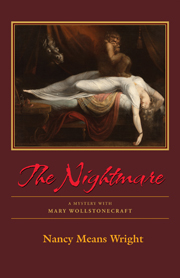
Nancy Means Wright’s latest novel is The Nightmare: a Mystery with Mary Wollstonecraft (Perseverance Press, September, '11). www.nancymeanswright.com
------
An 18th-century Feminist Takes on an Unfair, Feudal Practice
by Nancy Means Wright
“Property, ” Mary Wollstonecraft wrote in her flaming Vindication of the Rights of Man (1790), “should be fluctuating, which would be the case if it were more equally divided amongst all the children of a family. Else it is an everlasting rampart, in consequence of a barbarous feudal institution that enables the elder son to overpower talents and depress virtue.”
The “feudal institution” Mary decried in her rebuttal to the reactionary Edmund Burke, was the law of primogeniture. In practice since the Norman conquest, a father’s fortune would go directly to the eldest son, and so on down the male line—the objective being to keep estates intact from generation to generation.
“Security of property: Behold in a few words, the definition of English ‘liberty,’” was Mary’s ironic reply to Burke, who not only upheld the practice but had attacked Mary’s mentor, Unitarian Dr. Richard Price who like Mary, was thrilled with the Liberté, Égalité ideals of the French Revolutionaries.
“To this selfish principle (primogeniture),” she declared, “every nobler one is sacrificed!”
The practice was ensured by means of entail, a legal arrangement under which the father had only an allowance and life interest in the estate, which was then entailed to the eldest son. Any sale of the property was prevented by law, resulting in vast estates owned by extravagantly rich families. By the mid-19th century, one quarter of all British land was held by a mere 701 individuals. Primogeniture, they insisted, was the only way to ensure political and economic stability, and so remained on the law books until 1925!
Mary’s grandfather had amassed a small fortune as master silk weaver, but her father squandered it in his attempt to become a gentleman farmer. He failed at every move, and drank away much of the inheritance. Mary’s autocratic brother Ned didn’t inherit enough money to became a man of leisure, like many elder brothers, but he did practice law, and kept for himself the small legacy assigned to his six siblings. So after her mother’s death, elder daughter Mary was left with no money, but all the responsibility for her younger brothers and sisters.
At fourteen, Mary’s brother Henry was apprenticed to an apothecary-surgeon, and then disappeared from record. But Mary outfitted James for a naval career, and sent Charles off to make his fortune in America (with middling success). She helped her sister Eliza escape an abusive husband; yet unable to remarry, Eliza had to earn her way as governess. Governessing was the fate of the youngest sister, Everina, as well, and for a time, of Mary herself—“a most humilating occupation!” Her whole short life, Mary sent the little money she earned from her writing to prop up her siblings, along with her feckless father.
No wonder then, that early on, as Virginia Woolf put it, life for Mary became “one cry for justice!” And justice was sorely needed, according to philosopher Francis Bacon, who wrote that tempted by money and power, elder sons were likely to become “disobedient, negligent and wasteful.”
Like Mary, 18th-century Nelly Weeton valued family ties and responsibilities, even rejecting an offer of marriage to keep house for her elder brother Tom after their father died at sea. But Tom, who as a boy was close to Nelly, married a woman who wanted no part of the sister. He ultimately stole the little legacy their mother left Nelly, and virtually sold her into servitude. A desperate marriage to a tyrant who appropriated her teaching money, and after a separation, denied her entry to their daughter, turned Nelly’s life to abject misery. Mary Wollstonecraft’s stepsister, Claire Clairmont, had a similar loss when her indifferent lover, poet Lord Byron, an only son, refused all visits to their daughter, who at eight years of age died alone in a convent.
Although loving and supportive, Jane Austen’s elder brother Edward took advantage of the system through the practice of surrogate heirship and its device of name changing, aimed at keeping estates whole. Edward was adopted by a distant cousin, Thomas Knight, and gave up the name of Austen for Knight when he inherited. Biographer David Nokes suggested that Jane felt abandoned by her brother, although Jane’s only known comment was: “I must learn to make a better K.”
Yet the poison of primogeniture is paramount in Austen’s novels. In Pride and Prejudice the Bennet estate is entailed to the pompous Mr. Collins, clergyman cousin to Mr. Bennet who had no sons, leaving the silly Mrs. Bennet, who finds the subject of entail “beyond the reach of reason,” to scheme up husbands for her five daughters. Should she fail in the event of her husband’s death, mother and daughters would have no home or income. In Northanger Abbey, Austen portrays elder brother Frederick as corrupt and cruel, while in Mansfield Park elder Tom is everyone’s party boy. Austen questions the validity of primogeniture when she makes younger brother Edmund the good son, although the latter loses the young woman he loves because he isn’t rich enough and is destined to become a boring (to her) clergyman. Happily, in the long run, he discovers he’s better off without her.
The disparity of riches between elder and younger brothers was huge, often creating a wide rift between siblings. In a lecture on Shakespeare’s King Lear, Samuel Coleridge notes “the mournful alienation of brotherly love…in children of the same stock.” 19th century Anthony Trollope’s novels are full of younger sons pursuing heiresses, or simply seeking a comfortable bachelorhood without an expensive wife—whereas the elder son must marry in order to produce an heir—think Henry the Eighth!
But considering the fates of Henry’s wives, it was females who were the true victims. For most females there was little money or opportunity to find a suitable husband; some indigent ladies found a taboo against marrying beneath them and remained spinsters. But the main drawback, as Mary Wollstonecraft makes clear in her A Vindication of the Rights of Woman, was failure to receive an equal education. A lack of proper schooling, she allowed, often contributed to a pampered indolence in females, and “a false regard for wealth and status over reason and true moral values.” In her own life, her mother indulged her first born son, neglecting Mary, though it was Mary, not Ned, who lay nights in front of her mother’s bedchamber to waylay the drunken husband.
No doubt Mary was, in part, vindicating the abuses of her own life in her rebuttal to conservative Edmund Burke who considered primogeniture an anchor of social order, but she had known the “demon of property…to encroach on the sacred rights” of legions of unhappy men and women.
“I glow,” she cried, “with indignation!”
------
Nancy Means Wright’s latest novel is The Nightmare: a Mystery with Mary Wollstonecraft (Perseverance Press, September, '11). www.nancymeanswright.com

Friday, August 12, 2011
Reviews of obscure books: Silk and Stone, by Dinah Dean
It's been well over a year since my last entry in the Reviews of Obscure Books series, so I figured it was about time for a new one. This is my copy of Dinah Dean's Silk and Stone, and when you find a book as obscure as this one is, you don't care that one of its past owners slapped an ugly bookplate on the front cover rather than on the flyleaf. Well, actually that's not true, but I'll deal with it.
Among others, Dean has written six mostly unconnected novels that take place in Waltham Abbey in Essex between the 11th and 19th centuries. Silk and Stone, the 2nd in this unofficial series, is set during the civil wars between King Stephen and Empress Matilda in the 1140s. But while the main characters all end up in the East of England, the novel begins on a pilgrimage far to the east and south.
Norman lady Mabilia de Wix, her 17-year-old daughter Elys, and their maid are in Rome, having traveled there in the company of Mabilia's haughty brother, Templar knight Sir Richard de Hastings. Elys's older brother Matthew has a wound in his foot that refuses to heal, and the women have made pilgrimages to holy places all over England and France in the hopes of curing him. All have failed, and they don't understand why. Novelist Diana Norman would have made a slyly irreverent remark about this over-the-top situation, and indeed I expected one, but here, the novel's gentle humor mingles with sadness. Unless Matthew lives, the family's noble line will die out.
If that's not bad enough, Elys hates the thought of going into a convent. Mabilia has plans to retire to the cloister, seeing it as the safest place during these traumatic times of constant war, and wants to see Elys settled there too. Elys's dowry has already been given to the nuns, so she has no hope for a decent marriage. Elys has other plans, though. An accomplished needlewoman, she thinks she has what it takes to be a professional broiderer.
Aylwin of Winchester, a master mason from a noble Saxon bloodline, sympathizes with Elys's predicament, and they become friends as he, his friend Sir Fulk, and her family wander back to England together. Her quest for independence gains ground in the town of Waltham Abbey; she impresses Father Warmand with her skill, and he hires her to design and sew an elaborate cope, or church vestment.
With her unorthodox choice of career, her refusal to become a nun, her mother's and uncle's disapproval, and Sir Fulk's unwillingness to marry her despite his obvious admiration, Elys has her hands full. Aylwin has feelings for her, but Elys is still blind to his attentions. Matthew's days are numbered, too; only a miracle can cure him. Fortunately, one may be at hand.
This isn't a good book on which to test the 50-page rule. Today's commercial fiction is obliged to grip the reader's attention immediately, but the initial few chapters of this one are slow. Imagine the pacing of a pilgrimage in the Middle Ages, and you'll get an idea of how slow. Things pick up as the plot begins to cohere, happily, and as Elys emerges as the novel's central figure.
Her plight is easy to understand — who would want to be forced into a nunnery? — but she belongs to her time rather than ours. Her romance with Aylwin develops realistically, with the shadow of the Norman Conquest, some seventy years earlier, still lingering in the background. She also doesn't realize how fortunate she is, not until later. Through the depiction of Elys's older sister Judith, who is now called Sister Helen, readers get to see the bitter result of a woman's regret-filled life.
Dean presents a wonderfully detailed tapestry of the English medieval world, presenting the day-to-day occupations and concerns of nobility, craftspeople, and churchmen, although the weave isn't always as fine as it could be. In some scenes, she spoon-feeds information on England's political history; in others, she drops readers into a pile of medieval terminology and lets them sort out what's what. I liked the latter approach. The word "mystery" is used in the sense of "miracle," and to her credit, Dean explores her characters' religious mindsets without making them seem holier-than-thou. Instead, their faith feels like a natural part of their existence, which it was.
In her author's note, placed at the very beginning, Dean writes that many of her characters once lived, and that much of her plot is historically based rather than fictional. Lady Mabilia, Sir Richard, Matthew, and several of the townspeople are among the real ones, all mentioned in a chronicle written forty years later.
Dinah Dean's Silk and Stone was published by Barrie & Jenkins, London, in hardcover in 1990 (382pp). The RomanceWiki page has a complete bibliography of her work. Should you be interested in a copy of this one, there are a couple of reasonably-priced ones on Amazon UK. For now.
Among others, Dean has written six mostly unconnected novels that take place in Waltham Abbey in Essex between the 11th and 19th centuries. Silk and Stone, the 2nd in this unofficial series, is set during the civil wars between King Stephen and Empress Matilda in the 1140s. But while the main characters all end up in the East of England, the novel begins on a pilgrimage far to the east and south.
Norman lady Mabilia de Wix, her 17-year-old daughter Elys, and their maid are in Rome, having traveled there in the company of Mabilia's haughty brother, Templar knight Sir Richard de Hastings. Elys's older brother Matthew has a wound in his foot that refuses to heal, and the women have made pilgrimages to holy places all over England and France in the hopes of curing him. All have failed, and they don't understand why. Novelist Diana Norman would have made a slyly irreverent remark about this over-the-top situation, and indeed I expected one, but here, the novel's gentle humor mingles with sadness. Unless Matthew lives, the family's noble line will die out.
If that's not bad enough, Elys hates the thought of going into a convent. Mabilia has plans to retire to the cloister, seeing it as the safest place during these traumatic times of constant war, and wants to see Elys settled there too. Elys's dowry has already been given to the nuns, so she has no hope for a decent marriage. Elys has other plans, though. An accomplished needlewoman, she thinks she has what it takes to be a professional broiderer.
![]() |
| The legendary tomb of King Harold II, which resides in Waltham and is mentioned in the novel |
With her unorthodox choice of career, her refusal to become a nun, her mother's and uncle's disapproval, and Sir Fulk's unwillingness to marry her despite his obvious admiration, Elys has her hands full. Aylwin has feelings for her, but Elys is still blind to his attentions. Matthew's days are numbered, too; only a miracle can cure him. Fortunately, one may be at hand.
This isn't a good book on which to test the 50-page rule. Today's commercial fiction is obliged to grip the reader's attention immediately, but the initial few chapters of this one are slow. Imagine the pacing of a pilgrimage in the Middle Ages, and you'll get an idea of how slow. Things pick up as the plot begins to cohere, happily, and as Elys emerges as the novel's central figure.
Her plight is easy to understand — who would want to be forced into a nunnery? — but she belongs to her time rather than ours. Her romance with Aylwin develops realistically, with the shadow of the Norman Conquest, some seventy years earlier, still lingering in the background. She also doesn't realize how fortunate she is, not until later. Through the depiction of Elys's older sister Judith, who is now called Sister Helen, readers get to see the bitter result of a woman's regret-filled life.
![]() |
| The nave of Waltham Abbey |
In her author's note, placed at the very beginning, Dean writes that many of her characters once lived, and that much of her plot is historically based rather than fictional. Lady Mabilia, Sir Richard, Matthew, and several of the townspeople are among the real ones, all mentioned in a chronicle written forty years later.
Dinah Dean's Silk and Stone was published by Barrie & Jenkins, London, in hardcover in 1990 (382pp). The RomanceWiki page has a complete bibliography of her work. Should you be interested in a copy of this one, there are a couple of reasonably-priced ones on Amazon UK. For now.
Tuesday, August 09, 2011
Book review: The Last Time I Saw Paris, by Lynn Sheene
Lynn Sheene takes risks with her heroine, Claire Harris Stone, by making her a gold-digging Manhattan socialite. In May 1940, with the world on the brink of war, she shamelessly flirts with her husband's German clients to soften them up for business deals. Over the course of her debut novel The Last Time I Saw Paris, Sheene successfully transforms Claire into a woman who's much more selfless and sympathetic, but just as courageous and hard-edged - thanks to the considerable risks Claire takes for herself.
When her husband discovers she's not the blue-blood she claimed to be, Claire flees New York for Paris, the promised City of Light, hoping to connect up with a former lover. Germany has just invaded Poland, but Claire is still taken aback when the Nazis move in to occupy the city. (Her naïveté defies belief at times, especially given her street-smarts in other respects.) She takes refuge with an aristocratic florist, Madame Palain, who employs her under the table. Claire agrees to help the Resistance only because they can provide the fake identity papers she needs.
Madame Palain knows the importance of beauty during hard times and vows to keep her shop open. The floral deliveries Claire makes to Nazi gatherings at swanky hotels gives her the chance to gain intelligence for her contacts, who include an Englishman named Thomas Grey - a friend of her old lover. As she and Grey walk through the Luxembourg Gardens together, exchanging information, their opinions toward one another gradually shift until she comes to care for him and his safety more than she does for herself. Then her cover is blown, for a second time.
The novel offers up a vivid yet stark vision of a cultured European city at one of its darkest hours. Danger is ever-present; people are detained, carted away, and shot for the slimmest of "offenses," and fear and desperation become a tragic part of life. But despite the unease that grips northern France, the indomitable spirit of Paris endures and is described in terms that suit its nature. One park is "a stately woman, her well-bred bones showing through the ravages of the season." The plot grows increasingly suspenseful as the months and years pass under the Occupation, and as Claire is exposed to greater peril.
The ending raises more questions than it answers, but The Last Time I Saw Paris is well worth reading for its page-turning storyline, edgy atmosphere, and progressive insight into the character of a determined woman with a strong instinct for survival.
The Last Time I Saw Paris appeared in May from Berkley at $15/$17.50 in Canada (trade paperback, 354pp).
When her husband discovers she's not the blue-blood she claimed to be, Claire flees New York for Paris, the promised City of Light, hoping to connect up with a former lover. Germany has just invaded Poland, but Claire is still taken aback when the Nazis move in to occupy the city. (Her naïveté defies belief at times, especially given her street-smarts in other respects.) She takes refuge with an aristocratic florist, Madame Palain, who employs her under the table. Claire agrees to help the Resistance only because they can provide the fake identity papers she needs.
Madame Palain knows the importance of beauty during hard times and vows to keep her shop open. The floral deliveries Claire makes to Nazi gatherings at swanky hotels gives her the chance to gain intelligence for her contacts, who include an Englishman named Thomas Grey - a friend of her old lover. As she and Grey walk through the Luxembourg Gardens together, exchanging information, their opinions toward one another gradually shift until she comes to care for him and his safety more than she does for herself. Then her cover is blown, for a second time.
The novel offers up a vivid yet stark vision of a cultured European city at one of its darkest hours. Danger is ever-present; people are detained, carted away, and shot for the slimmest of "offenses," and fear and desperation become a tragic part of life. But despite the unease that grips northern France, the indomitable spirit of Paris endures and is described in terms that suit its nature. One park is "a stately woman, her well-bred bones showing through the ravages of the season." The plot grows increasingly suspenseful as the months and years pass under the Occupation, and as Claire is exposed to greater peril.
The ending raises more questions than it answers, but The Last Time I Saw Paris is well worth reading for its page-turning storyline, edgy atmosphere, and progressive insight into the character of a determined woman with a strong instinct for survival.
The Last Time I Saw Paris appeared in May from Berkley at $15/$17.50 in Canada (trade paperback, 354pp).
Saturday, August 06, 2011
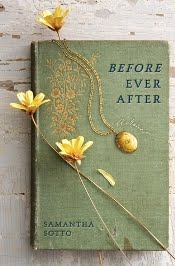
Book review: Before Ever After, by Samantha Sotto
Get ready for the unexpected when you pick up this offbeat, incredibly enjoyable novel, which will transport you on a memorable journey through Europe old and new.
American expat Shelley Gallus had put her life on hold after her husband, Max, was killed in a Madrid train bombing three years earlier. When a man who is his spitting image rings her doorbell in London, claiming to be Max’s grandson, Paolo, Shelley refuses to believe this time-bending impossibility. That is, until the similarities between Max and Paolo’s beloved and seemingly ageless "Nonno" become too profound to ignore.
She and Paolo board a plane for the Philippines, where he believes Max has resurfaced. Shelley’s reminiscences about how she and Max first met form the heart of the novel, and although its structure jumps around a lot, the story is easy to follow. Max had been her guide on a laid-back package tour through the back roads of Europe that Shelley joined on impulse.
As the tour group’s VW van rumbles along from the steps of Montmartre to Switzerland’s Emmental Valley, and from the red-roofed skyline of Slovenia's capital to the shadow of Mt. Vesuvius, Max recounts folkloric vignettes from history, each one set further back in time. Each is a perfect little slice of the past featuring ordinary people, their difficult times, and how they fought to save their loved ones.
Back on the plane with Paolo, Shelley realizes that perhaps Max’s stories were more than that. Perhaps they were his way of telling the truth about himself.
Sotto’s deceptively slim debut is as rich and satisfying as one of Max's famous baked egg and cheese breakfasts, minus the calories and cholesterol. Its tone moves from zany to thoughtful to painfully sad and back again, all the while evoking the lengths people travel for love.
Before Ever After was published by Crown in August at $23.00/$25.95 in Canada (hardcover, 294pp). Stop on over to the author's website for back story, her blog, a virtual tour of the places in the book, and pics of the cutest little VW van. This review was first published in August's Historical Novels Review.
American expat Shelley Gallus had put her life on hold after her husband, Max, was killed in a Madrid train bombing three years earlier. When a man who is his spitting image rings her doorbell in London, claiming to be Max’s grandson, Paolo, Shelley refuses to believe this time-bending impossibility. That is, until the similarities between Max and Paolo’s beloved and seemingly ageless "Nonno" become too profound to ignore.
She and Paolo board a plane for the Philippines, where he believes Max has resurfaced. Shelley’s reminiscences about how she and Max first met form the heart of the novel, and although its structure jumps around a lot, the story is easy to follow. Max had been her guide on a laid-back package tour through the back roads of Europe that Shelley joined on impulse.
As the tour group’s VW van rumbles along from the steps of Montmartre to Switzerland’s Emmental Valley, and from the red-roofed skyline of Slovenia's capital to the shadow of Mt. Vesuvius, Max recounts folkloric vignettes from history, each one set further back in time. Each is a perfect little slice of the past featuring ordinary people, their difficult times, and how they fought to save their loved ones.
Back on the plane with Paolo, Shelley realizes that perhaps Max’s stories were more than that. Perhaps they were his way of telling the truth about himself.
Sotto’s deceptively slim debut is as rich and satisfying as one of Max's famous baked egg and cheese breakfasts, minus the calories and cholesterol. Its tone moves from zany to thoughtful to painfully sad and back again, all the while evoking the lengths people travel for love.
Before Ever After was published by Crown in August at $23.00/$25.95 in Canada (hardcover, 294pp). Stop on over to the author's website for back story, her blog, a virtual tour of the places in the book, and pics of the cutest little VW van. This review was first published in August's Historical Novels Review.
Wednesday, August 03, 2011
An interview with Sonia Gensler, author of The Revenant
You'll find Sonia Gensler's The Revenant shelved in the Teen Paranormal Romance section at your local bookstore. However, it has far more in common with creepy supernatural mysteries like Patricia Clapp's Jane-Emily and Sarah Waters' The Little Stranger than it does with Twilight and its ilk.
The year is 1896, and 17-year old Willemina Hammond is desperate. To escape a home situation she detests, she boards a train from Tennessee to Indian Territory and steals the identity of one of her former classmates. But Willie's assumed role as an English teacher at the Cherokee Female Seminary in Tahlequah, Oklahoma is nothing like she expects.
Willie struggles to gain authority over her cliquish pupils, who are the same age as she is, and whose upper-class background gives them a sophistication she herself doesn't have. Then Willie learns that her bedroom used to belong to a former student who drowned in the river last year. What's causing the tapping on her window after dark — is it poor Ella's ghost, and if so, what does Ella want to tell her? What ever happened to the boy rumored to be Ella's lover? And can a romance between Willie and Eli Sevenstar, a handsome older student at the male seminary across town, ever work out?
The Cherokee Female Seminary was a real place, an institution of higher learning for wealthy Cherokee girls and lower-class scholarship students. Its building — a three-story, turreted structure that resembles a castle — is now part of the Northeastern State University campus. I loved walking through the rooms of the seminary along with Willie, noting the fully stocked library and gleaming wood tables and chairs. Willie's awkward experiences in front of a classroom ring true, the depiction of late 19th-century Cherokee life is seen from an intriguing new perspective, and the ghost story is eerie and unpredictable. The Revenant is an engrossing read which should appeal equally well to adults and YAs.
I hope you'll enjoy the following interview!
I wasn't familiar with the term "revenant" before picking up your book. What's the difference between a revenant and a regular ghost, if there is such a thing?
I don’t think there really is a difference. Revenant, with its French origins, seemed a more old-fashioned and romantic word to me than ghost, and over the course of the story I was able to give a double meaning to its definition of “one who returns.” I think the term can include creatures such as vampires or zombies, but obviously I didn’t go in that direction for this story!
How do you get into the right mood for writing scary scenes, like the ones in which Willie hears mysterious tapping at her window very late at night?
No one has asked this question before! Actually, it’s sort of the same as when I write romantic scenes. I rarely try to “set the mood” – I don’t have to be scared in order to write a scary scene. At times I try to remember moments when I was scared, but I have to be thinking pretty calmly and objectively in order to write about those moments. When the scene is stubbornly refusing to flow, I might review scary scenes from favorite ghostly novels for inspiration.
Now that I see how mundane my answer is, I’m tempted to light candles and play spooky music next time I have to write a scary scene, just to see how that affects the process!
I found your depiction of the Cherokee students and their families fascinating and enlightening, because it's a chapter of their history - and a segment of the population - you don't often read about. What sort of research did you do to ensure that the Cherokee characters were portrayed correctly?
For my research I visited the Oklahoma Historical Society and the Northeastern State University Archives. I also had the benefit of reading Devon Mihesuah’s Cultivating the Rosebuds: The Education of Women at the Cherokee Female Seminary, 1851-1909 as well a collection of oral histories entitled Cherokee Female Seminary Years, edited by Maggie Culver Fry. These books, along with the photographs, school catalogs, architectural plans, etc. obtained through the archives, gave me a pretty clear background on the history of the town, seminaries, and people. Once I had a draft, I arranged for an introduction to Dr. Richard Allen, former English teacher and current policy analyst for the Cherokee Nation. He kindly agreed to read the manuscript for me and offered valuable insights on historical context and characterization.
What sorts of things did you discover while doing on-site exploration of the old seminary building that you wouldn't have known about otherwise?
I think it was during a tour that I learned what parts of the building were off-limits to male seminary students. When invited to the school, boys were allowed access to the first floor, but could only step as far as the first landing on the staircase to the second floor. They were NOT to go to near the girls’ bedrooms. This wasn’t surprising information by any means, but it did get me thinking about certain plot points . . .
I know it may not be fair to ask a teacher to choose a favorite student, but were there any of the girls (or boys) whose backstory or character you enjoyed developing the most?
Fannie and Larkin Bell weren’t necessarily my favorite characters, but I did enjoy fleshing them out as the “mean girl” and her rakish older brother. It was especially fun to imagine their home for the Christmas party scenes – the house was loosely based on Rose Cottage in Park Hill, the home of Chief John Ross. Fannie is a royal pain, but I tried to show her strengths as well as flaws. I like to imagine that her frightening experiences at the seminary tempered her vanity and snobbery.
Willie's enthusiasm for Shakespeare's plays comes through clearly to her students at the Cherokee Female Seminary. Back when you were a teacher, did you have any favorite Shakespeare plays to read and act out with your classes?
I required my English II students to act out the assassination scene from Julius Caesar every year. They usually had a great time with that. It was a complicated and often maddening effort to throw costumes and props together and, after much rehearsing, film the scene. The experience certainly made for a great discussion when the students compared their version to the same scene in the 1970 film adaptation of the play, which portrays the assassination very . . . vividly.
Were there any fascinating tidbits you picked up during the writing process that you wanted to use in The Revenant but were unable to?
During the research process I went on one of the Haunted Seminary Hall tours, which are offered every October by Northeastern State University graduate students. At one point the guide took us to the second floor and, after pushing aside a tile from the drop ceiling, showed us what certainly looked like footprints on the original plaster ceiling. It was quite eerie, and no one had an explanation for it. I wish I could have worked that into the story somehow, but the proper way to include it never came to me.
Although Willie's only seventeen, the role she assumes puts her in an unusual position - she's expected to associate with other adults rather than students of her own age. For this and other reasons, I could easily see your book appealing to both YAs and adults. Did you deliberately set out to write a novel for the YA market, or didn't you have an age group in mind?
I did set out to write The Revenant as a YA book, but with the knowledge that YA has considerable crossover appeal to the adult market these days. The teen years are inherently full of drama and conflict, and I feel that most adults still have vivid memories of that time in their lives. I also liked the idea of my protagonist putting on a performance, and in this case, she was pretending to be an adult – a common fantasy for teens.
Thank you, Sonia!
------
The Revenant was published in June by Knopf in hardback ($16.99/$18.99 Canadian, 322pp). Visit Sonia's website at www.soniagensler.com for biographical information plus more historical background on the novel.
The year is 1896, and 17-year old Willemina Hammond is desperate. To escape a home situation she detests, she boards a train from Tennessee to Indian Territory and steals the identity of one of her former classmates. But Willie's assumed role as an English teacher at the Cherokee Female Seminary in Tahlequah, Oklahoma is nothing like she expects.
Willie struggles to gain authority over her cliquish pupils, who are the same age as she is, and whose upper-class background gives them a sophistication she herself doesn't have. Then Willie learns that her bedroom used to belong to a former student who drowned in the river last year. What's causing the tapping on her window after dark — is it poor Ella's ghost, and if so, what does Ella want to tell her? What ever happened to the boy rumored to be Ella's lover? And can a romance between Willie and Eli Sevenstar, a handsome older student at the male seminary across town, ever work out?The Cherokee Female Seminary was a real place, an institution of higher learning for wealthy Cherokee girls and lower-class scholarship students. Its building — a three-story, turreted structure that resembles a castle — is now part of the Northeastern State University campus. I loved walking through the rooms of the seminary along with Willie, noting the fully stocked library and gleaming wood tables and chairs. Willie's awkward experiences in front of a classroom ring true, the depiction of late 19th-century Cherokee life is seen from an intriguing new perspective, and the ghost story is eerie and unpredictable. The Revenant is an engrossing read which should appeal equally well to adults and YAs.
I hope you'll enjoy the following interview!
I wasn't familiar with the term "revenant" before picking up your book. What's the difference between a revenant and a regular ghost, if there is such a thing?
I don’t think there really is a difference. Revenant, with its French origins, seemed a more old-fashioned and romantic word to me than ghost, and over the course of the story I was able to give a double meaning to its definition of “one who returns.” I think the term can include creatures such as vampires or zombies, but obviously I didn’t go in that direction for this story!
How do you get into the right mood for writing scary scenes, like the ones in which Willie hears mysterious tapping at her window very late at night?
No one has asked this question before! Actually, it’s sort of the same as when I write romantic scenes. I rarely try to “set the mood” – I don’t have to be scared in order to write a scary scene. At times I try to remember moments when I was scared, but I have to be thinking pretty calmly and objectively in order to write about those moments. When the scene is stubbornly refusing to flow, I might review scary scenes from favorite ghostly novels for inspiration.
Now that I see how mundane my answer is, I’m tempted to light candles and play spooky music next time I have to write a scary scene, just to see how that affects the process!
![]() |
| The former Cherokee Female Seminary, now Seminary Hall, Northeastern State University |
For my research I visited the Oklahoma Historical Society and the Northeastern State University Archives. I also had the benefit of reading Devon Mihesuah’s Cultivating the Rosebuds: The Education of Women at the Cherokee Female Seminary, 1851-1909 as well a collection of oral histories entitled Cherokee Female Seminary Years, edited by Maggie Culver Fry. These books, along with the photographs, school catalogs, architectural plans, etc. obtained through the archives, gave me a pretty clear background on the history of the town, seminaries, and people. Once I had a draft, I arranged for an introduction to Dr. Richard Allen, former English teacher and current policy analyst for the Cherokee Nation. He kindly agreed to read the manuscript for me and offered valuable insights on historical context and characterization.
What sorts of things did you discover while doing on-site exploration of the old seminary building that you wouldn't have known about otherwise?
I think it was during a tour that I learned what parts of the building were off-limits to male seminary students. When invited to the school, boys were allowed access to the first floor, but could only step as far as the first landing on the staircase to the second floor. They were NOT to go to near the girls’ bedrooms. This wasn’t surprising information by any means, but it did get me thinking about certain plot points . . .
I know it may not be fair to ask a teacher to choose a favorite student, but were there any of the girls (or boys) whose backstory or character you enjoyed developing the most?
Fannie and Larkin Bell weren’t necessarily my favorite characters, but I did enjoy fleshing them out as the “mean girl” and her rakish older brother. It was especially fun to imagine their home for the Christmas party scenes – the house was loosely based on Rose Cottage in Park Hill, the home of Chief John Ross. Fannie is a royal pain, but I tried to show her strengths as well as flaws. I like to imagine that her frightening experiences at the seminary tempered her vanity and snobbery.
![]() |
| Author Sonia Gensler |
I required my English II students to act out the assassination scene from Julius Caesar every year. They usually had a great time with that. It was a complicated and often maddening effort to throw costumes and props together and, after much rehearsing, film the scene. The experience certainly made for a great discussion when the students compared their version to the same scene in the 1970 film adaptation of the play, which portrays the assassination very . . . vividly.
Were there any fascinating tidbits you picked up during the writing process that you wanted to use in The Revenant but were unable to?
During the research process I went on one of the Haunted Seminary Hall tours, which are offered every October by Northeastern State University graduate students. At one point the guide took us to the second floor and, after pushing aside a tile from the drop ceiling, showed us what certainly looked like footprints on the original plaster ceiling. It was quite eerie, and no one had an explanation for it. I wish I could have worked that into the story somehow, but the proper way to include it never came to me.
Although Willie's only seventeen, the role she assumes puts her in an unusual position - she's expected to associate with other adults rather than students of her own age. For this and other reasons, I could easily see your book appealing to both YAs and adults. Did you deliberately set out to write a novel for the YA market, or didn't you have an age group in mind?
I did set out to write The Revenant as a YA book, but with the knowledge that YA has considerable crossover appeal to the adult market these days. The teen years are inherently full of drama and conflict, and I feel that most adults still have vivid memories of that time in their lives. I also liked the idea of my protagonist putting on a performance, and in this case, she was pretending to be an adult – a common fantasy for teens.
Thank you, Sonia!
------
The Revenant was published in June by Knopf in hardback ($16.99/$18.99 Canadian, 322pp). Visit Sonia's website at www.soniagensler.com for biographical information plus more historical background on the novel.
Monday, August 01, 2011
Book review: The Mermaid Garden, by Santa Montefiore
Santa Montefiore’s novels combine gorgeously rendered settings, touching romance, and characters facing real world issues such as societal pressures and generational conflicts. Although one of its plotlines is set in the present day (2009) and the other forty years earlier, The Mermaid Garden doesn’t have the hallmarks of a historical novel and shouldn’t be judged as one. Other than an absence of technology, an emphasis on class differences, and the mention of a Bob Dylan song, there isn’t much to indicate a timeframe in the earlier storyline. It’s a strong sense of place rather than time that predominates, along with the impressions that the past never really goes away — and that second chances are there for the taking, for those courageous enough to grab them.
Floriana Farussi is a ten-year-old girl living in poverty in the village of Herba in Tuscany in the summer of 1966. When Dante Bonfanti, the teenage son of a wealthy businessman, catches her spying through the gate of his family’s 15th-century palazzo, he brings her through the main entrance and gives her a tour. With an alcoholic father and an absent mother, Floriana fits in well with the stray animals that populate the grounds, and she charms Dante and his family just as easily. The mermaid garden at La Magdalena becomes her sanctuary. Six years later, Floriana grows into a beautiful young woman, and she and Dante fall in love. Optimistic and innocent, Floriana believes their relationship stands a chance.
In the summer of 2009, Marina Turner runs an Italianate-style hotel in Devon, England, with her beloved husband, Grey. She has poured her heart into restoring it and will do anything to keep it afloat despite being in debt up to her ears. In the hopes of attracting new business, she advertises for an artist-in-residence who will teach her mostly elderly clientele how to paint. Argentine painter Rafa Santoro is the perfect choice; not only is he talented, handsome, and clever, but he seems to be exerting a calming influence on Marina’s grumpy stepdaughter, Clementine – and maybe more than that, too. Rafa is reticent about his past, though, and there’s a hotel burglar on the loose in the area…
Romantic and uplifting without being sappy, the novel lilts smoothly between locales and decades. While the tie between the two plotlines isn’t hard to predict, the twist at the end comes as a surprise. Because it’s classic summer escapism, it can be described as a beach read, but the characters are more complex than you’d expect from that. There’s humor, too, in a subplot involving Clementine’s stuffy boss and the risqué hanky-panky he gets into with his mistress. This is a book to bring outside to read in your own exotic garden, but if you don’t have one, settle back and let Montefiore’s novel conjure up its lush, tranquil atmosphere for you.
The Mermaid Garden was published in June by Touchstone/Simon and Schuster at $24.99 (419pp, hardcover). The British edition, called The House by the Sea, was published by Simon & Schuster UK in July at £12.99.
Floriana Farussi is a ten-year-old girl living in poverty in the village of Herba in Tuscany in the summer of 1966. When Dante Bonfanti, the teenage son of a wealthy businessman, catches her spying through the gate of his family’s 15th-century palazzo, he brings her through the main entrance and gives her a tour. With an alcoholic father and an absent mother, Floriana fits in well with the stray animals that populate the grounds, and she charms Dante and his family just as easily. The mermaid garden at La Magdalena becomes her sanctuary. Six years later, Floriana grows into a beautiful young woman, and she and Dante fall in love. Optimistic and innocent, Floriana believes their relationship stands a chance.
In the summer of 2009, Marina Turner runs an Italianate-style hotel in Devon, England, with her beloved husband, Grey. She has poured her heart into restoring it and will do anything to keep it afloat despite being in debt up to her ears. In the hopes of attracting new business, she advertises for an artist-in-residence who will teach her mostly elderly clientele how to paint. Argentine painter Rafa Santoro is the perfect choice; not only is he talented, handsome, and clever, but he seems to be exerting a calming influence on Marina’s grumpy stepdaughter, Clementine – and maybe more than that, too. Rafa is reticent about his past, though, and there’s a hotel burglar on the loose in the area…
Romantic and uplifting without being sappy, the novel lilts smoothly between locales and decades. While the tie between the two plotlines isn’t hard to predict, the twist at the end comes as a surprise. Because it’s classic summer escapism, it can be described as a beach read, but the characters are more complex than you’d expect from that. There’s humor, too, in a subplot involving Clementine’s stuffy boss and the risqué hanky-panky he gets into with his mistress. This is a book to bring outside to read in your own exotic garden, but if you don’t have one, settle back and let Montefiore’s novel conjure up its lush, tranquil atmosphere for you.
The Mermaid Garden was published in June by Touchstone/Simon and Schuster at $24.99 (419pp, hardcover). The British edition, called The House by the Sea, was published by Simon & Schuster UK in July at £12.99.
Winners of Moon in Leo
A quick note to announce the winners of the Moon in Leo ebook - congratulations to Melissa and Sarah, the other librarian!
I'll be in touch via email with download instructions. Hope you enjoy the read, and thanks to everyone who entered.
Tuesday, July 26, 2011
An interview with Stewart Binns, author of Conquest
Today Stewart Binns is visiting the blog to respond to some questions about his new novel Conquest, fast-paced adventure fiction about Hereward of Bourne – or Hereward the Wake, as he's better known. A legendary English hero whose existence is historically documented, Hereward led the resistance to the Normans' conquest of England in the landmark year of 1066. The principal story of Conquest, however, begins thirteen years beforehand. A strong and impetuous young man of eighteen, Hereward is a brilliant fighter who still has much to learn about the ways of the world.
Conquest was the first major novel about Hereward the Wake to appear in quite a while, and there have been several other authors writing about the tumultuous events of 11th-century England just within the last year, too. What attracted you to this time period, and why do you think readers are so interested in it now in particular?
I’ve always been fascinated by 11th century England and 1066 in particular. I think Senlac Ridge was the critical defining moment in English/British history where the outcome determined the kind of country England became and all that led from it: Britishness, Anglo-American (western) culture etc. It was a great battle in every sense: its consequences, its intensity, its protagonists and the fact that the margin between defeat and victory was so close. Hardrada and Stamford Bridge are part of this as well, and I’ve always been intrigued by the mix of Celt, Norse, Norman and Anglo-Saxon at the time and how different England and the modern world would have been if either Harald, or Harold had emerged victorious instead of William.
Hereward is an enigmatic figure with wonderful William Wallace-like hero potential, and I thought he was the perfect character to build both an heroic adventure around and to tell the story of those amazing times.
I think there is growing interest in English history at the moment as the English try to define themselves afresh in a newly-devolved Britain. Now that the Scots, Welsh and Irish are off doing their own thing, ‘Britain’ no longer exists in the way the English defined it, as, effectively, ‘Greater England’. The English tended to define ‘English’ as ‘British’ and that doesn’t work anymore, leaving the English in search of themselves and their past.
The novel is framed around Godwin of Ely's account of his earlier life in England. What made you decide to write the core of the novel in third person rather than first?
I suppose I wanted there to be a circle from The Old Man of the Wildwood and Godwin of Ely and for Hereward to survive into great old age. The Varangian Guard/Byzantium/John the Beautiful were irresistible as well. However, my biggest challenge was how the deal with William would work at the end of the Siege of Ely. Thus, the anonymity clause and the creation of Godwin. There are also factors at play that make book 2 work! (To be published next April).
In working through the material on Hereward's life, how did you decide which elements to take from the myths about him, and which from history?
I only took the bits that seem fairly substantial – the banishment and Ely, the rest is fiction. However, although the book is of course fiction, all the history is spot on in terms of main characters, events and chronology. That is really important to me.
Hereward's wife Torfida (or Torfrida) was a character in Charles Kingsley's 1865 novel about him, but was there any mention of her in other novels, or in history, before he wrote about her? How did you develop her character?
I slightly changed her name (by accident rather than design!) but she is mentioned in the 12th century Gesta. I wanted a strong female character, slightly mysterious and somewhat tragic. It is also mentioned that they had twins.
During his time as a mercenary, Hereward and his company travel throughout many parts of Britain and Europe - Ireland, Scotland, Scandinavia, Sicily, the Alps, France, and elsewhere. Did you get the chance to visit any of these sites yourself?
I have a policy only to write about places I’ve been to and can visualise. I’m lucky, I’ve travelled a lot!
The novel's action scenes certainly feel very realistic! What was your most enjoyable battle scene to write?
I’m told I write battles well. Two reasons I think: My day job is as a documentary-maker, so I suppose I think in pictures. Also, as an ex-soldier, I know how they think.
Most enjoyable battle scene to write - Senlac Ridge of course – one of the most important battles in world history. I really enjoyed trying to explain how it might have happened, especially the astonishing bravery on both sides. I’m also quite fond of Ely. There is no known detail of what happened there, so an author’s paradise!
What do you hope readers get out of reading Hereward's story?
Superficially, a good action/adventure romp through a great period of history and beneath that some thoughts about good and evil, right and wrong, truth and myth; some questions about courage and sacrifice and beneath those a little thesis about the making of England.
Conquest was published in February by Penguin UK at £6.99 (pb, 497pp).
Conquest was the first major novel about Hereward the Wake to appear in quite a while, and there have been several other authors writing about the tumultuous events of 11th-century England just within the last year, too. What attracted you to this time period, and why do you think readers are so interested in it now in particular?
I’ve always been fascinated by 11th century England and 1066 in particular. I think Senlac Ridge was the critical defining moment in English/British history where the outcome determined the kind of country England became and all that led from it: Britishness, Anglo-American (western) culture etc. It was a great battle in every sense: its consequences, its intensity, its protagonists and the fact that the margin between defeat and victory was so close. Hardrada and Stamford Bridge are part of this as well, and I’ve always been intrigued by the mix of Celt, Norse, Norman and Anglo-Saxon at the time and how different England and the modern world would have been if either Harald, or Harold had emerged victorious instead of William.
Hereward is an enigmatic figure with wonderful William Wallace-like hero potential, and I thought he was the perfect character to build both an heroic adventure around and to tell the story of those amazing times.
I think there is growing interest in English history at the moment as the English try to define themselves afresh in a newly-devolved Britain. Now that the Scots, Welsh and Irish are off doing their own thing, ‘Britain’ no longer exists in the way the English defined it, as, effectively, ‘Greater England’. The English tended to define ‘English’ as ‘British’ and that doesn’t work anymore, leaving the English in search of themselves and their past.
The novel is framed around Godwin of Ely's account of his earlier life in England. What made you decide to write the core of the novel in third person rather than first?
I suppose I wanted there to be a circle from The Old Man of the Wildwood and Godwin of Ely and for Hereward to survive into great old age. The Varangian Guard/Byzantium/John the Beautiful were irresistible as well. However, my biggest challenge was how the deal with William would work at the end of the Siege of Ely. Thus, the anonymity clause and the creation of Godwin. There are also factors at play that make book 2 work! (To be published next April).
In working through the material on Hereward's life, how did you decide which elements to take from the myths about him, and which from history?
I only took the bits that seem fairly substantial – the banishment and Ely, the rest is fiction. However, although the book is of course fiction, all the history is spot on in terms of main characters, events and chronology. That is really important to me.
Hereward's wife Torfida (or Torfrida) was a character in Charles Kingsley's 1865 novel about him, but was there any mention of her in other novels, or in history, before he wrote about her? How did you develop her character?
I slightly changed her name (by accident rather than design!) but she is mentioned in the 12th century Gesta. I wanted a strong female character, slightly mysterious and somewhat tragic. It is also mentioned that they had twins.
During his time as a mercenary, Hereward and his company travel throughout many parts of Britain and Europe - Ireland, Scotland, Scandinavia, Sicily, the Alps, France, and elsewhere. Did you get the chance to visit any of these sites yourself?
I have a policy only to write about places I’ve been to and can visualise. I’m lucky, I’ve travelled a lot!
The novel's action scenes certainly feel very realistic! What was your most enjoyable battle scene to write?
I’m told I write battles well. Two reasons I think: My day job is as a documentary-maker, so I suppose I think in pictures. Also, as an ex-soldier, I know how they think.
Most enjoyable battle scene to write - Senlac Ridge of course – one of the most important battles in world history. I really enjoyed trying to explain how it might have happened, especially the astonishing bravery on both sides. I’m also quite fond of Ely. There is no known detail of what happened there, so an author’s paradise!
What do you hope readers get out of reading Hereward's story?
Superficially, a good action/adventure romp through a great period of history and beneath that some thoughts about good and evil, right and wrong, truth and myth; some questions about courage and sacrifice and beneath those a little thesis about the making of England.
Conquest was published in February by Penguin UK at £6.99 (pb, 497pp).
Friday, July 22, 2011
Book review: A Lesson in Secrets, by Jacqueline Winspear
Jacqueline Winspear’s eighth Maisie Dobbs mystery demonstrates the truth spoken by one of her characters: “One always has riches when one has a book to read.” This is my first outing with Maisie, who by 1932 is a successful private detective in London. Feeling that I ought to get up to speed with this award-winning series, I requested a copy of A Lesson in Secrets to review. Reading novels out of order doesn’t bother me; if an author does her job well, the order shouldn’t matter, plus starting with a later volume gets me interested in reading about the characters’ past histories, too.
Maisie’s outward sophistication belies her humble origins as a domestic servant to the aristocratic Comptons – a family whose son James is now Maisie’s beau. In the years following World War I, the social fabric of Britain has unraveled and re-formed. The political climate is likewise shifting, not necessarily for the better. At the request of the British Secret Service and Scotland Yard, Maisie takes a post as a junior lecturer in philosophy at a small Cambridge college that has been enrolling an unusual number of students from abroad. Her task is to keep her ear to the ground for any activities “not in the interests of the Crown.”
Greville Liddicote, the founder of St. Francis, has pacifist leanings, and his institution’s curriculum is grounded in his principles. A controversial children’s book he wrote during World War I turned many would-be soldiers into “Conchies” – conscientious objectors – and reportedly caused a mutiny on the front lines. (If this event ever occurred, that is. The British government has kept the truth under wraps.) When Liddicote is found murdered in his office, Maisie is asked to stick to her own investigation and let Special Branch do its job, but everything is closely entangled, of course. The more Maisie learns about her fellow instructors and their connections, the closer she comes to unveiling a murderer.
The plot of A Lesson in Secrets is not so much suspenseful as intellectually provocative. Although she is new on the faculty, Maisie’s natural ease with her peers and students gets them talking, and her inquiry is neatly worked into the history of the period. The Nazi party on the rise in Germany is attracting followers throughout Britain and Europe. Few besides Maisie are attuned to the threat it may pose.
For a newcomer to the series like me, Maisie seems a little too perfect at first: she can quickly discern a cause of death, conduct a well-received philosophy lecture with little preparation, and is remarkably aware of her surroundings. For her, success lies not just in what you know, but in who you know. Over time, she has accumulated enough contacts who provide her with the information she seeks – even if it sometimes leads her up the wrong path.
Maisie is too wary of "happily ever after" endings for her romance with James to be smooth sailing, however, and episodes in her personal life still manage to surprise her. The mix makes her an intriguing character, and I'm now curious about her transformation from servant to wartime nurse to PI. Her back story is well developed here, and the secondary characters are equally well crafted. Even her late mentor Maurice Blanche, who had left her enough funds in his will to make her financially independent, lives on the page as a close memory. I look forward to meeting him in person in Winspear’s earlier books.
A Lesson in Secrets was published in April by Harper ($25.99, 323pp, hardcover).
Maisie’s outward sophistication belies her humble origins as a domestic servant to the aristocratic Comptons – a family whose son James is now Maisie’s beau. In the years following World War I, the social fabric of Britain has unraveled and re-formed. The political climate is likewise shifting, not necessarily for the better. At the request of the British Secret Service and Scotland Yard, Maisie takes a post as a junior lecturer in philosophy at a small Cambridge college that has been enrolling an unusual number of students from abroad. Her task is to keep her ear to the ground for any activities “not in the interests of the Crown.”
Greville Liddicote, the founder of St. Francis, has pacifist leanings, and his institution’s curriculum is grounded in his principles. A controversial children’s book he wrote during World War I turned many would-be soldiers into “Conchies” – conscientious objectors – and reportedly caused a mutiny on the front lines. (If this event ever occurred, that is. The British government has kept the truth under wraps.) When Liddicote is found murdered in his office, Maisie is asked to stick to her own investigation and let Special Branch do its job, but everything is closely entangled, of course. The more Maisie learns about her fellow instructors and their connections, the closer she comes to unveiling a murderer.
The plot of A Lesson in Secrets is not so much suspenseful as intellectually provocative. Although she is new on the faculty, Maisie’s natural ease with her peers and students gets them talking, and her inquiry is neatly worked into the history of the period. The Nazi party on the rise in Germany is attracting followers throughout Britain and Europe. Few besides Maisie are attuned to the threat it may pose.
For a newcomer to the series like me, Maisie seems a little too perfect at first: she can quickly discern a cause of death, conduct a well-received philosophy lecture with little preparation, and is remarkably aware of her surroundings. For her, success lies not just in what you know, but in who you know. Over time, she has accumulated enough contacts who provide her with the information she seeks – even if it sometimes leads her up the wrong path.
Maisie is too wary of "happily ever after" endings for her romance with James to be smooth sailing, however, and episodes in her personal life still manage to surprise her. The mix makes her an intriguing character, and I'm now curious about her transformation from servant to wartime nurse to PI. Her back story is well developed here, and the secondary characters are equally well crafted. Even her late mentor Maurice Blanche, who had left her enough funds in his will to make her financially independent, lives on the page as a close memory. I look forward to meeting him in person in Winspear’s earlier books.
A Lesson in Secrets was published in April by Harper ($25.99, 323pp, hardcover).
Saturday, July 16, 2011
A look at Kathleen Herbert's Moon in Leo, plus a giveaway
First, a disclosure: a quote of mine, based on my reading of Kathleen Herbert’s Dark Ages trilogy from the mid-'80s, is printed on the back cover and first page of Moon in Leo. Not surprisingly, the words I’d written earlier proved to be true about this book as well:
"I’ve always loved Kathleen Herbert’s work. Written with sensitivity, passion, and an extraordinarily vivid sense of place, her novels reflect the realities of life in a bygone age while still evoking all of its magic."
Moon in Leo takes place on the Furness peninsula in south Cumbria, England, a remote land of sparkling estuaries, rocky woodlands, and wide skies that glow pink and lavender in the setting sun. (See the cover at left.) The novel is saturated with atmosphere to the extent that the setting becomes almost a character in itself. In this beautiful yet perilous place, wayfarers who manage to pull themselves free of Morecambe Bay’s treacherous sands can find sanctuary on Chapel Island – the spot where Moon in Leo begins and ends.
Rosamund Halistan comes from a family of alchemists who have always kept to themselves, which means that she has been more sheltered from the world than other young women of her age. In 1678, her twin brother Stephen returns home from a long stay abroad. Although Rosamund had hoped to become his lifelong partner in the mystical arts, Stephen’s interests no longer lie in that direction; he had fallen in love with the exuberant Italian culture and, more dangerously, the religion of its people. Rosamund finds evidence that someone’s out to kill him, and she’s right.
Even eighteen years after Charles II’s restoration, memories of the Civil War remain at the forefront of everyone’s minds. To help keep the peace in a company of mixed faiths and political allegiances, Rosamund and Stephen agree to attend a house party organized by Sir John Westby, a former Royalist, and his wife, Prudence, a former Parliamentarian. Dark undercurrents of schemes and deception flow through the conversations, and though Rosamund doesn’t catch all of the nuances, she finds herself caught in the thick of the action. When tragedy forces her to confront the layers of corruption in the highest circles of the realm, she determines to preserve what means most to her: her family.
Two suitors vie for her hand, one a fellow seeker of alchemical truths, the other a gentleman of the royal bedchamber. As an heiress, she’s a hot commodity, and whether they have their eye on her person or her fortune (or both) is unclear. Rosamund is a true ingénue trapped in a world swirling with intrigue, and while she struggles to find a foothold, her naïveté means that the reader doesn’t know whom to trust either. Reality versus illusion is one of the novel’s most prominent themes, and over its course, the multifaceted characters are seen from numerous angles.
This lengthy book is set against the backdrop of the Popish Plot, a fictional conspiracy drummed up by Titus Oates in an effort to incite violence against England’s Catholics and prevent them from holding power. The historical background is solid, and the storyline feels intensely romantic, at least until one looks beneath the surface. While declarations of affection abound, amid pet names of “dear” and “darling” and “oh my love,” women in this sparsely populated countryside must rely on male protectors, and few women in this book choose wisely – if they’re permitted to choose at all. Herbert’s lush style can make it feel as if one was reading a classic written many years ago rather than a modern work. As a result, the many songs and bawdy rhymes inserted into the text feel even more authentic to the storyline she creates.
Ghostly visitations, sigils charged with magic, and hermetic spells play such a strong role that I sometimes felt as if I’d stepped into a Dion Fortune novel. Although most of the characters don't believe in such things, these occult happenings definitely feel real to Rosamund, influencing her actions beyond what feels natural. The multiplicity of religious beliefs in this deep, involving read make her world feel genuine, as do the well-crafted depictions of ordinary people – nobles, scholars, courtiers, and gypsies – caught in the tide of history.
Moon in Leo was published by Trifolium Books earlier this year (£11.99, trade pb, 401pp).
Contest info: I'm holding a giveaway for two electronic copies of Moon in Leo; the winners will be given directions by which they can download a copy at no charge from Smashwords. To enter, please leave a comment on this post. Deadline July 29th.
"I’ve always loved Kathleen Herbert’s work. Written with sensitivity, passion, and an extraordinarily vivid sense of place, her novels reflect the realities of life in a bygone age while still evoking all of its magic."
Moon in Leo takes place on the Furness peninsula in south Cumbria, England, a remote land of sparkling estuaries, rocky woodlands, and wide skies that glow pink and lavender in the setting sun. (See the cover at left.) The novel is saturated with atmosphere to the extent that the setting becomes almost a character in itself. In this beautiful yet perilous place, wayfarers who manage to pull themselves free of Morecambe Bay’s treacherous sands can find sanctuary on Chapel Island – the spot where Moon in Leo begins and ends.
Rosamund Halistan comes from a family of alchemists who have always kept to themselves, which means that she has been more sheltered from the world than other young women of her age. In 1678, her twin brother Stephen returns home from a long stay abroad. Although Rosamund had hoped to become his lifelong partner in the mystical arts, Stephen’s interests no longer lie in that direction; he had fallen in love with the exuberant Italian culture and, more dangerously, the religion of its people. Rosamund finds evidence that someone’s out to kill him, and she’s right.
Even eighteen years after Charles II’s restoration, memories of the Civil War remain at the forefront of everyone’s minds. To help keep the peace in a company of mixed faiths and political allegiances, Rosamund and Stephen agree to attend a house party organized by Sir John Westby, a former Royalist, and his wife, Prudence, a former Parliamentarian. Dark undercurrents of schemes and deception flow through the conversations, and though Rosamund doesn’t catch all of the nuances, she finds herself caught in the thick of the action. When tragedy forces her to confront the layers of corruption in the highest circles of the realm, she determines to preserve what means most to her: her family.
Two suitors vie for her hand, one a fellow seeker of alchemical truths, the other a gentleman of the royal bedchamber. As an heiress, she’s a hot commodity, and whether they have their eye on her person or her fortune (or both) is unclear. Rosamund is a true ingénue trapped in a world swirling with intrigue, and while she struggles to find a foothold, her naïveté means that the reader doesn’t know whom to trust either. Reality versus illusion is one of the novel’s most prominent themes, and over its course, the multifaceted characters are seen from numerous angles.
This lengthy book is set against the backdrop of the Popish Plot, a fictional conspiracy drummed up by Titus Oates in an effort to incite violence against England’s Catholics and prevent them from holding power. The historical background is solid, and the storyline feels intensely romantic, at least until one looks beneath the surface. While declarations of affection abound, amid pet names of “dear” and “darling” and “oh my love,” women in this sparsely populated countryside must rely on male protectors, and few women in this book choose wisely – if they’re permitted to choose at all. Herbert’s lush style can make it feel as if one was reading a classic written many years ago rather than a modern work. As a result, the many songs and bawdy rhymes inserted into the text feel even more authentic to the storyline she creates.
Ghostly visitations, sigils charged with magic, and hermetic spells play such a strong role that I sometimes felt as if I’d stepped into a Dion Fortune novel. Although most of the characters don't believe in such things, these occult happenings definitely feel real to Rosamund, influencing her actions beyond what feels natural. The multiplicity of religious beliefs in this deep, involving read make her world feel genuine, as do the well-crafted depictions of ordinary people – nobles, scholars, courtiers, and gypsies – caught in the tide of history.
Moon in Leo was published by Trifolium Books earlier this year (£11.99, trade pb, 401pp).
Contest info: I'm holding a giveaway for two electronic copies of Moon in Leo; the winners will be given directions by which they can download a copy at no charge from Smashwords. To enter, please leave a comment on this post. Deadline July 29th.
Thursday, July 14, 2011
A spotlight on Jude Morgan's next novel
Longtime blog readers may remember my high praise for Jude Morgan's The Taste of Sorrow, a masterful work about the Brontës. One of the things I enjoy most about his biographical novels is how carefully he matches his approach and his subjects; his books are all excellent, yet each is stylistically different from the others. He writes about artistic types, musicians and writers and such, and his books show deep insight into the creative process.
While glancing at my recent purchase of his subsequent novel, A Little Folly - he's been alternating biographical treatments with more lighthearted Regency fare - it occurred to me that it would be time for something new from him very soon.
So I checked Amazon UK, et voilà. The Secret Life of William Shakespeare will be out from Headline Review on March 1st next year, and here's the plot description, from the publisher:
The title is gimmicky, but it's what's inside that matters. Did I preorder it? You bet.
While glancing at my recent purchase of his subsequent novel, A Little Folly - he's been alternating biographical treatments with more lighthearted Regency fare - it occurred to me that it would be time for something new from him very soon.
So I checked Amazon UK, et voilà. The Secret Life of William Shakespeare will be out from Headline Review on March 1st next year, and here's the plot description, from the publisher:
The greatest writer of them all, brought to glorious life.
How well do you know the man you love? How much do you think you know about Shakespeare? What if they were one and the same? He is an ordinary man: unwilling craftsman, ambitious actor, resentful son, almost good-enough husband. And he is also a genius. The story of how a glove-maker from Warwickshire became the greatest writer of them all is vaguely known to most of us, but it would take an exceptional modern novelist to bring him to life. And now at last Jude Morgan, acclaimed author of Passion and The Taste of Sorrow, has taken Shakespeare's life, and created a masterpiece.
The title is gimmicky, but it's what's inside that matters. Did I preorder it? You bet.
Sunday, July 10, 2011
A visual preview of UK historical novels for late summer and autumn
With historical settings ranging from ancient Greece to Tudor England to 17th-century France to 19th-century India, here are some personal picks of historical novels set to be published in the UK over the next four months.

A.L. Berridge's In the Name of the King is swashbucking adventure set in France during the Thirty Years' War, a most uncommon setting. In 1640, the Chevalier de Roland tangles with a cruel nobleman to save a young woman's honor and finds himself enmeshed in a political conspiracy. 2nd in series after Honour and the Sword. Penguin, August 4th.

The forbidden romance between an Indian prince and an Englishwoman heats up colonial Lucknow, India, even as the couple battles society's prejudices and violence erupts all around them. A debut novel for Sangeeta Bhargava. Allison & Busby, July 25th.

Fiona Buckley's historical mystery heroine, Elizabethan lady-in-waiting Ursula Blanchard, re-emerges in this 9th entry in the series, which focuses on a covert plot to replace the queen with her Scots cousin. Doesn't the lady on the cover look like a 16th-century version of Adele? Creme de la Crime (now a Severn House imprint), Sept 29th.

Dickason has made a literary home for herself in 17th-century England. The little-known story of Lucy Russell, Countess of Bedford, a daring noblewoman who becomes a peace-weaver between James I and his daughter, Elizabeth of Bohemia, after Elizabeth and her husband lose their throne. Harper, November 24th.

Ewing is a versatile novelist, having mastered a variety of settings from Victorian and modern London to the colonial world of her native New Zealand. I believe this is her first American outing. Circus of Ghosts takes place in a circus in late 1840s New York and focuses on a mysterious woman adept at the dark art of mesmerism. Sequel to The Mesmerist. Sphere, July 28th.

Historical adventure in 13th-century Asia, as a Knight Templar travels from Palestine to the Mongol city of Xanadu to form an alliance against the Saracens - and encounters a Tartar warrior princess that complicates his plans. Why aren't more of Colin Falconer's novels published in the US? Atlantic, October 1.

A multi-period family saga set in Thessaloniki, Greece, in 1917 and ninety years later. I found Hislop's The Island a smoothly written, satisfying, and uplifting tale about a traumatic historical period, so I expect the same to be true here. Headline Review, October 27.

This one will be a must-purchase based on my experience reading McMahon's fabulous The Crimson Rooms. Season of Light, a love story set in pre-Revolutionary Paris, centers on a young Englishwoman, Asa Ardleigh, who falls in love with a dashing intellectual at the salon of Madame de Genlis. Weidenfeld & Nicolson, November 1.

This debut novel from Madeline Miller, an American classical historian, retells the story of the Trojan War from the viewpoint of Patroclus, good friend and more to the heroic Achilles, bringing to life elements of the tale that Homer only hinted at. Love, battles, and the hidden schemings of the gods. Bloomsbury, September 6th; also Ecco/HarperCollins US, next March.

Among all of the queens of England, Henrietta Maria is one of the few whose story has rarely been told in fiction. Described as an "English Gone with the Wind" by the publisher, Fiona Mountain's Cavalier Queen tells the story of a woman torn between the king who loves her and the man, Henry Jermyn, who wins her favor and supports her through years of exile and danger. Preface, October 25th.

Lucinda Riley's followup to her epic saga Hothouse Flower deals with two families and their tangled history in London and in Ireland during WWI. Penguin, October 13th.

A young woman in modern Wales traces her grandparents' lives in WWII-era Kashmir when she discovers an antique shawl in her father's house, and a lock of hair in an envelope tucked within it. The review at The Bookbag intrigues me. What a colorful and eye-catching cover, though almost too much is going on with it. HarperCollins, July 21st.

In this novel of the gem trade in Tudor-era Europe, Henry VIII is a vigorous man of 36 who has just fallen in love with Anne Boleyn. The main character of Will Whitaker's The King's Diamond, though, is jewel merchant Richard Dansey, whose determination to seize control of the family business leads him into danger. HarperPress, July 21st.
A.L. Berridge's In the Name of the King is swashbucking adventure set in France during the Thirty Years' War, a most uncommon setting. In 1640, the Chevalier de Roland tangles with a cruel nobleman to save a young woman's honor and finds himself enmeshed in a political conspiracy. 2nd in series after Honour and the Sword. Penguin, August 4th.
The forbidden romance between an Indian prince and an Englishwoman heats up colonial Lucknow, India, even as the couple battles society's prejudices and violence erupts all around them. A debut novel for Sangeeta Bhargava. Allison & Busby, July 25th.
Fiona Buckley's historical mystery heroine, Elizabethan lady-in-waiting Ursula Blanchard, re-emerges in this 9th entry in the series, which focuses on a covert plot to replace the queen with her Scots cousin. Doesn't the lady on the cover look like a 16th-century version of Adele? Creme de la Crime (now a Severn House imprint), Sept 29th.
Dickason has made a literary home for herself in 17th-century England. The little-known story of Lucy Russell, Countess of Bedford, a daring noblewoman who becomes a peace-weaver between James I and his daughter, Elizabeth of Bohemia, after Elizabeth and her husband lose their throne. Harper, November 24th.
Ewing is a versatile novelist, having mastered a variety of settings from Victorian and modern London to the colonial world of her native New Zealand. I believe this is her first American outing. Circus of Ghosts takes place in a circus in late 1840s New York and focuses on a mysterious woman adept at the dark art of mesmerism. Sequel to The Mesmerist. Sphere, July 28th.
Historical adventure in 13th-century Asia, as a Knight Templar travels from Palestine to the Mongol city of Xanadu to form an alliance against the Saracens - and encounters a Tartar warrior princess that complicates his plans. Why aren't more of Colin Falconer's novels published in the US? Atlantic, October 1.
A multi-period family saga set in Thessaloniki, Greece, in 1917 and ninety years later. I found Hislop's The Island a smoothly written, satisfying, and uplifting tale about a traumatic historical period, so I expect the same to be true here. Headline Review, October 27.
This one will be a must-purchase based on my experience reading McMahon's fabulous The Crimson Rooms. Season of Light, a love story set in pre-Revolutionary Paris, centers on a young Englishwoman, Asa Ardleigh, who falls in love with a dashing intellectual at the salon of Madame de Genlis. Weidenfeld & Nicolson, November 1.
This debut novel from Madeline Miller, an American classical historian, retells the story of the Trojan War from the viewpoint of Patroclus, good friend and more to the heroic Achilles, bringing to life elements of the tale that Homer only hinted at. Love, battles, and the hidden schemings of the gods. Bloomsbury, September 6th; also Ecco/HarperCollins US, next March.
Among all of the queens of England, Henrietta Maria is one of the few whose story has rarely been told in fiction. Described as an "English Gone with the Wind" by the publisher, Fiona Mountain's Cavalier Queen tells the story of a woman torn between the king who loves her and the man, Henry Jermyn, who wins her favor and supports her through years of exile and danger. Preface, October 25th.
Lucinda Riley's followup to her epic saga Hothouse Flower deals with two families and their tangled history in London and in Ireland during WWI. Penguin, October 13th.
A young woman in modern Wales traces her grandparents' lives in WWII-era Kashmir when she discovers an antique shawl in her father's house, and a lock of hair in an envelope tucked within it. The review at The Bookbag intrigues me. What a colorful and eye-catching cover, though almost too much is going on with it. HarperCollins, July 21st.
In this novel of the gem trade in Tudor-era Europe, Henry VIII is a vigorous man of 36 who has just fallen in love with Anne Boleyn. The main character of Will Whitaker's The King's Diamond, though, is jewel merchant Richard Dansey, whose determination to seize control of the family business leads him into danger. HarperPress, July 21st.
Tuesday, July 05, 2011
Guest post from Eileen Clymer Schwab: Shining a Light on Dark Times
I'd like to welcome Eileen Clymer Schwab to the blog today. In the following post, she discusses what inspires her to write about a tumultuous time in history - slavery in pre-Civil War America - and what she learned while researching the Underground Railroad. Thanks, Eileen, for a thought-provoking post, which pinpoints the reasons I enjoy novels set during this period, too (and why I wish there were more of them). If this isn't enough to get readers interested, Shadow of a Quarter Moon has an awesome cover. I'll be writing a review of it here in the coming weeks.
Shining a Light on Dark Times
One of the questions I often hear from readers is, “Do you find it difficult to write novels that are set in such a brutal period of American history?”
Let me confide to you that I am a “happily ever after” kind of gal. So the fact that I’ve written two novels against the backdrop of slavery in the 1800s may seem like a highly unusual choice. After all, what good can be gained by stirring old ghosts? For this reason, there is not a lot of adult fiction written about this period. I suspect this is because it is not a time our nation is proud of or wishes to reminisce over. Instead we hide it from sight like an ugly scar. Readers and writers alike often avoid revisiting these pre-Civil War years because of the horror and shame it stirs in our moral conscience.
As an author, I am inspired by the strength and courage of ordinary people in extraordinary circumstances; how friends, family, and inner conviction can change the course of our lives. Endless stories of inspiration, danger, upheaval, and bold beginnings are waiting to be unearthed from the ashes. In keeping the door closed on this period, we miss the chance to celebrate and marvel at the incredible acts of courage and daring deeds that were the genesis of social change in our country. The secret network known as the Underground Railroad is the perfect example of the best of America in the worst of America, and it serves as a vehicle of transformation for the main character in my latest novel.
In Shadow of a Quarter Moon, an unimaginable secret changes the course of Jacy Lane’s life; not once, but twice. First, when it is hidden from her, and then when it is revealed. As the daughter of a plantation owner, Jacy has been raised in privilege until she discovers that she is the offspring of a dalliance between her father and a slave. Amid the shock and complexities of her mixed heritage, Jacy is simply a woman longing for love, happiness, and a sense of wholeness; however the 1800s are not a simple time, and Jacy begins a treacherous journey of denial and self-discovery that is fraught with danger and life-altering choices. She soon discovers that what she chases is as elusive as the secret network she hopes can save them.
Writing a novel against this turbulent backdrop required a great deal of research. Often it was heart-wrenching, and at other times, awe-inspiring. For me, research is a process of discovery – not just of historical facts, but of tendencies, beliefs, and nuances of the time. Through this process I become better acquainted with my characters and the world around them. I wanted to touch and see as much as I could, beginning at the library, as well as visiting places like the Underground Railroad Freedom Center in Cincinnati and other historic sites found within our National Underground Railroad Network to Freedom. So often the surprises discovered in research shift plotlines or shape characters in unexpected ways. For example, while doing some research in North Carolina, I came across Dismal Swamp. As a writer, I could not overlook a name so vivid and descriptive, and I knew it would be mentioned in my story. At the time, I had no idea that the bleak sounding region was so rich and storied in Underground Railroad history, or that it would play such a significant role in my novel.
Shadow of a Quarter Moon and my first novel, Promise Bridge, shine light on both the villainous and heroic activity of that dark time. It was an honor to look back and give voice to a generation deserving of acknowledgment, tribute, and literary life, as with any other period in our history. Remembering and discussing their trials and triumphs can be one way of paying respect to their role in our social evolution. My hope is that the spirit of the Underground Railroad will never be forgotten.
---
Visit Eileen Clymer Schwab at her website, blog, on Facebook, and on Twitter. Shadow of a Quarter Moon is published today, July 5th, by NAL at $15.00 (trade paperback, 400pp). (Photo credit: Portrait Innovations)
Shining a Light on Dark Times
One of the questions I often hear from readers is, “Do you find it difficult to write novels that are set in such a brutal period of American history?”
Let me confide to you that I am a “happily ever after” kind of gal. So the fact that I’ve written two novels against the backdrop of slavery in the 1800s may seem like a highly unusual choice. After all, what good can be gained by stirring old ghosts? For this reason, there is not a lot of adult fiction written about this period. I suspect this is because it is not a time our nation is proud of or wishes to reminisce over. Instead we hide it from sight like an ugly scar. Readers and writers alike often avoid revisiting these pre-Civil War years because of the horror and shame it stirs in our moral conscience.
As an author, I am inspired by the strength and courage of ordinary people in extraordinary circumstances; how friends, family, and inner conviction can change the course of our lives. Endless stories of inspiration, danger, upheaval, and bold beginnings are waiting to be unearthed from the ashes. In keeping the door closed on this period, we miss the chance to celebrate and marvel at the incredible acts of courage and daring deeds that were the genesis of social change in our country. The secret network known as the Underground Railroad is the perfect example of the best of America in the worst of America, and it serves as a vehicle of transformation for the main character in my latest novel.
In Shadow of a Quarter Moon, an unimaginable secret changes the course of Jacy Lane’s life; not once, but twice. First, when it is hidden from her, and then when it is revealed. As the daughter of a plantation owner, Jacy has been raised in privilege until she discovers that she is the offspring of a dalliance between her father and a slave. Amid the shock and complexities of her mixed heritage, Jacy is simply a woman longing for love, happiness, and a sense of wholeness; however the 1800s are not a simple time, and Jacy begins a treacherous journey of denial and self-discovery that is fraught with danger and life-altering choices. She soon discovers that what she chases is as elusive as the secret network she hopes can save them.
Writing a novel against this turbulent backdrop required a great deal of research. Often it was heart-wrenching, and at other times, awe-inspiring. For me, research is a process of discovery – not just of historical facts, but of tendencies, beliefs, and nuances of the time. Through this process I become better acquainted with my characters and the world around them. I wanted to touch and see as much as I could, beginning at the library, as well as visiting places like the Underground Railroad Freedom Center in Cincinnati and other historic sites found within our National Underground Railroad Network to Freedom. So often the surprises discovered in research shift plotlines or shape characters in unexpected ways. For example, while doing some research in North Carolina, I came across Dismal Swamp. As a writer, I could not overlook a name so vivid and descriptive, and I knew it would be mentioned in my story. At the time, I had no idea that the bleak sounding region was so rich and storied in Underground Railroad history, or that it would play such a significant role in my novel.
Shadow of a Quarter Moon and my first novel, Promise Bridge, shine light on both the villainous and heroic activity of that dark time. It was an honor to look back and give voice to a generation deserving of acknowledgment, tribute, and literary life, as with any other period in our history. Remembering and discussing their trials and triumphs can be one way of paying respect to their role in our social evolution. My hope is that the spirit of the Underground Railroad will never be forgotten.
---
Visit Eileen Clymer Schwab at her website, blog, on Facebook, and on Twitter. Shadow of a Quarter Moon is published today, July 5th, by NAL at $15.00 (trade paperback, 400pp). (Photo credit: Portrait Innovations)
Wednesday, June 29, 2011
Book review: Death at Pullman, by Frances McNamara
Frances McNamara’s follow-up to Death at Hull House sees her enterprising young protagonist, former university student Emily Cabot, involved in tracking down another killer in late 19th-century Chicagoland. Emily is more of an interested observer than a classic amateur detective, which lets the story unfold more realistically than many other mysteries of this type. The plot is based around a historical incident whose authenticity remains intact.
In 1894, employees of the Pullman Palace Car Company, creator of sleeper cars for luxurious passenger travel by rail, have gone on strike. With demand for their products slowing down, wages have been cut, but rents in the company town of Pullman, Illinois, have held steady – forcing the workers into abject poverty. Emily and her mentor from Hull House, Jane Addams, arrive in Pullman to help bring about a solution to the crisis, which Emily thinks won’t take long to achieve. Unfortunately, she’s wrong. Soon after the women arrive, a young worker of Irish descent is found hanged, and a sign at the murder scene accuses him of being a spy for the company.
Tensions heat up. The American Railway Union muscles its way in on the workers’ side, wealthy George Pullman refuses to budge, and travel is brought to a standstill. While her friend Dr. Stephen Chapman takes care of the medical needs of the employees and their families, Emily has her hands full running a food supply station, growing more sympathetic to their plight every day. The model town of Pullman has proved to be anything but.
The combination of labor unrest, rivalries among local families, and past romantic intrigues is a combustible mix, an edgy scenario that is laid out convincingly, just eight years after Chicago’s deadly Haymarket affair. As Emily transforms from idealistic outsider to central player in the escalating conflict, she grows in confidence, proceeding with resoluteness of purpose while remaining aware of the tragic missteps on both sides. By this third book in the series, Emily has come into her own. Death at Pullman is a suspenseful re-creation of a critical moment in American social history, as seen from the viewpoint of a strong-willed, engaging fictional heroine.
Death at Pullman was published by Allium Press of Chicago, a small press focusing on titles of historical Chicago interest, in March at $14.99 (trade pb, 250pp).
In 1894, employees of the Pullman Palace Car Company, creator of sleeper cars for luxurious passenger travel by rail, have gone on strike. With demand for their products slowing down, wages have been cut, but rents in the company town of Pullman, Illinois, have held steady – forcing the workers into abject poverty. Emily and her mentor from Hull House, Jane Addams, arrive in Pullman to help bring about a solution to the crisis, which Emily thinks won’t take long to achieve. Unfortunately, she’s wrong. Soon after the women arrive, a young worker of Irish descent is found hanged, and a sign at the murder scene accuses him of being a spy for the company.
Tensions heat up. The American Railway Union muscles its way in on the workers’ side, wealthy George Pullman refuses to budge, and travel is brought to a standstill. While her friend Dr. Stephen Chapman takes care of the medical needs of the employees and their families, Emily has her hands full running a food supply station, growing more sympathetic to their plight every day. The model town of Pullman has proved to be anything but.
The combination of labor unrest, rivalries among local families, and past romantic intrigues is a combustible mix, an edgy scenario that is laid out convincingly, just eight years after Chicago’s deadly Haymarket affair. As Emily transforms from idealistic outsider to central player in the escalating conflict, she grows in confidence, proceeding with resoluteness of purpose while remaining aware of the tragic missteps on both sides. By this third book in the series, Emily has come into her own. Death at Pullman is a suspenseful re-creation of a critical moment in American social history, as seen from the viewpoint of a strong-willed, engaging fictional heroine.
Death at Pullman was published by Allium Press of Chicago, a small press focusing on titles of historical Chicago interest, in March at $14.99 (trade pb, 250pp).
Wednesday, June 22, 2011
Bride Flight giveaway winners
I feel I should be writing more about the Historical Novel Society conference, which was wonderful - thanks so much to all of the speakers, editors & agents, volunteers, and all of the attendees for participating. I returned late Monday night after a very long flight (and having to repack my bag in the middle of the San Diego airport because it went over the weight limit - too many books!). Since I'm still completely exhausted, and have a deadline for August's Historical Novels Review and some new responsibilities at work to take care of asap, I'm going to post more about the conference at a later time, I hope.
In the meantime, I wanted to announce the three winners of the Bride Flight giveaway contest. Copies of the book as well as sets of movie passes will be going out to: Linda B, Elizabeth D, and Noreen F. I'll be in touch via email with details, and congratulations!
Subscribe to:
Posts (Atom)