


Last July I briefly mentioned a publishing deal for Sarah Ferguson, Duchess of York, for her historical novel Hartmoor, which reportedly sold to St. Martin's Press. Today's Publishers Marketplace has the official word:
Duchess of York Sarah Ferguson's HARTMOOR, a historical novel written with novelist Laura Van Wormer, to Sally Richardson and Hope Dellon at St. Martin's, for publication in winter 2008, by Peter Sawyer of the Fifi Oscard Agency and Loretta Barrett (world).
The good news: Van Wormer is a published novelist (in contemporary mystery) and quite a successful one, it appears, although I've never read any of her work. She's also familiar with the historical period of Hartmoor, as she's been working on a biography of late 18th century actress-turned-aristocrat Elizabeth Farren (1762-1829) for almost 15 years. Her website includes a note to readers, dated yesterday, with more details about her collaboration with Ferguson.
Hope Dellon, one of the St. Martin's editors who purchased Hartmoor, will be one of nine publishing professionals meeting with prospective authors at June's HNS conference in Albany.
Monday, January 29, 2007


Friday, January 26, 2007

Sunday, January 21, 2007
This quarter's Editors' Choice books
As you may have seen (if you're on the main HistoricalNovelSociety Yahoo group), I've been doing some website updates this weekend. Reviews for the 19 books designated as HNS editors' choice titles for February 2007 are online now.
Some observations:
- So far I've read only three of them... Ines of My Soul, Mistress of the Art of Death and The Ruby in Her Navel. The EC decisions are made by the editors (ten of us) based on reviewers' opinions. I agreed on these three, though didn't feel that Ines is one of Allende's best (that one might not've made it on my personal list; I generally love her work, though felt this one dragged in the middle). I hadn't even heard of some of the choices, namely a few of the British titles, before the reviews were turned in to me.
- Whenever the books use different cover designs in the US and UK (and in the case of one of the titles, in Canada) I include them all on the website. For this issue, there were a number of these novels. The transatlantic differences always intrigue me, especially - in this case - the dual covers for Sam Barone's Dawn of Empire. I'm not sure if it's one of his, but the UK version looks like a Larry Rostant design with its classic "men's weapons" image; Rostant also did the covers for Tim Severin's Odinn's Child, with the Viking helmet, and those in Simon Scarrow's Roman series (UK editions). On the other hand, the US cover features an attractive, muscular woman facing a prehistoric city scene, as if the publisher was trying to reach fans of Clan of the Cave Bear-type novels in addition to male adventure readers. My ARC doesn't list the cover artist.
- Markus Zusak's The Book Thief - sold as a young adult title in the US, but adult fiction in the UK. Curious. The covers are also very different.
Anyway. Hope you enjoy the reviews. It's a quiet Sunday night here, or would be if football weren't playing in the background. I've finished up the Rutherfurd, which took me just over a week, and have started on a contemporary mystery set in northern New Mexico, Sandi Ault's Wild Indigo. Just for something different.
Some observations:
- So far I've read only three of them... Ines of My Soul, Mistress of the Art of Death and The Ruby in Her Navel. The EC decisions are made by the editors (ten of us) based on reviewers' opinions. I agreed on these three, though didn't feel that Ines is one of Allende's best (that one might not've made it on my personal list; I generally love her work, though felt this one dragged in the middle). I hadn't even heard of some of the choices, namely a few of the British titles, before the reviews were turned in to me.
- Whenever the books use different cover designs in the US and UK (and in the case of one of the titles, in Canada) I include them all on the website. For this issue, there were a number of these novels. The transatlantic differences always intrigue me, especially - in this case - the dual covers for Sam Barone's Dawn of Empire. I'm not sure if it's one of his, but the UK version looks like a Larry Rostant design with its classic "men's weapons" image; Rostant also did the covers for Tim Severin's Odinn's Child, with the Viking helmet, and those in Simon Scarrow's Roman series (UK editions). On the other hand, the US cover features an attractive, muscular woman facing a prehistoric city scene, as if the publisher was trying to reach fans of Clan of the Cave Bear-type novels in addition to male adventure readers. My ARC doesn't list the cover artist.
- Markus Zusak's The Book Thief - sold as a young adult title in the US, but adult fiction in the UK. Curious. The covers are also very different.
Anyway. Hope you enjoy the reviews. It's a quiet Sunday night here, or would be if football weren't playing in the background. I've finished up the Rutherfurd, which took me just over a week, and have started on a contemporary mystery set in northern New Mexico, Sandi Ault's Wild Indigo. Just for something different.
Friday, January 19, 2007
Five funny things about me
I decided to answer this meme, just because it's Friday. You be the judge about how funny (either strange, or ha-ha) they are, though I don't think they're quite at the level of the things on Susan's list.
(1) When I was around four years old, the kid across the street, Stevie Radle, and I decided it would be a good idea to lock ourselves out of my parents' house while they were out for a walk. I don't know why, but we thought this was a pretty fun game, at least until they came back. They hadn't brought any keys with them.
(2) During high school, I was an intern at the local university's planetarium. We put on shows, took visitors up to the observatory, and went down to the Connecticut shoreline at odd hours to view Halley's Comet. As a result, I got seriously interested in astronomy and, for a while, thought of majoring in it in college. Alas, I didn't care for the hard-core physics stuff, so that went by the wayside. I did, however, get to know constellations and their stories extremely well. I even pasted glow-in-the-dark stars in constellation patterns all over my bedroom ceiling. When the lights went out, the winter night sky - Orion, Taurus, Canis Major - came into view. Houseguests (like my grandmother) who slept in my bedroom after I moved out were kind of spooked by this.
(3) I have a weird photographic memory for books, titles, and cover art. Normally I only need to see a title/author combination once, even if it's just on a shelf at Borders, to have it register and stick. This information usually has no practical purpose, but it comes in handy for trivia contests or when people play the "I know it's by so-and-so and has a blue cover" game. It's also useful when I need to find a book on my shelves at home. Unfortunately, this ability doesn't extend to remembering people's names or faces. By the time a student's left the reference desk, even if I've been helping them for 15 minutes, I've already forgotten what they look like unless it's someone I've worked with a lot.
(4) I made some extra money one holiday season by working at a mall music store. They had a really bad selection of jazz, blues, and folk music, among other things. Not a surprise. I was a big folk music fan, and sometimes got into conversations with customers about our favorite groups. I'd even happily refer them to a store with a much wider choice of CDs if they had trouble finding what they wanted at the mall and didn't want to wait for a special order. A couple people asked me if my boss knew I was making referrals to their competitors. "Of course," I said, untruthfully. I didn't realize what a stroke of business genius this was, not having seen how it worked for Mr. Macy in Miracle on 34th Street yet.
(5) My first ever official publication was a humor piece called "Are You an Internet Nerd?", which got accepted to the Usenet group rec.humor.funny back in 1991, when I was in linguistics grad school. There are still copies floating around the web. I was real excited when the Electronic Frontier Foundation asked if they could reprint it in their online newsletter. Some of the references still make sense, amazingly.
(1) When I was around four years old, the kid across the street, Stevie Radle, and I decided it would be a good idea to lock ourselves out of my parents' house while they were out for a walk. I don't know why, but we thought this was a pretty fun game, at least until they came back. They hadn't brought any keys with them.
(2) During high school, I was an intern at the local university's planetarium. We put on shows, took visitors up to the observatory, and went down to the Connecticut shoreline at odd hours to view Halley's Comet. As a result, I got seriously interested in astronomy and, for a while, thought of majoring in it in college. Alas, I didn't care for the hard-core physics stuff, so that went by the wayside. I did, however, get to know constellations and their stories extremely well. I even pasted glow-in-the-dark stars in constellation patterns all over my bedroom ceiling. When the lights went out, the winter night sky - Orion, Taurus, Canis Major - came into view. Houseguests (like my grandmother) who slept in my bedroom after I moved out were kind of spooked by this.
(3) I have a weird photographic memory for books, titles, and cover art. Normally I only need to see a title/author combination once, even if it's just on a shelf at Borders, to have it register and stick. This information usually has no practical purpose, but it comes in handy for trivia contests or when people play the "I know it's by so-and-so and has a blue cover" game. It's also useful when I need to find a book on my shelves at home. Unfortunately, this ability doesn't extend to remembering people's names or faces. By the time a student's left the reference desk, even if I've been helping them for 15 minutes, I've already forgotten what they look like unless it's someone I've worked with a lot.
(4) I made some extra money one holiday season by working at a mall music store. They had a really bad selection of jazz, blues, and folk music, among other things. Not a surprise. I was a big folk music fan, and sometimes got into conversations with customers about our favorite groups. I'd even happily refer them to a store with a much wider choice of CDs if they had trouble finding what they wanted at the mall and didn't want to wait for a special order. A couple people asked me if my boss knew I was making referrals to their competitors. "Of course," I said, untruthfully. I didn't realize what a stroke of business genius this was, not having seen how it worked for Mr. Macy in Miracle on 34th Street yet.
(5) My first ever official publication was a humor piece called "Are You an Internet Nerd?", which got accepted to the Usenet group rec.humor.funny back in 1991, when I was in linguistics grad school. There are still copies floating around the web. I was real excited when the Electronic Frontier Foundation asked if they could reprint it in their online newsletter. Some of the references still make sense, amazingly.
Thursday, January 18, 2007
Lunchtime musings
I'm on my lunch break after two very busy hours at the reference desk... I worked the shift alone because most of my colleagues are away at ALA Midwinter in Seattle. It continues to surprise me when students approach the desk asking where our "fiction section" is, or where we keep books by popular novelists. This morning I helped students find books by Terry Goodkind, Margaret George, Janet Evanovich... and a few more. I'm generally pleased to get these questions, as they let me use my readers' advisory knowledge on the job rather than as the side-thing it normally is.
As it happens, my library does purchase novels for recreational reading, so I was able to help the folks who asked. But apart from our Bestsellers (brand new hardcover fiction) and our Read and Relax collection (new paperbacks), we don't have a "fiction section." All of the other novels are mixed in with other works of literature and shelved by Library of Congress call number in the stacks. However, most academic libraries don't have budget lines for popular fiction (and ours is fairly small), so I'm not sure where this expectation comes from. Do students expect all types of libraries to have the same types of books? I'm honestly curious. When you go to a university library, do you think you'll find a section for popular reading? Would you hope to find one there?
I'm still only 2/3 done with the Rutherfurd, so the mention of Margaret George above is all the historical fiction content this post has for now.
As it happens, my library does purchase novels for recreational reading, so I was able to help the folks who asked. But apart from our Bestsellers (brand new hardcover fiction) and our Read and Relax collection (new paperbacks), we don't have a "fiction section." All of the other novels are mixed in with other works of literature and shelved by Library of Congress call number in the stacks. However, most academic libraries don't have budget lines for popular fiction (and ours is fairly small), so I'm not sure where this expectation comes from. Do students expect all types of libraries to have the same types of books? I'm honestly curious. When you go to a university library, do you think you'll find a section for popular reading? Would you hope to find one there?
I'm still only 2/3 done with the Rutherfurd, so the mention of Margaret George above is all the historical fiction content this post has for now.
Sunday, January 14, 2007
A brief and unintentionally amusing weekend interlude
While en route to the laundry room this afternoon (exciting weekend here) I got distracted by my Robert Hale bookshelf. Has anyone else read Janet Kilbourne's Where Nobles Tread? I hadn't made note of the subject before, but it's an obscurish historical novel about one of Queen Isabella's ladies-in-waiting who becomes torn between two men, the devilishly irresistible Piers Gaveston, favorite of Edward II, and Gaveston's enemy, William Darcy.
I debated reading and reviewing it as part of my "obscure books" series but don't think I can get through it in its entirety. The opening scene is... memorable. I can't decide if Gaveston's being portrayed more like a reject from Saturday Night Fever (he and his "tanned, muscular body" make their entrance wearing tight-fitting hose, a rich purple tunic, and a white, sequined shirt, the latter two of which are open to the waist - exposing a silver medallion dangling against his manly chest) or some refugee from Woodstock (because of his long, flowing black hair). Isabella is a sharp-tongued harridan who moans in detail about her unhappy marriage to her new lady-in-waiting two minutes after meeting her. And Edward is tall, handsome, and generally royal in appearance, but the bigger problem is that he knows he's "just plain damn lazy and always would be" (p.25).
I'd say it degenerates from here, but there is no high point to the novel, really. Example dialogue consists of "Die, you filthy traitor!" and "You dirty bastard... all you can think about is his body, isn't it?" I understand the author was a mere seventeen when it was published, and it shows... but despite her young age, she writes quite imaginative sex scenes.
Several copies are available on ABE. Start shopping now. For now, I think I'll be heading back to Princes of Ireland.
I debated reading and reviewing it as part of my "obscure books" series but don't think I can get through it in its entirety. The opening scene is... memorable. I can't decide if Gaveston's being portrayed more like a reject from Saturday Night Fever (he and his "tanned, muscular body" make their entrance wearing tight-fitting hose, a rich purple tunic, and a white, sequined shirt, the latter two of which are open to the waist - exposing a silver medallion dangling against his manly chest) or some refugee from Woodstock (because of his long, flowing black hair). Isabella is a sharp-tongued harridan who moans in detail about her unhappy marriage to her new lady-in-waiting two minutes after meeting her. And Edward is tall, handsome, and generally royal in appearance, but the bigger problem is that he knows he's "just plain damn lazy and always would be" (p.25).
I'd say it degenerates from here, but there is no high point to the novel, really. Example dialogue consists of "Die, you filthy traitor!" and "You dirty bastard... all you can think about is his body, isn't it?" I understand the author was a mere seventeen when it was published, and it shows... but despite her young age, she writes quite imaginative sex scenes.
Several copies are available on ABE. Start shopping now. For now, I think I'll be heading back to Princes of Ireland.
Saturday, January 13, 2007
Those long historical novels
There are novels that you can't put down. Then there are others you have trouble picking up. Literally.
After a failed attempt at Ghislaine Schoeller's Lady Jane, a (deservedly?) obscure and rather emotionless biographical novel about Lady Jane Digby (I made it 150 pages in), I've begun reading Edward Rutherfurd's The Princes of Ireland: The Dublin Saga in preparation for a read-alike article for NoveList. It's first of a two-volume series, and fortunately it looks less dense than Sarum or Russka - the print's bigger, for one - but it's still 760pp long. For a while this afternoon I was vegging out on the couch, head propped against a cushion, but found it impossible to read Princes with a cat on my lap. I tried holding it in the air, but my wrists got tired quickly; I tried leaning it against my knees, but that wasn't comfortable. Eventually the cat got sick of being displaced by a book and jumped off.
That made reading a lot easier.
Historical novels have a reputation for being long books, don't they. Some are, I fear, unnecessarily so. Fantasy novels have a similar problem lately... read the review and comment trail for this heavily hyped upcoming work of epic fantasy, a 900-pager. That one did look interesting to me, but I'd have to be in an awfully ambitious mood to pick it up.
Length does make sense for the type of multi-generational epic that Rutherfurd writes, I suppose. It occurred to me to wonder what the longest historical novels in my collection were, because I knew that Princes probably wouldn't come close. These ranked at the top:
Paul Anderson's Hunger's Brides: A Novel of the Baroque, at 1376pp. (The paperback edition, called Sor Juana or the Breath of Heaven: The Essential Story from the Epic Hunger's Brides, is just over half the length.)
Henryk Sienkiewicz's With Fire and Sword, at 1135pp.
Mary Gentle's Ash: A Secret History, at 1113pp. (UK edition. The US edition was split up into four paperbacks, released a couple months apart. I heard this was one reason that Ash didn't succeed stateside.)
James Michener's Centennial and Alaska, at 1088pp and 1073pp respectively.
Daniel Peters' The Incas, at 1057pp.
Rutherfurd's Sarum, at 1056pp.
Donna Gillespie's The Light Bearer, at 1024pp. (Mass market paperback edition.)
Diana Gabaldon's A Breath of Snow and Ashes, at 992pp.
Margaret George's The Memoirs of Cleopatra, at 964pp.
In case you're curious, Susanna Clarke's Jonathan Strange and Mr. Norrell, at 800pp, is somewhat further down the list.
Figuring this out was easy - I opened up my catalog in Readerware and sorted the books by # of pages. Page length doesn't always correlate with word count, since I suspect Faulks' Human Traces, with its tiny print and 570pp+ of text, is probably just as long as anything written by George or Gabaldon. No easy way to count words, though.
I've read Rutherfurd before, but I have to say that Princes really hasn't grabbed me yet, and I'm 75pp in. Lots of emphasis on geography and history, not so much on character or action. The maps of Dublin and environs are a big help, with all the references to places and bodies of water and what directions they are in relation to other things. I hope Princes picks up some before the scene switches to a later time period, as I know it's bound to do soon.
After a failed attempt at Ghislaine Schoeller's Lady Jane, a (deservedly?) obscure and rather emotionless biographical novel about Lady Jane Digby (I made it 150 pages in), I've begun reading Edward Rutherfurd's The Princes of Ireland: The Dublin Saga in preparation for a read-alike article for NoveList. It's first of a two-volume series, and fortunately it looks less dense than Sarum or Russka - the print's bigger, for one - but it's still 760pp long. For a while this afternoon I was vegging out on the couch, head propped against a cushion, but found it impossible to read Princes with a cat on my lap. I tried holding it in the air, but my wrists got tired quickly; I tried leaning it against my knees, but that wasn't comfortable. Eventually the cat got sick of being displaced by a book and jumped off.
That made reading a lot easier.
Historical novels have a reputation for being long books, don't they. Some are, I fear, unnecessarily so. Fantasy novels have a similar problem lately... read the review and comment trail for this heavily hyped upcoming work of epic fantasy, a 900-pager. That one did look interesting to me, but I'd have to be in an awfully ambitious mood to pick it up.
Length does make sense for the type of multi-generational epic that Rutherfurd writes, I suppose. It occurred to me to wonder what the longest historical novels in my collection were, because I knew that Princes probably wouldn't come close. These ranked at the top:
Paul Anderson's Hunger's Brides: A Novel of the Baroque, at 1376pp. (The paperback edition, called Sor Juana or the Breath of Heaven: The Essential Story from the Epic Hunger's Brides, is just over half the length.)
Henryk Sienkiewicz's With Fire and Sword, at 1135pp.
Mary Gentle's Ash: A Secret History, at 1113pp. (UK edition. The US edition was split up into four paperbacks, released a couple months apart. I heard this was one reason that Ash didn't succeed stateside.)
James Michener's Centennial and Alaska, at 1088pp and 1073pp respectively.
Daniel Peters' The Incas, at 1057pp.
Rutherfurd's Sarum, at 1056pp.
Donna Gillespie's The Light Bearer, at 1024pp. (Mass market paperback edition.)
Diana Gabaldon's A Breath of Snow and Ashes, at 992pp.
Margaret George's The Memoirs of Cleopatra, at 964pp.
In case you're curious, Susanna Clarke's Jonathan Strange and Mr. Norrell, at 800pp, is somewhat further down the list.
Figuring this out was easy - I opened up my catalog in Readerware and sorted the books by # of pages. Page length doesn't always correlate with word count, since I suspect Faulks' Human Traces, with its tiny print and 570pp+ of text, is probably just as long as anything written by George or Gabaldon. No easy way to count words, though.
I've read Rutherfurd before, but I have to say that Princes really hasn't grabbed me yet, and I'm 75pp in. Lots of emphasis on geography and history, not so much on character or action. The maps of Dublin and environs are a big help, with all the references to places and bodies of water and what directions they are in relation to other things. I hope Princes picks up some before the scene switches to a later time period, as I know it's bound to do soon.
Monday, January 08, 2007
A transatlantic issue
 An ARC of this upcoming novel arrived via UPS this evening, courtesy of Ballantine. It will be on the next review book list. Normally this is the type of novel I'd snag for myself, eliminating it from the review pile before it even got there, and if I didn't take it, one of my fellow editors (who has similar tastes) surely would.
Thing is, I already own a copy, since it was published by Hutchinson (UK) last April. And when I asked my co-editor about it, she said she'd bought her copy last year, too. But the US publication date isn't until March 2007.
I know we're not the only ones so impatient to read it (or, in this case, own, as I still haven't read it - bad me) that we went to the trouble of ordering from Amazon UK and paying a small fortune in postage. I'm curious how many of the "royal fiction" crowd (you know who you are) did the same, especially non-British folks. I remember reading Susan's review last summer, for example, and had purchased my copy around the same time.
I suspect the year-long delay was unavoidable from the publisher's standpoint. But nonetheless, I wonder if the lag time, along with the ease of transatlantic ordering, will cut into the market for the US edition to any great extent. Elizabeth Chadwick posted about this issue last year on the Historical Novel Society email list, with regard to her novel The Greatest Knight, which, at that time, hadn't found an American publisher. (It still hasn't.) Alison Weir's a well-known name to folks interested in Tudor-era history. The fact that this is her first novel, combined with the popularity of Jane Grey, plus the proliferation of existing reviews - people have been discussing it on forums and blogs for months - makes me wonder if the online "buzz" that normally accompanies new releases has passed.
What do you think - do you regularly purchase novels from overseas booksellers if you know you'll have to wait a while for a more local edition? How long are you willing to wait? And what specific authors, or novels, are you willing to shell out the big bucks (in postage) for?
Sunday, January 07, 2007
An ambitious weekend
In the past seven days, I've started and finished four review books (titles in the sidebar at left) and have written four reviews. I'll email them to my editor tomorrow. Apart from one, due 1/11, they're at least three weeks early, so he may be surprised. Mostly I wanted to get them out of the way, but now I'm faced with the unexpected realization that I have a choice as to what to read next.
As I write, I'm also making some baklava for Mark's birthday tomorrow (found some phyllo that had been sitting in the freezer way too long) that's based off an Internet recipe. It contains scintillatingly helpful directions such as "boil Baklava syrup until syrupy," so maybe I should be more suspicious, especially as it comes from a Southern cuisine website. They didn't mean southern Greece, I don't think.
Other random updates:
My review of Beverly Swerling's City of Glory is on Amazon now.
I posted a bunch of UK titles on the forthcoming books page that were sent to me by one of the UK HNS editors (Ann Oughton). I also posted St. Martin's Press titles through next August.
Conference registration has been open for two months, and we're about half full. We'll sell out early for sure.
Baklava's done now. It looks really good, if I do say so.
As I write, I'm also making some baklava for Mark's birthday tomorrow (found some phyllo that had been sitting in the freezer way too long) that's based off an Internet recipe. It contains scintillatingly helpful directions such as "boil Baklava syrup until syrupy," so maybe I should be more suspicious, especially as it comes from a Southern cuisine website. They didn't mean southern Greece, I don't think.
Other random updates:
My review of Beverly Swerling's City of Glory is on Amazon now.
I posted a bunch of UK titles on the forthcoming books page that were sent to me by one of the UK HNS editors (Ann Oughton). I also posted St. Martin's Press titles through next August.
Conference registration has been open for two months, and we're about half full. We'll sell out early for sure.
Baklava's done now. It looks really good, if I do say so.
Friday, January 05, 2007
Piles and piles of books
If I seem a little scattered or absent lately, it's because my living room has been taken over by historical novels. More so than usual.
First, a pile of recent purchases and Christmas gifts:
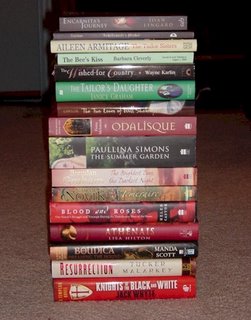
Click on it for a larger picture. When I ordered it, I had no idea The Summer Garden was 850 pages long. Can this woman write short books? Yikes. The copy of Temeraire is the Australian edition, of all things. Curious, but it has a cool embossed cover with a black dragon on it.
Secondly, two piles with review books about to be mailed to reviewers for the next HNR (once my co-editor Ellen determines who's getting what, that is).
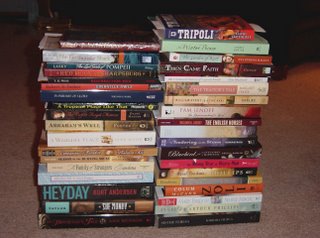
The people behind me in line at the post office next Wednesday are going to love me.
First, a pile of recent purchases and Christmas gifts:

Click on it for a larger picture. When I ordered it, I had no idea The Summer Garden was 850 pages long. Can this woman write short books? Yikes. The copy of Temeraire is the Australian edition, of all things. Curious, but it has a cool embossed cover with a black dragon on it.
Secondly, two piles with review books about to be mailed to reviewers for the next HNR (once my co-editor Ellen determines who's getting what, that is).

The people behind me in line at the post office next Wednesday are going to love me.
Tuesday, January 02, 2007
An interview with Deanna Raybourn
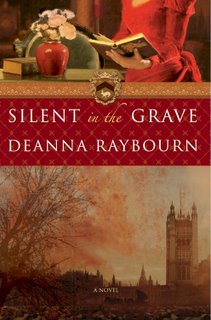 Last April, I spotted Deanna Raybourn's Silent in the Grave in Publisher's Weekly's list of "galleys to grab" at BookExpo America, and blogged about it. While at BEA in DC in June, I met Deanna at her signing booth, and we chatted about the blog, historical fiction in general, and the exciting "headless woman" treatment her novel was going to get (at left; the cover of the galley I received showed an earlier version).
Silent in the Grave begins a trilogy starring Lady Julia Grey, an unwitting and unlikely amateur detective. Her adventure begins in 1866. Her inattentive husband, Sir Edward Grey, has just collapsed and died during a dinner party at his London townhouse. The family doctor blames Edward’s longstanding heart condition, and Julia believes him, despite suggestions by Edward’s private inquiry agent, Nicholas Brisbane, that it was murder. It’s over a year later when Julia comes across compelling evidence that proves Brisbane was right. She engages Brisbane’s services, and during their investigation, she uncovers unpleasant and frequently sordid facts about her late husband’s behavior, as well as surprising truths about herself.
Despite its length, Silent in the Grave is a gripping, fast-paced read that balances its darker aspects with deft humor, and I thoroughly enjoyed it. Deanna is a sixth-generation Texan who now makes her home in a Virginia college town. Silent in the Grave is her first novel. More information can be found at her website, www.deannaraybourn.com, or her novel's site, www.silentinthegrave.com.
What attracted you to Victorian England?
Oddly enough, the book was initially conceived as a Regency piece. I wrote the first fifty pages or so with an 1816 setting before I decided it needed to be changed. The Regency was a frothy and sparkling time and dictated a different voice for Julia. Moving the action sixty or seventy years further into the nineteenth century changed that voice entirely. It brought in something darker and edgier, and I think the repression and shadowed sexuality of the Victorians is much more in keeping with the story than the vivacity and lightness of Regency manners. It also changed the domestic technology, so that necessitated a fresh batch of research. I gnashed my teeth for awhile over that, but ultimately it served the book much better to change the historical setting.
Lady Julia narrates her story in the first person, which is somewhat unusual for a historical mystery. Why did you choose to write from her viewpoint, and how did you create her voice?
I actually didn’t choose the viewpoint. Very early on in the plotting phase the first line popped into my head, and I loved it. That established the voice, and it felt right for the book so I went with it.
The members of Julia's family, the Marches, are quite eccentric, to say the least. Are any of them based on real people, historical or otherwise?
The Marches are entirely original. Throughout history, the English aristocracy has been loaded with deliciously eccentric characters, most of them far more outrageous than the Marches. In the case of the Marches, it may have arrested their development a bit as well by allowing them to follow their own whims. The typical person on the street may have their caprices, but they can’t give way to them because they have a job to hold down or children to raise or a house to keep or they’re afraid of what the neighbors might think. The Marches are rich enough to indulge their follies and highly-born enough not to care for anyone’s opinion. Taken as a whole, they remind me a bit of the Mitfords, but they aren’t based on any particular family.
Silent in the Grave includes a fair amount of detail on medicine, and medical research, in Victorian times. How did you go about researching this?
The Internet is a glorious thing. Before researching this book, I had only ever used it for shopping or e-mail, but with this story, I learned how to ferret out pretty much anything I needed to know. I still made endless trips to the library; I consulted a helpful urologist; I e-mailed a staff member at the University of Edinburgh medical school, but for quick fact-checking, nothing beats the Internet.
One of the aspects I enjoyed most was that despite the dark atmosphere, which became more and more pervasive toward the end, you incorporate a good amount of humor into the novel. For example - Julia's morbid Aunt Ursula (aka "the Ghoul"), the missing Tower raven, and the wry comments Julia utters on occasion. I wonder if you could talk a little about the role of humor in historical fiction, and in Silent in the Grave in particular – why was it important to you?
Humor is tremendously important, particularly in historical fiction because it humanizes characters who can so easily stray into sounding pedantic or dry without it. On the other hand, it is essential to use it subtly or the historic atmosphere is shattered. And there are different kinds of humor in the book. Julia banters with her sister, Portia, and they trade friendly insults, but that interaction is completely different in tone from the scathing sarcasm she might direct at Nicholas, or the wryness of her personal observations in the narrative. Humorous characters, such as the Ghoul, were put in deliberately to lighten the tone of the book and provide a balance to the darker elements. I didn’t want the grim circumstances of a murder investigation to define the relationships in the book. It was important to me that real life peek around the curtains and wink at the reader from time to time.
On p.260, Julia comments that she "adored history, not the dry dates and boring battles, but the stories and people who populated them." Does her statement reflect your own views on history as well - and if not, how do they differ?
History can be painfully dry. The key to making it come alive is not to neglect the human element. Everyone knows Wellington decimated Napoleon at Waterloo, but the story becomes much more interesting when you discover that part of Napoleon’s defeat allegedly came from his inability to mount a horse and survey the battlefield due to raging hemorrhoids. Bloody Mary Tudor becomes a great deal less monstrous and much more pitiful when you move past the burnings at Smithfield and realize she was so desperate to have a child she managed to mistake terminal cancer for a pregnancy she joyfully announced to the court. Facts are only as interesting as the stories behind them.
One scene finds Julia glancing at books in her study, reminiscing about treasured reads from her youth. She remarks that many were "romantic stories with dark, brooding men with mysterious pasts and scornful glances" which, to her anger and chagrin, left her with an overactive imagination. Nicholas Brisbane fits the image of the classic tortured hero in some ways, but not in others. How did you develop his character?
Julia just sprang from my head like Athena, fully-formed. Nicholas was WORK. I did start with the idea of dark and brooding because I wanted a man who would quicken Julia’s pulse and play into her fantasies, but I wanted him flawed, deeply and perhaps irreparably flawed. I knew there had to be some experimentation on his part with illicit substances, but I wanted it to be from medical necessity. I wanted Nicholas to be full of contradictions: from a good family, but socially questionable; of aristocratic blood, but mixed with something else; well-connected, but technically in trade. And I knew he needed a mysterious past full of secrets even I don’t know. He has traveled the world, and on his travels he has collected scars and souvenirs and arcane bits of knowledge that are occasionally useful. The one thing he has never found is a woman as engaging as Julia Grey. Ultimately, I wanted to create a character so complex that even if Julia did end up spending the whole of her life with him, she would never fully understand him.
Throughout the novel, I noticed you took care to use British spellings and terminology. As an American author writing about historical England, what are some other cross-cultural issues you felt you had to pay special attention to? How did you get into the mindset for writing about Victorian times?
My reading is primarily British, which helps enormously. Besides the obvious research materials, I read novels either set or written in the time period. If I’m in the mood to putter in the kitchen, I read Nigella Lawson or Rita Konig rather than American authors. If I’m thinking about gardens, I pull out my Beverley Nichols. Even if I’m taking a break from “work” mode and reading something frothy, it’s usually British chick lit, not American. There is something about British writing that manages to be both exotic and extremely comforting at the same time. One of the most gratifying compliments I’ve received was from the head of my publisher’s UK office; he was surprised the writer was American—he assumed I was British! But my father is only a first-generation American, so I’m not too far removed in any case. For me, the most difficult aspect was not establishing a British voice, it was establishing an upper-class, nineteenth-century voice. The aristocracy inhabits a rarified world that can be extremely difficult for an outsider to comprehend. But the more I read, the more I realized how little has changed. If you go beyond formal writing and read personal correspondence or diaries, Victorians could be strikingly informal and recognizable to a modern reader.
What are some of the more interesting or odd facts you uncovered during the research process?
I borrowed a textbook from a kindly urologist full of pictures that still give me nightmares. It was useful, but VERY disturbing.
With your double major in English and history, it seems almost logical that you ended up writing historical fiction. What about the genre attracted you?
Actually, it happened the other way around. I double-majored in English and history because I wanted to write historical fiction. I wasn’t entirely certain what specific genre I wanted to target, but I had always written, and what I wrote was always set in the past. My English courses taught me dramatic structure, how to pick apart characters, how to look at a story from a critical standpoint; my history courses taught me research skills. Both disciplines have proven extremely helpful, perhaps English more so.
Thanks, Deanna, for your willingness to do the interview. Silent in the Grave was published in January 2007 by MIRA ($21.95 US / $26.95 Can) in hardback, 509pp, ISBN 0-7783-2410-9.
Monday, January 01, 2007
My 2007 reading resolutions
It's that time of year. Who knows if I'll actually keep any of these, but it's my intention to do so, anyway, as of this first day of 2007...
1) To read more books, period. I've become a slower reader over the years, and to some degree this is unavoidable (and American Idol begins again in two weeks, so this will be a challenge)... but there are a number of great-sounding books from 2006 (and earlier) that I've yet to read, and really should have.
2) To buy fewer books that don't immediately rank highly in the TBR pile. My shelves are already overfull. Note to self to be a good librarian and borrow more books from my workplace.
3) To break bad reviewing habits, i.e., waiting too long after finishing a novel before beginning the review, because this entails re-reading the novel, or at least skimming, and I don't have time for this - for reasons above.
4) To read at least one classic novel that's new to me, for my own edification. (No, there's no unspoken "if it kills me" in there... or, well, maybe there is.) But it was embarrassing last year, perusing the library's copy of 1000 Great Books to Read Before You Die and realizing how few I'd read, and even worse, that there were some I hadn't heard of. Suggestions welcome.
5) To keep an ongoing reading list. I always know if I've read a given book or not, but my attempt to develop a Top 10 list for 2006 made me realize that I should have been noting these titles all along. I'll be doing so on this blog's sidebar, somewhere.
I'll be posting the interview tomorrow morning. I tried twice to get a draft version going today, but Blogger kept eating it, and I've no desire to fight with it any longer. Given this, I further resolve to do all composition of lengthy blog posts in MS Word rather than here, lest this happen again.
1) To read more books, period. I've become a slower reader over the years, and to some degree this is unavoidable (and American Idol begins again in two weeks, so this will be a challenge)... but there are a number of great-sounding books from 2006 (and earlier) that I've yet to read, and really should have.
2) To buy fewer books that don't immediately rank highly in the TBR pile. My shelves are already overfull. Note to self to be a good librarian and borrow more books from my workplace.
3) To break bad reviewing habits, i.e., waiting too long after finishing a novel before beginning the review, because this entails re-reading the novel, or at least skimming, and I don't have time for this - for reasons above.
4) To read at least one classic novel that's new to me, for my own edification. (No, there's no unspoken "if it kills me" in there... or, well, maybe there is.) But it was embarrassing last year, perusing the library's copy of 1000 Great Books to Read Before You Die and realizing how few I'd read, and even worse, that there were some I hadn't heard of. Suggestions welcome.
5) To keep an ongoing reading list. I always know if I've read a given book or not, but my attempt to develop a Top 10 list for 2006 made me realize that I should have been noting these titles all along. I'll be doing so on this blog's sidebar, somewhere.
I'll be posting the interview tomorrow morning. I tried twice to get a draft version going today, but Blogger kept eating it, and I've no desire to fight with it any longer. Given this, I further resolve to do all composition of lengthy blog posts in MS Word rather than here, lest this happen again.
Friday, December 29, 2006
End of the year post...
The Great New England Bookstore Tour (known in other circles as Christmas vacation) is over, and I managed to find/purchase/receive about a dozen new historical novels. I even got the chance to read four of them while in Connecticut, while my slow-moving review book lay neglected on the coffee table back home. It's starting to make me feel guilty, though, so I'll be taking it up again shortly.
I probably won't be blogging again until after New Year's, as I'll be compiling and editing reviews for next week's deadline, processing the conference registrations that arrived while I was gone, and attempting to make the switch to the new Blogger without losing anything. In the meanwhile, if you haven't seen it for a time, I've updated the HNS forthcoming books page with titles through next August, in particular new historical fiction from Penguin, Houghton Mifflin, and Simon & Schuster.
In early January, I'll be posting an interview with Deanna Raybourn, whose debut historical Silent in the Grave is newly out in bookstores - and which I mentioned as a "galley to grab" at last year's BEA. Time permitting, I hope to interview other historical novelists for the blog in the future.
Hope you all have a great new year, and here's to more good reading for 2007!
I probably won't be blogging again until after New Year's, as I'll be compiling and editing reviews for next week's deadline, processing the conference registrations that arrived while I was gone, and attempting to make the switch to the new Blogger without losing anything. In the meanwhile, if you haven't seen it for a time, I've updated the HNS forthcoming books page with titles through next August, in particular new historical fiction from Penguin, Houghton Mifflin, and Simon & Schuster.
In early January, I'll be posting an interview with Deanna Raybourn, whose debut historical Silent in the Grave is newly out in bookstores - and which I mentioned as a "galley to grab" at last year's BEA. Time permitting, I hope to interview other historical novelists for the blog in the future.
Hope you all have a great new year, and here's to more good reading for 2007!
Saturday, December 23, 2006
Islands of books
I'm writing from Connecticut, where I'll be until a couple days after Christmas. Just got back from one of my favorite used bookstores, the Niantic Book Barn, down by the shore in Niantic, on this foggy but surprisingly warm day. The store comprises one large two-story barn plus a loose collection of maybe half a dozen outbuildings, each of which is packed with used books. The one at the entrance, where books are bought when the weather's fair, is called Ellis Island. Quirky signs and shelf labels are scattered throughout the entire store; for example, the section labeled "That Pestiferous Little Corsican" features Napoleonic history. "Do not place books on the radiator - remember Fahrenheit 451!" warns another sign in the Haunted Barn.
The Book Barn also boasts the floppiest and laziest bookstore cats I've ever seen. They're so tame and used to being petted by customers that they don't even wake up. If you're not into cats, you can head outside (follow the bleating and baaing) to the small fenced-in area and visit with the friendly goats.
I bought two books - Manda Scott's latest Boudica novel (not having read the first two in the series didn't stop me, although maybe it should have) and Wayne Karlin's The Wished-For Country, set in colonial Maryland. Fortunately, Librarything tells me that I don't already own either one. It's an occasional problem.
The Book Barn also boasts the floppiest and laziest bookstore cats I've ever seen. They're so tame and used to being petted by customers that they don't even wake up. If you're not into cats, you can head outside (follow the bleating and baaing) to the small fenced-in area and visit with the friendly goats.
I bought two books - Manda Scott's latest Boudica novel (not having read the first two in the series didn't stop me, although maybe it should have) and Wayne Karlin's The Wished-For Country, set in colonial Maryland. Fortunately, Librarything tells me that I don't already own either one. It's an occasional problem.
Wednesday, December 20, 2006
The latest big medieval deal, and a top 10 list
This deal has been on the front page of Publishers Marketplace for the past few days:
Karen Maitland's A COMPANY OF LIARS, set in England in 1348, as the plague is spreading and a band of misfits are trying to outrun it, including a scar-faced trader in holy relics, a minstrel from Venice, an itinerant painter of church frescoes, a deformed storyteller wanted by the law, a strange albino child, a healer, and a bad-tempered magician traveling with an embalmed mermaid, and THE OWL KILLERS, also set in the middle ages, to Kate Miciak for Dial and Bantam, in a major deal, by Kathleen Anderson at Anderson Literary Management, on behalf of Victoria Hobbs at A.M. Heath (NA).
I said earlier I'd do an end-of-the-year Top 10 list, but there are so many historical novels from 2006 I haven't read that it's almost silly. But disclaimers aside, here they are, in alphabetical order by author:
Gretchen Craig, Always and Forever (Louisiana, 1823-37)
Margaret Ball, Duchess of Aquitaine (Aquitaine and Paris, France, 1137-49)
Charles Frazier, Thirteen Moons (Great Smoky Mountains, North Carolina, 1830s)
Margaret George, Helen of Troy (ancient Greece)
Sally Gunning, The Widow's War (Cape Cod, Massachusetts, 1761)
Jane Harris, The Observations (Scotland, 1863)
Amy Hassinger, The Priest's Madonna (Rennes-le-Château, France, 1890s)
Jaime Manriquez, Our Lives Are the Rivers (Ecuador and Peru, 1820s)
James Morrow, The Last Witchfinder (England, Massachusetts, and Pennsylvania, 1688)
Mary Sharratt, The Vanishing Point (Maryland, 1689)
Where reviews that I've written exist on the free web, I've linked them. For the Amazon reviews, look for the Booklist mentions.
As for what I'm reading now, I'm nearly done with Ann Waldron's The Princeton Imposter, part of the "Death is Academic" murder mystery series set on the Princeton campus. It showed up in yesterday's UPS mail, and I got sucked in after reading the first couple pages.
Karen Maitland's A COMPANY OF LIARS, set in England in 1348, as the plague is spreading and a band of misfits are trying to outrun it, including a scar-faced trader in holy relics, a minstrel from Venice, an itinerant painter of church frescoes, a deformed storyteller wanted by the law, a strange albino child, a healer, and a bad-tempered magician traveling with an embalmed mermaid, and THE OWL KILLERS, also set in the middle ages, to Kate Miciak for Dial and Bantam, in a major deal, by Kathleen Anderson at Anderson Literary Management, on behalf of Victoria Hobbs at A.M. Heath (NA).
I said earlier I'd do an end-of-the-year Top 10 list, but there are so many historical novels from 2006 I haven't read that it's almost silly. But disclaimers aside, here they are, in alphabetical order by author:
Gretchen Craig, Always and Forever (Louisiana, 1823-37)
Margaret Ball, Duchess of Aquitaine (Aquitaine and Paris, France, 1137-49)
Charles Frazier, Thirteen Moons (Great Smoky Mountains, North Carolina, 1830s)
Margaret George, Helen of Troy (ancient Greece)
Sally Gunning, The Widow's War (Cape Cod, Massachusetts, 1761)
Jane Harris, The Observations (Scotland, 1863)
Amy Hassinger, The Priest's Madonna (Rennes-le-Château, France, 1890s)
Jaime Manriquez, Our Lives Are the Rivers (Ecuador and Peru, 1820s)
James Morrow, The Last Witchfinder (England, Massachusetts, and Pennsylvania, 1688)
Mary Sharratt, The Vanishing Point (Maryland, 1689)
Where reviews that I've written exist on the free web, I've linked them. For the Amazon reviews, look for the Booklist mentions.
As for what I'm reading now, I'm nearly done with Ann Waldron's The Princeton Imposter, part of the "Death is Academic" murder mystery series set on the Princeton campus. It showed up in yesterday's UPS mail, and I got sucked in after reading the first couple pages.
Monday, December 18, 2006
Old favorites, and some new ones
About five years ago, I wrote a column for HNR on specific novels that deserved to be published (or republished), because I felt there was a strong market for them. To my surprise, nearly all of them have since appeared in print, or will shortly. As examples: Donna Gillespie's Lady of the Light, Judith Merkle Riley's The Water Devil, Anya Seton's Green Darkness and Katherine, Colin Falconer's The Sultan's Harem...
I don't know if I've been lucky, whether I can pick them, or what.
Then this evening, while browsing the HarperCollins rights guide (this is what I do in my spare time, see), I read that Patricia Clapp's Jane-Emily is going to be reprinted next July by Harper Paperbacks. This is very exciting news. Jane-Emily was one of my two favorite novels as a child, the other being Janet Lunn's Twin Spell. With no idea of where my original copy disappeared to, I considered getting a copy off ABE a few months ago, but didn't feel like paying very much for a paperback in ratty condition. Now I won't have to.
In case you don't know it, Jane-Emily is a classic novel of the supernatural set in Lynn, Massachusetts, in 1912. Jane, a nine-year-old orphan spending the summer at her grandmother's stately home with her eighteen-year-old Aunt Louisa (who narrates) , makes contact with the spirit of another young girl, Emily, who died on the grounds of the same house twelve years earlier. Every time I see a glass reflecting ball in someone's yard, it reminds me of Jane-Emily, for in the novel, it glows whenever Emily's ghost is nearby. It's haunting, romantic, and terrifying, and with Jane and Louisa as the two protagonists, it can be read and enjoyed by people of any age.
Not to mention that the cover was seriously cool. Picture a New England-style house in the deep blue of late evening, with a reflecting ball mysteriously aglow in the foreground. This is what I remember, 20 or so years after I last read the novel, though I can't find a photo online.
While typing this, I visited the Amazon page for Jane-Emily and read comments by both the publisher and Patricia Clapp's granddaughter, who posted there.
Has anyone else read it? Do you know of any novels that are currently unavailable that you'd like to see published?
I don't know if I've been lucky, whether I can pick them, or what.
Then this evening, while browsing the HarperCollins rights guide (this is what I do in my spare time, see), I read that Patricia Clapp's Jane-Emily is going to be reprinted next July by Harper Paperbacks. This is very exciting news. Jane-Emily was one of my two favorite novels as a child, the other being Janet Lunn's Twin Spell. With no idea of where my original copy disappeared to, I considered getting a copy off ABE a few months ago, but didn't feel like paying very much for a paperback in ratty condition. Now I won't have to.
In case you don't know it, Jane-Emily is a classic novel of the supernatural set in Lynn, Massachusetts, in 1912. Jane, a nine-year-old orphan spending the summer at her grandmother's stately home with her eighteen-year-old Aunt Louisa (who narrates) , makes contact with the spirit of another young girl, Emily, who died on the grounds of the same house twelve years earlier. Every time I see a glass reflecting ball in someone's yard, it reminds me of Jane-Emily, for in the novel, it glows whenever Emily's ghost is nearby. It's haunting, romantic, and terrifying, and with Jane and Louisa as the two protagonists, it can be read and enjoyed by people of any age.
Not to mention that the cover was seriously cool. Picture a New England-style house in the deep blue of late evening, with a reflecting ball mysteriously aglow in the foreground. This is what I remember, 20 or so years after I last read the novel, though I can't find a photo online.
While typing this, I visited the Amazon page for Jane-Emily and read comments by both the publisher and Patricia Clapp's granddaughter, who posted there.
Has anyone else read it? Do you know of any novels that are currently unavailable that you'd like to see published?
Saturday, December 16, 2006
In a bit of synchronicity
On the subject of women's historical fiction discussed in my 12/12 post - have a look at "Tapestry of Tales," an article from today's (well, tomorrow's) The Scotsman.
It's written from a UK viewpoint, which may (?) explain the comment "It is still a form that is dominated by women, and it is hard not to wonder if that is the reason for the industry's ambivalent attitude to one of its biggest success stories." Is this true in the UK? I hardly think the US publishing world is ambivalent to women's historical fiction; quite the opposite.
The article's lengthy and quite detailed, and definitely worth reading for an overview of the genre - though they oversimplify the HNS definition of historical fiction, and don't make much of a case for their argument. I'm also confused by Philippa Gregory's comments - Anya Seton (which the paper spells as "Seaton") wrote about Katherine of Aragon? Did she mean Norah Lofts, I wonder?
It's written from a UK viewpoint, which may (?) explain the comment "It is still a form that is dominated by women, and it is hard not to wonder if that is the reason for the industry's ambivalent attitude to one of its biggest success stories." Is this true in the UK? I hardly think the US publishing world is ambivalent to women's historical fiction; quite the opposite.
The article's lengthy and quite detailed, and definitely worth reading for an overview of the genre - though they oversimplify the HNS definition of historical fiction, and don't make much of a case for their argument. I'm also confused by Philippa Gregory's comments - Anya Seton (which the paper spells as "Seaton") wrote about Katherine of Aragon? Did she mean Norah Lofts, I wonder?
Three deals and not much more
We saw "The Holiday" earlier this evening up in Savoy... of course, my ears perked up when the Jude Law character said that his father wrote historical fiction. A very respectable profession. Then I had to see whether I recognized any titles on his bookshelves (Lalita Tademy's Cane River was one of them, for the record; he has good taste).
Things may be quiet around here for a while, as all the book reviews for Feb 2007' s HNR are arriving, and I'm in the midst of reading a decent but slow-moving review book. But for now, here are some deals from Publishers Lunch on Friday.
Gerri Brightwell's THE DARK LANTERN, about the secrets in a Victorian London household and how they affect the master's experiments in establishing identity through body measurements, to Allison McCabe at Crown, for six figures, in a pre-empt, for publication in spring 2008, by Zoe Fishman at Lowenstein-Yost (world). (The author's website includes the opening pages)
C.J. Sansom's WINTER IN MADRID, a spy thriller set in 1940s Spain, again to Kathryn Court at Viking, for publication in winter 2008, by Jean Naggar of the Jean V. Naggar Literary Agency, for Antony Topping of Greene & Heaton (US).
(Glad to see this one is being published in the US, finally)
National commentator and columnist Robin Gerber's ELEANOR VERSUS IKE, a fictional reimagining (inspired by actual events) of what would have happened if Eleanor Roosevelt ran for president against Eisenhower in 1952, to be published just in time for the historic 2008 presidential primaries, to Sarah Durand at William Morrow, by Stephanie Tade at the Stephanie Tade Agency.
Lastly, there are a couple editorial positions open at the HNS Newsletter. The newspapers described have online book review sections, so geography isn't a factor (you don't need to be British to cover British papers). For details, contact Sarah Cuthbertson at the email at the end of this announcement:
***WANTED: Editors!!***Lucienne and Sarah will both be leaving the HNS Newsletter at the end of January 2007. Ideally, from 1 February 2007 we'd like at least one new editor to cover one or more British newspapers. Obviously, the more editors the merrier as it would spread the load. The job means scanning newspaper book review pages for reviews of historical fiction and non-fiction and pasting the details (book title and author, name of newspaper, review date, name of reviewer, review URL) into a newsletter template under the relevant headings. For historical fiction add a taster quote from the review; for non-fiction only add a quote or description if the topic isn't obvious from the title. It takes about 30-45 minutes per newspaper per week. The links are then sent to the co-ordinating editor who compiles each issue and posts it to the members once a fortnight via Yahoo Groups. At present the editors take turns as co-ordinator for 2 months each. For more details, if needed, contact sarah76cuthbert@aol.com
Things may be quiet around here for a while, as all the book reviews for Feb 2007' s HNR are arriving, and I'm in the midst of reading a decent but slow-moving review book. But for now, here are some deals from Publishers Lunch on Friday.
Gerri Brightwell's THE DARK LANTERN, about the secrets in a Victorian London household and how they affect the master's experiments in establishing identity through body measurements, to Allison McCabe at Crown, for six figures, in a pre-empt, for publication in spring 2008, by Zoe Fishman at Lowenstein-Yost (world). (The author's website includes the opening pages)
C.J. Sansom's WINTER IN MADRID, a spy thriller set in 1940s Spain, again to Kathryn Court at Viking, for publication in winter 2008, by Jean Naggar of the Jean V. Naggar Literary Agency, for Antony Topping of Greene & Heaton (US).
(Glad to see this one is being published in the US, finally)
National commentator and columnist Robin Gerber's ELEANOR VERSUS IKE, a fictional reimagining (inspired by actual events) of what would have happened if Eleanor Roosevelt ran for president against Eisenhower in 1952, to be published just in time for the historic 2008 presidential primaries, to Sarah Durand at William Morrow, by Stephanie Tade at the Stephanie Tade Agency.
Lastly, there are a couple editorial positions open at the HNS Newsletter. The newspapers described have online book review sections, so geography isn't a factor (you don't need to be British to cover British papers). For details, contact Sarah Cuthbertson at the email at the end of this announcement:
***WANTED: Editors!!***Lucienne and Sarah will both be leaving the HNS Newsletter at the end of January 2007. Ideally, from 1 February 2007 we'd like at least one new editor to cover one or more British newspapers. Obviously, the more editors the merrier as it would spread the load. The job means scanning newspaper book review pages for reviews of historical fiction and non-fiction and pasting the details (book title and author, name of newspaper, review date, name of reviewer, review URL) into a newsletter template under the relevant headings. For historical fiction add a taster quote from the review; for non-fiction only add a quote or description if the topic isn't obvious from the title. It takes about 30-45 minutes per newspaper per week. The links are then sent to the co-ordinating editor who compiles each issue and posts it to the members once a fortnight via Yahoo Groups. At present the editors take turns as co-ordinator for 2 months each. For more details, if needed, contact sarah76cuthbert@aol.com
Tuesday, December 12, 2006
Idle observations on current historical novels
I've been pulling together a list of what I call "traditional historical novels" (genre fiction, that is, as opposed to literary fiction - though the line between them is blurring more and more) published between mid-2004 and mid-2007. You may find this interesting. The numbers will change slightly as more novels are published or announced, but thus far, 2/3 of them (98 out of 148) fit the "women in history" theme. In fact, most fit one of these categories:
- biographical novel of a female ruler, or female member of a royal family
- biographical novel of the wife/consort/mistress of some famous man (including biblical figures)
- novel of a fictional woman's daily life in a given time period
What I'm not seeing are many new deals for this type of novel in Publishers Marketplace, though there have been a few. It makes me wonder whether this theme - along with the corresponding headless bodice covers - will have played itself out in the next year or two.
I haven't yet started analyzing literary historical novels for the same time period, though I know there are many more of them.
- biographical novel of a female ruler, or female member of a royal family
- biographical novel of the wife/consort/mistress of some famous man (including biblical figures)
- novel of a fictional woman's daily life in a given time period
What I'm not seeing are many new deals for this type of novel in Publishers Marketplace, though there have been a few. It makes me wonder whether this theme - along with the corresponding headless bodice covers - will have played itself out in the next year or two.
I haven't yet started analyzing literary historical novels for the same time period, though I know there are many more of them.
Sunday, December 10, 2006
Visiting a new world
This post's topic may seem tangential to what I usually talk about, but bear with me - it may not have to do with historical fiction per se, but it does touch upon history (well, that may be a stretch) and reading in general.
I spent Friday afternoon at the University of Illinois undergraduate library seeing a demo of library services within Second Life, a 3-D virtual world where people can interact with one another and the world around them by creating "avatars" that represent themselves. About 25 other librarians from central Illinois attended, and the organizers told us to bring our avatars if we had them (seriously)... and a few did.
Now I'm not a gamer, and the last time I used software to enter a "virtual world" of any kind (other than the Internet itself), it was probably 1985, and everything was text-based. At the risk of sounding like a dork, I'll admit this Second Life thing totally amazed me. I had no idea that people could create a 3-D virtual world that looked so realistic (well, in an anime-like, computer-generated kind of fashion). There are buildings, landscapes, and waterways, and people have re-created a number of real-life contemporary and historical properties "in-world" (the lingo for describing something within that environment). You can see some screenshots of the Second Life environment here, including an image of Caledon, a 19th century library where avatars are required to be dressed in Victorian attire in order to enter.
A number of librarians worldwide have gotten together to provide library services within Second Life, figuring that if they are to remain relevant and up-to-date in the 21st century, they (we) should go to places where patrons are spending their time. And as they have found, if you do enter Second Life identified as a librarian, people will ask you questions, just like they do in real life (aka "first life"). Staff at the Alliance Library System in Peoria schedule regular book discussion groups in this virtual environment. Basically, people can bring their avatars over to a common locale at a certain time and chat with one another online about that week's book. The blog at InfoIsland.org summarizes current and upcoming library events, such as an immersive exhibit and re-enactment of "Marie Antoinette, the Teen Queen," which has been rescheduled for sometime after Christmas.
And if you attend Bradley University, you can take a continuing education course completely within the Second Life environment.
What do you think of this concept - is this what people will have to do to reach readers in the future? Does anyone reading this regularly visit Second Life? If you're an author, can you visualize yourself giving a presentation or reading here? It was hard to get my mind around the whole concept, and I don't have the free time that it seems to demand, but I found it fascinating in a strange sort of way.
I spent Friday afternoon at the University of Illinois undergraduate library seeing a demo of library services within Second Life, a 3-D virtual world where people can interact with one another and the world around them by creating "avatars" that represent themselves. About 25 other librarians from central Illinois attended, and the organizers told us to bring our avatars if we had them (seriously)... and a few did.
Now I'm not a gamer, and the last time I used software to enter a "virtual world" of any kind (other than the Internet itself), it was probably 1985, and everything was text-based. At the risk of sounding like a dork, I'll admit this Second Life thing totally amazed me. I had no idea that people could create a 3-D virtual world that looked so realistic (well, in an anime-like, computer-generated kind of fashion). There are buildings, landscapes, and waterways, and people have re-created a number of real-life contemporary and historical properties "in-world" (the lingo for describing something within that environment). You can see some screenshots of the Second Life environment here, including an image of Caledon, a 19th century library where avatars are required to be dressed in Victorian attire in order to enter.
A number of librarians worldwide have gotten together to provide library services within Second Life, figuring that if they are to remain relevant and up-to-date in the 21st century, they (we) should go to places where patrons are spending their time. And as they have found, if you do enter Second Life identified as a librarian, people will ask you questions, just like they do in real life (aka "first life"). Staff at the Alliance Library System in Peoria schedule regular book discussion groups in this virtual environment. Basically, people can bring their avatars over to a common locale at a certain time and chat with one another online about that week's book. The blog at InfoIsland.org summarizes current and upcoming library events, such as an immersive exhibit and re-enactment of "Marie Antoinette, the Teen Queen," which has been rescheduled for sometime after Christmas.
And if you attend Bradley University, you can take a continuing education course completely within the Second Life environment.
What do you think of this concept - is this what people will have to do to reach readers in the future? Does anyone reading this regularly visit Second Life? If you're an author, can you visualize yourself giving a presentation or reading here? It was hard to get my mind around the whole concept, and I don't have the free time that it seems to demand, but I found it fascinating in a strange sort of way.
Subscribe to:
Posts (Atom)